Market Overview
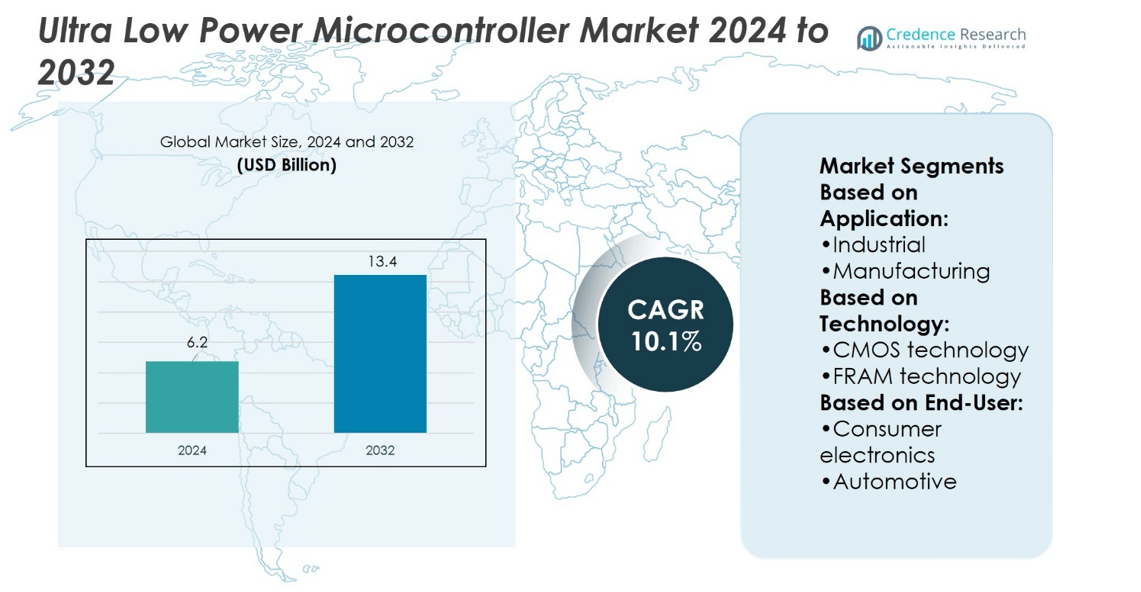
Ultra Low Power Microcontroller Market size was valued at USD 6.2 billion in 2024 and is anticipated to reach USD 13.4 billion by 2032, at a CAGR of 10.1% during the forecast period.
| REPORT ATTRIBUTE |
DETAILS |
| Historical Period |
2020-2023 |
| Base Year |
2024 |
| Forecast Period |
2025-2032 |
| Ultra Low Power Microcontroller Market Size 2024 |
USD 6.2 billion |
| Ultra Low Power Microcontroller Market, CAGR |
10.1% |
| Ultra Low Power Microcontroller Market Size 2032 |
USD 13.4 billion |
The Ultra Low Power Microcontroller Market grows through rising demand for energy-efficient electronics, expanding IoT adoption, and increasing use of portable devices across industries. It gains momentum from healthcare applications that require reliable, low-maintenance monitoring systems and automotive integration in electric and connected vehicles. Industrial automation and smart manufacturing projects accelerate reliance on ultra-low power solutions for efficient sensor networks and predictive maintenance. Advances in wireless connectivity, edge intelligence, and energy-harvesting technologies strengthen adoption. Sustainability initiatives further support market expansion, as manufacturers focus on reducing power consumption while delivering compact, high-performance designs for diverse end-use applications worldwide.
North America holds the largest share of the Ultra Low Power Microcontroller Market, followed by Europe and Asia-Pacific, with Latin America and the Middle East & Africa contributing smaller but emerging shares. Growth in North America is supported by advanced IoT adoption, while Europe benefits from strong automotive and industrial automation projects. Asia-Pacific records rapid expansion through consumer electronics and smart city initiatives. Key players shaping the market include Texas Instruments, STMicroelectronics, Microchip Technology, Renesas Electronics, and NXP Semiconductors.
Market Insights
- The Ultra Low Power Microcontroller Market size was valued at USD 6.2 billion in 2024 and is projected to reach USD 13.4 billion by 2032, at a CAGR of 10.1%.
- Rising demand for energy-efficient electronics and portable devices drives consistent market growth.
- Expanding IoT adoption and smart connectivity trends strengthen integration of ultra-low power controllers.
- Strong competition exists among leading players focusing on innovation, scalability, and sector-specific solutions.
- Design complexities, higher R&D costs, and performance limitations act as restraints to faster adoption.
- North America leads the market, Europe follows, and Asia-Pacific grows rapidly with strong consumer electronics demand.
- Latin America and Middle East & Africa show emerging adoption, supported by industrial and smart city projects.
Access crucial information at unmatched prices!
Request your sample report today & start making informed decisions powered by Credence Research Inc.!
Download Sample
Market Drivers
Growing Demand for Energy Efficiency Across Devices
The Ultra Low Power Microcontroller Market grows with the rising demand for energy efficiency across electronics. Consumers expect longer battery life in wearables, sensors, and portable devices. Manufacturers integrate these controllers to reduce active and standby power use. It enables compact products with extended operation between charges. This demand aligns with sustainability goals across industries. The shift strengthens adoption across consumer and industrial applications.
- For instance, OptimumNano integrated a digital production line platform that processes 500,000 battery cells per day using intelligent microcontrollers to manage energy-saving operations (workers cut from 365 to 28 on a 1 GWh production line).
Expanding Role in IoT and Smart Connectivity
The Ultra Low Power Microcontroller Market benefits from increasing IoT deployments and smart connectivity solutions. Devices in smart homes, cities, and factories need reliable performance with minimal power draw. It ensures continuous operation for connected sensors and nodes with limited energy. Scalability of IoT relies on low power components to maintain long lifecycles. These microcontrollers also improve wireless communication efficiency. The trend positions them as core enablers of modern IoT ecosystems.
- For instance, STMicroelectronics’ STM32WBA6 MCU embeds up to 2 MB of on-chip Flash memory and 512 kB RAM, runs on an Arm Cortex-M33 core up to 100 MHz, and supports concurrent Bluetooth, Zigbee, Thread, and Matter protocols within a single wireless subsystem.
Advancements in Healthcare and Medical Devices
The Ultra Low Power Microcontroller Market advances with healthcare applications requiring precision and reliability. Portable medical monitors, implantables, and diagnostic devices use ultra-low power designs to extend usability. It ensures accurate readings with reduced maintenance needs. Healthcare providers prioritize devices that minimize patient burden and maximize uptime. These controllers enable next-generation wearables for real-time health tracking. The medical field thus drives significant innovation in microcontroller development.
Support from Industrial Automation and Edge Computing
The Ultra Low Power Microcontroller Market expands through industrial automation and edge computing adoption. Smart factories require efficient controllers to manage distributed sensors and machinery. It supports localized decision-making without heavy reliance on cloud systems. Energy-conscious microcontrollers enable predictive maintenance and process optimization. They also reduce costs by lowering power demands in large-scale operations. Industrial reliance on efficient, responsive controllers sustains market momentum.
Market Trends
Integration of Advanced Low Power Architectures
The Ultra Low Power Microcontroller Market shows a clear trend toward advanced low power architectures. Manufacturers design products with optimized cores that balance performance and energy use. It enables extended functionality without compromising battery life in compact devices. Features like multiple sleep modes and dynamic voltage scaling gain traction. Developers use these innovations to address power constraints in IoT and portable systems. This shift reflects an industry-wide focus on smarter energy management.
- For instance, Camelion Batterien GmbH introduced its AlwaysReady Ni-MH rechargeable AA battery with a rated capacity of 2100 mAh per cell and a maximum of 1000 recharge cycles, enabling long-term use in power-sensitive electronics.
Growing Adoption in Wearable and Consumer Electronics
The Ultra Low Power Microcontroller Market strengthens with increasing adoption in wearables and consumer electronics. Fitness trackers, smartwatches, and wireless accessories rely on controllers with long battery performance. It supports high-frequency data capture and Bluetooth communication while minimizing energy loss. Compact packaging and reduced heat output further suit consumer devices. Demand for lightweight electronics accelerates innovation in ultra-low power designs. This trend shapes competition among key players targeting lifestyle electronics.
- For instance, Panasonic’s PAN1783 Bluetooth 5.4 Low Energy module integrates two Arm Cortex-M33 cores (application and network), offers dimensions of 15.6 mm × 8.7 mm × 2.2 mm, and achieves system current of just 0.9 µA in System Off and 1.3 µA in System.
Rising Role in Wireless and Sensor-Driven Applications
The Ultra Low Power Microcontroller Market evolves with demand for wireless and sensor-driven applications. Devices in smart homes, logistics, and industrial monitoring depend on controllers with efficient radio integration. It allows reliable performance under constrained energy budgets. Growth in LPWAN and Bluetooth Low Energy adoption supports this trajectory. Manufacturers prioritize microcontrollers with embedded connectivity and sensor hubs. The trend strengthens their role as enablers of real-time, distributed intelligence.
Expansion Through Healthcare and Edge Computing Solutions
The Ultra Low Power Microcontroller Market advances through healthcare technology and edge computing solutions. Portable diagnostics, patient monitoring, and implantable devices require precise control with low energy draw. It ensures continuous operation while reducing the need for frequent maintenance. Edge computing also benefits from efficient microcontrollers that process data locally. Developers deploy these systems to reduce latency and enhance security. These factors highlight an expanding application base across critical industries.
Market Challenges Analysis
Complex Design Requirements and Cost Pressures
The Ultra Low Power Microcontroller Market faces challenges due to complex design requirements and rising cost pressures. Manufacturers must balance power efficiency, processing speed, and system integration within limited silicon area. It increases research and development expenses, making affordability difficult for smaller companies. Customization for diverse end-use applications further complicates design cycles. High competition among suppliers places constant pressure on pricing strategies. These factors slow adoption in cost-sensitive markets where budget constraints dominate.
Limitations in Performance and Compatibility Across Applications
The Ultra Low Power Microcontroller Market also struggles with performance limitations and compatibility issues across varied applications. Devices with ultra-low power profiles often sacrifice processing strength, which restricts use in advanced workloads. It creates difficulties in industrial and healthcare sectors that demand both efficiency and high performance. Integration with legacy systems and evolving IoT standards remains another barrier. Limited developer support and fragmented software ecosystems further hinder deployment. These constraints restrict widespread adoption despite strong market potential.
Market Opportunities
Expansion Through IoT, Smart Devices, and Connected Ecosystems
The Ultra Low Power Microcontroller Market offers strong opportunities through rapid growth in IoT and connected ecosystems. Smart homes, industrial IoT, and logistics systems require efficient controllers for continuous operation. It ensures reliable performance in sensor networks, smart meters, and energy-harvesting devices. Demand for intelligent edge devices creates prospects for microcontrollers with integrated connectivity and security features. The rising use of smart city projects further drives adoption. These trends open pathways for companies to scale across multiple industries.
Advancements in Healthcare, Wearables, and Edge Intelligence
The Ultra Low Power Microcontroller Market also benefits from expanding healthcare and wearable technology adoption. Portable monitors, diagnostic devices, and implantables depend on ultra-low power solutions for patient safety. It supports continuous operation with reduced maintenance needs and longer lifecycles. Edge intelligence creates another opportunity by enabling localized data processing in industrial and consumer applications. Growth in AI-enabled microcontrollers further expands potential across automation and predictive systems. These areas highlight attractive opportunities for future innovation and investment.
Market Segmentation Analysis:
By Application
The Ultra Low Power Microcontroller Market demonstrates wide adoption across multiple application areas. In industrial settings, it supports automation, predictive maintenance, and sensor-driven monitoring with reduced energy use. Manufacturing applications benefit from efficient controllers that manage robotics, process control, and machine-to-machine communication. Automotive systems rely on these controllers for power-efficient electronics, including infotainment, battery management, and safety systems. Healthcare devices, such as diagnostic tools and wearable monitors, require ultra-low power capabilities to ensure continuous operation with minimal maintenance. Consumer electronics, including smartphones, wearables, and accessories, represent a key growth driver due to demand for extended battery performance. Home appliances integrate these controllers to enable smart features and improved energy efficiency, while other segments include logistics, smart grids, and security systems.
- For instance, Fedco Batteries assembles custom lithium-ion battery packs in its 16,000 sq ft Fond du Lac, Wisconsin facility, supporting applications in medical devices, industrial controls, e-Mobility, and utility meters.
By Technology
The Ultra Low Power Microcontroller Market advances through technological innovation with CMOS and FRAM technology leading adoption. CMOS technology dominates due to its scalability, low leakage currents, and proven compatibility with a broad range of applications. It enables high-density integration and reliable performance in consumer and industrial devices. FRAM technology gains traction for applications requiring non-volatile memory with fast write speeds and low power consumption. This technology is particularly relevant for healthcare, metering, and energy-harvesting devices. Other emerging technologies address niche requirements such as secure data handling, real-time control, and ultra-low leakage. Together, these technologies enhance performance efficiency and broaden the scope of deployment.
- For instance, Samsung’s foundry 28 nm eMRAM process supports write speeds up to 1000 times faster than embedded Flash, while operating at lower voltage and cutting energy use significantly—offering a scalable, NVRAM alternative for MCU integration.
By End-User
The Ultra Low Power Microcontroller Market records significant demand from end-users in consumer electronics, automotive, and industrial sectors. Consumer electronics lead adoption, with wearables, smart devices, and portable systems driving demand for controllers that extend battery life. It ensures optimal performance in compact designs where energy efficiency is a critical feature. Automotive manufacturers integrate these controllers into electric vehicles, safety systems, and connected car platforms. Industrial end-users rely on them for energy-efficient automation, factory control, and intelligent sensor integration. Each end-user group demonstrates strong reliance on low power solutions, which ensures sustained growth and ongoing innovation in the market landscape.
Segments:
Based on Application:
Based on Technology:
- CMOS technology
- FRAM technology
Based on End-User:
- Consumer electronics
- Automotive
Based on the Geography:
- North America
- Europe
- UK
- France
- Germany
- Italy
- Spain
- Russia
- Belgium
- Netherlands
- Austria
- Sweden
- Poland
- Denmark
- Switzerland
- Rest of Europe
- Asia Pacific
- China
- Japan
- South Korea
- India
- Australia
- Thailand
- Indonesia
- Vietnam
- Malaysia
- Philippines
- Taiwan
- Rest of Asia Pacific
- Latin America
- Brazil
- Argentina
- Peru
- Chile
- Colombia
- Rest of Latin America
- Middle East
- UAE
- KSA
- Israel
- Turkey
- Iran
- Rest of Middle East
- Africa
- Egypt
- Nigeria
- Algeria
- Morocco
- Rest of Africa
Regional Analysis
North America
North America holds a market share of 34% in the Ultra Low Power Microcontroller Market. The region benefits from its advanced semiconductor industry, strong IoT adoption, and widespread integration of energy-efficient electronics. Leading companies in the United States and Canada focus on developing ultra-low power controllers for consumer devices, automotive electronics, and healthcare applications. It supports the deployment of smart homes, smart cities, and industrial IoT infrastructure, driving steady demand for efficient microcontrollers. Healthcare device manufacturers also invest heavily in ultra-low power solutions for wearable monitors and portable diagnostic systems, aligning with the region’s focus on digital health. Automotive demand grows with the expansion of electric vehicles and connected car systems, requiring reliable and low-energy components. Together, these factors secure North America’s dominant position in global adoption.
Europe
Europe accounts for a market share of 28% in the Ultra Low Power Microcontroller Market. The region benefits from strong industrial automation projects, automotive innovation, and sustainability-driven regulations. It supports deployment of microcontrollers across electric vehicles, renewable energy systems, and industrial control applications. European automakers integrate these controllers into EV battery systems, advanced driver assistance systems, and infotainment platforms. The region also promotes energy-efficient designs under strict environmental policies, fueling broader adoption in consumer electronics and home appliances. Healthcare applications, especially in Germany and the Nordics, drive demand for ultra-low power devices in medical monitoring and diagnostics. The emphasis on smart manufacturing under Industry 4.0 strategies further strengthens Europe’s adoption base. These developments maintain Europe’s position as the second-largest regional market.
Asia-Pacific
Asia-Pacific captures a market share of 25% in the Ultra Low Power Microcontroller Market. Rapid urbanization, expansion of consumer electronics, and rising demand for smart devices contribute to strong growth. It records high adoption in China, Japan, South Korea, and India, where semiconductor production and electronics manufacturing are highly concentrated. Consumer electronics brands rely on these microcontrollers for smartphones, wearables, and smart appliances, meeting demand for extended battery life and compact form factors. Automotive adoption rises with the increasing production of electric vehicles and hybrid platforms across the region. Healthcare sectors in Japan and China adopt ultra-low power devices for portable monitoring systems, boosting opportunities for medical electronics. Industrial automation projects and smart city initiatives also accelerate usage of energy-efficient microcontrollers. Asia-Pacific stands as the fastest-growing regional segment, with its share expected to rise steadily.
Latin America
Latin America holds a market share of 7% in the Ultra Low Power Microcontroller Market. The region demonstrates emerging adoption across smart infrastructure, consumer electronics, and automotive sectors. Brazil and Mexico lead demand due to growing electronics manufacturing and connected vehicle projects. It supports small-scale adoption of microcontrollers in healthcare monitoring devices and industrial systems, though infrastructure challenges limit rapid expansion. Rising urban populations drive interest in smart appliances and connected home solutions that require energy-efficient designs. Automotive integration expands gradually as regional manufacturers focus on safety and power management systems. Government initiatives supporting digitization and smart city programs provide additional momentum. Despite slower growth compared to larger markets, Latin America represents a promising developing region.
Middle East & Africa
The Middle East & Africa contributes a market share of 6% in the Ultra Low Power Microcontroller Market. Adoption in this region remains at an early stage but shows potential across industrial and infrastructure projects. It supports energy-efficient designs in oil and gas monitoring systems, power grids, and industrial automation. Healthcare adoption increases in urban centers, where portable diagnostic and monitoring devices are gaining traction. Consumer electronics remain a small but growing application area as disposable income and demand for smart devices expand. Governments in the Gulf countries promote smart city initiatives, supporting integration of IoT solutions that rely on ultra-low power microcontrollers. Industrial demand across South Africa and the UAE further supports gradual adoption. Although the share remains modest, long-term opportunities emerge as technology infrastructure strengthens.
Shape Your Report to Specific Countries or Regions & Enjoy 30% Off!
Key Player Analysis
Competitive Analysis
The Ultra Low Power Microcontroller Market include Optimum Nano Energy Co. Ltd, Spectrum Brands, INC, Camelion Batterien GmbH, Panasonic Corporation, Godrej.com, Fedco Batteries, Sony Corporation of America, SAMSUNG, Energizer, and Illinois Capacitor. The Ultra Low Power Microcontroller Market evolves through rapid adoption across multiple industries, driven by the rising demand for energy efficiency and compact system designs. It supports a wide range of applications including consumer electronics, healthcare, automotive, and industrial automation, where extended battery life and reliable performance are critical. Growing use of IoT devices and connected ecosystems further increases reliance on ultra-low power controllers, enabling seamless operation in resource-constrained environments. Advances in wireless connectivity, edge intelligence, and energy-harvesting technologies enhance functionality while reducing overall power draw. The market also benefits from global sustainability initiatives that encourage manufacturers to design energy-conscious products. Continuous innovation and application diversification ensure strong long-term growth prospects across developed and emerging regions.
Recent Developments
- In May 2025, a developer of neuromorphic processors, Innatera, made an announcement about its project Pulsar. That is the company’s first commercially available microcontroller, which will offer intelligence like the human brain into edge devices.
- In September 2024, Samsung announced that it had developed an ultra-compact all-solid-state battery tailored for wearable devices, with an energy density of 200 watt-hours per liter. These rechargeable batteries have solid electrolytes, maintaining the space between the anode and cathode electrodes.
- In June 2024, TDK Corporation announced the development of a material for CeraCharge, a next-generation solid-state battery with 1,000 Wh/L energy density. This material has been developed using oxide-based solid electrolytes and lithium alloy anodes.
- In April 2023, Xiaomi announced the launch of a multifunctional desk lamp with a rechargeable battery. The company has presented this portable desk lamp in the China market.
Report Coverage
The research report offers an in-depth analysis based on Application, Technology, End-User and Geography. It details leading market players, providing an overview of their business, product offerings, investments, revenue streams, and key applications. Additionally, the report includes insights into the competitive environment, SWOT analysis, current market trends, as well as the primary drivers and constraints. Furthermore, it discusses various factors that have driven market expansion in recent years. The report also explores market dynamics, regulatory scenarios, and technological advancements that are shaping the industry. It assesses the impact of external factors and global economic changes on market growth. Lastly, it provides strategic recommendations for new entrants and established companies to navigate the complexities of the market.
Future Outlook
- The market will expand with rising adoption of IoT-enabled devices.
- Demand will grow in consumer electronics with focus on longer battery life.
- Healthcare devices will increasingly integrate ultra-low power controllers for reliability.
- Automotive systems will adopt these controllers for electric and connected vehicles.
- Industrial automation will rely more on energy-efficient microcontrollers for predictive maintenance.
- Edge computing will boost demand for controllers with embedded intelligence.
- Smart home and smart city projects will drive adoption across connected ecosystems.
- Advancements in wireless technologies will strengthen integration with low power designs.
- Sustainability goals will encourage broader use of energy-conscious microcontrollers.
- Ongoing R&D will enhance functionality while reducing overall power consumption.



