
Market Overview
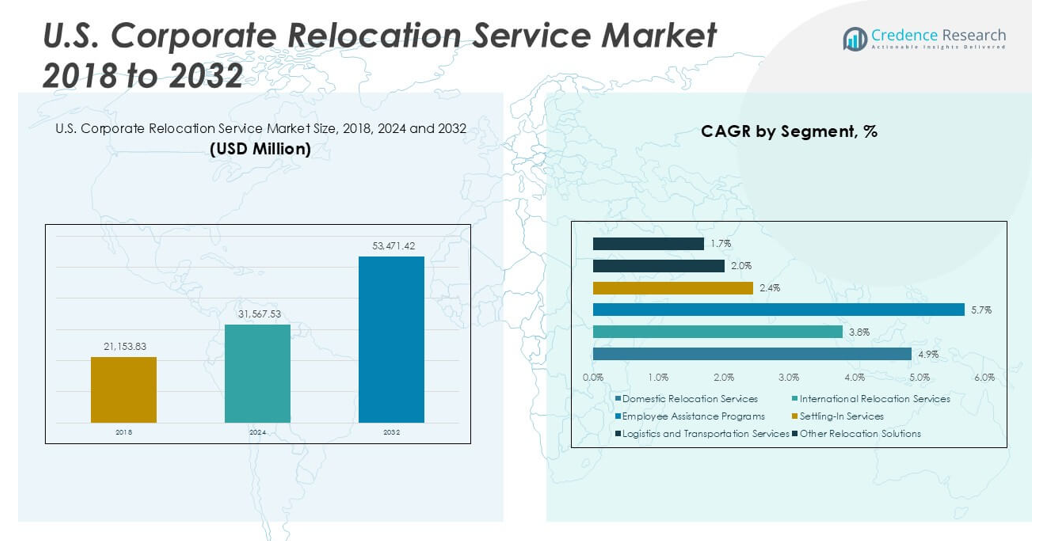
The U.S. Corporate Relocation Service market size was valued at USD 21,153.83 million in 2018, increased to USD 31,567.53 million in 2024, and is anticipated to reach USD 53,471.42 million by 2032, at a CAGR of 6.34% during the forecast period.
| REPORT ATTRIBUTE | DETAILS |
|---|---|
| Historical Period | 2020-2023 |
| Base Year | 2024 |
| Forecast Period | 2025-2032 |
| U.S. Corporate Relocation Service Market Size 2024 | USD 31,567.53 million |
| U.S. Corporate Relocation Service Market, CAGR | 6.34% |
| U.S. Corporate Relocation Service Market, Size 2032 | USD 53,471.42 million |
The U.S. Corporate Relocation Service market is led by prominent players such as Cartus, SIRVA, Graebel Companies, Inc., Altair Global, Aires, Sterling Lexicon, and XONEX, each offering integrated relocation solutions tailored to diverse corporate needs. These companies dominate through expansive service portfolios, advanced relocation technologies, and global mobility expertise. Strategic partnerships and digital innovation remain central to their market positioning. Regionally, the South holds the largest market share at 33%, driven by business-friendly environments and high inbound corporate migration. The Northeast and Midwest follow with 28% and 22% respectively, supported by concentrated corporate hubs and expanding regional operations.
Market Insights
- The U.S. Corporate Relocation Service market was valued at USD 31,567.53 million in 2024 and is projected to reach USD 53,471.42 million by 2032, growing at a CAGR of 6.34% during the forecast period.
- Rising workforce mobility, internal restructuring, and talent optimization are driving demand for domestic and international relocation services among large and mid-sized enterprises.
- Increasing adoption of relocation management software and mobile applications is transforming the service delivery landscape, with domestic relocation services holding the largest product segment share.
- The market is highly competitive, led by key players such as Cartus, SIRVA, Graebel Companies, and Altair Global, who are leveraging technology and strategic partnerships to maintain their market position.
- Regionally, the South leads with 33% market share, followed by the Northeast at 28%, Midwest at 22%, and West at 17%; however, high relocation costs and regulatory complexities continue to pose challenges for employers.
Market Segmentation Analysis:
By Product
In the U.S. Corporate Relocation Service market, Domestic Relocation Services emerged as the dominant sub-segment, accounting for the largest market share in 2024. The preference for domestic moves among corporations is driven by internal restructuring, expansion to new states, and centralized talent deployment. These services typically involve home sale and purchase assistance, temporary housing, and moving support. The rise in remote work policies and strategic regional relocations by tech and financial firms further supports the growth of this segment. Meanwhile, international relocation services are gradually gaining traction due to increasing cross-border assignments.
- For instance, Cartus facilitated over 62,000 domestic relocations in the U.S. in 2023 alone, utilizing a network of more than 16,000 agents to handle logistics, temporary housing, and real estate support.
By Technology
Among technology segments, Relocation Management Software held the largest market share in 2024, reflecting a growing demand for streamlined relocation operations. These platforms offer end-to-end visibility, task tracking, and cost management, making them essential tools for HR and mobility managers. The adoption of digital platforms is further fueled by the need for real-time communication, policy compliance, and data security. While mobile applications and AI-driven tools are gaining relevance for user convenience and predictive insights, relocation software remains the preferred choice due to its integration capabilities and comprehensive workflow management.
- For instance, Graebel Companies, Inc. processed over 98,000 relocation cases through its Graebel GlobalCONNECT® platform in 2023, providing clients with real-time dashboards and compliance reporting for over 165 countries.
By End User
Corporate Entities dominated the end user segment, holding the majority share in 2024 due to their frequent and large-scale employee transfers. These organizations invest heavily in structured relocation programs to retain talent, reduce transition stress, and ensure operational continuity across locations. Sectors such as IT, consulting, and manufacturing have shown the highest adoption, driven by national expansion and talent redistribution strategies. Although government organizations and educational institutions also contribute to market demand, their relocation volumes and budgets remain comparatively lower than large private sector employers.
Market Overview
Rising Workforce Mobility Across U.S. Corporations
The growing demand for flexible workforce strategies is a major driver of the U.S. Corporate Relocation Service market. Companies are increasingly relocating employees to strategic locations to optimize operations, access diverse talent pools, and respond to regional market opportunities. With post-pandemic hybrid work models stabilizing, many firms are reshaping physical office footprints, prompting intra-state and inter-state transfers. This shift has intensified the need for comprehensive relocation support services, including housing assistance, temporary accommodations, and logistics management, thereby fueling consistent demand across both small and large enterprises.
- For instance, SIRVA supported more than 250,000 employee moves in North America in 2023, with 60% related to internal workforce restructuring and new branch rollouts.
Increasing Demand for Talent Retention and Employee Satisfaction
To enhance employee retention and engagement, organizations are investing in relocation packages that prioritize convenience and support. Corporate relocation services now emphasize not only the physical move but also the well-being of the relocating employee and their family. Enhanced offerings such as settling-in assistance, educational support for children, and spousal employment help are becoming standard components of relocation policies. These services contribute to improved employee satisfaction, reduced turnover rates, and a stronger employer brand, thereby making relocation service providers vital strategic partners in talent management.
- For instance, Aires reported a 34% increase in adoption of its Family Integration Services between 2022 and 2023, supporting over 18,000 spouses and dependents with transition plaing and school placement services.
Adoption of Technology-Driven Relocation Solutions
The integration of advanced technology into relocation processes is significantly driving market growth. Solutions such as relocation management software, AI-based analytics, and mobile applications have transformed service delivery by offering real-time tracking, personalized recommendations, and cost control. Employers benefit from improved operational transparency and policy compliance, while employees enjoy smoother transition experiences. The use of virtual reality for orientation and automation for document handling has further optimized relocation timelines. This technological shift is encouraging corporations to outsource relocation management to tech-enabled service providers.
Key Trends & Opportunities
Growing Popularity of Sustainable Relocation Practices
Environmental concerns and corporate sustainability goals are reshaping relocation strategies. Companies are increasingly seeking green moving solutions, such as energy-efficient transportation, digital documentation, and partnerships with eco-conscious vendors. This trend presents an opportunity for service providers to differentiate by offering carbon footprint tracking and sustainable move packages. Additionally, firms are aligning relocation processes with broader ESG (Environmental, Social, and Governance) objectives, prompting a demand for vendors that support long-term sustainability commitments while delivering efficient services.
- For instance, Sterling Lexicon introduced its Eco-Move Program in 2023, reducing moving truck emissions by 27% through route optimization and biodegradable packaging across 8,000 U.S.-based relocations.
Expansion of Services for Niche Sectors and Roles
There is rising demand for tailored relocation services catering to niche sectors such as healthcare, academia, and nonprofit organizations. These industries often require specialized handling of employee needs, such as licensing support for healthcare professionals or assistance for international researchers. Furthermore, C-suite and high-skilled technical roles increasingly require VIP-level relocation experiences, presenting providers with opportunities to offer premium, white-glove services. These tailored offerings not only drive revenue growth but also strengthen client loyalty in a competitive market.
- For instance, Altair Global managed over 12,000 healthcare-related employee moves in 2023, including licensure verification, medical facility onboarding, and compliance tracking across 48 states.
Key Challenges
High Cost and Budget Constraints for Employers
One of the primary challenges in the U.S. Corporate Relocation Service market is the rising cost of services, including housing, transportation, and insurance. Inflationary pressures and limited real estate availability in urban areas make relocation packages expensive for employers. Budget constraints, especially among mid-sized and nonprofit organizations, often lead to limited service adoption or reduced support offerings. This poses a barrier to market growth and encourages cost-focused decision-making that may compromise employee experience.
Complex Regulatory and Tax Compliance Issues
Navigating federal, state, and local tax laws, as well as employment and housing regulations, poses a significant challenge for relocation service providers and employers alike. Compliance varies greatly depending on the origin and destination locations, and any misstep can result in penalties, delays, or legal exposure. For companies managing large-scale or cross-border relocations, staying compliant requires significant administrative resources and legal oversight, thereby increasing operational complexity and cost burdens for both internal HR departments and external vendors.
Logistical Disruptions and Supply Chain Constraints
The relocation market is also affected by unpredictable logistical issues, including delays in household goods shipping, vehicle transportation, and availability of temporary housing. Natural disasters, fuel price fluctuations, and labor shortages in the moving industry can cause significant delays and increase costs. These disruptions negatively impact the employee experience and erode confidence in relocation providers. In response, companies must build contingency plans and diversify vendor relationships, which adds further complexity and operational strain.
Regional Analysis
Northeast Region
The Northeast region accounted for a significant share of the U.S. Corporate Relocation Service market in 2024, holding approximately 28% of the total market. This dominance is largely attributed to the presence of major financial, legal, and consulting firms in cities like New York, Boston, and Philadelphia, which frequently engage in employee relocation to meet talent and operational needs. The region's high cost of living and competitive job market necessitate comprehensive relocation packages, including housing and family support services. Additionally, a dense population and established infrastructure support efficient relocation logistics, further reinforcing its leading market position.
Midwest Region
The Midwest region held around 22% of the U.S. Corporate Relocation Service market in 2024, driven by the growth of manufacturing, healthcare, and technology hubs across cities like Chicago, Minneapolis, and Detroit. The region’s affordability and expanding business environment have made it an attractive destination for corporate expansions and workforce realignments. Companies relocating to or within the Midwest often seek cost-effective relocation solutions, creating demand for bundled services that include logistics, settling-in support, and employee assistance. Moreover, the increasing adoption of regional headquarters by major corporations has boosted internal mobility, further supporting market growth in this region.
South Region
The South region represented the largest share of the U.S. Corporate Relocation Service market in 2024, accounting for approximately 33% of the total. This growth is fueled by rapid business expansion, favorable tax environments, and a lower cost of living in states such as Texas, Florida, Georgia, and North Carolina. The region continues to attract a diverse corporate base, particularly in technology, finance, and healthcare sectors, leading to frequent employee relocations. Additionally, inbound migration trends and corporate restructuring post-pandemic have accelerated demand for full-service relocation providers, making the South a key driver of national market growth.
West Region
In 2024, the West region contributed about 17% to the U.S. Corporate Relocation Service market. Although it holds a smaller share compared to other regions, high-value relocations to tech-driven cities such as San Francisco, Seattle, and Denver remain prevalent. The concentration of technology firms and startups often results in frequent talent mobility, both domestically and internationally. However, the high cost of living and housing shortages in key metropolitan areas present challenges for relocating employees, increasing reliance on premium relocation services. Companies in the West are also early adopters of tech-enabled relocation platforms, contributing to market innovation despite a modest overall share.
Market Segmentations:
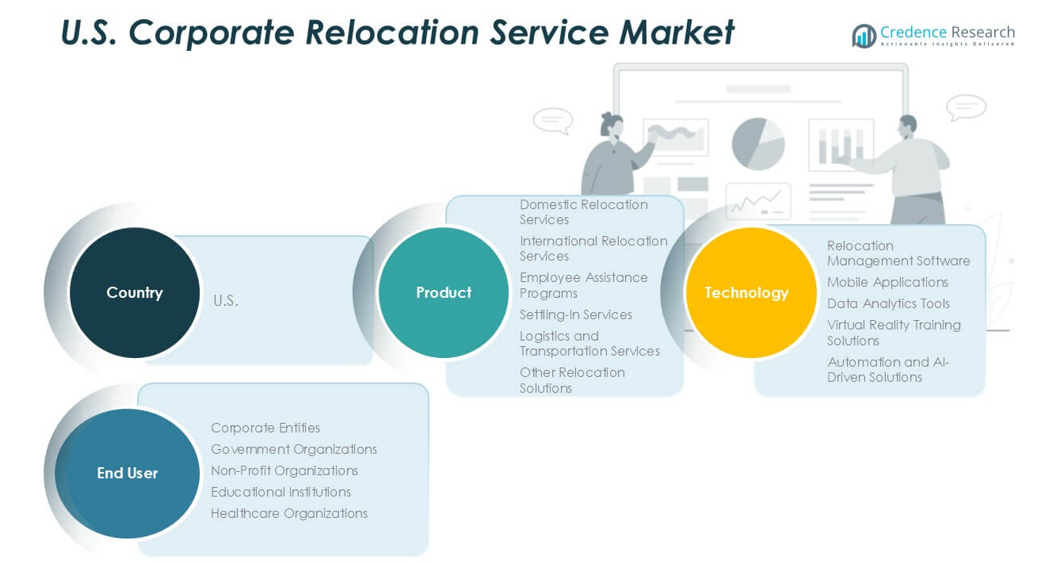
By Product:
- Domestic Relocation Services
- International Relocation Services
- Employee Assistance Programs
- Settling-In Services
- Logistics and Transportation Services
- Other Relocation Solutions
By Technology:
- Relocation Management Software
- Mobile Applications
- Data Analytics Tools
- Virtual Reality Training Solutions
- Automation and AI-Driven Solutions
By End User:
- Corporate Entities
- Government Organizations
- Non-Profit Organizations
- Educational Institutions
- Healthcare Organizations
By Geography:
- North America
- U.S.
- Canada
- Mexico
- Europe
- Germany
- France
- U.K.
- Italy
- Spain
- Rest of Europe
- Asia Pacific
- China
- Japan
- India
- South Korea
- South-east Asia
- Rest of Asia Pacific
- Latin America
- Brazil
- Argentina
- Rest of Latin America
- Middle East & Africa
- GCC Countries
- South Africa
- Rest of the Middle East and Africa
Competitive Landscape
The U.S. Corporate Relocation Service market is characterized by a competitive landscape dominated by a mix of established players and specialized service providers. Key companies such as Cartus, SIRVA, Graebel Companies, Inc., Altair Global, Aires, Sterling Lexicon, and XONEX offer comprehensive relocation solutions that cater to domestic and international corporate clients. These firms compete on the basis of service breadth, technological integration, global reach, and personalized support. Market leaders are increasingly investing in digital platforms, AI-driven tools, and relocation management software to streamline operations and enhance the employee experience. Strategic mergers, acquisitions, and partnerships are common, aimed at expanding geographic presence and service capabilities. Additionally, companies are focusing on sustainability initiatives and diversity-focused relocation policies to align with evolving corporate values. The competitive intensity is expected to remain high, with innovation and client-centric solutions serving as key differentiators in retaining large enterprise clients and capturing emerging opportunities in mid-market and niche sectors.
Key Player Analysis
- Cartus
- SIRVA
- Graebel Companies, Inc.
- Altair Global
- Aires
- Sterling Lexicon
- XONEX
Recent Developments
- In July 2025, Graebel launched new global partnerships aimed at enhancing sustainability in its global mobility services and has adopted data-driven decision making through predictive analytics and digital dashboards (globalCONNECT platform). There is also an emphasis on technology, with virtual surveys (partnering with Shyft) to quickly generate cost estimates without in-person visits, and holistic service delivery across 165+ countries.
- In April 2025, Cartus published its US & Canada Domestic Mobility Survey, showing increased or stable relocation volumes for over 70% of companies in 2025. Trends influencing this growth include market expansion, local talent shortages, and company growth. Key developments include rising process costs (addressed by efficiency measures and flexible policy benefits), broader adoption of remote work without corresponding relocation benefits, and increased use of non-traditional services such as discard/donate programs and enhanced settling-in support.
- In 2025, SIRVA is actively expanding its offerings by prioritizing temporary living solutions for relocating employees, recognizing the crucial support needed during the initial transition phase while simultaneously investing in technological advancements to streamline the relocation process, mirroring the broader industry trend towards automation and improved user experience.
Market Concentration & Characteristics
The U.S. Corporate Relocation Service Market shows a moderate to high level of market concentration, with a few dominant players controlling a significant portion of the total market revenue. Companies such as Cartus, SIRVA, Graebel Companies, and Altair Global consistently secure large enterprise contracts due to their broad service portfolios, advanced digital platforms, and global capabilities. It features a blend of full-service providers and niche vendors catering to specific relocation needs, such as settling-in services or employee assistance programs. The market reflects characteristics of high customer dependency, complex service customization, and strong demand for integration with internal HR systems. Technology plays a central role, with relocation management software and data analytics tools becoming standard offerings. Pricing remains competitive, but quality, speed, and service scope often drive vendor selection. Client loyalty depends heavily on service consistency and policy compliance. Long-term contracts and bundled service packages are common, making entry for new firms challenging without differentiated value propositions.
Report Coverage
The research report offers an in-depth analysis based on Product, Technology, End-User and Geography. It details leading market players, providing an overview of their business, product offerings, investments, revenue streams, and key applications. Additionally, the report includes insights into the competitive environment, SWOT analysis, current market trends, as well as the primary drivers and constraints. Furthermore, it discusses various factors that have driven market expansion in recent years. The report also explores market dynamics, regulatory scenarios, and technological advancements that are shaping the industry. It assesses the impact of external factors and global economic changes on market growth. Lastly, it provides strategic recommendations for new entrants and established companies to navigate the complexities of the market.
Future Outlook
- The U.S. corporate relocation service market is expected to witness steady growth driven by increased employee mobility and business expansion activities.
- Companies are increasingly investing in streamlined relocation programs to attract and retain top talent across regions.
- Demand for tech-enabled relocation services is rising as businesses seek more efficient and transparent solutions.
- Hybrid and remote work models are reshaping corporate relocation strategies to focus on flexibility and employee preferences.
- The growing number of mergers and acquisitions is prompting a rise in executive relocations and office consolidations.
- Sustainability concerns are influencing relocation service providers to offer eco-friendly moving solutions.
- Outsourcing of relocation processes is becoming more common as firms aim to reduce internal HR workload.
- Data security and compliance are gaining importance as relocation involves sensitive employee and corporate information.
- Customization of relocation packages is becoming a priority to align with varying employee needs and expectations.
- The market is seeing increased competition among vendors offering end-to-end relocation services and value-added support.

Request a Free Sample
Fill in your details and we'll send you a free sample report.
- Sample data tables & charts
- Research methodology
Market Dynamics
Rising Workforce Mobility and Internal Restructuring
U.S. corporations are increasingly relocating employees to optimize operations, access new talent pools, and respond to regional market opportunities, driving sustained demand for comprehensive relocation services.
Adoption of Technology-Driven Relocation Solutions
The integration of relocation management software, AI analytics, and mobile applications is streamlining relocation processes, improving transparency, and enhancing the employee experience, making tech-enabled services a key market growth factor.
Talent Retention and Employee Satisfaction Initiatives
Companies are investing in robust relocation packages and support services to attract and retain top talent, reduce transition stress, and strengthen employer branding, thereby increasing reliance on professional relocation providers.
Regional Business Expansion and Inbound Migration
Business-friendly environments, especially in the South and select metropolitan areas, are prompting corporate expansions and office consolidations, resulting in higher volumes of employee relocations and greater demand for relocation services.
Sustainability and ESG-Focused Relocation Practices
Growing corporate emphasis on sustainability is leading to increased demand for eco-friendly moving solutions, digital documentation, and carbon footprint tracking, creating new opportunities for service differentiation and market expansion.
Need a Custom Version of This Report?
Tailor the scope, geography, or segments to your exact requirements.
- Custom geography or segment scope
- Direct access to our analyst team
Frequently Asked Questions
What is the current size of the U.S. Corporate Relocation Service Market?
What factors are driving the growth of the U.S. Corporate Relocation Service Market?
What are some challenges faced by the U.S. Corporate Relocation Service Market?
Who are the major players in the U.S. Corporate Relocation Service Market?
Table of Content
Chapter 1 Market Segmentation
- 1.1 Segmentation Framework
- 1.1.1 Product and Service Classification
- 1.1.2 Application and End-Use Classification
- 1.1.3 Technology and Solution Classification
- 1.1.4 Customer and Distribution Channel Classification
- 1.1.5 Geographic Segmentation
- 1.1.6 Market Segment Definitions and Boundaries
- 1.2 By Product
- 1.2.1 Domestic Relocation Services
- 1.2.2 International Relocation Services
- 1.2.3 Employee Assistance Programs
- 1.2.4 Settling-In Services
- 1.2.5 Logistics and Transportation Services
- 1.2.6 Other Relocation Solutions
- 1.3 By End User
- 1.3.1 Corporate Entities
- 1.3.2 Government Organizations
- 1.3.3 Non-Profit Organizations
- 1.3.4 Educational Institutions
- 1.3.5 Healthcare Organizations
- 1.4 By Technology
- 1.4.1 Relocation Management Software
- 1.4.2 Mobile Applications
- 1.4.3 Data Analytics Tools
- 1.4.4 Virtual Reality Training Solutions
- 1.4.5 Automation and AI-Driven Solutions
Chapter 2 Introduction
- 2.1 Report Objectives and Scope
- 2.2 Product Definition and Industry Terminology
- 2.3 Market Inclusions and Exclusions
- 2.4 Research Process
- 2.4.1 Primary Research and Expert Interviews
- 2.4.2 Secondary Research and Source Review
- 2.4.3 Top-Down and Bottom-Up Estimation
- 2.4.4 Data Triangulation and Verification
- 2.5 Market Size Measurement Basis
- 2.5.1 2024: USD 31,567.53 million → 2032: USD 53,471.42 million
- 2.6 Historical and Forecast Reference Periods
- 2.6.1 Base Year: 2024
- 2.6.2 Forecast Period: 2024-2032
- 2.7 Research Assumptions and Limitations
Chapter 3 Executive Summary
- 3.1 Market Snapshot and Key Findings
- 3.2 Base-Year Market Size, 2024
- 3.3 Forecast Market Size, 2032
- 3.4 Revenue and Volume Growth Outlook
- 3.5 Key Demand and Supply Indicators
- 3.6 Leading Market Segments
- 3.7 Fastest-Growing Market Opportunities
- 3.8 Regional Performance Highlights
- 3.9 Technology and Industry Transformation
- 3.10 Competitive Landscape Summary
- 3.11 Analyst View and Strategic Implications
Chapter 4 U.S. Corporate Relocation Service Market Trends and Developments
- 4.1 Historical Industry Development
- 4.2 Recent Market Trends and Developments
- 4.3 Demand and Customer Behavior Trends
- 4.4 Technology and Product Innovation
- 4.5 Artificial Intelligence, Automation and Digitalization
- 4.6 Local Manufacturing and Supply Chain Realignment
- 4.7 Industry Partnerships, Mergers and Acquisitions
- 4.8 Sustainability and Circular Economy Developments
- 4.9 Government and Private Sector Investment Trends
- 4.10 Emerging Business Models and Commercialization
- 4.11 Industry Developments and Announcements
Chapter 5 U.S. Corporate Relocation Service Market Supply and Demand Analysis
- 5.1 Demand Trend and Consumption Analysis
- 5.2 Demand Forecast, 2024-2032
- 5.3 Supply Chain Structure and Procurement Trends
- 5.4 Supply-Demand Gap and Bottlenecks
- 5.5 Import Dependence and Sourcing Structure
- 5.6 Regional Supply and Demand Concentration
Chapter 6 U.S. Corporate Relocation Service Market Pricing Analysis
- 6.1 Pricing Structure and Measurement
- 6.2 Historical Pricing Trends
- 6.3 Pricing Outlook, 2024-2032
- 6.4 Pricing by Product and Market Segment
- 6.5 Geographic Pricing Differences
- 6.6 Key Input, Energy, Labor and Logistics Costs
- 6.7 Contract Pricing and Purchasing Models
- 6.8 Pricing Sensitivity and Competitive Positioning
- 6.9 Price, Margin and Profitability Implications
Chapter 7 U.S. Corporate Relocation Service Market Dynamics
- 7.1 Market Growth Drivers
- 7.1.1 Demand-Side Drivers
- 7.1.2 Technology and Innovation Drivers
- 7.1.3 Infrastructure and Investment Drivers
- 7.1.4 Regulatory and Policy Drivers
- 7.2 Market Restraints
- 7.2.1 Cost and Affordability Constraints
- 7.2.2 Technology and Adoption Barriers
- 7.2.3 Supply Chain and Operational Constraints
- 7.3 Market Challenges
- 7.3.1 Competitive Pressure and Margin Erosion
- 7.3.2 Skills, Infrastructure and Implementation Gaps
- 7.4 Emerging Market Opportunities
- 7.5 Market Dynamics Impact and Time-Horizon Assessment
Chapter 8 U.S. Corporate Relocation Service Value Chain Analysis
- 8.1 Industry Value Chain Overview
- 8.2 Upstream Suppliers and Critical Inputs
- 8.3 Technology and Component Providers
- 8.4 Manufacturing or Service Delivery
- 8.5 Distribution, Channel Partners and Integrators
- 8.6 Downstream Applications and End Users
- 8.7 Value Addition and Profit Pools
- 8.8 Vertical Integration and Outsourcing
- 8.9 Supplier Concentration and Risk
- 8.10 Supply Chain Localization and Resilience
Chapter 9 U.S. Corporate Relocation Service Market Regulations and Policies
- 9.1 Relevant Laws, Standards and Compliance Frameworks
- 9.2 Product, Service, Safety and Quality Requirements
- 9.3 Government Policies, Incentives and Subsidies
- 9.4 Imports, Exports and Trade Barriers
- 9.5 Public Procurement and Local Content Requirements
- 9.6 Data Protection, AI and Cybersecurity Compliance
- 9.7 Upcoming Policy Changes and Market Implications
Chapter 10 U.S. Corporate Relocation Service Market Hotspots and Opportunities
- 10.1 Market Opportunity Mapping and Growth Hotspots
- 10.2 High-Growth Applications and Customer Groups
- 10.3 Underserved Markets and White-Space Opportunities
- 10.4 Emerging Technology and Product Opportunities
- 10.5 New Capacity and Investment Hotspots
- 10.6 Market Entry and Expansion Opportunities
- 10.7 Distribution and Partnership Opportunities
- 10.8 Near-Term and Long-Term Commercial Potential
- 10.9 Opportunity Attractiveness and Execution Risks
Chapter 11 U.S. Corporate Relocation Service Market Outlook, 2024-2032
- 11.1 Market Size and Analysis
- 11.1.1 Revenue (Market Measurement: 2024: USD 31,567.53 million → 2032: USD 53,471.42 million)
- 11.1.2 Historical Market Size
- 11.1.3 Base-Year Market Size, 2024
- 11.2 Market Forecast, 2024-2032
- 11.2.1 Revenue Forecast to 2032
- 11.2.2 CAGR and Year-on-Year Growth
- 11.2.3 Incremental Revenue Opportunity
- 11.3 Forecast Assumptions and Scenario Analysis
- 11.3.1 Base-Case Forecast
- 11.3.2 Optimistic and Conservative Scenarios
- 11.3.3 Technology, Pricing and Policy Sensitivities
- 11.4 Market Attractiveness and Growth Outlook
Chapter 12 U.S. Corporate Relocation Service Market Segmentation and Outlook
- 12.1 Segmentation Summary and Market Shares, 2024
- 12.2 Largest and Fastest-Growing Segments
- 12.3 By Product - Market Size and Forecast, 2024-2032
- 12.3.1 Segment Definition and Scope
- 12.3.2 Historical Market Size
- 12.3.3 Revenue Forecast, 2024-2032
- 12.3.4 Base-Year Market Share, 2024
- 12.3.5 Segment CAGR and Growth Drivers
- 12.3.6 Subsegment Market Size and Forecast
- 12.3.6.1 Domestic Relocation Services
- 12.3.6.2 International Relocation Services
- 12.3.6.3 Employee Assistance Programs
- 12.3.6.4 Settling-In Services
- 12.3.6.5 Logistics and Transportation Services
- 12.3.6.6 Other Relocation Solutions
- 12.3.7 Subsegment Pricing and Adoption Trends
- 12.3.8 Leading Suppliers and Competition
- 12.3.9 Regional Demand and Opportunities
- 12.4 By End User - Market Size and Forecast, 2024-2032
- 12.4.1 Segment Definition and Scope
- 12.4.2 Historical Market Size
- 12.4.3 Revenue Forecast, 2024-2032
- 12.4.4 Base-Year Market Share, 2024
- 12.4.5 Segment CAGR and Growth Drivers
- 12.4.6 Subsegment Market Size and Forecast
- 12.4.6.1 Corporate Entities
- 12.4.6.2 Government Organizations
- 12.4.6.3 Non-Profit Organizations
- 12.4.6.4 Educational Institutions
- 12.4.6.5 Healthcare Organizations
- 12.4.7 Subsegment Pricing and Adoption Trends
- 12.4.8 Leading Suppliers and Competition
- 12.4.9 Regional Demand and Opportunities
- 12.5 By Technology - Market Size and Forecast, 2024-2032
- 12.5.1 Segment Definition and Scope
- 12.5.2 Historical Market Size
- 12.5.3 Revenue Forecast, 2024-2032
- 12.5.4 Base-Year Market Share, 2024
- 12.5.5 Segment CAGR and Growth Drivers
- 12.5.6 Subsegment Market Size and Forecast
- 12.5.6.1 Relocation Management Software
- 12.5.6.2 Mobile Applications
- 12.5.6.3 Data Analytics Tools
- 12.5.6.4 Virtual Reality Training Solutions
- 12.5.6.5 Automation and AI-Driven Solutions
- 12.5.7 Subsegment Pricing and Adoption Trends
- 12.5.8 Leading Suppliers and Competition
- 12.5.9 Regional Demand and Opportunities
- 12.6 Segment Growth Comparison
- 12.7 Segment Attractiveness and Priority Matrix
Chapter 13 U.S. Corporate Relocation Service End-Use and Application Market Outlook
- 13.1 End-Use Industry and Customer Demand Structure
- 13.2 Leading Applications and Customer Groups
- 13.3 End-Use Market Size, Share and Forecast
- 13.4 Major End-Use Industry Deep Dives
- 13.4.1 Customer Requirements and Use Cases
- 13.4.2 Demand and Replacement Cycles
- 13.4.3 Technical and Regulatory Considerations
- 13.4.4 Purchasing and Procurement Models
- 13.4.5 Leading Vendors and Distribution Channels
- 13.4.6 Forecast and Commercial Opportunities
- 13.5 Emerging Applications and Cross-Segment Demand
- 13.6 End-Use Industry Investment Priorities
Chapter 14 U.S. Corporate Relocation Service Geographic Market Outlook, 2024-2032
- 14.1 Domestic Market Distribution and Demand Clusters
- 14.2 State- or Province-Wise Market Size and Forecast, 2024-2032
- 14.3 City and Metropolitan Market Outlook
- 14.4 Industrial, Manufacturing and Commercial Clusters
- 14.5 Geographic Concentration of Key End Users
- 14.6 Local Pricing and Purchasing Differences
- 14.7 Domestic Production Facilities and Capacity Map
- 14.8 Local Infrastructure and Project Pipeline
- 14.9 State-Level Policy and Incentive Differences
- 14.10 Subnational Investment Hotspots and Opportunities
- 14.11 Distribution and Logistics Networks
- 14.12 Domestic Competitive Footprint
Chapter 15 U.S. Corporate Relocation Service Technology, Innovation and Sustainability Outlook
- 15.1 Technology Landscape and Maturity
- 15.2 Product, Process and Service Innovation
- 15.3 AI, Automation and Digital Tools in the Industry
- 15.4 Technology Adoption and Performance Benchmarking
- 15.5 Innovation Pipeline and R&D Investment
- 15.6 Energy Efficiency and Resource Management
- 15.7 Sustainability, Recycling and Circularity
- 15.8 Technology Roadmap, 2024-2032
- 15.9 Risks of Obsolescence and Technology Substitution
Chapter 16 U.S. Corporate Relocation Service Market Key Strategic Imperatives
- 16.1 Growth and Market Entry Priorities
- 16.2 High-Return Products and Segments
- 16.3 Pricing, Profitability and Cost Optimization
- 16.4 Technology Investment and Product Differentiation
- 16.5 Supply Chain Localization and Resilience
- 16.6 Distribution and Customer Acquisition
- 16.7 Partnership, Acquisition and Capacity Strategy
- 16.8 Regional Expansion Priorities
- 16.9 Short-, Medium- and Long-Term Actions
Chapter 17 Competition Outlook
- 17.1 Industry Competition Characteristics
- 17.2 Market Structure and Concentration
- 17.3 Market Share and Competitive Positioning, 2024
- 17.4 Company-Wise Revenue and Product Benchmarking
- 17.5 Production and Service Capacity Benchmarking
- 17.6 Technology, Pricing and Differentiation
- 17.7 Regional Footprint and Distribution Strength
- 17.8 Mergers, Acquisitions and Strategic Alliances
- 17.9 New Entrants and Competitive Threats
- 17.10 Porter's Five Forces and Industry Attractiveness
- 17.11 Competitive Outlook, 2024-2032
Chapter 18 Company Profiles
- 18.1 Company Coverage and Selection Criteria
- 18.2 Cartus
- 18.2.1 Business Description
- 18.2.2 Company Ownership and Geographic Presence
- 18.2.3 Product and Service Portfolio
- 18.2.4 Manufacturing and Operating Footprint
- 18.2.5 Financial Performance and Investment
- 18.2.6 Market Share and Competitive Position
- 18.2.7 Technology and Innovation Capabilities
- 18.2.8 Strategic Alliances or Partnerships
- 18.2.9 Recent Developments
- 18.2.10 Growth Strategy and Outlook
- 18.3 SIRVA
- 18.4 Graebel Companies, Inc.
- 18.5 Altair Global
- 18.6 Aires
- 18.7 Sterling Lexicon
- 18.8 XONEX
- 18.9 Weichert Workforce Mobility
- 18.10 Brookfield Global Relocation Services
- 18.11 NEI Global Relocation
- 18.12 Other Relevant Market Participants
Note: Every listed company is profiled on the structure shown under the first company. The company list is preliminary and may change based on research findings, market developments, data availability and client requirements.
Chapter 19 Disclaimer
- 19.1 Research and Forecast Disclaimer
- 19.2 Data Source and Estimation Limitations
Note: The depth of individual sections depends on data availability for this market. Volume, capacity, trade and other unit-based metrics are included where applicable.

