Market Overview
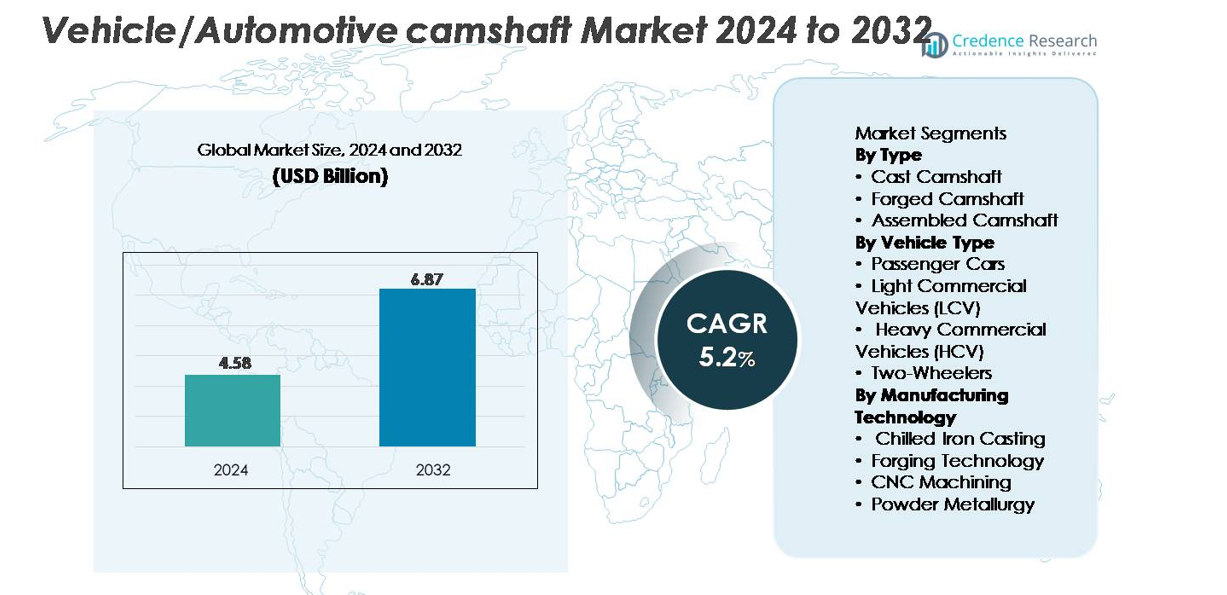
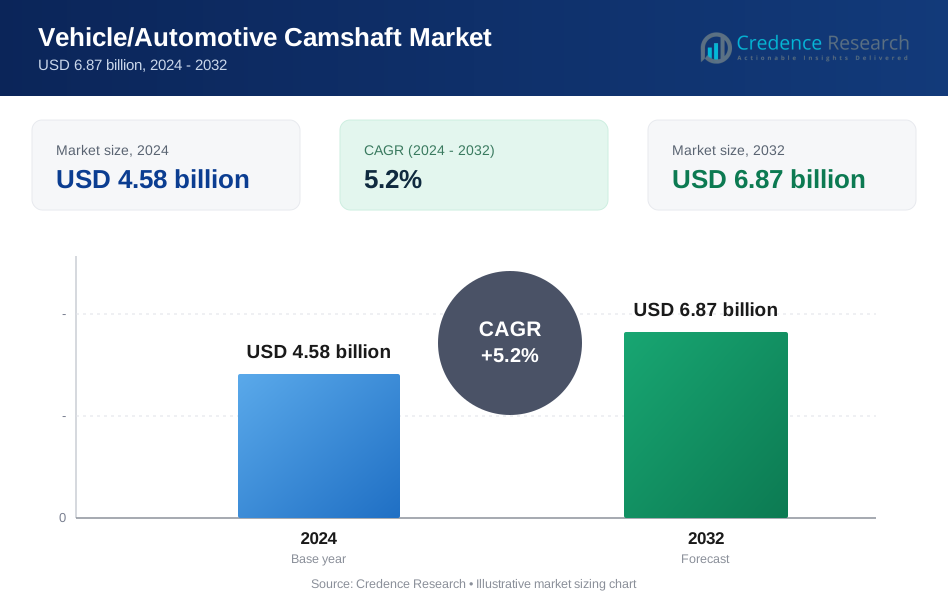
The Vehicle/Automotive Camshaft Market was valued at USD 4.58 billion in 2024 and is projected to reach USD 6.87 billion by 2032, expanding at a CAGR of 5.2% during the forecast period.
| REPORT ATTRIBUTE | DETAILS |
|---|---|
| Historical Period | 2020-2023 |
| Base Year | 2024 |
| Forecast Period | 2025-2032 |
| Vehicle/Automotive Camshaft Market Size 2024 | USD 4.58 billion |
| Vehicle/Automotive Camshaft Market, CAGR | 5.2% |
| Vehicle/Automotive Camshaft Market Size 2032 | USD 6.87 billion |
The Vehicle/Automotive Camshaft market is shaped by a strong group of global manufacturers that lead in casting, forging, and precision machining technologies. Key players such as Schaeffler, MAHLE, Thyssenkrupp, Musashi Seimitsu Industry, Aichi Forge, and Linamar maintain competitive strength through advanced forging capabilities, automated CNC machining, and partnerships with major OEMs. Companies like Precision Camshafts, Riken, Estas Camshaft, and Crane Cams further contribute with expertise in chilled casting, surface hardening, and performance-focused camshaft designs. Asia Pacific, holding approximately 38% of the global market share, remains the dominant region due to its extensive automotive production base and strong supply chain for cast and forged components.
Market Insights
- The global Vehicle/Automotive Camshaft Market was valued at USD 4.58 billion in 2024 and is projected to reach USD 6.87 billion by 2032, growing at a CAGR of 5.2%.
- Demand strengthens as cast camshafts hold the largest segment share due to cost efficiency, while forged camshafts gain traction in performance and heavy-duty vehicles; rising ICE engine production and hybrid powertrains continue to fuel industry growth.
- Trends focus on lightweight hollow camshafts, powder-metallurgy designs, and precision CNC machining that improve durability and efficiency, along with increasing integration of VVT and DOHC engine architectures.
- Competition intensifies as major players such as Schaeffler, MAHLE, Thyssenkrupp, Musashi Seimitsu Industry, and Precision Camshafts invest in automated grinding, forging upgrades, and OEM partnerships to expand global supply capabilities.
- Asia Pacific leads the market with 38% share, followed by Europe at 27% and North America at 23%, driven by strong automotive manufacturing bases and high adoption of multi-valve engine platforms.
Market Segmentation Analysis:
By Type
Cast camshafts hold the dominant share in the market, supported by their widespread use across mass-produced passenger vehicles due to lower manufacturing costs and proven durability. OEMs favor chilled cast iron camshafts for high wear resistance, enabling longer service intervals in high-mileage models. Forged camshafts continue gaining traction in performance-oriented and heavy-duty applications because of their superior tensile strength and fatigue resistance. Assembled camshafts remain a niche segment but attract interest from engine developers seeking lightweight architectures with improved valve-train flexibility in multi-cylinder engines.
- For instance, Linamar, a leading independent producer of camshafts, manufactures assembled camshafts using a lightweight hydroformed process and precision grinding across its manufacturing facilities worldwide, enabling significant weight reductions in high-performance engine platforms.
By Vehicle Type
Passenger cars represent the leading segment, capturing the largest market share due to high global production volumes and the increased adoption of DOHC and VVT-enabled engines requiring more complex camshaft configurations. Light commercial vehicles also contribute significantly as fleet operators demand durable camshafts capable of supporting extended operational cycles. Heavy commercial vehicles rely heavily on forged camshafts to withstand high torque loads, making them an important value-driven segment. Meanwhile, two-wheelers account for steady demand, particularly in emerging markets where single-overhead camshaft engines dominate commuter motorcycle platforms.
- For instance, Bharat Forge operates 18 manufacturing facilities across five countries, producing forged components suitable for heavy-duty powertrains. Meanwhile, two-wheelers maintain steady demand, particularly in emerging markets such as the Asia Pacific region, which is the largest global market for these vehicles.
By Manufacturing Technology
Chilled iron casting is the dominant manufacturing technology, holding the largest share owing to its cost-efficiency and ability to produce camshafts with high surface hardness for mass-market vehicles. Forging technology continues to expand as OEMs prioritize strength and mechanical reliability in commercial vehicles and high-performance engines. CNC machining enhances precision and enables tighter tolerances, driving its adoption for premium vehicle platforms. Powder metallurgy remains a growing niche, offering lightweight and reduced-material camshaft solutions aligned with OEM efforts to optimize fuel efficiency and reduce engine mass.
Key Growth Drivers:
Rising Global Vehicle Production and ICE Engine Demand
Increasing global production of passenger cars and commercial vehicles remains a core catalyst for camshaft demand, as internal combustion engines continue to dominate powertrain architectures despite the growth of electrification. Emerging markets in Asia and Latin America are experiencing strong vehicle replacement cycles and expanding manufacturing footprints, reinforcing steady demand for cast and forged camshafts used in high-volume engine platforms. Automakers are also refreshing engine lineups with improved thermal efficiency and reduced emissions, which requires precision-engineered camshafts with optimized profiles, surface hardening, and better valve-timing integration. Even as hybrids gain traction, ICE engines remain integral to hybrid powertrains, sustaining long-term camshaft utilization for multi-cylinder configurations. The expansion of shared mobility fleets, logistics networks, and last-mile delivery vehicles further stimulates need for durable camshaft components engineered for extended duty cycles and higher operating loads.
- For instance, Precision Camshafts Ltd. (PCL) operates manufacturing facilities with a combined annual casting capacity of approximately 11 million units and a machined camshafts capacity of 4 million units, enabling large-scale supply for global ICE vehicle platforms.
Advancements in Engine Architecture and Valvetrain Technologies
The shift toward multi-valve engines, dual overhead camshaft (DOHC) systems, and variable valve timing (VVT) architectures significantly drives camshaft innovation and volume growth. Modern engines require camshafts capable of delivering precise valve lift and duration control to meet fuel efficiency and emissions targets mandated across global regulatory frameworks. Automakers increasingly integrate hollow camshafts, hybrid material designs, and friction-optimized profiles that enhance combustion efficiency and reduce parasitic losses. VVT-enabled engines, which rely on dynamic phasing of camshaft rotation, further expand opportunities for high-strength, accurately machined camshafts. These design upgrades stimulate demand for CNC-machined and forged variants capable of supporting aggressive valve events, higher RPM performance, and thermal stability under boosted and direct-injection operating conditions. As OEMs continue focusing on higher power density engines, advanced camshaft materials and manufacturing technologies will remain essential.
- For instance, Linamar manufactures advanced hollow and assembled camshafts using hydroformed tubes and precision-welded lobes across its 65 global manufacturing facilities, supporting high-efficiency DOHC platforms.
Growth in Heavy-Duty Mobility, Commercial Fleets, and Aftermarket Services
Rising utilization of heavy commercial vehicles, LCV fleets, and industrial-duty engines boosts demand for high-strength camshafts with superior fatigue resistance. Global expansion of logistics, e-commerce, and infrastructure development stimulates higher production of long-haul trucks, construction vehicles, and agricultural machinery each requiring robust valvetrain components engineered for high torque loads and prolonged service hours. This drives adoption of forged camshafts and chilled-iron variants with enhanced wear properties. In parallel, the aftermarket sector grows steadily as aging vehicle populations require replacement camshafts and remanufactured engine components. Fleet operators prioritize long-life camshafts that can sustain multi-shift operations, reinforcing demand for precision-ground profiles and surface-hardened alloys. The combination of OEM and aftermarket demand anchors strong, recurring revenue streams for camshaft manufacturers, particularly in regions with large commercial vehicle fleets and extended vehicle life cycles.
Key Trends and Opportunities:
Shift Toward Lightweight, High-Strength, and Low-Friction Camshaft Designs
Automakers are accelerating adoption of lightweight and efficiency-optimized camshaft designs as part of broader engine downsizing and emissions-reduction strategies. Hollow camshafts, hybrid steel-aluminum designs, and friction-reduced surface treatments are gaining prominence due to their ability to improve engine responsiveness and fuel economy. Powder metallurgy offers opportunities for producing lightweight profiles with controlled porosity and reduced material waste, aligning with sustainability goals. Engine developers increasingly use simulation-led design, advanced grinding systems, and precision CNC machining to refine camshaft geometry for lower frictional losses. These trends create opportunities for suppliers specializing in metallurgical innovation and digital manufacturing. As engines evolve to support tighter emission regulations, the ability to deliver lighter, stronger, and thermally stable camshafts becomes a differentiating factor for global manufacturers.
- For instance, Linamar manufactures lightweight assembled camshafts using hydroformed tubes and welded lobes across 65 global manufacturing sites, supporting reduced mass in modern DOHC engines.
Increasing Adoption of Variable Valve Timing (VVT) and Performance-Oriented Engines
The rapid integration of VVT systems across mass-market and premium vehicles presents a major growth opportunity for technologically advanced camshafts. VVT-equipped engines require camshafts with ultra-precise machining tolerances, high torsional rigidity, and reliable performance under dynamic load cycles. Performance vehicles and turbocharged engines also push camshaft requirements higher, demanding advanced materials and intricate profiles to support optimized valve lift curves. Automakers are expanding the use of dual VVT and cam-phasing mechanisms, thereby increasing the technical sophistication and value of camshaft components. As high-power and high-efficiency engines continue to proliferate, suppliers offering engineered camshafts compatible with dynamic timing actuators and advanced lubrication systems stand to capture significant market opportunities.
- For instance, Schaeffler enhances VVT system production through its global network of over 100 manufacturing locations, supplying camshaft phasing units and precision-machined valvetrain components for high-load engines.
Expansion of Automation and Smart Manufacturing in Camshaft Production
Camshaft production is undergoing digital transformation as manufacturers adopt CNC machining centers, robotic handling, inline surface inspection, and automated grinding systems that improve consistency and throughput. Smart manufacturing enables precision machining at micron-level tolerances, critical for modern valvetrain systems. Integration of IoT-enabled quality monitoring, real-time tool wear detection, and digital twins enhances process reliability while reducing scrap rates. These advancements open opportunities for suppliers able to supply high-performance camshafts at scale while meeting stringent OEM quality standards. Automation also supports production of complex geometries required for VVT and DOHC engines, strengthening long-term competitiveness.
Key Challenges:
Growing Shift Toward Electric Vehicles and Reduction in ICE-Dependent Components
The global acceleration of battery electric vehicle (BEV) adoption poses a structural challenge for the camshaft market due to the absence of ICE valvetrain components in pure electric drivetrains. As governments tighten emission regulations and incentivize zero-emission vehicles, automakers are allocating more resources to electrification platforms that do not require camshafts. Hybrid vehicles offer temporary insulation, but long-term BEV expansion could gradually reduce OEM demand. Suppliers must navigate fluctuating ICE production volumes, delayed engine refresh cycles, and inventory optimization pressures. Diversification into hybrid components, precision machining services, or non-automotive engine markets becomes increasingly important to mitigate long-term electrification risks.
High Manufacturing Complexity, Cost Pressures, and Raw Material Volatility
Camshaft manufacturers face persistent challenges related to high machining complexity, rising energy costs, and volatility in steel, alloy, and metallurgical input prices. Producing forged and precision-ground camshafts requires sophisticated equipment and skilled labor, raising capital and operational expenditures. OEMs simultaneously demand cost reductions, pushing suppliers to optimize production while maintaining stringent dimensional accuracy and durability requirements. Fluctuations in alloy steel and casting-grade iron prices further strain margins, particularly for suppliers operating on long-term fixed contracts. Ensuring consistent quality while controlling material waste and machining cycle times remains a critical challenge across global production facilities.
Regional Analysis:
North America
North America accounts for roughly 23% of the global camshaft market, supported by strong production of light trucks, SUVs, and high-performance gasoline engines. The U.S. remains the primary contributor, with OEMs emphasizing advanced forged camshafts for durability and high-load applications. Demand is reinforced by a sizable aftermarket, driven by long vehicle lifespans and high replacement rates for older ICE platforms. Despite growing EV adoption, internal combustion engines maintain a significant footprint, particularly in commercial fleets and utility vehicles, sustaining steady demand for precision-machined and wear-resistant camshaft components.
Europe
Europe holds an estimated 27% share, driven by its strong automotive manufacturing base and adoption of advanced multi-valve and DOHC engine architectures. Germany, Italy, and France lead camshaft demand due to high production of premium vehicles requiring precisely machined and lightweight camshaft designs. Stringent emission regulations accelerate integration of VVT-enabled engines, boosting requirements for high-precision forged and CNC-machined camshafts. Although the region is advancing toward electrified platforms, hybrid powertrains maintain robust demand for complex valvetrain systems. Additionally, Europe’s well-established aftermarket supports ongoing replacement needs for aging ICE vehicle fleets.
Asia Pacific
Asia Pacific dominates the global market with approximately 38% share, driven by large-scale automotive manufacturing in China, India, Japan, and South Korea. High-volume production of passenger cars, two-wheelers, and commercial vehicles fuels strong adoption of cast and chilled-iron camshafts. The region’s expanding middle-class consumer base and rapid urbanization push OEMs to boost output, sustaining steady demand across all vehicle categories. Local suppliers increasingly invest in automated forging and CNC machining technologies to meet global quality requirements. APAC’s growing aftermarket, supported by extensive vehicle parc, also contributes significantly to camshaft replacement and remanufacturing activities.
Latin America
Latin America captures nearly 7% of the global market, with Brazil and Mexico serving as the primary manufacturing hubs for passenger cars and commercial vehicles. Steady demand for durable camshafts supports applications in flex-fuel engines and light commercial fleets widely used in logistics and agriculture. Economic recovery and expansion of regional assembly operations improve OEM procurement of cast and forged camshafts. The aftermarket remains a significant contributor due to extended vehicle usage cycles and reliance on cost-effective replacement parts. Despite moderate electrification, ICE dominance ensures consistent camshaft demand across key markets.
Middle East & Africa
The Middle East & Africa region accounts for around 5% of the market, driven primarily by demand from commercial vehicles, off-highway equipment, and diesel-powered fleets used in construction, mining, and logistics. GCC countries and South Africa represent the largest consumption centers, relying heavily on forged and heavy-duty camshafts suited for high-temperature and high-load operations. The aftermarket plays a vital role due to challenging operating environments that accelerate wear rates. Growing investments in infrastructure and industrialization support demand for durable engine components, although EV penetration remains limited, keeping ICE-based vehicles dominant.
Market Segmentations:
By Type
- Cast Camshaft
- Forged Camshaft
- Assembled Camshaft
By Vehicle Type
- Passenger Cars
- Light Commercial Vehicles (LCV)
- Heavy Commercial Vehicles (HCV)
- Two-Wheelers
By Manufacturing Technology
- Chilled Iron Casting
- Forging Technology
- CNC Machining
- Powder Metallurgy
By Geography
- North America
- U.S.
- Canada
- Mexico
- Europe
- Germany
- France
- U.K.
- Italy
- Spain
- Rest of Europe
- Asia Pacific
- China
- Japan
- India
- South Korea
- South-east Asia
- Rest of Asia Pacific
- Latin America
- Brazil
- Argentina
- Rest of Latin America
- Middle East & Africa
- GCC Countries
- South Africa
- Rest of the Middle East and Africa
Competitive Landscape:
The competitive landscape of the Vehicle/Automotive Camshaft market is characterized by a mix of global OEM suppliers, specialized forging and casting companies, and precision machining manufacturers competing on technology, quality, and cost efficiency. Leading players focus on expanding production capabilities for forged and CNC-machined camshafts to meet rising demand from high-performance and commercial vehicle segments. Companies increasingly invest in automated grinding, robotic handling, and advanced surface-hardening processes to enhance durability and dimensional accuracy. Strategic collaborations with automakers support co-development of camshafts tailored for DOHC, VVT, and downsized turbocharged engines. Many manufacturers are diversifying into lightweight hollow camshafts and powder-metallurgy variants to align with efficiency and emission targets. The aftermarket remains a key revenue stream, encouraging suppliers to offer remanufactured and replacement camshafts with OEM-grade performance. Overall, competition is intensifying as firms modernize production lines and pursue global supply contracts to strengthen market presence.
Key Player Analysis:
- Crane Cams
- Linamar
- Aichi Forge
- Schaeffler
- Musashi Seimitsu Industry
- MAHLE
- Thyssenkrupp
- Riken
- Estas Camshaft
- Precision Camshafts
Recent Developments:
- In July 2025, Musashi marked 23 years of operations in India and announced an R&D expansion via the launch of a new “technology excellence centre” under its Indian arm
- In 2024, Precision Camshafts Ltd. (PCL) has continued to advance its EV business, specifically by partnering with companies like Bluwheelz to retrofit LCVs, and is actively developing its LCV retrofitting capabilities
- In October 2, 2023, Riken Corporation and Nippon Piston Ring Co., Ltd. merged to form a new holding company, NPR-Riken Corporation. The new entity aimed to combine their strengths in engine components like piston rings and valve seats.
Report Coverage:
The research report offers an in-depth analysis based on Type, Vehicle type, Manufacturing technology and Geography. It details leading market players, providing an overview of their business, product offerings, investments, revenue streams, and key applications. Additionally, the report includes insights into the competitive environment, SWOT analysis, current market trends, as well as the primary drivers and constraints. Furthermore, it discusses various factors that have driven market expansion in recent years. The report also explores market dynamics, regulatory scenarios, and technological advancements that are shaping the industry. It assesses the impact of external factors and global economic changes on market growth. Lastly, it provides strategic recommendations for new entrants and established companies to navigate the complexities of the market.
Future Outlook:
- The market will retain steady demand as internal combustion engines remain essential in passenger cars, hybrids, and commercial vehicles.
- Advancements in DOHC, VVT, and turbocharged engines will increase the need for precision-forged and CNC-machined camshafts.
- Lightweight hollow and hybrid-material camshafts will gain wider adoption to support efficiency and emission-reduction targets.
- Automation in casting, forging, and grinding operations will enhance production consistency and reduce cycle times.
- Growth in commercial fleets and logistics operations will boost demand for high-strength camshafts built for heavy-duty cycles.
- Aftermarket sales will rise as aging global vehicle fleets require remanufactured and replacement camshaft components.
- Powder metallurgy camshafts will expand gradually due to improved material uniformity and manufacturing cost benefits.
- Partnerships between OEMs and suppliers will accelerate development of camshafts optimized for next-generation engine platforms.
- Asia Pacific will maintain market leadership with ongoing expansion of automotive manufacturing and export capacity.
- Electrification will moderate long-term growth, prompting suppliers to diversify into hybrid, industrial, and non-automotive engine applications.
Request a Free Sample
Fill in your details and we'll send you a free sample report.
- Sample data tables & charts
- Research methodology
Market Dynamics
Rising Global Vehicle Production and ICE Engine Demand
Continued growth in global production of passenger cars and commercial vehicles sustains high demand for camshafts, as internal combustion engines remain prevalent in both new and replacement vehicle markets, especially in emerging economies.
Advancements in Engine Architecture and Valvetrain Technologies
The shift toward multi-valve, DOHC, and VVT-enabled engines requires more complex, precision-engineered camshafts, driving innovation and increasing the value and volume of camshaft components supplied to OEMs.
Growth in Heavy-Duty Mobility, Commercial Fleets, and Aftermarket Services
Expansion of logistics, commercial fleets, and industrial vehicles increases the need for durable, high-strength camshafts, while the aging global vehicle fleet boosts aftermarket demand for replacement and remanufactured camshaft components.
Shift Toward Lightweight, High-Strength, and Low-Friction Camshaft Designs
Automakers' focus on engine downsizing, efficiency, and emissions reduction is accelerating adoption of lightweight, hollow, and hybrid-material camshafts, creating opportunities for suppliers with advanced metallurgical and manufacturing capabilities.
Expansion of Automation and Smart Manufacturing in Camshaft Production
The adoption of CNC machining, robotic handling, and digital quality control in camshaft manufacturing enhances production consistency, reduces costs, and enables the supply of high-precision camshafts required for modern engine platforms.
Need a Custom Version of This Report?
Tailor the scope, geography, or segments to your exact requirements.
- Custom geography or segment scope
- Direct access to our analyst team
Frequently Asked Questions
What is the current market size for the Vehicle Camshaft market, and what is its projected size in 2032?
At what Compound Annual Growth Rate is the Vehicle Camshaft market projected to grow between 2025 and 2032?
Which Vehicle Camshaft market segment held the largest share in 2024?
What are the primary factors fueling the growth of the Vehicle Camshaft market?
Who are the leading companies in the Vehicle Camshaft market?
Which region commanded the largest share of the Vehicle Camshaft market in 2024?
Table of Content
Chapter 1 Market Segmentation
- 1.1 Segmentation Framework
- 1.1.1 Product and Service Classification
- 1.1.2 Application and End-Use Classification
- 1.1.3 Technology and Solution Classification
- 1.1.4 Customer and Distribution Channel Classification
- 1.1.5 Geographic Segmentation
- 1.1.6 Market Segment Definitions and Boundaries
- 1.2 By Type
- 1.2.1 Cast Camshaft
- 1.2.2 Forged Camshaft
- 1.2.3 Assembled Camshaft
- 1.3 By Vehicle Type
- 1.3.1 Passenger Cars
- 1.3.2 Light Commercial Vehicles (LCV)
- 1.3.3 Heavy Commercial Vehicles (HCV)
- 1.3.4 Two-Wheelers
- 1.4 By Manufacturing Technology
- 1.4.1 Chilled Iron Casting
- 1.4.2 Forging Technology
- 1.4.3 CNC Machining
- 1.4.4 Powder Metallurgy
Chapter 2 Introduction
- 2.1 Report Objectives and Scope
- 2.2 Product Definition and Industry Terminology
- 2.3 Market Inclusions and Exclusions
- 2.4 Research Process
- 2.4.1 Primary Research and Expert Interviews
- 2.4.2 Secondary Research and Source Review
- 2.4.3 Top-Down and Bottom-Up Estimation
- 2.4.4 Data Triangulation and Verification
- 2.5 Market Size Measurement Basis
- 2.5.1 2024: USD 4.58 billion → 2032: USD 6.87 billion
- 2.6 Historical and Forecast Reference Periods
- 2.6.1 Base Year: 2024
- 2.6.2 Forecast Period: 2024-2032
- 2.7 Research Assumptions and Limitations
Chapter 3 Executive Summary
- 3.1 Market Snapshot and Key Findings
- 3.2 Base-Year Market Size, 2024
- 3.3 Forecast Market Size, 2032
- 3.4 Revenue and Volume Growth Outlook
- 3.5 Key Demand and Supply Indicators
- 3.6 Leading Market Segments
- 3.7 Fastest-Growing Market Opportunities
- 3.8 Regional Performance Highlights
- 3.9 Technology and Industry Transformation
- 3.10 Competitive Landscape Summary
- 3.11 Analyst View and Strategic Implications
Chapter 4 Global Vehicle/Automotive Camshaft Market Trends and Developments
- 4.1 Historical Industry Development
- 4.2 Recent Market Trends and Developments
- 4.3 Demand and Customer Behavior Trends
- 4.4 Technology and Product Innovation
- 4.5 Artificial Intelligence, Automation and Digitalization
- 4.6 Local Manufacturing and Supply Chain Realignment
- 4.7 Industry Partnerships, Mergers and Acquisitions
- 4.8 Sustainability and Circular Economy Developments
- 4.9 Government and Private Sector Investment Trends
- 4.10 Emerging Business Models and Commercialization
- 4.11 Industry Developments and Announcements
Chapter 5 Global Vehicle/Automotive Camshaft Market Production, Supply and Demand Analysis
- 5.1 Demand Trend and Consumption Analysis
- 5.2 Demand Forecast, 2024-2032
- 5.3 Production and Output Trend
- 5.4 Production and Output Forecast, 2024-2032
- 5.5 Installed Capacity and Capacity Utilization
- 5.6 Company-Wise Production Plants and Statistics
- 5.6.1 Installed Production Capacity
- 5.6.2 Actual Production
- 5.6.3 Planned Capacity and Expansion Targets
- 5.7 Supply Chain Structure and Procurement Trends
- 5.8 Supply-Demand Gap and Bottlenecks
- 5.9 Import Dependence and Sourcing Structure
- 5.10 Contract Manufacturing and Outsourcing
- 5.11 Regional Supply and Demand Concentration
Chapter 6 Global Vehicle/Automotive Camshaft Market Pricing Analysis
- 6.1 Pricing Structure and Measurement
- 6.2 Historical Pricing Trends
- 6.3 Pricing Outlook, 2024-2032
- 6.4 Average Selling Price and Unit Economics
- 6.5 Pricing by Product and Market Segment
- 6.6 Geographic Pricing Differences
- 6.7 Key Input, Energy, Labor and Logistics Costs
- 6.8 Contract Pricing and Purchasing Models
- 6.9 Pricing Sensitivity and Competitive Positioning
- 6.10 Price, Margin and Profitability Implications
Chapter 7 Global Vehicle/Automotive Camshaft Market Dynamics
- 7.1 Market Growth Drivers
- 7.1.1 Demand-Side Drivers
- 7.1.2 Technology and Innovation Drivers
- 7.1.3 Infrastructure and Investment Drivers
- 7.1.4 Regulatory and Policy Drivers
- 7.2 Market Restraints
- 7.2.1 Cost and Affordability Constraints
- 7.2.2 Technology and Adoption Barriers
- 7.2.3 Supply Chain and Operational Constraints
- 7.3 Market Challenges
- 7.3.1 Competitive Pressure and Margin Erosion
- 7.3.2 Skills, Infrastructure and Implementation Gaps
- 7.4 Emerging Market Opportunities
- 7.5 Market Dynamics Impact and Time-Horizon Assessment
Chapter 8 Global Vehicle/Automotive Camshaft Value Chain Analysis
- 8.1 Industry Value Chain Overview
- 8.2 Upstream Suppliers and Critical Inputs
- 8.3 Technology and Component Providers
- 8.4 Manufacturing or Service Delivery
- 8.5 Distribution, Channel Partners and Integrators
- 8.6 Downstream Applications and End Users
- 8.7 Value Addition and Profit Pools
- 8.8 Vertical Integration and Outsourcing
- 8.9 Supplier Concentration and Risk
- 8.10 Supply Chain Localization and Resilience
Chapter 9 Global Vehicle/Automotive Camshaft Market Regulations and Policies
- 9.1 Relevant Laws, Standards and Compliance Frameworks
- 9.2 Product, Service, Safety and Quality Requirements
- 9.3 Government Policies, Incentives and Subsidies
- 9.4 Imports, Exports and Trade Barriers
- 9.5 Public Procurement and Local Content Requirements
- 9.6 Environmental and Sustainability Compliance
- 9.7 Upcoming Policy Changes and Market Implications
Chapter 10 Global Vehicle/Automotive Camshaft Market Hotspots and Opportunities
- 10.1 Market Opportunity Mapping and Growth Hotspots
- 10.2 High-Growth Applications and Customer Groups
- 10.3 Underserved Markets and White-Space Opportunities
- 10.4 Emerging Technology and Product Opportunities
- 10.5 New Capacity and Investment Hotspots
- 10.6 Market Entry and Expansion Opportunities
- 10.7 Distribution and Partnership Opportunities
- 10.8 Near-Term and Long-Term Commercial Potential
- 10.9 Opportunity Attractiveness and Execution Risks
Chapter 11 Global Vehicle/Automotive Camshaft Market Outlook, 2024-2032
- 11.1 Market Size and Analysis
- 11.1.1 Revenue (Market Measurement: 2024: USD 4.58 billion → 2032: USD 6.87 billion)
- 11.1.2 Market Volume and Quantity Sold
- 11.1.3 Historical Market Size
- 11.1.4 Base-Year Market Size, 2024
- 11.2 Market Forecast, 2024-2032
- 11.2.1 Revenue Forecast to 2032
- 11.2.2 Volume Forecast to 2032
- 11.2.3 CAGR and Year-on-Year Growth
- 11.2.4 Incremental Revenue Opportunity
- 11.3 Forecast Assumptions and Scenario Analysis
- 11.3.1 Base-Case Forecast
- 11.3.2 Optimistic and Conservative Scenarios
- 11.3.3 Technology, Pricing and Policy Sensitivities
- 11.4 Market Attractiveness and Growth Outlook
Chapter 12 Global Vehicle/Automotive Camshaft Market Segmentation and Outlook
- 12.1 Segmentation Summary and Market Shares, 2024
- 12.2 Largest and Fastest-Growing Segments
- 12.3 By Type - Market Size and Forecast, 2024-2032
- 12.3.1 Segment Definition and Scope
- 12.3.2 Historical Market Size
- 12.3.3 Revenue Forecast, 2024-2032
- 12.3.4 Volume Forecast, 2024-2032
- 12.3.5 Base-Year Market Share, 2024
- 12.3.6 Segment CAGR and Growth Drivers
- 12.3.7 Subsegment Market Size and Forecast
- 12.3.7.1 Cast Camshaft
- 12.3.7.2 Forged Camshaft
- 12.3.7.3 Assembled Camshaft
- 12.3.8 Subsegment Pricing and Adoption Trends
- 12.3.9 Leading Suppliers and Competition
- 12.3.10 Regional Demand and Opportunities
- 12.4 By Vehicle Type - Market Size and Forecast, 2024-2032
- 12.4.1 Segment Definition and Scope
- 12.4.2 Historical Market Size
- 12.4.3 Revenue Forecast, 2024-2032
- 12.4.4 Volume Forecast, 2024-2032
- 12.4.5 Base-Year Market Share, 2024
- 12.4.6 Segment CAGR and Growth Drivers
- 12.4.7 Subsegment Market Size and Forecast
- 12.4.7.1 Passenger Cars
- 12.4.7.2 Light Commercial Vehicles (LCV)
- 12.4.7.3 Heavy Commercial Vehicles (HCV)
- 12.4.7.4 Two-Wheelers
- 12.4.8 Subsegment Pricing and Adoption Trends
- 12.4.9 Leading Suppliers and Competition
- 12.4.10 Regional Demand and Opportunities
- 12.5 By Manufacturing Technology - Market Size and Forecast, 2024-2032
- 12.5.1 Segment Definition and Scope
- 12.5.2 Historical Market Size
- 12.5.3 Revenue Forecast, 2024-2032
- 12.5.4 Volume Forecast, 2024-2032
- 12.5.5 Base-Year Market Share, 2024
- 12.5.6 Segment CAGR and Growth Drivers
- 12.5.7 Subsegment Market Size and Forecast
- 12.5.7.1 Chilled Iron Casting
- 12.5.7.2 Forging Technology
- 12.5.7.3 CNC Machining
- 12.5.7.4 Powder Metallurgy
- 12.5.8 Subsegment Pricing and Adoption Trends
- 12.5.9 Leading Suppliers and Competition
- 12.5.10 Regional Demand and Opportunities
- 12.6 Segment Growth Comparison
- 12.7 Segment Attractiveness and Priority Matrix
Chapter 13 Global Vehicle/Automotive Camshaft Geographic Market Outlook, 2024-2032
- 13.1 Regional Market Size and Share, 2024
- 13.2 Regional Market Forecast, 2024-2032
- 13.3 Regional Pricing, Production and Demand Differences
- 13.4 North America
- 13.4.1 United States
- 13.4.2 Canada
- 13.4.3 Mexico
- 13.5 Europe
- 13.5.1 Germany
- 13.5.2 France
- 13.5.3 Italy
- 13.5.4 United Kingdom
- 13.5.5 Spain
- 13.5.6 Poland
- 13.5.7 Russia
- 13.5.8 Netherlands
- 13.5.9 Belgium
- 13.5.10 Sweden
- 13.5.11 Denmark
- 13.5.12 Norway
- 13.5.13 Rest of Europe
- 13.6 Asia Pacific
- 13.6.1 China
- 13.6.2 India
- 13.6.3 Japan
- 13.6.4 South Korea
- 13.6.5 Thailand
- 13.6.6 Indonesia
- 13.6.7 Vietnam
- 13.6.8 Malaysia
- 13.6.9 Australia
- 13.6.10 Rest of Asia Pacific
- 13.7 Latin America
- 13.7.1 Brazil
- 13.7.2 Argentina
- 13.7.3 Colombia
- 13.7.4 Chile
- 13.7.5 Rest of Latin America
- 13.8 Middle East
- 13.8.1 Saudi Arabia
- 13.8.2 United Arab Emirates
- 13.8.3 Turkey
- 13.8.4 Israel
- 13.8.5 Iran
- 13.8.6 Rest of the Middle East
- 13.9 Africa
- 13.9.1 South Africa
- 13.9.2 Egypt
- 13.9.3 Nigeria
- 13.9.4 Morocco
- 13.9.5 Rest of Africa
- 13.10 Regional Investment, Policy and Supply Chain Differences
- 13.11 Regional Competitive Landscape
- 13.12 Geographic Growth Hotspots
Chapter 14 Global Vehicle/Automotive Camshaft Technology, Innovation and Sustainability Outlook
- 14.1 Technology Landscape and Maturity
- 14.2 Product, Process and Service Innovation
- 14.3 AI, Automation and Digital Tools in the Industry
- 14.4 Technology Adoption and Performance Benchmarking
- 14.5 Innovation Pipeline and R&D Investment
- 14.6 Patent and Intellectual Property Trends
- 14.7 Energy Efficiency and Resource Management
- 14.8 Sustainability, Recycling and Circularity
- 14.9 Technology Roadmap, 2024-2032
- 14.10 Risks of Obsolescence and Technology Substitution
Chapter 15 Global Vehicle/Automotive Camshaft Market Key Strategic Imperatives
- 15.1 Growth and Market Entry Priorities
- 15.2 High-Return Products and Segments
- 15.3 Pricing, Profitability and Cost Optimization
- 15.4 Technology Investment and Product Differentiation
- 15.5 Supply Chain Localization and Resilience
- 15.6 Distribution and Customer Acquisition
- 15.7 Partnership, Acquisition and Capacity Strategy
- 15.8 Regional Expansion Priorities
- 15.9 Short-, Medium- and Long-Term Actions
Chapter 16 Competition Outlook
- 16.1 Industry Competition Characteristics
- 16.2 Market Structure and Concentration
- 16.3 Market Share and Competitive Positioning, 2024
- 16.4 Company-Wise Revenue and Product Benchmarking
- 16.5 Production and Service Capacity Benchmarking
- 16.6 Technology, Pricing and Differentiation
- 16.7 Regional Footprint and Distribution Strength
- 16.8 Mergers, Acquisitions and Strategic Alliances
- 16.9 New Entrants and Competitive Threats
- 16.10 Porter's Five Forces and Industry Attractiveness
- 16.11 Competitive Outlook, 2024-2032
Chapter 17 Company Profiles
- 17.1 Company Coverage and Selection Criteria
- 17.2 Schaeffler
- 17.2.1 Business Description
- 17.2.2 Company Ownership and Geographic Presence
- 17.2.3 Product and Service Portfolio
- 17.2.4 Manufacturing and Operating Footprint
- 17.2.5 Production Capacity and Expansion Plans
- 17.2.6 Financial Performance and Investment
- 17.2.7 Market Share and Competitive Position
- 17.2.8 Technology and Innovation Capabilities
- 17.2.9 Strategic Alliances or Partnerships
- 17.2.10 Recent Developments
- 17.2.11 Growth Strategy and Outlook
- 17.3 MAHLE
- 17.4 Thyssenkrupp
- 17.5 Musashi Seimitsu Industry
- 17.6 Linamar
- 17.7 Aichi Forge
- 17.8 Precision Camshafts
- 17.9 Riken
- 17.10 Estas Camshaft
- 17.11 Crane Cams
- 17.12 Other Relevant Market Participants
Note: Every listed company is profiled on the structure shown under the first company. The company list is preliminary and may change based on research findings, market developments, data availability and client requirements.
Chapter 18 Disclaimer
- 18.1 Research and Forecast Disclaimer
- 18.2 Data Source and Estimation Limitations
Note: The depth of individual sections depends on data availability for this market. Volume, capacity, trade and other unit-based metrics are included where applicable.