
| REPORT ATTRIBUTE | DETAILS |
|---|---|
| Historical Period | 2019-2022 |
| Base Year | 2023 |
| Forecast Period | 2024-2032 |
| Aspergillosis Treatment Market Size 2023 | USD 4381.2 Million |
| Aspergillosis Treatment Market, CAGR | 4.3% |
| Aspergillosis Treatment Market Size 2032 | USD 6399.6 Million |
Market Insights
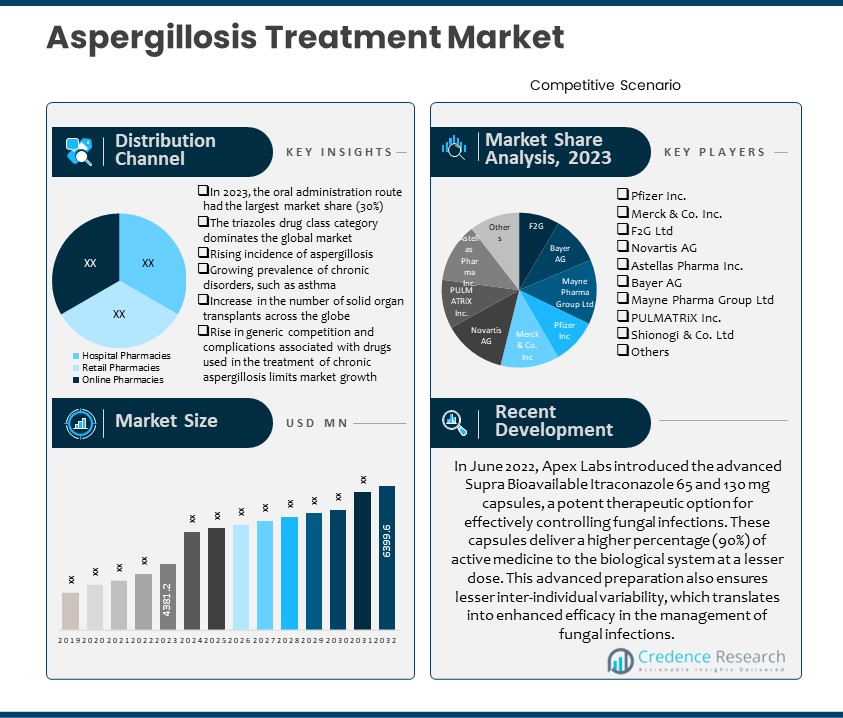
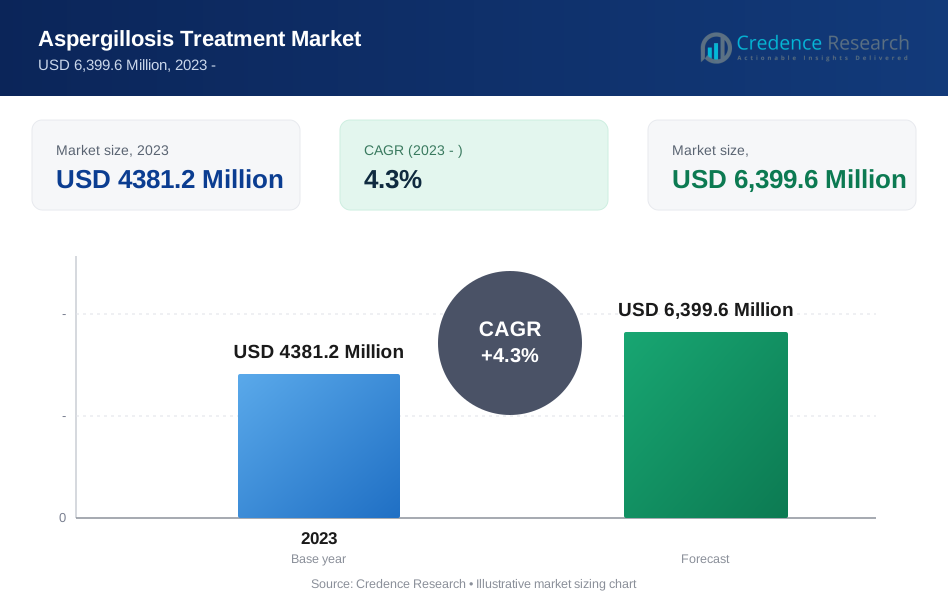
- The global demand for aspergillosis treatment was valued at USD 4381.2 Million in 2023 and is expected to reach USD 6399.6 Million in 2032, growing at a CAGR of 4.3% between 2024 and 2032.
- The triazoles are the market leader by drug class, accounting for more than 18% of total value in 2023, while the amphotericin B category is likely to grow substantially over the projected period.
- The Aspergilloma (fungal ball) indication segment dominates the global need for aspergillosis treatments, accounting for more than 20% of revenue in 2023.
- The oral administration method led the market in 2023 with a 30% share, while the inhaled (for pulmonary aspergillosis) category is predicted to grow at the fastest pace over the coming years.
- Adult patients dominated the market, with 58% of the total revenue share by patient population category. In contrast, the pediatric patients segment will expand at an elevated CAGR.
- North America is behind the expansion of the aspergillosis treatment industry, accounting for more than one-third of the overall market share in 2023. Europe and Asia Pacific combined account for just under 54%. Europe accounted for more than 19% of the market in 2023.
- Aspergillosis is a range of disorders caused by aspergillus infections. Aspergillus is a fungus whose spores are found in the air but do not usually cause disease. Individuals with damaged lungs, delicate immune systems, and allergies are more vulnerable to aspergillus-induced infections.
Executive Summary
Market Definition
Aspergillosis is a type of fungal infection triggered by the Aspergillus fungus. It predominantly affects the respiratory tract, resulting in symptoms that range from mild allergies to serious lung infections. Non-invasive Allergic Pulmonary Aspergillosis (ABPA), Invasive Aspergillosis, and Chronic Pulmonary Aspergilloma (CPA) are among the most common Aspergillus infections. Invasive aspergillosis is uncommon and occurs mostly in immunocompromised patients. Chronic pulmonary aspergillosis is a rare pulmonary disease that increases symptoms of respiratory disorders like asthma.
The nature and intensity of the infection determine aspergillosis treatment. Timely and proper treatment is critical for controlling these infections, alleviating symptoms, preventing disease progression, and improving outcomes. Effective treatment reduces the morbidity, hospitalization, and fatality rates associated with aspergillosis. Moreover, addressing the market demand for aspergillosis treatment is important for improving the quality of life for affected patients, reducing the cost burden on healthcare systems, and increasing general public health by preventing the disease from spreading.
Market Overview
The global aspergillosis treatment market has witnessed consistent growth over recent years and is set to grow at a CAGR of 4.3% between 2024 and 2032. The market was valued at USD 4381.2 million in 2023 and is expected to reach USD 6399.6 million in 2032.
Aspergillosis, an acute fungal infection, is a major respiratory concern, particularly in immunocompromised people. It can cause a range of symptoms, from moderate shortness of breath to serious pneumonia and invasive fungal growth inside the lungs. It can be diagnosed via pulmonary emission tests, blood and tissue tests, biopsy, and other methods. With a growing number of patients with weakened immune systems, there has been a higher market need for modern treatments to manage this complex condition. The market increase indicates the healthcare industry's continuous commitment to addressing the urgent medical needs of aspergillosis patients through the development of innovative treatments.
The pharmaceutical sector has moved its focus to the development of new drugs and treatment options to address the challenges faced by aspergillosis. Existing antifungal treatments have limitations in efficacy and safety, which necessitate the discovery of alternative solutions. Thus, companies are making substantial investments in R&D initiatives to discover innovative antifungal agents and treatment modalities with higher efficacy and fewer negative effects. The market for aspergillosis treatments, for example, saw a major shift in June 2022 when Endo introduced the first generic version of Noxafil (posaconazole) injection. This generic posaconazole injectable is specifically designed to treat invasive aspergillosis in patients aged 13 and above, including both adults and pediatrics.
The expanding awareness of aspergillosis, combined with an increased focus on discovering novel therapies, is further projected to drive market expansion. As drug manufacturers continue to research and invest in new medications, there is a positive outlook for improved patient care and results in the modern treatment of these serious fungal disorders. As R&D activities improve, the market is anticipated to see an evolution in the treatment of aspergillosis, which benefits patients globally.
Segmentation by Drug Class
- Triazoles, including drugs like voriconazole and itraconazole, emerged as the predominant treatment choice, capturing a market share of over 18% in terms of value in 2023. The efficacy and tolerability of triazoles have made them the preferred option for healthcare providers in managing aspergillosis cases.
- The amphotericin B class is likely to witness the fastest growth rate within the forecast period. This growth can be attributed to advancements in formulation techniques, leading to improved safety profiles and enhanced patient outcomes.
Segmentation by Administration Route
- Oral administration is the most popular method of delivering aspergillosis therapies worldwide, accounting for more than 30% of the market in 2023. This preference comes from patient convenience, increased adherence to treatment regimens, and the wider availability of oral formulations of key antifungal drugs.
- The inhaled (for pulmonary aspergillosis) category is anticipated to post the highest market CAGR due to its targeted delivery and efficacy in treating respiratory infections.
Segmentation by Indication
- Allergic bronchopulmonary aspergillosis (ABPA) and chronic pulmonary aspergillosis (CPA) contribute significantly to the remaining global market demands. These indications represent complex and chronic forms of aspergillosis, requiring long-term management strategies and specialized treatment approaches.
- The Aspergilloma (fungal ball) category leads the market with a revenue share of over 20% in 2023. Aspergillomas present unique challenges due to their potential for complications such as hemoptysis, which necessitate tailored therapeutic interventions.
Segmentation by Patient Population
- The pediatric patient category is projected to experience the largest CAGR, primarily due to an increase in pediatric aspergillosis cases, prompting targeted R&D activities to address the unique treatment needs of children.
- Adult patients constitute a commanding market share of nearly 58% in 2023, owing to the higher prevalence of aspergillosis among adults and established treatment protocols.
Segmentation by Distribution Channel
- The hospital pharmacies category dominates the market, accounting for 40% of global revenue. These pharmacies play a crucial role in supplying medications to healthcare facilities and managing complex treatment regimens for patients with aspergillosis.
- Retail pharmacies are the fastest-growing distribution channel, attributed to improved patient access to drugs and an increased focus on community-based healthcare services.
- Online Pharmacies have also gained market traction and are offering convenience and accessibility for patients seeking aspergillosis treatments. The online platform allows patients to order medications from the comfort of their homes and receive them through doorstep delivery services.
Segmentation by Region
- North America stands out as a leading market for aspergillosis treatment, contributing to over one-third of the industry's growth in 2023. Factors such as well-established medical infrastructure and facilities, robust research initiatives, and higher awareness among healthcare professionals propel market expansion in this region.
- Europe and Asia Pacific collectively account for just under 54% of the market share in 2023, with Europe holding a significant portion exceeding 19% during the same period. These regions exhibit a growing demand for advanced antifungal therapies and innovative treatment approaches.
- The rest of the world, encompassing regions such as Latin America, the Middle East, and Africa, contributes to the remaining market demand for aspergillosis treatment solutions. Increasing healthcare expenditures, increased access to healthcare services, and rising awareness about fungal infections boost market growth in these regions.
Increased rates of fungal infections, growing awareness of the disease among medical experts and the general public, improvements in diagnostic techniques, increased healthcare spending, a robust product pipeline, and an increase in studies and trials to introduce new and modified treatment options are some of the factors supporting the global market growth for aspergillosis treatments. For example, the University of Minnesota published an updated report on the burden of severe fungal infections in India. Chronic pulmonary aspergillosis affects an estimated 212,502 people per year, with 42,766 dying within a year after being diagnosed. The authors estimate that pulmonary TB accounts for approximately 90% of the burden of chronic pulmonary aspergillosis, with a total prevalence of around 1.7 million cases in India.
North America controls the majority portion of the global aspergillosis treatment market share. This expansion can be ascribed to causes such as the rising burden of fungal illnesses among the target population and increased industry activity for drug developments across the regional countries. The United States is one of the most economically developed countries in the region, along with Canada and Mexico. However, fungus-related infections in the country have posed challenges to health authorities. As per the statistics published by the Centres for Disease Control & Prevention (CDC) in June 2022, Candida is a common source of blood-related infections in the U.S., along with a few drug-resistant types. Thus, antifungal drugs are in higher demand across the United States.
Europe has the second-largest share of the aspergillosis treatment industry, owing to the European Government's aggressive initiatives to battle aspergillosis and respiratory diseases. Moreover, on October 25, 2023, WHO and the European Centre for Disease Prevention & Control (ECDC) launched the weekly European Respiratory Virus Surveillance Summary (ERVISS). This online platform displays integrated surveillance information for aspergillosis, COVID-19, influenza, and RSV in the WHO European Region, which includes the European Union/Economic Area.
Key Highlights of the Report
The global aspergillosis treatment market is segmented by drug class, administration route, indication, patient population, distribution channel, and region. Triazoles emerge as the primary drug class choice, which is mainly offering effective treatment options for managing acute aspergillosis infections. Oral administration remains the dominant route due to patient convenience, while inhaled therapies for pulmonary aspergillosis cases show promising growth prospects. Major indications contributing to robust market demand include allergic bronchopulmonary aspergillosis (ABPA), chronic pulmonary aspergillosis (CPA), and aspergilloma (fungal ball). The adult patient population constitutes a significant share, with hospital pharmacies leading in distribution channels, followed by rapidly growing retail pharmacies and the emerging online pharmacy segment.
The increasing frequency of fungal infections, improving disease awareness among healthcare professionals and the general public, and innovations in diagnostic techniques are the key growth factors for the global aspergillosis treatment market revenue. In addition, ongoing drug research studies and trials to create new and better treatment alternatives are expected to support market developments throughout the projection period. This encompasses the discovery of new antifungal medications, combination therapy, and targeted therapies to improve treatment efficacy and limit the onset of drug resistance. Besides, various regional regulatory frameworks, reimbursement policies, and healthcare infrastructure all have an impact on the market for aspergillosis treatments. However, the higher costs of treatment, lack of awareness of these infections, drug interactions, side effects, and limited treatment options for certain forms of aspergillosis restrain the market growth.
What Are The Main Drivers Of The Global Aspergillosis Treatment Market?
The market for aspergillosis treatment is expanding due to several factors, including a growing awareness of fungal diseases, an increase in over-the-counter (OTC) anti-fungal medications, and rising usage of antibiotics in developing nations. The growing acceptance of several over-the-counter (OTC) antifungal drugs like clotrimazole, amphotericin B, miconazole, econazole, and ketoconazole, which interfere with the fungal cell wall and impede the ability of the fungus to grow and reproduce, is a significant factor contributing to the positive outlook of the market. Another factor predicted to fuel market expansion is a rise in cases of onychomycosis, a yeast infection of the toes and fingers. For example, according to CDC data updated in September 2022, onychomycosis can affect up to 14% of the global population, with fungal toenail infections being more prevalent than fungal fingernail infections.
What Are The Major Challenges Faced By The Global Aspergillosis Treatment Market?
Strict and prolonged drug approval processes for therapeutic medications constrain revenue growth in the aspergillosis treatment market. Depending on the level of infection, aspergillosis can result in a number of severe complications, which further impede market expansion. Several of them are bleeding. Serious bleeding in the lungs, sometimes fatal, can be caused by both invasive aspergillosis and aspergillomas. The most dangerous outcome of invasive aspergillosis is when the infection spreads to other body organs, including the kidneys, heart, and brain. The spread of invasive aspergillosis is rapid and can be deadly. Drug recalls, and the withdrawal and termination of clinical trials are also likely to hinder market growth over the projection period. For example, in December 2018, Astellas Pharma China Inc. discontinued its post-marketing study to investigate the efficacy and safety of Micafungin treatment for invasive aspergillosis patients.
What Are The Growth Opportunities In The Global Aspergillosis Treatment Market?
The rising incidence of various associated risk factors, including impaired immune systems, underlying pulmonary disorders, chronic corticosteroid usage, ecological exposure to Aspergillus spores, and IV drug use, are significant upside possibilities for the aspergillosis treatment industry. Besides, the market is expanding due to the increasing use of galactomannan testing for the detection of invasive aspergillosis in patients receiving hematopoietic stem cell transplantation or undergoing hematological malignancies. Furthermore, the growing use of nebulized antifungal therapy, which includes administering antifungal medications directly to the lungs via a nebulizer to treat allergic bronchopulmonary aspergillosis, will continue to propel the aspergillosis treatment market in the forthcoming years.
Market Drivers
Several factors drive the global aspergillosis treatment market. The following are the key drivers of the global aspergillosis treatment market:
Increased Global Prevalence of Aspergillosis
The rising prevalence of aspergillosis worldwide is a major growth factor for the aspergillosis treatment industry. Aspergillosis affects people of all ages and has serious implications, especially among vulnerable populations. People with impaired immune systems are more likely to develop aspergillosis. This includes HIV/AIDS patients, cancer patients undergoing radiation therapy, organ transplant recipients, people with autoimmune illnesses, and those using long-term immunosuppressive drugs. The expanding population of immunocompromised people as a result of various medical diseases and therapies leads to an increase in aspergillosis cases. Thus, the market demand for effective aspergillosis treatment is growing to control and avoid complications, improve patient outcomes, and save lives. Improved diagnostic capabilities and elevated awareness of aspergillosis have resulted in more cases being identified and reported.
Aspergillosis is an alarming global health concern, with different incidence rates across geographical regions. According to the WHO, chronic pulmonary aspergillosis affects approximately 3 million individuals worldwide, and the number of cases is rapidly increasing. Aspergillosis causes serious mortality and morbidity, particularly in severe instances and when the infection spreads outside the lungs. For instance, invasive aspergillosis has a high fatality rate, especially in those with suppressed immune systems. In addition, Aspergillosis has a severe impact on the quality of life of those who are affected. Symptoms such as a chronic cough, shortness of breath, exhaustion, and recurring lung infections cause physical discomfort, limits in everyday activities, and mental suffering. Healthcare providers are now more vigilant in recognizing the symptoms and signs of aspergillosis, leading to an increase in the number of diagnosed cases and increased demand for effective aspergillosis therapy, hence propelling the aspergillosis treatment market forward.
Market Restraints
The global aspergillosis treatment market faces challenges that may limit its growth. These include the following:
Limited Awareness and High Treatment Costs
One of the major barriers to the effective management of aspergillosis is a lack of information among the general population, which restricts the growth of the aspergillosis treatment market size. Many people are unaware of aspergillosis symptoms, which include a persistent cough, difficulty breathing, discomfort in the chest, drowsiness, and recurring respiratory tract infections. Thus, people may avoid seeking medical assistance or misinterpret their symptoms for those of other common respiratory disorders. Individuals suffering from aspergillosis may also encounter a delayed diagnosis as a result of limited awareness. This causes a delay in starting proper treatment, which can lead to illness progression and complications.
The high expense of treating aspergillosis is another factor impeding the expansion of the global market. Voriconazole, posaconazole, and isavuconazole are some of the more costly anti-fungal drugs used to treat aspergillosis. The cost of these treatments, particularly when taken for an extended period of time, is projected to place a financial strain on both patients and healthcare systems. Moreover, aspergillosis treatments often require long-term care, particularly in acute and chronic instances. The necessity for long-term treatment doubles the entire cost of disease management, including medicine, laboratory testing, medical imaging, and follow-up appointments. Patients undergoing antifungal therapy should be monitored on a regular basis to determine treatment response, drug levels, and any side effects. This might involve additional laboratory testing, diagnostic imaging scans, and physician consultations, escalating the entire treatment cost.
Opportunities
The global aspergillosis treatment market offers significant growth opportunities. These include the following:
Increase in the Number of Ongoing Clinical Trials
Several key players are investing heavily in R&D operations to develop new classes of drugs and formulations with higher efficacy and lower toxicity. An increase in ongoing clinical trials is one important reason contributing to the consistent growth opportunities for the aspergillosis treatment industry. For example, clinicaltrails.gov reports that in March 2022, a study titled Olorofim Aspergillus Infection Study (OASIS) was conducted, with the goal of comparing treatment with Olorofim to therapies with AmBisome followed by standard of care (SOC) in patients with IFD caused by proven IA or possible lower respiratory tract disease Aspergillus species (invasive aspergillosis, IA). Thus, these studies are expected to be completed by March 2025.
Furthermore, as per clinicaltrails.gov, there is another ongoing study by Merck Sharp & Dohme LLC on Posaconazole Intravenous and Oral in Children With Invasive Aspergillosis (IA). The objective of this research is to assess the safety, effectiveness, and pharmacokinetics of Posaconazole (POS) intravenous (IV) and oral suspensions in pediatric participants with invasive aspergillosis (IA) who are between the ages of 2 and <18. The study is anticipated to conclude by April 2024.
Competitive Landscape
Key Players
The global aspergillosis treatment market is highly competitive, with the presence of several key players, including pharmaceutical companies, healthcare institutions, and research organizations. Listed below are some of the leading market players, along with their respective market shares:
- Pfizer Inc.
- Merck & Co. Inc.
- F2G
- Novartis AG
- Astellas Pharma Inc.
- Bayer AG
- Mayne Pharma Group Ltd
- PULMATRiX Inc.
- Others
These entities are actively engaged in developing and commercializing innovative treatments, diagnostic tools, and therapeutic strategies to address the challenges posed by aspergillosis. Established pharmaceutical companies and biotechnology firms have diverse product portfolios comprising antifungal medications, immunomodulators, diagnostic kits, and medical devices used in aspergillosis management.
In February 2023, PULMATRiX Inc., a clinical-stage biopharma company developing innovative inhaled drugs to treat serious diseases with its patented iSPERSE technology, announced the first patient dose in a Phase 2b trial assessing the efficacy and safety of PUR1900 in subjects with Allergic Bronchopulmonary Aspergillosis (ABPA) and asthma. PUR1900 is an iSPERSE-enabled dry powder version of itraconazole designed for inhalation pulmonary administration.
In May 2022, Shionogi & Co. Ltd and F2G Ltd signed a strategic partnership to develop and commercialize Olorofim, a new antifungal drug for invasive fungal illnesses, throughout Asia Pacific and Europe.
In December 2022, Asahi Kasei Pharma received approval in Japan to formulate and commercialize Cresemba Capsule 100 mg & Cresemba Intravenous Infusion 200 mg (generic name: isavuconazonium sulfate, development) for the treatment of aspergillosis, mucormycosis, and cryptococcosis.
Summary of Key Findings
- The global aspergillosis treatment market has been steadily growing in recent years, owing to the rising prevalence of aspergillus infections, particularly among immunocompromised patients such as those with HIV/AIDS, cancer, or undergoing organ transplantation.
- The market is segmented by drug class, administration route, indication, patient population, distribution channel, and region.
- Antifungal drugs, particularly triazoles such as voriconazole and isavuconazole, dominate the aspergillosis treatment landscape due to their efficacy in combating aspergillus species.
- Invasive aspergillosis (IA), a severe form of disease indication affecting organs like the lungs, brain, and sinuses, accounts for a significant portion of the market demand for antifungal medications.
- The North American region currently dominates the aspergillosis treatment market, attributed to advanced healthcare facilities, higher healthcare spending, and a large patient pool.
- Key players in the aspergillosis treatment market include Pfizer Inc., Gilead Sciences Inc., Merck & Co., Inc., Novartis AG, and Johnson & Johnson Services, Inc., among others, heavily focusing on R&D initiatives to launch novel antifungal therapies and expand their global market presence.
Future Outlook
- Combination therapies involving antifungal agents such as echinocandins (e.g., caspofungin) or polyenes (e.g., amphotericin B) alongside triazoles are gaining market traction for managing difficult-to-treat cases and preventing resistance.
- The market is witnessing a shift towards personalized medicine approaches, with a focus on genetic susceptibility testing and individualized treatment regimens based on patient factors such as immune status and drug tolerability.
How CXOs Can Benefit from the Credence Research Aspergillosis Treatment Market Report:
The Credence Research Aspergillosis Treatment Market Report offers CXOs a comprehensive overview of the market, covering:
- Market Size and Growth Forecast: The report provides detailed estimates of the global aspergillosis treatment market size, segmented by drug class, administration route, indication, patient population, distribution channel, and region. It also includes forecasts for the market through 2032 based on key trends and drivers.
- Market Segmentation: The report segments the aspergillosis treatment market by drug class, administration route, indication, patient population, distribution channel, and region. This segmentation helps CXOs understand the market dynamics and identify strategic opportunities within each segment.
- Competitive Landscape: The report profiles the key players in the aspergillosis treatment market and provides insights into their strategies, product portfolios, market positioning, and financial performance. CXOs can leverage this information to benchmark their strategies and assess competitive threats and opportunities.
- Key Trends and Drivers: The report identifies and analyzes critical trends and drivers shaping the aspergillosis treatment market. CXOs can use this information to make data-driven decisions, understand market dynamics, and capitalize on emerging opportunities.
CXOs can leverage insights from the Credence Research Aspergillosis Treatment Market Report to:
- Identify Growth Opportunities: The report helps CXOs pinpoint growth opportunities within the aspergillosis treatment market. For instance, it highlights the increasing demand for innovative antifungal drugs and personalized treatment approaches as key growth areas.
- Make Informed Investment Decisions: With insights into market trends and the competitive landscape, CXOs can make informed investment decisions regarding drug development, clinical research, and strategic partnerships. For example, understanding the demand for specific drug classes or administration routes can guide investment priorities.
- Develop competitive strategies: The report assists CXOs in developing competitive strategies by analyzing market trends, competitor strategies, and customer preferences. This includes strategies for product differentiation, pricing strategies, and market positioning to gain a competitive edge.
- Track market developments: The report enables CXOs to track market developments, regulatory changes, and technological advancements that impact the aspergillosis treatment market. This proactive approach helps CXOs stay ahead of the competition and adapt their strategies accordingly.
Overall, the Credence Research Aspergillosis Treatment Market Report proves to be a valuable resource for CXOs seeking a deeper understanding of the market and identifying growth opportunities.
Segmentation
- By Drug Class
- Triazoles
- Voriconazole
- Posaconazole
- Isavuconazole
- Echinocandins
- Caspofungin
- Micafungin
- Anidulafungin
- Polyenes
- Amphotericin B
- Others (e.g., itraconazole, terbinafine)
- By Administration Route
- Oral
- Intravenous (IV)
- Topical (for localized infections)
- Inhaled (for pulmonary aspergillosis)
- By Indication
- Invasive Pulmonary Aspergillosis (IPA)
- Allergic Bronchopulmonary Aspergillosis (ABPA)
- Aspergilloma (Fungal Ball)
- Chronic Pulmonary Aspergillosis (CPA)
- Invasive Aspergillosis in Immunocompromised Patients (e.g., transplant recipients, HIV/AIDS patients, cancer patients)
- Cutaneous Aspergillosis
- Sinusitis and Rhinosinusitis
- Others
- By Patient Population
- Adult Patients
- Pediatric Patients
- By Distribution Channel
- Hospital Pharmacies
- Retail Pharmacies
- Online Pharmacies
- By Region
- North America
- The U.S.
- Canada
- Mexico
- Europe
- Germany
- France
- The U.K.
- Italy
- Spain
- Rest of Europe
- Asia Pacific
- China
- Japan
- India
- South Korea
- South-east Asia
- Rest of Asia Pacific
- Latin America
- Brazil
- Argentina
- Rest of Latin America
- Middle East & Africa
- GCC Countries
- South Africa
- Rest of the Middle East and Africa
- North America
Request a Free Sample
Fill in your details and we'll send you a free sample report.
- Sample data tables & charts
- Research methodology
Need a Custom Version of This Report?
Tailor the scope, geography, or segments to your exact requirements.
- Custom geography or segment scope
- Direct access to our analyst team
Frequently Asked Questions
What is the current size of the global aspergillosis treatment market?
What is the expected growth rate of the aspergillosis treatment market between 2024 and 2032?
Which category is leading the market share in terms of drug class?
Which indication segment governs the demand for aspergillosis treatment globally?
Who are the major players in the global aspergillosis treatment market?
Table of Content
Chapter 1. Report Introduction
- 1.1 Report Description & Purpose
- 1.1.1 Report Title & Market Definition
- 1.1.2 Unique Selling Propositions (USP) & Key Differentiators
- 1.1.3 Value Proposition for Stakeholders
- 1.2 Research Objectives
- 1.2.1 Market Sizing Objectives (Volume & Revenue) (Volume Where Applicable)
- 1.2.2 Segmentation Objectives
- 1.2.3 Competitive Intelligence Objectives
- 1.2.4 Forecast & Scenario Objectives
- 1.3 Report Scope
- 1.3.1 Aspergillosis Treatment Scope – Segments & Subsegments Covered
- 1.3.2 Geographic Scope – Regions & Countries Covered
- 1.3.3 Historical Period, Base Year & Forecast Period (2023; forecast to the forecast period)
- 1.3.4 Inclusions & Exclusions
- 1.4 Industry Classification & Applicable Codes
- 1.5 Currency, Measurement Units & Valuation Basis
- 1.6 Target Stakeholders
- 1.7 Limitations & Assumptions
Chapter 2. Executive Summary
- 2.1 Global Aspergillosis Treatment Market Snapshot
- 2.1.1 Market Size – Historical (2023) & Forecast (the forecast period) (2023: USD 4381.2 Million → forecast year: USD 6,399.6 Million)
- 2.1.2 Volume & Revenue – Global Totals (Volume Where Applicable)
- 2.1.3 Key Market Highlights – Top Five Facts
- 2.2 Aspergillosis Treatment Market Segmentation Snapshot
- 2.2.1 Market Split by Region – 2023 vs.
- 2.3 Competitive Snapshot
- 2.3.1 Top 10 Players by Revenue Share – 2023
- 2.3.2 Top 10 Players by Volume Share – 2023 (Volume Where Applicable)
- 2.3.3 Recent Strategic Developments (18-Month Summary)
- 2.4 Key Investment Highlights & Strategic Conclusions
Chapter 3. Aspergillosis Treatment Market Dynamics & Industry Analysis
- 3.1 Market Overview & Context
- 3.1.1 Aspergillosis Treatment Market Position in the Broader Industry Value Chain
- 3.1.2 Demand Structure & Purchasing Dynamics
- 3.1.3 Market Maturity & Development Stage by Region
- 3.2 Aspergillosis Treatment Market Drivers
- 3.3 Aspergillosis Treatment Market Restraints & Challenges
- 3.4 Aspergillosis Treatment Market Opportunities
- 3.5 Porter's Five Forces Analysis
- 3.5.1 Threat of New Entrants
- 3.5.2 Bargaining Power of Suppliers
- 3.5.3 Bargaining Power of Buyers
- 3.5.4 Threat of Substitutes
- 3.5.5 Competitive Rivalry – Intensity Assessment
- 3.6 Aspergillosis Treatment Value Chain Analysis
- 3.6.1 Upstream – Key Inputs, Resources & Suppliers
- 3.6.1.1 Key Input/Resource 1
- 3.6.1.2 Key Input/Resource 2
- 3.6.1.3 Key Input/Resource 3
- 3.6.2 Midstream – Core Operations & Value Creation
- 3.6.2.1 Operating Model & Process Overview
- 3.6.2.2 Key Operating Locations & Capabilities by Company
- 3.6.3 Downstream – Market Channels & End Users
- 3.6.3.1 Direct Sales & Customer Engagement Channels
- 3.6.3.2 Indirect Sales, Intermediaries & Partner Channels
- 3.6.4 Value Chain Profitability Analysis
- 3.6.1 Upstream – Key Inputs, Resources & Suppliers
- 3.7 PESTEL Analysis
- 3.7.1 Political Factors
- 3.7.2 Economic Factors
- 3.7.3 Social Factors
- 3.7.4 Technological Factors
- 3.7.5 Environmental Factors
- 3.7.6 Legal Factors
- 3.8 Aspergillosis Treatment Supply Chain Analysis
- 3.8.1 Critical Input & Resource Availability Risk Assessment
- 3.8.2 Supplier & Operational Concentration Risk (Geographic Exposure)
- 3.8.3 Supply & Service Disruption Impact Analysis
- 3.9 Regulatory & Policy Landscape
Note: The regulatory and policy landscape section covers regulations based on their applicability to the market, Aspergillosis Treatment category, geography, and scope of the study. Only regulatory frameworks with a material impact on operations, compliance, trade, sustainability, or market access are analyzed in detail.
Chapter 4. Key Investment Pockets & Opportunity Analysis
- 4.1 Aspergillosis Treatment Market Attractiveness Analysis
- 4.1.1 By Region – Investment Attractiveness Matrix (Market Size × CAGR)
- 4.2 Absolute Revenue Growth Opportunity
- 4.2.1 By Region – Absolute Revenue Growth Through the forecast period
- 4.3 Incremental Demand Opportunity
- 4.3.1 By Region – Incremental Demand Through the forecast period
- 4.3.2 Segment – Incremental Demand
- 4.4 Emerging Submarket Opportunity Deep Dive (Subject to Applicability)
- 4.5 Priority Market Opportunity Scorecards
- 4.5.1 United States
- 4.5.2 Europe
- 4.5.3 Asia
- 4.5.4 Middle East & Africa
Note: Priority market opportunity scorecards reflect the geographic scope and strategic relevance of the study. Listed markets are indicative and may be adapted to the industry.
Chapter 5. Aspergillosis Treatment Cross-Border Trade & Market Access Analysis
- 5.1 International Trade & Cross-Border Activity Overview
- 5.1.1 Global Export Value by Country (2023)
- 5.1.2 Global Export Volume by Country (2023) (Volume Where Applicable)
- 5.1.3 Global Import Value by Country (2023)
- 5.1.4 Global Import Volume by Country (2023) (Volume Where Applicable)
- 5.1.5 Net Trade Balance by Country (2023)
- 5.2 Export Analysis – Segment
- 5.2.1 Category 1 (Applicable Classification Code)
- 5.2.2 Category 2 (Applicable Classification Code)
- 5.2.3 Category 3 (Applicable Classification Code)
- 5.2.4 Category 4 (Applicable Classification Code)
- 5.2.5 Category 5 (Applicable Classification Code)
- 5.3 Import Analysis – Segment
- 5.3.1 Category 1 (Applicable Classification Code)
- 5.3.2 Category 2 (Applicable Classification Code)
- 5.3.3 Category 3 (Applicable Classification Code)
- 5.3.4 Category 4 (Applicable Classification Code)
- 5.3.5 Category 5 (Applicable Classification Code)
- 5.4 Cross-Border Pricing & Transaction Benchmarks
- 5.4.1 Export Pricing – Segment & Country
- 5.4.2 Import Pricing – Segment & Source Country
- 5.4.3 Price Trends (2023)
- 5.5 Key Cross-Border Trade & Delivery Routes
- 5.5.1 Cross-Border Trade/Delivery Route 1
- 5.5.2 Cross-Border Trade/Delivery Route 2
- 5.5.3 Cross-Border Trade/Delivery Route 3
- 5.5.4 Cross-Border Trade/Delivery Route 4
- 5.5.5 Cross-Border Trade/Delivery Route 5
- 5.6 Trade Policy & Market Access Impact Assessment
- 5.6.1 Tariff & Non-Tariff Barriers
- 5.6.2 Regional Trade & Economic Integration Frameworks
- 5.6.3 Bilateral & Multilateral Trade Agreements
- 5.6.4 Cross-Border Operating, Licensing & Localization Requirements
Note: This chapter applies where cross-border trade or delivery is relevant to Aspergillosis Treatment. Goods, services, and digital offerings are assessed using applicable classifications and transaction measures. Import-export volumes, trade balances, and route analyses are included only where meaningful to the market.
Chapter 6. Competitive Landscape & Company Benchmarking
- 6.1 Aspergillosis Treatment Market Concentration & Structure
- 6.1.1 Herfindahl-Hirschman Index (HHI) – vs. 2023
- 6.1.2 Leading, Mid-Sized & Emerging Player Structure
- 6.1.3 Global, Regional & Local Player Dynamics
- 6.2 Aspergillosis Treatment Market Share Analysis – 2023
- 6.2.1 Global Revenue Share by Company
- 6.2.2 Global Volume Share by Company (Volume Where Applicable)
- 6.2.3 Regional Revenue Share
- 6.2.4 Market Share Evolution ( vs. 2023)
- 6.2.5 Company Market Share by Key Segment
- 6.2.6 Company Market Share by Customer Group
- 6.3 Operating Scale, Capacity & Infrastructure Analysis
- 6.3.1 Global Operating Scale & Supply Capacity
- 6.3.2 Resource Utilization & Operating Efficiency
- 6.3.3 Output, Service Delivery & Activity Metrics
- 6.3.4 Operating Footprint & Infrastructure Map
- 6.3.5 Planned Operational & Capacity Expansion
- 6.4 Aspergillosis Treatment Competitive Benchmarking Matrix
- 6.4.1 Revenue, Growth, Profitability & Operating Metric Comparison
- 6.4.2 Channel Revenue Mix
- 6.4.3 Geographic Revenue Exposure
- 6.4.4 R&D Intensity
- 6.4.5 Sustainability Maturity
- 6.5 Strategic Developments in Aspergillosis Treatment (Last 24 Months)
- 6.5.1 Mergers, Acquisitions & Divestments
- 6.5.2 New Products, Services & Solutions in Aspergillosis Treatment
- 6.5.3 Operational & Infrastructure Expansions
- 6.5.4 Strategic Alliances, Joint Ventures & Partnerships
- 6.5.5 Distribution Expansion & Market Entry
- 6.5.6 Sustainability & ESG Initiatives
- 6.6 Competitive Strategy Mapping
- 6.6.1 Leader, Challenger, Follower & Niche Classification
- 6.6.2 Pricing Strategy Comparison
- 6.6.3 Channel Strategy Matrix
Note: Strategic developments are included based on their materiality and the availability of reliable information.
Chapter 7. Global Aspergillosis Treatment Market – By Sales & Delivery Channel
- 7.1 Segment Overview
- 7.1.1 Volume & Revenue Split by Channel (2023 & ) (Volume Where Applicable)
- 7.1.2 Channel Mix Evolution (the forecast period)
Chapter 8. Regional Market Analysis – Global Overview
- 8.1 Global Regional Overview
- 8.1.1 Regional Volume Share (Volume Where Applicable)
- 8.1.2 Regional Revenue Share
- 8.1.3 Regional Volume by Region (Volume Where Applicable)
- 8.1.4 Regional Revenue by Region
- 8.1.5 Regional Forecast Through the forecast period
- 8.2 Cross-Regional Segment Analysis
- 8.2.1 By Sales & Delivery Channel
- 8.2.2 By Competitive Positioning & Price Tier
Chapter 9. North America Aspergillosis Treatment Market
- 9.1 United States
- 9.2 Canada
- 9.3 Mexico
Chapter 10. Europe Aspergillosis Treatment Market
- 10.1 Germany
- 10.2 France
- 10.3 Italy
- 10.4 United Kingdom
- 10.5 Spain
- 10.6 Poland
- 10.7 Russia
- 10.8 Netherlands
- 10.9 Belgium
- 10.10 Sweden
- 10.11 Denmark
- 10.12 Norway
- 10.13 Rest of Europe
Chapter 11. Asia Pacific Aspergillosis Treatment Market
- 11.1 China
- 11.2 India
- 11.3 Japan
- 11.4 South Korea
- 11.5 Thailand
- 11.6 Indonesia
- 11.7 Vietnam
- 11.8 Malaysia
- 11.9 Australia
- 11.10 Rest of Asia Pacific
Chapter 12. Latin America Aspergillosis Treatment Market
- 12.1 Brazil
- 12.2 Argentina
- 12.3 Colombia
- 12.4 Chile
- 12.5 Rest of Latin America
Chapter 13. Middle East Aspergillosis Treatment Market
- 13.1 Saudi Arabia
- 13.2 United Arab Emirates
- 13.3 Turkey
- 13.4 Israel
- 13.5 Iran
- 13.6 Rest of the Middle East
Chapter 14. Africa Aspergillosis Treatment Market
- 14.1 South Africa
- 14.2 Egypt
- 14.3 Nigeria
- 14.4 Morocco
- 14.5 Rest of Africa
Chapter 15. Aspergillosis Treatment Company Profiles
- 15.1 [Company 01]
- 15.1.1 Company Overview
- 15.1.2 Key Management Personnel
- 15.1.3 Products & Services Portfolio
- 15.1.4 Financial Performance
- 15.1.5 Key Market Focus & Geographic Presence
- 15.1.6 Recent Developments & Strategic Initiatives
Note: The company profile list is preliminary and may change based on research findings, market developments, data availability, and client requirements.
Chapter 16. Appendices
- Appendix A – List of Abbreviations & Acronyms
- Appendix B – Industry Classification Code Reference – Full Series
- Appendix C – Supply, Output & Operating Capacity Data Tables
- Appendix D – End-Use & Demand Base Tables
- Appendix E – Demand, Adoption & Usage Assumptions
- Appendix F – Pricing & Revenue Metric Reference Tables
- Appendix G – Company Operations & Infrastructure Database
- Appendix H – Cross-Border Trade & Activity Data Tables (Where Applicable)
- Appendix I – Regulatory Summary Tables
- Appendix J – Primary Research Participant List (Anonymized)
- Appendix K – Primary Research Questionnaire Framework
- Appendix L – Data Sources & Bibliography
- Appendix M – Market Size Divergence & Source Comparison
Chapter 17. Research Methodology
- 17.1 Research Framework & Philosophy
- 17.2 Secondary Research – Sources, Hierarchy & Data Extraction
- 17.3 Data Modeling – Bottom-Up & Top-Down Market Sizing
- 17.4 Primary Research – Stakeholder Framework, LOI & Sample Sizes
- 17.5 Forecast Methodology – Regression, Scenario & Sensitivity Analysis
- 17.6 Quality Control – Four-Layer Validation Framework
- 17.7 Limitations & Standard Assumptions
- 17.8 Disclaimer
