
| REPORT ATTRIBUTE | DETAILS |
|---|---|
| Historical Period | 2019-2022 |
| Base Year | 2023 |
| Forecast Period | 2024-2032 |
| Gaucher Disease Therapeutics Market Size 2023 | USD 1358.2 million |
| Gaucher Disease Therapeutics Market, CAGR | 2.50% |
| Gaucher Disease Therapeutics Market Size 2032 | USD 1696.20 million |
Market Insights
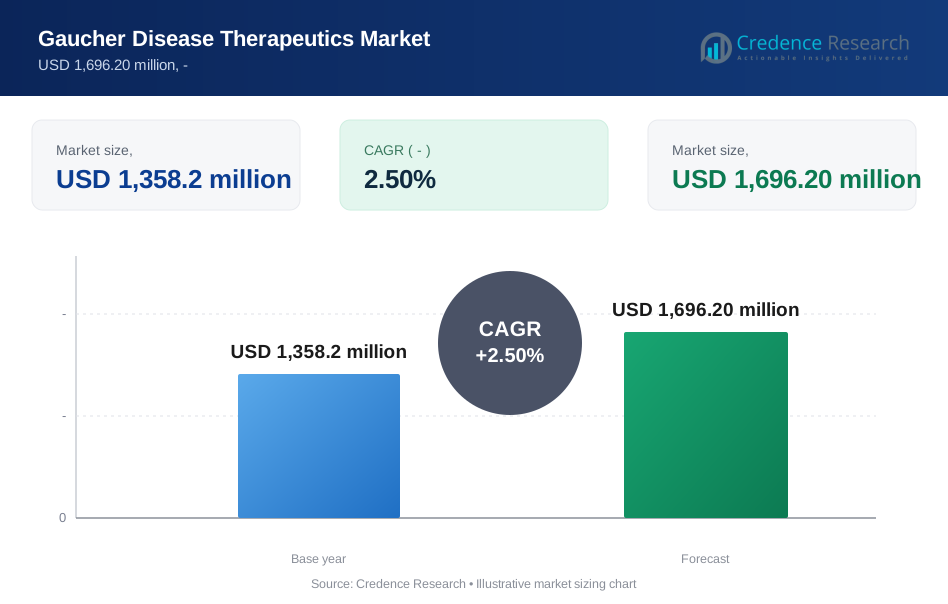
- Between 2024 and 2032, the global market for Gaucher disease therapeutics is projected to expand at a compound annual growth rate (CAGR) of 2.50%, from an estimated USD 1358.2 million in 2023 to USD 1696.20 million in 2032.
- The largest category is enzyme replacement therapy (ERT). Substrate reduction therapy (SRT), on the other hand, is expected to grow at a strong CAGR.
- The intravenous (IV) administration category will expand at a rapid rate of growth.
- Throughout the projected period, the CAGR for hospitals and clinics is anticipated to be the highest.
- North America controlled the Gaucher disease therapeutics market.
- Regarding the market share of Gaucher disease therapeutics, Europe is expected to come second.
- Asia Pacific is expected to experience the fastest growth in the Gaucher disease therapeutics industry.
- An increase in reported cases is driving the demand for efficient therapies for Gaucher disease, and the global market is growing due to biotechnology breakthroughs.
- New drug approvals that increase treatment options, along with policies and incentives for rare illness research and drug development, could boost the market for Gaucher disease therapeutics.
Executive Summary
Market Definition
The demand for medications and therapies intended to control and treat Gaucher disease, an uncommon hereditary lysosomal storage illness caused by a glucocerebrosidase deficiency, is known as the Gaucher Disease Therapeutics Market. This enzyme deficit causes the accumulation of glucocerebroside within cells, primarily affecting the spleen, liver, and bone marrow.
Market Overview
It is predicted that the gaucher disease therapeutics industry will continue its upward trajectory between 2024 and 2032, growing at a compound annual growth rate (CAGR) of 2.50%. From its projected USD 1358.2 million in 2023 to USD 1696.20 million in 2032, the market will continue to grow.
During the projected period, the market is anticipated to be driven by a rise in the number of patients with rare diseases, rising healthcare sector investment, and rising public awareness of GD. The most prevalent type of lysosomal storage disease is Gaucher disease, an autosomal recessive metabolic condition. Gaucher illness affects almost 1 in 40,000 live births in people of all ages, according to the National Gaucher Foundation (NGF) of the United States.
Mutations in the GBA gene result in decreased glucocerebrosidase synthesis and glucocerebroside buildup, which cause genetic diseases. This extra fat builds up in the kidney, liver, spleen, brain, bone marrow, and lungs, impairing normal bodily processes. During the projected period, the market is anticipated to rise modestly. Among the main factors driving the market's growth are the increasing prevalence of lysosomal storage disorder and the increased efforts to find more people with GD.
Segmentation by Therapy Type
- Enzyme replacement therapy (ERT) is the market leader in terms of therapy type. The Gaucher disease therapeutics market is experiencing a surge in demand for enzyme replacement therapy (ERT) as a result of improved patient outcomes and more accessibility to healthcare services brought about by rising awareness, increasing diagnostic rates, and breakthroughs in treatment choices.
- The substrate reduction therapy (SRT) category will exhibit a sizable CAGR during the projected period. Because of its ease of oral administration, efficacy in treating type 1 Gaucher disease, and expanding patient and medical professional preference for non-intravenous treatment options, substrate reduction therapy (SRT) is becoming more and more in demand in the Gaucher disease therapeutics market.
- Other therapy types, including pharmacological chaperones, substrate inhibitors, gene therapy, and supportive therapies, also support the need for Gaucher disease therapeutics.
Segmentation by Route of Administration
- The intravenous (IV) administration category is projected to develop at a greater CAGR over the forecast period. Because IV administration is widely used in enzyme replacement therapy (ERT) and has a proven track record of efficacy and quick therapeutic benefits, it continues to be in high demand in the Gaucher disease therapeutics market.
- The oral administration category will likely register a significant CAGR during forecasting. Due to patient preferences for convenience, increased adherence, and the efficacy of substrate reduction therapy (SRT) choices, there is a growing need for oral administration in the Gaucher disease therapeutics industry.
Segmentation by End-User
- The hospitals and clinics category is projected to grow faster over the projection period. Because of developed diagnostic tools, all-encompassing patient care, and the accessibility of specialized therapies like enzyme replacement therapy (ERT) and substrate reduction therapy (SRT), there is an increasing requirement for gaucher disease therapeutics in hospitals and clinics.
- Other end-users, including specialty clinics and home care settings, influence the need for Gaucher disease therapeutics.
Segmentation by Region
- North America leads the Gaucher disease therapeutics industry. Growing recognition of innovative treatments and strong backing from patient advocacy organizations accelerate the North American market's expansion further. Another important factor is the existence of major pharmaceutical corporations.
- Europe is estimated to rank second in the market size of Gaucher disease therapeutics.
- It is anticipated that the Gaucher disease therapeutics market in Asia Pacific will grow quickly.
- The remaining need for gaucher disease therapeutics is met by regions including Latin America, the Middle East, and Africa.
Numerous global awareness campaigns and programs about rare illnesses are being run by governments and international organizations. For example, the Australian government stated in July 2023 that it would allocate USD 3.3 million to assist about 2 million individuals who are afflicted with uncommon diseases. That will provide them with the encouragement they need to develop fresh educational initiatives and raise awareness.
North America is expected to become the world's largest market for gaucher disease therapeutics. Due to improved healthcare infrastructure, treatment accessibility, and increasing knowledge of Gaucher disease, North America accounted for the greatest revenue share in 2022—roughly 45%. In March 2020, NORD produced research estimating that there are about 6000 GD patients in the United States alone. People are becoming more aware of GD due to organizations like the National Gaucher Foundation of Canada and the National Gaucher Foundation of the United States. Due to the continued existence of Ashkenazi Jews and superior infrastructure facilities for the treatment of GD and other rare diseases, North America overtook Europe in revenue share.
It is projected that the Gaucher disease therapeutics market will develop at the fastest rate in the Asia Pacific region. Government efforts to raise public knowledge of uncommon and potentially fatal diseases and the expansion of healthcare facilities can support this rise. To help patients with extremely uncommon and life-threatening disorders afford their medications, the Australian government, for example, administers the Life Saving Drug Program (LSDP), which includes a list of GD medications.
Key Highlights of the Report
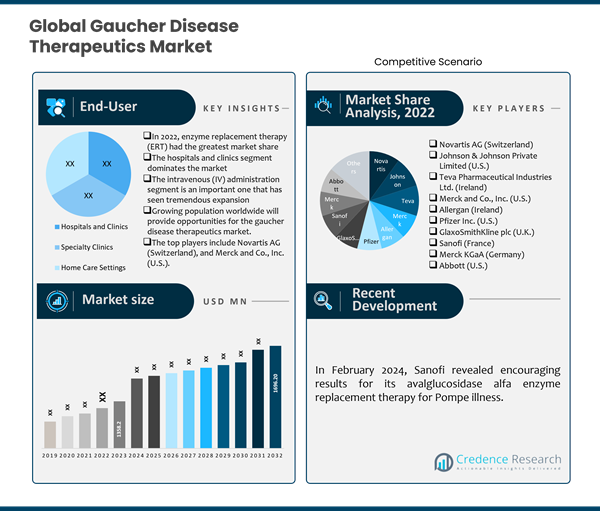
The global gaucher disease therapeutics market is segmented by therapy type, route of administration, end-user, and region. Enzyme replacement therapy (ERT) is the market spearhead. Hospitals and clinics are the top end-user categories. Throughout the forecast period, intravenous (IV) administration is expected to grow at the greatest CAGR. North America is seeing the most growth in the Gaucher disease therapeutics market.
Nowadays, the welfare of developing populations and the healthcare industry have become increasingly important to the world economies. Therefore, there has been a sharp increase in funding for rare disease patients in an effort to raise living standards. For example, the Canadian government stated in March 2023 that it will invest around USD 1.5 billion over three years to encourage the provision of genuine, affordable, and effective medications for people with rare diseases. These factors boost the growth of the Gaucher disease therapeutics market.
The region with the largest projected global market share for Gaucher disease therapeutics is expected to be North America. Significant R&D investments, high awareness, and an advanced healthcare infrastructure propel the North American market for gaucher disease therapeutics. In addition, it is projected that the Asia Pacific market will grow at the quickest rate. Expanding healthcare facilities, increased diagnostic capabilities, and growing consumer awareness are driving market expansion in the Asia Pacific area. Expanding markets are facilitated by government initiatives and the rising incidence of uncommon diseases. The vast patient populations in emerging economies, such as China and India, are important drivers.
Which Key Factors Are Driving The Global Gaucher Disease Therapeutics Market?
The market for Gaucher disease therapeutics is growing due to increased healthcare spending, improved access to cutting-edge medicines, and developments in gene therapy and CRISPR-Cas9 technologies.
What Are The Main Challenges Confronting The Global Gaucher Disease Therapeutics Market?
The major challenges confronting the Gaucher disease therapeutics sector are the lack of medical personnel skilled in detecting and treating Gaucher illness, as well as the possible side effects and long-term safety issues of treatments.
What Market Opportunities Exist For Gaucher Disease Therapeutics Globally?
The market for therapeutics for Gaucher disease continues to grow due to several causes, including substantial investments in research and development for new medications and growth prospects in developing nations with expanding healthcare systems.
Market Drivers
Growing Gaucher Disease Prevalence
The demand for treatments for Gaucher disease is expanding due to the escalating incidence of the condition. Effective therapies are in greater demand as this uncommon genetic condition is diagnosed in more people. A greater number of instances are recorded, which highlights the need for cutting-edge therapies. This is due to optimized diagnostic methods and more awareness. Pharmaceutical companies spend in R&D as a result of this increase in demand, which results in the development and approval of novel medicines like substrate reduction therapy (SRT) and enzyme replacement therapy (ERT). As a result, the increasing number of patients guarantees a steady market for therapies for Gaucher's illness, encouraging developments and increasing treatment alternatives to suit the requirements of afflicted parties.
Market Restraints
Treatment for Gaucher Disease is Expensive
The treatment for Gaucher disease is complex and expensive. It can be costly to live with Gaucher's sickness. An annual dose of enzyme replacement therapy (ERT), the main treatment for Gaucher disease, can range from $139,000 to over $300,000. Unexpected expenses, like travel costs and emergency service fees, are common for patients during their course of treatment. The anticipated average yearly economic cost of Gaucher disease is $48,771, according to the National Library of Medicine (NLM). The anticipated $41,816.2 (85.7% of total costs) represents the average direct healthcare expenditures for Gaucher disease. These expenses were mostly incurred by taking medication at home (61.3%), obtaining inpatient care (15.3%), receiving outpatient care (3.8%), and paying for diagnostic tests such as blood and imaging (3.4%). Many patients with Gaucher's illness have significant financial hardships in maintaining their health. Patients with Gaucher illness can live regular lives, but they must always have the proper care.
Opportunities
Innovations in Genetic Research Technology
The discovery of novel therapeutic techniques made possible by technological developments in genetic research presents a substantial opportunity for the Gaucher Disease Therapeutics Market. Gene therapy and CRISPR-Cas9 technologies are examples of innovations that show promise in treating the underlying genetic abnormalities causing Gaucher disease. Compared to conventional therapy, these state-of-the-art methods may provide longer-lasting, more effective results. Furthermore, improvements in genetic screening and diagnostics enable earlier and more precise illness detection, enabling prompt intervention. Genetic research has promoted advancements in customized medicine, allowing for more specialized care that leads to better patient results. These advances in technology draw funding and stimulate pharmaceutical research, broadening the therapeutic horizon and providing hope for improved treatment and possibly even a cure for Gaucher disease.
Competitive Landscape
Key Players
A number of significant players dominate the highly competitive global market for Gaucher disease therapeutics. A handful of the top market players are shown below, together with their respective market shares:
- Novartis AG (Switzerland)
- Johnson & Johnson Private Limited (U.S.)
- Teva Pharmaceutical Industries Ltd. (Ireland)
- Merck and Co., Inc. (U.S.)
- Allergan (Ireland)
- Pfizer Inc. (U.S.)
- GlaxoSmithKline plc (U.K.)
- Sanofi (France)
- Merck KGaA (Germany)
- Abbott (U.S.)
- Boehringer Ingelheim International GmbH. (Germany)
- Takeda Pharmaceutical Company Limited (Japan)
- Amicus Therapeutics, Inc. (U.S.)
- Moderna, Inc. (U.S.)
- Greenovation Biotech GmbH (Germany)
- Biomarin (U.S.)
- JCR Pharmaceuticals Co., Ltd (Japan)
- ISU ABXIS (South Korea)
- Idorsia Pharmaceuticals Ltd (Switzerland)
- AVROBIO, Inc. (U.S.)
- Resverlogix Corp. (Canada)
- Enzyvant (U.S.)
- CHIESI Farmaceutici SpA (Italy)
- Others
In order to stay competitive, these organizations give priority to product innovation, expansion of their distribution channels, and mergers and acquisitions.
By creating cutting-edge ideas and goods, the foremost manufacturers in the global market for gaucher disease therapeutics consistently strive to stay one step ahead of the competition.
In February 2024, the first Hunter syndrome gene therapy experiment was started in Manchester, United Kingdom, with the goal of replacing weekly enzyme therapy. Under the direction of Professor Brian Bigger, the study offers young patients hope in the wake of successful studies in mice.
In January 2024, Enzyme replacement treatment JR-441 (JCR Pharmaceuticals) was classified as an orphan medication by the USA FDA for Sanfilippo syndrome type A. In an effort to facilitate its advancement, it was given incentives for clinical development and review.
In November 2023, Takeda's enzyme replacement medication for a rare blood condition was approved by the FDA. It was a momentous occasion that showcased improvements in medical care and gave hope to those with life-threatening illnesses.
How are Companies Performing in the Gaucher Disease Therapeutics Market?
Companies in the Gaucher disease therapeutics market are performing well because of improvements in available treatments, smart partnerships, and an emphasis on R&D. Prominent pharmaceutical companies, like Sanofi Genzyme, Takeda Pharmaceutical, and Pfizer, are leading the way in this regard, using their vast resources to create and sell cutting-edge treatments. These companies have developed efficient substrate reduction therapies (SRT) and enzyme replacement therapies (ERT), which have considerably improved patient outcomes and quality of life.
Companies concentrate on introducing real medical solutions and alternatives to current remedies. For example, Freeline declared in January 2022 that the FDA had acknowledged its IND (International New Drug) application for FLT201, a gene treatment. For individuals with Gaucher disease, this investigational gene treatment has been licensed and is anticipated to be an important advancement.
To get a competitive edge, the market's companies are increasingly engaging in mergers and acquisitions. The acquisition of Prevail Therapeutics, which Lilly revealed in December 2020, will enable Lilly to launch a gene therapy program to create medicines for Gaucher disease patients.
Major companies in the market with notable sales and broad usage include Takeda's Vpriv and Sanofi Genzyme's Cerezyme and Cerdelga. Protalix BioTherapeutics, which is well-known for its plant cell-based ERT, was acquired by Pfizer, which illustrates the market's competitive dynamics and room for expansion. Furthermore, the introduction of innovative gene and oral medicines is changing the therapeutic landscape and opening up new therapy options.
Summary of Key Findings
- The market for Gaucher disease therapeutics is expected to expand due to the growing acceptability of early diagnosis and the surge in government awareness campaigns.
- The market is segmented by therapy type, route of administration, end-user, and region.
- In the market, the most prevalent therapy type is enzyme replacement therapy (ERT).
- Intravenous (IV) administration is the foremost route of administration category.
- Hospitals and clinics are expected to grow fastest in terms of CAGR during the forecast period.
- In terms of market development, North America is a leader; the market is highly competitive with key players including Novartis AG (Switzerland), Johnson & Johnson Private Limited (U.S.), Teva Pharmaceutical Industries Ltd. (Ireland), Merck and Co., Inc. (U.S.), Allergan (Ireland), Pfizer Inc. (U.S.), GlaxoSmithKline plc (U.K.), Sanofi (France), Merck KGaA (Germany), Abbott (U.S.), Boehringer Ingelheim International GmbH. (Germany), Takeda Pharmaceutical Company Limited (Japan), Amicus Therapeutics, Inc. (U.S.), Moderna, Inc. (U.S.), Greenovation Biotech GmbH (Germany), Biomarin (U.S.), JCR Pharmaceuticals Co., Ltd (Japan), ISU ABXIS (South Korea), Idorsia Pharmaceuticals Ltd (Switzerland), AVROBIO, Inc. (U.S.), Resverlogix Corp. (Canada), Enzyvant (U.S.), CHIESI Farmaceutici SpA (Italy), and Others.
Future Outlook
- The Gaucher disease therapeutics industry is expected to increase significantly in North America, and its outlook is positive worldwide.
- The primary driver of the market for gaucher disease therapeutics is the increasing need for an adequately effective and safe treatment.
- Stringent regulatory procedures for medication approval, which can postpone the release of new treatments, are the biggest obstacles to the industry's growth in the Gaucher disease therapeutics sector.
- Developing new products, reaching a wider market, and maintaining competitive prices are all necessary for major businesses to stay ahead of the competition.
How the Credence Research Gaucher Disease Therapeutics Market Report Can Help CXOs
The Credence Research Gaucher Disease Therapeutics Market Report provides CXOs with an extensive market overview and comprises the following:
- Market size and growth forecast: The study offers comprehensive market estimations for gaucher disease therapeutics globally, broken down by therapy type, route of administration, end-user, and region. Furthermore, the report includes market forecasts through 2032, derived from key drivers and trends.
- Market segmentation: The gaucher disease therapeutics market is divided into segments by therapy type, route of administration, end-user, and region in the research report. This segmentation helps CXOs understand the market and the opportunities inside each area in great depth.
- Competitive landscape: The study report provides a thorough analysis of the leading businesses in the Gaucher disease therapeutics sector, together with details on their revenue streams, product lines, and business strategies. With this information, CXOs can assess and identify their competitors.
- Key trends and drivers: The study report analyzes and highlights the key developments and elements driving the market for gaucher disease therapeutics. CXOs can utilize this information to make well-informed choices regarding their plans and investments.
The Credence Research Gaucher Disease Therapeutics Market Report provides CXOs with insights that they may utilize to:
- Identify growth opportunities: This analysis is likely to help CXOs find fresh growth prospects in the Gaucher disease therapeutics sector. For example, the research recognizes the increasing requirement for Gaucher disease therapeutics from hospitals and clinics as a crucial opportunity.
- Make informed investment decisions: The study aids CXOs in making informed decisions about Gaucher disease therapeutics. For example, it delivers information on the key variables to consider while picking Gaucher disease therapeutics solutions and evaluating suppliers.
- Develop competitive strategies: CXOs can utilize the research report to establish competitive strategies for their gaucher disease therapeutics firms. The study paper explores the primary tactics employed by Gaucher disease therapeutics providers to set themselves apart from their rivals.
- Track market developments: By tracking market advancements, this research report could assist CXOs in remaining ahead of the curve. For example, it provides information about the latest advancements and patterns in the Gaucher disease therapeutics industry.
The Credence Research Gaucher Disease Therapeutics Market Report is helpful for CXOs who want to learn more about the market and identify potential opportunities.
Segmentation
-
By Therapy Type
- Enzyme Replacement Therapy (ERT)
- Recombinant Enzymes
- Long-Acting ERT
- Novel ERT Formulations
- Substrate Reduction Therapy (SRT)
- Pharmacological Chaperones
- Substrate Inhibitors
- Gene Therapy
- Viral Vector-Based Gene Therapy
- Non-Viral Gene Therapy
- Supportive Therapies
- Symptomatic Treatment
- Nutritional Support
-
By Route of Administration
- Intravenous (IV) Administration
- Oral Administration
-
By End-User
- Hospitals and Clinics
- Specialty Clinics
- Home Care Settings
-
By Region
- North America
- U.S
- Canada
- Mexico
- Europe
- Germany
- France
- UK
- Italy
- Spain
- Rest of Europe
- Asia Pacific
- China
- Japan
- India
- South Korea
- South-east Asia
- Rest of Asia Pacific
- Latin America
- Brazil
- Argentina
- Rest of Latin America
- Middle East & Africa
- GCC Countries
- South Africa
- The Rest of the Middle East and Africa
- North America
- Enzyme Replacement Therapy (ERT)
Adjacent Markets
Several adjacent markets in the Gaucher disease therapeutics market have high revenue growth opportunities. The key adjacent markets for the Gaucher disease therapeutics market -
Adjacent Markets |
||
| Fabry Disease Therapeutics Market | Pompe Disease Therapeutics Market | Cystic Fibrosis Therapeutics Market |
| Hemophilia Therapeutics Market | Huntington's Disease Therapeutics Market | Thalassemia Therapeutics Market |
| Orphan Drugs Market | Gene Therapy Market | Rare Disease Diagnostics Market |
Request a Free Sample
Fill in your details and we'll send you a free sample report.
- Sample data tables & charts
- Research methodology
Need a Custom Version of This Report?
Tailor the scope, geography, or segments to your exact requirements.
- Custom geography or segment scope
- Direct access to our analyst team
Frequently Asked Questions
How much does the global market currently hold for Gaucher disease therapeutics?
What is the Glaucoma Therapeutics Market CAGR?
In terms of therapy type, which market category is leading?
Regarding the route of administration, which market category is in the lead?
Which end-user segment is estimated to have the highest CAGR throughout the forecast period?
In which region is the market for Gaucher disease therapeutics expanding?
Who are the main players in the global Gaucher disease therapeutics industry?
Which market factors are the primary drivers of the Gaucher disease therapeutics industry?
What main market challenges prevent the growth of the Gaucher disease therapeutics sector?
What are the main market opportunities for the Gaucher disease therapeutics sector?
Table of Content
Chapter 1. Report Introduction
- 1.1 Report Description & Purpose
- 1.1.1 Report Title & Market Definition
- 1.1.2 Unique Selling Propositions (USP) & Key Differentiators
- 1.1.3 Value Proposition for Stakeholders
- 1.2 Research Objectives
- 1.2.1 Market Sizing Objectives (Volume & Revenue)
- 1.2.2 Segmentation Objectives
- 1.2.3 Competitive Intelligence Objectives
- 1.2.4 Forecast & Scenario Objectives
- 1.3 Report Scope
- 1.3.1 Gaucher Disease Therapeutics Scope – Types & Subtypes Covered
- 1.3.2 Geographic Scope – Regions & Countries Covered
- 1.3.3 Historical Period, Base Year & Forecast Period (the historical period; forecast to the forecast period)
- 1.3.4 Inclusions & Exclusions
- 1.4 HS Code & Classification Framework
- 1.5 Currency, Units & Pricing Basis
- 1.6 Target Stakeholders
- 1.7 Limitations & Assumptions
Chapter 2. Executive Summary
- 2.1 Global Gaucher Disease Therapeutics Market Snapshot
- 2.1.1 Market Size – Historical (the historical period) & Forecast (the forecast period) (base year: USD 1,358.2 million → forecast year: USD 1,696.20 million)
- 2.1.2 Volume & Revenue – Global Totals
- 2.1.3 Key Market Highlights – Top Five Facts
- 2.2 Gaucher Disease Therapeutics Market Segmentation Snapshot
- 2.2.1 Market Split by Region – vs.
- 2.3 Competitive Snapshot
- 2.3.1 Top 10 Players by Revenue Share –
- 2.3.2 Top 10 Players by Volume Share –
- 2.3.3 Recent Strategic Developments (18-Month Summary)
- 2.4 Key Investment Highlights & Strategic Conclusions
Chapter 3. Gaucher Disease Therapeutics Market Dynamics & Industry Analysis
- 3.1 Market Overview & Context
- 3.1.1 Gaucher Disease Therapeutics Market Position in the Broader Automotive Value Chain
- 3.1.2 OEM vs. Replacement Market Dynamics
- 3.1.3 Market Maturity & Development Stage by Region
- 3.2 Gaucher Disease Therapeutics Market Drivers
- 3.3 Gaucher Disease Therapeutics Market Restraints & Challenges
- 3.4 Gaucher Disease Therapeutics Market Opportunities
- 3.5 Porter's Five Forces Analysis
- 3.5.1 Threat of New Entrants
- 3.5.2 Bargaining Power of Suppliers
- 3.5.3 Bargaining Power of Buyers
- 3.5.4 Threat of Substitutes
- 3.5.5 Competitive Rivalry – Intensity Assessment
- 3.6 Gaucher Disease Therapeutics Value Chain Analysis
- 3.6.1 Upstream – Raw Material/Input Suppliers
- 3.6.1.1 Raw Material/Input 1
- 3.6.1.2 Raw Material/Input 2
- 3.6.1.3 Raw Material/Input 3
- 3.6.2 Midstream – Production/Manufacturing/Service Delivery
- 3.6.2.1 Production/Process Overview
- 3.6.2.2 Key Facility Locations & Capacity by Manufacturer
- 3.6.3 Downstream – Distribution & End Consumer
- 3.6.3.1 Primary Channel – B2B/OEM
- 3.6.3.2 Secondary Channels – Dealer, Retail, Online, Direct
- 3.6.4 Value Chain Profitability Analysis
- 3.6.1 Upstream – Raw Material/Input Suppliers
- 3.7 PESTEL Analysis
- 3.7.1 Political Factors
- 3.7.2 Economic Factors
- 3.7.3 Social Factors
- 3.7.4 Technological Factors
- 3.7.5 Environmental Factors
- 3.7.6 Legal Factors
- 3.8 Gaucher Disease Therapeutics Supply Chain Analysis
- 3.8.1 Raw Material/Input Supply Risk Assessment
- 3.8.2 Manufacturing Concentration Risk (Geographic Exposure)
- 3.8.3 Trade Disruption Impact Analysis
- 3.9 Regulatory & Policy Landscape
Note: The regulatory and policy landscape section covers regulations based on their applicability to the market, Gaucher Disease Therapeutics category, geography, and scope of the study. Only regulatory frameworks with a material impact on operations, compliance, trade, sustainability, or market access are analyzed in detail.
Chapter 4. Key Investment Pockets & Opportunity Analysis
- 4.1 Gaucher Disease Therapeutics Market Attractiveness Analysis
- 4.1.1 By Region – Investment Attractiveness Matrix (Volume × CAGR)
- 4.2 Absolute Revenue Growth Opportunity
- 4.2.1 By Region – Absolute USD Growth Through the forecast period
- 4.3 Incremental Volume Opportunity
- 4.3.1 By Region – Incremental Volume Through the forecast period
- 4.3.2 Segment – Incremental Volume
- 4.4 Emerging Submarket Opportunity Deep Dive (Subject to Applicability)
- 4.5 Emerging Market Opportunity Scorecards
- 4.5.1 United States
- 4.5.2 Europe
- 4.5.3 Asia
- 4.5.4 Middle East & Africa
Note: Emerging Market Opportunity Scorecards will be included based on relevance and strategic importance. Regions listed are indicative and may vary depending on data availability and market dynamics.
Chapter 5. Gaucher Disease Therapeutics Import-Export Analysis & Trade Flows
- 5.1 Global Trade Overview
- 5.1.1 Global Export Value by Country (the historical period)
- 5.1.2 Global Export Volume by Country (the historical period)
- 5.1.3 Global Import Value by Country (the historical period)
- 5.1.4 Global Import Volume by Country (the historical period)
- 5.1.5 Net Trade Balance by Country (the historical period)
- 5.2 Export Analysis – Segment
- 5.2.1 Type 1 (HS Code)
- 5.2.2 Type 2 (HS Code)
- 5.2.3 Type 3 (HS Code)
- 5.2.4 Type 4 (HS Code)
- 5.2.5 Type 5 (HS Code)
- 5.3 Import Analysis – Segment
- 5.3.1 Type 1 (HS Code)
- 5.3.2 Type 2 (HS Code)
- 5.3.3 Type 3 (HS Code)
- 5.3.4 Type 4 (HS Code)
- 5.3.5 Type 5 (HS Code)
- 5.4 Average Unit Trade Prices
- 5.4.1 Average Export Price – Segment & Country
- 5.4.2 Average Import Price – Segment & Source Country
- 5.4.3 Price Trends (the historical period)
- 5.5 Key Trade Route Analysis
- 5.5.1 Trade Route 1
- 5.5.2 Trade Route 2
- 5.5.3 Trade Route 3
- 5.5.4 Trade Route 4
- 5.5.5 Trade Route 5
- 5.6 Trade Policy Impact Assessment
- 5.6.1 US Anti-Dumping & Section 301 Tariffs
- 5.6.2 EU Customs Union Impact
- 5.6.3 Major Free Trade Agreements
- 5.6.4 USMCA Rules of Origin
Note: Trade policy analysis will be included only where relevant to the Gaucher Disease Therapeutics market.
Chapter 6. Competitive Landscape & Company Benchmarking
- 6.1 Gaucher Disease Therapeutics Market Concentration & Structure
- 6.1.1 Herfindahl-Hirschman Index (HHI) – vs.
- 6.1.2 Tier 1, Tier 2 & Tier 3 Market Structure
- 6.1.3 Global, Regional & Local Player Dynamics
- 6.2 Gaucher Disease Therapeutics Market Share Analysis –
- 6.2.1 Global Revenue Share by Company
- 6.2.2 Global Volume Share by Company
- 6.2.3 Regional Revenue Share
- 6.2.4 Market Share Evolution ( vs. )
- 6.2.5 OEM Segment Share by Company
- 6.2.6 Replacement Segment Share by Company
- 6.3 Production/Delivery Capacity & Facility Analysis
- 6.3.1 Global Installed Capacity
- 6.3.2 Capacity Utilization Rates
- 6.3.3 Production/Output Volume
- 6.3.4 Facility Locations & Capacity Map
- 6.3.5 Planned Capacity Additions
- 6.4 Gaucher Disease Therapeutics Competitive Benchmarking Matrix
- 6.4.1 Revenue, Volume, CAGR & Profitability Comparison
- 6.4.2 Channel Revenue Mix
- 6.4.3 Geographic Revenue Exposure
- 6.4.4 R&D Intensity
- 6.4.5 Sustainability Maturity
- 6.5 Strategic Developments in Gaucher Disease Therapeutics (Last 24 Months)
- 6.5.1 Mergers, Acquisitions & Divestments
- 6.5.2 New Gaucher Disease Therapeutics Launches
- 6.5.3 Facility Expansions
- 6.5.4 Strategic Alliances, Joint Ventures & Partnerships
- 6.5.5 Distribution Expansion & Market Entry
- 6.5.6 Sustainability & ESG Initiatives
- 6.6 Competitive Strategy Mapping
- 6.6.1 Leader, Challenger, Follower & Niche Classification
- 6.6.2 Pricing Strategy Comparison
- 6.6.3 Channel Strategy Matrix
Note: Strategic developments are included based on their materiality and the availability of reliable information.
Chapter 7. Global Gaucher Disease Therapeutics Market – By Distribution Channel
- 7.1 Segment Overview
- 7.1.1 Volume & Revenue Split by Channel ( & )
- 7.1.2 Channel Mix Evolution (the forecast period)
Chapter 8. Regional Market Analysis – Global Overview
- 8.1 Global Regional Overview
- 8.1.1 Regional Volume Share
- 8.1.2 Regional Revenue Share
- 8.1.3 Regional Volume by Region
- 8.1.4 Regional Revenue by Region
- 8.1.5 Regional Forecast Through the forecast period
- 8.2 Cross-Regional Segment Analysis
- 8.2.1 By Distribution Channel
- 8.2.2 By Brand/Price Tier
Chapter 9. North America Gaucher Disease Therapeutics Market
- 9.1 United States
- 9.2 Canada
- 9.3 Mexico
Chapter 10. Europe Gaucher Disease Therapeutics Market
- 10.1 Germany
- 10.2 France
- 10.3 Italy
- 10.4 United Kingdom
- 10.5 Spain
- 10.6 Poland
- 10.7 Russia
- 10.8 Netherlands
- 10.9 Belgium
- 10.10 Sweden
- 10.11 Denmark
- 10.12 Norway
- 10.13 Rest of Europe
Chapter 11. Asia Pacific Gaucher Disease Therapeutics Market
- 11.1 China
- 11.2 India
- 11.3 Japan
- 11.4 South Korea
- 11.5 Thailand
- 11.6 Indonesia
- 11.7 Vietnam
- 11.8 Malaysia
- 11.9 Australia
- 11.10 Rest of Asia Pacific
Chapter 12. Latin America Gaucher Disease Therapeutics Market
- 12.1 Brazil
- 12.2 Argentina
- 12.3 Colombia
- 12.4 Chile
- 12.5 Rest of Latin America
Chapter 13. Middle East Gaucher Disease Therapeutics Market
- 13.1 Saudi Arabia
- 13.2 United Arab Emirates
- 13.3 Turkey
- 13.4 Israel
- 13.5 Iran
- 13.6 Rest of the Middle East
Chapter 14. Africa Gaucher Disease Therapeutics Market
- 14.1 South Africa
- 14.2 Egypt
- 14.3 Nigeria
- 14.4 Morocco
- 14.5 Rest of Africa
Chapter 15. Gaucher Disease Therapeutics Company Profiles
- 15.1 [Company 01]
- 15.1.1 Company Overview
- 15.1.2 Key Management Personnel
- 15.1.3 Products & Services Portfolio
- 15.1.4 Financial Performance
- 15.1.5 Key Market Focus & Geographic Presence
- 15.1.6 Recent Developments & Strategic Initiatives
Note: The company profile list is preliminary and may change based on research findings, market developments, data availability, and client requirements.
Chapter 16. Appendices
- Appendix A – List of Abbreviations & Acronyms
- Appendix B – Industry Classification Code Reference – Full Series
- Appendix C – Production & Capacity Data Tables
- Appendix D – End-Use & Demand Base Tables
- Appendix E – Consumption & Replacement Rate Assumptions
- Appendix F – ASP Reference Tables
- Appendix G – Manufacturing & Facility Database
- Appendix H – Import-Export Data Tables
- Appendix I – Regulatory Summary Tables
- Appendix J – Primary Research Participant List (Anonymized)
- Appendix K – Primary Research Questionnaire Framework
- Appendix L – Data Sources & Bibliography
- Appendix M – Market Size Divergence & Source Comparison
Chapter 17. Research Methodology
- 17.1 Research Framework & Philosophy
- 17.2 Secondary Research – Sources, Hierarchy & Data Extraction
- 17.3 Data Modeling – Bottom-Up & Top-Down Market Sizing
- 17.4 Primary Research – Stakeholder Framework, LOI & Sample Sizes
- 17.5 Forecast Methodology – Regression, Scenario & Sensitivity Analysis
- 17.6 Quality Control – Four-Layer Validation Framework
- 17.7 Limitations & Standard Assumptions
- 17.8 Disclaimer
