
| REPORT ATTRIBUTE | DETAILS |
|---|---|
| Historical Period | 2019-2022 |
| Base Year | 2023 |
| Forecast Period | 2024-2032 |
| Managed Security Services Market Size 2024 | USD 35,815 Million |
| Managed Security Services Market, CAGR | 14% |
| Managed Security Services Market Size 2032 | USD 102,165.3 Million |
Market Overview
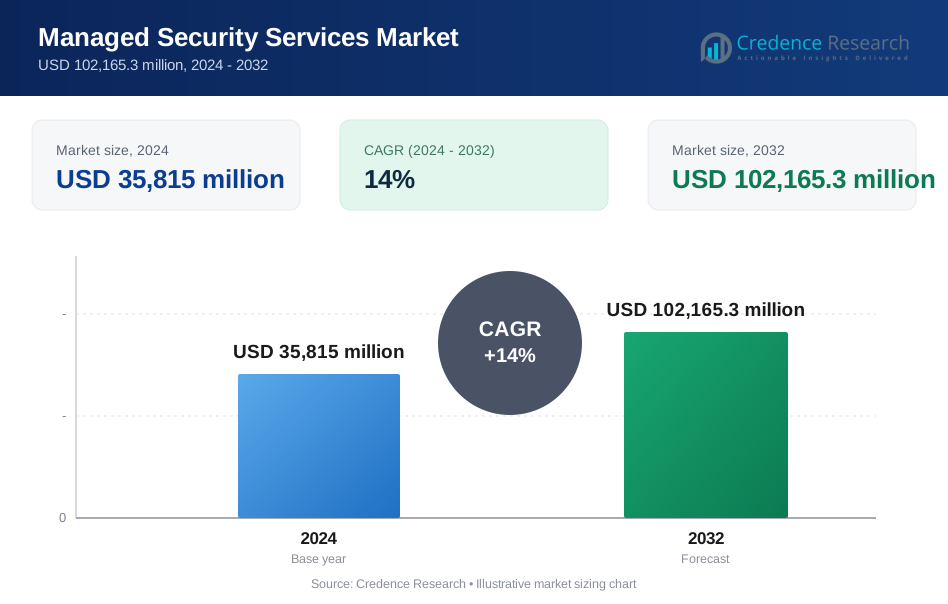
The Managed Security Services Market is projected to grow significantly from USD 35,815 million in 2024 to USD 102,165.3 million by 2032, reflecting a robust compound annual growth rate (CAGR) of 14%.
The Managed Security Services market is driven by the increasing frequency and sophistication of cyberattacks, prompting organizations to prioritize robust security measures. Growing regulatory compliance requirements further fuel demand for comprehensive security solutions. Additionally, the rising adoption of cloud-based services enhances the need for managed security to protect sensitive data across diverse environments. Trends such as the integration of artificial intelligence and machine learning into security protocols improve threat detection and response capabilities. Furthermore, the expansion of the Internet of Things (IoT) amplifies the complexity of security management, driving organizations to seek specialized managed services for effective protection.
The Managed Security Services market is witnessing significant growth across various regions, with North America leading due to its high adoption of advanced technologies and stringent regulatory requirements. Key players in this region include IBM, Cisco, and Secureworks, which are continuously innovating their offerings. In the Asia-Pacific region, companies like NTT, Fujitsu, and TCS are gaining traction, driven by increasing digitization and awareness of cybersecurity threats. Europe also plays a vital role, with firms such as Atos and Capgemini focusing on compliance and tailored solutions to meet the unique needs of diverse industries in the region.
Market Drivers
Shortage of Cybersecurity Professionals
The growing demand for effective cybersecurity solutions is compounded by a notable shortage of skilled professionals in the field. For instance, the global cybersecurity workforce gap reached a new high with an estimated 4.8 million professionals needed to effectively secure organizations, a 19% year-on-year increase. Organizations face challenges in hiring and training in-house cybersecurity teams, which can be both expensive and time-consuming. This skills gap often leaves businesses vulnerable, making Managed Security Services (MSS) an attractive alternative to bolster their security posture without the overhead of developing internal expertise.
Cost-Effectiveness
MSS providers offer a cost-effective approach to cybersecurity by delivering scalable solutions tailored to meet varying security needs. By leveraging the expertise and specialized tools that MSS providers bring, organizations can avoid the substantial upfront costs associated with building and maintaining an internal security team. For instance, the average annual cost of running an in-house SOC is $2.84 million, while the average annual cost of using an MSSP is $1.42 million. This flexibility allows businesses to allocate resources more efficiently while ensuring they receive comprehensive protection against evolving threats.
Rising Cyber Threats
The landscape of cyber threats is rapidly evolving, with cybercriminals continually refining their tactics to launch sophisticated attacks, including ransomware, phishing, and DDoS assaults. The proliferation of connected devices, alongside increased cloud adoption and digital transformation, has significantly expanded the attack surface for organizations. As a result, the financial and reputational repercussions of data breaches have made cybersecurity a top priority for businesses across various sectors, necessitating robust and proactive security measures.
Compliance Requirements
In industries such as healthcare, finance, and government, stringent compliance regulations necessitate the implementation of robust cybersecurity measures. Failure to meet these requirements can lead to significant penalties, including hefty fines and legal consequences. By utilizing Managed Security Services, organizations can ensure they remain compliant with industry standards while benefiting from the proactive threat detection and incident response capabilities offered by MSS providers. This collaboration enables businesses to focus on their core operations while effectively managing their security obligations.
Market Trends
Cloud-Based Solutions and AI-Driven Technologies
The emergence of cloud-based Managed Security Services (MSS) marks a significant trend in the cybersecurity landscape, offering unparalleled scalability to meet evolving security needs. These solutions enable organizations to adjust their security infrastructure dynamically, effectively addressing varying levels of risk without the burden of substantial upfront investments. By reducing operational costs and enhancing accessibility, cloud-based MSS allows security teams to respond to incidents from anywhere, thereby improving overall responsiveness. Complementing this trend is the integration of Artificial Intelligence (AI) and Machine Learning (ML) into security frameworks. AI and ML algorithms excel at analyzing vast datasets, identifying patterns, and detecting emerging threats with remarkable efficiency. These technologies automate routine security tasks, enabling analysts to concentrate on more complex challenges. Furthermore, predictive analytics capabilities allow organizations to foresee potential attacks, fostering a proactive approach to cybersecurity that significantly mitigates risks.
Extended Detection and Response (XDR) and Security as a Service
Another notable trend is the rise of Extended Detection and Response (XDR), which provides a unified platform for detecting, investigating, and responding to threats across multiple security domains. This holistic approach enhances visibility into the entire security landscape, allowing organizations to improve their threat detection and response capabilities. In parallel, Security as a Service (SaaS) models are gaining traction, providing subscription-based MSS that is accessible to organizations of all sizes. This model supports rapid deployment, enabling businesses to enhance their security posture quickly and efficiently. The increasing prevalence of Internet of Things (IoT) and Operational Technology (OT) devices further complicates security efforts by expanding the attack surface. To address these challenges, MSS providers are developing specialized solutions tailored for IoT and OT environments. For instance, a survey found that the European Union's General Data Protection Regulation (GDPR) and other regional data protection laws impose stringent requirements on organizations to safeguard personal data, driving the demand for MSS in the region. Additionally, as regulatory demands intensify, organizations are focusing on compliance and risk management, leveraging MSS providers to ensure adherence to industry-specific regulations such as GDPR, HIPAA, and PCI DSS. These providers also assist organizations in assessing and managing security risks, thus minimizing liabilities. The implementation of Managed Detection and Response (MDR) services complements these efforts, offering 24/7 monitoring of networks and systems for suspicious activity. With expert response teams available to quickly address security incidents, organizations can significantly reduce downtime and mitigate damage, reinforcing their overall security infrastructure.
Market Challenges Analysis
Complexity of Cyber Threats and Data Privacy Compliance
The complexity of cyber threats poses a significant challenge for Managed Security Service (MSS) providers. Cybercriminals continuously evolve their tactics, making it increasingly difficult for security teams to stay ahead of emerging threats. Advanced attacks, such as ransomware and supply chain compromises, require specialized expertise and sophisticated tools that many organizations may struggle to implement. For instance, a University of Maryland study quantified the near-constant rate of hacker attacks on computers with Internet access, occurring every 39 seconds on average. Furthermore, data breach costs have increased significantly, with the global average cost of a data breach in 2024 reaching $4.88 million, a 10% increase over the previous year These evolving threats underscore the necessity for MSS providers to maintain a proactive and adaptable approach to cybersecurity, continuously updating their strategies and technologies to effectively counteract the latest tactics employed by cyber adversaries. Furthermore, MSS providers face stringent regulations regarding data privacy and security, such as GDPR, HIPAA, and PCI DSS. Compliance with these regulations is critical, as any data breach can have severe repercussions, including financial penalties and reputational damage for both the provider and its customers. Navigating these regulatory landscapes while ensuring robust data protection adds another layer of complexity to their operations.
Integration Challenges and Skill Shortages
Integrating Managed Security Services with existing security infrastructures presents notable challenges, particularly for organizations with diverse technology environments. Compatibility issues can arise, complicating the seamless implementation of MSS solutions and potentially leading to gaps in security coverage. Additionally, concerns surrounding data sharing with MSS providers can heighten anxieties about data privacy and security, creating further hesitation among potential clients. Compounding these integration challenges is the ongoing skill shortage in the cybersecurity field. MSS providers require highly skilled professionals to effectively manage and respond to an array of cyber threats. However, the intense competition for this talent can drive up salaries and make it increasingly difficult to hire and retain qualified staff. This scarcity of expertise not only hampers the effectiveness of MSS offerings but can also impact the provider’s ability to deliver timely and efficient responses to security incidents. As customer expectations rise for proactive protection and rapid response to threats, the combination of these challenges makes it imperative for MSS providers to enhance their capabilities while managing the intricate dynamics of the cybersecurity landscape.
Market Segmentation Analysis:
By Service Type:
The Managed Security Services (MSS) market is segmented by service type, which encompasses a diverse range of offerings tailored to meet various security needs. Managed Identity and Access Management (IAM) focuses on ensuring that only authorized users have access to sensitive information, thus enhancing overall data security. Managed Vulnerability Management involves the identification and remediation of vulnerabilities within an organization’s systems, proactively reducing the risk of cyberattacks. Furthermore, Managed Risk and Compliance services assist organizations in navigating the complexities of regulatory frameworks, ensuring adherence to essential regulations like GDPR and HIPAA. Managed Detection and Response (MDR) provides continuous monitoring and rapid incident response, enabling organizations to quickly address potential threats. Managed Firewall services safeguard networks by controlling incoming and outgoing traffic based on predetermined security rules. Additionally, Managed Security Information and Event Management (SIEM) and Log Management services aggregate and analyze security data to provide comprehensive insights into an organization’s security posture. Other service types, such as Managed Endpoint Detection and Response (EDR), also contribute to the growing breadth of MSS offerings, addressing emerging security challenges.
By Type:
The Managed Security Services market is also segmented by type, primarily categorized into Fully Managed and Co-Managed services. Fully Managed services offer complete outsourcing of an organization’s security needs to MSS providers, ensuring that security operations are handled by experienced professionals. This approach allows organizations to leverage specialized expertise, advanced tools, and 24/7 monitoring without the burden of managing these functions internally. In contrast, Co-Managed services enable organizations to retain a degree of control over their security operations while collaborating with MSS providers. This model is particularly appealing to businesses that wish to integrate their existing security teams with external experts, thereby enhancing their overall security posture. The flexibility of these service types caters to varying organizational needs and resource capabilities, making MSS accessible to a broader range of businesses. As the threat landscape continues to evolve, the demand for both Fully Managed and Co-Managed services is expected to grow, driving innovation and investment in the MSS sector. This segmentation allows organizations to choose the level of support that best aligns with their strategic objectives and risk management requirements.
Segments:
Based on Service Type:
- Managed IAM
- Managed Vulnerability Management
- Managed Risk and compliance
- Managed detection and response
- Managed Firewall
- Managed SIEM and Log Management
- Other service type
Based on Type
- Fully Managed
- Co-Managed
Based on Organization size
- Large Enterprises
- SMEs
Based on Security Type
- Network Security
- Cloud Security
- Endpoint Security
- Application Security
Based on Vertical
- BFSI
- Government
- Healthcare & Life Sciences
- Telecommunications
- IT and ITeS
- Retail and eCommerce
- Energy and Utilities
- Manufacturing
- Other Verticals
Based on the Geography:
- North America
- U.S.
- Canada
- Mexico
- Europe
- Germany
- France
- U.K.
- Italy
- Spain
- Rest of Europe
- Asia Pacific
- China
- Japan
- India
- South Korea
- South-east Asia
- Rest of Asia Pacific
- Latin America
- Brazil
- Argentina
- Rest of Latin America
- Middle East & Africa
- GCC Countries
- South Africa
- Rest of the Middle East and Africa
Regional Analysis
North America
North America holds a significant share of the Managed Security Services (MSS) market, accounting for approximately 40% of the total market revenue. This dominance can be attributed to the high adoption rate of advanced technologies, increased awareness of cybersecurity threats, and stringent regulatory requirements across various industries. Major players in the region, including IBM, Cisco, and Fortinet, are continuously innovating their service offerings to address the evolving threat landscape. Additionally, the presence of numerous small and medium-sized enterprises (SMEs) seeking to enhance their security posture contributes to the growing demand for managed services. Organizations in sectors such as finance, healthcare, and government are particularly inclined toward MSS due to the sensitive nature of their data and the potential financial repercussions of data breaches. As cyber threats become more sophisticated, North American businesses are increasingly turning to MSS providers for comprehensive and proactive security solutions.
Asia-Pacific
In contrast, the Asia-Pacific region is witnessing rapid growth in the Managed Security Services market, currently holding about 25% of the global market share. This growth is primarily driven by the increasing digitization of businesses, rising awareness of cybersecurity issues, and the expanding adoption of cloud-based solutions. Countries such as China, India, and Australia are at the forefront of this trend, as organizations prioritize data security amidst growing regulatory demands. The region's diverse industries, including manufacturing, retail, and telecommunications, are increasingly investing in managed services to address their unique security challenges. Furthermore, the rise of cyber threats in the region, coupled with a shortage of skilled cybersecurity professionals, has prompted organizations to seek the expertise of MSS providers to safeguard their assets effectively. As a result, the Asia-Pacific MSS market is expected to grow significantly, driven by both large enterprises and SMEs seeking reliable security solutions.
Key Player Analysis
- Atos (France)
- Kudelski Security (Switzerland)
- Cisco (US)
- TCS (India)
- Secureworks (US)
- NTT (Japan)
- Fujitsu (Japan)
- Capgemini (France)
- Verizon (US)
- Trustwave (US)
- Orange Cyberdefense (France)
- IBM (US)
- DXC Technology (US)
- HPE (US)
- Accenture (Ireland)
- AT&T (US)
Competitive Analysis
The Managed Security Services (MSS) market is highly competitive, with leading players continually enhancing their offerings to maintain market share. IBM, Cisco, Secureworks, NTT, Fujitsu, TCS, Accenture, DXC Technology, Trustwave, Atos, Orange Cyberdefense, Capgemini, HPE, Verizon, and AT&T are at the forefront of this dynamic landscape. Leading players continuously invest in advanced technologies and innovative solutions to address the evolving threat landscape effectively. Many companies focus on integrating artificial intelligence and machine learning into their services for better threat detection and response capabilities. Additionally, there is a trend toward offering customizable solutions that cater to specific industry needs, such as compliance with stringent regulations. As organizations increasingly prioritize cybersecurity, MSS providers differentiate themselves through superior customer support, rapid response times, and robust service-level agreements (SLAs). This competitive environment drives ongoing improvements in service quality, flexibility, and scalability, ultimately benefiting clients seeking reliable security solutions.
Recent Developments
- In November 2023, Rapid7 chose TruVisor as its exclusive distributor for cybersecurity solutions in the ASEAN and India regions. This partnership aims to enhance their joint customers' cybersecurity capabilities through Rapid7’s security platforms. This strategic collaboration is significant in the growing cybersecurity market in these regions.
- In November 2023, Accenture acquired Innotec Security, a privately held company specializing in cybersecurity-as-a-service, cyber resilience, and cyber risk management, expanding its capabilities and footprint in Spain. Innotec Security was previously owned by parent company Entelgy Group. The acquisition of Innotec Security-which also has a presence in Barcelona, Seville, and the Basque Country-will add 500 cybersecurity professionals to Accenture Security’s workforce of 20,000 professionals globally, making Accenture Security one of the top managed security services (MSS) players in Spain.
- In August 2023, DXC Technology signed an IT Infrastructure Services Agreement with AT&T; under the agreement, DXC will manage AT&T’s midrange IT infrastructure, which spans AT&T’s enterprise compute, storage, backup, and recovery environments. DXC will also provide system, database, storage administration, hardware architecture, and maintenance across these environments.
- In June 2023, Secureworks unveiled the Taegis XDR (Extended detection and response), and Taegis Managed XDR for OT (operational technology) offerings to help industrial organizations protect against cyber threats. Taegis XDR combines IT security telemetry with OT intelligence and uses analytics and machine learning to help organizations identify threats and prioritize the most serious ones.
Market Concentration & Characteristics
The Managed Security Services (MSS) market exhibits moderate concentration, characterized by a mix of established players and emerging companies. Major firms dominate the landscape, leveraging extensive resources and advanced technologies to deliver comprehensive security solutions. These organizations typically offer a broad range of services, including threat detection, incident response, and compliance management, catering to various industries such as finance, healthcare, and government. However, the market also sees a growing number of specialized providers focusing on niche areas, such as cloud security and managed detection and response. This duality fosters innovation and competition, allowing businesses to choose from a diverse array of services tailored to their specific needs. The MSS market is also characterized by a strong emphasis on regulatory compliance, as organizations face increasing pressure to adhere to stringent data protection laws. As cyber threats continue to evolve, the demand for robust, flexible, and scalable MSS solutions is expected to rise, driving further growth in this dynamic sector.
Report Coverage
The research report offers an in-depth analysis based on Service Type, Type, Organization size, Security Type, Vertical and Geography. It details leading market players, providing an overview of their business, product offerings, investments, revenue streams, and key applications. Additionally, the report includes insights into the competitive environment, SWOT analysis, current market trends, as well as the primary drivers and constraints. Furthermore, it discusses various factors that have driven market expansion in recent years. The report also explores market dynamics, regulatory scenarios, and technological advancements that are shaping the industry. It assesses the impact of external factors and global economic changes on market growth. Lastly, it provides strategic recommendations for new entrants and established companies to navigate the complexities of the market.
Future Outlook
- The Managed Security Services market is expected to experience robust growth due to increasing cyber threats and regulatory compliance demands.
- Organizations will increasingly adopt cloud-based MSS solutions for enhanced scalability and cost-effectiveness.
- Integration of artificial intelligence and machine learning will become more prevalent, improving threat detection and response capabilities.
- There will be a rising demand for specialized MSS offerings tailored to industry-specific regulatory requirements.
- Collaboration between MSS providers and organizations will strengthen, fostering co-managed security models.
- The focus on proactive threat hunting and incident response will intensify to minimize potential damages from cyberattacks.
- Remote work and the expansion of IoT devices will drive the need for comprehensive security solutions across various endpoints.
- Increased investment in cybersecurity talent and training will be essential to address the skills gap in the industry.
- The market will see greater emphasis on user education and awareness programs to combat social engineering attacks.
- Strategic partnerships between MSS providers and technology vendors will enhance service offerings and innovation in the sector.
Request a Free Sample
Fill in your details and we'll send you a free sample report.
- Sample data tables & charts
- Research methodology
Market Dynamics
Shortage of Cybersecurity Professionals
The global shortage of skilled cybersecurity professionals makes it difficult for organizations to build and maintain in-house security teams, increasing reliance on managed security service providers to fill this gap and ensure robust protection.
Cost-Effectiveness
Managed Security Services offer organizations a scalable and cost-efficient alternative to building internal security operations, reducing both upfront investments and ongoing operational costs while providing access to advanced tools and expertise.
Rising Cyber Threats
The increasing frequency and sophistication of cyberattacks, including ransomware and phishing, are compelling organizations to seek comprehensive, proactive security solutions from MSS providers to protect sensitive data and maintain business continuity.
Regulatory Compliance Requirements
Stringent regulations such as GDPR, HIPAA, and PCI DSS require organizations to implement advanced security measures, driving demand for MSS providers who can ensure compliance and manage complex regulatory landscapes.
Cloud Adoption and Digital Transformation
The rapid shift to cloud-based environments and digital business models expands the attack surface, necessitating specialized managed security services to safeguard data and applications across hybrid and multi-cloud infrastructures.
Need a Custom Version of This Report?
Tailor the scope, geography, or segments to your exact requirements.
- Custom geography or segment scope
- Direct access to our analyst team
Frequently Asked Questions
What is the current size of the Managed Security Services market?
What factors are driving the growth of the Managed Security Services market?
What are the key segments within the Managed Security Services market?
What are some challenges faced by the Managed Security Services market?
Who are the major players in the Managed Security Services market?
Table of Content
Chapter 1 Market Segmentation
- 1.1 Segmentation Framework
- 1.1.1 Product and Service Classification
- 1.1.2 Application and End-Use Classification
- 1.1.3 Technology and Solution Classification
- 1.1.4 Customer and Distribution Channel Classification
- 1.1.5 Geographic Segmentation
- 1.1.6 Market Segment Definitions and Boundaries
- 1.2 By Type
- 1.2.1 Fully Managed
- 1.2.2 Co-Managed
- 1.3 By Service Type
- 1.3.1 Managed IAM
- 1.3.2 Managed Vulnerability Management
- 1.3.3 Managed Risk and Compliance
- 1.3.4 Managed Detection and Response
- 1.3.5 Managed Firewall
- 1.3.6 Managed SIEM and Log Management
- 1.3.7 Other Service Types
- 1.4 By Security Type
- 1.4.1 Network Security
- 1.4.2 Cloud Security
- 1.4.3 Endpoint Security
- 1.4.4 Application Security
- 1.5 By Organization Size
- 1.5.1 Large Enterprises
- 1.5.2 SMEs
Chapter 2 Introduction
- 2.1 Report Objectives and Scope
- 2.2 Product Definition and Industry Terminology
- 2.3 Market Inclusions and Exclusions
- 2.4 Research Process
- 2.4.1 Primary Research and Expert Interviews
- 2.4.2 Secondary Research and Source Review
- 2.4.3 Top-Down and Bottom-Up Estimation
- 2.4.4 Data Triangulation and Verification
- 2.5 Market Size Measurement Basis
- 2.5.1 2024: USD 35,815 million → 2032: USD 102,165.3 million
- 2.6 Historical and Forecast Reference Periods
- 2.6.1 Base Year: 2024
- 2.6.2 Forecast Period: 2024-2032
- 2.7 Research Assumptions and Limitations
Chapter 3 Executive Summary
- 3.1 Market Snapshot and Key Findings
- 3.2 Base-Year Market Size, 2024
- 3.3 Forecast Market Size, 2032
- 3.4 Revenue and Volume Growth Outlook
- 3.5 Key Demand and Supply Indicators
- 3.6 Leading Market Segments
- 3.7 Fastest-Growing Market Opportunities
- 3.8 Regional Performance Highlights
- 3.9 Technology and Industry Transformation
- 3.10 Competitive Landscape Summary
- 3.11 Analyst View and Strategic Implications
Chapter 4 Global Managed Security Services Market Trends and Developments
- 4.1 Historical Industry Development
- 4.2 Recent Market Trends and Developments
- 4.3 Demand and Customer Behavior Trends
- 4.4 Technology and Product Innovation
- 4.5 Artificial Intelligence, Automation and Digitalization
- 4.6 Local Manufacturing and Supply Chain Realignment
- 4.7 Industry Partnerships, Mergers and Acquisitions
- 4.8 Sustainability and Circular Economy Developments
- 4.9 Government and Private Sector Investment Trends
- 4.10 Emerging Business Models and Commercialization
- 4.11 Industry Developments and Announcements
Chapter 5 Global Managed Security Services Market Supply and Demand Analysis
- 5.1 Demand Trend and Consumption Analysis
- 5.2 Demand Forecast, 2024-2032
- 5.3 Supply Chain Structure and Procurement Trends
- 5.4 Supply-Demand Gap and Bottlenecks
- 5.5 Import Dependence and Sourcing Structure
- 5.6 Regional Supply and Demand Concentration
Chapter 6 Global Managed Security Services Market Pricing Analysis
- 6.1 Pricing Structure and Measurement
- 6.2 Historical Pricing Trends
- 6.3 Pricing Outlook, 2024-2032
- 6.4 Pricing by Product and Market Segment
- 6.5 Geographic Pricing Differences
- 6.6 Key Input, Energy, Labor and Logistics Costs
- 6.7 Contract Pricing and Purchasing Models
- 6.8 Pricing Sensitivity and Competitive Positioning
- 6.9 Price, Margin and Profitability Implications
Chapter 7 Global Managed Security Services Market Dynamics
- 7.1 Market Growth Drivers
- 7.1.1 Demand-Side Drivers
- 7.1.2 Technology and Innovation Drivers
- 7.1.3 Infrastructure and Investment Drivers
- 7.1.4 Regulatory and Policy Drivers
- 7.2 Market Restraints
- 7.2.1 Cost and Affordability Constraints
- 7.2.2 Technology and Adoption Barriers
- 7.2.3 Supply Chain and Operational Constraints
- 7.3 Market Challenges
- 7.3.1 Competitive Pressure and Margin Erosion
- 7.3.2 Skills, Infrastructure and Implementation Gaps
- 7.4 Emerging Market Opportunities
- 7.5 Market Dynamics Impact and Time-Horizon Assessment
Chapter 8 Global Managed Security Services Value Chain Analysis
- 8.1 Industry Value Chain Overview
- 8.2 Upstream Suppliers and Critical Inputs
- 8.3 Technology and Component Providers
- 8.4 Manufacturing or Service Delivery
- 8.5 Distribution, Channel Partners and Integrators
- 8.6 Downstream Applications and End Users
- 8.7 Value Addition and Profit Pools
- 8.8 Vertical Integration and Outsourcing
- 8.9 Supplier Concentration and Risk
- 8.10 Supply Chain Localization and Resilience
Chapter 9 Global Managed Security Services Market Regulations and Policies
- 9.1 Relevant Laws, Standards and Compliance Frameworks
- 9.2 Product, Service, Safety and Quality Requirements
- 9.3 Government Policies, Incentives and Subsidies
- 9.4 Imports, Exports and Trade Barriers
- 9.5 Public Procurement and Local Content Requirements
- 9.6 Data Protection, AI and Cybersecurity Compliance
- 9.7 Upcoming Policy Changes and Market Implications
Chapter 10 Global Managed Security Services Market Hotspots and Opportunities
- 10.1 Market Opportunity Mapping and Growth Hotspots
- 10.2 High-Growth Applications and Customer Groups
- 10.3 Underserved Markets and White-Space Opportunities
- 10.4 Emerging Technology and Product Opportunities
- 10.5 New Capacity and Investment Hotspots
- 10.6 Market Entry and Expansion Opportunities
- 10.7 Distribution and Partnership Opportunities
- 10.8 Near-Term and Long-Term Commercial Potential
- 10.9 Opportunity Attractiveness and Execution Risks
Chapter 11 Global Managed Security Services Market Outlook, 2024-2032
- 11.1 Market Size and Analysis
- 11.1.1 Revenue (Market Measurement: 2024: USD 35,815 million → 2032: USD 102,165.3 million)
- 11.1.2 Historical Market Size
- 11.1.3 Base-Year Market Size, 2024
- 11.2 Market Forecast, 2024-2032
- 11.2.1 Revenue Forecast to 2032
- 11.2.2 CAGR and Year-on-Year Growth
- 11.2.3 Incremental Revenue Opportunity
- 11.3 Forecast Assumptions and Scenario Analysis
- 11.3.1 Base-Case Forecast
- 11.3.2 Optimistic and Conservative Scenarios
- 11.3.3 Technology, Pricing and Policy Sensitivities
- 11.4 Market Attractiveness and Growth Outlook
Chapter 12 Global Managed Security Services Market Segmentation and Outlook
- 12.1 Segmentation Summary and Market Shares, 2024
- 12.2 Largest and Fastest-Growing Segments
- 12.3 By Type - Market Size and Forecast, 2024-2032
- 12.3.1 Segment Definition and Scope
- 12.3.2 Historical Market Size
- 12.3.3 Revenue Forecast, 2024-2032
- 12.3.4 Base-Year Market Share, 2024
- 12.3.5 Segment CAGR and Growth Drivers
- 12.3.6 Subsegment Market Size and Forecast
- 12.3.6.1 Fully Managed
- 12.3.6.2 Co-Managed
- 12.3.7 Subsegment Pricing and Adoption Trends
- 12.3.8 Leading Suppliers and Competition
- 12.3.9 Regional Demand and Opportunities
- 12.4 By Service Type - Market Size and Forecast, 2024-2032
- 12.4.1 Segment Definition and Scope
- 12.4.2 Historical Market Size
- 12.4.3 Revenue Forecast, 2024-2032
- 12.4.4 Base-Year Market Share, 2024
- 12.4.5 Segment CAGR and Growth Drivers
- 12.4.6 Subsegment Market Size and Forecast
- 12.4.6.1 Managed IAM
- 12.4.6.2 Managed Vulnerability Management
- 12.4.6.3 Managed Risk and Compliance
- 12.4.6.4 Managed Detection and Response
- 12.4.6.5 Managed Firewall
- 12.4.6.6 Managed SIEM and Log Management
- 12.4.6.7 Other Service Types
- 12.4.7 Subsegment Pricing and Adoption Trends
- 12.4.8 Leading Suppliers and Competition
- 12.4.9 Regional Demand and Opportunities
- 12.5 By Security Type - Market Size and Forecast, 2024-2032
- 12.5.1 Segment Definition and Scope
- 12.5.2 Historical Market Size
- 12.5.3 Revenue Forecast, 2024-2032
- 12.5.4 Base-Year Market Share, 2024
- 12.5.5 Segment CAGR and Growth Drivers
- 12.5.6 Subsegment Market Size and Forecast
- 12.5.6.1 Network Security
- 12.5.6.2 Cloud Security
- 12.5.6.3 Endpoint Security
- 12.5.6.4 Application Security
- 12.5.7 Subsegment Pricing and Adoption Trends
- 12.5.8 Leading Suppliers and Competition
- 12.5.9 Regional Demand and Opportunities
- 12.6 By Organization Size - Market Size and Forecast, 2024-2032
- 12.6.1 Segment Definition and Scope
- 12.6.2 Historical Market Size
- 12.6.3 Revenue Forecast, 2024-2032
- 12.6.4 Base-Year Market Share, 2024
- 12.6.5 Segment CAGR and Growth Drivers
- 12.6.6 Subsegment Market Size and Forecast
- 12.6.6.1 Large Enterprises
- 12.6.6.2 SMEs
- 12.6.7 Subsegment Pricing and Adoption Trends
- 12.6.8 Leading Suppliers and Competition
- 12.6.9 Regional Demand and Opportunities
- 12.7 Segment Growth Comparison
- 12.8 Segment Attractiveness and Priority Matrix
Chapter 13 Global Managed Security Services Geographic Market Outlook, 2024-2032
- 13.1 Regional Market Size and Share, 2024
- 13.2 Regional Market Forecast, 2024-2032
- 13.3 Regional Pricing, Production and Demand Differences
- 13.4 North America
- 13.4.1 United States
- 13.4.2 Canada
- 13.4.3 Mexico
- 13.5 Europe
- 13.5.1 Germany
- 13.5.2 France
- 13.5.3 Italy
- 13.5.4 United Kingdom
- 13.5.5 Spain
- 13.5.6 Poland
- 13.5.7 Russia
- 13.5.8 Netherlands
- 13.5.9 Belgium
- 13.5.10 Sweden
- 13.5.11 Denmark
- 13.5.12 Norway
- 13.5.13 Rest of Europe
- 13.6 Asia Pacific
- 13.6.1 China
- 13.6.2 India
- 13.6.3 Japan
- 13.6.4 South Korea
- 13.6.5 Thailand
- 13.6.6 Indonesia
- 13.6.7 Vietnam
- 13.6.8 Malaysia
- 13.6.9 Australia
- 13.6.10 Rest of Asia Pacific
- 13.7 Latin America
- 13.7.1 Brazil
- 13.7.2 Argentina
- 13.7.3 Colombia
- 13.7.4 Chile
- 13.7.5 Rest of Latin America
- 13.8 Middle East
- 13.8.1 Saudi Arabia
- 13.8.2 United Arab Emirates
- 13.8.3 Turkey
- 13.8.4 Israel
- 13.8.5 Iran
- 13.8.6 Rest of the Middle East
- 13.9 Africa
- 13.9.1 South Africa
- 13.9.2 Egypt
- 13.9.3 Nigeria
- 13.9.4 Morocco
- 13.9.5 Rest of Africa
- 13.10 Regional Investment, Policy and Supply Chain Differences
- 13.11 Regional Competitive Landscape
- 13.12 Geographic Growth Hotspots
Chapter 14 Global Managed Security Services Technology, Innovation and Sustainability Outlook
- 14.1 Technology Landscape and Maturity
- 14.2 Product, Process and Service Innovation
- 14.3 AI, Automation and Digital Tools in the Industry
- 14.4 Technology Adoption and Performance Benchmarking
- 14.5 Innovation Pipeline and R&D Investment
- 14.6 Energy Efficiency and Resource Management
- 14.7 Sustainability, Recycling and Circularity
- 14.8 Technology Roadmap, 2024-2032
- 14.9 Risks of Obsolescence and Technology Substitution
Chapter 15 Global Managed Security Services Market Key Strategic Imperatives
- 15.1 Growth and Market Entry Priorities
- 15.2 High-Return Products and Segments
- 15.3 Pricing, Profitability and Cost Optimization
- 15.4 Technology Investment and Product Differentiation
- 15.5 Supply Chain Localization and Resilience
- 15.6 Distribution and Customer Acquisition
- 15.7 Partnership, Acquisition and Capacity Strategy
- 15.8 Regional Expansion Priorities
- 15.9 Short-, Medium- and Long-Term Actions
Chapter 16 Competition Outlook
- 16.1 Industry Competition Characteristics
- 16.2 Market Structure and Concentration
- 16.3 Market Share and Competitive Positioning, 2024
- 16.4 Company-Wise Revenue and Product Benchmarking
- 16.5 Production and Service Capacity Benchmarking
- 16.6 Technology, Pricing and Differentiation
- 16.7 Regional Footprint and Distribution Strength
- 16.8 Mergers, Acquisitions and Strategic Alliances
- 16.9 New Entrants and Competitive Threats
- 16.10 Porter's Five Forces and Industry Attractiveness
- 16.11 Competitive Outlook, 2024-2032
Chapter 17 Company Profiles
- 17.1 Company Coverage and Selection Criteria
- 17.2 IBM
- 17.2.1 Business Description
- 17.2.2 Company Ownership and Geographic Presence
- 17.2.3 Product and Service Portfolio
- 17.2.4 Manufacturing and Operating Footprint
- 17.2.5 Financial Performance and Investment
- 17.2.6 Market Share and Competitive Position
- 17.2.7 Technology and Innovation Capabilities
- 17.2.8 Strategic Alliances or Partnerships
- 17.2.9 Recent Developments
- 17.2.10 Growth Strategy and Outlook
- 17.3 Cisco
- 17.4 Secureworks
- 17.5 NTT
- 17.6 Fujitsu
- 17.7 TCS
- 17.8 Atos
- 17.9 Capgemini
- 17.10 Accenture
- 17.11 Verizon
- 17.12 Other Relevant Market Participants
Note: Every listed company is profiled on the structure shown under the first company. The company list is preliminary and may change based on research findings, market developments, data availability and client requirements.
Chapter 18 Disclaimer
- 18.1 Research and Forecast Disclaimer
- 18.2 Data Source and Estimation Limitations
Note: The depth of individual sections depends on data availability for this market. Volume, capacity, trade and other unit-based metrics are included where applicable.

