
BMW starts Gen6 battery production in Shenyang, its third Neue Klasse pack site
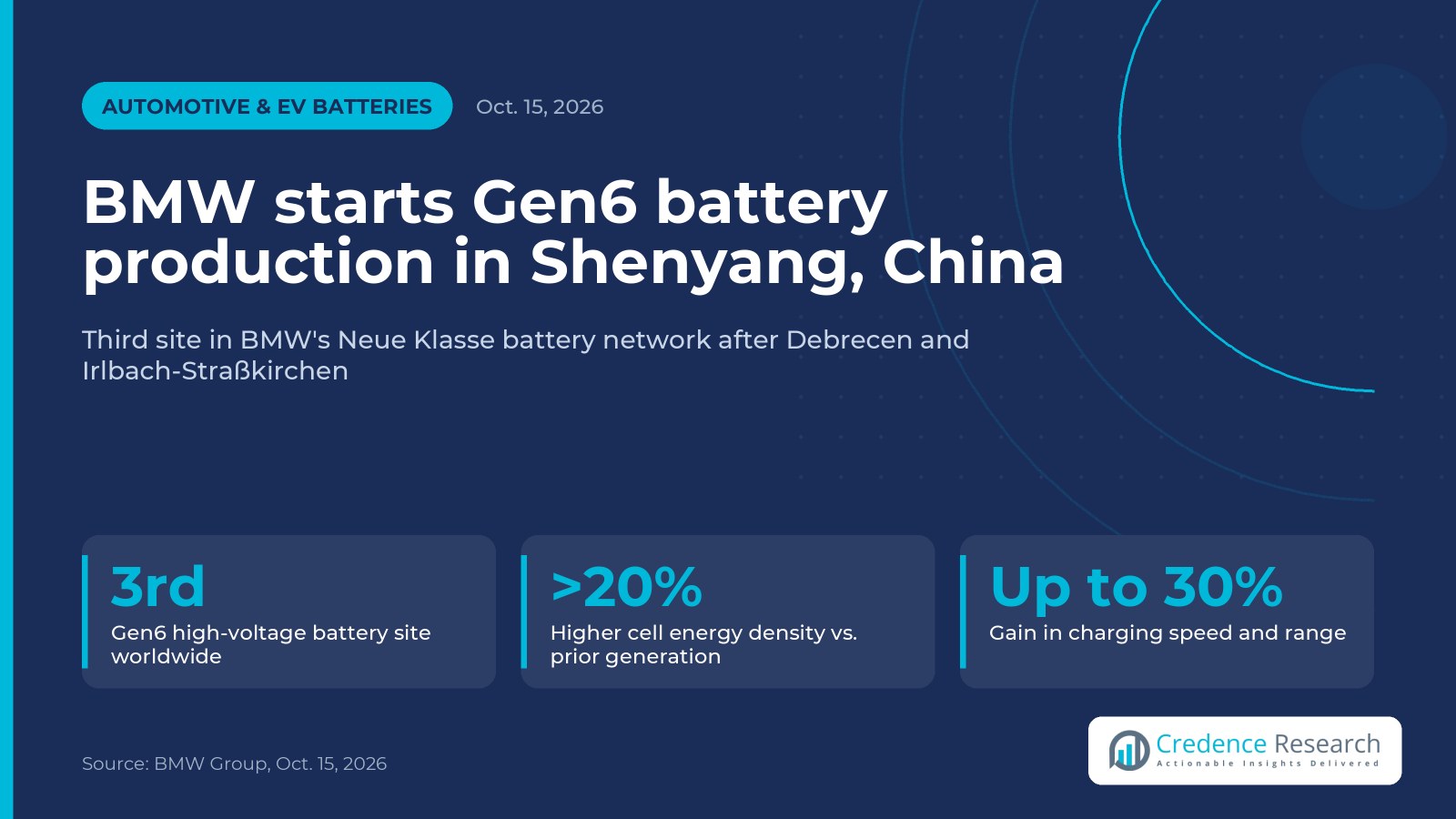
BMW Group has started series production of its sixth-generation high-voltage batteries in Shenyang, China, making the northeastern city the third site in its global network for the packs, the carmaker said Oct. 15, 2026. The batteries will power the all-electric Neue Klasse models that BMW builds in China.
Key developments
- Shenyang follows Debrecen, Hungary, and Irlbach-Straßkirchen, Germany. Battery assembly in Woodruff, South Carolina, and San Luis Potosí, Mexico, is due to begin series production in the coming months.
- The Gen6 packs use new cylindrical cells that BMW says offer more than 20% higher energy density than the previous generation, with charging speed and range each improved by up to 30%.
- The cells sit directly in the battery housing in a cell-to-pack design with no module level, and a BMW-developed control unit called the Energy Master is mounted on the pack to handle power supply and battery management.
- The release does not disclose the investment, production capacity or headcount for the Shenyang battery operation.
Industry background
The Neue Klasse is BMW's dedicated electric vehicle architecture and the basis for its next generation of models. Instead of shipping finished packs between continents, BMW is assembling them next to each vehicle plant from purchased cells. The Shenyang line follows a set process: cells are inspected and combined with cooling units into clusters, laser-cleaned, welded to the contact system, bonded with a foaming process and sealed in the housing before the Energy Master is fitted. Every pack then goes through an end-of-line test.
BMW says the line uses digital twins, data analytics and AI-supported inspection, with inline systems checking laser welds in real time.
Industry implications
Pack assembly is where BMW keeps control of its battery technology even though it does not make cells. The cell-to-pack layout, the cooling design and the Energy Master's software all determine how much usable range and charging speed a car delivers. Building that layer in-house at each major vehicle plant lets BMW apply the same design across regions while sourcing cells locally.
The quality approach matters as much as the hardware. Cylindrical cell packs contain many individual welded connections, so real-time weld monitoring and full end-of-line testing are central to keeping warranty and recall risk in check as volumes rise.
Competitive and supply chain implications
China is the most competitive electric vehicle market in the world. Domestic brands such as BYD, NIO, Xpeng and Li Auto have built their own battery supply chains, and many offer fast charging and long range at lower prices. A locally built premium pack gives BMW a shorter supply chain and lower logistics cost in that market.
BMW has previously named Chinese suppliers CATL and EVE Energy among its large cylindrical cell partners, which places Shenyang close to its cell sources. Local assembly also reduces exposure to shipping disruption and to trade measures on imported battery packs.
Regional implications
Shenyang, in Liaoning province, is home to BMW Brilliance Automotive, BMW's joint venture and its largest production base. The battery line deepens the site's role and adds advanced manufacturing work to a region that has long depended on heavy industry. It also shows BMW continuing to commit production technology to China even as many Western automakers reassess their exposure there.
Credence Research analysis
The start of production is a delivery milestone rather than a new strategy, but it confirms that BMW's regional battery model is moving from plan to practice. With Europe and China now running and two North American sites close behind, BMW will soon assemble Gen6 packs on three continents. The missing figures limit how far outsiders can assess the operation. Without disclosed capacity, the real test will be how quickly Chinese-built Neue Klasse models reach customers and how the packs perform in a market where buyers compare charging speed closely. BMW's performance claims are its own, and independent test data will matter.
What comes next
- Start of series production at Woodruff, South Carolina, and San Luis Potosí, Mexico, in the coming months.
- Launch and delivery timing for the first Neue Klasse models built in China.
- Any disclosure of Shenyang battery capacity or cell sourcing for the China line.
- Independent range and charging test results for Gen6-equipped vehicles.
Sources
About the Author

Senior Research Analyst – Strategic Advisory