
AEP plans $4 billion fuel cell plant in Wyoming to supply Google
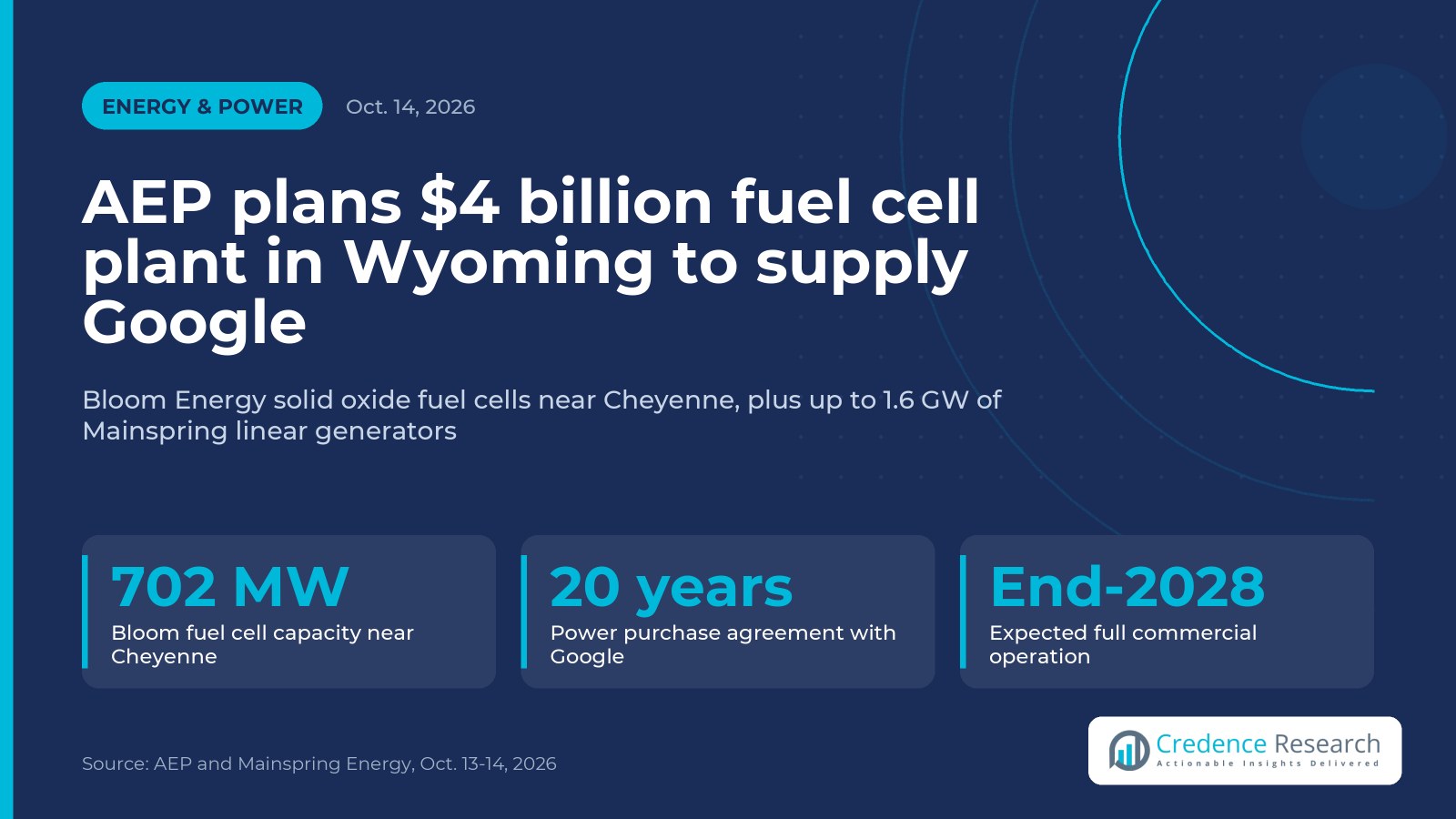
American Electric Power plans to invest about $4 billion in a 702-megawatt fuel cell power plant near Cheyenne, Wyoming, and will sell its entire output to Google under a 20-year power purchase agreement, the Columbus, Ohio-based utility announced Oct. 14, 2026. The plant will run on solid oxide fuel cells supplied by Bloom Energy.
Key developments
- The project company, Cheyenne Fuel Cell LLC, is about 92% owned and controlled by AEP. Funds advised by Basalt Infrastructure Partners own nearly 8%.
- Construction is scheduled to begin in 2026, and AEP expects the plant to be fully operating by the end of 2028.
- Bloom's cells generate electricity through an electrochemical reaction rather than by burning natural gas. AEP plans to add carbon capture to bring the plant's emissions close to zero.
- A day earlier, on Oct. 13, AEP agreed to buy up to 1.6 gigawatts of linear generators from Mainspring Energy through 2034, starting with a 190-megawatt tranche and first deliveries in 2027.
Industry background
Large data center campuses now ask utilities for hundreds of megawatts at a time, often faster than transmission upgrades or new combined-cycle plants can deliver. Orders for large gas turbines face multiyear waits, which has pushed developers and utilities toward modular technologies that can be installed in blocks. Fuel cells fit that profile. They are built in factories, shipped as units and stacked on site.
Google has been lining up supply in the Cheyenne area for some time. AEP noted that the new plant follows Google's agreements with Black Hills Corp., which took effect Sept. 30.
Industry implications
The deal shows a regulated utility building dedicated generation for a single technology customer and recovering the cost through a long-term contract with that customer. That structure can shield other ratepayers from the cost of serving a very large load, an issue state regulators across the country are working through as data center requests grow.
It also changes the scale at which fuel cells are used. The technology has mostly served commercial sites and backup applications. A 702-megawatt installation puts it in the same planning conversation as a mid-size gas plant.
Competitive and supply chain implications
For Bloom Energy, the project is a large reference installation that will test its factory output and installation teams. For turbine makers such as GE Vernova, Siemens Energy and Mitsubishi Power, it is a reminder that long lead times are opening space for alternatives. Reciprocating-engine suppliers, including Wärtsilä and Caterpillar, compete for the same speed-to-power demand, and Mainspring's linear generators now join that field with a gigawatt-scale utility order.
Fuel supply remains the main dependency. The fuel cells avoid combustion but still consume natural gas and produce carbon dioxide until capture is in place, so pipeline capacity into the Cheyenne area matters to the project's reliability.
Regional implications
Wyoming offers natural gas production, open land and a cool climate that suits data centers. Cheyenne has become one of the Mountain West's main data center locations, and a 702-megawatt plant will make it a test case for how the state's utilities and regulators handle large single-customer loads.
Credence Research analysis
The announcement suggests utilities are treating speed of delivery as a product. AEP is offering Google power on a timeline that conventional generation and grid expansion may not match, and it is using two modular technologies at once to do it. The carbon capture plan is the least developed part. Fuel cells keep the fuel stream separate from air, so their exhaust is easier to treat than turbine flue gas, but AEP has not described the capture method, its cost or its schedule. The release also does not list the regulatory approvals the project needs. Until those details appear, the plant should be viewed as reliable gas-based capacity with a decarbonization option rather than as near-zero-emissions power.
What comes next
- Start of construction near Cheyenne, scheduled for 2026.
- Any state regulatory filings tied to the project and its contract structure.
- Details on the carbon capture technology, partner and timeline.
- First Mainspring generator deliveries to AEP in 2027, and the locations where they will be installed.
- Full commercial operation of the fuel cell plant, targeted for the end of 2028.
Sources
About the Author

Senior Industry Consultant