
Lockheed Martin invests $300 million in Texas missile parts plant, adds Hadrian automation cell
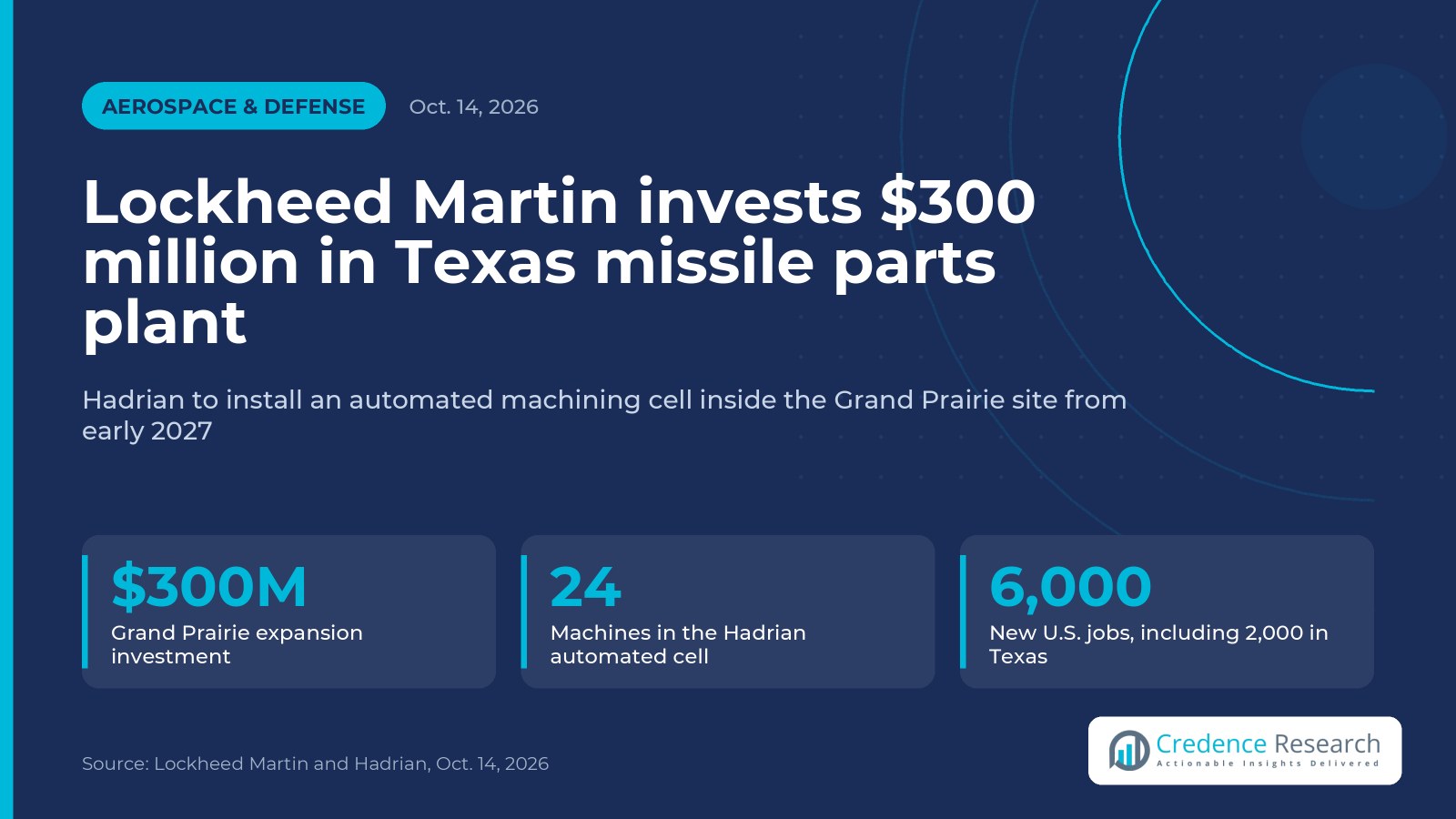
Lockheed Martin is investing $300 million to expand its Missiles and Fire Control manufacturing site in Grand Prairie, Texas, and will bring in an automated machining cell built by startup Hadrian, the company announced Oct. 14, 2026. Lockheed tied the work to 6,000 new jobs across the U.S., including 2,000 in Texas.
Key developments
- The Grand Prairie site will grow to more than 735,000 square feet, with 100,000 square feet of new space and 85,000 square feet of offices converted to advanced manufacturing.
- More than 30 high-precision machines are already installed, and nearly 100 more are expected by the end of 2026.
- Under a seven-year agreement, Hadrian will place a 24-machine automated machining cell inside the plant, run by Lockheed's own workforce. Hadrian said commissioning begins in early 2027, with more cells phased in over the term.
- The expansion is part of a Lockheed plan to invest $8 billion to $9 billion through 2030 to modernize or expand more than 20 U.S. facilities.
Industry background
Grand Prairie is a parts plant rather than a final assembly line. Its nearly 800 production employees made about 250,000 parts in 2025 for all Missiles and Fire Control programs, including the PAC-3 MSE interceptor, THAAD, the Precision Strike Missile and the Joint Advanced Tactical Missile. Those components move to final assembly in Camden, Arkansas, and Troy, Alabama.
Missile production depends on a long chain of machined housings, fins, seeker parts and rocket motors. As the U.S. and allied governments try to rebuild interceptor and long-range strike inventories, that chain, not final assembly, has often set the pace.
Industry implications
The Hadrian agreement introduces a "factory within a factory" model to a prime contractor's plant. An outside automation company designs and installs a production cell, and the prime's employees operate it. The approach aims at two constraints at once: the shortage of skilled machinists and the time it takes to qualify new external suppliers for defense parts. If it works at Grand Prairie, other primes are likely to consider similar arrangements.
Competitive and supply chain implications
The investment strengthens Lockheed's position as Washington pushes for faster munitions output, and it keeps pressure on RTX's Raytheon, its main competitor in air and missile defense interceptors. For traditional tier-two machine shops, the deal is a signal that some high-volume work may shift into automated cells inside prime contractor plants.
Propulsion is the next bottleneck. A day earlier, on Oct. 13, Lockheed signed a cooperation agreement with Italy's Avio to buy solid rocket motors for the Extended Range GMLRS and the Precision Strike Missile from Avio USA's new plant in Hurt, Virginia, once the motors are qualified. Avio says it has committed more than $500 million to new U.S. rocket motor capacity. Together, the two announcements show Lockheed working on both machined parts and motors rather than on assembly capacity alone.
Regional implications
The expansion reinforces a munitions manufacturing corridor that runs from North Texas through Camden, Arkansas, to Troy, Alabama. Hadrian is building out its own footprint in the same direction, with new sites in Arizona and Alabama alongside its two facilities in Torrance, California. Avio's Virginia plant adds an East Coast propulsion source.
Credence Research analysis
The $300 million figure is modest for a company of Lockheed's size. The more telling detail is the Hadrian structure. It shows a prime contractor choosing to bring automation inside its own walls instead of relying only on a wider supplier base that has struggled to scale. That keeps quality control and security in-house while borrowing the speed of a venture-backed manufacturer.
The risk is concentration. Pulling more machining into one site raises the stakes if that site is disrupted, and automated cells still depend on raw material, tooling and inspection capacity. Output data from Grand Prairie in 2027 will show whether the model delivers faster parts flow or simply moves the bottleneck elsewhere in the chain.
What comes next
- Installation of nearly 100 additional machines at Grand Prairie by the end of 2026.
- Commissioning of the first Hadrian cell in early 2027.
- Qualification of Avio USA's solid rocket motors and a start date for production in Virginia.
- Further facility announcements under Lockheed's plan covering more than 20 U.S. sites through 2030.
Sources
About the Author

Senior Industry Consultant