
FDA launches Rare Disease Framework Initiative, plans Oct. 28 public meeting
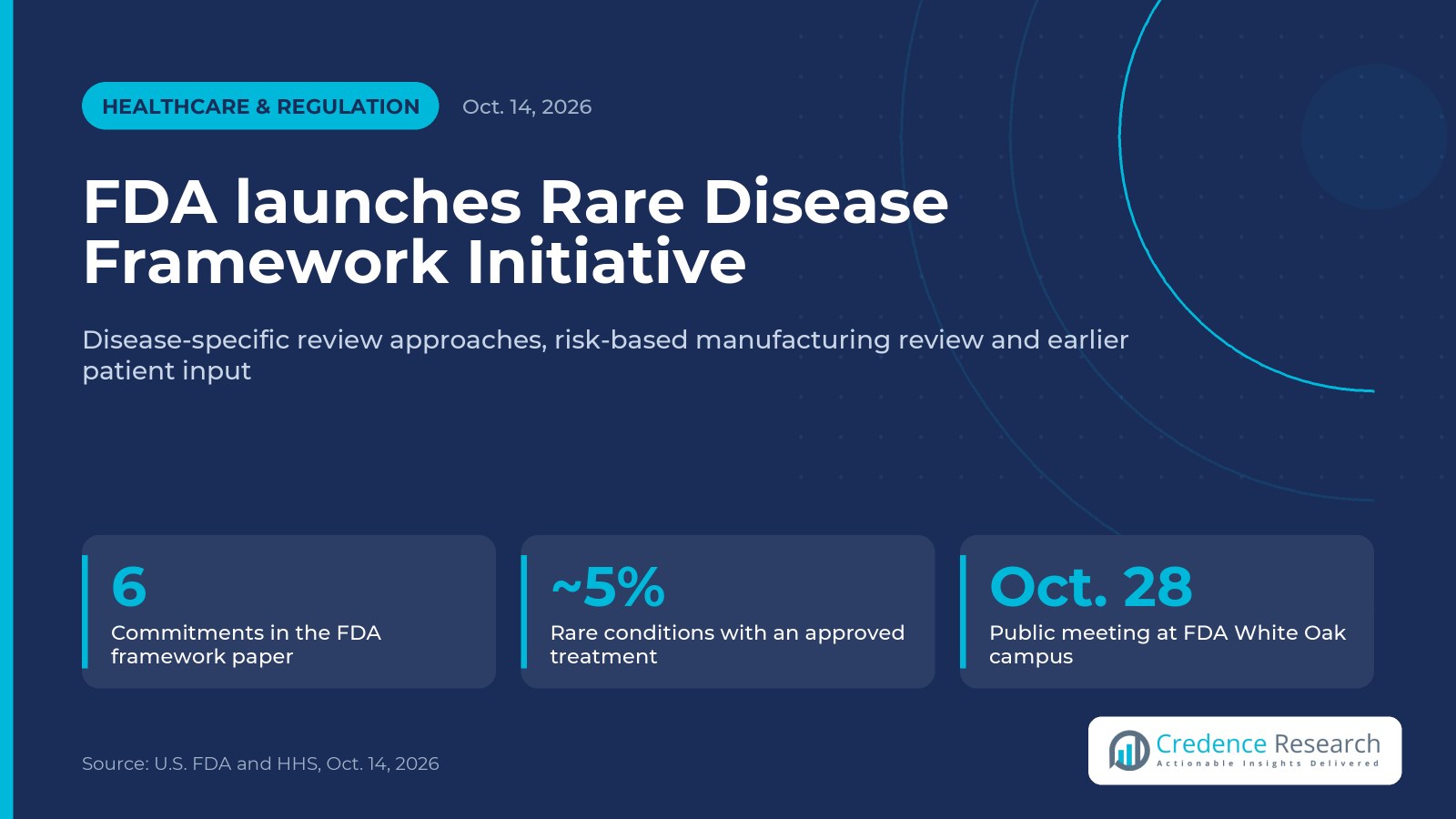
The U.S. Food and Drug Administration launched a Rare Disease Framework Initiative on Oct. 14, 2026, aiming to replace a largely uniform review approach with frameworks fitted to each rare disease, its patients, the product type and the evidence a small population can realistically produce. The agency, based in Silver Spring, Maryland, will hold a public meeting on the effort Oct. 28 at its White Oak campus.
Key developments
- The initiative is led by the FDA's Rare Disease Innovation Hub, working with the Office of the Commissioner, the Center for Drug Evaluation and Research and the Center for Biologics Evaluation and Research.
- An FDA paper titled "A New Framework for Rare Disease Review" sets out six commitments: clearer and more predictable decisions, patient input at defined milestones, wider use of outside experts, shared training and resources, risk-based review of manufacturing and pre-approval inspections, and support for novel trial designs and statistical methods.
- The FDA says only about 5% of rare conditions have an approved treatment.
- The Reagan-Udall Foundation will facilitate the Oct. 28 meeting. Sector roundtables, a request for information and internal feedback sessions will follow, and the outcome could include new guidance, regulatory changes, staff training and organizational changes.
Industry background
Rare disease drug development runs into a basic problem. Many conditions affect too few patients to support large randomized trials, and natural history data are often thin. The FDA already has tools for these cases, including orphan drug incentives, accelerated approval and its 2025 Rare Disease Evidence Principles. Sponsors have long argued, however, that decisions vary between review divisions and that requirements are hard to predict before a filing.
Agency leaders stressed that the statutory standard for safety and effectiveness stays in place. Acting FDA Commissioner Kyle Diamantas framed the effort around consistency and predictability, and Amy Comstock Rick, who directs the Rare Disease Innovation Hub, said the framework should improve predictability for sponsors and patients alike.
Industry implications
The most concrete commitment for industry may be the risk-based approach to chemistry, manufacturing and controls review and pre-approval inspections. Gene and cell therapies, which make up a large share of rare disease pipelines, often face delays tied to manufacturing questions rather than to clinical results. Clearer manufacturing expectations could shorten those delays.
Predictability also has financial value. Small biotech companies raise money milestone by milestone, and investors price regulatory uncertainty into every round. Disease-specific expectations agreed early would make it easier to plan trials and budgets.
Competitive and supply chain implications
Developers with programs near a filing, especially in gene therapy, will watch how quickly the framework turns into guidance. Contract development and manufacturing organizations that produce viral vectors and cell therapies also have a stake, since inspection practices and manufacturing data expectations shape how they design processes for small-batch products.
Regional implications
The initiative is U.S.-specific, but most rare disease sponsors run global programs. If FDA expectations move away from those of the European Medicines Agency and other regulators, companies may face separate evidence packages for different markets. Alignment between agencies will matter for developers outside the United States as much as for those within it.
Credence Research analysis
The initiative is a process launch, not a rule change, and its value depends on what follows. The agency has listed principles but no timeline or specific guidance documents. Sponsors will judge it by whether review divisions apply tailored expectations consistently, not by the language of the paper. The manufacturing commitment is the piece most likely to change outcomes in the near term, because it addresses a common cause of delay without lowering clinical evidence standards. Leadership continuity is a factor to watch, since the effort is being launched under an acting commissioner.
What comes next
- The public meeting at the FDA White Oak campus on Oct. 28, 2026.
- Publication of a request for information and the schedule for sector roundtables.
- Draft guidance documents for specific diseases or product types.
- Signs of the framework in actual review decisions for rare disease filings.
Sources
About the Author

Healthcare & Biotech Analyst