
GlobalFoundries picked to run two Japan-funded 300mm chip fabs in New York
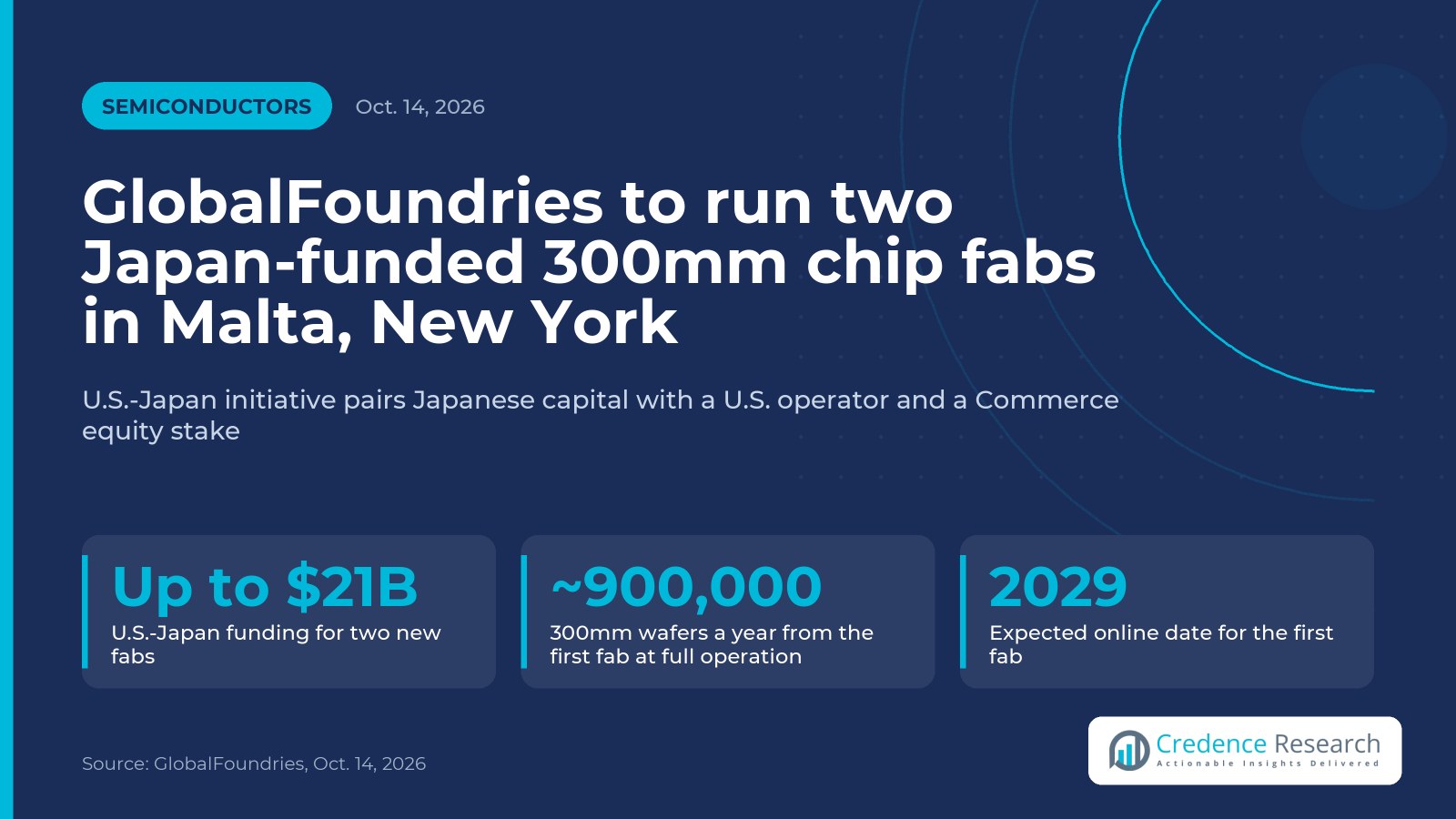
GlobalFoundries will build and operate two new 300-millimeter semiconductor fabs at its campus in Malta, New York, under a U.S.-Japan initiative worth up to $21 billion, the company announced Oct. 14, 2026. Japan is supplying the capital, while GlobalFoundries contributes the process technology, the manufacturing expertise and the day-to-day operation of both plants.
Key developments
- The first fab carries an initial investment of about $10 billion and is expected to come online in 2029. At full operation it would add about 900,000 300mm wafers a year of U.S. capacity.
- A second fab, backed by roughly another $10 billion, is expected to add about the same wafer capacity. The company has not given a start date for it.
- GlobalFoundries agreed with the U.S. Department of Commerce to redirect $955 million of its existing CHIPS and Science Act award toward silicon photonics, silicon-germanium and advanced packaging in Malta and in Burlington, Vermont. Under a separate agreement, Commerce will receive about 4% equity in the company.
- The company expects about 27,000 construction and ecosystem jobs and more than 1,000 high-skilled manufacturing jobs in New York's Capital Region. It plans to break ground on the first fab later in 2026.
Industry background
GlobalFoundries stepped back from leading-edge logic in 2018 and now concentrates on what it calls differentiated technologies. These are radio-frequency, power, mixed-signal and embedded-memory processes that carmakers, industrial firms and network equipment makers design into products for a decade or longer. Such chips rarely make headlines, but shortages of them stalled vehicle assembly lines in 2021 and 2022. The new fabs will sit on permitted land next to the company's existing Fab 8.
The customers quoted alongside the announcement show who the capacity is meant for. General Motors pointed to its direct supply agreement with GlobalFoundries, which the companies describe as the first between an automaker and a foundry. Renesas said it is planning around the New York capacity as an extension of its own production footprint. Apple, Cirrus Logic and toolmaker Tokyo Electron also backed the project.
Industry implications
The financing structure stands apart from the first wave of CHIPS Act projects, which relied on federal grants paid to the operator. Here a foreign government funds the buildout, an American company runs it and Washington holds equity in the operator, as it did with Intel in 2025. If it works, U.S. officials gain a way to add fab capacity without new appropriations.
The CHIPS reallocation points to a second theme, the data center. Silicon photonics and advanced packaging sit at the center of efforts to move data between AI accelerators with light instead of copper, an area where GlobalFoundries competes with TSMC and Tower Semiconductor.
Competitive and supply chain implications
In specialty and mature nodes, GlobalFoundries faces TSMC, UMC and Tower, along with Chinese foundries SMIC and Hua Hong, which have added capacity quickly. Long-term commitments from automotive and industrial buyers would let the Malta fabs compete on supply security rather than on price alone.
Equipment availability is the main supply chain question. ASML said in its third-quarter results, released the same day, that its currently planned supply for 2027 and 2028 will not fully meet customer demand, even with a planned 30% increase in key lithography capacity in 2027. Fabs that break ground in 2026 and 2027 will compete for those tool slots.
Regional implications
The project deepens the Capital Region's semiconductor cluster around Malta and its supplier base. For Japan, it is one of the first large industrial projects to come out of its investment commitments under the trade agreement with the United States, with Japanese firms Tokyo Electron and Renesas already attached.
Credence Research analysis
The announcement matters less for its wafer count than for who controls the capacity and who has asked for it. Statements from GM, Renesas and Apple suggest the fabs are being planned around named demand, which lowers the risk of adding mature-node capacity during a period of price pressure from Chinese foundries.
The open question is economics. The release does not say how returns will be shared with the Japanese funders or what volume and pricing commitments customers have made. Those terms, more than the headline funding, will decide whether the fabs run full once they open.
What comes next
- A groundbreaking date for the first fab, which GlobalFoundries said it will announce separately.
- Details of the funding agreements with Japan and completion of the CHIPS award amendment.
- Further customer agreements tied to the new capacity ahead of the 2029 start-up.
Sources
About the Author

Senior Consultant – ICT & Emerging Technologies