
China proposes export controls on 40 AI, biomedicine and solar technologies
China has proposed adding 40 artificial intelligence, biomedicine and photovoltaic technologies to its catalog of technologies prohibited or restricted from export, and it put an interim registration requirement on those exports into force the same day. The Ministry of Commerce and the Ministry of Science and Technology released the draft revision in Beijing on Oct. 16, 2026, as Announcement No. 48, opening public comment through Nov. 15.
Key developments
- The draft adds 40 technologies to the Catalogue of Technologies Prohibited and Restricted from Export: 23 in artificial intelligence, 12 in photovoltaics and five in biomedicine. Of the 40, 14 are proposed for prohibition and 26 for restriction.
- Exporters of any listed technology must register each transaction before export on the commerce ministry's technology trade platform, starting Oct. 16 and running until the revised catalog takes effect. Exports already under way but not finished are covered.
- Registration applies to transfers of technology ownership abroad, licensing of domestic technology for overseas use, and changes in ownership or actual control of domestic technology to a foreign entity.
- Named examples include proposed bans on perovskite and tandem cell module production technology and on an IP-owned cell and gene therapy process platform, and a proposed restriction on polysilicon engineering technology with single-line capacity of at least 30,000 metric tons a year.
- The ministries said technology already in the public domain through open-source release or academic publication will not be controlled, and that products made with the listed technologies fall outside the scope.
How the export catalog works
The catalog is China's main legal tool for controlling outbound transfers of know-how, as distinct from physical goods. It rests on the Foreign Trade Law and the Regulations on the Administration of Technology Import and Export. Technologies on the prohibited list cannot be exported at all, while restricted technologies need an export license. The catalog was first issued in 2001 and has been revised several times since, most recently in 2025, according to the state-run Global Times.
The new draft groups AI items around large models, AI agents, computing clusters and information processing. The biomedicine items cover pathogenic microorganisms, cell and gene therapy, and small nucleic acid drugs. The photovoltaic items focus on polysilicon, wafer and cell manufacturing, and the ministry said control would also reach a small number of key equipment items that carry the listed processes. Global Times reported that the restricted AI items include design technologies for 2.5D and 3D AI chips and 3D flash memory; that detail does not appear in the ministry's web summary and sits in a draft annex.
A commerce ministry spokesperson said the revision is routine and does not target any specific country, region or entity, citing the export control practices of other major economies as context.
Industry implications
For AI developers, the ministry drew a line between moving model technology out of mainland China and selling access to it. Offering a model through APIs, apps, web interfaces, software-as-a-service or lightweight on-device deployment is not treated as a technology export. Localized deployment of a restricted model overseas is, though deployment on a company's own overseas cloud may qualify for automatic licensing. The ministry said most AI technologies remain freely exportable.
In biomedicine, the timing matters because Chinese biotech companies have become frequent licensors of drug candidates to overseas partners. The ministry said licensing or outsourcing of IP-owned process platforms would not be controlled, and that automatic licensing would apply to licensed exports of IP-owned target discovery technology. Deal teams will still need to check whether a planned out-licensing transaction touches a listed item and file a registration before it closes.
In solar, the list aims at the process know-how and core tools behind China's polysilicon, wafer and cell production base. Perovskite and tandem module production technology sits on the proposed prohibited list, which signals that Beijing views next-generation cell designs as strategic assets rather than mature commodities.
Competitive and supply chain implications
The solar provisions could weigh most directly on supply chains. Manufacturers in the United States, India, Southeast Asia, the Middle East and Europe have looked to Chinese equipment makers and engineering firms to build polysilicon, wafer and cell lines outside China. A restriction on large-scale polysilicon engineering technology and controls on key equipment carrying listed processes would add a licensing step, and possible delays, to those projects.
For AI, the measures add compliance work for Chinese model developers expanding abroad but leave the common commercial route, cloud and API access, untouched. The tiered treatment of large models described by Global Times, with core models trained on sensitive national data at the prohibited end and other important models restricted, gives Beijing a formal lever over cross-border transfers of its most capable systems.
For multinational pharmaceutical companies, the biomedicine section creates a new pre-closing step on China-sourced assets. Because the interim registration is already in force, any licensing or acquisition involving a listed technology now needs a filing before export, even while the final catalog is still being written.
Regional implications
Inside China, the rules fall on technology exporters registered in the mainland, including AI labs, solar manufacturers and biotech companies that have used licensing and overseas expansion as growth channels.
Outside China, the effects are likely to show up first where Chinese solar know-how has been central to new capacity, such as Southeast Asia, the Middle East and emerging U.S. and Indian projects. In the United States and Europe, buyers of Chinese biotech licenses will need to plan for registration and possible licensing on the Chinese side, alongside their own national security reviews.
Credence Research analysis
The draft fits a pattern in which China answers foreign technology controls with its own, aimed at areas where it holds a lead. Solar manufacturing process know-how and fast-moving biotech platforms are two such areas, and the AI items cover the model and agent layer where Chinese developers have gained ground. Choosing to control the transfer of know-how rather than finished products lets Beijing keep exporting solar modules, drugs and AI services while retaining leverage over who can replicate the underlying capability abroad.
The detail of the carve-outs suggests the ministries want to limit damage to commercial deal flow. Automatic licensing for open-source AI, exemptions for API access and allowances for IP-owned platform licensing in biomedicine all point to a targeted regime. The immediate interim registration, however, gives authorities a live view of outbound transactions before the final list is fixed. For overseas buyers, the practical risk is less an outright block than added time and uncertainty on deals and factory projects that depend on Chinese technology.
What comes next
- The public comment period runs from Oct. 16 to Nov. 15, 2026, covering the scope, technical indicators, control policies and facilitation measures.
- Interim pre-export registration applies now and continues until the revised catalog is formally issued and takes effect.
- The ministries will review comments before finalizing the list of prohibited and restricted technologies; no effective date has been set.
- Overseas solar projects using Chinese engineering and equipment, and pending out-licensing deals by Chinese biotech companies, are the transactions most likely to test the new process first.
- The commerce ministry said the catalog will be adjusted over time, with technologies removed as they become less advanced.
Sources
- Ministry of Commerce and Ministry of Science and Technology, Announcement No. 48 of 2026 (Chinese)
- Ministry of Commerce spokesperson remarks on the catalog revision (Chinese)
- Global Times report on the draft revised catalog
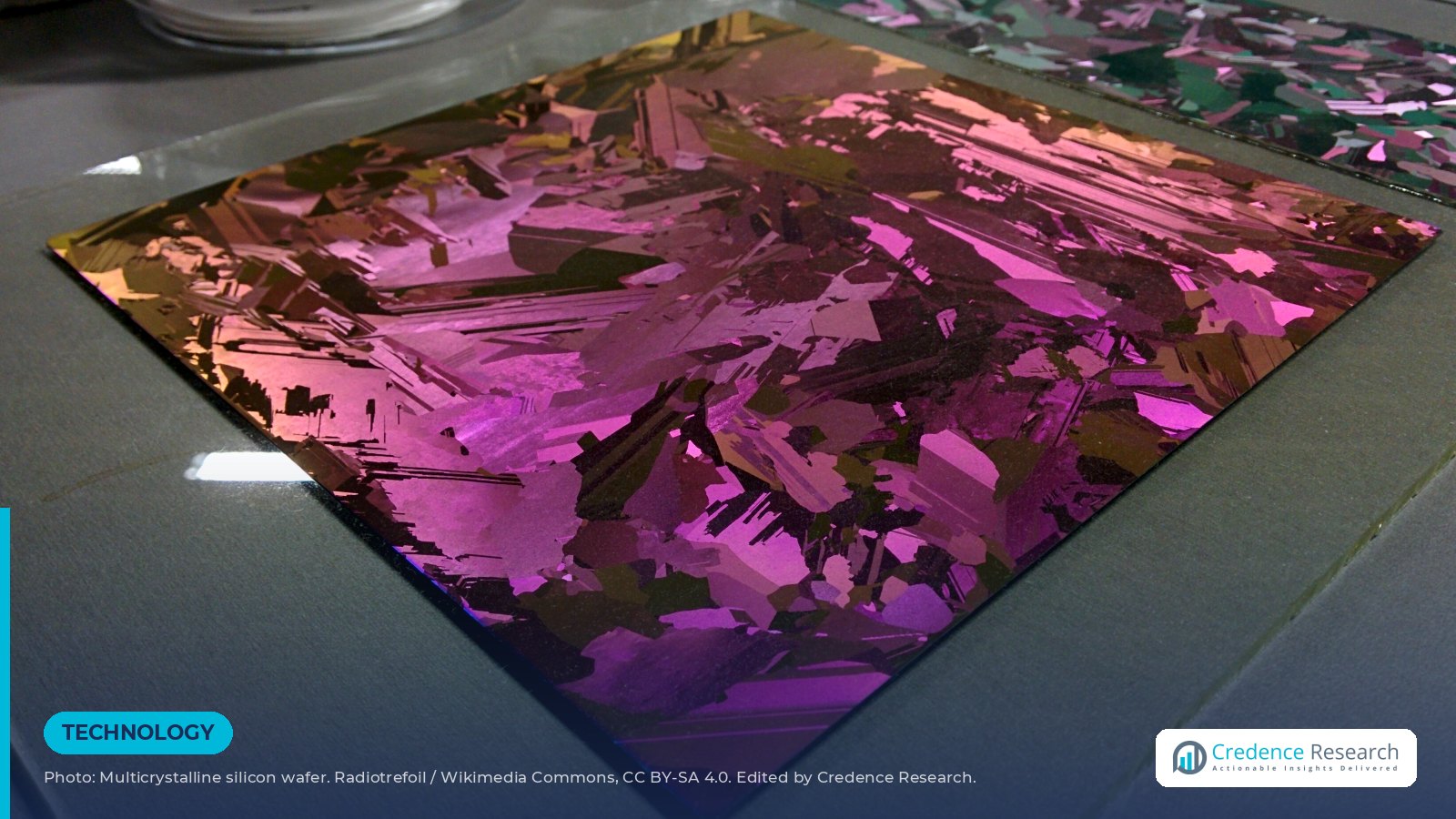
Image: Multicrystalline silicon wafer, by Radiotrefoil via Wikimedia Commons, CC BY-SA 4.0. Cropped and edited by Credence Research.

About the Author

Senior News Editor at Credence Research Inc