
Volvo Cars expands NVIDIA partnership to bring eyes-off automated driving to next-generation cars
Volvo Cars and NVIDIA said on Oct. 15, 2026, that they are expanding their automated driving partnership, with Volvo pairing its in-house vehicle safety systems with NVIDIA's Hyperion sensor and compute architecture, Halos OS and Alpamayo driving software. The Swedish automaker said the technology will debut in a next-generation Volvo car built under its recently announced product push, and that the aim is a system able to drive door to door, from highways and dense city streets to parking, while gradually introducing eyes-off and mind-off driving.
Key developments
- Volvo will combine its safety systems and engineering with three NVIDIA layers: the Hyperion sensor and compute architecture, the Halos OS safety layer and the Alpamayo Stack driving software.
- The first application will be a next-generation Volvo car that forms part of the company's plan for 13 all-new cars by the end of 2030.
- The system is meant to handle highways, busy urban streets and parking, with eyes-off and mind-off functions introduced in stages.
- Neither company disclosed financial terms, the launch model or a start-of-production date.
- The deal extends a collaboration that began in 2017 and already covers the NVIDIA DRIVE Orin computer in the Volvo EX90.
How the technology stack fits together
The announcement moves Volvo from buying NVIDIA chips to adopting much of NVIDIA's full automated driving platform. Hyperion is NVIDIA's reference sensor and compute architecture built on its DRIVE AGX Thor processor. Halos is the company's safety system, which sits beneath the driving software and is designed to keep the vehicle within defined safety limits. Alpamayo, unveiled at CES on Jan. 5, 2026, is an open family of AI models, simulation tools and datasets aimed at the rare "long-tail" situations that rule-based software struggles with.
The first Alpamayo model is a 10-billion-parameter vision language action model that takes video input and outputs a driving trajectory along with a reasoning trace explaining each decision. NVIDIA positions it as a teacher model that automakers fine-tune on their own fleet data and distill into smaller in-car software, validated in its open-source AlpaSim simulator. According to TechCrunch, NVIDIA said the stack runs its AI models alongside classical machine learning software with camera and radar perception to provide redundancy.
Volvo's contribution is its safety engineering and real-world crash and incident knowledge. Chief Executive Håkan Samuelsson said the combination of the brand's safety expertise and NVIDIA's AI creates a unique opportunity to build safer cars. NVIDIA founder and CEO Jensen Huang said accelerated computing has turned the car into an intelligent machine that can understand the world around it.
Industry implications
The move reflects a broader shift among mid-sized automakers away from building complete autonomy software in-house. Developing perception, planning and validation tools at scale requires large training compute, data pipelines and simulation capacity. By standardizing on NVIDIA's reference architecture, Volvo can focus engineering resources on safety validation, vehicle integration and brand-specific behavior while relying on a supplier for the core AI tooling.
The emphasis on eyes-off and mind-off operation also signals a step beyond today's hands-off highway assistance systems. Under an eyes-off system, the vehicle, not the driver, is responsible for monitoring the road within approved conditions. That raises the bar on redundancy, liability and regulatory approval, areas where Volvo's safety reputation is likely to be tested. TechCrunch reported that Volvo's Alwin Bakkenes said the first vehicle with the new system would arrive within the decade and that the software would extend beyond battery-electric models to plug-in hybrids and gasoline cars.
Competitive and supply chain implications
NVIDIA is consolidating its position as a platform supplier for automated driving. When it launched Alpamayo, the chipmaker named Lucid, JLR, Uber and Berkeley DeepDrive as parties interested in using the models for Level 4 development. Volvo's commitment to Hyperion, Halos and Alpamayo together gives NVIDIA another long-term reference customer for its full stack rather than for compute alone. Competitors pursuing eyes-off driving include General Motors, which has targeted 2028 for its first eyes-off system, and Tesla, which develops its driving software internally.
For the supply chain, deeper standardization on one reference design could narrow the field for sensor, compute and software suppliers on future Volvo programs. TechCrunch reported that Volvo plans to standardize more on Hyperion, including its sensor set. That may favor suppliers already qualified within NVIDIA's ecosystem for cameras, radar and related components. It also increases Volvo's dependence on a single chip and software vendor at a time when automakers are weighing how much of the software-defined vehicle to control themselves.
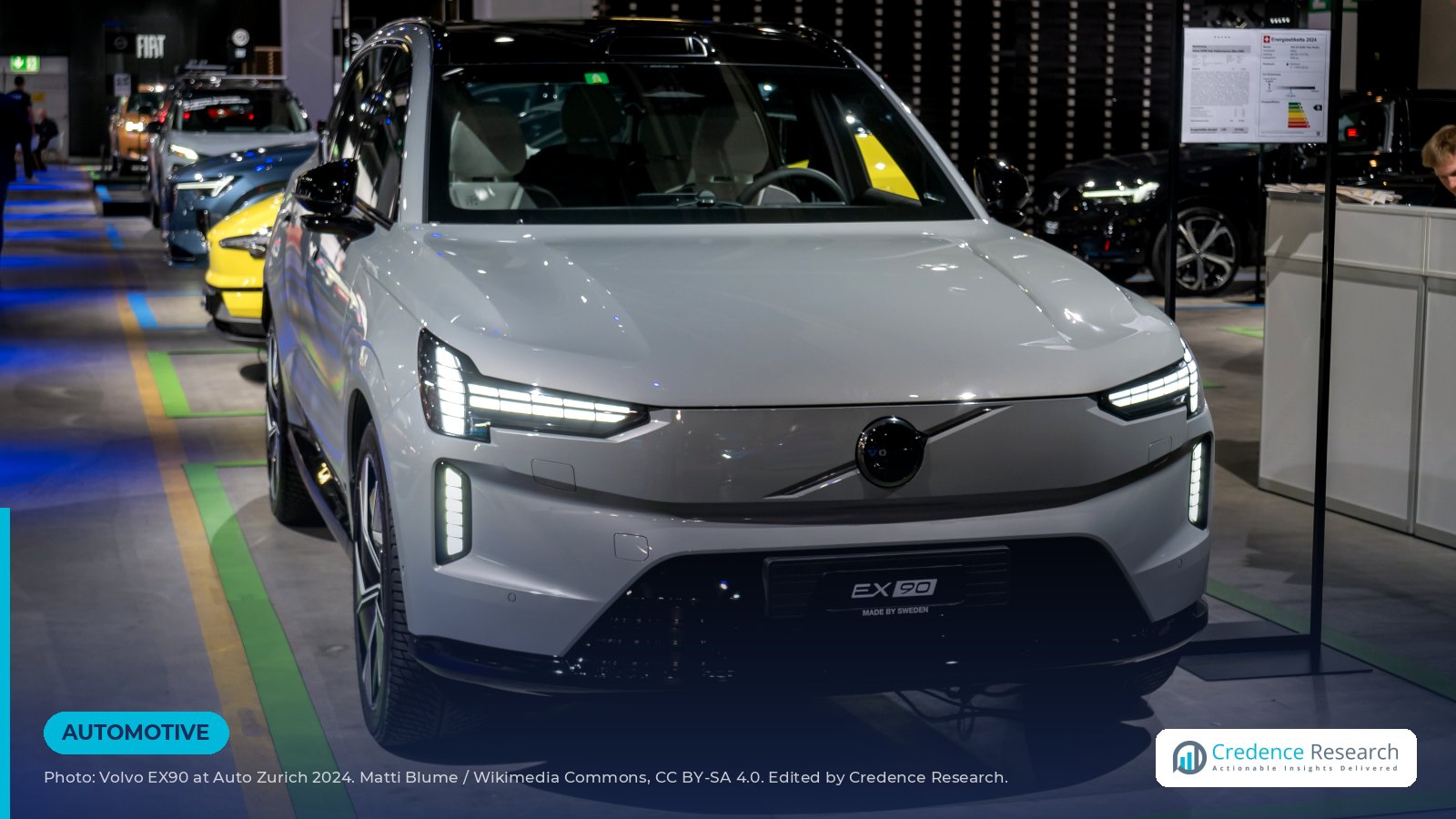
Volvo already uses NVIDIA hardware across its electric range. The EX90's central computer runs on a DRIVE Orin system-on-a-chip rated at more than 250 trillion operations per second, and Volvo said in 2024 that it planned cars built on DRIVE Thor, rated at up to 1,000 trillion operations per second, later this decade. Its software unit Zenseact trains driving models on NVIDIA DGX systems.
Regional implications
Volvo's Sept. 17 product plan splits its 13 new cars into seven for Western markets and six for China. The Western models will be software-defined, run on the company's HuginCore computing platform and use the SPA2 and SPA3 architectures, while China models will draw on a dedicated tech stack developed with parent Geely. The NVIDIA announcement does not say which regions will receive the new automated driving system first, but the Western software-defined lineup is the most direct fit.
Volvo builds cars in Gothenburg, Sweden; Ghent, Belgium; South Carolina; and Chengdu, Daqing and Taizhou in China. Any eyes-off launch will depend on approvals that differ by market. Europe works through United Nations vehicle regulations, while U.S. deployment depends on federal safety standards and a patchwork of state rules. China has its own pilot framework for conditional automation.
Credence Research analysis
The agreement is less about a single feature and more about who owns the intelligence layer in future cars. Volvo is effectively betting that a supplier platform, tuned with its own safety data, will reach eyes-off capability faster and at lower cost than an independent build. That logic fits a company that sold just over 710,000 cars in 2025 and has said it expects technology and manufacturing investment to fall from current levels. The tradeoff is reduced differentiation in core driving software, which places more weight on how Volvo validates and limits the system rather than on the algorithms themselves.
The lack of a named model, timeline or financial terms means the commercial impact cannot yet be measured. The partnership also spans a leadership transition, with Klaus Zellmer due to succeed Samuelsson as CEO no later than Oct. 1, 2027. The main signals to watch are whether Volvo names a launch vehicle and region, how it defines the operating conditions for eyes-off driving, and whether other automakers adopt NVIDIA's full stack rather than its chips alone.
What comes next
- Volvo to identify the first next-generation car that will carry the expanded NVIDIA system.
- Rollout of new models under the 13-car plan through the end of 2030.
- Validation of eyes-off functions and regulatory filings in target markets.
- CEO transition to Klaus Zellmer no later than Oct. 1, 2027.
- Further Alpamayo model releases, which NVIDIA has said will add parameters and commercial use options.
Sources
- Volvo Cars: Volvo Cars and NVIDIA expand partnership to advance safe automated driving
- NVIDIA Newsroom: Volvo Cars and NVIDIA Expand Partnership to Advance Safe Automated Driving
- Volvo Cars: Volvo Cars launches largest-ever product push
- TechCrunch: Volvo makes a bigger bet on Nvidia
Image: Volvo EX90 at Auto Zurich 2024, by Matti Blume via Wikimedia Commons, CC BY-SA 4.0. Cropped and edited by Credence Research.
.jpg)
About the Author

Senior News Editor at Credence Research Inc