
Demand Response Management Systems Market Overview:
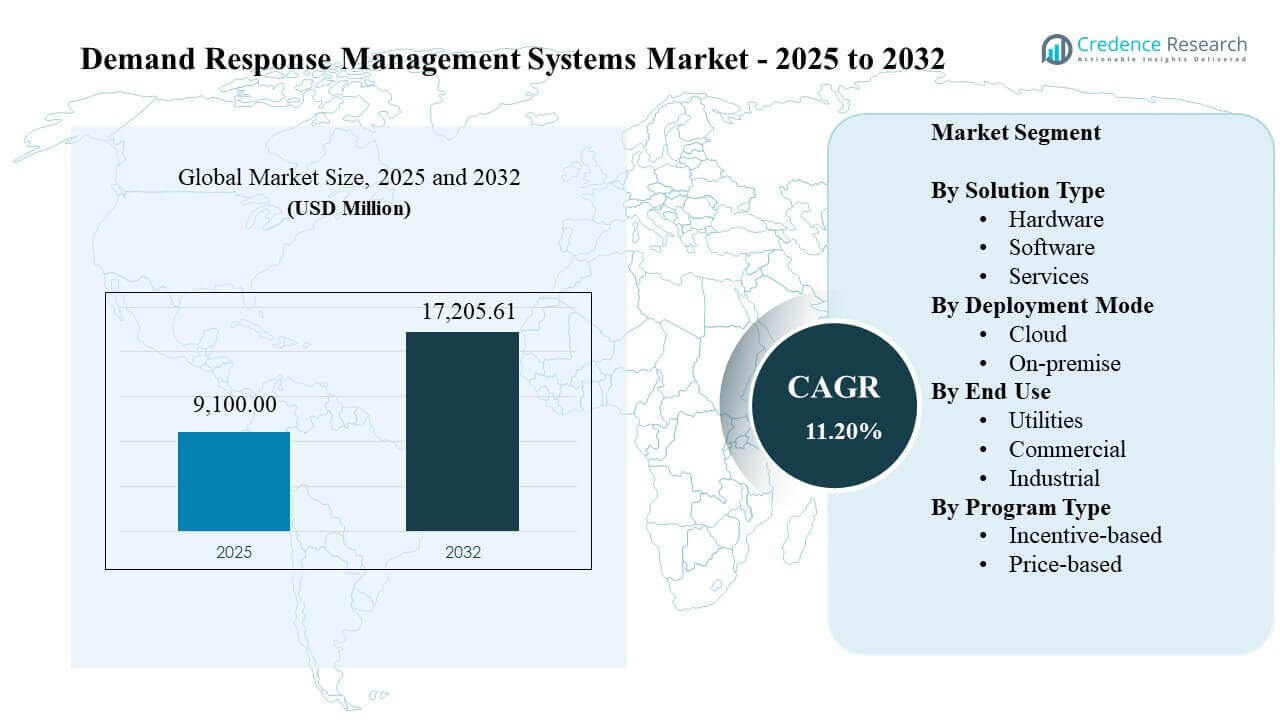
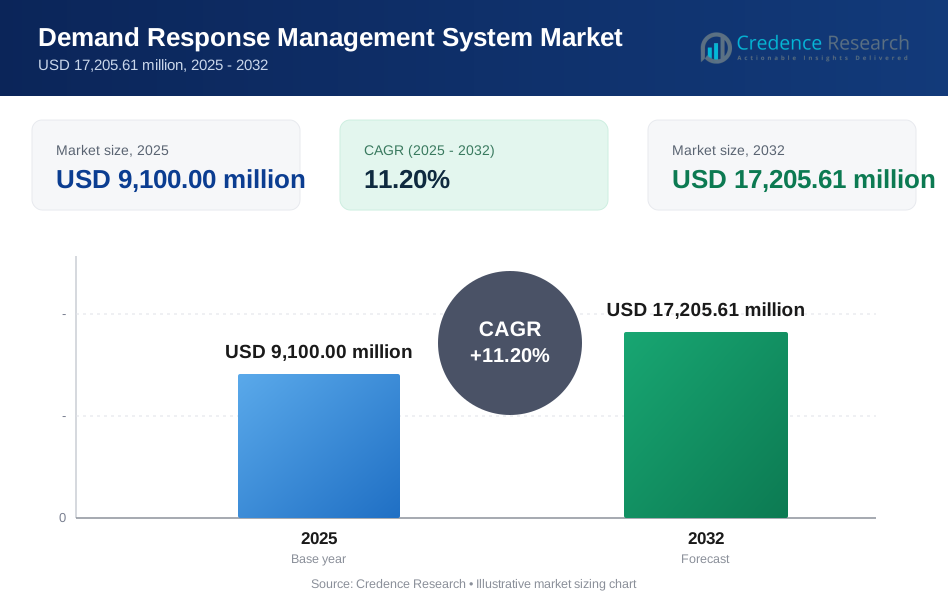
The global Demand Response Management Systems Market size was estimated at USD 9,100.00 million in 2025 and is expected to reach USD 17,205.61 million by 2032, growing at a CAGR of 11.20% from 2025 to 2032. Growth is driven primarily by grid operators and utilities scaling flexible demand as a reliability resource to manage peak loads and rising electrification, especially as variable renewable generation increases balancing needs. North America continues to anchor deployments, but adoption momentum broadens as utilities and large energy users prioritize automation, measurement, and dispatchable load flexibility.
| REPORT ATTRIBUTE | DETAILS |
|---|---|
| Historical Period | 2020-2024 |
| Base Year | 2025 |
| Forecast Period | 2026-2032 |
| Demand Response Management Systems Market Size 2025 | USD 9,100.00 million |
| Demand Response Management Systems Market , CAGR | 11.20% |
| Demand Response Management Systems Market Size 2032 | USD 17,205.61 million |
Key Market Trends & Insights
- North America accounted for 36.7% of revenue in 2025, reflecting early program maturity and broad utility adoption of automated demand response.
- Europe represented 28.4% share in 2025, supported by market liberalization and flexibility procurement in power systems.
- Asia Pacific held 24.1% share in 2025, with growth tied to grid modernization and expanding commercial and industrial participation.
- Software led the market by solution type with 52.6% share in 2025, as orchestration, analytics, and integration layers become central to program performance.
- Cloud deployments led with 59.3% share in 2025, reflecting scalability needs for portfolio aggregation, analytics, and multi-site control.
Segment Analysis
Demand response management systems adoption is expanding as utilities and grid operators treat flexible demand as a dispatchable asset for peak shaving, contingency support, and integration of intermittent generation. Buying decisions increasingly prioritize platforms that can enroll diverse assets, automate event signaling, verify performance, and support settlement-ready reporting across customer classes. Program managers also look for interoperability with metering, distribution operations, and DER systems to reduce operational friction and improve event predictability.
Market growth is reinforced by the shift from manual, notification-driven demand response toward automated, data-driven program execution. Commercial buildings and industrial sites continue to invest in controls and telemetry that improve response accuracy, but utilities remain the central budget holders in many regions because they sponsor incentives and operate program portfolios. As utilities expand beyond curtailment into flexibility and optimization, solution requirements increasingly emphasize analytics, cybersecurity, and integration services.
By Solution Type Insights
Software accounted for the largest share of 52.6% in 2025. Software platforms lead because they unify forecasting, event orchestration, measurement, and performance analytics across diverse portfolios. Utilities and aggregators also rely on software to integrate customer devices, AMI data, and control systems into a single operational layer. Services remain important for program design, integration, and ongoing optimization, but software is the control plane that scales repeatable outcomes across territories.
By Deployment Mode Insights
Cloud accounted for the largest share of 59.3% in 2025. Cloud architectures lead due to faster scaling across customer portfolios and improved ability to run high-frequency analytics for event performance and load forecasting. Cloud deployment also supports multi-utility and multi-territory rollouts with consistent updates and standardized workflows. On-premise systems retain relevance in environments with strict data governance, legacy integration constraints, or conservative utility IT policies, but growth increasingly favors cloud-led modernization.
By End Use Insights
Utilities accounted for the largest share of 41.8% in 2025. Utilities lead because they typically sponsor and administer programs, fund incentives, and require platforms that support enrollment, dispatch, verification, and reporting at scale. Utilities also adopt DRMS to defer capacity investments, manage congestion, and improve reliability under tighter reserve margins. Commercial and industrial users participate as resource providers, but utilities remain the primary buyers of integrated program management capabilities.
By Program Type Insights
Incentive-based programs accounted for the largest share of 57.1% in 2025. Incentive-based structures lead because they provide clearer participation economics and more controllable performance during events, which utilities value for reliability outcomes. These programs align well with automated dispatch and verification, improving predictability and settlement confidence. Price-based programs expand with dynamic tariffs and improved customer analytics, but adoption varies more widely based on market rules and customer readiness.
Demand Response Management Systems Market Drivers
Grid reliability needs and peak demand pressure
Electricity systems face higher peak stress as electrification expands and load profiles become more volatile. Demand response provides a fast, scalable alternative to peaking capacity additions in many markets. DRMS platforms make programs operationally viable by automating event signaling, tracking participation, and measuring verified performance. Utilities also use demand response to manage localized constraints and improve resilience during extreme weather and outage risks. As peak management becomes strategic, DRMS investment rises across planning and operations teams.
- For instance, Florida Power & Light has stated that its On Call direct load control program can reduce up to 2,000 MW by cycling enrolled residential air conditioners, water heaters, and pool pumps, demonstrating how automated demand-side control can support grid reliability during peak conditions.
Renewable integration and flexibility procurement
Higher penetration of wind and solar increases the value of flexible demand that can shift or curtail at short notice. DRMS platforms help translate flexibility goals into executable programs across residential, commercial, and industrial portfolios. Automation improves response consistency, which supports utility confidence in demand-side resources for balancing needs. In regions adopting flexibility markets or grid services procurement, DRMS systems support enrollment, dispatch, and performance reporting. This shift strengthens demand response as a grid resource beyond traditional peak events.
- For instance, Next Kraftwerke reported that its virtual power plant connected more than 14,500 distributed energy units with about 12,000 MW of aggregated capacity, underscoring how software-based orchestration can mobilize flexible resources to balance variable renewable generation.
Digitalization of utility operations and data availability
Utilities continue to modernize metering and distribution systems, improving visibility into load behavior and response potential. DRMS solutions benefit from better interval data, device telemetry, and integration pathways that reduce implementation friction. Software-led platforms can rapidly segment customers, personalize participation, and optimize event strategy based on observed outcomes. The move toward cloud-based operations also accelerates platform adoption and standardization across territories. As data maturity increases, demand response programs expand in scope and sophistication.
Commercial and industrial energy management adoption
Commercial buildings and industrial sites increasingly invest in automation and controls that improve operational efficiency and energy cost performance. DR participation becomes easier when building management systems and industrial control systems can integrate directly with event signals and verification workflows. DRMS platforms support portfolio aggregation across sites, which is important for multi-facility operators. Incentive payments and avoided peak charges strengthen participation economics in many markets. This broadens the addressable base for managed flexibility.
Demand Response Management Systems Market Challenges
Demand response outcomes depend on predictable customer participation, but load behavior can be variable across seasons, operating schedules, and business cycles. Program performance also becomes harder to manage as portfolios diversify across devices, customer types, and DER combinations. Implementation complexity rises when utilities must integrate DRMS with metering, distribution operations, billing, and customer engagement systems. These integration needs can extend deployment timelines and increase total cost of ownership. As a result, procurement cycles can be longer than typical enterprise software buying.
- For instance, Honeywell’s automated demand response deployment in California enrolled 61 customers across 282 sites and enabled 49.8 MW of curtailable load, while the company also reported that about 90% of targeted customers lacked an operating EMS controlling connected equipment and therefore required installation or upgrade support, with implementation costs at about $400 per kW of curtailable load.
Regulatory and market-rule variability remains a major constraint, particularly for price-based participation and cross-territory scalability. Some regions have limited mechanisms to value flexibility, creating weaker incentives for program expansion. Cybersecurity requirements also intensify as automated dispatch and device connectivity increase operational risk exposure. Utilities and large C&I customers may require rigorous testing, auditing, and access controls that slow rollouts. In markets with legacy infrastructure, insufficient telemetry and controls can reduce verified performance.
Demand Response Management Systems Market Trends and Opportunities
Utilities are shifting from event-only programs toward continuous flexibility optimization, creating demand for platforms that can manage more frequent dispatch and more granular measurement. Cloud-first DRMS deployments are also growing, supported by improved scalability and more consistent software updates across territories. Another trend is the tighter coupling of DRMS with DER orchestration, enabling coordinated operation of demand response, storage, and distributed generation. This convergence increases the value of platforms that support interoperability and standardized data models. Vendors that simplify integration and verification can improve adoption.
- For instance, AutoGrid reported that AutoGrid Flex had more than 2,000 MW of DERs under contract with more than 25 global energy companies, and the same platform was deployed for TotalEnergies’ 25 MW/25 MWh battery project in France, where it enables grid support in less than 500 milliseconds.
Opportunity expands as program managers seek better customer engagement, targeting, and personalization to increase participation and reduce dropout. Advanced analytics and automation can improve event success rates by optimizing which customers receive signals and when. Commercial aggregation and multi-site participation models also broaden the market as enterprises seek consolidated reporting and incentive capture. As grid operators focus on resilience, demand response portfolios that can respond quickly to contingencies gain importance. This supports expansion into new use cases beyond traditional peak shaving.
Regional Insights
North America
North America led the market with 36.7% share in 2025, supported by mature demand response program structures, strong utility adoption, and larger addressable portfolios across residential and C&I customers. Program operators prioritize automation, measurement, and predictable dispatch to improve reliability outcomes. Broader platform deployments also benefit from higher penetration of smart meters and building controls in many service territories. Utility modernization investments continue to reinforce adoption of software-led DRMS systems.
Europe
Europe captured 28.4% share in 2025, reflecting growing focus on flexibility procurement as power systems integrate higher shares of variable renewable generation. Market and regulatory structures support demand-side participation in many countries, which encourages platform investment and program expansion. Utilities and aggregators emphasize verification and settlement-ready reporting to meet market participation requirements. Integration with broader grid digitalization initiatives strengthens the role of DRMS in operational planning and balancing.
Asia Pacific
Asia Pacific accounted for 24.1% share in 2025, driven by grid modernization, urbanization-related load growth, and expanding adoption of commercial building automation. Utilities and system operators increasingly explore flexibility tools to manage peak demand and improve system reliability. The region also benefits from large industrial bases that can provide meaningful curtailment or shifting capacity when incentives and controls align. Adoption pace varies by market maturity, but investment in scalable platforms supports growth.
Latin America
Latin America represented 6.5% share in 2025, supported by selective adoption in larger power markets and early-stage program development focused on reliability and peak management. Commercial and industrial participation can be a strong entry point where tariffs, capacity constraints, or reliability needs create clear economics. Utilities and regulators continue to evaluate program structures, which shapes the pace of broader rollouts. Growth opportunities improve as metering, control infrastructure, and program rules become more standardized.
Middle East & Africa
The Middle East & Africa held 4.3% share in 2025, reflecting uneven program maturity and variable rollout of enabling infrastructure across countries. Adoption tends to concentrate where utilities pursue modernization programs and where large commercial and industrial sites can deliver measurable flexibility. Market structure differences and data availability constraints can slow scaling of advanced DRMS deployments. As grid modernization progresses, platform adoption is positioned to expand, especially for high-demand urban centers and industrial zones.
Competitive Landscape
Competition is shaped by vendors positioning DRMS within broader utility grid modernization, DER orchestration, and enterprise energy management portfolios. Differentiation centers on automation quality, verification rigor, interoperability with utility systems, cybersecurity posture, and the ability to scale portfolios across customer classes. Providers also compete on implementation capability, program design support, and long-term optimization services that improve event success rates. Platform vendors increasingly emphasize cloud deployment and analytics to support higher-frequency dispatch and more granular reporting.
Schneider Electric competes by integrating demand flexibility capabilities with broader energy management and grid digitalization portfolios that span commercial buildings, industrial facilities, and utility solutions. The company’s approach benefits from cross-domain expertise in controls, software, and services, which supports end-to-end deployment and ongoing optimization. Schneider Electric’s positioning also aligns with buyers seeking coordinated strategies across demand-side efficiency, flexibility, and operational resilience. This integrated stance can be attractive to utilities and large enterprises consolidating energy platforms.
The industry research and growth report includes detailed analyses of the competitive landscape of the market and information about key companies, including:
- Schneider Electric
- Siemens
- ABB
- Eaton
- Honeywell
- Oracle
- IBM
- Enel X
- AutoGrid
- Johnson Controls
Qualitative and quantitative analysis of companies has been conducted to help clients understand the wider business environment as well as the strengths and weaknesses of key industry players. Data is qualitatively analyzed to categorize companies as pure play, category-focused, industry-focused, and diversified; it is quantitatively analyzed to categorize companies as dominant, leading, strong, tentative, and weak.
Recent Developments
- In December 2025, EnergyHub announced the acquisition of Resideo Grid Services’ demand response business, a move aimed at expanding its grid-edge flexibility and DERMS capabilities for utility customers.
- In March 2025, Bidgely acquired Grid4C to strengthen its AI-powered energy analytics platform, adding capabilities such as predictive load forecasting, fault detection, and improved demand response optimization for utilities.
- In May 2024, Honeywell entered into a partnership with Enel North America to enhance building automation and demand response solutions for commercial and industrial organizations through automated energy load control.
- In May 2024, Siemens launched Gridscale X, a modular grid software platform designed to improve DER visibility, increase grid flexibility, and support more advanced demand response-style grid management.
Report Scope
| Report Attribute | Details |
| Market size value in 2025 | USD 9,100.00 million |
| Revenue forecast in 2032 | USD 17,205.61 million |
| Growth rate (CAGR) | 11.20% (2025–2032) |
| Base year | 2025 |
| Forecast period | 2026–2032 |
| Quantitative units | USD million |
| Segments covered | Solution Type Outlook: Hardware, Software, Services; Deployment Mode Outlook: Cloud, On-premise; End Use Outlook: Utilities, Commercial, Industrial; Program Type Outlook: Incentive-based, Price-based |
| Regional scope | North America, Europe, Asia Pacific, Latin America, Middle East & Africa |
| Key companies profiled | Schneider Electric; Siemens; ABB; Eaton; Honeywell; Oracle; IBM; Enel X; AutoGrid; Johnson Controls |
| No. of Pages | 334 |
Segmentation
By Solution Type
- Hardware
- Software
- Services
By Deployment Mode
- Cloud
- On-premise
By End Use
- Utilities
- Commercial
- Industrial
By Program Type
- Incentive-based
- Price-based
By Region
- North America
- U.S.
- Canada
- Mexico
- Europe
- Germany
- France
- U.K.
- Italy
- Spain
- Rest of Europe
- Asia Pacific
- China
- Japan
- India
- South Korea
- South-east Asia
- Rest of Asia Pacific
- Latin America
- Brazil
- Argentina
- Rest of Latin America
- Middle East & Africa
- GCC Countries
- South Africa
- Rest of the Middle East and Africa
Request a Free Sample
Fill in your details and we'll send you a free sample report.
- Sample data tables & charts
- Research methodology
Need a Custom Version of This Report?
Tailor the scope, geography, or segments to your exact requirements.
- Custom geography or segment scope
- Direct access to our analyst team
Frequently Asked Questions
What is the market size of the Demand Response Management Systems Market in 2025 and its forecast for 2032?
What is the CAGR for the Demand Response Management Systems Market during 2025–2032?
Which segment holds the largest share in the market?
What factors are driving growth in the Demand Response Management Systems Market?
Who are the key companies in the Demand Response Management Systems Market?
Which region leads the Demand Response Management Systems Market?
Table of Content
Chapter 1. Report Introduction
- 1.1 Report Description & Purpose
- 1.1.1 Report Title & Market Definition
- 1.1.2 Unique Selling Propositions (USP) & Key Differentiators
- 1.1.3 Value Proposition for Stakeholders
- 1.2 Research Objectives
- 1.2.1 Market Sizing Objectives (Volume & Revenue)
- 1.2.2 Segmentation Objectives
- 1.2.3 Competitive Intelligence Objectives
- 1.2.4 Forecast & Scenario Objectives
- 1.3 Report Scope
- 1.3.1 Demand Response Management System Scope – Types & Subtypes Covered
- 1.3.2 Geographic Scope – Regions & Countries Covered
- 1.3.3 Historical Period, Base Year & Forecast Period (2025; forecast to 2032)
- 1.3.4 Inclusions & Exclusions
- 1.4 HS Code & Classification Framework
- 1.5 Currency, Units & Pricing Basis
- 1.6 Target Stakeholders
- 1.7 Limitations & Assumptions
Chapter 2. Executive Summary
- 2.1 Global Demand Response Management System Market Snapshot
- 2.1.1 Market Size – Historical (2025) & Forecast (2025-2032) (2025: USD 9,100.00 million → 2032: USD 17,205.61 million)
- 2.1.2 Volume & Revenue – Global Totals
- 2.1.3 Key Market Highlights – Top Five Facts
- 2.2 Demand Response Management System Market Segmentation Snapshot
- 2.2.1 Market Split by Region – 2025 vs. 2032
- 2.3 Competitive Snapshot
- 2.3.1 Top 10 Players by Revenue Share – 2025
- 2.3.2 Top 10 Players by Volume Share – 2025
- 2.3.3 Recent Strategic Developments (18-Month Summary)
- 2.4 Key Investment Highlights & Strategic Conclusions
Chapter 3. Demand Response Management System Market Dynamics & Industry Analysis
- 3.1 Market Overview & Context
- 3.1.1 Demand Response Management System Market Position in the Broader Automotive Value Chain
- 3.1.2 OEM vs. Replacement Market Dynamics
- 3.1.3 Market Maturity & Development Stage by Region
- 3.2 Demand Response Management System Market Drivers
- 3.3 Demand Response Management System Market Restraints & Challenges
- 3.4 Demand Response Management System Market Opportunities
- 3.5 Porter's Five Forces Analysis
- 3.5.1 Threat of New Entrants
- 3.5.2 Bargaining Power of Suppliers
- 3.5.3 Bargaining Power of Buyers
- 3.5.4 Threat of Substitutes
- 3.5.5 Competitive Rivalry – Intensity Assessment
- 3.6 Demand Response Management System Value Chain Analysis
- 3.6.1 Upstream – Raw Material/Input Suppliers
- 3.6.1.1 Raw Material/Input 1
- 3.6.1.2 Raw Material/Input 2
- 3.6.1.3 Raw Material/Input 3
- 3.6.2 Midstream – Production/Manufacturing/Service Delivery
- 3.6.2.1 Production/Process Overview
- 3.6.2.2 Key Facility Locations & Capacity by Manufacturer
- 3.6.3 Downstream – Distribution & End Consumer
- 3.6.3.1 Primary Channel – B2B/OEM
- 3.6.3.2 Secondary Channels – Dealer, Retail, Online, Direct
- 3.6.4 Value Chain Profitability Analysis
- 3.6.1 Upstream – Raw Material/Input Suppliers
- 3.7 PESTEL Analysis
- 3.7.1 Political Factors
- 3.7.2 Economic Factors
- 3.7.3 Social Factors
- 3.7.4 Technological Factors
- 3.7.5 Environmental Factors
- 3.7.6 Legal Factors
- 3.8 Demand Response Management System Supply Chain Analysis
- 3.8.1 Raw Material/Input Supply Risk Assessment
- 3.8.2 Manufacturing Concentration Risk (Geographic Exposure)
- 3.8.3 Trade Disruption Impact Analysis
- 3.9 Regulatory & Policy Landscape
Note: The regulatory and policy landscape section covers regulations based on their applicability to the market, Demand Response Management System category, geography, and scope of the study. Only regulatory frameworks with a material impact on operations, compliance, trade, sustainability, or market access are analyzed in detail.
Chapter 4. Key Investment Pockets & Opportunity Analysis
- 4.1 Demand Response Management System Market Attractiveness Analysis
- 4.1.1 By Region – Investment Attractiveness Matrix (Volume × CAGR)
- 4.2 Absolute Revenue Growth Opportunity
- 4.2.1 By Region – Absolute USD Growth Through 2032
- 4.3 Incremental Volume Opportunity
- 4.3.1 By Region – Incremental Volume Through 2032
- 4.3.2 Segment – Incremental Volume
- 4.4 Emerging Submarket Opportunity Deep Dive (Subject to Applicability)
- 4.5 Emerging Market Opportunity Scorecards
- 4.5.1 United States
- 4.5.2 Europe
- 4.5.3 Asia
- 4.5.4 Middle East & Africa
Note: Emerging Market Opportunity Scorecards will be included based on relevance and strategic importance. Regions listed are indicative and may vary depending on data availability and market dynamics.
Chapter 5. Demand Response Management System Import-Export Analysis & Trade Flows
- 5.1 Global Trade Overview
- 5.1.1 Global Export Value by Country (2025)
- 5.1.2 Global Export Volume by Country (2025)
- 5.1.3 Global Import Value by Country (2025)
- 5.1.4 Global Import Volume by Country (2025)
- 5.1.5 Net Trade Balance by Country (2025)
- 5.2 Export Analysis – Segment
- 5.2.1 Type 1 (HS Code)
- 5.2.2 Type 2 (HS Code)
- 5.2.3 Type 3 (HS Code)
- 5.2.4 Type 4 (HS Code)
- 5.2.5 Type 5 (HS Code)
- 5.3 Import Analysis – Segment
- 5.3.1 Type 1 (HS Code)
- 5.3.2 Type 2 (HS Code)
- 5.3.3 Type 3 (HS Code)
- 5.3.4 Type 4 (HS Code)
- 5.3.5 Type 5 (HS Code)
- 5.4 Average Unit Trade Prices
- 5.4.1 Average Export Price – Segment & Country
- 5.4.2 Average Import Price – Segment & Source Country
- 5.4.3 Price Trends (2025)
- 5.5 Key Trade Route Analysis
- 5.5.1 Trade Route 1
- 5.5.2 Trade Route 2
- 5.5.3 Trade Route 3
- 5.5.4 Trade Route 4
- 5.5.5 Trade Route 5
- 5.6 Trade Policy Impact Assessment
- 5.6.1 US Anti-Dumping & Section 301 Tariffs
- 5.6.2 EU Customs Union Impact
- 5.6.3 Major Free Trade Agreements
- 5.6.4 USMCA Rules of Origin
Note: Trade policy analysis will be included only where relevant to the Demand Response Management System market.
Chapter 6. Competitive Landscape & Company Benchmarking
- 6.1 Demand Response Management System Market Concentration & Structure
- 6.1.1 Herfindahl-Hirschman Index (HHI) – vs. 2025
- 6.1.2 Tier 1, Tier 2 & Tier 3 Market Structure
- 6.1.3 Global, Regional & Local Player Dynamics
- 6.2 Demand Response Management System Market Share Analysis – 2025
- 6.2.1 Global Revenue Share by Company
- 6.2.2 Global Volume Share by Company
- 6.2.3 Regional Revenue Share
- 6.2.4 Market Share Evolution ( vs. 2025)
- 6.2.5 OEM Segment Share by Company
- 6.2.6 Replacement Segment Share by Company
- 6.3 Production/Delivery Capacity & Facility Analysis
- 6.3.1 Global Installed Capacity
- 6.3.2 Capacity Utilization Rates
- 6.3.3 Production/Output Volume
- 6.3.4 Facility Locations & Capacity Map
- 6.3.5 Planned Capacity Additions
- 6.4 Demand Response Management System Competitive Benchmarking Matrix
- 6.4.1 Revenue, Volume, CAGR & Profitability Comparison
- 6.4.2 Channel Revenue Mix
- 6.4.3 Geographic Revenue Exposure
- 6.4.4 R&D Intensity
- 6.4.5 Sustainability Maturity
- 6.5 Strategic Developments in Demand Response Management System (Last 24 Months)
- 6.5.1 Mergers, Acquisitions & Divestments
- 6.5.2 New Demand Response Management System Launches
- 6.5.3 Facility Expansions
- 6.5.4 Strategic Alliances, Joint Ventures & Partnerships
- 6.5.5 Distribution Expansion & Market Entry
- 6.5.6 Sustainability & ESG Initiatives
- 6.6 Competitive Strategy Mapping
- 6.6.1 Leader, Challenger, Follower & Niche Classification
- 6.6.2 Pricing Strategy Comparison
- 6.6.3 Channel Strategy Matrix
Note: Strategic developments are included based on their materiality and the availability of reliable information.
Chapter 7. Global Demand Response Management System Market – By Distribution Channel
- 7.1 Segment Overview
- 7.1.1 Volume & Revenue Split by Channel (2025 & 2032)
- 7.1.2 Channel Mix Evolution (2025-2032)
Chapter 8. Regional Market Analysis – Global Overview
- 8.1 Global Regional Overview
- 8.1.1 Regional Volume Share
- 8.1.2 Regional Revenue Share
- 8.1.3 Regional Volume by Region
- 8.1.4 Regional Revenue by Region
- 8.1.5 Regional Forecast Through 2032
- 8.2 Cross-Regional Segment Analysis
- 8.2.1 By Distribution Channel
- 8.2.2 By Brand/Price Tier
Chapter 9. North America Demand Response Management System Market
- 9.1 United States
- 9.2 Canada
- 9.3 Mexico
Chapter 10. Europe Demand Response Management System Market
- 10.1 Germany
- 10.2 France
- 10.3 Italy
- 10.4 United Kingdom
- 10.5 Spain
- 10.6 Poland
- 10.7 Russia
- 10.8 Netherlands
- 10.9 Belgium
- 10.10 Sweden
- 10.11 Denmark
- 10.12 Norway
- 10.13 Rest of Europe
Chapter 11. Asia Pacific Demand Response Management System Market
- 11.1 China
- 11.2 India
- 11.3 Japan
- 11.4 South Korea
- 11.5 Thailand
- 11.6 Indonesia
- 11.7 Vietnam
- 11.8 Malaysia
- 11.9 Australia
- 11.10 Rest of Asia Pacific
Chapter 12. Latin America Demand Response Management System Market
- 12.1 Brazil
- 12.2 Argentina
- 12.3 Colombia
- 12.4 Chile
- 12.5 Rest of Latin America
Chapter 13. Middle East Demand Response Management System Market
- 13.1 Saudi Arabia
- 13.2 United Arab Emirates
- 13.3 Turkey
- 13.4 Israel
- 13.5 Iran
- 13.6 Rest of the Middle East
Chapter 14. Africa Demand Response Management System Market
- 14.1 South Africa
- 14.2 Egypt
- 14.3 Nigeria
- 14.4 Morocco
- 14.5 Rest of Africa
Chapter 15. Demand Response Management System Company Profiles
- 15.1 [Company 01]
- 15.1.1 Company Overview
- 15.1.2 Key Management Personnel
- 15.1.3 Products & Services Portfolio
- 15.1.4 Financial Performance
- 15.1.5 Key Market Focus & Geographic Presence
- 15.1.6 Recent Developments & Strategic Initiatives
Note: The company profile list is preliminary and may change based on research findings, market developments, data availability, and client requirements.
Chapter 16. Appendices
- Appendix A – List of Abbreviations & Acronyms
- Appendix B – Industry Classification Code Reference – Full Series
- Appendix C – Production & Capacity Data Tables
- Appendix D – End-Use & Demand Base Tables
- Appendix E – Consumption & Replacement Rate Assumptions
- Appendix F – ASP Reference Tables
- Appendix G – Manufacturing & Facility Database
- Appendix H – Import-Export Data Tables
- Appendix I – Regulatory Summary Tables
- Appendix J – Primary Research Participant List (Anonymized)
- Appendix K – Primary Research Questionnaire Framework
- Appendix L – Data Sources & Bibliography
- Appendix M – Market Size Divergence & Source Comparison
Chapter 17. Research Methodology
- 17.1 Research Framework & Philosophy
- 17.2 Secondary Research – Sources, Hierarchy & Data Extraction
- 17.3 Data Modeling – Bottom-Up & Top-Down Market Sizing
- 17.4 Primary Research – Stakeholder Framework, LOI & Sample Sizes
- 17.5 Forecast Methodology – Regression, Scenario & Sensitivity Analysis
- 17.6 Quality Control – Four-Layer Validation Framework
- 17.7 Limitations & Standard Assumptions
- 17.8 Disclaimer
