Acute Agitation and Aggression Treatment Market Overview:
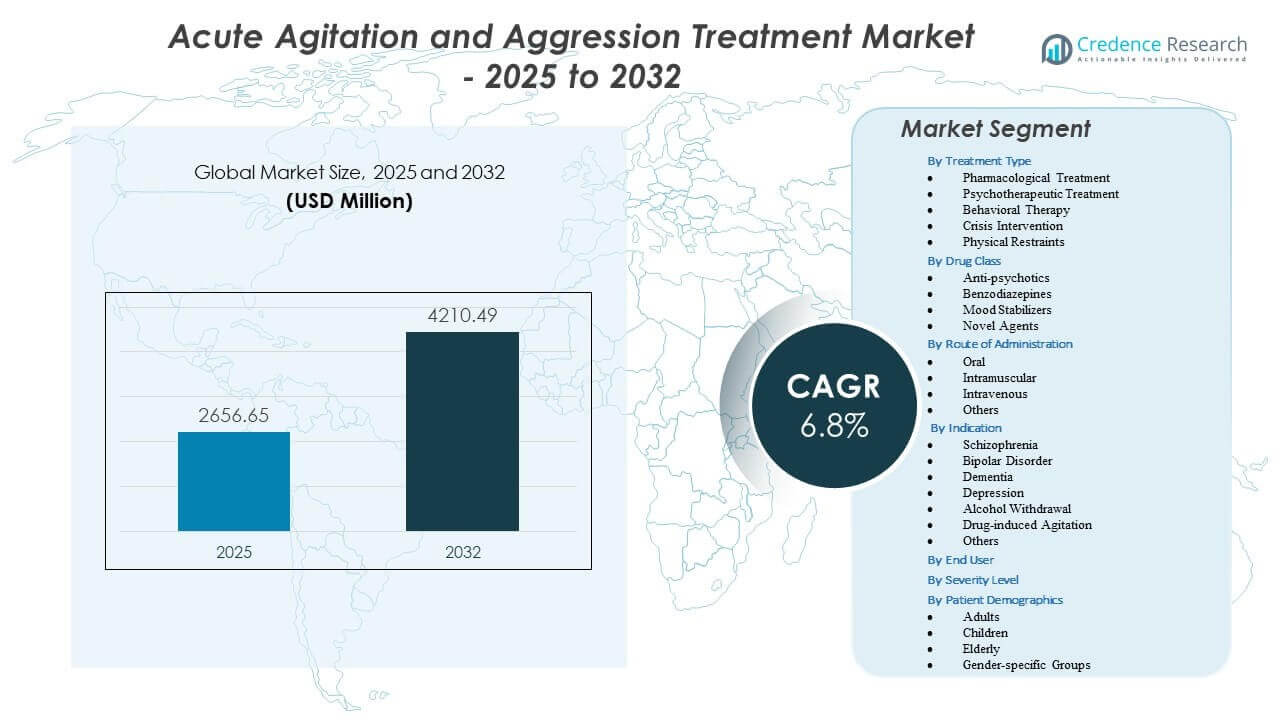
The Acute Agitation and Aggression Treatment Market is projected to grow from USD 2,656.65 million in 2025 to an estimated USD 4,210.49 million by 2032, with a compound annual growth rate (CAGR) of 6.8% from 2025 to 2032.
| RT ATTRIBUTE |
DETAILS |
| Historical Period |
2020-2023 |
| Base Year |
2024 |
| Forecast Period |
2025-2032 |
| Acute Agitation and Aggression Treatment Market Size 2025 |
USD 2,656.65 million |
| Acute Agitation and Aggression Treatment Market, CAGR |
6.8% |
| Acute Agitation and Aggression Treatment Market Size 2032 |
USD 4,210.49 million |
Acute Agitation and Aggression Treatment Market Insights:
- Rising cases of schizophrenia, bipolar disorder, dementia, and substance-related emergencies strengthen demand for rapid-acting therapies that support safer intervention.
- Restraint-free care policies and concerns over sedation risks push providers to adopt non-invasive delivery formats and improved clinical protocols.
- North America leads due to strong psychiatric infrastructure, while Europe maintains steady growth supported by advanced care models.
- Asia-Pacific emerges as the fastest-growing region with expanding mental health investment and rising focus on emergency behavioral stabilization.
Acute Agitation and Aggression Treatment Market Drivers
Rising Prevalence of Psychiatric and Neurological Disorders Fueling Rapid Demand Growth
The Acute Agitation and Aggression Treatment Market expands due to rising cases of bipolar disorder, schizophrenia, dementia, and substance-related emergencies. Emergency departments witness heavy patient inflow, which raises the need for fast-acting drug options. Hospitals prefer therapies that calm patients within minutes to avoid staff injuries. Several countries report rising dementia-related agitation among older adults. This trend strengthens the demand for safe non-invasive therapies. The Acute Agitation and Aggression Treatment Market relies on updated clinical protocols that support early intervention. It encourages providers to invest in training programs that enhance treatment delivery. Stronger awareness of behavioral emergencies drives wider adoption of advanced formulations.
Access crucial information at unmatched prices!
Request your sample report today & start making informed decisions powered by Credence Research Inc.!
Download Sample
Growing Adoption of Non-Invasive and Rapid-Acting Drug Delivery Systems
The Acute Agitation and Aggression Treatment Market benefits from growing interest in inhaled, sublingual, and intranasal drug delivery. These formats support fast control during unpredictable behavioral episodes. Care teams prefer them because they reduce physical restraint needs. The convenience improves patient acceptance and lowers treatment delays. Pharmaceutical companies expand portfolios to offer alternatives to intramuscular injections. It improves outcomes in crowded emergency settings. Wider regulatory support encourages more trials focused on patient comfort. Rising demand for ease-of-use products strengthens market penetration.
- For instance, BioXcel Therapeutics developed IGALMI (dexmedetomidine), a sublingual film that achieved a primary endpoint in its SERENITY I and II trials by demonstrating a rapid onset of action, significantly reducing agitation in patients with schizophrenia and bipolar disorder within 20 minutes of administration.
Increasing Focus on Patient Safety and Reduced Use of Physical Restraints
The Acute Agitation and Aggression Treatment Market gains momentum from global attention on restraint-free care. Hospitals face pressure to limit physical control due to injuries and ethical concerns. Safer medications reduce the risk of escalation. Providers adopt structured assessment tools that help them detect agitation early. Stronger safety frameworks encourage staff training and protocol upgrades. New guidelines prioritize rapid calming without deep sedation. It supports development of targeted therapies that balance speed and safety. Growing emphasis on humane care improves treatment uptake.
Improved Clinical Evidence Supporting Novel Therapies and Advanced Behavioral Protocols
The Acute Agitation and Aggression Treatment Market accelerates due to strong trial evidence supporting new formulations. Companies introduce therapies that act faster with fewer side effects. Updated research improves clinician confidence and prescriber loyalty. Behavioral health centers adopt integrated treatment pathways to support stable outcomes. Adoption rises when therapies show clear benefits in diverse psychiatric settings. It helps reduce repeat emergencies and improves care efficiency. Strengthened payer support encourages broader treatment access. Evidence-backed innovation promotes long-term market growth.
- For instance, Intra-Cellular Therapies showcased clinical data for Lumateperone, revealing that the 42 mg dose demonstrated a safety profile comparable to a placebo, with a weight gain of less than 1 kg and a metabolic profile showing no significant changes in glucose or cholesterol levels over a 6-week treatment period.
Acute Agitation and Aggression Treatment Market Trends
Increasing Shift Toward Digital Monitoring and Predictive Behavioral Assessment Tools
The Acute Agitation and Aggression Treatment Market observes a shift toward digital tools that forecast agitation risk. Wearable sensors track motion patterns linked to escalating behavior. Hospitals use predictive dashboards that improve emergency preparedness. These tools help teams intervene before aggression peaks. Providers pair digital alerts with calming strategies for better outcomes. Demand grows for integrated systems that support behavioral units. It encourages collaboration between technology firms and psychiatric institutions. Rising investment in digital mental health enhances treatment accuracy.
Expansion of Home-Based and Community Behavioral Crisis Response Programs
The Acute Agitation and Aggression Treatment Market sees a rise in community-level intervention models. Crisis response teams support patients outside hospitals to prevent escalation. Home-based care models reduce emergency visits and improve comfort. Governments invest in mobile care units that deliver early behavioral support. The trend improves continuity of care for chronic psychiatric patients. It strengthens coordination between clinicians and social services. Demand grows for safe therapies suited for non-hospital settings. Community-led programs drive adoption of flexible treatment options.
- For instance, Magellan Health implemented a behavioral health crisis program that utilizes mobile response teams, which successfully diverted 80% of psychiatric emergency calls from hospital emergency departments to community-based stabilization centers, significantly reducing the immediate need for high-dose intramuscular sedatives.
Increasing Development of Personalized Agitation Management Protocols
The Acute Agitation and Aggression Treatment Market benefits from precision approaches tailored to underlying conditions. Clinicians use symptom patterns to choose targeted therapies. Pharmacogenomic insights improve drug response prediction. Providers adopt structured plans for dementia, bipolar disorder, and autism-related agitation. The shift reduces trial-and-error prescribing in critical situations. It supports safer and faster intervention choices. Hospitals use electronic health records to store personalized plans. The structure helps improve patient stability during crisis episodes.
Rising Industry Collaboration to Strengthen Novel Drug Pipeline and Delivery Innovations
The Acute Agitation and Aggression Treatment Market strengthens due to partnerships focused on new formulations. Pharmaceutical companies collaborate with behavioral research institutes to study safer drug mechanisms. The trend encourages wider exploration of non-sedative calming agents. Several firms invest in advanced inhalation and oral-film technologies. It enables improved onset times and reduced side effects. Partnerships speed up regulatory review through shared evidence. Hospitals welcome products backed by strong clinical cooperation. Expanding drug development programs improve long-term innovation cycles.
- For instance, Vanda Pharmaceuticals collaborated with several research centers to advance the development of Fanapt (iloperidone), which recently received FDA approval for the acute treatment of manic or mixed episodes associated with Bipolar I disorder, based on clinical trials involving 400 patients where the drug achieved a primary endpoint of significantly reducing YMRS (Young Mania Rating Scale) scores within 4 weeks.
Acute Agitation and Aggression Treatment Market Challenges Analysis
Limited Access to Trained Behavioral Emergency Staff and Variability in Clinical Protocols
The Acute Agitation and Aggression Treatment Market faces challenges due to shortages of trained psychiatric emergency professionals. Many hospitals struggle to maintain specialists during peak hours. Variability in treatment protocols lowers consistency across facilities. Staff often rely on outdated approaches that delay safe intervention. It creates gaps in outcomes for high-risk patients. Large rural regions report limited access to advanced drug options. Training programs remain uneven across countries. Slow adoption of standardized pathways restricts market progress.
Safety Concerns, Side Effects, and Slow Regulatory Approval of Novel Therapies
The Acute Agitation and Aggression Treatment Market encounters barriers linked to safety concerns around sedation and respiratory risks. New therapies undergo strict clinical review due to sensitive patient populations. Regulatory pathways move slowly when data lacks long-term evidence. Providers hesitate to adopt products with complex risk profiles. It limits uptake in crowded emergency departments. Some patients show unpredictable responses that complicate treatment choice. Pharmaceutical firms face high trial costs for behavioral medications. Market expansion slows when approval timelines extend.
Acute Agitation and Aggression Treatment Market Opportunities
Rising Demand for Rapid-Acting, Non-Invasive Therapies Across Emergency and Community Care Settings
The Acute Agitation and Aggression Treatment Market holds strong opportunities tied to demand for inhaled, intranasal, and oral-film drugs. Emergency departments prefer options that act within minutes. Community programs adopt easy-to-use therapies to prevent hospital admission. Growing preference for restraint-free interventions creates new market space. It encourages companies to design safer alternatives to injectable sedatives. Governments invest in behavioral crisis teams that require portable solutions. Providers value products that offer predictable calming outcomes. Expanding usage across care settings opens multi-segment growth.
Increasing Investment in Digital Behavioral Health, Predictive Tools, and Personalized Care Models
The Acute Agitation and Aggression Treatment Market benefits from rising investment in predictive monitoring and personalized intervention plans. Digital tools detect early agitation signs through continuous tracking. Hospitals build integrated systems that guide clinicians during crises. It supports tailored treatment choices that improve patient safety. Pharmaceutical companies explore companion digital tools for new drug launches. Predictive analytics improve resource planning for high-risk patients. Growing support for mental health innovation accelerates development pipelines. Strong momentum in digital care enhances long-term market opportunity.
Acute Agitation and Aggression Treatment Market Segmentation Analysis:
By Treatment Type
The Acute Agitation and Aggression Treatment Market shows strong adoption across pharmacological and non-pharmacological interventions. Pharmacological treatment dominates due to its fast onset of action in high-risk environments. Providers use antipsychotics and benzodiazepines widely to stabilize patients during severe agitation. Psychotherapeutic treatment gains traction in controlled settings where long-term behavioral support improves outcomes. Behavioral therapy helps reduce repeat agitation episodes in chronic psychiatric conditions. Crisis intervention teams use structured protocols to prevent escalation during emergency calls. Physical restraints remain a last-resort option due to safety concerns and regulatory pressure. It continues to shift toward safer, patient-centered treatment approaches across care settings.
By Drug Class
The Acute Agitation and Aggression Treatment Market records strong usage of anti-psychotics, which remain the frontline drug class for rapid control in acute psychiatric episodes. These medications stabilize dopamine pathways and reduce agitation within minutes in supervised medical settings. Benzodiazepines support calming during anxiety-driven or substance-related agitation. Mood stabilizers play a key role for bipolar patients who exhibit recurring agitation patterns. Novel agents, including inhaled formulations and sublingual films, gain attention for fast delivery and improved patient acceptance. Providers seek options with predictable safety profiles for diverse psychiatric and neurological conditions. It benefits from a wider clinical pipeline focused on rapid symptom control. Demand rises for therapies that lower sedation risk and shorten emergency interventions.
By Route of Administration
The Acute Agitation and Aggression Treatment Market uses multiple administration routes to support diverse clinical needs. Oral formulations assist in early-stage agitation where patient cooperation exists. Intramuscular delivery remains essential for severe episodes requiring immediate stabilization. Intravenous administration provides controlled dosing in hospital emergencies with continuous monitoring. Emerging routes such as inhaled or sublingual products offer faster onset and improved patient comfort. These alternatives help reduce reliance on invasive approaches in crowded emergency departments. Providers favor routes that reduce restraint usage and accelerate clinical response. It evolves toward flexible delivery formats that improve staff safety and patient experience across treatment settings.
- For instance, Alexza Pharmaceuticals’ Adasuve (inhaled loxapine) utilizes the Staccato delivery system to achieve peak plasma concentrations (\(C_{max}\)) in approximately 2 minutes, allowing for a 33% reduction in agitation scores within 10 minutes of a single inhalation in clinical settings.
By Indication
The Acute Agitation and Aggression Treatment Market sees high demand from schizophrenia-related agitation, which remains the largest clinical indication. Bipolar disorder contributes significantly due to recurrent manic episodes that require rapid calming. Dementia-related agitation grows with rising elderly populations and memory care admissions. Depression-linked agitation appears in both inpatient and outpatient psychiatric settings. Alcohol withdrawal and drug-induced agitation create urgent needs in emergency departments where fast stabilization prevents complications. Other neurological or metabolic conditions may trigger sudden behavioral changes that require targeted intervention. It supports wide therapeutic application across psychiatric, geriatric, and substance-related care pathways.
- For instance, Otsuka and Lundbeck received FDA approval for Rexulti (brexpiprazole) for agitation associated with Alzheimer’s dementia based on two Phase 3 studies where the drug showed a 31% and 23.5% greater improvement on the Cohen-Mansfield Agitation Inventory (CMAI) total score compared to the placebo group.
By End User
The Acute Agitation and Aggression Treatment Market maintains strong penetration in hospitals and emergency departments because they manage the highest volume of acute psychiatric episodes. Psychiatric care facilities rely on structured protocols and trained staff to handle severe agitation. Ambulatory surgical centers treat patients with post-operative behavioral complications or pre-existing mental health conditions. Long-term care facilities report growing agitation among dementia patients, which increases demand for safer therapies. Home healthcare and outpatient clinics focus on early intervention to prevent emergency escalation. Providers across segments prioritize non-invasive treatment and faster calming strategies. It supports a wide network of acute and long-term care environments requiring consistent behavioral management resources.
By Severity Level
The Acute Agitation and Aggression Treatment Market adapts treatment choices based on severity patterns. Mild agitation often responds well to verbal de-escalation and early pharmacological support. Moderate agitation requires structured protocols and possible medication to prevent harm to patients or staff. Severe agitation demands rapid-acting agents and controlled monitoring due to risk of violence or injury. Acute episodes arise suddenly in psychiatric, neurological, or substance-related conditions and require immediate stabilization. Chronic conditions present recurring agitation where long-term therapy planning improves outcomes. Providers tailor interventions carefully to avoid unnecessary sedation. It supports scalable care pathways shaped by patient risk levels and clinical urgency.
By Patient Demographics
The Acute Agitation and Aggression Treatment Market spans adults, children, elderly patients, and gender-specific groups. Adults form the largest share due to high reported cases of acute psychiatric episodes. Children require specialized dosing strategies and behavioral support to manage agitation safely. Elderly patients experience agitation linked to dementia, cognitive decline, or medication interactions. Gender-specific groups show varied symptom patterns influenced by hormonal, psychological, or cultural factors. Cultural background influences treatment response and communication strategies in crisis management. Providers design tailored protocols that respect demographic differences and safety needs. It expands focus on personalized care for diverse patient populations across global health systems.
Segmentation:
By Treatment Type
- Pharmacological Treatment
- Psychotherapeutic Treatment
- Behavioral Therapy
- Crisis Intervention
- Physical Restraints
By Drug Class
- Anti-psychotics
- Benzodiazepines
- Mood Stabilizers
- Novel Agents
By Route of Administration
- Oral
- Intramuscular
- Intravenous
- Others
By Indication
- Schizophrenia
- Bipolar Disorder
- Dementia
- Depression
- Alcohol Withdrawal
- Drug-induced Agitation
- Others
By End User
- Hospitals & Emergency Departments
- Psychiatric Care Facilities
- Ambulatory Surgical Centers
- Long-term Care Facilities
- Home Healthcare & Outpatient Clinics
By Severity Level
- Mild Agitation
- Moderate Agitation
- Severe Agitation
- Acute Episodes
- Chronic Conditions
By Patient Demographics
- Adults
- Children
- Elderly
- Gender-specific Groups
By Region
- North America
- Europe
- Germany
- France
- U.K.
- Italy
- Spain
- Rest of Europe
- Asia Pacific
- China
- Japan
- India
- South Korea
- South-east Asia
- Rest of Asia Pacific
- Latin America
- Brazil
- Argentina
- Rest of Latin America
- Middle East & Africa
- GCC Countries
- South Africa
- Rest of the Middle East and Africa
Regional Analysis:
North America holds the largest share of the Acute Agitation and Aggression Treatment Market, accounting for nearly 38% of the global value. Strong psychiatric care infrastructure supports rapid adoption of advanced pharmacological and non-pharmacological therapies. Emergency departments across the United States report high patient volume, which strengthens demand for fast-acting drug delivery formats. Growing use of digital monitoring tools also improves early detection of agitation. It benefits from favorable reimbursement coverage and active clinical research programs. Regional hospitals invest in staff training to improve safety and reduce restraint use.
Europe represents about 28% of the Acute Agitation and Aggression Treatment Market and maintains steady growth across both Western and Eastern regions. Countries emphasize patient-centered care models that promote rapid calming strategies with lower sedation risk. The region sees strong adoption of novel formulations tailored for dementia-related agitation. Psychiatric facilities collaborate closely with research institutes to refine treatment pathways. It gains momentum from government-funded mental health programs that expand access to emergency and community care services. Rising regulatory guidance supports safer treatment practices.
Asia-Pacific holds nearly 22% of the market and emerges as the fastest-growing region. Rising mental health awareness increases treatment uptake across hospitals and psychiatric centers. Several countries invest in crisis intervention teams to reduce emergency admissions. The Acute Agitation and Aggression Treatment Market expands rapidly as healthcare systems scale capacity for acute psychiatric care. It benefits from the adoption of non-invasive therapies suitable for crowded emergency environments. South America and the Middle East & Africa together represent the remaining 12%, with growth driven by improved psychiatric infrastructure and better access to emergency care.
Shape Your Report to Specific Countries or Regions & Enjoy 30% Off!
Key Player Analysis:
- Eli Lilly and Company
- Pfizer, Inc.
- GlaxoSmithKline (GSK) plc
- Johnson & Johnson
- H. Lundbeck A/S
- Otsuka Pharmaceutical Co., Ltd.
- Bristol-Myers Squibb
- Alkermes plc
- BioXcel Therapeutics
- Impel Pharmaceuticals
- AbbVie Inc.
- Amneal Pharmaceuticals LLC
Competitive Analysis:
The Acute Agitation and Aggression Treatment Market features strong competition among pharmaceutical firms, medical device companies, and digital health innovators. Major players invest in fast-acting drug formulations designed for emergency and psychiatric use. Companies develop inhaled and sublingual agents that reduce reliance on intramuscular injections. It gains competitive momentum from increased interest in non-invasive treatment routes. Several firms expand portfolios through clinical trials targeting agitation linked to schizophrenia, bipolar disorder, and dementia. Partnerships with psychiatric institutions help refine treatment efficacy and safety. Leading players work to differentiate products through rapid onset, reduced sedation risk, and improved patient comfort. Growing industry focus on personalized intervention strategies supports ongoing innovation and intensifies competition across global markets.
Recent Developments:
- In January 2026, Eli Lilly and Company entered a definitive agreement to acquire Ventyx Biosciences for approximately $1.2 billion in an all-cash deal. This acquisition aims to bolster Lilly’s development of oral therapies targeting inflammatory-mediated diseases, including potential applications in neuroinflammatory conditions linked to agitation.
- In January 2025, Johnson & Johnson announced a $14.6 billion acquisition of Intra-Cellular Therapies (ITCI), the developer of Caplyta, a medication approved for bipolar disorder that addresses acute agitation symptoms.
Report Coverage:
The research report offers an in-depth analysis based on Treatment Type, Drug Class, Route of Administration, Indication, End User, Severity Level and Patient Demographics. It details leading market players, providing an overview of their business, product offerings, investments, revenue streams, and key applications. Additionally, the report includes insights into the competitive environment, SWOT analysis, current market trends, as well as the primary drivers and constraints. Furthermore, it discusses various factors that have driven market expansion in recent years. The report also explores market dynamics, regulatory scenarios, and technological advancements that are shaping the industry. It assesses the impact of external factors and global economic changes on market growth. Lastly, it provides strategic recommendations for new entrants and established companies to navigate the complexities of the market.
Future Outlook:
- Growing demand for rapid-acting therapies will shape innovation in the Acute Agitation and Aggression Treatment Market.
- Wider adoption of non-invasive delivery formats will support safer and more predictable intervention outcomes.
- Rising focus on restraint-free care will encourage hospitals to upgrade protocols and expand staff training.
- Digital monitoring tools will help identify agitation earlier and reduce emergency escalations.
- New clinical evidence for novel agents will drive stronger acceptance among psychiatric and emergency teams.
- Expansion of community-based crisis response programs will reduce pressure on hospital systems.
- Increasing emphasis on personalized intervention plans will improve treatment precision.
- Investments from major pharmaceutical companies will accelerate pipeline development across key indications.
- Emerging markets will scale psychiatric infrastructure, widening access to advanced therapies.
- Cross-sector partnerships will strengthen research, support regulatory progress, and enhance delivery models.



