
Market Overview:
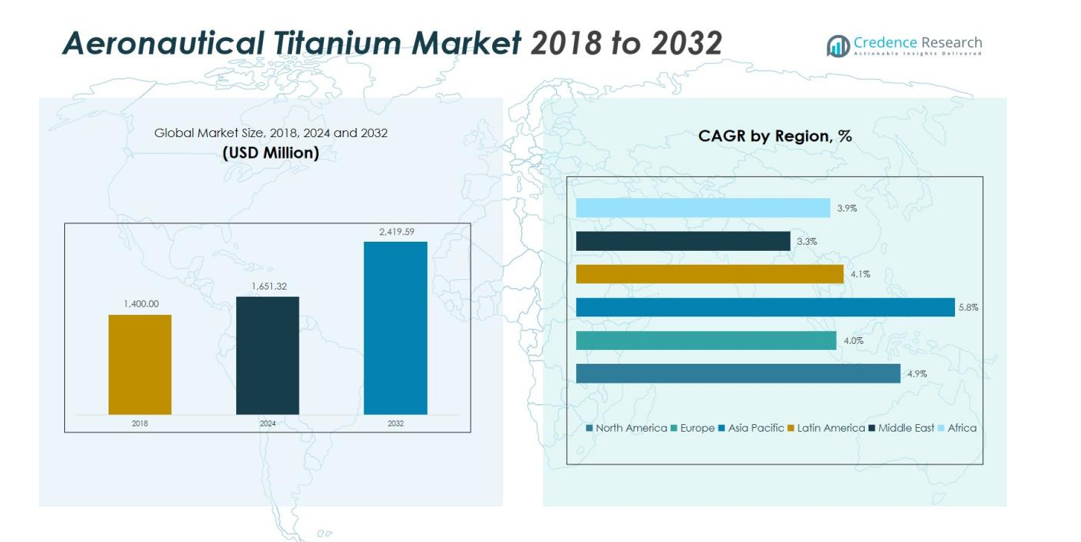
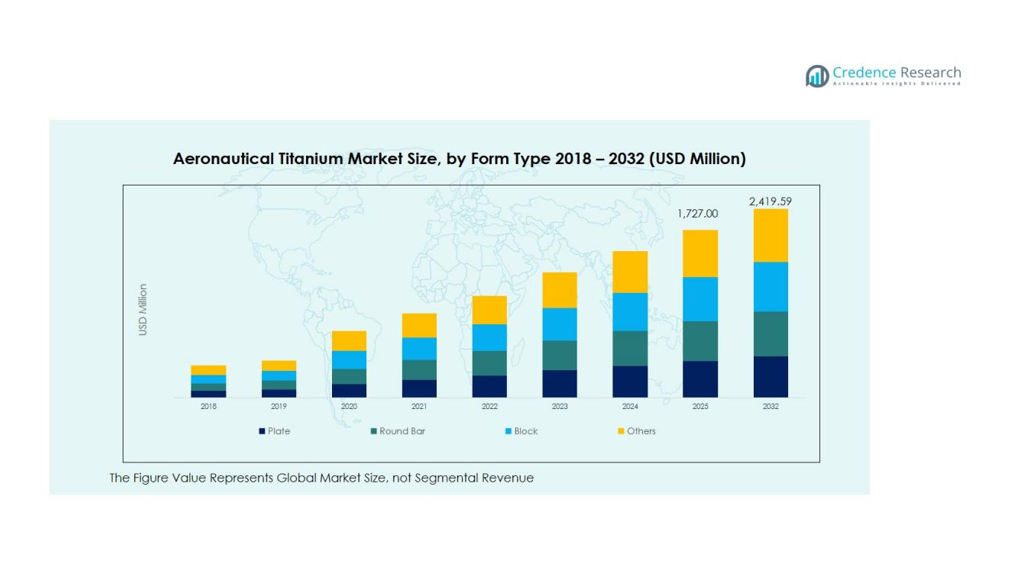
The Global Aeronautical Titanium Market size was valued at USD 1,400.00 million in 2018 to USD 1,651.32 million in 2024 and is anticipated to reach USD 2,419.59 million by 2032, at a CAGR of 4.94% during the forecast period.
| REPORT ATTRIBUTE | DETAILS |
|---|---|
| Historical Period | 2020-2023 |
| Base Year | 2024 |
| Forecast Period | 2025-2032 |
| Aeronautical Titanium Market Size 2024 | USD 1,651.32 million |
| Aeronautical Titanium Market, CAGR | 4.94% |
| Aeronautical Titanium Market Size 2032 | USD 2,419.59 million |
Rising aircraft production, coupled with the modernization of commercial and military fleets, is boosting demand for aeronautical-grade titanium. The expanding aerospace sector, driven by growing air passenger traffic and defense spending, also fuels market growth. Additionally, advances in titanium extraction, forging, and additive manufacturing technologies are lowering production costs and improving material efficiency, further supporting industry expansion.
Regionally, North America dominates the global market owing to strong aerospace manufacturing bases in the United States and Canada. Europe follows, driven by major aircraft producers such as Airbus and Rolls-Royce. The Asia-Pacific region is expected to witness the fastest growth due to expanding aviation infrastructure, increasing aircraft orders, and rising investments in domestic aerospace manufacturing in countries like China, Japan, and India.
Market Insights:
- The Global Aeronautical Titanium Market was valued at USD 1,400.00 million in 2018, reached USD 1,651.32 million in 2024, and is projected to attain USD 2,419.59 million by 2032, registering a CAGR of 4.94% during the forecast period.
- North America holds 32% of the global share, driven by established aerospace manufacturing bases and strong defense aircraft production in the United States and Canada.
- Europe accounts for 25% of the market, supported by leading aircraft manufacturers such as Airbus and Rolls-Royce and extensive R&D in sustainable aviation materials.
- Asia Pacific represents 30% of the total share and is the fastest-growing region, propelled by rising aircraft production, expanding aviation infrastructure, and strong government support in China, Japan, and India.
- By form type, plates and sheets together contribute nearly 55% of total revenue due to their widespread use in fuselage and wing components. By manufacturing method, traditional processes dominate with over 70% share, reflecting their proven reliability and high production capacity in aerospace-grade titanium manufacturing.
Market Drivers:
Rising Aircraft Production and Fleet Modernization
The Global Aeronautical Titanium Market is driven by the steady increase in aircraft production across commercial and defense sectors. Major manufacturers are expanding output to meet the growing demand for air travel and next-generation aircraft. Titanium’s superior strength-to-weight ratio and corrosion resistance make it essential for lightweight airframe structures and engine components. The continuous replacement of aging fleets with fuel-efficient aircraft is further boosting the consumption of titanium alloys worldwide.
- For instance, to meet strong airline demand, Boeing received approval in October 2025 to increase the production rate of its 737 MAX aircraft to 42 jets per month.
Advancements in Titanium Manufacturing Technologies
Innovations in processing and manufacturing technologies have significantly reduced titanium production costs. Developments in additive manufacturing, powder metallurgy, and near-net-shape forging are enhancing precision and material efficiency. These advancements are enabling manufacturers to produce high-performance titanium parts for complex aerospace applications. It is supporting cost-effective large-scale adoption of titanium in both new and retrofitted aircraft.
Growing Demand for Fuel Efficiency and Sustainability
A strong focus on fuel efficiency is encouraging airlines and aircraft makers to use lighter materials. Titanium plays a crucial role in improving fuel economy by reducing overall aircraft weight without compromising safety. Its recyclability and long service life also align with global sustainability goals. The growing emphasis on eco-friendly materials strengthens titanium’s position as a preferred aerospace material.
- For instance, the Boeing 787 Dreamliner's design incorporates a significant amount of titanium, which contributes to making the aircraft lighter and more fuel-efficient.
Expanding Defense and Space Programs
The defense and space sectors are increasingly incorporating titanium in high-performance systems. Rising global defense budgets and satellite launches are creating consistent demand for titanium-based components. It is used extensively in fighter jets, missiles, and spacecraft structures due to its exceptional durability and heat resistance. Expanding space exploration initiatives further contribute to the material’s long-term growth potential.
Market Trends:
Growing Integration of Titanium Alloys in Next-Generation Aircraft
The Global Aeronautical Titanium Market is witnessing a rising trend toward the extensive use of titanium alloys in modern aircraft designs. Manufacturers are increasing titanium content in airframes, engine components, and landing gear systems to improve durability and reduce maintenance needs. Titanium’s compatibility with composite materials enhances structural integrity and supports the shift toward lightweight, fuel-efficient aircraft. Aerospace OEMs are partnering with material suppliers to secure a stable titanium supply chain and optimize component performance. It is also gaining traction due to its ability to withstand high temperatures in advanced jet engines. This integration trend aligns with the aerospace industry's focus on efficiency, longevity, and safety.
- For instance, in the Boeing 777, the substitution of a high-strength steel component with the titanium alloy Ti-10V-2Fe-3Al resulted in a weight savings of over 580 kg.
Advancement in Recycling and Additive Manufacturing Technologies
The industry is embracing recycling and additive manufacturing to meet sustainability goals and reduce material costs. Titanium scrap recovery and closed-loop recycling systems are being implemented to minimize waste during production. Additive manufacturing enables precision in complex aerospace parts while reducing raw material consumption. It supports faster prototyping and customization of titanium components for specific aircraft models. Manufacturers are investing in automated production systems to improve consistency and throughput. These advancements enhance material utilization and align with the growing preference for environmentally responsible manufacturing practices within the aerospace sector.
- For instance, GE Aerospace has received FAA approval for more than 10 additively manufactured parts for its commercial engines, including the GEnx and GE9X models.
Market Challenges Analysis:
High Production Costs and Limited Supply Chain Integration
The Global Aeronautical Titanium Market faces significant challenges due to high production costs and complex supply chains. Titanium extraction and processing require energy-intensive methods, increasing overall material expenses. Limited integration among raw material suppliers, forge shops, and aerospace OEMs creates bottlenecks in availability and pricing stability. It also experiences fluctuations in titanium sponge supply, influenced by geopolitical and mining constraints. These factors often lead to longer lead times and inconsistent pricing across regions. The need for sustained collaboration among suppliers and manufacturers remains crucial to stabilize the titanium value chain.
Stringent Certification Requirements and Technological Barriers
erospace-grade titanium components must meet strict certification and quality standards before approval for use. Meeting these requirements increases testing time, regulatory costs, and overall project timelines. Smaller manufacturers struggle to meet advanced metallurgical and machining standards demanded by the aerospace sector. It limits their entry into high-value supply contracts and reduces competition. Complex forming and welding processes also require skilled labor and advanced equipment, creating operational challenges. These technological and regulatory constraints continue to restrict the pace of market expansion.
Market Opportunities:
Rising Demand from Emerging Aerospace Manufacturing Hubs
The Global Aeronautical Titanium Market presents strong opportunities in emerging aerospace hubs across Asia-Pacific and the Middle East. Expanding aircraft manufacturing facilities in China, India, and the UAE are creating new titanium supply contracts and partnerships. Governments are investing heavily in domestic aerospace capabilities, encouraging local sourcing of titanium components. It benefits from these initiatives through increased demand for airframe and engine-grade alloys. The rising presence of MRO facilities in these regions also supports steady aftermarket consumption. Strengthening regional supply chains and localized production will further boost titanium adoption in upcoming aerospace projects.
Growing Adoption in Electric and Hybrid Aircraft Development
The growing focus on electric and hybrid aircraft is opening new growth avenues for titanium applications. Lightweight titanium alloys improve battery efficiency and reduce structural weight in sustainable aircraft designs. Manufacturers are exploring titanium’s use in advanced propulsion systems and thermal management components. It aligns well with the aviation industry’s carbon reduction targets and shift toward green technologies. Increased funding for aerospace innovation programs worldwide is driving research on new titanium composites. These developments are expected to create long-term opportunities for material suppliers and component manufacturers.
Market Segmentation Analysis:
By Form Type
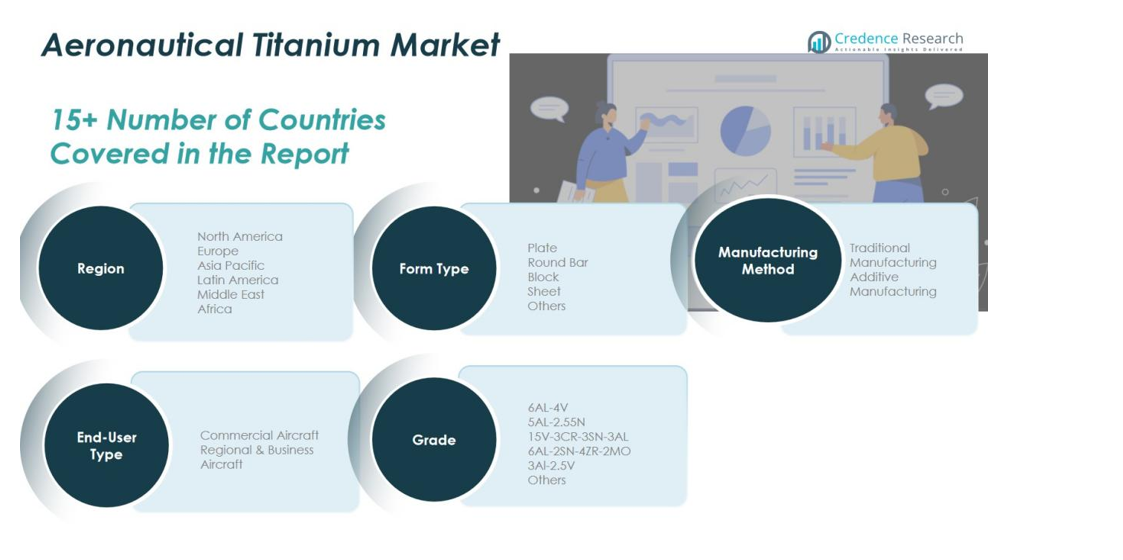
The Global Aeronautical Titanium Market is segmented by form into plate, round bar, block, sheet, and others. Plates and sheets hold a dominant share due to their extensive use in aircraft fuselage and wing structures. Round bars and blocks are widely utilized in landing gears, engine mounts, and fasteners where strength and precision are critical. It continues to see steady growth in sheet applications driven by lightweight design requirements and advanced forming techniques. The rising adoption of custom titanium forms in new aircraft models further supports segment expansion.
- For instance, Airbus utilizes approximately 77 tons of titanium for the structure and fittings of its A380 aircraft, demonstrating the extensive application of titanium plates and sheets in large airframes.
By Manufacturing Method
The market is categorized into traditional manufacturing and additive manufacturing. Traditional methods, including forging and machining, account for the majority share due to their established reliability in aerospace-grade titanium production. Additive manufacturing is gaining traction due to its ability to produce complex geometries and minimize material waste. It offers flexibility and faster prototyping for engine and structural components. The shift toward precision and cost efficiency is encouraging wider acceptance of 3D-printed titanium parts across aerospace OEMs.
- For instance, the Direct Energy Deposition (DED) method of additive manufacturing can produce large titanium aerospace parts at a material deposition rate of up to 320 cc/h, significantly accelerating the creation of complex components.
By Grade
The market is divided into grades such as 6AL-4V, 5AL-2.55N, 15V-3CR-3SN-3AL, 6AL-2SN-4ZR-2MO, 3AL-2.5V, and others. The 6AL-4V grade dominates due to its superior strength, fatigue resistance, and weldability. It is preferred for aircraft structural and engine applications. High-performance grades like 15V-3CR-3SN-3AL are seeing increased use in military and high-temperature environments, reflecting ongoing advancements in aerospace material engineering.
Segmentations:
By Form Type
- Plate
- Round Bar
- Block
- Sheet
- Others
By Manufacturing Method
- Traditional Manufacturing
- Additive Manufacturing
By End-User
- Commercial Aircraft
- Regional & Business Aircraft
By Grade
- 6AL-4V
- 5AL-2.55N
- 15V-3CR-3SN-3AL
- 6AL-2SN-4ZR-2MO
- 3AL-2.5V
- Others
By Region
- North America
- U.S.
- Canada
- Mexico
- Europe
- Germany
- France
- U.K.
- Italy
- Spain
- Rest of Europe
- Asia Pacific
- China
- Japan
- India
- South Korea
- South-east Asia
- Rest of Asia Pacific
- Latin America
- Brazil
- Argentina
- Rest of Latin America
- Middle East & Africa
- GCC Countries
- South Africa
- Rest of the Middle East and Africa
Regional Analysis
North America
The North America Aeronautical Titanium Market size was valued at USD 354.20 million in 2018 to USD 410.51 million in 2024 and is anticipated to reach USD 600.31 million by 2032, at a CAGR of 4.9% during the forecast period. The Global Aeronautical Titanium Market Market records North America as the largest regional contributor, accounting for 32% of global revenue. Strong aerospace manufacturing bases in the United States and Canada drive titanium consumption for aircraft engines, fuselage components, and landing gears. It benefits from well-established suppliers and advanced material processing infrastructure. The presence of leading OEMs such as Boeing and Lockheed Martin ensures consistent demand for high-grade titanium alloys. Government investments in defense aircraft programs further strengthen market growth across the region.
Europe
The Europe Aeronautical Titanium Market size was valued at USD 286.30 million in 2018 to USD 320.81 million in 2024 and is anticipated to reach USD 436.14 million by 2032, at a CAGR of 4.0% during the forecast period. Europe holds 25% of the total market share, supported by strong aerospace hubs in France, Germany, and the UK. The Global Aeronautical Titanium Market Market in this region is driven by Airbus and Rolls-Royce’s continuous aircraft and engine development programs. It gains from robust R&D capabilities and integration of advanced material processing technologies. European firms are also expanding titanium recycling systems to reduce dependency on imports. Growth is sustained by increasing demand for sustainable and lightweight aircraft components.
Asia Pacific
The Asia Pacific Aeronautical Titanium Market size was valued at USD 541.80 million in 2018 to USD 656.97 million in 2024 and is anticipated to reach USD 1,026.64 million by 2032, at a CAGR of 5.8% during the forecast period. Asia Pacific commands the fastest growth rate, contributing 30% of the global share. The Global Aeronautical Titanium Market Market in this region expands with rising aircraft manufacturing in China, Japan, and India. It benefits from government-led aviation development programs and the localization of aerospace supply chains. Increased defense spending and commercial air traffic further accelerate titanium demand. Major regional producers are also investing in additive manufacturing to enhance production efficiency.
Latin America
The Latin America Aeronautical Titanium Market size was valued at USD 98.00 million in 2018 to USD 114.59 million in 2024 and is anticipated to reach USD 156.96 million by 2032, at a CAGR of 4.1% during the forecast period. Latin America holds 7% of the global market share. The Global Aeronautical Titanium Market Market in this region is supported by growing aircraft fleet renewals and MRO activities. It benefits from regional aerospace centers in Brazil and Mexico, where OEM collaborations are expanding. Government incentives for aviation infrastructure development encourage titanium usage in new aircraft assembly. Strengthening defense modernization efforts also support stable titanium demand across the region.
Middle East
The Middle East Aeronautical Titanium Market size was valued at USD 43.40 million in 2018 to USD 47.22 million in 2024 and is anticipated to reach USD 60.75 million by 2032, at a CAGR of 3.3% during the forecast period. The region represents 4% of the global share, led by strong aircraft procurement from Gulf countries. The Global Aeronautical Titanium Market Market here grows through investments in fleet expansion and MRO hubs. It benefits from increased demand for wide-body aircraft used in long-haul operations. Strategic partnerships with global aerospace manufacturers are improving titanium supply chains. Ongoing development of aviation clusters in the UAE and Saudi Arabia is fostering new opportunities for titanium suppliers.
Africa
The Africa Aeronautical Titanium Market size was valued at USD 76.30 million in 2018 to USD 101.23 million in 2024 and is anticipated to reach USD 138.81 million by 2032, at a CAGR of 3.9% during the forecast period. Africa accounts for 2% of the total market share. The Global Aeronautical Titanium Market Market in this region is developing steadily due to rising aviation investments in South Africa and Egypt. It is supported by fleet modernization programs and growing airline connectivity across the continent. Expanding aerospace maintenance facilities are increasing regional titanium imports. Emerging partnerships with global suppliers are expected to strengthen long-term market presence.
Key Player Analysis:
- ATI
- Plymouth Tube Company USA
- TIMET
- Dynamic Metals Ltd.
- Reliance Steel & Aluminum Co.
- Smiths Advanced Metals
- JINHAO Co., Ltd.
- ASM Aerospace Specification Metals, Inc.
- Aubert & Duval
- Jaco Aerospace
- Shenyang Yongye Industry Co., Ltd.
Competitive Analysis:
The Global Aeronautical Titanium Market is moderately consolidated, with competition shaped by innovation, production capacity, and long-term aerospace contracts. Key players include ATI, Plymouth Tube Company USA, TIMET, Dynamic Metals Ltd., Reliance Steel & Aluminum Co., Smiths Advanced Metals, JINHAO Co., Ltd., ASM Aerospace Specification Metals, Inc., and Aubert & Duval. It is driven by strategic alliances with aircraft manufacturers and a focus on high-grade alloy development. Companies are investing in precision forging, additive manufacturing, and recycling technologies to improve efficiency and sustainability. Leading firms continue expanding global distribution networks to strengthen supply reliability and cost competitiveness. The emphasis on lightweight materials and next-generation aerospace designs is pushing market participants to enhance R&D and quality certification capabilities.
Recent Developments:
- In July 2025, Ati Motors introduced its humanoid-inspired industrial robot, Sherpa Mecha, and the Sherpa 10K, a high-capacity autonomous tugger, at its Product Day event in Bengaluru.
- In October 2025, Dynamic Metals Ltd. successfully secured a $175,000 grant to advance its exploration projects for precious and critical metals in Western Australia.
Report Coverage:
The research report offers an in-depth analysis based on Form Type, Manufacturing Method, End-User, Grade and Region. It details leading market players, providing an overview of their business, product offerings, investments, revenue streams, and key applications. Additionally, the report includes insights into the competitive environment, SWOT analysis, current market trends, as well as the primary drivers and constraints. Furthermore, it discusses various factors that have driven market expansion in recent years. The report also explores market dynamics, regulatory scenarios, and technological advancements that are shaping the industry. It assesses the impact of external factors and global economic changes on market growth. Lastly, it provides strategic recommendations for new entrants and established companies to navigate the complexities of the market.
Future Outlook:
- The Global Aeronautical Titanium Market is expected to experience steady growth driven by rising aircraft production and modernization programs.
- Manufacturers will increasingly adopt advanced titanium alloys to enhance strength, corrosion resistance, and fatigue performance in next-generation aircraft.
- Additive manufacturing will gain wider use for producing complex titanium parts with reduced waste and faster turnaround times.
- Expanding commercial aviation in emerging economies will create new opportunities for titanium suppliers and processors.
- The demand for lightweight materials will intensify as airlines focus on improving fuel efficiency and reducing carbon emissions.
- Defense and space programs will remain key contributors, driving high-performance titanium alloy requirements.
- Strategic collaborations between titanium producers and aerospace OEMs will improve supply chain stability and material quality.
- Automation and digital monitoring technologies will optimize titanium production and machining processes.
- Sustainability goals will push the adoption of titanium recycling and closed-loop manufacturing systems.
- Long-term market growth will rely on continued investments in aerospace innovation, material science, and global manufacturing integration.

Request a Free Sample
Fill in your details and we'll send you a free sample report.
- Sample data tables & charts
- Research methodology
Market Dynamics
Rising Aircraft Production and Fleet Modernization
The steady increase in commercial and defense aircraft production, along with the replacement of aging fleets with fuel-efficient models, is driving demand for aeronautical-grade titanium due to its strength-to-weight ratio and corrosion resistance.
Advancements in Titanium Manufacturing Technologies
Innovations in additive manufacturing, powder metallurgy, and near-net-shape forging are reducing production costs and enabling the creation of complex, high-performance titanium parts, making titanium more accessible for aerospace applications.
Growing Demand for Fuel Efficiency and Sustainability
Airlines and aircraft manufacturers are prioritizing lightweight materials like titanium to improve fuel economy and reduce emissions, while titanium’s recyclability and long service life align with global sustainability goals.
Expanding Defense and Space Programs
Increased defense budgets and space exploration initiatives are boosting the use of titanium in fighter jets, missiles, and spacecraft, leveraging its durability and heat resistance for high-performance aerospace systems.
Emergence of New Aerospace Manufacturing Hubs
Rapid growth in aerospace manufacturing in Asia-Pacific and the Middle East, supported by government investments and localization of supply chains, is creating new opportunities for titanium suppliers and expanding the global market footprint.
Need a Custom Version of This Report?
Tailor the scope, geography, or segments to your exact requirements.
- Custom geography or segment scope
- Direct access to our analyst team
Frequently Asked Questions
What is the current market size for the Global Aeronautical Titanium Market, and what is its projected size in 2032?
At what Compound Annual Growth Rate is the Global Aeronautical Titanium Market projected to grow between 2024 and 2032?
Which Global Aeronautical Titanium Market segment held the largest share in 2024?
What are the primary factors fueling the growth of the Global Aeronautical Titanium Market?
Who are the leading companies in the Global Aeronautical Titanium Market?
What are the attractive investment prepositions in the global Aeronautical Titanium industry?
Table of Content
Chapter 1 Market Segmentation
- 1.1 Segmentation Framework
- 1.1.1 Product and Service Classification
- 1.1.2 Application and End-Use Classification
- 1.1.3 Technology and Solution Classification
- 1.1.4 Customer and Distribution Channel Classification
- 1.1.5 Geographic Segmentation
- 1.1.6 Market Segment Definitions and Boundaries
- 1.2 By Grade
- 1.2.1 6AL-4V
- 1.2.2 5AL-2.55N
- 1.2.3 15V-3CR-3SN-3AL
- 1.2.4 6AL-2SN-4ZR-2MO
- 1.2.5 3AL-2.5V
- 1.2.6 Others
- 1.3 By End-User
- 1.3.1 Commercial Aircraft
- 1.3.2 Regional & Business Aircraft
- 1.4 By Form Type
- 1.4.1 Plate
- 1.4.2 Round Bar
- 1.4.3 Block
- 1.4.4 Sheet
- 1.4.5 Others
- 1.5 By Manufacturing Method
- 1.5.1 Traditional Manufacturing
- 1.5.2 Additive Manufacturing
Chapter 2 Introduction
- 2.1 Report Objectives and Scope
- 2.2 Product Definition and Industry Terminology
- 2.3 Market Inclusions and Exclusions
- 2.4 Research Process
- 2.4.1 Primary Research and Expert Interviews
- 2.4.2 Secondary Research and Source Review
- 2.4.3 Top-Down and Bottom-Up Estimation
- 2.4.4 Data Triangulation and Verification
- 2.5 Market Size Measurement Basis
- 2.5.1 2024: USD 1,651.32 million → 2032: USD 2,419.59 million
- 2.6 Historical and Forecast Reference Periods
- 2.6.1 Base Year: 2024
- 2.6.2 Forecast Period: 2024-2032
- 2.7 Research Assumptions and Limitations
Chapter 3 Executive Summary
- 3.1 Market Snapshot and Key Findings
- 3.2 Base-Year Market Size, 2024
- 3.3 Forecast Market Size, 2032
- 3.4 Revenue and Volume Growth Outlook
- 3.5 Key Demand and Supply Indicators
- 3.6 Leading Market Segments
- 3.7 Fastest-Growing Market Opportunities
- 3.8 Regional Performance Highlights
- 3.9 Technology and Industry Transformation
- 3.10 Competitive Landscape Summary
- 3.11 Analyst View and Strategic Implications
Chapter 4 Global Aeronautical Titanium Market Trends and Developments
- 4.1 Historical Industry Development
- 4.2 Recent Market Trends and Developments
- 4.3 Demand and Customer Behavior Trends
- 4.4 Technology and Product Innovation
- 4.5 Artificial Intelligence, Automation and Digitalization
- 4.6 Local Manufacturing and Supply Chain Realignment
- 4.7 Industry Partnerships, Mergers and Acquisitions
- 4.8 Sustainability and Circular Economy Developments
- 4.9 Government and Private Sector Investment Trends
- 4.10 Emerging Business Models and Commercialization
- 4.11 Industry Developments and Announcements
Chapter 5 Global Aeronautical Titanium Market Production, Supply and Demand Analysis
- 5.1 Demand Trend and Consumption Analysis
- 5.2 Demand Forecast, 2024-2032
- 5.3 Production and Output Trend
- 5.4 Production and Output Forecast, 2024-2032
- 5.5 Installed Capacity and Capacity Utilization
- 5.6 Company-Wise Production Plants and Statistics
- 5.6.1 Installed Production Capacity
- 5.6.2 Actual Production
- 5.6.3 Planned Capacity and Expansion Targets
- 5.7 Supply Chain Structure and Procurement Trends
- 5.8 Supply-Demand Gap and Bottlenecks
- 5.9 Import Dependence and Sourcing Structure
- 5.10 Contract Manufacturing and Outsourcing
- 5.11 Regional Supply and Demand Concentration
Chapter 6 Global Aeronautical Titanium Market Pricing Analysis
- 6.1 Pricing Structure and Measurement
- 6.2 Historical Pricing Trends
- 6.3 Pricing Outlook, 2024-2032
- 6.4 Average Selling Price and Unit Economics
- 6.5 Pricing by Product and Market Segment
- 6.6 Geographic Pricing Differences
- 6.7 Key Input, Energy, Labor and Logistics Costs
- 6.8 Contract Pricing and Purchasing Models
- 6.9 Pricing Sensitivity and Competitive Positioning
- 6.10 Price, Margin and Profitability Implications
Chapter 7 Global Aeronautical Titanium Market Dynamics
- 7.1 Market Growth Drivers
- 7.1.1 Demand-Side Drivers
- 7.1.2 Technology and Innovation Drivers
- 7.1.3 Infrastructure and Investment Drivers
- 7.1.4 Regulatory and Policy Drivers
- 7.2 Market Restraints
- 7.2.1 Cost and Affordability Constraints
- 7.2.2 Technology and Adoption Barriers
- 7.2.3 Supply Chain and Operational Constraints
- 7.3 Market Challenges
- 7.3.1 Competitive Pressure and Margin Erosion
- 7.3.2 Skills, Infrastructure and Implementation Gaps
- 7.4 Emerging Market Opportunities
- 7.5 Market Dynamics Impact and Time-Horizon Assessment
Chapter 8 Global Aeronautical Titanium Value Chain Analysis
- 8.1 Industry Value Chain Overview
- 8.2 Upstream Suppliers and Critical Inputs
- 8.3 Technology and Component Providers
- 8.4 Manufacturing or Service Delivery
- 8.5 Distribution, Channel Partners and Integrators
- 8.6 Downstream Applications and End Users
- 8.7 Value Addition and Profit Pools
- 8.8 Vertical Integration and Outsourcing
- 8.9 Supplier Concentration and Risk
- 8.10 Supply Chain Localization and Resilience
Chapter 9 Global Aeronautical Titanium Market Regulations and Policies
- 9.1 Relevant Laws, Standards and Compliance Frameworks
- 9.2 Product, Service, Safety and Quality Requirements
- 9.3 Government Policies, Incentives and Subsidies
- 9.4 Imports, Exports and Trade Barriers
- 9.5 Public Procurement and Local Content Requirements
- 9.6 Environmental and Sustainability Compliance
- 9.7 Upcoming Policy Changes and Market Implications
Chapter 10 Global Aeronautical Titanium Market Hotspots and Opportunities
- 10.1 Market Opportunity Mapping and Growth Hotspots
- 10.2 High-Growth Applications and Customer Groups
- 10.3 Underserved Markets and White-Space Opportunities
- 10.4 Emerging Technology and Product Opportunities
- 10.5 New Capacity and Investment Hotspots
- 10.6 Market Entry and Expansion Opportunities
- 10.7 Distribution and Partnership Opportunities
- 10.8 Near-Term and Long-Term Commercial Potential
- 10.9 Opportunity Attractiveness and Execution Risks
Chapter 11 Global Aeronautical Titanium Market Outlook, 2024-2032
- 11.1 Market Size and Analysis
- 11.1.1 Revenue (Market Measurement: 2024: USD 1,651.32 million → 2032: USD 2,419.59 million)
- 11.1.2 Market Volume and Quantity Sold
- 11.1.3 Historical Market Size
- 11.1.4 Base-Year Market Size, 2024
- 11.2 Market Forecast, 2024-2032
- 11.2.1 Revenue Forecast to 2032
- 11.2.2 Volume Forecast to 2032
- 11.2.3 CAGR and Year-on-Year Growth
- 11.2.4 Incremental Revenue Opportunity
- 11.3 Forecast Assumptions and Scenario Analysis
- 11.3.1 Base-Case Forecast
- 11.3.2 Optimistic and Conservative Scenarios
- 11.3.3 Technology, Pricing and Policy Sensitivities
- 11.4 Market Attractiveness and Growth Outlook
Chapter 12 Global Aeronautical Titanium Market Segmentation and Outlook
- 12.1 Segmentation Summary and Market Shares, 2024
- 12.2 Largest and Fastest-Growing Segments
- 12.3 By Grade - Market Size and Forecast, 2024-2032
- 12.3.1 Segment Definition and Scope
- 12.3.2 Historical Market Size
- 12.3.3 Revenue Forecast, 2024-2032
- 12.3.4 Volume Forecast, 2024-2032
- 12.3.5 Base-Year Market Share, 2024
- 12.3.6 Segment CAGR and Growth Drivers
- 12.3.7 Subsegment Market Size and Forecast
- 12.3.7.1 6AL-4V
- 12.3.7.2 5AL-2.55N
- 12.3.7.3 15V-3CR-3SN-3AL
- 12.3.7.4 6AL-2SN-4ZR-2MO
- 12.3.7.5 3AL-2.5V
- 12.3.7.6 Others
- 12.3.8 Subsegment Pricing and Adoption Trends
- 12.3.9 Leading Suppliers and Competition
- 12.3.10 Regional Demand and Opportunities
- 12.4 By End-User - Market Size and Forecast, 2024-2032
- 12.4.1 Segment Definition and Scope
- 12.4.2 Historical Market Size
- 12.4.3 Revenue Forecast, 2024-2032
- 12.4.4 Volume Forecast, 2024-2032
- 12.4.5 Base-Year Market Share, 2024
- 12.4.6 Segment CAGR and Growth Drivers
- 12.4.7 Subsegment Market Size and Forecast
- 12.4.7.1 Commercial Aircraft
- 12.4.7.2 Regional & Business Aircraft
- 12.4.8 Subsegment Pricing and Adoption Trends
- 12.4.9 Leading Suppliers and Competition
- 12.4.10 Regional Demand and Opportunities
- 12.5 By Form Type - Market Size and Forecast, 2024-2032
- 12.5.1 Segment Definition and Scope
- 12.5.2 Historical Market Size
- 12.5.3 Revenue Forecast, 2024-2032
- 12.5.4 Volume Forecast, 2024-2032
- 12.5.5 Base-Year Market Share, 2024
- 12.5.6 Segment CAGR and Growth Drivers
- 12.5.7 Subsegment Market Size and Forecast
- 12.5.7.1 Plate
- 12.5.7.2 Round Bar
- 12.5.7.3 Block
- 12.5.7.4 Sheet
- 12.5.7.5 Others
- 12.5.8 Subsegment Pricing and Adoption Trends
- 12.5.9 Leading Suppliers and Competition
- 12.5.10 Regional Demand and Opportunities
- 12.6 By Manufacturing Method - Market Size and Forecast, 2024-2032
- 12.6.1 Segment Definition and Scope
- 12.6.2 Historical Market Size
- 12.6.3 Revenue Forecast, 2024-2032
- 12.6.4 Volume Forecast, 2024-2032
- 12.6.5 Base-Year Market Share, 2024
- 12.6.6 Segment CAGR and Growth Drivers
- 12.6.7 Subsegment Market Size and Forecast
- 12.6.7.1 Traditional Manufacturing
- 12.6.7.2 Additive Manufacturing
- 12.6.8 Subsegment Pricing and Adoption Trends
- 12.6.9 Leading Suppliers and Competition
- 12.6.10 Regional Demand and Opportunities
- 12.7 Segment Growth Comparison
- 12.8 Segment Attractiveness and Priority Matrix
Chapter 13 Global Aeronautical Titanium End-Use and Application Market Outlook
- 13.1 End-Use Industry and Customer Demand Structure
- 13.2 Leading Applications and Customer Groups
- 13.3 End-Use Market Size, Share and Forecast
- 13.4 Major End-Use Industry Deep Dives
- 13.4.1 Customer Requirements and Use Cases
- 13.4.2 Demand and Replacement Cycles
- 13.4.3 Technical and Regulatory Considerations
- 13.4.4 Purchasing and Procurement Models
- 13.4.5 Leading Vendors and Distribution Channels
- 13.4.6 Forecast and Commercial Opportunities
- 13.5 Emerging Applications and Cross-Segment Demand
- 13.6 End-Use Industry Investment Priorities
Chapter 14 Global Aeronautical Titanium Geographic Market Outlook, 2024-2032
- 14.1 Regional Market Size and Share, 2024
- 14.2 Regional Market Forecast, 2024-2032
- 14.3 Regional Pricing, Production and Demand Differences
- 14.4 North America
- 14.4.1 United States
- 14.4.2 Canada
- 14.4.3 Mexico
- 14.5 Europe
- 14.5.1 Germany
- 14.5.2 France
- 14.5.3 Italy
- 14.5.4 United Kingdom
- 14.5.5 Spain
- 14.5.6 Poland
- 14.5.7 Russia
- 14.5.8 Netherlands
- 14.5.9 Belgium
- 14.5.10 Sweden
- 14.5.11 Denmark
- 14.5.12 Norway
- 14.5.13 Rest of Europe
- 14.6 Asia Pacific
- 14.6.1 China
- 14.6.2 India
- 14.6.3 Japan
- 14.6.4 South Korea
- 14.6.5 Thailand
- 14.6.6 Indonesia
- 14.6.7 Vietnam
- 14.6.8 Malaysia
- 14.6.9 Australia
- 14.6.10 Rest of Asia Pacific
- 14.7 Latin America
- 14.7.1 Brazil
- 14.7.2 Argentina
- 14.7.3 Colombia
- 14.7.4 Chile
- 14.7.5 Rest of Latin America
- 14.8 Middle East
- 14.8.1 Saudi Arabia
- 14.8.2 United Arab Emirates
- 14.8.3 Turkey
- 14.8.4 Israel
- 14.8.5 Iran
- 14.8.6 Rest of the Middle East
- 14.9 Africa
- 14.9.1 South Africa
- 14.9.2 Egypt
- 14.9.3 Nigeria
- 14.9.4 Morocco
- 14.9.5 Rest of Africa
- 14.10 Regional Investment, Policy and Supply Chain Differences
- 14.11 Regional Competitive Landscape
- 14.12 Geographic Growth Hotspots
Chapter 15 Global Aeronautical Titanium Technology, Innovation and Sustainability Outlook
- 15.1 Technology Landscape and Maturity
- 15.2 Product, Process and Service Innovation
- 15.3 AI, Automation and Digital Tools in the Industry
- 15.4 Technology Adoption and Performance Benchmarking
- 15.5 Innovation Pipeline and R&D Investment
- 15.6 Patent and Intellectual Property Trends
- 15.7 Energy Efficiency and Resource Management
- 15.8 Sustainability, Recycling and Circularity
- 15.9 Technology Roadmap, 2024-2032
- 15.10 Risks of Obsolescence and Technology Substitution
Chapter 16 Global Aeronautical Titanium Market Key Strategic Imperatives
- 16.1 Growth and Market Entry Priorities
- 16.2 High-Return Products and Segments
- 16.3 Pricing, Profitability and Cost Optimization
- 16.4 Technology Investment and Product Differentiation
- 16.5 Supply Chain Localization and Resilience
- 16.6 Distribution and Customer Acquisition
- 16.7 Partnership, Acquisition and Capacity Strategy
- 16.8 Regional Expansion Priorities
- 16.9 Short-, Medium- and Long-Term Actions
Chapter 17 Competition Outlook
- 17.1 Industry Competition Characteristics
- 17.2 Market Structure and Concentration
- 17.3 Market Share and Competitive Positioning, 2024
- 17.4 Company-Wise Revenue and Product Benchmarking
- 17.5 Production and Service Capacity Benchmarking
- 17.6 Technology, Pricing and Differentiation
- 17.7 Regional Footprint and Distribution Strength
- 17.8 Mergers, Acquisitions and Strategic Alliances
- 17.9 New Entrants and Competitive Threats
- 17.10 Porter's Five Forces and Industry Attractiveness
- 17.11 Competitive Outlook, 2024-2032
Chapter 18 Company Profiles
- 18.1 Company Coverage and Selection Criteria
- 18.2 ATI
- 18.2.1 Business Description
- 18.2.2 Company Ownership and Geographic Presence
- 18.2.3 Product and Service Portfolio
- 18.2.4 Manufacturing and Operating Footprint
- 18.2.5 Production Capacity and Expansion Plans
- 18.2.6 Financial Performance and Investment
- 18.2.7 Market Share and Competitive Position
- 18.2.8 Technology and Innovation Capabilities
- 18.2.9 Strategic Alliances or Partnerships
- 18.2.10 Recent Developments
- 18.2.11 Growth Strategy and Outlook
- 18.3 Plymouth Tube Company USA
- 18.4 TIMET
- 18.5 Dynamic Metals Ltd.
- 18.6 Reliance Steel & Aluminum Co.
- 18.7 Smiths Advanced Metals
- 18.8 JINHAO Co., Ltd.
- 18.9 ASM Aerospace Specification Metals, Inc.
- 18.10 Aubert & Duval
- 18.11 Jaco Aerospace
- 18.12 Other Relevant Market Participants
Note: Every listed company is profiled on the structure shown under the first company. The company list is preliminary and may change based on research findings, market developments, data availability and client requirements.
Chapter 19 Disclaimer
- 19.1 Research and Forecast Disclaimer
- 19.2 Data Source and Estimation Limitations
Note: The depth of individual sections depends on data availability for this market. Volume, capacity, trade and other unit-based metrics are included where applicable.

