Market Overview
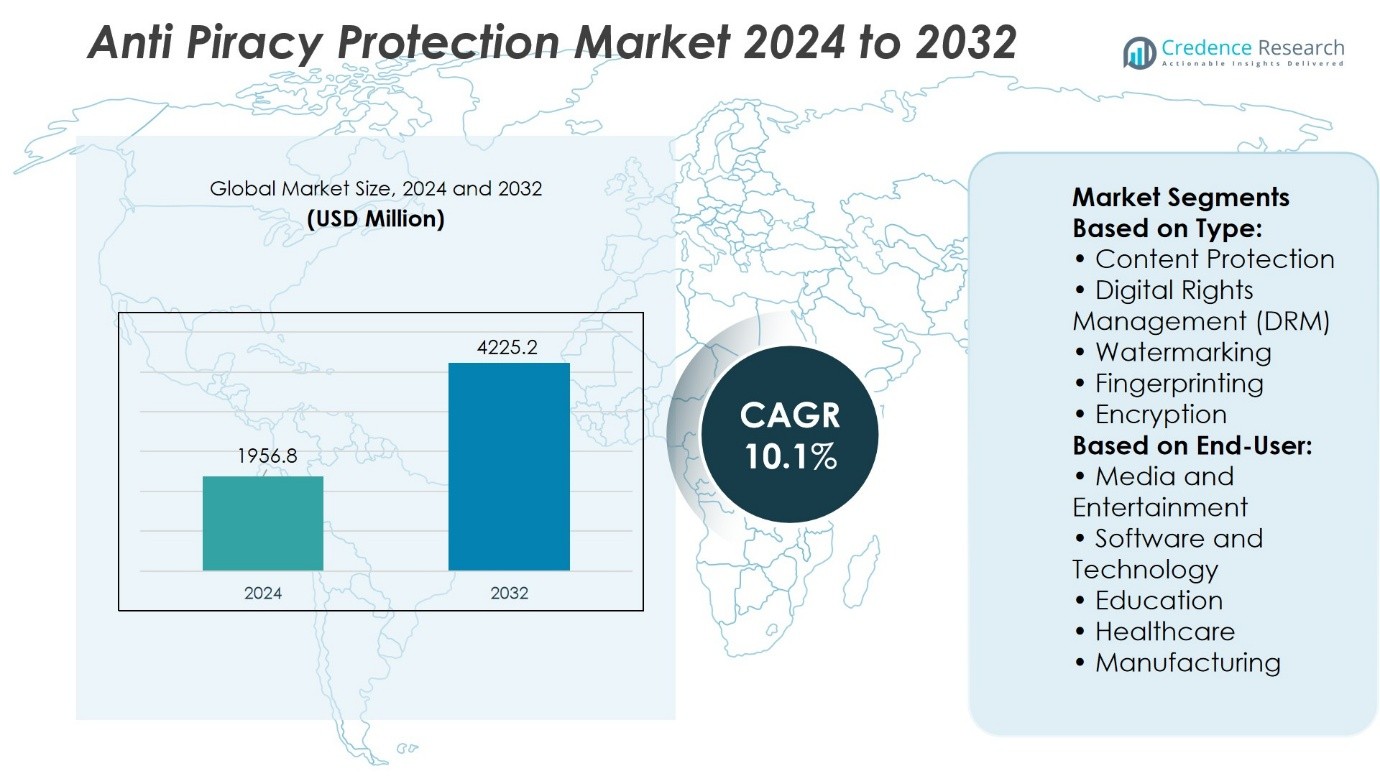
Anti-Piracy Protection Market size was valued at USD 1956.8 million in 2024 and is anticipated to reach USD 4225.2 million by 2032, at a CAGR of 10.1% during the forecast period.
| REPORT ATTRIBUTE | DETAILS |
|---|---|
| Historical Period | 2020-2024 |
| Base Year | 2024 |
| Forecast Period | 2025-2032 |
| Anti-Piracy Protection Market Size 2024 | USD 1956.8 Million |
| Anti-Piracy Protection Market, CAGR | 10.1% |
| Anti-Piracy Protection Market Size 2032 | USD 4225.2 Million |
The Anti-Piracy Protection Market grows on rising digital piracy across entertainment, software, and e-learning platforms, driving stronger adoption of content protection systems. It benefits from regulatory enforcement and industry-wide focus on intellectual property compliance. Advancements in digital rights management, forensic watermarking, and encryption strengthen security frameworks for global enterprises. It also reflects a trend toward AI and machine learning integration that improves detection speed and accuracy. Expanding demand for cloud-based solutions supports scalable and flexible coverage, while collaborations between regulators and technology providers enhance enforcement efficiency across diverse digital ecosystems.
The Anti-Piracy Protection Market shows strong adoption in North America and Europe due to advanced enforcement frameworks, while Asia-Pacific emerges as a high-growth region driven by rising digital consumption. Latin America and the Middle East & Africa display steady demand with increasing regulatory support. Key players strengthen global presence through innovation and partnerships, including McAfee LLC, Irdeto, Verimatrix, Synamedia, Castlabs, Friend MTS Limited, Brightcove Inc, APP Global, PallyCon (INKA ENTWORKS), and Vobile.
Market Insights
- The Anti-Piracy Protection Market size was valued at USD 1956.8 million in 2024 and is projected to reach USD 4225.2 million by 2032, growing at a CAGR of 10.1%.
- Rising incidents of digital piracy across entertainment, software, and e-learning platforms drive the demand for stronger content protection solutions.
- Advancements in digital rights management, forensic watermarking, and encryption enhance security frameworks for enterprises across multiple industries.
- Competitive dynamics focus on innovation, service integration, and partnerships, with global players expanding their reach through advanced technologies.
- High costs of implementation and limited awareness among smaller enterprises act as restraints to wider adoption.
- North America and Europe lead adoption due to strict enforcement frameworks, while Asia-Pacific shows fastest growth supported by rising digital consumption.
- Latin America and the Middle East & Africa display steady adoption with growing regulatory support and increasing reliance on cloud-based protection systems.
Market Drivers
Rising Incidents of Digital Piracy Across Entertainment and Software Sectors
The Anti-Piracy Protection Market gains traction from the growing volume of illegal content distribution in films, music, gaming, and software. It responds to increasing cases of copyright infringement where unauthorized platforms host or distribute premium content. The rise of global streaming platforms has intensified the need for robust protection against illegal downloads and unauthorized streams. It ensures that media companies safeguard intellectual property and reduce substantial revenue losses from piracy. Expanding internet penetration in developing regions has further elevated the risks of illicit file sharing. It strengthens demand for comprehensive anti-piracy tools that provide visibility, detection, and takedown services.
- For instance, Muso recorded 17 billion visits to music piracy websites even without discussing percentages, this concrete total underscores how music piracy continues to escalate in absolute terms.
Advancements in Content Protection Technologies Supporting Secure Delivery
The Anti-Piracy Protection Market benefits from innovations in digital rights management, forensic watermarking, and blockchain authentication. It leverages these tools to prevent tampering with copyrighted materials and secure distribution channels. Companies deploy forensic watermarking to trace pirated content back to its source with high precision. It enhances accountability by linking unique identifiers to users or devices involved in illegal activity. Secure encryption protocols allow businesses to protect streaming services and software access. It ensures a stronger digital ecosystem where content providers maintain control over distribution.
- For instance, Intel’s High-bandwidth Digital Content Protection (HDCP) assigns unique 56-bit keys to each licensed device, enabling encrypted data transmission and strict device authentication to prevent unauthorized playback.
Expanding Regulatory Enforcement and Global Intellectual Property Laws
The Anti-Piracy Protection Market experiences growth through stricter international frameworks designed to protect intellectual property. It is supported by national governments that introduce tougher penalties against content piracy and mandate compliance with copyright laws. Trade agreements increasingly include digital rights protection as a priority, reinforcing the legal environment for enforcement. It creates favorable conditions for solution providers to deliver compliant services to industries vulnerable to piracy. Stronger cooperation among law enforcement, regulators, and private firms improves takedown efficiency. It accelerates the adoption of anti-piracy measures across multiple sectors.
Increasing Dependence on Digital Platforms Driving Need for Piracy Safeguards
The Anti-Piracy Protection Market expands as industries shift critical operations and services toward digital channels. It addresses vulnerabilities associated with streaming, e-commerce, e-learning, and cloud-based platforms that face rising piracy risks. Growing consumer preference for digital consumption creates greater exposure to piracy threats if left unprotected. It enables enterprises to safeguard brand reputation, customer trust, and profitability. Heightened competition in digital services highlights the necessity of maintaining secure environments. It drives continuous investment in advanced anti-piracy systems that deliver rapid detection and enforcement.
Market Trends
Growing Adoption of AI and Machine Learning for Piracy Detection
The Anti-Piracy Protection Market advances through the integration of AI and machine learning tools for faster detection of illegal content. It applies predictive analytics to identify suspicious traffic patterns across streaming and file-sharing platforms. Automated crawlers scan millions of websites daily to uncover unauthorized links and downloads. It reduces manual intervention and accelerates the takedown process for pirated content. Machine learning models continuously refine detection accuracy based on evolving piracy techniques. It positions AI-enabled solutions as critical assets in the fight against digital infringement.
- For instance, ScoreDetect’s AI-driven platform is integrated with over 6,000 web applications, enabling comprehensive content scanning and proactive piracy detection across diverse digital channels.
Rising Demand for Cloud-Based Anti-Piracy Solutions Across Enterprises
The Anti-Piracy Protection Market sees an uptrend in the deployment of cloud-based security platforms designed to handle large-scale piracy incidents. It allows enterprises to integrate scalable protection without extensive infrastructure investment. Cloud-enabled solutions provide real-time monitoring across multiple regions, improving response times against piracy threats. It strengthens coverage for industries operating globally, including entertainment, e-learning, and software services. Centralized dashboards deliver actionable insights that help companies manage piracy risks more effectively. It drives sustained preference for flexible and remotely managed protection systems.
- For instance, Verimatrix’s Secure Delivery Platform-its cloud-based anti-piracy ecosystem integrating Streamkeeper DRM, watermarking, and Counterspy defenses covers content security for more than 1 billion end-users across its customer base, reflecting substantial enterprise-scale deployment of cloud-native protection.
Expansion of Piracy Threats into New Digital Channels and Formats
The Anti-Piracy Protection Market experiences new challenges from the rise of illicit activities in live streaming, mobile apps, and social media platforms. It addresses these threats with advanced watermarking and monitoring technologies. Piracy groups increasingly exploit short-form content channels and peer-to-peer networks to distribute copyrighted material. It compels solution providers to expand their capabilities across multiple digital touchpoints. Growth of hybrid work models and remote digital access also increases exposure to software piracy. It fosters demand for solutions capable of safeguarding both consumer and enterprise ecosystems.
Strong Industry Collaborations Strengthening Global Piracy Enforcement
The Anti-Piracy Protection Market benefits from growing partnerships between technology providers, media companies, and law enforcement agencies. It improves enforcement outcomes by combining resources and expertise across borders. Industry alliances share intelligence networks that accelerate identification of piracy hubs and infringing operators. It enhances efficiency in removing illegal content and disrupting pirate business models. Joint task forces between public and private entities help establish stronger deterrents against repeat offenders. It creates a cooperative environment where anti-piracy efforts gain global momentum and visibility.
Market Challenges Analysis
High Complexity of Piracy Networks and Evasion Tactics
The Anti-Piracy Protection Market faces persistent obstacles due to the sophisticated methods used by piracy groups. It must counter tactics such as mirror websites, encrypted peer-to-peer networks, and hidden servers that continuously adapt to enforcement measures. Cybercriminals leverage global hosting providers and anonymization tools, which complicates jurisdictional enforcement. It requires advanced detection systems that track piracy sources across fragmented digital ecosystems. Constant innovation by illegal operators raises the cost of monitoring and response for service providers. It places continuous pressure on solution developers to remain ahead of fast-evolving piracy techniques.
Cost Constraints and Limited Awareness Among Smaller Enterprises
The Anti-Piracy Protection Market encounters challenges from cost-sensitive organizations that hesitate to invest in protection solutions. It highlights a gap where smaller media firms, software developers, and independent content creators remain vulnerable to piracy. Lack of awareness about the scale of financial and reputational risks reduces adoption among these groups. It limits the reach of anti-piracy services to large corporations with established compliance budgets. Service providers must design affordable, scalable options that cater to small and mid-sized enterprises. It underscores the need for broader education and outreach efforts to drive adoption across diverse user segments.
Market Opportunities
Expanding Role of Emerging Markets in Strengthening Piracy Protection Demand
The Anti-Piracy Protection Market holds significant potential in emerging economies where digital consumption is expanding at a rapid pace. It addresses growing risks from unauthorized streaming, counterfeit software, and unlicensed e-learning platforms. Rising internet penetration in Asia-Pacific, Latin America, and Africa creates opportunities for scalable protection solutions. It enables service providers to deliver localized enforcement strategies tailored to regional content markets. Expanding digital payments and subscription-based services also create an environment where piracy prevention is critical. It positions emerging markets as high-value growth regions for solution developers and enforcement partners.
Integration of Next-Generation Technologies Enhancing Future Adoption
The Anti-Piracy Protection Market finds opportunity in leveraging blockchain, forensic watermarking, and advanced AI for stronger security frameworks. It capitalizes on blockchain’s transparency to authenticate transactions and reduce risks of illegal duplication. Forensic watermarking supports identification of pirated sources with traceable markers embedded in digital content. It creates new avenues for collaboration with content distributors seeking proactive protection. AI-powered systems strengthen monitoring efficiency across large volumes of digital traffic. It opens prospects for solution providers to deliver high-performance anti-piracy platforms with broad cross-industry application.
Market Segmentation Analysis:
Segment Analysis
By Type
The Anti-Piracy Protection Market divides into content protection, digital rights management (DRM), watermarking, fingerprinting, and encryption. Content protection remains a core area where enterprises use multi-layered systems to block unauthorized distribution across websites, streaming platforms, and peer-to-peer networks. It delivers visibility into illegal uploads and strengthens enforcement actions. Digital rights management secures licensed content by controlling access, playback, and duplication across user devices. It ensures that publishers and distributors maintain authority over their digital assets. Watermarking and fingerprinting strengthen traceability by embedding unique identifiers and enabling rapid detection of pirated content. Encryption complements these tools by safeguarding data in transit and storage, ensuring high-value assets remain inaccessible to unauthorized users.
- For instance, Cognizant’s 24/7 anti-piracy service identifies and suppresses 5 million piracy host sites annually, including 65,000 livestream event videos and leaked trailers.
By End-User
The Anti-Piracy Protection Market serves multiple industries, with media and entertainment holding a central role due to widespread risks in films, television, music, and gaming. It helps content owners combat illegal downloads, unauthorized streaming, and counterfeit distribution. Software and technology companies rely on anti-piracy solutions to prevent illegal replication of licensed programs and intellectual property theft. It allows firms to protect revenue streams and maintain brand integrity. Education platforms use these tools to secure digital libraries, e-learning modules, and copyrighted training content. Healthcare organizations depend on anti-piracy protection to safeguard digital patient data and proprietary medical content, reducing exposure to cyber-enabled theft. Manufacturing industries also integrate protection systems to prevent design theft, counterfeit spare parts, and leakage of trade secrets. It highlights the broad scope of anti-piracy protection across both consumer-facing and enterprise-driven applications.
- For instance, Rightscorp represents over 1.5 million copyrighted works, including music, films demonstrating the in-servicing content owners across the and publishing sectors.
Segments:
Based on Type:
- Content Protection
- Digital Rights Management (DRM)
- Watermarking
- Fingerprinting
- Encryption
Based on End-User:
- Media and Entertainment
- Software and Technology
- Education
- Healthcare
- Manufacturing
Based on the Geography:
- North America
- U.S.
- Canada
- Mexico
- Europe
- Germany
- France
- U.K.
- Italy
- Spain
- Rest of Europe
- Asia Pacific
- China
- Japan
- India
- South Korea
- South-east Asia
- Rest of Asia Pacific
- Latin America
- Brazil
- Argentina
- Rest of Latin America
- Middle East & Africa
- GCC Countries
- South Africa
- Rest of the Middle East and Africa
Regional Analysis
North America
North America holds the largest share of the Anti-Piracy Protection Market at 35%, supported by the strong presence of leading technology providers and content distributors in the United States and Canada. It benefits from early adoption of advanced digital rights management systems, forensic watermarking, and encryption solutions. The entertainment sector drives demand, with streaming platforms, gaming companies, and software developers prioritizing secure delivery models. It gains further momentum from strong enforcement frameworks, including the Digital Millennium Copyright Act (DMCA), which supports aggressive takedown initiatives. Healthcare and education sectors also contribute to adoption, as both rely on secure digital platforms to deliver services and manage sensitive data. It demonstrates a mature and innovation-driven environment where piracy prevention forms a critical part of business strategies.
Europe
Europe accounts for 28% of the Anti-Piracy Protection Market, shaped by strict intellectual property regulations under the European Union and national governments. It places strong emphasis on compliance with copyright directives, which has created consistent demand across media, technology, and publishing industries. The region adopts watermarking and fingerprinting solutions extensively to secure television broadcasts, live sports, and pay-per-view events. It benefits from regional collaborations between regulators and private firms that accelerate enforcement actions against piracy networks. The software industry, particularly in Germany, France, and the UK, drives the application of DRM systems to limit illegal replication of licensed products. It establishes Europe as a regulatory-driven and compliance-focused market with steady growth in anti-piracy measures.
Asia-Pacific
Asia-Pacific contributes 22% of the Anti-Piracy Protection Market, fueled by rapid digital transformation, expanding streaming services, and high internet penetration. It faces widespread challenges from unauthorized distribution across social media, peer-to-peer networks, and unlicensed websites. The growing adoption of e-learning platforms and cloud-based software in China, India, Japan, and South Korea drives demand for content security. It supports adoption of encryption and digital rights management tools to counter rising piracy volumes. Regional governments strengthen enforcement measures through cybercrime units and stricter copyright laws, which complement industry-led initiatives. It reflects a high-growth market where technological adoption and enforcement maturity vary widely, creating opportunities for global and regional solution providers.
Latin America
Latin America represents 8% of the Anti-Piracy Protection Market, influenced by growing streaming consumption and persistent piracy in films, sports broadcasting, and software. It shows a strong demand for affordable anti-piracy protection solutions that can adapt to cost-sensitive markets. Countries such as Brazil and Mexico are central to growth, supported by rising digital penetration and increasing enforcement cooperation with international agencies. It faces infrastructure gaps that sometimes limit rapid deployment of advanced solutions but also opens opportunities for cloud-based and managed services. Local content creators and regional broadcasters invest in watermarking to safeguard revenues from live programming. It positions Latin America as an emerging market with rising awareness and adoption of piracy protection systems.
Middle East & Africa
The Middle East & Africa capture 7% of the Anti-Piracy Protection Market, driven by growing investments in digital platforms and entertainment services. It faces significant piracy risks across pay-TV, sports broadcasting, and software distribution. Countries such as the UAE, Saudi Arabia, and South Africa are leading adopters, supported by government-backed initiatives to combat piracy. It focuses on digital rights management and monitoring services to protect content distributed across mobile and satellite channels. The presence of global technology players and regional distributors fosters adoption of secure delivery solutions. It reflects a developing market where piracy control is increasingly recognized as essential for the sustainability of digital industries.
Key Player Analysis
- Brightcove Inc
- Irdeto
- PallyCon (INKA ENTWORKS)
- Vobile
- McAfee LLC
- Castlabs
- Verimatrix
- APP Global
- Friend MTS Limited
- Synamedia
Competitive Analysis
The Anti-Piracy Protection Market features a competitive landscape led by McAfee LLC, Irdeto, Verimatrix, Synamedia, Castlabs, Friend MTS Limited, Brightcove Inc, APP Global, PallyCon (INKA ENTWORKS), and Vobile. The Anti-Piracy Protection Market reflects an environment of intense competition where companies differentiate through technological innovation, service reliability, and global scalability. It emphasizes advanced solutions such as digital rights management, watermarking, fingerprinting, and AI-driven monitoring to address increasingly complex piracy threats. Firms invest heavily in research and development to enhance detection speed, takedown efficiency, and integration with streaming, software, and enterprise platforms. It shows strong reliance on partnerships with media companies, broadcasters, and regulators to strengthen enforcement and expand market presence. Competitive dynamics also highlight the importance of cloud-based solutions that deliver flexible, scalable protection across industries. It positions innovation in blockchain, real-time monitoring, and forensic watermarking as critical factors that influence leadership and long-term customer adoption in the market.
Recent Developments
- In 2024, Irdeto won the Anti-Piracy category in the Cybersecurity Excellence Awards for Irdeto Irdeto-developed end-to-end suite of content protection solutions.
- In September 2024, Verimatrix’s Counterspy anti-piracy award-winning service underscored its power to combat digital piracy.
Market Concentration & Characteristics
The Anti-Piracy Protection Market demonstrates moderate concentration, with a mix of global leaders and specialized regional firms shaping competition. It is characterized by a strong presence of technology-driven companies that provide digital rights management, watermarking, fingerprinting, and encryption services. Leading firms maintain extensive portfolios covering content protection for media, software, gaming, and live broadcasting, while smaller providers focus on niche applications such as e-learning or healthcare. It highlights continuous innovation as vendors integrate AI, machine learning, and blockchain to counter sophisticated piracy networks. Strategic partnerships with media companies, broadcasters, and regulators define competitive dynamics and strengthen enforcement capacity. It reflects a market where high technological entry barriers, regulatory compliance demands, and strong customer reliance on long-term contracts secure the position of established players while leaving space for agile firms offering specialized and cost-efficient solutions.
Report Coverage
The research report offers an in-depth analysis based on Type, End-User and Geography. It details leading market players, providing an overview of their business, product offerings, investments, revenue streams, and key applications. Additionally, the report includes insights into the competitive environment, SWOT analysis, current market trends, as well as the primary drivers and constraints. Furthermore, it discusses various factors that have driven market expansion in recent years. The report also explores market dynamics, regulatory scenarios, and technological advancements that are shaping the industry. It assesses the impact of external factors and global economic changes on market growth. Lastly, it provides strategic recommendations for new entrants and established companies to navigate the complexities of the market.
Future Outlook
- The Anti-Piracy Protection Market will expand with stronger demand from streaming platforms and digital publishers.
- It will integrate advanced AI and machine learning to detect piracy with higher accuracy.
- Cloud-based security solutions will gain preference for scalability and real-time monitoring.
- It will see rising adoption of blockchain technology for content authentication and transaction security.
- Growing collaboration between regulators and private firms will enhance enforcement efficiency.
- It will benefit from stricter global intellectual property laws and compliance frameworks.
- Demand from e-learning, software, and healthcare sectors will increase adoption beyond entertainment.
- It will prioritize forensic watermarking and fingerprinting for live sports and premium video protection.
- Emerging markets with rising digital consumption will create new opportunities for providers.
- It will remain driven by continuous innovation as piracy networks evolve with advanced tactics.

Request a Free Sample
Fill in your details and we'll send you a free sample report.
- Sample data tables & charts
- Research methodology
Need a Custom Version of This Report?
Tailor the scope, geography, or segments to your exact requirements.
- Custom geography or segment scope
- Direct access to our analyst team
Frequently Asked Questions
What is the current market size for Anti-Piracy Protection Market, and what is its projected size in 2032?
At what Compound Annual Growth Rate is the Anti-Piracy Protection Market projected to grow between 2025 and 2032?
Which Anti-Piracy Protection Market segment held the largest share in 2024?
What are the primary factors fueling the growth of the Anti-Piracy Protection Market?
Who are the leading companies in the Anti-Piracy Protection Market?
Which region commanded the largest share of the Anti-Piracy Protection Market in 2024?
Table of Content
Chapter 1. Report Introduction
- 1.1 Report Description & Purpose
- 1.1.1 Report Title & Market Definition
- 1.1.2 Unique Selling Propositions (USP) & Key Differentiators
- 1.1.3 Value Proposition for Stakeholders
- 1.2 Research Objectives
- 1.2.1 Market Sizing Objectives (Volume & Revenue) (Volume Where Applicable)
- 1.2.2 Segmentation Objectives
- 1.2.3 Competitive Intelligence Objectives
- 1.2.4 Forecast & Scenario Objectives
- 1.3 Report Scope
- 1.3.1 Anti-Piracy Protection Scope – Segments & Subsegments Covered
- 1.3.2 Geographic Scope – Regions & Countries Covered
- 1.3.3 Historical Period, Base Year & Forecast Period (2024; forecast to 2032)
- 1.3.4 Inclusions & Exclusions
- 1.4 Industry Classification & Applicable Codes
- 1.5 Currency, Measurement Units & Valuation Basis
- 1.6 Target Stakeholders
- 1.7 Limitations & Assumptions
Chapter 2. Executive Summary
- 2.1 Global Anti-Piracy Protection Market Snapshot
- 2.1.1 Market Size – Historical (2024) & Forecast (2024-2032) (2024: USD 1956.8 million → 2032: USD 4225.2 million)
- 2.1.2 Volume & Revenue – Global Totals (Volume Where Applicable)
- 2.1.3 Key Market Highlights – Top Five Facts
- 2.2 Anti-Piracy Protection Market Segmentation Snapshot
- 2.2.1 Market Split by Region – 2024 vs. 2032
- 2.3 Competitive Snapshot
- 2.3.1 Top 10 Players by Revenue Share – 2024
- 2.3.2 Top 10 Players by Volume Share – 2024 (Volume Where Applicable)
- 2.3.3 Recent Strategic Developments (18-Month Summary)
- 2.4 Key Investment Highlights & Strategic Conclusions
Chapter 3. Anti-Piracy Protection Market Dynamics & Industry Analysis
- 3.1 Market Overview & Context
- 3.1.1 Anti-Piracy Protection Market Position in the Broader Industry Value Chain
- 3.1.2 Demand Structure & Purchasing Dynamics
- 3.1.3 Market Maturity & Development Stage by Region
- 3.2 Anti-Piracy Protection Market Drivers
- 3.3 Anti-Piracy Protection Market Restraints & Challenges
- 3.4 Anti-Piracy Protection Market Opportunities
- 3.5 Porter's Five Forces Analysis
- 3.5.1 Threat of New Entrants
- 3.5.2 Bargaining Power of Suppliers
- 3.5.3 Bargaining Power of Buyers
- 3.5.4 Threat of Substitutes
- 3.5.5 Competitive Rivalry – Intensity Assessment
- 3.6 Anti-Piracy Protection Value Chain Analysis
- 3.6.1 Upstream – Key Inputs, Resources & Suppliers
- 3.6.1.1 Key Input/Resource 1
- 3.6.1.2 Key Input/Resource 2
- 3.6.1.3 Key Input/Resource 3
- 3.6.2 Midstream – Core Operations & Value Creation
- 3.6.2.1 Operating Model & Process Overview
- 3.6.2.2 Key Operating Locations & Capabilities by Company
- 3.6.3 Downstream – Market Channels & End Users
- 3.6.3.1 Direct Sales & Customer Engagement Channels
- 3.6.3.2 Indirect Sales, Intermediaries & Partner Channels
- 3.6.4 Value Chain Profitability Analysis
- 3.6.1 Upstream – Key Inputs, Resources & Suppliers
- 3.7 PESTEL Analysis
- 3.7.1 Political Factors
- 3.7.2 Economic Factors
- 3.7.3 Social Factors
- 3.7.4 Technological Factors
- 3.7.5 Environmental Factors
- 3.7.6 Legal Factors
- 3.8 Anti-Piracy Protection Supply Chain Analysis
- 3.8.1 Critical Input & Resource Availability Risk Assessment
- 3.8.2 Supplier & Operational Concentration Risk (Geographic Exposure)
- 3.8.3 Supply & Service Disruption Impact Analysis
- 3.9 Regulatory & Policy Landscape
Note: The regulatory and policy landscape section covers regulations based on their applicability to the market, Anti-Piracy Protection category, geography, and scope of the study. Only regulatory frameworks with a material impact on operations, compliance, trade, sustainability, or market access are analyzed in detail.
Chapter 4. Key Investment Pockets & Opportunity Analysis
- 4.1 Anti-Piracy Protection Market Attractiveness Analysis
- 4.1.1 By Region – Investment Attractiveness Matrix (Market Size × CAGR)
- 4.2 Absolute Revenue Growth Opportunity
- 4.2.1 By Region – Absolute Revenue Growth Through 2032
- 4.3 Incremental Demand Opportunity
- 4.3.1 By Region – Incremental Demand Through 2032
- 4.3.2 Segment – Incremental Demand
- 4.4 Emerging Submarket Opportunity Deep Dive (Subject to Applicability)
- 4.5 Priority Market Opportunity Scorecards
- 4.5.1 United States
- 4.5.2 Europe
- 4.5.3 Asia
- 4.5.4 Middle East & Africa
Note: Priority market opportunity scorecards reflect the geographic scope and strategic relevance of the study. Listed markets are indicative and may be adapted to the industry.
Chapter 5. Anti-Piracy Protection Cross-Border Trade & Market Access Analysis
- 5.1 International Trade & Cross-Border Activity Overview
- 5.1.1 Global Export Value by Country (2024)
- 5.1.2 Global Export Volume by Country (2024) (Volume Where Applicable)
- 5.1.3 Global Import Value by Country (2024)
- 5.1.4 Global Import Volume by Country (2024) (Volume Where Applicable)
- 5.1.5 Net Trade Balance by Country (2024)
- 5.2 Export Analysis – Segment
- 5.2.1 Category 1 (Applicable Classification Code)
- 5.2.2 Category 2 (Applicable Classification Code)
- 5.2.3 Category 3 (Applicable Classification Code)
- 5.2.4 Category 4 (Applicable Classification Code)
- 5.2.5 Category 5 (Applicable Classification Code)
- 5.3 Import Analysis – Segment
- 5.3.1 Category 1 (Applicable Classification Code)
- 5.3.2 Category 2 (Applicable Classification Code)
- 5.3.3 Category 3 (Applicable Classification Code)
- 5.3.4 Category 4 (Applicable Classification Code)
- 5.3.5 Category 5 (Applicable Classification Code)
- 5.4 Cross-Border Pricing & Transaction Benchmarks
- 5.4.1 Export Pricing – Segment & Country
- 5.4.2 Import Pricing – Segment & Source Country
- 5.4.3 Price Trends (2024)
- 5.5 Key Cross-Border Trade & Delivery Routes
- 5.5.1 Cross-Border Trade/Delivery Route 1
- 5.5.2 Cross-Border Trade/Delivery Route 2
- 5.5.3 Cross-Border Trade/Delivery Route 3
- 5.5.4 Cross-Border Trade/Delivery Route 4
- 5.5.5 Cross-Border Trade/Delivery Route 5
- 5.6 Trade Policy & Market Access Impact Assessment
- 5.6.1 Tariff & Non-Tariff Barriers
- 5.6.2 Regional Trade & Economic Integration Frameworks
- 5.6.3 Bilateral & Multilateral Trade Agreements
- 5.6.4 Cross-Border Operating, Licensing & Localization Requirements
Note: This chapter applies where cross-border trade or delivery is relevant to Anti-Piracy Protection. Goods, services, and digital offerings are assessed using applicable classifications and transaction measures. Import-export volumes, trade balances, and route analyses are included only where meaningful to the market.
Chapter 6. Competitive Landscape & Company Benchmarking
- 6.1 Anti-Piracy Protection Market Concentration & Structure
- 6.1.1 Herfindahl-Hirschman Index (HHI) – vs. 2024
- 6.1.2 Leading, Mid-Sized & Emerging Player Structure
- 6.1.3 Global, Regional & Local Player Dynamics
- 6.2 Anti-Piracy Protection Market Share Analysis – 2024
- 6.2.1 Global Revenue Share by Company
- 6.2.2 Global Volume Share by Company (Volume Where Applicable)
- 6.2.3 Regional Revenue Share
- 6.2.4 Market Share Evolution ( vs. 2024)
- 6.2.5 Company Market Share by Key Segment
- 6.2.6 Company Market Share by Customer Group
- 6.3 Operating Scale, Capacity & Infrastructure Analysis
- 6.3.1 Global Operating Scale & Supply Capacity
- 6.3.2 Resource Utilization & Operating Efficiency
- 6.3.3 Output, Service Delivery & Activity Metrics
- 6.3.4 Operating Footprint & Infrastructure Map
- 6.3.5 Planned Operational & Capacity Expansion
- 6.4 Anti-Piracy Protection Competitive Benchmarking Matrix
- 6.4.1 Revenue, Growth, Profitability & Operating Metric Comparison
- 6.4.2 Channel Revenue Mix
- 6.4.3 Geographic Revenue Exposure
- 6.4.4 R&D Intensity
- 6.4.5 Sustainability Maturity
- 6.5 Strategic Developments in Anti-Piracy Protection (Last 24 Months)
- 6.5.1 Mergers, Acquisitions & Divestments
- 6.5.2 New Products, Services & Solutions in Anti-Piracy Protection
- 6.5.3 Operational & Infrastructure Expansions
- 6.5.4 Strategic Alliances, Joint Ventures & Partnerships
- 6.5.5 Distribution Expansion & Market Entry
- 6.5.6 Sustainability & ESG Initiatives
- 6.6 Competitive Strategy Mapping
- 6.6.1 Leader, Challenger, Follower & Niche Classification
- 6.6.2 Pricing Strategy Comparison
- 6.6.3 Channel Strategy Matrix
Note: Strategic developments are included based on their materiality and the availability of reliable information.
Chapter 7. Global Anti-Piracy Protection Market – By Sales & Delivery Channel
- 7.1 Segment Overview
- 7.1.1 Volume & Revenue Split by Channel (2024 & 2032) (Volume Where Applicable)
- 7.1.2 Channel Mix Evolution (2024-2032)
Chapter 8. Regional Market Analysis – Global Overview
- 8.1 Global Regional Overview
- 8.1.1 Regional Volume Share (Volume Where Applicable)
- 8.1.2 Regional Revenue Share
- 8.1.3 Regional Volume by Region (Volume Where Applicable)
- 8.1.4 Regional Revenue by Region
- 8.1.5 Regional Forecast Through 2032
- 8.2 Cross-Regional Segment Analysis
- 8.2.1 By Sales & Delivery Channel
- 8.2.2 By Competitive Positioning & Price Tier
Chapter 9. North America Anti-Piracy Protection Market
- 9.1 United States
- 9.2 Canada
- 9.3 Mexico
Chapter 10. Europe Anti-Piracy Protection Market
- 10.1 Germany
- 10.2 France
- 10.3 Italy
- 10.4 United Kingdom
- 10.5 Spain
- 10.6 Poland
- 10.7 Russia
- 10.8 Netherlands
- 10.9 Belgium
- 10.10 Sweden
- 10.11 Denmark
- 10.12 Norway
- 10.13 Rest of Europe
Chapter 11. Asia Pacific Anti-Piracy Protection Market
- 11.1 China
- 11.2 India
- 11.3 Japan
- 11.4 South Korea
- 11.5 Thailand
- 11.6 Indonesia
- 11.7 Vietnam
- 11.8 Malaysia
- 11.9 Australia
- 11.10 Rest of Asia Pacific
Chapter 12. Latin America Anti-Piracy Protection Market
- 12.1 Brazil
- 12.2 Argentina
- 12.3 Colombia
- 12.4 Chile
- 12.5 Rest of Latin America
Chapter 13. Middle East Anti-Piracy Protection Market
- 13.1 Saudi Arabia
- 13.2 United Arab Emirates
- 13.3 Turkey
- 13.4 Israel
- 13.5 Iran
- 13.6 Rest of the Middle East
Chapter 14. Africa Anti-Piracy Protection Market
- 14.1 South Africa
- 14.2 Egypt
- 14.3 Nigeria
- 14.4 Morocco
- 14.5 Rest of Africa
Chapter 15. Anti-Piracy Protection Company Profiles
- 15.1 [Company 01]
- 15.1.1 Company Overview
- 15.1.2 Key Management Personnel
- 15.1.3 Products & Services Portfolio
- 15.1.4 Financial Performance
- 15.1.5 Key Market Focus & Geographic Presence
- 15.1.6 Recent Developments & Strategic Initiatives
Note: The company profile list is preliminary and may change based on research findings, market developments, data availability, and client requirements.
Chapter 16. Appendices
- Appendix A – List of Abbreviations & Acronyms
- Appendix B – Industry Classification Code Reference – Full Series
- Appendix C – Supply, Output & Operating Capacity Data Tables
- Appendix D – End-Use & Demand Base Tables
- Appendix E – Demand, Adoption & Usage Assumptions
- Appendix F – Pricing & Revenue Metric Reference Tables
- Appendix G – Company Operations & Infrastructure Database
- Appendix H – Cross-Border Trade & Activity Data Tables (Where Applicable)
- Appendix I – Regulatory Summary Tables
- Appendix J – Primary Research Participant List (Anonymized)
- Appendix K – Primary Research Questionnaire Framework
- Appendix L – Data Sources & Bibliography
- Appendix M – Market Size Divergence & Source Comparison
Chapter 17. Research Methodology
- 17.1 Research Framework & Philosophy
- 17.2 Secondary Research – Sources, Hierarchy & Data Extraction
- 17.3 Data Modeling – Bottom-Up & Top-Down Market Sizing
- 17.4 Primary Research – Stakeholder Framework, LOI & Sample Sizes
- 17.5 Forecast Methodology – Regression, Scenario & Sensitivity Analysis
- 17.6 Quality Control – Four-Layer Validation Framework
- 17.7 Limitations & Standard Assumptions
- 17.8 Disclaimer