Antifouling Coatings Market Overview:
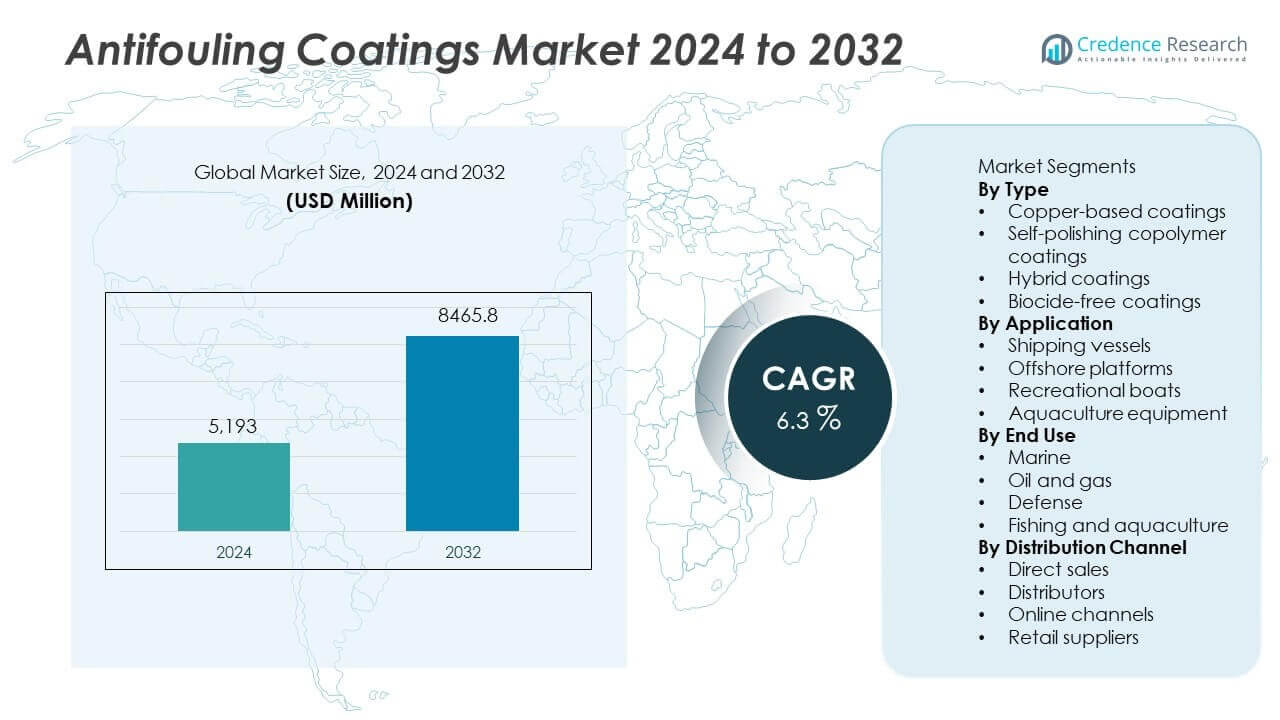
The Antifouling Coatings market size stood at USD 5,193 million in 2024. Analysts expect the value to reach USD 8,465.8 million by 2032, supported by a CAGR of 6.3% during the forecast period.
| REPORT ATTRIBUTE | DETAILS |
|---|---|
| Historical Period | 2020-2023 |
| Base Year | 2024 |
| Forecast Period | 2025-2032 |
| Antifouling Coatings Market Size 2024 | USD 5,193 million |
| Antifouling Coatings Market, CAGR | 6.3% |
| Antifouling Coatings Market Size 2032 | USD 8,465.8 million |
Antifouling Coatings Market Insights
- Demand rises as vessel operators focus on fuel savings and reduced drag, with copper-based coatings leading the market at 42% due to strong antifouling performance.
- Eco-friendly and biocide-free coatings gain momentum as regulations tighten and marine sustainability goals increase, pushing growth in hybrid and self-polishing formulations.
- Key players expand portfolios and global reach, while high coating and dry-docking costs limit adoption in price-sensitive markets.
- Asia Pacific leads with a 34% share, followed by Europe at 32% and North America at 27%, supported by active shipbuilding, offshore expansion, and rising marine trade.
Antifouling Coatings Market Segmentation Analysis:
By Type
Copper-based coatings lead the Antifouling Coatings market with a 42% share, driven by strong marine usage and proven protection against biofouling in harsh sea environments. Self-polishing copolymer coatings gain traction due to controlled biocide release and longer service life, reducing maintenance downtime. Hybrid coatings continue to expand as manufacturers blend advanced polymers and biocides for improved fuel efficiency and durability. Biocide-free coatings grow steadily in response to environmental regulations and customer demand for sustainable solutions. Rising vessel traffic and stricter fuel efficiency standards support long-term demand across all coating types.
- For instance, Hempel’s hybrid solutions demonstrated minimal speed loss over a multi-year trial period.
By Application
Shipping vessels dominate the Antifouling Coatings market with a 58% share, supported by fleet expansion, rising international trade, and the need to reduce drag and fuel consumption. Offshore platforms follow as operators invest in long-lasting protective layers for structural performance and corrosion resistance. Recreational boats drive seasonal demand in coastal regions and tourism hubs. Aquaculture equipment expands usage as farms seek to limit algae and organism buildup. Growth across applications is supported by environmental rules, higher marine operating costs, and strong focus on operational efficiency and asset protection.
- For instance, Boero Group supplied hull systems to a large number of leisure boats in Europe, shipping product packages to a significant number of customers across many countries in a recent reporting period.
By End Use
The marine sector holds a 64% share of the Antifouling Coatings market due to heavy coating adoption across cargo ships, tankers, and passenger fleets. Oil and gas assets require high-performance antifouling protection for offshore rigs and subsea structures, maintaining steady demand. Defense fleets continue to invest in advanced coatings to improve vessel readiness and reduce maintenance cycles. Fishing and aquaculture operators expand adoption to minimize fouling-related losses and equipment wear. Long-term growth across end uses is supported by rising sea trade, modernization efforts, and global focus on reducing marine fuel emissions.
Key Growth Drivers
Rising Global Maritime Trade
Expanding international seaborne trade is a major growth driver for antifouling coatings as shipping fleets continue to grow in size and operational frequency. Higher vessel movement increases biofouling risk, raising the need for long-lasting protective coatings to reduce drag and enhance fuel efficiency. Shipping operators adopt advanced antifouling solutions to lower operational costs and improve turnaround time. Increased commercial activity in developing regions also contributes to higher coating consumption. These factors collectively support stronger product demand across cargo ships, tankers, and container vessels.
- For instance, AkzoNobel supplied antifouling systems for more than 3,500 active merchant vessels in 2023, supporting global fleet movement.
Focus on Fuel Efficiency and Emission Reduction
Eco-driven performance goals accelerate antifouling coating usage as marine operators work to reduce emissions and fuel consumption. Fouling buildup significantly increases hull friction, raising engine load and fuel usage. Modern antifouling coatings help limit resistance and improve hydrodynamics, supporting lower operating costs. The shift toward high-performance and self-polishing coatings aligns with international emission standards such as IMO regulations. Rising fuel prices further encourage investment in coatings that extend service intervals and reduce lifecycle expenses.
- For instance, Jotun recorded drag reduction equal to 9,000 tons of annual fuel savings across treated vessels.
Growth in Offshore Infrastructure and Aquaculture
Expansion in offshore oil, gas, wind energy, and aquaculture contributes to higher antifouling coating demand. Offshore structures face severe marine exposure, increasing the need for durable protection to prevent organism buildup and corrosion. Aquaculture nets, cages, and equipment also depend on coatings to maintain water flow efficiency and structural reliability. Growing seafood production and offshore energy development strengthen long-term consumption patterns. These applications broaden the market beyond traditional vessel usage and improve revenue diversification.
Key Trends & Opportunities
Shift Toward Eco-Friendly and Biocide-Free Coatings
Environmental regulations and sustainability goals drive development of biocide-free antifouling coatings that reduce ecological impact. Manufacturers invest in advanced polymer technologies, silicone-based systems, and foul-release solutions to replace traditional copper-based products. Growing support from regulatory bodies and marine operators accelerates adoption. This shift opens new market opportunities by aligning product design with global environmental priorities, while reducing compliance risk.
- For instance, Chugoku Marine Paints deployed biocide-free hull systems across 1,200 vessels in 2023, using silicone release layers for foul prevention.
Growth in High-Performance Hybrid and Self-Polishing Solutions
Hybrid and self-polishing coatings offer strong opportunities by improving service life, lowering maintenance frequency, and enhancing performance under varying seawater conditions. These solutions combine multiple active components and polymer structures to extend wear resistance and maintain smooth hull surfaces. Demand continues rising among commercial fleets and offshore assets seeking predictable protection and cost savings. Advances in formulation science and product testing are expected to support stronger market penetration.
- For instance, PPG verified that its fouling release coatings maintained surface smoothness and significant fuel efficiency during extensive field trials on a large fleet of commercial vessels.
Key Challenges
Strict Environmental and Regulatory Compliance Requirements
Antifouling coatings face regulatory pressure due to potential marine toxicity and environmental risks associated with biocide release. Compliance with IMO, EPA, and regional rules increases complexity for manufacturers and may limit certain ingredients. Reformulation costs, testing procedures, and approval delays impact product development timelines. This environment poses barriers to market entry and increases operational expense.
High Cost of Advanced Coatings and Application Processes
Premium antifouling solutions involve higher manufacturing and application costs, increasing budget pressures for vessel owners and offshore operators. Surface preparation, labor, and dry-docking requirements add to overall expense. Cost sensitivity remains especially strong among smaller fleets and in price-driven markets. Limited access to advanced technologies may slow adoption, particularly in emerging regions.
Regional Analysis
North America
North America holds a 27% share of the Antifouling Coatings market, supported by strong demand from commercial fleets, offshore platforms, and defense vessels. The region benefits from ongoing naval modernization, robust marine infrastructure, and expanding coastal trade routes. Strict environmental regulations drive adoption of advanced, low-toxicity coatings, while higher dry-docking and maintenance standards reinforce sustained product use. Growing interest in energy-efficient vessels and emerging offshore wind projects further boosts demand. Investments in R&D and coatings innovation also strengthen the region’s long-term market prospects.
Europe
Europe accounts for a 32% share of the Antifouling Coatings market, driven by large commercial shipping operations, advanced marine technology adoption, and strong regulatory oversight. The region sees high usage of eco-friendly coatings as operators comply with biocide restrictions and emission targets. Shipyards and repair facilities support consistent coating activity across the Mediterranean and North Sea. Naval fleet upgrades and offshore oil, gas, and wind activities add momentum. Increased focus on performance efficiency and sustainable marine practices reinforces Europe’s dominant position.
Asia Pacific
Asia Pacific leads the Antifouling Coatings market with a 34% share, fueled by large-scale shipbuilding capacity, expanding export trade, and high vessel traffic. Countries such as China, Japan, and South Korea drive strong marine production and repair activity, supporting steady coating consumption. Rapid offshore oil, gas, and aquaculture growth also increases application scope. Cost-effective manufacturing and rising technology adoption enhance regional competitiveness. Continued investment in marine infrastructure and international shipping routes strengthens long-term demand.
Latin America
Latin America holds a 5% share of the Antifouling Coatings market supported by regional shipping activity, fishing industries, and offshore oil operations. Brazil, Mexico, and Chile lead coating consumption as marine transport and export volume grow. Market progress is influenced by vessel maintenance needs, climate exposure, and increasing interest in product durability. Economic fluctuations and limited access to advanced options slow broader adoption. However, expanding trade routes and offshore exploration offer growth potential.
Middle East & Africa
The Middle East & Africa region represents a 2% share of the Antifouling Coatings market, driven by marine logistics, offshore petroleum assets, and naval operations. Rising port development and coastal transport activity support steady coating use. Warmer sea conditions intensify fouling risks, encouraging investment in durable solutions. Budget pressures and limited technology access restrict high-performance uptake in some areas, though urban coastal hubs show stronger demand. Emerging maritime trade and infrastructure development support gradual market expansion.
Antifouling Coatings Market Segmentations:
By Type
- Copper-based coatings
- Self-polishing copolymer coatings
- Hybrid coatings
- Biocide-free coatings
By Application
- Shipping vessels
- Offshore platforms
- Recreational boats
- Aquaculture equipment
By End Use
- Marine
- Oil and gas
- Defense
- Fishing and aquaculture
By Distribution Channel
- Direct sales
- Distributors
- Online channels
- Retail suppliers
By Geography
- North America
- U.S.
- Canada
- Mexico
- Europe
- Germany
- France
- U.K.
- Italy
- Spain
- Rest of Europe
- Asia Pacific
- China
- Japan
- India
- South Korea
- South-east Asia
- Rest of Asia Pacific
- Latin America
- Brazil
- Argentina
- Rest of Latin America
- Middle East & Africa
- GCC Countries
- South Africa
- Rest of the Middle East and Africa
Competitive Landscape
Competitive landscape analysis shows leading companies such as AkzoNobel, Jotun, Hempel, PPG Industries, Kansai Paint, Nippon Paint Marine, BASF, Sherwin-Williams, Chugoku Marine Paints, and Boero Group shaping market performance through product innovation, sustainability focus, and strong global distribution. Many companies continue to invest in biocide-free and foul-release technologies to align with environmental regulations and customer demand for greener solutions. Advanced polymer science, enhanced durability, and fuel-saving benefits support technology differentiation. Strategic partnerships with shipyards and maintenance service providers strengthen market access and long-term coating cycles. Rising investment in self-polishing and hybrid coating platforms positions major players for competitive advantage. Companies also expand presence in Asia Pacific to capture strong shipbuilding and export activity. Ongoing R&D, portfolio diversification, and compliance-driven reformulation continue to shape the evolving competitive environment.
Key Player Analysis
- AkzoNobel
- Jotun
- Hempel
- PPG Industries
- Kansai Paint
- Nippon Paint Marine
- BASF SE
- Sherwin-Williams
- Chugoku Marine Paints
- Boero Group
Recent Developments
- In October 2025, Hempel expanded its self-polishing copolymer antifouling range in Asia-Pacific, improving service intervals for commercial vessels.
- In May 2025, Jotun launched an AI-powered hull performance solution tied to its antifouling coatings to cut fuel use and emissions.
- In 2025, Kansai Paint maintained global supply of its TAKATA QUANTUM antifouling paint with strong fuel-saving performance.
Report Coverage
The research report offers an in-depth analysis based on Type, Application, End Use, Distribution Channel and Geography. It details leading market players, providing an overview of their business, product offerings, investments, revenue streams, and key applications. Additionally, the report includes insights into the competitive environment, SWOT analysis, current market trends, as well as the primary drivers and constraints. Furthermore, it discusses various factors that have driven market expansion in recent years. The report also explores market dynamics, regulatory scenarios, and technological advancements that are shaping the industry. It assesses the impact of external factors and global economic changes on market growth. Lastly, it provides strategic recommendations for new entrants and established companies to navigate the complexities of the market.
Future Outlook
- Global vessel expansion will increase antifouling coating demand.
- Eco-friendly and biocide-free coatings will gain wider adoption.
- Hybrid and foul-release systems will improve performance and durability.
- Fuel efficiency needs will drive technology upgrades.
- Offshore oil, gas, and wind projects will expand coating usage.
- Ship repair and maintenance cycles will boost recurring sales.
- Digital inspection and monitoring tools will support product selection.
- Asia Pacific shipbuilding growth will strengthen regional demand.
- Regulatory pressure will accelerate reformulation and R&D investment.
- Long-lasting coatings will reduce downtime and extend service intervals.

Request a Free Sample
Fill in your details and we'll send you a free sample report.
- Sample data tables & charts
- Research methodology
Need a Custom Version of This Report?
Tailor the scope, geography, or segments to your exact requirements.
- Custom geography or segment scope
- Direct access to our analyst team
Frequently Asked Questions
What is the current market size for Antifouling Coatings market, and what is its projected size in 2032?
At what Compound Annual Growth Rate is the Antifouling Coatings market projected to grow between 2024 and 2032?
Which Antifouling Coatings market segment held the largest share in 2024?
What are the primary factors fueling the growth of the Antifouling Coatings market?
Who are the leading companies in the Antifouling Coatings market?
Which region commanded the largest share of the Antifouling Coatings market in 2024?
Table of Content
Chapter 1 Market Segmentation
- 1.1 Segmentation Framework
- 1.1.1 Product and Service Classification
- 1.1.2 Application and End-Use Classification
- 1.1.3 Technology and Solution Classification
- 1.1.4 Customer and Distribution Channel Classification
- 1.1.5 Geographic Segmentation
- 1.1.6 Market Segment Definitions and Boundaries
Chapter 2 Introduction
- 2.1 Report Objectives and Scope
- 2.2 Product Definition and Industry Terminology
- 2.3 Market Inclusions and Exclusions
- 2.4 Research Process
- 2.4.1 Primary Research and Expert Interviews
- 2.4.2 Secondary Research and Source Review
- 2.4.3 Top-Down and Bottom-Up Estimation
- 2.4.4 Data Triangulation and Verification
- 2.5 Market Size Measurement Basis
- 2.5.1 2024: USD 5,193 million → 2032: USD 8,465.8 million
- 2.6 Historical and Forecast Reference Periods
- 2.6.1 Base Year: 2024
- 2.6.2 Forecast Period: 2024-2032
- 2.7 Research Assumptions and Limitations
Chapter 3 Executive Summary
- 3.1 Market Snapshot and Key Findings
- 3.2 Base-Year Market Size, 2024
- 3.3 Forecast Market Size, 2032
- 3.4 Revenue and Volume Growth Outlook
- 3.5 Key Demand and Supply Indicators
- 3.6 Leading Market Segments
- 3.7 Fastest-Growing Market Opportunities
- 3.8 Regional Performance Highlights
- 3.9 Technology and Industry Transformation
- 3.10 Competitive Landscape Summary
- 3.11 Analyst View and Strategic Implications
Chapter 4 Global Antifouling Coatings Market Trends and Developments
- 4.1 Historical Industry Development
- 4.2 Recent Market Trends and Developments
- 4.3 Demand and Customer Behavior Trends
- 4.4 Technology and Product Innovation
- 4.5 Artificial Intelligence, Automation and Digitalization
- 4.6 Local Manufacturing and Supply Chain Realignment
- 4.7 Industry Partnerships, Mergers and Acquisitions
- 4.8 Sustainability and Circular Economy Developments
- 4.9 Government and Private Sector Investment Trends
- 4.10 Emerging Business Models and Commercialization
- 4.11 Industry Developments and Announcements
Chapter 5 Global Antifouling Coatings Market Production, Supply and Demand Analysis
- 5.1 Demand Trend and Consumption Analysis
- 5.2 Demand Forecast, 2024-2032
- 5.3 Production and Output Trend
- 5.4 Production and Output Forecast, 2024-2032
- 5.5 Installed Capacity and Capacity Utilization
- 5.6 Company-Wise Production Plants and Statistics
- 5.6.1 Installed Production Capacity
- 5.6.2 Actual Production
- 5.6.3 Planned Capacity and Expansion Targets
- 5.7 Supply Chain Structure and Procurement Trends
- 5.8 Supply-Demand Gap and Bottlenecks
- 5.9 Import Dependence and Sourcing Structure
- 5.10 Contract Manufacturing and Outsourcing
- 5.11 Regional Supply and Demand Concentration
Chapter 6 Global Antifouling Coatings Market Pricing Analysis
- 6.1 Pricing Structure and Measurement
- 6.2 Historical Pricing Trends
- 6.3 Pricing Outlook, 2024-2032
- 6.4 Average Selling Price and Unit Economics
- 6.5 Pricing by Product and Market Segment
- 6.6 Geographic Pricing Differences
- 6.7 Key Input, Energy, Labor and Logistics Costs
- 6.8 Contract Pricing and Purchasing Models
- 6.9 Pricing Sensitivity and Competitive Positioning
- 6.10 Price, Margin and Profitability Implications
Chapter 7 Global Antifouling Coatings Market Dynamics
- 7.1 Market Growth Drivers
- 7.1.1 Demand-Side Drivers
- 7.1.2 Technology and Innovation Drivers
- 7.1.3 Infrastructure and Investment Drivers
- 7.1.4 Regulatory and Policy Drivers
- 7.2 Market Restraints
- 7.2.1 Cost and Affordability Constraints
- 7.2.2 Technology and Adoption Barriers
- 7.2.3 Supply Chain and Operational Constraints
- 7.3 Market Challenges
- 7.3.1 Competitive Pressure and Margin Erosion
- 7.3.2 Skills, Infrastructure and Implementation Gaps
- 7.4 Emerging Market Opportunities
- 7.5 Market Dynamics Impact and Time-Horizon Assessment
Chapter 8 Global Antifouling Coatings Value Chain Analysis
- 8.1 Industry Value Chain Overview
- 8.2 Upstream Suppliers and Critical Inputs
- 8.3 Technology and Component Providers
- 8.4 Manufacturing or Service Delivery
- 8.5 Distribution, Channel Partners and Integrators
- 8.6 Downstream Applications and End Users
- 8.7 Value Addition and Profit Pools
- 8.8 Vertical Integration and Outsourcing
- 8.9 Supplier Concentration and Risk
- 8.10 Supply Chain Localization and Resilience
Chapter 9 Global Antifouling Coatings Market Regulations and Policies
- 9.1 Relevant Laws, Standards and Compliance Frameworks
- 9.2 Product, Service, Safety and Quality Requirements
- 9.3 Government Policies, Incentives and Subsidies
- 9.4 Imports, Exports and Trade Barriers
- 9.5 Public Procurement and Local Content Requirements
- 9.6 Environmental and Sustainability Compliance
- 9.7 Upcoming Policy Changes and Market Implications
Chapter 10 Global Antifouling Coatings Market Hotspots and Opportunities
- 10.1 Market Opportunity Mapping and Growth Hotspots
- 10.2 High-Growth Applications and Customer Groups
- 10.3 Underserved Markets and White-Space Opportunities
- 10.4 Emerging Technology and Product Opportunities
- 10.5 New Capacity and Investment Hotspots
- 10.6 Market Entry and Expansion Opportunities
- 10.7 Distribution and Partnership Opportunities
- 10.8 Near-Term and Long-Term Commercial Potential
- 10.9 Opportunity Attractiveness and Execution Risks
Chapter 11 Global Antifouling Coatings Market Outlook, 2024-2032
- 11.1 Market Size and Analysis
- 11.1.1 Revenue (Market Measurement: 2024: USD 5,193 million → 2032: USD 8,465.8 million)
- 11.1.2 Market Volume and Quantity Sold
- 11.1.3 Historical Market Size
- 11.1.4 Base-Year Market Size, 2024
- 11.2 Market Forecast, 2024-2032
- 11.2.1 Revenue Forecast to 2032
- 11.2.2 Volume Forecast to 2032
- 11.2.3 CAGR and Year-on-Year Growth
- 11.2.4 Incremental Revenue Opportunity
- 11.3 Forecast Assumptions and Scenario Analysis
- 11.3.1 Base-Case Forecast
- 11.3.2 Optimistic and Conservative Scenarios
- 11.3.3 Technology, Pricing and Policy Sensitivities
- 11.4 Market Attractiveness and Growth Outlook
Chapter 12 Global Antifouling Coatings Market Segmentation and Outlook
- 12.1 Segmentation Summary and Market Shares, 2024
- 12.2 Largest and Fastest-Growing Segments
- 12.3 Segment Growth Comparison
- 12.4 Segment Attractiveness and Priority Matrix
Chapter 13 Global Antifouling Coatings Geographic Market Outlook, 2024-2032
- 13.1 Regional Market Size and Share, 2024
- 13.2 Regional Market Forecast, 2024-2032
- 13.3 Regional Pricing, Production and Demand Differences
- 13.4 North America
- 13.4.1 United States
- 13.4.2 Canada
- 13.4.3 Mexico
- 13.5 Europe
- 13.5.1 Germany
- 13.5.2 France
- 13.5.3 Italy
- 13.5.4 United Kingdom
- 13.5.5 Spain
- 13.5.6 Poland
- 13.5.7 Russia
- 13.5.8 Netherlands
- 13.5.9 Belgium
- 13.5.10 Sweden
- 13.5.11 Denmark
- 13.5.12 Norway
- 13.5.13 Rest of Europe
- 13.6 Asia Pacific
- 13.6.1 China
- 13.6.2 India
- 13.6.3 Japan
- 13.6.4 South Korea
- 13.6.5 Thailand
- 13.6.6 Indonesia
- 13.6.7 Vietnam
- 13.6.8 Malaysia
- 13.6.9 Australia
- 13.6.10 Rest of Asia Pacific
- 13.7 Latin America
- 13.7.1 Brazil
- 13.7.2 Argentina
- 13.7.3 Colombia
- 13.7.4 Chile
- 13.7.5 Rest of Latin America
- 13.8 Middle East
- 13.8.1 Saudi Arabia
- 13.8.2 United Arab Emirates
- 13.8.3 Turkey
- 13.8.4 Israel
- 13.8.5 Iran
- 13.8.6 Rest of the Middle East
- 13.9 Africa
- 13.9.1 South Africa
- 13.9.2 Egypt
- 13.9.3 Nigeria
- 13.9.4 Morocco
- 13.9.5 Rest of Africa
- 13.10 Regional Investment, Policy and Supply Chain Differences
- 13.11 Regional Competitive Landscape
- 13.12 Geographic Growth Hotspots
Chapter 14 Global Antifouling Coatings Technology, Innovation and Sustainability Outlook
- 14.1 Technology Landscape and Maturity
- 14.2 Product, Process and Service Innovation
- 14.3 AI, Automation and Digital Tools in the Industry
- 14.4 Technology Adoption and Performance Benchmarking
- 14.5 Innovation Pipeline and R&D Investment
- 14.6 Patent and Intellectual Property Trends
- 14.7 Energy Efficiency and Resource Management
- 14.8 Sustainability, Recycling and Circularity
- 14.9 Technology Roadmap, 2024-2032
- 14.10 Risks of Obsolescence and Technology Substitution
Chapter 15 Global Antifouling Coatings Market Key Strategic Imperatives
- 15.1 Growth and Market Entry Priorities
- 15.2 High-Return Products and Segments
- 15.3 Pricing, Profitability and Cost Optimization
- 15.4 Technology Investment and Product Differentiation
- 15.5 Supply Chain Localization and Resilience
- 15.6 Distribution and Customer Acquisition
- 15.7 Partnership, Acquisition and Capacity Strategy
- 15.8 Regional Expansion Priorities
- 15.9 Short-, Medium- and Long-Term Actions
Chapter 16 Competition Outlook
- 16.1 Industry Competition Characteristics
- 16.2 Market Structure and Concentration
- 16.3 Market Share and Competitive Positioning, 2024
- 16.4 Company-Wise Revenue and Product Benchmarking
- 16.5 Production and Service Capacity Benchmarking
- 16.6 Technology, Pricing and Differentiation
- 16.7 Regional Footprint and Distribution Strength
- 16.8 Mergers, Acquisitions and Strategic Alliances
- 16.9 New Entrants and Competitive Threats
- 16.10 Porter's Five Forces and Industry Attractiveness
- 16.11 Competitive Outlook, 2024-2032
Chapter 17 Company Profiles
- 17.1 Company Coverage and Selection Criteria
- 17.2 Leading Market Participants – Standard Profile Structure
- 17.2.1 Business Description
- 17.2.2 Company Ownership and Geographic Presence
- 17.2.3 Product and Service Portfolio
- 17.2.4 Manufacturing and Operating Footprint
- 17.2.5 Production Capacity and Expansion Plans
- 17.2.6 Financial Performance and Investment
- 17.2.7 Market Share and Competitive Position
- 17.2.8 Technology and Innovation Capabilities
- 17.2.9 Strategic Alliances or Partnerships
- 17.2.10 Recent Developments
- 17.2.11 Growth Strategy and Outlook
- 17.3 Other Relevant Market Participants
Note: Every listed company is profiled on the structure shown under the first company. The company list is preliminary and may change based on research findings, market developments, data availability and client requirements.
Chapter 18 Disclaimer
- 18.1 Research and Forecast Disclaimer
- 18.2 Data Source and Estimation Limitations
Note: The depth of individual sections depends on data availability for this market. Volume, capacity, trade and other unit-based metrics are included where applicable.