
| REPORT ATTRIBUTE | DETAILS |
|---|---|
| Historical Period | 2019-2022 |
| Base Year | 2023 |
| Forecast Period | 2024-2032 |
| Asynchronous Motors Market Size 2023 | USD 12584.2 Million |
| Asynchronous Motors Market, CAGR | 8.00% |
| Asynchronous Motors Market Size 2032 | USD 25155.9 Million |
Market Insights
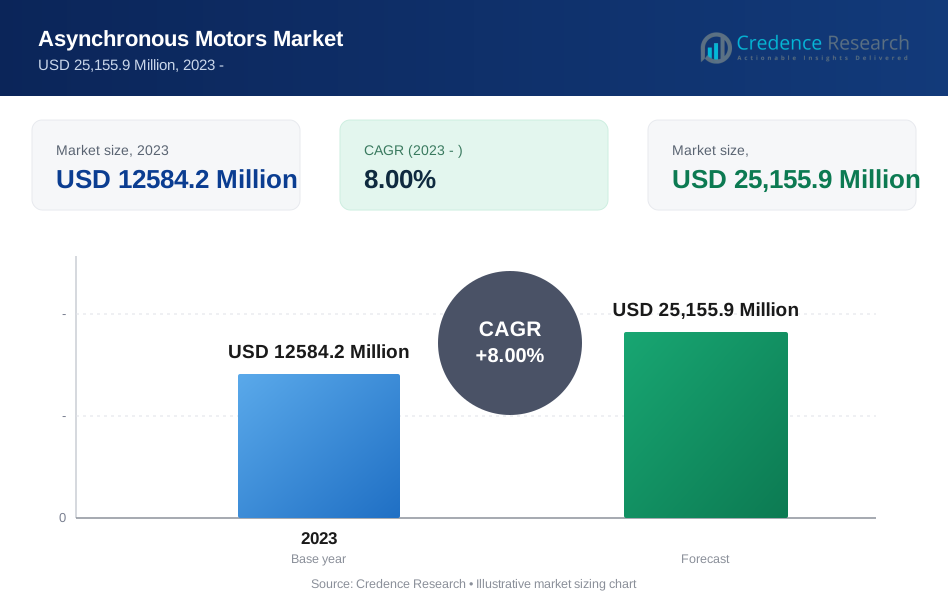
- The global Asynchronous Motors Market reached a valuation of USD 12584.2 Million in 2023 and is anticipated to surge to USD 25155.9 Million by 2032, exhibiting a robust CAGR of 8.00% from 2024 to 2032.
- Among the key segments, Three-Phase Induction Motors emerged as the market leader by type of asynchronous motor, holding approximately 52-58% of the total market share in 2023. However, Variable-Speed Induction Motors are projected to witness the highest growth rate during the forecast period.
- Totally Enclosed Fan-Cooled (TEFC) Motors currently hold the largest market share approx 48-52% in 2023. However, Explosion-Proof (XP) Motors is projected to witness the highest CAGR during the forecast period.
- Medium-Horsepower Motors currently hold the largest market share approx 48-50% in 2023. However, High-Horsepower Motors is projected to witness the highest CAGR during the forecast period.
- Standard Efficiency Motors currently hold the largest market share approx 45% in 2023. However, Premium Efficiency Motors is projected to witness the highest CAGR during the forecast period.
- Asia Pacific accounts for the largest share of the market in 2023, followed by North America and Europe with a collective share of just under 55%.
- The rise in demand for asynchronous motors, driven by industrialization, urbanization, and infrastructure development, fuels the growth of the Asynchronous Motors Market.
- Key opportunities in the market include significant growth potential in automation and robotics, increased adoption across various industries, and continuous advancements in motor technologies, fostering market expansion.
Executive Summary
Market Definition
The asynchronous motor market is a growing industry playing a major role in various industries including industrial, commercial and residential applications. Asynchronous motors, also known as induction motors due to their simplicity, reliability and cost effectiveness. They work by creating a rotating magnetic field that induces current in the rotor, resulting in torque generation and rotation. One of the major drivers of the asynchronous motor market is the increasing demand for energy efficient solutions. Asynchronous motors are known for their efficiency, making them popular with businesses aiming to reduce energy costs and carbon footprints. Moreover, government regulations and incentives promoting energy efficient technologies further enhance market growth. Another factor driving the growth of the market is the wide range of applications served by asynchronous motors. It is used in pumps, fans, compressors, conveyors and industrial equipment. The versatility and flexibility of asynchronous motors make them desirable for many end users.
Market Overview
The Asynchronous Motors Market has demonstrated consistent expansion and is projected to maintain a robust CAGR of 8.00% from 2024 to 2032. Valued at USD 12584.2 million in 2023, this market is expected to reach USD 25155.9 million by 2032.
Among the key segments, Three-Phase Induction Motors emerged as the market leader by type of asynchronous motor, holding approximately 52-58% of the total market share in 2023. However, Variable-Speed Induction Motors are projected to witness the highest growth rate during the forecast period.
Totally Enclosed Fan-Cooled (TEFC) Motors emerged as the market leader by type of Enclosure Type hold the largest market share approx 48-52% in 2023. However, Explosion-Proof (XP) Motors is projected to witness the highest CAGR during the forecast period.
Medium-Horsepower Motors by Power Rating and Application hold the largest market share approx 48-50% in 2023. However, High-Horsepower Motors is projected to witness the highest CAGR during the forecast period.
Standard Efficiency Motors by Efficiency Class and Standards hold the largest market share approx 45% in 2023. However, Premium Efficiency Motors is projected to witness the highest CAGR during the forecast period.
Asia Pacific accounts for the largest share of the market in 2023, followed by North America and Europe with a collective share of just under 55%.
The rise in demand for asynchronous motors, driven by industrialization, urbanization, and infrastructure development, fuels the growth of the Asynchronous Motors Market.
Key opportunities in the market include significant growth potential in automation and robotics, increased adoption across various industries, and continuous advancements in motor technologies, fostering market expansion.
Segmentation by Type of Asynchronous Motors
- Three-Phase Induction Motors currently hold the largest market share approx 52-58% in 2023. Three-stage induction motors are preferred for their efficiency, reliability and ability to handle heavy loads. It is commonly used in industries such as construction, oil, gas and power generation.
- Variable-Speed Induction Motors is projected to witness the highest CAGR during the forecast period. High growth can be attributed to increasing energy efficiency and production management in various industries. Variable-speed induction motors offer the benefit of speed control, which helps to improve energy efficiency and optimize the efficiency of pumps, fans, conveyors and other applications.
Segmentation by Enclosure Type
- Totally Enclosed Fan-Cooled (TEFC) Motors currently hold the largest market share approx 48-52% in 2023. TEFC devices are designed to resist dust, water, and other contaminants, making them suitable for harsh environments. They are generally used in areas where protection from external elements is critical, such as industrial equipment, outdoor installations and debris areas.
- Explosion-Proof (XP) Motors is projected to witness the highest CAGR during the forecast period. The insulating machinery is designed to contain materials contain and prevent internal explosions, providing a safe environment for working in areas where flammable gas, steam or dust may occur.
Segmentation by Power Rating and Application
- Medium-Horsepower Motors currently hold the largest market share approx 48-50% in 2023. It is commonly used in applications requiring downward voltages such as pumps, fans, compressors, conveyors, and industrial equipment. Medium-horsepower machines abound because of their ability to balance performance and performance, making them suitable for a wide range of applications.
- High-Horsepower Motors is projected to witness the highest CAGR during the forecast period. High-horsepower machines are used in high-power demanding industries application, such as large industrial equipment, heavy machinery, cutting machines and mills.
Segmentation by Efficiency Class and Standards
- Standard Efficiency Motors currently hold the largest market share approx 45% in 2023. Standard efficiency motors meet basic efficiency requirements and are typically used in industries with less stringent efficiency standards or in areas where advanced technology is generally affordable and readily available, and provides it’s popular for all-purpose use.
- Premium Efficiency Motors is projected to witness the highest CAGR during the forecast period. Premium efficiency motors offer significant energy savings compared to standard efficiency motors, reducing operating costs and reducing carbon emissions.
Segmentation by Region
- Asia Pacific held significant share around 32-35% of the market in 2023. This dominance is primarily due to its strong technical segment and booming infrastructure development. Countries like China, India and Japan are the biggest donors. The region generally benefits from lower construction costs and higher consumer density, making it an attractive location for manufacturers.
- North America and Europe collectively account for just under 55% share in 2023, with North America holding over 20% share in the same year.
- The rest of the world, including Latin America, the Middle East, and Africa, supplies the remaining demand for Asynchronous Motors.
Stringent energy efficiency regulations, leading to demand for low-efficiency appliances, advances in automation and strong focus on energy efficiency are the major factors driving the market growth.
The Asia-Pacific region held the largest market share of the Asynchronous Motors market. This growth can be attributed to several factors such as rapid industrialization, urbanization and industrialization in China, India, Japan etc. These countries have witnessed tremendous growth in manufacturing, automobile industry and in manufacturing, specializing in asynchronous motors. For instance, according to the International Trade Administration, China remains the world's automotive industry, with impressive production and sales figures. In 2021, it sold over 26 million vehicles, an increase of 7.1% from 2020. Domestic production is projected to reach 35 million by 2025, showcasing China's dominance in the global automotive industry. Moreover, increasing attention to energy efficiency and adoption of green technologies has led to the demand for asynchronous motors in various applications. These motors are known for their robustness, reliability and it is cost-effective, making it suitable for a wide range of industrial and commercial applications. Moreover government initiatives and policies encouraging technological development including foreign investment have further stimulated market growth in the region. Due to continuous technological development and increased demand for automation in industry hence, the Asia-Pacific Asynchronous Motors market is anticipated to continue its growth trajectory in the forecast period.
The North America is hold prominent share in the Asynchronous Motors Market. The region’s dominance is driven by a strong corporate presence, advanced manufacturing processes and a strong focus on technological innovation. Countries such as the United States and Canada are leading the way in the use of asynchronous motors in industries as diverse as automotive, aerospace and energy. Increased emphasis on energy efficiency, durability and environmentally friendly solutions has further increased the demand for asynchronous motors in North America. These devices deliver advantages offers features such as high reliability, low maintenance and improved performance, making it ideal for modern industrial applications. Moreover, favorable government policies, tax incentives and investments in infrastructure play an important role in accelerating market growth.For instance, The US Department of Energy has confirmed new energy conservation standards for electric motors, published in the Federal Register on June 2023. After reviewing comments, the DOE affirmed the effectiveness and compliance of these standards, which aim to enhance energy efficiency in the industry. Leading market players, research institutes and technological advancements in the region has contributed to its prominent position in the global asynchronous motor market.

Key Highlights of the Report
The Asynchronous Motors Market is segmented by Type of Asynchronous Motors, Enclosure Type, Power Rating and Application, Efficiency Class and Standards, and Region. The increasing demand for energy-efficient and reliable motors across various industries is driving the adoption of asynchronous motors in applications such as pumps, fans, compressors, and industrial equipment. This surge in demand is largely due to the advantages offered by asynchronous motors, such as their efficiency, reliability, and cost-effectiveness.
Three-Phase Induction Motors hold a dominant position in the market, providing essential properties for industrial applications, including high efficiency, reliability, and ability to handle heavy loads. Additionally, Variable-Speed Induction Motors are experiencing rapid growth, especially in applications requiring speed control for improved energy efficiency and performance.
Key user segments include industrial equipment manufacturers, commercial enterprises, and residential applications, reflecting a diverse adoption of asynchronous motors across various sectors. The rapid growth in industrialization and infrastructure development indicates an increasing trend toward energy-efficient motors for reduced operational costs and environmental impact.
Asia Pacific drives the market growth, with major players like ABB, Siemens, and Nidec leading the market. This dominance is attributed to the region's strong technical segment, booming infrastructure development, and high consumer density. Additionally, government initiatives, technological advancements, and increased focus on energy efficiency contribute to the region's leadership in the Asynchronous Motors Market.
What Are The Main Drivers Of The Global Asynchronous Motors Market?
Global Asynchronous Motors Market is primarily driven by include industrialization, urbanization, and infrastructure development, particularly in emerging economies. Additionally, advancements in motor technologies and favorable government regulations supporting the use of asynchronous motors further drive the market growth.
What Are The Major Challenges Faced By The Global Asynchronous Motors Market?
The global Asynchronous Motors market faces challenges with stiff competition from new motor technologies offering high performance and efficiency. Regulatory standards and environmental concerns pushing the demand for energy efficiency intensive, requiring developers to constantly innovate. Disruptions in the supply chain, fluctuations in raw material prices and geopolitical conflicts can affect market development. Furthermore, the rapid pace of technological advances and the shift towards electric vehicles and renewable energy make it difficult to adapt to changing industry dynamics.
What Are The Growth Opportunities In The Global Asynchronous Motors Market?
The global Asynchronous Motors market presents growth opportunities driven by the increasing use of automation and robotics in various industries. The increasing emphasis on energy efficiency and sustainability is fueling the demand for asynchronous devices in renewable energy and electric vehicles. Furthermore, expanding technological development in emerging economies, infrastructure projects across the globe will create strong demand for asynchronous motors and growth in the Internet of Things (IoT).
Market Drivers
Growing Demand Of Three-Phase Induction Motors
The growing demand of three-phase induction motors drive the asynchronous motors market. These devices offer many advantages over their single-channel counterparts, especially in terms of high power and efficiency. As a result, they are widely used in a variety of industries, from manufacturing to HVAC systems, chemical oil and gas, transportation and mining. However, three-phase induction motors exhibit better operating characteristics compared to other developed devices. Their ability to operate at constant speeds under load conditions makes them ideal for many industrial applications requiring constant torque. Furthermore, their rugged construction ensures durability and shrinkage downtime and maintenance costs. For instance, in June 2023, ABB introduced the AMI 5800 NEMA modular induction motor, designed for demanding applications in industries like chemical oil and gas. The motor, rated at 1750 HP, provides exceptional energy efficiency and reliability. Its high-strength welded steel frame reduces stress and minimizes vibrations, ensuring dependable operation even in harsh conditions. With a 25-year lifespan or 20,000 starts, this modular and customizable motor was launched in 2023 to serve various industrial needs.
Market Restraints
Regulatory Standards And Environmental Concerns
Regulatory standards and environmental concerns hinder the asynchronous motors market . Strict energy efficiency regulations require manufacturers to design and manufacture highly efficient devices, driving up production costs. Compliance with environmental regulations involves the reduction of hazardous materials and emissions during manufacturing, significantly affects operating costs and supply chain. These regulatory and environmental factors create barriers to entry and competition, influencing market dynamics and growth potential for asynchronous motors in the global market.
Opportunities
Adoption Of Various Strategies Among Market Players
Adoption of various strategies among market players create opportunity for the market. The major companies serving the global Asynchronous Motors Market are ABB, Emerson, GE, TECO, Regal-Beloit, Nidec, Siemens, among others. The market players are considerably contributing to the market growth by the adoption of various strategies including mergers & acquisitions, collaborations, funding, and new product launches, to stay competitive in the market. For instance, in August 2021, Emerson unveiled its Copeland 110cc variable speed scroll compressor and 36kW inverter drive solution, aiming for energy savings and environmental benefits in commercial air-conditioning applications like chillers, data centers, and package air conditioners. Both products are made in China and globally distributed, leveraging asynchronous motor technology within VFDs to optimize efficiency and reduce resource consumption.
Competitive Landscape
Key Players
The global Asynchronous Motors market is highly competitive, with several key players. Some of the major players in the market and their market share are as follows:
- ABB
- Emerson
- GE
- TECO
- Regal-Beloit
- Nidec
- Siemens
- Tatung
- Hitachi
- WEG
- Bosch Rexroth
- SEW-Eurodrive
- Cummins
- YASKAWA
- Toshiba
- VEM
- NORD
- Landert
- ABM Greiffenberger
- SPG
- Brook Crompton
- Sterling Electric
- Wolong
- XEMC
- JLEM
- Huali Group
- Jiangte
- WNM
- Ydmotor
- Dazhong
- Others
These organizations prioritize product innovation, distribution channel expansion, and mergers and acquisitions to stay competitive.
The global Asynchronous Motors market's key players continually seek to stay ahead by offering new products and developments.
In July 2023, Bosch Rexroth opened a production facility in Querétaro, Mexico, in 202X. The investment totaled approximately 160 million euros, resulting in around 900 new job opportunities by 2027. Focusing on mobile hydraulics and factory automation, the move aimed to boost local production and improve customer service in the North American market by providing shorter delivery times for hydraulic pumps, motors, valves, and factory automation components.
In July 2023, Siemens established Innomotics as a standalone, fully owned subsidiary operating in Germany, focusing on low- to high-voltage motors, geared motors, medium-voltage converters, and motor spindles.
Summary of Key Findings
- The Asynchronous Motors Market is experiencing significant growth propelled by the increasing demand for energy-efficient and reliable motors across various industries such as industrial equipment, commercial applications, and residential sectors. This growth is driven by the advantages offered by asynchronous motors, including their efficiency, reliability, and cost-effectiveness.
- Market segmentation is based on type of asynchronous motors, enclosure type, power rating and application, efficiency class and standards, and region, reflecting the diverse applications and specialized needs within the asynchronous motors industry.
- Three-Phase Induction Motors dominate the market, providing essential properties for industrial applications such as high efficiency, reliability, and ability to handle heavy loads. Additionally, Variable-Speed Induction Motors are experiencing rapid growth, especially in applications requiring speed control for improved energy efficiency and performance.
- Totally Enclosed Fan-Cooled (TEFC) Motors dominate the market, they are generally used in areas where protection from external elements is critical, such as industrial equipment, outdoor installations and debris areas. Additionally, Explosion-Proof (XP) Motors are experiencing rapid growth, especially in providing a safe environment for working in areas where flammable gas, steam or dust may occur.
- Standard Efficiency Motors dominate the market, owing to uses in industries with less stringent efficiency standards or in areas where advanced technology is generally affordable and readily available, and provides it’s popular for all-purpose use. Additionally, Premium Efficiency Motors is projected to witness the highest CAGR during the forecast period.
- Key user segments include industrial equipment manufacturers, commercial enterprises, and residential applications, indicating widespread adoption across various sectors. The increasing trend toward energy-efficient motors for reduced operational costs and environmental impact drives growth in the industrial sector.
Future Outlook
- The Asynchronous Motors Market exhibits promising growth prospects, particularly in Asia Pacific, driven by rapid industrialization, urbanization, and infrastructure development. Market players should capitalize on this growth potential by focusing on innovation and technological advancements.
- Anticipated challenges in the forecast period include addressing the competition from new motor technologies offering high performance and efficiency, regulatory standards, and environmental concerns.
- To stay competitive, industry players should prioritize product innovation, technological advancements, and strategic partnerships to meet evolving market demands and maintain their position in the dynamic Asynchronous Motors Market.
How CXOs Can Benefit from the Credence Research Asynchronous Motors Market Report
The Credence Research Asynchronous Motors Market Report provides CXOs with a comprehensive overview of the market, including:
- Market size and growth forecast: The report provides detailed estimates of the global Asynchronous Motors Market size, segmented by type of asynchronous motors, enclosure type, power rating and application, efficiency class and standards, and region. It also includes forecasts for the market through 2032, based on key trends and drivers.
- Market segmentation: The report segments the Asynchronous Motors Market by type of asynchronous motors, enclosure type, power rating and application, efficiency class and standards, and region. The increasing demand for advanced solutions is driven. This segmentation provides CXOs with a granular understanding of the market and the opportunities in each segment.
- Competitive landscape: The report profiles the key players in the Asynchronous Motors Market and provides insights into their strategies, product offerings, and financial performance. This information can help CXOs to identify and assess their competition.
- Key trends and drivers: The report identifies and analyzes the key trends and drivers that are shaping the Asynchronous Motors Market. This information can help CXOs to make informed decisions about their investments and strategies.
CXOs can use the insights from the Credence Research Asynchronous Motors Market Report to:
- Identify growth opportunities: The report can help CXOs to identify new growth opportunities in the Asynchronous Motors Market. For example, the report identifies the growing demand for Asynchronous Motors from cloud computing providers and telecom companies as a key opportunity.
- Make informed investment decisions: The report can help CXOs to make informed investment decisions about Asynchronous Motors. For example, the report provides insights into the key factors to consider when evaluating Asynchronous Motors providers and selecting Asynchronous Motors solutions.
- Develop competitive strategies: The report can help CXOs to develop competitive strategies for their Asynchronous Motors businesses. For example, the report identifies the key strategies that Asynchronous Motors providers are using to differentiate themselves from their competitors.
- Track market developments: The report can help CXOs to track market developments and stay ahead of the curve. For example, the report provides insights into the latest trends and innovations in the Asynchronous Motors Market.
Overall, the Credence Research Asynchronous Motors Market Report is a valuable resource for CXOs who are looking to gain a deeper understanding of the market and identify opportunities for growth.
Segmentation
-
By Type of Asynchronous Motors:
- Single-Phase Induction Motors
- Three-Phase Induction Motors
- Squirrel Cage Induction Motors
- Wound Rotor Induction Motors
- Single-Speed Induction Motors
- Variable-Speed Induction Motors
-
By Enclosure Type:
- Open Drip-Proof (ODP) Motors
- Totally Enclosed Fan-Cooled (TEFC) Motors
- Totally Enclosed Non-Ventilated (TENV) Motors
- Explosion-Proof (XP) Motors
- Water-Cooled Motors
-
By Power Rating and Application:
- Fractional Horsepower (FHP) Motors
- Medium-Horsepower Motors
- High-Horsepower Motors
-
By Efficiency Class and Standards:
- Standard Efficiency Motors
- High Efficiency Motors
- Premium Efficiency Motors
-
By Region
- North America
- US
- Canada
- Mexico
- Europe
- Germany
- France
- UK.
- Italy
- Spain
- Rest of Europe
- Asia Pacific
- China
- Japan
- India
- South Korea
- South-east Asia
- Rest of Asia Pacific
- Latin America
- Brazil
- Argentina
- Rest of Latin America
- Middle East & Africa
- GCC Countries
- South Africa
- Rest of Middle East and Africa
- North America
Adjacent Markets
In the Asynchronous Motors market, there are several adjacent markets which has high revenue growth opportunities. The key adjacent markets for Asynchronous Motors market -
Adjacent Markets |
||
| Electric Vehicles (EVs) Market | Wind Turbine Generators | Mining Equipment |
| Renewable Energy Sector | Marine and Offshore Applications | Water and Wastewater Treatment Plants |
| Industrial Automation and Robotics | Agricultural Machinery | Oil and Gas Industry |
Request a Free Sample
Fill in your details and we'll send you a free sample report.
- Sample data tables & charts
- Research methodology
Need a Custom Version of This Report?
Tailor the scope, geography, or segments to your exact requirements.
- Custom geography or segment scope
- Direct access to our analyst team
Frequently Asked Questions
What is the current size of the global Asynchronous Motors market?
What is the expected growth rate of the Asynchronous Motors market between 2024 and 2032?
Which segment is leading the market share in terms of Type of Asynchronous Motors?
Which Enclosure Type Segments governs the demand for Asynchronous Motorss in the world?
Which Power Rating and Application Specific Asynchronous Motors segment is expected to post the highest CAGR during the forecast period?
Which region is fueling the growth of the Asynchronous Motors industry?
Who are the major players in the global Asynchronous Motors market?
What are the major market drivers of the Asynchronous Motors industry?
What are the major market restraints of the Asynchronous Motors industry?
What are the major market opportunities of the Asynchronous Motors industry?
Table of Content
Chapter 1. Report Introduction
- 1.1 Report Description & Purpose
- 1.1.1 Report Title & Market Definition
- 1.1.2 Unique Selling Propositions (USP) & Key Differentiators
- 1.1.3 Value Proposition for Stakeholders
- 1.2 Research Objectives
- 1.2.1 Market Sizing Objectives (Volume & Revenue)
- 1.2.2 Segmentation Objectives
- 1.2.3 Competitive Intelligence Objectives
- 1.2.4 Forecast & Scenario Objectives
- 1.3 Report Scope
- 1.3.1 Asynchronous Motors Scope – Types & Subtypes Covered
- 1.3.2 Geographic Scope – Regions & Countries Covered
- 1.3.3 Historical Period, Base Year & Forecast Period (2023; forecast to the forecast period)
- 1.3.4 Inclusions & Exclusions
- 1.4 HS Code & Classification Framework
- 1.5 Currency, Units & Pricing Basis
- 1.6 Target Stakeholders
- 1.7 Limitations & Assumptions
Chapter 2. Executive Summary
- 2.1 Global Asynchronous Motors Market Snapshot
- 2.1.1 Market Size – Historical (2023) & Forecast (the forecast period) (2023: USD 12584.2 Million → forecast year: USD 25,155.9 Million)
- 2.1.2 Volume & Revenue – Global Totals
- 2.1.3 Key Market Highlights – Top Five Facts
- 2.2 Asynchronous Motors Market Segmentation Snapshot
- 2.2.1 Market Split by Region – 2023 vs.
- 2.3 Competitive Snapshot
- 2.3.1 Top 10 Players by Revenue Share – 2023
- 2.3.2 Top 10 Players by Volume Share – 2023
- 2.3.3 Recent Strategic Developments (18-Month Summary)
- 2.4 Key Investment Highlights & Strategic Conclusions
Chapter 3. Asynchronous Motors Market Dynamics & Industry Analysis
- 3.1 Market Overview & Context
- 3.1.1 Asynchronous Motors Market Position in the Broader Automotive Value Chain
- 3.1.2 OEM vs. Replacement Market Dynamics
- 3.1.3 Market Maturity & Development Stage by Region
- 3.2 Asynchronous Motors Market Drivers
- 3.3 Asynchronous Motors Market Restraints & Challenges
- 3.4 Asynchronous Motors Market Opportunities
- 3.5 Porter's Five Forces Analysis
- 3.5.1 Threat of New Entrants
- 3.5.2 Bargaining Power of Suppliers
- 3.5.3 Bargaining Power of Buyers
- 3.5.4 Threat of Substitutes
- 3.5.5 Competitive Rivalry – Intensity Assessment
- 3.6 Asynchronous Motors Value Chain Analysis
- 3.6.1 Upstream – Raw Material/Input Suppliers
- 3.6.1.1 Raw Material/Input 1
- 3.6.1.2 Raw Material/Input 2
- 3.6.1.3 Raw Material/Input 3
- 3.6.2 Midstream – Production/Manufacturing/Service Delivery
- 3.6.2.1 Production/Process Overview
- 3.6.2.2 Key Facility Locations & Capacity by Manufacturer
- 3.6.3 Downstream – Distribution & End Consumer
- 3.6.3.1 Primary Channel – B2B/OEM
- 3.6.3.2 Secondary Channels – Dealer, Retail, Online, Direct
- 3.6.4 Value Chain Profitability Analysis
- 3.6.1 Upstream – Raw Material/Input Suppliers
- 3.7 PESTEL Analysis
- 3.7.1 Political Factors
- 3.7.2 Economic Factors
- 3.7.3 Social Factors
- 3.7.4 Technological Factors
- 3.7.5 Environmental Factors
- 3.7.6 Legal Factors
- 3.8 Asynchronous Motors Supply Chain Analysis
- 3.8.1 Raw Material/Input Supply Risk Assessment
- 3.8.2 Manufacturing Concentration Risk (Geographic Exposure)
- 3.8.3 Trade Disruption Impact Analysis
- 3.9 Regulatory & Policy Landscape
Note: The regulatory and policy landscape section covers regulations based on their applicability to the market, Asynchronous Motors category, geography, and scope of the study. Only regulatory frameworks with a material impact on operations, compliance, trade, sustainability, or market access are analyzed in detail.
Chapter 4. Key Investment Pockets & Opportunity Analysis
- 4.1 Asynchronous Motors Market Attractiveness Analysis
- 4.1.1 By Region – Investment Attractiveness Matrix (Volume × CAGR)
- 4.2 Absolute Revenue Growth Opportunity
- 4.2.1 By Region – Absolute USD Growth Through the forecast period
- 4.3 Incremental Volume Opportunity
- 4.3.1 By Region – Incremental Volume Through the forecast period
- 4.3.2 Segment – Incremental Volume
- 4.4 Emerging Submarket Opportunity Deep Dive (Subject to Applicability)
- 4.5 Emerging Market Opportunity Scorecards
- 4.5.1 United States
- 4.5.2 Europe
- 4.5.3 Asia
- 4.5.4 Middle East & Africa
Note: Emerging Market Opportunity Scorecards will be included based on relevance and strategic importance. Regions listed are indicative and may vary depending on data availability and market dynamics.
Chapter 5. Asynchronous Motors Import-Export Analysis & Trade Flows
- 5.1 Global Trade Overview
- 5.1.1 Global Export Value by Country (2023)
- 5.1.2 Global Export Volume by Country (2023)
- 5.1.3 Global Import Value by Country (2023)
- 5.1.4 Global Import Volume by Country (2023)
- 5.1.5 Net Trade Balance by Country (2023)
- 5.2 Export Analysis – Segment
- 5.2.1 Type 1 (HS Code)
- 5.2.2 Type 2 (HS Code)
- 5.2.3 Type 3 (HS Code)
- 5.2.4 Type 4 (HS Code)
- 5.2.5 Type 5 (HS Code)
- 5.3 Import Analysis – Segment
- 5.3.1 Type 1 (HS Code)
- 5.3.2 Type 2 (HS Code)
- 5.3.3 Type 3 (HS Code)
- 5.3.4 Type 4 (HS Code)
- 5.3.5 Type 5 (HS Code)
- 5.4 Average Unit Trade Prices
- 5.4.1 Average Export Price – Segment & Country
- 5.4.2 Average Import Price – Segment & Source Country
- 5.4.3 Price Trends (2023)
- 5.5 Key Trade Route Analysis
- 5.5.1 Trade Route 1
- 5.5.2 Trade Route 2
- 5.5.3 Trade Route 3
- 5.5.4 Trade Route 4
- 5.5.5 Trade Route 5
- 5.6 Trade Policy Impact Assessment
- 5.6.1 US Anti-Dumping & Section 301 Tariffs
- 5.6.2 EU Customs Union Impact
- 5.6.3 Major Free Trade Agreements
- 5.6.4 USMCA Rules of Origin
Note: Trade policy analysis will be included only where relevant to the Asynchronous Motors market.
Chapter 6. Competitive Landscape & Company Benchmarking
- 6.1 Asynchronous Motors Market Concentration & Structure
- 6.1.1 Herfindahl-Hirschman Index (HHI) – vs. 2023
- 6.1.2 Tier 1, Tier 2 & Tier 3 Market Structure
- 6.1.3 Global, Regional & Local Player Dynamics
- 6.2 Asynchronous Motors Market Share Analysis – 2023
- 6.2.1 Global Revenue Share by Company
- 6.2.2 Global Volume Share by Company
- 6.2.3 Regional Revenue Share
- 6.2.4 Market Share Evolution ( vs. 2023)
- 6.2.5 OEM Segment Share by Company
- 6.2.6 Replacement Segment Share by Company
- 6.3 Production/Delivery Capacity & Facility Analysis
- 6.3.1 Global Installed Capacity
- 6.3.2 Capacity Utilization Rates
- 6.3.3 Production/Output Volume
- 6.3.4 Facility Locations & Capacity Map
- 6.3.5 Planned Capacity Additions
- 6.4 Asynchronous Motors Competitive Benchmarking Matrix
- 6.4.1 Revenue, Volume, CAGR & Profitability Comparison
- 6.4.2 Channel Revenue Mix
- 6.4.3 Geographic Revenue Exposure
- 6.4.4 R&D Intensity
- 6.4.5 Sustainability Maturity
- 6.5 Strategic Developments in Asynchronous Motors (Last 24 Months)
- 6.5.1 Mergers, Acquisitions & Divestments
- 6.5.2 New Asynchronous Motors Launches
- 6.5.3 Facility Expansions
- 6.5.4 Strategic Alliances, Joint Ventures & Partnerships
- 6.5.5 Distribution Expansion & Market Entry
- 6.5.6 Sustainability & ESG Initiatives
- 6.6 Competitive Strategy Mapping
- 6.6.1 Leader, Challenger, Follower & Niche Classification
- 6.6.2 Pricing Strategy Comparison
- 6.6.3 Channel Strategy Matrix
Note: Strategic developments are included based on their materiality and the availability of reliable information.
Chapter 7. Global Asynchronous Motors Market – By Distribution Channel
- 7.1 Segment Overview
- 7.1.1 Volume & Revenue Split by Channel (2023 & )
- 7.1.2 Channel Mix Evolution (the forecast period)
Chapter 8. Regional Market Analysis – Global Overview
- 8.1 Global Regional Overview
- 8.1.1 Regional Volume Share
- 8.1.2 Regional Revenue Share
- 8.1.3 Regional Volume by Region
- 8.1.4 Regional Revenue by Region
- 8.1.5 Regional Forecast Through the forecast period
- 8.2 Cross-Regional Segment Analysis
- 8.2.1 By Distribution Channel
- 8.2.2 By Brand/Price Tier
Chapter 9. North America Asynchronous Motors Market
- 9.1 United States
- 9.2 Canada
- 9.3 Mexico
Chapter 10. Europe Asynchronous Motors Market
- 10.1 Germany
- 10.2 France
- 10.3 Italy
- 10.4 United Kingdom
- 10.5 Spain
- 10.6 Poland
- 10.7 Russia
- 10.8 Netherlands
- 10.9 Belgium
- 10.10 Sweden
- 10.11 Denmark
- 10.12 Norway
- 10.13 Rest of Europe
Chapter 11. Asia Pacific Asynchronous Motors Market
- 11.1 China
- 11.2 India
- 11.3 Japan
- 11.4 South Korea
- 11.5 Thailand
- 11.6 Indonesia
- 11.7 Vietnam
- 11.8 Malaysia
- 11.9 Australia
- 11.10 Rest of Asia Pacific
Chapter 12. Latin America Asynchronous Motors Market
- 12.1 Brazil
- 12.2 Argentina
- 12.3 Colombia
- 12.4 Chile
- 12.5 Rest of Latin America
Chapter 13. Middle East Asynchronous Motors Market
- 13.1 Saudi Arabia
- 13.2 United Arab Emirates
- 13.3 Turkey
- 13.4 Israel
- 13.5 Iran
- 13.6 Rest of the Middle East
Chapter 14. Africa Asynchronous Motors Market
- 14.1 South Africa
- 14.2 Egypt
- 14.3 Nigeria
- 14.4 Morocco
- 14.5 Rest of Africa
Chapter 15. Asynchronous Motors Company Profiles
- 15.1 [Company 01]
- 15.1.1 Company Overview
- 15.1.2 Key Management Personnel
- 15.1.3 Products & Services Portfolio
- 15.1.4 Financial Performance
- 15.1.5 Key Market Focus & Geographic Presence
- 15.1.6 Recent Developments & Strategic Initiatives
Note: The company profile list is preliminary and may change based on research findings, market developments, data availability, and client requirements.
Chapter 16. Appendices
- Appendix A – List of Abbreviations & Acronyms
- Appendix B – Industry Classification Code Reference – Full Series
- Appendix C – Production & Capacity Data Tables
- Appendix D – End-Use & Demand Base Tables
- Appendix E – Consumption & Replacement Rate Assumptions
- Appendix F – ASP Reference Tables
- Appendix G – Manufacturing & Facility Database
- Appendix H – Import-Export Data Tables
- Appendix I – Regulatory Summary Tables
- Appendix J – Primary Research Participant List (Anonymized)
- Appendix K – Primary Research Questionnaire Framework
- Appendix L – Data Sources & Bibliography
- Appendix M – Market Size Divergence & Source Comparison
Chapter 17. Research Methodology
- 17.1 Research Framework & Philosophy
- 17.2 Secondary Research – Sources, Hierarchy & Data Extraction
- 17.3 Data Modeling – Bottom-Up & Top-Down Market Sizing
- 17.4 Primary Research – Stakeholder Framework, LOI & Sample Sizes
- 17.5 Forecast Methodology – Regression, Scenario & Sensitivity Analysis
- 17.6 Quality Control – Four-Layer Validation Framework
- 17.7 Limitations & Standard Assumptions
- 17.8 Disclaimer
