
| REPORT ATTRIBUTE | DETAILS |
|---|---|
| Historical Period | 2019-2022 |
| Base Year | 2023 |
| Forecast Period | 2024-2032 |
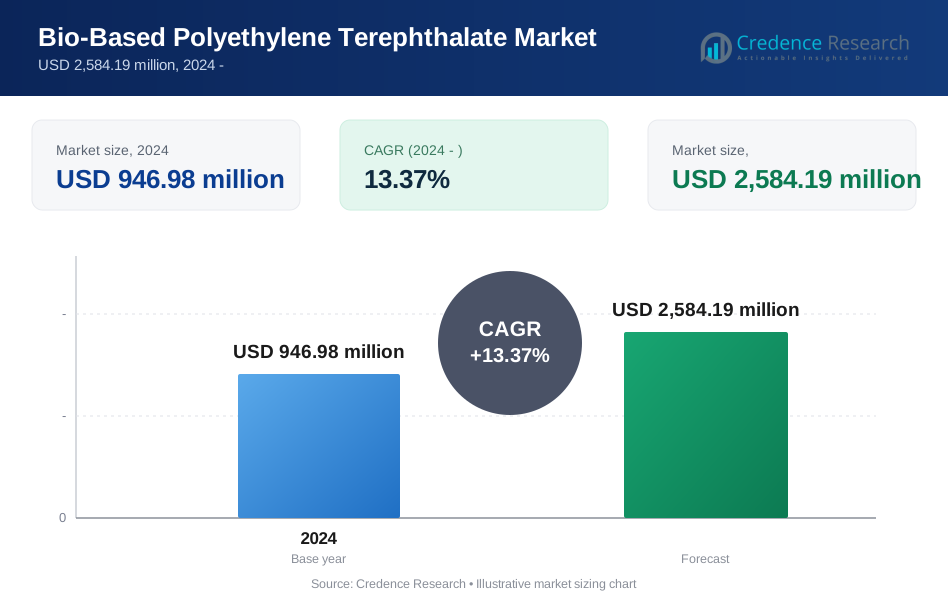
| Bio-based Polyethylene Terephthalate (Bio-PET) Market Size 2024 | USD 946.98 million |
| Bio-based Polyethylene Terephthalate (Bio-PET) Market, CAGR | 13.37% |
| Bio-based Polyethylene Terephthalate (Bio-PET) Market Size 2032 | 2,584.19 million |
Market Overview:
The Bio-based Polyethylene Terephthalate (Bio-PET) Market is expected to grow significantly, with an estimated market size of USD 946.98 million in 2024, projected to reach USD 2,584.19 million by 2032, exhibiting a robust CAGR of 13.37% during the forecast period. This growth underscores the increasing demand for sustainable alternatives to conventional plastics, as companies and consumers shift towards bio-based solutions that offer similar durability and flexibility with reduced environmental impact. The rise of bio-based PET products, often derived from renewable sources like sugarcane and corn, highlights the market’s alignment with global efforts to reduce greenhouse gas emissions and transition to a circular economy.
Key drivers of the Bio-PET Market include growing environmental awareness, supportive government policies, and advancements in bioplastic production technology. Many companies are adopting bio-based materials to achieve sustainability goals and address consumer demand for eco-friendly packaging. For instance, large consumer goods companies are increasingly using bio-based PET for bottles and containers, especially in the beverage and personal care industries, as part of their carbon reduction initiatives. Additionally, regulatory policies encouraging lower carbon footprints, combined with incentives for renewable materials, are expected to boost the bio-PET demand in various sectors, including packaging, automotive, and textiles.
Regionally, North America and Europe lead the market due to robust regulatory frameworks supporting sustainable materials, consumer preference for eco-friendly products, and advancements in bioplastic technology. Europe’s strict regulations on single-use plastics and strong commitment to sustainability are fostering significant adoption of bio-PET across the region. Meanwhile, North America, particularly the United States, is witnessing growth driven by rising environmental awareness and increasing bioplastic investments. The Asia-Pacific region is anticipated to experience the fastest growth over the forecast period, with China, Japan, and India investing heavily in bioplastic production and infrastructure to meet growing demand for sustainable products. Expanding consumer awareness and supportive policies in emerging economies are expected to further position the Asia-Pacific region as a key player in the bio-PET market in the coming years.
Market Drivers:
Rising Environmental Awareness and Demand for Sustainable Solutions:
A growing global awareness of environmental sustainability is driving the demand for bio-based alternatives to traditional plastics. Bio-based polyethylene terephthalate (Bio-PET), derived from renewable resources, offers a lower carbon footprint, aligning with both corporate and consumer sustainability goals. For instance, a survey by the European Commission in 2023 revealed that over 70% of European consumers prefer eco-friendly packaging, indicating a strong shift toward sustainable products. This consumer demand is pushing industries, particularly packaging and consumer goods, to replace fossil-fuel-based plastics with bio-based options.
Supportive Government Policies and Regulatory Mandates:
Government initiatives promoting renewable resources and reduced plastic waste are vital to the Bio-PET market’s growth. Many countries have introduced regulations encouraging the use of bio-based materials to reduce environmental impact. For instance, the European Union’s Single-Use Plastics Directive mandates the reduction of traditional plastics and promotes the use of renewable materials, including Bio-PET, in packaging. In the United States, several states have adopted laws that incentivize companies to switch to bioplastics, while Japan’s 2022 Plastics Resource Recycling Act aims to double the country’s usage of bioplastics by 2030.
Technological Advancements in Bio-Based Polymer Production:
Advances in biotechnology and material science have enhanced the production efficiency and cost-effectiveness of Bio-PET. Researchers and companies are working to improve bio-based polymer formulations that maintain performance while being cost-competitive with conventional PET. For example, Coca-Cola’s PlantBottle, which incorporates bio-based PET, demonstrates how major players leverage new technologies to increase renewable content without compromising functionality. Such technological improvements make Bio-PET a more viable option for various industries, including food and beverage, textiles, and automotive.
Increasing Corporate Sustainability Initiatives:
Corporate commitments to sustainability and carbon reduction are also significant drivers of Bio-PET adoption. Global corporations are increasingly setting ambitious targets to reduce carbon emissions and environmental impact, and bio-based materials are central to these efforts. For instance, Unilever announced plans to halve its use of virgin plastic by 2025, largely by incorporating recycled and bio-based materials into its packaging. Such corporate initiatives demonstrate the commitment to sustainable materials, further accelerating demand for Bio-PET across multiple sectors.
Market Trends:
Increasing Adoption in the Beverage Industry:
The beverage industry is witnessing a significant shift toward bio-based polyethylene terephthalate (Bio-PET) for packaging, as companies seek sustainable alternatives that align with environmental goals. Major beverage companies are using Bio-PET to reduce their carbon footprint and respond to consumer demand for eco-friendly packaging. For instance, PepsiCo committed to making 100% of its packaging recyclable, compostable, or biodegradable by 2025, with a strong focus on bio-based and recyclable materials. This shift reflects the beverage sector’s growing reliance on Bio-PET to enhance sustainability and reduce reliance on traditional plastics.
Advances in Bio-Based PET Technology:
Technological innovation in bio-polymer production is enhancing the viability of Bio-PET by improving cost-efficiency and performance characteristics. Researchers are developing methods to increase the bio-based content of PET without compromising durability, which allows for broader applications across industries. For example, DuPont has developed a Bio-PET resin with enhanced barrier properties, making it suitable for a variety of packaging applications, including food and beverage. These advancements ensure that Bio-PET can compete with conventional PET, further driving adoption across industries.
Expansion of Bio-PET Use in Textiles and Automotive:
Bio-PET is gaining traction beyond packaging, particularly in the textile and automotive industries, where companies are integrating bio-based materials to meet sustainability standards. Leading textile brands are incorporating Bio-PET into fabrics to reduce environmental impact and cater to eco-conscious consumers. For instance, Adidas has integrated bio-based materials in select apparel lines, aligning with its goal to use only recycled or sustainably sourced materials by 2024. The automotive industry is similarly exploring Bio-PET for interior components, as companies like Toyota target a substantial reduction in plastic waste and carbon emissions.
Rising Government and Industry Collaborations:
Collaborations between governments, research institutions, and companies are accelerating Bio-PET research, production, and adoption. These partnerships support advancements in bio-based materials and create incentives for manufacturers to transition to sustainable alternatives. For example, Japan’s New Energy and Industrial Technology Development Organization (NEDO) has partnered with various industries to boost bioplastic adoption, providing funding and support to scale Bio-PET production. Such collaborations play a crucial role in overcoming production challenges and enhancing the feasibility of Bio-PET, reinforcing its position as a preferred choice for sustainable plastic solutions.
Market Challenges Analysis:
High Production Costs and Limited Feedstock Availability:
One of the primary challenges in the Bio-based Polyethylene Terephthalate (Bio-PET) Market is the high production cost, largely due to expensive bio-based feedstocks like sugarcane and corn. Bio-PET production requires specialized resources and technologies, making it more costly than traditional PET derived from fossil fuels. Limited availability of feedstocks also restricts production capacity, particularly as demand for renewable resources grows across various industries. This cost factor poses a barrier for smaller manufacturers and limits large-scale adoption across cost-sensitive sectors.
Inadequate Infrastructure and Recycling Challenges:
Another significant restraint is the lack of adequate recycling infrastructure for bio-based plastics, which impacts Bio-PET’s overall sustainability appeal. While Bio-PET can be recycled alongside traditional PET, many recycling facilities are not equipped to efficiently process or distinguish bio-based materials. According to the U.S. Environmental Protection Agency (EPA), less than 10% of all plastics are recycled annually in the United States, indicating the need for improved recycling systems. Without adequate infrastructure, the environmental benefits of Bio-PET diminish, affecting its market growth and attractiveness.
Regulatory and Certification Hurdles:
Strict regulatory requirements and certification standards add to the complexity of entering the Bio-PET market. Regulatory authorities, such as the European Chemicals Agency (ECHA), mandate rigorous testing and compliance protocols for bio-based materials to ensure quality and safety standards. While these regulations support product safety and environmental responsibility, they can delay product development timelines and increase operational costs. Certification processes, including life-cycle assessments and bio-based content verification, also present added financial and logistical challenges for companies.
Competition from Other Bio-based Plastics:
The Bio-PET market also faces competition from other bio-based plastics, such as polylactic acid (PLA) and polyhydroxyalkanoates (PHA), which have gained traction due to lower production costs and different functional applications. These materials, often more accessible and adaptable to varying needs, create competition within the bio-plastics industry. As manufacturers diversify into various bio-based materials, Bio-PET must continuously innovate to maintain its position, addressing both cost efficiency and performance attributes to remain competitive.
Market Segmentation Analysis:
By Type
The Bio-based Polyethylene Terephthalate (Bio-PET) Market is segmented by type into partially bio-based PET and fully bio-based PET. Currently, partially bio-based PET, which incorporates renewable resources like sugarcane in its production, dominates the market due to its established applications in industries such as packaging and textiles. Fully bio-based PET is an emerging area with strong growth potential as technological advancements improve its viability and cost-efficiency, making it a focus for ongoing research and development efforts.
By Technology
By technology, the market is segmented into conventional fermentation processes and advanced bio-refinery techniques. Conventional fermentation processes are widely used due to their cost-effectiveness and relatively mature production methods, making them more accessible for manufacturers. However, advanced bio-refinery technologies are gaining traction as they allow for higher yield efficiencies and a broader range of renewable feedstocks. These technologies are expected to see accelerated adoption as companies seek to enhance production scalability and improve sustainability outcomes.
By End User
End-user segmentation in the Bio-PET market includes packaging, textiles, automotive, and consumer goods industries. The packaging sector holds the largest share, as Bio-PET is extensively used for bottles, containers, and other packaging solutions. The textile industry follows closely, with brands incorporating Bio-PET in fabrics to meet sustainability standards and consumer demand for eco-friendly products. The automotive sector also represents a growing segment, as Bio-PET is increasingly used in interior components and upholstery, aligning with the industry’s focus on reducing plastic waste and carbon emissions.
Segmentations:
By Application:
- Bottles
- Bags
- 3D Printing
- Foils and Fibers
- Carpets
- Others
By End-use Industry:
- Packaging
- Food and Beverages Products
- Pharmaceutical Products
- Cosmetics Products
- Automotive
- Sheets
- Foams
- Fabrics
- Textile
- Others
By Geography
- North America
- U.S.
- Canada
- Mexico
- Europe
- Germany
- France
- U.K.
- Italy
- Spain
- Rest of Europe
- Asia Pacific
- China
- Japan
- India
- South Korea
- South-east Asia
- Rest of Asia Pacific
- Latin America
- Brazil
- Argentina
- Rest of Latin America
- Middle East & Africa
- GCC Countries
- South Africa
- Rest of the Middle East and Africa
Regional Analysis:
North America
North America holds a substantial share in the global Bio-based Polyethylene Terephthalate (Bio-PET) Market, representing approximately 30% of the market. This leadership is driven by high demand for sustainable packaging, advanced R&D capabilities, and supportive government policies. The United States, in particular, has seen rising adoption of bio-based PET in the packaging industry as large consumer goods companies emphasize sustainability in their packaging materials. Regulatory measures, such as incentives for bio-based materials and funding for green technology initiatives, further strengthen Bio-PET adoption in the region. Canada also contributes to this market growth, especially in its focus on reducing plastic waste and supporting renewable material solutions.
Europe
Europe is another key region, accounting for around 28% of the global Bio-PET market share. The European Union’s stringent regulations, including the Single-Use Plastics Directive and ambitious waste reduction targets, have fostered a strong demand for sustainable alternatives like Bio-PET. Countries such as Germany, France, and the Netherlands lead the way, with numerous initiatives to replace conventional plastics in consumer packaging. The European Commission’s active support for the circular economy has propelled bio-based materials forward, positioning Europe as a global leader in sustainable plastics. Many European companies have also adopted bio-based PET as part of their carbon reduction strategies, increasing its presence across diverse sectors, from food packaging to textiles.
Asia-Pacific
The Asia-Pacific region is expected to exhibit the fastest growth in the Bio-PET Market over the forecast period, with an estimated 25% market share. Countries like Japan, China, and India are investing significantly in bioplastics production and infrastructure as consumer awareness of environmental issues rises. Japan’s focus on reducing plastic waste, exemplified by the Plastics Resource Recycling Act, emphasizes bioplastic usage, positioning the country as a key player in the regional Bio-PET market. China’s commitment to sustainability has also led to increased investment in renewable materials, and India’s proactive initiatives for waste management further boost the adoption of Bio-PET. With large, untapped consumer bases and growing eco-consciousness, the Asia-Pacific region is poised to become a major driver of the global Bio-PET market.
Latin America, Middle East, and Africa
Together, Latin America, the Middle East, and Africa account for about 17% of the global Bio-PET market share. Although these regions have a smaller share, they present considerable growth opportunities due to rising environmental awareness and gradually improving infrastructure for sustainable products. Brazil, in particular, has demonstrated a strong commitment to bio-based materials, with government support for bioplastics initiatives. South Africa is also progressing in this area, driven by efforts to reduce plastic waste and adopt sustainable solutions in packaging. While challenges such as limited infrastructure and high costs remain, the gradual shift toward bio-based materials in these regions could make them significant markets for Bio-PET in the coming years.
Key Player Analysis:
- The Coca-Cola Company
- Toray Industries, Inc.
- M&G Chemicals
- Teijin Limited
- Anellotech, Inc.
- Toyota Tsusho Corporation
- Indorama Ventures Public Company Limited
- Plastipak Holdings, Inc.
- Braskem S.A.
- Danone S.A.
Competitive Analysis:
The Bio-based Polyethylene Terephthalate (Bio-PET) Market is highly competitive, driven by both established multinational corporations and emerging innovators in the bioplastics sector. Key players such as Coca-Cola, Toray Industries, and Braskem lead through substantial investments in R&D, partnerships, and scalable production techniques to meet rising demand for sustainable packaging solutions. Companies are increasingly focusing on vertical integration and sourcing renewable feedstocks to reduce production costs and environmental impact. Strategic alliances, such as Toyota Tsusho’s collaboration with renewable chemical companies, further enable technology advancement and market penetration. Regulatory standards promoting bio-based materials and sustainability goals are accelerating the entry of new players, intensifying competition across global regions. High entry barriers, including regulatory compliance and infrastructure requirements, favor established entities, pushing them to continuously innovate to maintain market share while meeting growing consumer and environmental demands.
Recent Developments:
- Coca-Cola introduced a new commitment in 2023 to transition its packaging toward a 50% bio-based and recyclable content by 2030, emphasizing Bio-PET as a critical material. This aligns with Coca-Cola’s broader sustainability goals under its "World Without Waste" initiative, designed to minimize environmental impact by increasing the renewable content in its packaging.
- Toray Industries released an updated TCFD (Task Force on Climate-related Financial Disclosures) report in June 2024, featuring advanced carbon footprint analysis and reduction targets for its Bio-PET products. This update reflects Toray’s dedication to transparency and carbon reduction across its supply chain, particularly in bioplastics production.
- Toyota Tsusho launched a new joint venture in early 2024 focused on expanding Bio-PET production in response to increased demand for sustainable materials. The initiative includes plans for regional production facilities to reduce emissions associated with material transport, bolstering Toyota Tsusho’s sustainable manufacturing goals.
- Braskem initiated a collaborative research program in 2023 with global partners to explore innovative feedstocks for Bio-PET, aiming to diversify bio-material sources beyond traditional options like sugarcane. This initiative seeks to enhance production scalability and further reduce environmental impact, aligning with Braskem’s carbon neutrality ambitions.
Market Concentration & Characteristics:
The Bio-based Polyethylene Terephthalate (Bio-PET) Market is moderately concentrated, with key players holding significant shares due to high entry barriers, including substantial R&D requirements and stringent regulatory compliance. Leading companies such as Coca-Cola, Toray Industries, and Braskem dominate through extensive production capabilities, established distribution networks, and strong partnerships across industries like packaging, automotive, and consumer goods. These firms invest heavily in innovation to improve bio-PET efficiency and reduce costs, making them well-positioned to meet rising demand for sustainable materials. Smaller players and new entrants face challenges due to high production costs and limited access to renewable feedstocks, although government incentives for sustainable initiatives are creating gradual market entry opportunities. The industry’s concentrated structure drives continuous advancements in bio-PET technology and reinforces commitment to sustainability, as established companies leverage economies of scale to maintain competitive advantage in the global market.
Report Coverage:
The research report offers an in-depth analysis based on Application, End-use Industry, and Geography. It details leading market players, providing an overview of their business, product offerings, investments, revenue streams, and key applications. Additionally, the report includes insights into the competitive environment, SWOT analysis, current market trends, as well as the primary drivers and constraints. Furthermore, it discusses various factors that have driven market expansion in recent years. The report also explores market dynamics, regulatory scenarios, and technological advancements that are shaping the industry. It assesses the impact of external factors and global economic changes on market growth. Lastly, it provides strategic recommendations for new entrants and established companies to navigate the complexities of the market.
Future Outlook:
- Demand for Bio-PET is expected to grow as industries increasingly seek sustainable alternatives to traditional plastics.
- Advances in biotechnology will improve production efficiency, lowering costs and expanding Bio-PET's market reach.
- Government regulations supporting renewable materials will encourage further adoption of Bio-PET across sectors.
- Consumer preference for eco-friendly packaging will drive Bio-PET’s use in food and beverage applications.
- Strategic collaborations between Bio-PET producers and end-use industries will enhance product development and innovation.
- Expansion of recycling infrastructure will support Bio-PET’s circular economy potential and sustainability profile.
- Rising investments in R&D will accelerate the shift towards fully bio-based PET, moving beyond partially bio-based variants.
- Emerging markets are anticipated to adopt Bio-PET more widely due to increased environmental awareness and improved infrastructure.
- Continuous innovation in feedstock sources, including non-food-based bio-resources, will diversify Bio-PET’s production inputs.
- Growing corporate sustainability commitments will solidify Bio-PET’s role as a key material in reducing carbon footprints across industries.
Request a Free Sample
Fill in your details and we'll send you a free sample report.
- Sample data tables & charts
- Research methodology
Need a Custom Version of This Report?
Tailor the scope, geography, or segments to your exact requirements.
- Custom geography or segment scope
- Direct access to our analyst team
Frequently Asked Questions
What is the current size of the Bio-based Polyethylene Terephthalate Market?
What factors are driving the growth of the Bio-based Polyethylene Terephthalate Market?
What are some challenges faced by the Bio-based Polyethylene Terephthalate Market?
Who are the major players in the Bio-based Polyethylene Terephthalate Market?
Which segment is leading the market share?
Table of Content
Chapter 1. Report Introduction
- 1.1 Report Description & Purpose
- 1.1.1 Report Title & Market Definition
- 1.1.2 Unique Selling Propositions (USP) & Key Differentiators
- 1.1.3 Value Proposition for Stakeholders
- 1.2 Research Objectives
- 1.2.1 Market Sizing Objectives (Volume & Revenue)
- 1.2.2 Segmentation Objectives
- 1.2.3 Competitive Intelligence Objectives
- 1.2.4 Forecast & Scenario Objectives
- 1.3 Report Scope
- 1.3.1 Bio-Based Polyethylene Terephthalate Scope – Types & Subtypes Covered
- 1.3.2 Geographic Scope – Regions & Countries Covered
- 1.3.3 Historical Period, Base Year & Forecast Period (2024; forecast to the forecast period)
- 1.3.4 Inclusions & Exclusions
- 1.4 HS Code & Classification Framework
- 1.5 Currency, Units & Pricing Basis
- 1.6 Target Stakeholders
- 1.7 Limitations & Assumptions
Chapter 2. Executive Summary
- 2.1 Global Bio-Based Polyethylene Terephthalate Market Snapshot
- 2.1.1 Market Size – Historical (2024) & Forecast (the forecast period) (2024: USD 946.98 million → forecast year: USD 2,584.19 million)
- 2.1.2 Volume & Revenue – Global Totals
- 2.1.3 Key Market Highlights – Top Five Facts
- 2.2 Bio-Based Polyethylene Terephthalate Market Segmentation Snapshot
- 2.2.1 Market Split by Region – 2024 vs.
- 2.3 Competitive Snapshot
- 2.3.1 Top 10 Players by Revenue Share – 2024
- 2.3.2 Top 10 Players by Volume Share – 2024
- 2.3.3 Recent Strategic Developments (18-Month Summary)
- 2.4 Key Investment Highlights & Strategic Conclusions
Chapter 3. Bio-Based Polyethylene Terephthalate Market Dynamics & Industry Analysis
- 3.1 Market Overview & Context
- 3.1.1 Bio-Based Polyethylene Terephthalate Market Position in the Broader Automotive Value Chain
- 3.1.2 OEM vs. Replacement Market Dynamics
- 3.1.3 Market Maturity & Development Stage by Region
- 3.2 Bio-Based Polyethylene Terephthalate Market Drivers
- 3.3 Bio-Based Polyethylene Terephthalate Market Restraints & Challenges
- 3.4 Bio-Based Polyethylene Terephthalate Market Opportunities
- 3.5 Porter's Five Forces Analysis
- 3.5.1 Threat of New Entrants
- 3.5.2 Bargaining Power of Suppliers
- 3.5.3 Bargaining Power of Buyers
- 3.5.4 Threat of Substitutes
- 3.5.5 Competitive Rivalry – Intensity Assessment
- 3.6 Bio-Based Polyethylene Terephthalate Value Chain Analysis
- 3.6.1 Upstream – Raw Material/Input Suppliers
- 3.6.1.1 Raw Material/Input 1
- 3.6.1.2 Raw Material/Input 2
- 3.6.1.3 Raw Material/Input 3
- 3.6.2 Midstream – Production/Manufacturing/Service Delivery
- 3.6.2.1 Production/Process Overview
- 3.6.2.2 Key Facility Locations & Capacity by Manufacturer
- 3.6.3 Downstream – Distribution & End Consumer
- 3.6.3.1 Primary Channel – B2B/OEM
- 3.6.3.2 Secondary Channels – Dealer, Retail, Online, Direct
- 3.6.4 Value Chain Profitability Analysis
- 3.6.1 Upstream – Raw Material/Input Suppliers
- 3.7 PESTEL Analysis
- 3.7.1 Political Factors
- 3.7.2 Economic Factors
- 3.7.3 Social Factors
- 3.7.4 Technological Factors
- 3.7.5 Environmental Factors
- 3.7.6 Legal Factors
- 3.8 Bio-Based Polyethylene Terephthalate Supply Chain Analysis
- 3.8.1 Raw Material/Input Supply Risk Assessment
- 3.8.2 Manufacturing Concentration Risk (Geographic Exposure)
- 3.8.3 Trade Disruption Impact Analysis
- 3.9 Regulatory & Policy Landscape
Note: The regulatory and policy landscape section covers regulations based on their applicability to the market, Bio-Based Polyethylene Terephthalate category, geography, and scope of the study. Only regulatory frameworks with a material impact on operations, compliance, trade, sustainability, or market access are analyzed in detail.
Chapter 4. Key Investment Pockets & Opportunity Analysis
- 4.1 Bio-Based Polyethylene Terephthalate Market Attractiveness Analysis
- 4.1.1 By Region – Investment Attractiveness Matrix (Volume × CAGR)
- 4.2 Absolute Revenue Growth Opportunity
- 4.2.1 By Region – Absolute USD Growth Through the forecast period
- 4.3 Incremental Volume Opportunity
- 4.3.1 By Region – Incremental Volume Through the forecast period
- 4.3.2 Segment – Incremental Volume
- 4.4 Emerging Submarket Opportunity Deep Dive (Subject to Applicability)
- 4.5 Emerging Market Opportunity Scorecards
- 4.5.1 United States
- 4.5.2 Europe
- 4.5.3 Asia
- 4.5.4 Middle East & Africa
Note: Emerging Market Opportunity Scorecards will be included based on relevance and strategic importance. Regions listed are indicative and may vary depending on data availability and market dynamics.
Chapter 5. Bio-Based Polyethylene Terephthalate Import-Export Analysis & Trade Flows
- 5.1 Global Trade Overview
- 5.1.1 Global Export Value by Country (2024)
- 5.1.2 Global Export Volume by Country (2024)
- 5.1.3 Global Import Value by Country (2024)
- 5.1.4 Global Import Volume by Country (2024)
- 5.1.5 Net Trade Balance by Country (2024)
- 5.2 Export Analysis – Segment
- 5.2.1 Type 1 (HS Code)
- 5.2.2 Type 2 (HS Code)
- 5.2.3 Type 3 (HS Code)
- 5.2.4 Type 4 (HS Code)
- 5.2.5 Type 5 (HS Code)
- 5.3 Import Analysis – Segment
- 5.3.1 Type 1 (HS Code)
- 5.3.2 Type 2 (HS Code)
- 5.3.3 Type 3 (HS Code)
- 5.3.4 Type 4 (HS Code)
- 5.3.5 Type 5 (HS Code)
- 5.4 Average Unit Trade Prices
- 5.4.1 Average Export Price – Segment & Country
- 5.4.2 Average Import Price – Segment & Source Country
- 5.4.3 Price Trends (2024)
- 5.5 Key Trade Route Analysis
- 5.5.1 Trade Route 1
- 5.5.2 Trade Route 2
- 5.5.3 Trade Route 3
- 5.5.4 Trade Route 4
- 5.5.5 Trade Route 5
- 5.6 Trade Policy Impact Assessment
- 5.6.1 US Anti-Dumping & Section 301 Tariffs
- 5.6.2 EU Customs Union Impact
- 5.6.3 Major Free Trade Agreements
- 5.6.4 USMCA Rules of Origin
Note: Trade policy analysis will be included only where relevant to the Bio-Based Polyethylene Terephthalate market.
Chapter 6. Competitive Landscape & Company Benchmarking
- 6.1 Bio-Based Polyethylene Terephthalate Market Concentration & Structure
- 6.1.1 Herfindahl-Hirschman Index (HHI) – vs. 2024
- 6.1.2 Tier 1, Tier 2 & Tier 3 Market Structure
- 6.1.3 Global, Regional & Local Player Dynamics
- 6.2 Bio-Based Polyethylene Terephthalate Market Share Analysis – 2024
- 6.2.1 Global Revenue Share by Company
- 6.2.2 Global Volume Share by Company
- 6.2.3 Regional Revenue Share
- 6.2.4 Market Share Evolution ( vs. 2024)
- 6.2.5 OEM Segment Share by Company
- 6.2.6 Replacement Segment Share by Company
- 6.3 Production/Delivery Capacity & Facility Analysis
- 6.3.1 Global Installed Capacity
- 6.3.2 Capacity Utilization Rates
- 6.3.3 Production/Output Volume
- 6.3.4 Facility Locations & Capacity Map
- 6.3.5 Planned Capacity Additions
- 6.4 Bio-Based Polyethylene Terephthalate Competitive Benchmarking Matrix
- 6.4.1 Revenue, Volume, CAGR & Profitability Comparison
- 6.4.2 Channel Revenue Mix
- 6.4.3 Geographic Revenue Exposure
- 6.4.4 R&D Intensity
- 6.4.5 Sustainability Maturity
- 6.5 Strategic Developments in Bio-Based Polyethylene Terephthalate (Last 24 Months)
- 6.5.1 Mergers, Acquisitions & Divestments
- 6.5.2 New Bio-Based Polyethylene Terephthalate Launches
- 6.5.3 Facility Expansions
- 6.5.4 Strategic Alliances, Joint Ventures & Partnerships
- 6.5.5 Distribution Expansion & Market Entry
- 6.5.6 Sustainability & ESG Initiatives
- 6.6 Competitive Strategy Mapping
- 6.6.1 Leader, Challenger, Follower & Niche Classification
- 6.6.2 Pricing Strategy Comparison
- 6.6.3 Channel Strategy Matrix
Note: Strategic developments are included based on their materiality and the availability of reliable information.
Chapter 7. Global Bio-Based Polyethylene Terephthalate Market – By Distribution Channel
- 7.1 Segment Overview
- 7.1.1 Volume & Revenue Split by Channel (2024 & )
- 7.1.2 Channel Mix Evolution (the forecast period)
Chapter 8. Regional Market Analysis – Global Overview
- 8.1 Global Regional Overview
- 8.1.1 Regional Volume Share
- 8.1.2 Regional Revenue Share
- 8.1.3 Regional Volume by Region
- 8.1.4 Regional Revenue by Region
- 8.1.5 Regional Forecast Through the forecast period
- 8.2 Cross-Regional Segment Analysis
- 8.2.1 By Distribution Channel
- 8.2.2 By Brand/Price Tier
Chapter 9. North America Bio-Based Polyethylene Terephthalate Market
- 9.1 United States
- 9.2 Canada
- 9.3 Mexico
Chapter 10. Europe Bio-Based Polyethylene Terephthalate Market
- 10.1 Germany
- 10.2 France
- 10.3 Italy
- 10.4 United Kingdom
- 10.5 Spain
- 10.6 Poland
- 10.7 Russia
- 10.8 Netherlands
- 10.9 Belgium
- 10.10 Sweden
- 10.11 Denmark
- 10.12 Norway
- 10.13 Rest of Europe
Chapter 11. Asia Pacific Bio-Based Polyethylene Terephthalate Market
- 11.1 China
- 11.2 India
- 11.3 Japan
- 11.4 South Korea
- 11.5 Thailand
- 11.6 Indonesia
- 11.7 Vietnam
- 11.8 Malaysia
- 11.9 Australia
- 11.10 Rest of Asia Pacific
Chapter 12. Latin America Bio-Based Polyethylene Terephthalate Market
- 12.1 Brazil
- 12.2 Argentina
- 12.3 Colombia
- 12.4 Chile
- 12.5 Rest of Latin America
Chapter 13. Middle East Bio-Based Polyethylene Terephthalate Market
- 13.1 Saudi Arabia
- 13.2 United Arab Emirates
- 13.3 Turkey
- 13.4 Israel
- 13.5 Iran
- 13.6 Rest of the Middle East
Chapter 14. Africa Bio-Based Polyethylene Terephthalate Market
- 14.1 South Africa
- 14.2 Egypt
- 14.3 Nigeria
- 14.4 Morocco
- 14.5 Rest of Africa
Chapter 15. Bio-Based Polyethylene Terephthalate Company Profiles
- 15.1 [Company 01]
- 15.1.1 Company Overview
- 15.1.2 Key Management Personnel
- 15.1.3 Products & Services Portfolio
- 15.1.4 Financial Performance
- 15.1.5 Key Market Focus & Geographic Presence
- 15.1.6 Recent Developments & Strategic Initiatives
Note: The company profile list is preliminary and may change based on research findings, market developments, data availability, and client requirements.
Chapter 16. Appendices
- Appendix A – List of Abbreviations & Acronyms
- Appendix B – Industry Classification Code Reference – Full Series
- Appendix C – Production & Capacity Data Tables
- Appendix D – End-Use & Demand Base Tables
- Appendix E – Consumption & Replacement Rate Assumptions
- Appendix F – ASP Reference Tables
- Appendix G – Manufacturing & Facility Database
- Appendix H – Import-Export Data Tables
- Appendix I – Regulatory Summary Tables
- Appendix J – Primary Research Participant List (Anonymized)
- Appendix K – Primary Research Questionnaire Framework
- Appendix L – Data Sources & Bibliography
- Appendix M – Market Size Divergence & Source Comparison
Chapter 17. Research Methodology
- 17.1 Research Framework & Philosophy
- 17.2 Secondary Research – Sources, Hierarchy & Data Extraction
- 17.3 Data Modeling – Bottom-Up & Top-Down Market Sizing
- 17.4 Primary Research – Stakeholder Framework, LOI & Sample Sizes
- 17.5 Forecast Methodology – Regression, Scenario & Sensitivity Analysis
- 17.6 Quality Control – Four-Layer Validation Framework
- 17.7 Limitations & Standard Assumptions
- 17.8 Disclaimer
