
| REPORT ATTRIBUTE | DETAILS |
|---|---|
| Historical Period | 2019-2022 |
| Base Year | 2023 |
| Forecast Period | 2024-2032 |
| Countertop Pizza Warmers and Merchandisers Market Size 2024 | USD 2,232.25 million |
| Countertop Pizza Warmers and Merchandisers Market, CAGR | 4.1% |
| Countertop Pizza Warmers and Merchandisers Market Size 2032 | USD 3,078.56 million |
Market Overview:
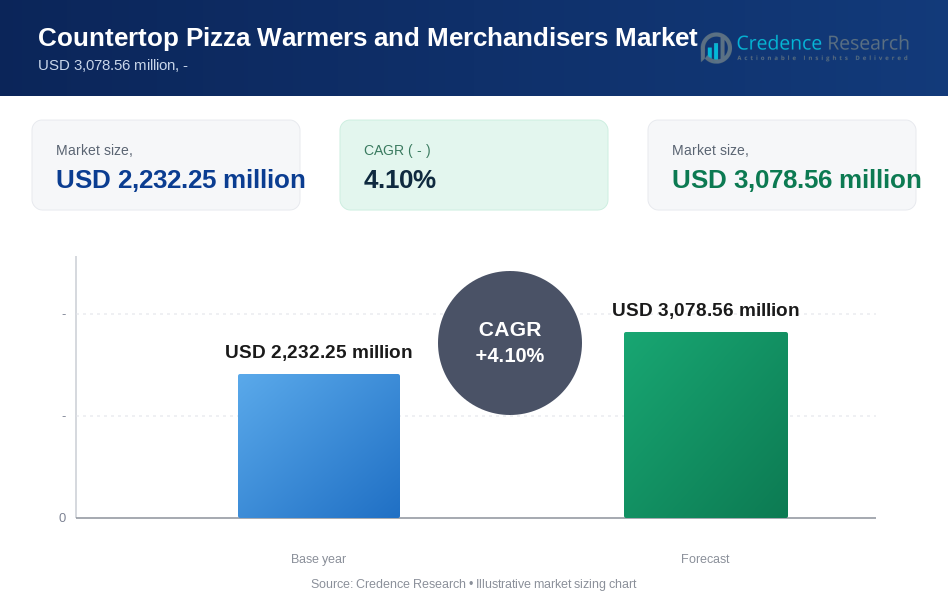
The Countertop Pizza Warmers and Merchandisers Market are expected to grow steadily, with its valuation projected to rise from USD 2,232.25 million in 2024 to approximately USD 3,078.56 million by 2032, reflecting a compound annual growth rate (CAGR) of 4.1% during the forecast period.
This growth highlights the increasing demand for efficient, space-saving equipment in foodservice establishments, such as pizzerias, quick-service restaurants, and convenience stores. Countertop pizza warmers and merchandisers not only maintain optimal pizza quality and temperature but also enhance product visibility, making them essential for maximizing sales and improving customer experience.
Several factors drive the market's growth. The rising consumer preference for ready-to-eat and freshly prepared meals has increased the demand for countertop pizza warmers, which ensure pizzas remain fresh and visually appealing. The expanding quick-service restaurant sector, driven by fast-paced urban lifestyles, further fuels demand. Additionally, innovations in heating and display technologies, such as energy-efficient designs and customizable features, are attracting investments from foodservice operators. The increasing adoption of these solutions in convenience stores and cafeterias due to their compact design and ease of operation also contributes significantly to market expansion.
Regionally, North America holds the largest market share, driven by the high concentration of quick-service restaurants and advanced foodservice infrastructure. Europe follows, supported by the region's established bakery and pizzeria culture. Meanwhile, the Asia-Pacific region is emerging as the fastest-growing market, fueled by rising urbanization, increasing disposable incomes, and the growing popularity of Western-style fast food in countries like China and India. Latin America and the Middle East & Africa are also witnessing steady growth, driven by evolving food consumption patterns and expanding foodservice sectors. These regional trends reflect diverse opportunities for market players worldwide.
Market Drivers:
Restaurant Industry Growth:
The foodservice industry's unprecedented growth has significantly impacted the countertop pizza warmers market. For instance, the National Restaurant Association reports that restaurant industry sales, reflecting a strong recovery and expansion in the sector. This growth is expected to create nearly 200,000 new jobs, pushing total employment in the industry to 15.7 million. The expansion of food service establishments has created substantial opportunities for pizza warming equipment manufacturers.
Consumer Dining Preferences:
The rising trend in pizza consumption has directly influenced the market growth. Studies indicate that 90% of consumers plan to maintain or increase their pizza consumption in 2024, while 95% of pizza operators anticipate similar or improved performance. This consumer behavior has prompted restaurants to invest in quality warming equipment to maintain food temperature and quality.
Technological Integration:
The restaurant industry's increasing reliance on technology to reduce labor costs and boost operational efficiency has driven innovation in warming equipment. For instance, with 98% of restaurant operators citing higher labor costs as a major concern, many establishments are turning to advanced warming solutions that enhance energy efficiency and functionality. This shift has led to a notable increase in the adoption of automated warming equipment across various food service segments. This technological advancement has particularly benefited corporate firms and commercial establishments seeking automated solutions.
Disposable Income and Urbanization:
Rising disposable income, particularly in developing regions, has positively influenced market growth. The expanding hospitality sector, coupled with the emergence of cloud kitchens and online food delivery services, has created new opportunities for market expansion. Urban consumers' increasing preference for convenient dining solutions has further accelerated the adoption of countertop pizza warmers across various food service segments.
Market Trends:
Smart Technology Integration:
The integration of digital controls and IoT capabilities has revolutionized countertop pizza warming solutions. Modern units now feature remote temperature monitoring and performance tracking capabilities, enabling operators to optimize their operations. For instance, modern countertop pizza warmers now feature IoT capabilities that allow operators to monitor and control temperatures remotely via smartphone apps. This technology not only ensures optimal food safety but also helps reduce energy consumption by allowing adjustments based on real-time demand. These smart warmers demonstrate up to 75% energy savings through LED lighting systems compared to traditional incandescent options, while maintaining optimal food quality.
Energy Efficiency Focus:
Environmental consciousness has driven manufacturers to develop more sustainable warming solutions. Advanced heating elements, including infrared and convection systems, provide uniform heating while minimizing energy consumption. For instance, a recent model from a leading manufacturer incorporates LED lighting systems that provide up to 75% energy savings compared to traditional incandescent bulbs, while maintaining the visual appeal of the displayed pizzas. These technological improvements align with the industry's push toward sustainability, as 90% of consumers plan to maintain or increase their pizza consumption in 2024.
Hygiene and Safety Features:
The emphasis on food safety has prompted the development of antimicrobial surfaces and easy-to-clean components in modern warming units. This trend aligns with evolving consumer preferences, as 95% of pizza operators anticipate similar or improved performance in the coming year. For instance, many new warming units now include antimicrobial surfaces and easy-to-clean components, addressing the heightened emphasis on food safety. Additionally, some models integrate touchless features and UV-C sanitization stations to further enhance hygiene standards in busy food service environments. The integration of touchless features and UV-C sanitization stations demonstrates the industry's commitment to maintaining high hygiene standards.
Customization and Flexibility:
Manufacturers are responding to diverse business needs by introducing adjustable shelving and multiple temperature zones within single units. This adaptability allows operators to showcase various products while maintaining optimal serving temperatures. The trend toward personalization reflects the broader movement in the food service industry, where businesses seek to differentiate themselves through unique offerings
Market Challenges Analysis:
Regulatory Standards and Compliance Requirements:
The countertop pizza warmers and merchandisers market face challenges associated with stringent regulations and compliance requirements set by authorities such as the U.S. Food and Drug Administration (FDA) and the European Food Safety Authority (EFSA). These regulations ensure that foodservice equipment meets hygiene, safety, and energy efficiency standards. Adhering to these requirements often leads to increased manufacturing costs, which can limit affordability for smaller foodservice operators. Additionally, varying regulations across regions complicate the global distribution of these products, creating barriers for manufacturers seeking to expand internationally.
High Initial Costs and Maintenance Requirements:
The relatively high initial investment and ongoing maintenance costs of countertop pizza warmers and merchandisers can deter adoption, particularly among small and independent foodservice establishments. These costs are further amplified by the need for energy-efficient models, which, while reducing operational expenses in the long term, require advanced technologies and materials that drive up upfront prices.
Market Saturation in Developed Regions:
In developed regions such as North America and Europe, market saturation presents a significant challenge. The high concentration of foodservice establishments already equipped with pizza warmers limits the potential for new sales, shifting market dynamics toward product upgrades and replacements rather than expansion.
Economic Instability in Emerging Markets:
Economic fluctuations and limited purchasing power in emerging markets, such as parts of Latin America and Africa, hinder the widespread adoption of premium countertop pizza warmers and merchandisers. Manufacturers must navigate price sensitivity while maintaining product quality and compliance with international standards.
Market Segmentation Analysis:
By Type
The countertop pizza warmers and merchandisers market is segmented into static warmers and rotating warmers. Static warmers dominate the market due to their simplicity, reliability, and cost-effectiveness, making them ideal for small to medium-sized foodservice establishments. Rotating warmers, known for their enhanced product visibility and even heating, are gaining popularity among high-traffic locations like convenience stores and quick-service restaurants. These units attract consumer attention, boosting sales and enhancing the overall dining experience.
By Technology
Based on technology, the market is segmented into conventional heating systems and advanced heating systems. Conventional systems remain prevalent due to their affordability and ease of use. However, advanced heating systems, incorporating features like energy-efficient components, precise temperature control, and humidity regulation, are becoming increasingly popular. These innovations ensure consistent product quality while reducing energy consumption, catering to sustainability-conscious operators.
By End User
End users of countertop pizza warmers and merchandisers include quick-service restaurants, pizzerias, convenience stores, and cafeterias. Quick-service restaurants represent the largest segment, driven by their high reliance on equipment that ensures rapid service and optimal food quality. Convenience stores are an emerging growth area, adopting these units to expand their food offerings and attract customers. Pizzerias and cafeterias also contribute significantly, leveraging these solutions to maintain the freshness and appeal of their products.
Segmentations:
By Type:
- Electric
- Gas
- Conveyor
- Display
By Application:
- Commercial
- Restaurants
- Cafes
- Pizzerias
- Household
- Others
By Country:
- North America
- U.S.
- Canada
- Mexico
- Europe
- Germany
- France
- U.K.
- Italy
- Spain
- Rest of Europe
- Asia Pacific
- China
- Japan
- India
- South Korea
- South-east Asia
- Rest of Asia Pacific
- Latin America
- Brazil
- Argentina
- Rest of Latin America
- Middle East & Africa
- GCC Countries
- South Africa
- Rest of the Middle East and Africa
Regional Analysis:
North America
North America holds the largest share of the countertop pizza warmers and merchandisers market, accounting for approximately 35% of the global market. This dominance is driven by the region's well-established foodservice industry, characterized by a high concentration of quick-service restaurants, pizzerias, and convenience stores. The United States leads the regional market due to its strong culture of fast food and high consumer demand for ready-to-eat meals. Additionally, the widespread adoption of advanced foodservice technologies and energy-efficient solutions supports market growth. Manufacturers in this region benefit from stringent food safety regulations enforced by the U.S. Food and Drug Administration (FDA), driving innovation in product design and materials.
Europe
Europe accounts for about 28% of the global market, with key contributions from countries like Germany, France, and Italy. The region's rich culinary heritage, particularly its association with pizza, bolsters the adoption of countertop pizza warmers. The growing preference for grab-and-go meal options, especially in urban areas, further drives demand. Additionally, strict regulations by entities like the European Food Safety Authority (EFSA) ensure high standards of quality and efficiency in foodservice equipment. The increasing focus on energy-efficient and visually appealing warmers is shaping the regional market.
Asia-Pacific
Asia-Pacific is the fastest-growing region, capturing around 22% of the global market share. Rising urbanization, increasing disposable incomes, and the growing popularity of Western-style fast food in countries like China, India, and Japan contribute significantly to market expansion. The region's thriving quick-service restaurant industry and the increasing presence of international food chains create substantial opportunities for countertop pizza warmer manufacturers. Local manufacturers also benefit from lower production costs, which enable competitive pricing in both domestic and export markets.
Latin America
Latin America represents approximately 8% of the global market, with notable contributions from Brazil and Mexico. The rising number of convenience stores and quick-service restaurants in these countries drives the demand for countertop pizza warmers. However, economic instability and limited infrastructure in some areas present challenges to widespread adoption.
Middle East & Africa
The Middle East & Africa account for the remaining 7% of the global market, showcasing moderate growth. Increasing urbanization, the expansion of the foodservice sector, and a rising preference for convenience foods are fueling demand in countries such as South Africa and the UAE. However, the market faces challenges related to economic disparities and lower consumer purchasing power in certain regions.
Key Player Analysis:
- Nemco Food Equipment
- Hatco Corporation
- Vollrath Company, LLC
- Star Manufacturing International, Inc.
- FWE – Food Warming Equipment Company, Inc.
- APW Wyott
- Winco DWS Inc.
- Alto-Shaam, Inc.
- Tomlinson Industries
- Hatfield Metal Fabrication Inc.
Competitive Analysis:
The countertop pizza warmers and merchandisers market are moderately fragmented, with a mix of global and regional players competing to capture market share. Key players such as Nemco Food Equipment, Hatco Corporation, and Vollrath Company, LLC dominate the market through their extensive product portfolios, innovation in energy-efficient designs, and strong distribution networks. These companies focus on integrating advanced heating technologies and customizable display options to meet the diverse needs of foodservice establishments. Regional manufacturers, such as Tomlinson Industries and APW Wyott, cater to localized demands with cost-effective solutions, particularly in emerging markets. Competition is further fueled by the increasing adoption of aesthetically appealing and compact designs to optimize space and enhance customer engagement. Strategic collaborations, new product launches, and geographic expansions are common strategies employed by players to strengthen their market positions. As demand for convenience foods and ready-to-eat meals grows, the competitive landscape is expected to remain dynamic and innovation-driven.
Recent Developments:
- In 2022 Winco introduced the EDM-2, a rotating pizza warmer and merchandiser designed for commercial use in pizzerias, restaurants, and concession stands. This unit features heat and passive humidity control, engineered airflow for consistent temperature and humidity, and a capacity to hold four 14-inch pizza pans.
- In 2023 Koolmore released the HDC-6C-SS, a countertop displays warmer aimed at enhancing food presentation and preservation. This model offers adjustable temperature controls, interior lighting, and a spacious design suitable for various food items, including pizzas.
- In 2023 Benchmark USA launched the 51012 model, featuring a humidified rotating display to maintain pizza freshness and visual appeal. The unit includes LED lighting and a rotisserie motor, catering to establishments seeking to showcase their pizza offerings effectively.
- In 2024 Hatco expanded its Flav-R-Savor® line with new models incorporating advanced heating elements and improved energy efficiency. These cabinets are designed to maintain optimal food temperatures and moisture levels, enhancing product quality and customer satisfaction.
Market Concentration & Characteristics:
The countertop pizza warmers and merchandisers market exhibit a moderately concentrated structure, with leading players such as Nemco Food Equipment, Hatco Corporation, and Vollrath Company, LLC commanding significant market shares due to their robust product offerings, advanced heating technologies, and extensive distribution networks. These players focus on innovations like energy-efficient designs, customizable temperature controls, and visually appealing displays to attract foodservice establishments. The market is characterized by high demand from quick-service restaurants, pizzerias, and convenience stores, driven by the increasing consumption of ready-to-eat foods. Regional manufacturers contribute to market diversity by offering cost-effective and tailored solutions for emerging markets. Key trends shaping the market include the growing adoption of compact, space-saving designs and advancements in display technologies that enhance product visibility and customer engagement. As demand for efficient and reliable food warming solutions grows, the market remains dynamic and innovation-driven.
Report Coverage:
The research report offers an in-depth analysis based on Type, Application, and Country. It details leading market players, providing an overview of their business, product offerings, investments, revenue streams, and key applications. Additionally, the report includes insights into the competitive environment, SWOT analysis, current market trends, as well as the primary drivers and constraints. Furthermore, it discusses various factors that have driven market expansion in recent years. The report also explores market dynamics, regulatory scenarios, and technological advancements that are shaping the industry. It assesses the impact of external factors and global economic changes on market growth. Lastly, it provides strategic recommendations for new entrants and established companies to navigate the complexities of the market.
Future Outlook:
- Demand for countertop pizza warmers and merchandisers will continue to grow as quick-service restaurants and convenience stores expand globally.
- Technological advancements, such as energy-efficient heating systems and humidity control, will enhance product quality and operational efficiency.
- The growing preference for visually appealing displays will drive innovation in design and functionality to maximize product visibility and customer engagement.
- Compact and space-saving designs will gain traction, catering to the needs of small and medium-sized foodservice establishments.
- Emerging markets in Asia-Pacific and Latin America will present significant growth opportunities, driven by urbanization and the rising popularity of Western-style fast food.
- Increasing competition will push manufacturers to invest in R&D for advanced features and customizable options to differentiate their offerings.
- The foodservice industry's focus on sustainability will encourage the development of environmentally friendly materials and energy-saving technologies.
- Strategic partnerships and collaborations with restaurant chains and foodservice providers will enable manufacturers to strengthen distribution networks and market reach.
- Replacement demand in saturated markets like North America and Europe will drive sales of upgraded, feature-rich models.
- Enhanced customer expectations for quality and convenience will continue to shape the market, emphasizing innovation and reliability in equipment performance.
Request a Free Sample
Fill in your details and we'll send you a free sample report.
- Sample data tables & charts
- Research methodology
Market Dynamics
Restaurant Industry Growth
The rapid expansion of the foodservice sector, especially quick-service restaurants and pizzerias, is increasing the need for efficient pizza warming and merchandising equipment to maintain food quality and meet high customer turnover.
Consumer Dining Preferences
A growing preference for ready-to-eat and freshly prepared meals, particularly pizza, is prompting foodservice operators to invest in countertop warmers that keep products fresh and visually appealing, thereby boosting sales.
Technological Integration
Advancements such as energy-efficient heating elements, digital controls, and IoT-enabled monitoring are making pizza warmers more attractive to operators seeking to reduce labor costs and improve operational efficiency.
Urbanization and Disposable Income
Rising urban populations and higher disposable incomes, especially in developing regions, are driving demand for convenient dining solutions, leading to greater adoption of countertop pizza warmers in new and expanding foodservice outlets.
Focus on Food Safety and Hygiene
Stricter food safety regulations and heightened consumer awareness are encouraging the adoption of warmers with antimicrobial surfaces, easy-to-clean designs, and advanced hygiene features, supporting market growth.
Need a Custom Version of This Report?
Tailor the scope, geography, or segments to your exact requirements.
- Custom geography or segment scope
- Direct access to our analyst team
Frequently Asked Questions
What is the current size of the Countertop Pizza Warmers and Merchandisers Market?
What factors are driving the growth of the Countertop Pizza Warmers and Merchandisers Market?
What are some challenges faced by the Countertop Pizza Warmers and Merchandisers Market?
Who are the major players in the Countertop Pizza Warmers and Merchandisers Market?
Which segment is leading the market share?
Table of Content
Chapter 1 Market Segmentation
- 1.1 Segmentation Framework
- 1.1.1 Product and Service Classification
- 1.1.2 Application and End-Use Classification
- 1.1.3 Technology and Solution Classification
- 1.1.4 Customer and Distribution Channel Classification
- 1.1.5 Geographic Segmentation
- 1.1.6 Market Segment Definitions and Boundaries
- 1.2 By Type
- 1.2.1 Electric
- 1.2.2 Gas
- 1.2.3 Conveyor
- 1.2.4 Display
- 1.3 By End User
- 1.3.1 Quick-Service Restaurants
- 1.3.2 Convenience Stores
- 1.3.3 Pizzerias
- 1.3.4 Cafeterias
- 1.4 By Technology
- 1.4.1 Conventional Heating Systems
- 1.4.2 Advanced Heating Systems
- 1.5 By Application
- 1.5.1 Commercial
- 1.5.2 Restaurants
- 1.5.3 Cafes
- 1.5.4 Pizzerias
- 1.5.5 Household
- 1.5.6 Others
Chapter 2 Introduction
- 2.1 Report Objectives and Scope
- 2.2 Product Definition and Industry Terminology
- 2.3 Market Inclusions and Exclusions
- 2.4 Research Process
- 2.4.1 Primary Research and Expert Interviews
- 2.4.2 Secondary Research and Source Review
- 2.4.3 Top-Down and Bottom-Up Estimation
- 2.4.4 Data Triangulation and Verification
- 2.5 Market Size Measurement Basis
- 2.5.1 2024: USD 2,232.25 million → 2032: USD 3,078.56 million
- 2.6 Historical and Forecast Reference Periods
- 2.6.1 Base Year: 2024
- 2.6.2 Forecast Period: 2024-2032
- 2.7 Research Assumptions and Limitations
Chapter 3 Executive Summary
- 3.1 Market Snapshot and Key Findings
- 3.2 Base-Year Market Size, 2024
- 3.3 Forecast Market Size, 2032
- 3.4 Revenue and Volume Growth Outlook
- 3.5 Key Demand and Supply Indicators
- 3.6 Leading Market Segments
- 3.7 Fastest-Growing Market Opportunities
- 3.8 Regional Performance Highlights
- 3.9 Technology and Industry Transformation
- 3.10 Competitive Landscape Summary
- 3.11 Analyst View and Strategic Implications
Chapter 4 Global Countertop Pizza Warmers and Merchandisers Market Trends and Developments
- 4.1 Historical Industry Development
- 4.2 Recent Market Trends and Developments
- 4.3 Demand and Customer Behavior Trends
- 4.4 Technology and Product Innovation
- 4.5 Artificial Intelligence, Automation and Digitalization
- 4.6 Local Manufacturing and Supply Chain Realignment
- 4.7 Industry Partnerships, Mergers and Acquisitions
- 4.8 Sustainability and Circular Economy Developments
- 4.9 Government and Private Sector Investment Trends
- 4.10 Emerging Business Models and Commercialization
- 4.11 Industry Developments and Announcements
Chapter 5 Global Countertop Pizza Warmers and Merchandisers Market Production, Supply and Demand Analysis
- 5.1 Demand Trend and Consumption Analysis
- 5.2 Demand Forecast, 2024-2032
- 5.3 Production and Output Trend
- 5.4 Production and Output Forecast, 2024-2032
- 5.5 Installed Capacity and Capacity Utilization
- 5.6 Company-Wise Production Plants and Statistics
- 5.6.1 Installed Production Capacity
- 5.6.2 Actual Production
- 5.6.3 Planned Capacity and Expansion Targets
- 5.7 Supply Chain Structure and Procurement Trends
- 5.8 Supply-Demand Gap and Bottlenecks
- 5.9 Import Dependence and Sourcing Structure
- 5.10 Contract Manufacturing and Outsourcing
- 5.11 Regional Supply and Demand Concentration
Chapter 6 Global Countertop Pizza Warmers and Merchandisers Market Pricing Analysis
- 6.1 Pricing Structure and Measurement
- 6.2 Historical Pricing Trends
- 6.3 Pricing Outlook, 2024-2032
- 6.4 Average Selling Price and Unit Economics
- 6.5 Pricing by Product and Market Segment
- 6.6 Geographic Pricing Differences
- 6.7 Key Input, Energy, Labor and Logistics Costs
- 6.8 Contract Pricing and Purchasing Models
- 6.9 Pricing Sensitivity and Competitive Positioning
- 6.10 Price, Margin and Profitability Implications
Chapter 7 Global Countertop Pizza Warmers and Merchandisers Market Dynamics
- 7.1 Market Growth Drivers
- 7.1.1 Demand-Side Drivers
- 7.1.2 Technology and Innovation Drivers
- 7.1.3 Infrastructure and Investment Drivers
- 7.1.4 Regulatory and Policy Drivers
- 7.2 Market Restraints
- 7.2.1 Cost and Affordability Constraints
- 7.2.2 Technology and Adoption Barriers
- 7.2.3 Supply Chain and Operational Constraints
- 7.3 Market Challenges
- 7.3.1 Competitive Pressure and Margin Erosion
- 7.3.2 Skills, Infrastructure and Implementation Gaps
- 7.4 Emerging Market Opportunities
- 7.5 Market Dynamics Impact and Time-Horizon Assessment
Chapter 8 Global Countertop Pizza Warmers and Merchandisers Value Chain Analysis
- 8.1 Industry Value Chain Overview
- 8.2 Upstream Suppliers and Critical Inputs
- 8.3 Technology and Component Providers
- 8.4 Manufacturing or Service Delivery
- 8.5 Distribution, Channel Partners and Integrators
- 8.6 Downstream Applications and End Users
- 8.7 Value Addition and Profit Pools
- 8.8 Vertical Integration and Outsourcing
- 8.9 Supplier Concentration and Risk
- 8.10 Supply Chain Localization and Resilience
Chapter 9 Global Countertop Pizza Warmers and Merchandisers Market Regulations and Policies
- 9.1 Relevant Laws, Standards and Compliance Frameworks
- 9.2 Product, Service, Safety and Quality Requirements
- 9.3 Government Policies, Incentives and Subsidies
- 9.4 Imports, Exports and Trade Barriers
- 9.5 Public Procurement and Local Content Requirements
- 9.6 Environmental and Sustainability Compliance
- 9.7 Upcoming Policy Changes and Market Implications
Chapter 10 Global Countertop Pizza Warmers and Merchandisers Market Hotspots and Opportunities
- 10.1 Market Opportunity Mapping and Growth Hotspots
- 10.2 High-Growth Applications and Customer Groups
- 10.3 Underserved Markets and White-Space Opportunities
- 10.4 Emerging Technology and Product Opportunities
- 10.5 New Capacity and Investment Hotspots
- 10.6 Market Entry and Expansion Opportunities
- 10.7 Distribution and Partnership Opportunities
- 10.8 Near-Term and Long-Term Commercial Potential
- 10.9 Opportunity Attractiveness and Execution Risks
Chapter 11 Global Countertop Pizza Warmers and Merchandisers Market Outlook, 2024-2032
- 11.1 Market Size and Analysis
- 11.1.1 Revenue (Market Measurement: 2024: USD 2,232.25 million → 2032: USD 3,078.56 million)
- 11.1.2 Market Volume and Quantity Sold
- 11.1.3 Historical Market Size
- 11.1.4 Base-Year Market Size, 2024
- 11.2 Market Forecast, 2024-2032
- 11.2.1 Revenue Forecast to 2032
- 11.2.2 Volume Forecast to 2032
- 11.2.3 CAGR and Year-on-Year Growth
- 11.2.4 Incremental Revenue Opportunity
- 11.3 Forecast Assumptions and Scenario Analysis
- 11.3.1 Base-Case Forecast
- 11.3.2 Optimistic and Conservative Scenarios
- 11.3.3 Technology, Pricing and Policy Sensitivities
- 11.4 Market Attractiveness and Growth Outlook
Chapter 12 Global Countertop Pizza Warmers and Merchandisers Market Segmentation and Outlook
- 12.1 Segmentation Summary and Market Shares, 2024
- 12.2 Largest and Fastest-Growing Segments
- 12.3 By Type - Market Size and Forecast, 2024-2032
- 12.3.1 Segment Definition and Scope
- 12.3.2 Historical Market Size
- 12.3.3 Revenue Forecast, 2024-2032
- 12.3.4 Volume Forecast, 2024-2032
- 12.3.5 Base-Year Market Share, 2024
- 12.3.6 Segment CAGR and Growth Drivers
- 12.3.7 Subsegment Market Size and Forecast
- 12.3.7.1 Electric
- 12.3.7.2 Gas
- 12.3.7.3 Conveyor
- 12.3.7.4 Display
- 12.3.8 Subsegment Pricing and Adoption Trends
- 12.3.9 Leading Suppliers and Competition
- 12.3.10 Regional Demand and Opportunities
- 12.4 By End User - Market Size and Forecast, 2024-2032
- 12.4.1 Segment Definition and Scope
- 12.4.2 Historical Market Size
- 12.4.3 Revenue Forecast, 2024-2032
- 12.4.4 Volume Forecast, 2024-2032
- 12.4.5 Base-Year Market Share, 2024
- 12.4.6 Segment CAGR and Growth Drivers
- 12.4.7 Subsegment Market Size and Forecast
- 12.4.7.1 Quick-Service Restaurants
- 12.4.7.2 Convenience Stores
- 12.4.7.3 Pizzerias
- 12.4.7.4 Cafeterias
- 12.4.8 Subsegment Pricing and Adoption Trends
- 12.4.9 Leading Suppliers and Competition
- 12.4.10 Regional Demand and Opportunities
- 12.5 By Technology - Market Size and Forecast, 2024-2032
- 12.5.1 Segment Definition and Scope
- 12.5.2 Historical Market Size
- 12.5.3 Revenue Forecast, 2024-2032
- 12.5.4 Volume Forecast, 2024-2032
- 12.5.5 Base-Year Market Share, 2024
- 12.5.6 Segment CAGR and Growth Drivers
- 12.5.7 Subsegment Market Size and Forecast
- 12.5.7.1 Conventional Heating Systems
- 12.5.7.2 Advanced Heating Systems
- 12.5.8 Subsegment Pricing and Adoption Trends
- 12.5.9 Leading Suppliers and Competition
- 12.5.10 Regional Demand and Opportunities
- 12.6 By Application - Market Size and Forecast, 2024-2032
- 12.6.1 Segment Definition and Scope
- 12.6.2 Historical Market Size
- 12.6.3 Revenue Forecast, 2024-2032
- 12.6.4 Volume Forecast, 2024-2032
- 12.6.5 Base-Year Market Share, 2024
- 12.6.6 Segment CAGR and Growth Drivers
- 12.6.7 Subsegment Market Size and Forecast
- 12.6.7.1 Commercial
- 12.6.7.2 Restaurants
- 12.6.7.3 Cafes
- 12.6.7.4 Pizzerias
- 12.6.7.5 Household
- 12.6.7.6 Others
- 12.6.8 Subsegment Pricing and Adoption Trends
- 12.6.9 Leading Suppliers and Competition
- 12.6.10 Regional Demand and Opportunities
- 12.7 Segment Growth Comparison
- 12.8 Segment Attractiveness and Priority Matrix
Chapter 13 Global Countertop Pizza Warmers and Merchandisers End-Use and Application Market Outlook
- 13.1 End-Use Industry and Customer Demand Structure
- 13.2 Leading Applications and Customer Groups
- 13.3 End-Use Market Size, Share and Forecast
- 13.4 Major End-Use Industry Deep Dives
- 13.4.1 Customer Requirements and Use Cases
- 13.4.2 Demand and Replacement Cycles
- 13.4.3 Technical and Regulatory Considerations
- 13.4.4 Purchasing and Procurement Models
- 13.4.5 Leading Vendors and Distribution Channels
- 13.4.6 Forecast and Commercial Opportunities
- 13.5 Emerging Applications and Cross-Segment Demand
- 13.6 End-Use Industry Investment Priorities
Chapter 14 Global Countertop Pizza Warmers and Merchandisers Geographic Market Outlook, 2024-2032
- 14.1 Regional Market Size and Share, 2024
- 14.2 Regional Market Forecast, 2024-2032
- 14.3 Regional Pricing, Production and Demand Differences
- 14.4 North America
- 14.4.1 United States
- 14.4.2 Canada
- 14.4.3 Mexico
- 14.5 Europe
- 14.5.1 Germany
- 14.5.2 France
- 14.5.3 Italy
- 14.5.4 United Kingdom
- 14.5.5 Spain
- 14.5.6 Poland
- 14.5.7 Russia
- 14.5.8 Netherlands
- 14.5.9 Belgium
- 14.5.10 Sweden
- 14.5.11 Denmark
- 14.5.12 Norway
- 14.5.13 Rest of Europe
- 14.6 Asia Pacific
- 14.6.1 China
- 14.6.2 India
- 14.6.3 Japan
- 14.6.4 South Korea
- 14.6.5 Thailand
- 14.6.6 Indonesia
- 14.6.7 Vietnam
- 14.6.8 Malaysia
- 14.6.9 Australia
- 14.6.10 Rest of Asia Pacific
- 14.7 Latin America
- 14.7.1 Brazil
- 14.7.2 Argentina
- 14.7.3 Colombia
- 14.7.4 Chile
- 14.7.5 Rest of Latin America
- 14.8 Middle East
- 14.8.1 Saudi Arabia
- 14.8.2 United Arab Emirates
- 14.8.3 Turkey
- 14.8.4 Israel
- 14.8.5 Iran
- 14.8.6 Rest of the Middle East
- 14.9 Africa
- 14.9.1 South Africa
- 14.9.2 Egypt
- 14.9.3 Nigeria
- 14.9.4 Morocco
- 14.9.5 Rest of Africa
- 14.10 Regional Investment, Policy and Supply Chain Differences
- 14.11 Regional Competitive Landscape
- 14.12 Geographic Growth Hotspots
Chapter 15 Global Countertop Pizza Warmers and Merchandisers Technology, Innovation and Sustainability Outlook
- 15.1 Technology Landscape and Maturity
- 15.2 Product, Process and Service Innovation
- 15.3 AI, Automation and Digital Tools in the Industry
- 15.4 Technology Adoption and Performance Benchmarking
- 15.5 Innovation Pipeline and R&D Investment
- 15.6 Patent and Intellectual Property Trends
- 15.7 Energy Efficiency and Resource Management
- 15.8 Sustainability, Recycling and Circularity
- 15.9 Technology Roadmap, 2024-2032
- 15.10 Risks of Obsolescence and Technology Substitution
Chapter 16 Global Countertop Pizza Warmers and Merchandisers Market Key Strategic Imperatives
- 16.1 Growth and Market Entry Priorities
- 16.2 High-Return Products and Segments
- 16.3 Pricing, Profitability and Cost Optimization
- 16.4 Technology Investment and Product Differentiation
- 16.5 Supply Chain Localization and Resilience
- 16.6 Distribution and Customer Acquisition
- 16.7 Partnership, Acquisition and Capacity Strategy
- 16.8 Regional Expansion Priorities
- 16.9 Short-, Medium- and Long-Term Actions
Chapter 17 Competition Outlook
- 17.1 Industry Competition Characteristics
- 17.2 Market Structure and Concentration
- 17.3 Market Share and Competitive Positioning, 2024
- 17.4 Company-Wise Revenue and Product Benchmarking
- 17.5 Production and Service Capacity Benchmarking
- 17.6 Technology, Pricing and Differentiation
- 17.7 Regional Footprint and Distribution Strength
- 17.8 Mergers, Acquisitions and Strategic Alliances
- 17.9 New Entrants and Competitive Threats
- 17.10 Porter's Five Forces and Industry Attractiveness
- 17.11 Competitive Outlook, 2024-2032
Chapter 18 Company Profiles
- 18.1 Company Coverage and Selection Criteria
- 18.2 Nemco Food Equipment
- 18.2.1 Business Description
- 18.2.2 Company Ownership and Geographic Presence
- 18.2.3 Product and Service Portfolio
- 18.2.4 Manufacturing and Operating Footprint
- 18.2.5 Production Capacity and Expansion Plans
- 18.2.6 Financial Performance and Investment
- 18.2.7 Market Share and Competitive Position
- 18.2.8 Technology and Innovation Capabilities
- 18.2.9 Strategic Alliances or Partnerships
- 18.2.10 Recent Developments
- 18.2.11 Growth Strategy and Outlook
- 18.3 Hatco Corporation
- 18.4 Vollrath Company, LLC
- 18.5 Star Manufacturing International, Inc.
- 18.6 FWE – Food Warming Equipment Company, Inc.
- 18.7 APW Wyott
- 18.8 Winco DWS Inc.
- 18.9 Alto-Shaam, Inc.
- 18.10 Tomlinson Industries
- 18.11 Hatfield Metal Fabrication Inc.
- 18.12 Other Relevant Market Participants
Note: Every listed company is profiled on the structure shown under the first company. The company list is preliminary and may change based on research findings, market developments, data availability and client requirements.
Chapter 19 Disclaimer
- 19.1 Research and Forecast Disclaimer
- 19.2 Data Source and Estimation Limitations
Note: The depth of individual sections depends on data availability for this market. Volume, capacity, trade and other unit-based metrics are included where applicable.

