
| REPORT ATTRIBUTE | DETAILS |
|---|---|
| Historical Period | 2020-2023 |
| Base Year | 2024 |
| Forecast Period | 2025-2032 |
| Refrigerator Water Filter Market Size 2024 | USD 3,748.9 Million |
| Refrigerator Water Filter Market, CAGR | 5.4% |
| Refrigerator Water Filter Market Size 2032 | USD 5,709.9 Million |
Market Overview:
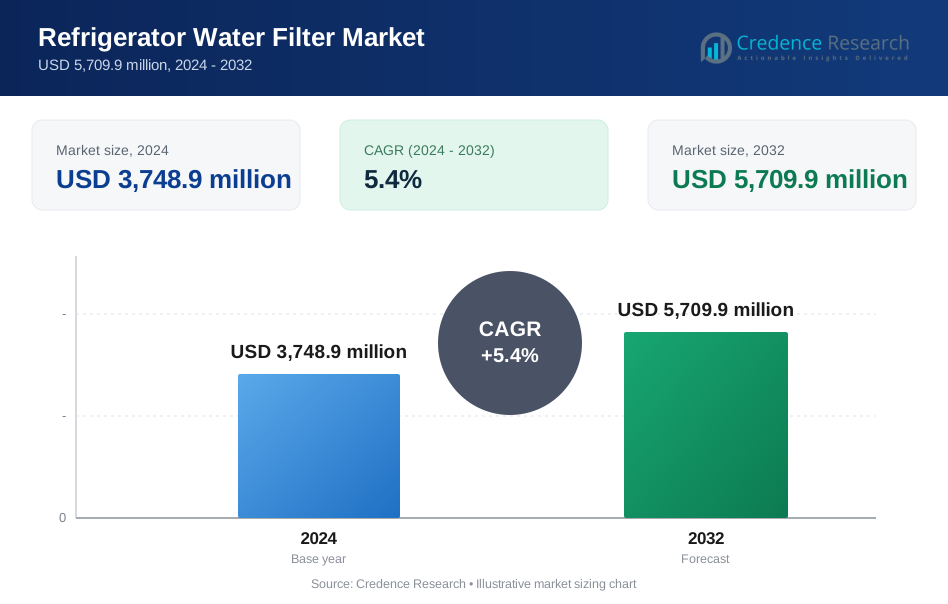
The Refrigerator Water Filter Market is projected to grow from USD 3,748.9 million in 2024 to USD 5,709.9 million by 2032, with a compound annual growth rate (CAGR) of 5.4%.
The Refrigerator Water Filter market is driven by increasing consumer demand for clean and safe drinking water, coupled with growing health awareness. As water quality concerns rise, more households are opting for refrigerator water filters to improve water taste and remove contaminants. Additionally, the trend toward eco-friendly solutions and sustainability is boosting market growth, as consumers seek products that reduce plastic bottle usage. Technological advancements, such as the integration of smart features in filters, are also influencing market dynamics, offering enhanced convenience and efficiency. Moreover, the expansion of online retail channels and partnerships with major appliance brands are improving product accessibility and visibility. As urbanization continues, the need for water filtration solutions in residential and commercial spaces is expected to drive the market further. These factors, alongside the growing inclination toward home appliances that offer improved functionality, position the Refrigerator Water Filter market for steady growth in the coming years.
The Refrigerator Water Filter market is geographically diverse, with North America holding the largest market share at 35% in 2024, driven by high consumer awareness and advanced home appliance adoption. Europe follows closely, accounting for 28% of the market, with strong demand in countries like Germany, France, and the UK, fueled by water contamination concerns and sustainability trends. The Asia-Pacific region, with a 22% share, is experiencing the fastest growth due to rising disposable incomes and increasing health awareness in markets such as China, India, and Japan. Latin America and the Middle East & Africa collectively hold a 15% share, with growth opportunities emerging as urbanization and water safety awareness increase. Key players across these regions include Pentair PLC, Culligan, LG Electronics, Brita LP, and Kent RO Systems Ltd.
Market Insights:
- The Refrigerator Water Filter market is expected to grow from USD 3,748.9 million in 2024 to USD 5,709.9 million by 2032, with a CAGR of 5.4%.
- Rising health awareness and concerns over water contamination are key drivers, pushing more households to adopt water filtration solutions.
- Eco-conscious consumers are contributing to market growth by seeking sustainable products that reduce plastic waste, such as refrigerator water filters.
- Technological advancements, including smart features like replacement alerts and sensors, are enhancing consumer convenience and increasing demand.
- Online retail channels and partnerships with major appliance brands are improving product accessibility, contributing to steady market expansion.
- North America leads the market with a 35% share, followed by Europe (28%), and Asia-Pacific (22%), which is expected to see the fastest growth.
- Latin America and the Middle East & Africa, holding 15% of the market, offer potential for growth as urbanization and water safety awareness increase.
Market Drivers:
Increasing Health and Wellness Awareness:
One of the key drivers for the growth of the Refrigerator Water Filter market is the rising consumer awareness surrounding health and wellness. For instance, Whirlpool provides filters that help remove harmful contaminants such as chlorine, heavy metals, and bacteria, ensuring that the water consumers drink is both safe and healthy. As more people recognize the importance of drinking clean and purified water, the demand for refrigerator water filters has surged. This heightened awareness of water quality is pushing more households to adopt water filtration solutions for better overall well-being.
Growing Concerns About Water Contamination:
With increasing concerns over water contamination from industrial, agricultural, and environmental sources, consumers are seeking ways to ensure the safety of their drinking water. For instance, Samsung offers filtration systems in refrigerators that effectively combat contaminants present in tap water. The rise in awareness about potential risks, such as lead and pesticides, has accelerated the adoption of water filters as a proactive measure to safeguard family health, especially in areas with known water quality issues.
Advancements in Filtration Technology:
Technological advancements in filtration systems are another major driver of market growth. LG Electronics introduces innovative water filtration technologies with smart features like built-in sensors that alert users when it’s time for a replacement, making refrigerator water filters more user-friendly and convenient. Manufacturers are improving efficiency, reducing maintenance requirements, and offering better performance. These innovations are attracting a growing number of tech-savvy consumers who value both functionality and convenience in their home appliances.
Environmental Sustainability:
The increasing shift toward eco-friendly and sustainable products is also playing a crucial role in driving the Refrigerator Water Filter market. Electrolux offers refrigerator water filters that help reduce plastic waste by providing a more sustainable way to access clean drinking water. Consumers are becoming more environmentally conscious and are actively seeking alternatives to single-use plastic bottles. As a result, the market is witnessing strong growth, driven by the desire to adopt sustainable living practices while ensuring high-quality water consumption.
Market Trends:
Smart Water Filtration Systems:
A prominent trend in the Refrigerator Water Filter market is the growing adoption of smart water filtration systems. For instance, Miele has introduced modern filters equipped with sensors that monitor filter performance and provide alerts when a replacement is necessary. These intelligent features improve convenience for consumers by eliminating the guesswork involved in filter maintenance. As more households embrace smart home technologies, the integration of these systems into refrigerator water filters is expected to gain further momentum.
Expansion of Online Sales Channels:
The shift toward e-commerce has significantly impacted the Refrigerator Water Filter market, with a growing number of consumers opting to purchase filters online. Amazon, Best Buy, and Walmart are increasingly providing a wide range of water filters, enhancing accessibility for consumers. The convenience of online shopping, combined with competitive pricing and direct-to-door delivery, is driving this trend. Manufacturers and retailers are capitalizing on this shift by offering detailed product information, reviews, and easy comparison tools to help consumers make informed decisions.
Focus on Sustainable Products:
Sustainability has become a central focus for consumers in recent years, and the Refrigerator Water Filter market is no exception. For instance, LG Electronics is introducing filters that are not only more effective in removing contaminants but are also designed with eco-friendly materials. The use of recyclable components and reduction in plastic waste are important selling points for environmentally conscious consumers. As sustainability continues to be a key priority, demand for products that contribute to a greener lifestyle is expected to grow.
Enhanced Filtration Technologies:
Advancements in filtration technologies are driving improvements in the performance and efficiency of refrigerator water filters. GE is focusing on creating filters with higher filtration capacity, longer life spans, and greater contaminant removal capabilities. Filters using activated carbon, reverse osmosis, and other advanced materials are gaining popularity for their ability to produce cleaner, better-tasting water. These technological advancements ensure that refrigerator water filters continue to meet the evolving needs of consumers who demand both quality and reliability.
Market Challenges Analysis:
High Initial Costs and Maintenance Expenses:
One of the key challenges facing the Refrigerator Water Filter market is the relatively high initial cost of high-quality filtration systems and ongoing maintenance expenses. While the long-term benefits of cleaner, safer water may outweigh the initial investment, many consumers are deterred by the upfront cost associated with purchasing a premium water filter. Additionally, replacement filters and maintenance requirements can add to the total cost of ownership over time, particularly for advanced systems with smart features. For example, according to HomeGuide, replacing filters in reverse osmosis systems can cost between $100 and $200 annually, depending on the system type and water quality. This financial barrier can make some consumers hesitant to invest in refrigerator water filters, especially in markets where cost-consciousness prevails. Even though these systems can offer significant advantages, such as better taste, improved water quality, and health benefits, many potential customers view the high costs as prohibitive, limiting the market's broader adoption. The challenge lies in finding a balance between affordability and performance, making these systems more accessible to a wider range of consumers.
Lack of Consumer Awareness and Misconceptions:
Another significant challenge is the lack of consumer awareness regarding the importance and benefits of refrigerator water filters. Many individuals may underestimate the potential risks of consuming untreated tap water, or they may not fully understand the differences between various types of filtration technologies. Misconceptions about the effectiveness of filters, or the belief that tap water is already sufficiently clean, can lead to lower adoption rates in some regions. Additionally, a lack of clear and reliable information can cause consumers to be skeptical about the performance of water filters, particularly with the abundance of options available in the market. To address this challenge, manufacturers need to invest in consumer education and marketing efforts that clearly communicate the benefits of water filtration, the health risks associated with untreated water, and how advanced filtration systems can enhance water quality. Without increasing awareness and dispelling common myths, it will be difficult to expand the market further and reach untapped consumer segments. Enhancing transparency and educating consumers on water safety will be crucial for overcoming this barrier.
Market Opportunities:
The Refrigerator Water Filter market presents significant opportunities driven by rising consumer demand for high-quality, purified drinking water. As health-conscious consumers become more aware of the potential contaminants in tap water, the need for effective filtration solutions continues to grow. This shift in consumer behavior creates an opportunity for manufacturers to develop and offer advanced filtration technologies that remove harmful substances, such as heavy metals, bacteria, and chlorine, while improving water taste. Additionally, the trend toward sustainable living opens up opportunities for companies to design environmentally friendly filters made from recyclable materials or those that reduce plastic waste. By addressing both health and environmental concerns, brands can capitalize on the increasing preference for eco-conscious, health-focused home products.
Another key opportunity lies in the growing adoption of smart home technologies. With an increasing number of households incorporating smart devices, the integration of intelligent features into refrigerator water filters presents a compelling market opportunity. Filters with built-in sensors, automatic replacement alerts, and performance tracking can provide consumers with added convenience and functionality. As consumers demand more connected and efficient home appliances, refrigerator water filters with smart capabilities are likely to see strong growth. Furthermore, expanding online sales channels and forging strategic retail partnerships will enhance product accessibility, enabling manufacturers to reach a wider audience and tap into new markets. This combination of health awareness, sustainability, and technological advancements positions the Refrigerator Water Filter market for sustained growth in the coming years.
Market Segmentation Analysis:
By Categories
The Refrigerator Water Filter market is segmented by filter type, including carbon filters, reverse osmosis filters, and UV filters. Carbon filters dominate the market due to their cost-effectiveness and ability to remove impurities, while reverse osmosis and UV filters are gaining popularity for offering enhanced purification, targeting specific contaminants like heavy metals and bacteria.
By Point of Use
Point of use (POU) filters installed directly in refrigerators are driving demand, as consumers increasingly prioritize convenience and on-demand access to clean water. These filters eliminate the need for separate filtration systems, providing an efficient solution for households. The residential sector dominates this segment, but commercial applications are also expanding.
By Distribution Channel
Distribution channels include online platforms, supermarkets, and appliance stores. Online sales have seen significant growth due to the convenience of direct delivery and easy comparison of products. Retail partnerships with major appliance brands and enhanced in-store experiences also contribute to steady market expansion across traditional and digital channels.
Segments:
Based on Categories
- Carbon Block Refrigerator Water Filters
- Granular Activated Carbon (GAC) Refrigerator Water Filters
- Reverse Osmosis (RO) Refrigerator Water
- UV Filters
Based on Point Of Use
- Countertop
- Under The Counter
- Faucet-mounted
- Pitcher
- Others
Based on Distribution Channel
- Direct
- Indirect
Based on the Geography:
- North America
- U.S.
- Canada
- Mexico
- Europe
- Germany
- France
- U.K.
- Italy
- Spain
- Rest of Europe
- Asia Pacific
- China
- Japan
- India
- South Korea
- South-east Asia
- Rest of Asia Pacific
- Latin America
- Brazil
- Argentina
- Rest of Latin America
- Middle East & Africa
- GCC Countries
- South Africa
- Rest of the Middle East and Africa
Regional Analysis:
North America
North America holds the largest market share in the Refrigerator Water Filter market, accounting for 35% of the global market in 2024. The region’s dominance is driven by high consumer awareness of water quality, strict regulations on drinking water safety, and the widespread use of modern home appliances, including refrigerators with built-in filtration systems. The United States, in particular, is a key contributor to the market’s growth, with consumers increasingly opting for smart water filters with advanced technologies. Additionally, the growing focus on health and wellness, along with a strong inclination toward eco-friendly products, has further boosted demand for refrigerator water filters in this region.
Europe
Europe follows North America closely, with a market share of 28% in 2024. The European market is characterized by increasing concerns over water contamination and the rising adoption of sustainable, energy-efficient appliances. Countries such as Germany, France, and the United Kingdom are at the forefront of this trend, with consumers seeking advanced water filtration technologies to address specific contaminants. The European Union’s stringent environmental regulations also play a significant role in promoting the use of refrigerator water filters that reduce plastic waste. As a result, eco-conscious consumers in Europe are driving the demand for filters made from recyclable materials and those that support a more sustainable lifestyle.
Asia-Pacific
The Asia-Pacific region is expected to witness the fastest growth in the Refrigerator Water Filter market, with a market share of 22% in 2024. Rapid urbanization, rising disposable incomes, and growing health awareness in countries such as China, India, and Japan are key drivers of market growth. As middle-class populations expand and consumers in the region become more aware of the health risks associated with unfiltered water, the demand for advanced water filtration systems is on the rise. Moreover, the increasing penetration of smart home appliances and the development of e-commerce platforms in the region further contribute to the market’s expansion, making it a key area of focus for global manufacturers.
Latin America and the Middle East & Africa
Latin America and the Middle East & Africa (MEA) collectively account for a smaller market share, 15% in 2024, but present significant growth opportunities. In Latin America, growing urbanization and increasing concerns over water quality are boosting demand for refrigerator water filters, particularly in countries like Brazil and Mexico. Meanwhile, in the MEA region, economic growth and the adoption of modern appliances in urban areas are driving market expansion. However, lower consumer awareness and limited infrastructure for clean water remain challenges in these regions, slowing adoption rates. Nonetheless, as awareness of water-related health risks increases, these regions are expected to offer long-term growth potential.
Key Player Analysis:
- Pentair PLC (USA)
- Culligan International Company (USA)
- Kent RO Systems Ltd. (India)
- Best Water Technology Group (Austria)
- LG Electronics (South Korea)
- iSpring Water Systems LLC (USA)
- Unilever PLC (UK)
- Brita LP (USA)
- O. Smith Corporation (USA)
- Panasonic Corporation (Japan)
- Helen of Troy Limited (USA)
Competitive Analysis:
The Refrigerator Water Filter market is highly competitive, with leading players such as Pentair PLC, Culligan International Company, Kent RO Systems Ltd., Best Water Technology Group, LG Electronics, iSpring Water Systems LLC, Unilever PLC, Brita LP, O. Smith Corporation, Panasonic Corporation, and Helen of Troy Limited driving innovation and market growth. Pentair PLC offers a wide range of products featuring advanced filtration technologies, including reverse osmosis, UV filtration, and activated carbon systems. These companies compete by offering a wide range of products featuring advanced filtration technologies, including reverse osmosis, UV filtration, and activated carbon systems. Additionally, they are focusing on expanding their product portfolios, enhancing online distribution channels, and integrating smart features into their filtration systems to meet rising consumer demand for convenience and efficiency. The emphasis on eco-friendly and sustainable solutions, coupled with efforts to reduce plastic waste, further intensifies competition as brands differentiate themselves in an increasingly environmentally conscious market. Their global presence and strategic partnerships with major retailers give them a strong competitive edge.
Recent Developments:
- In 2024, LG Pro Builder, a division of LG Electronics, entered into a three-year agreement with Florida-based SimplyDwell Homes to provide their homebuyers with America’s most reliable line of appliances, including those featured in the new Broadleaf community. SimplyDwell Homes is a newly established business unit of Neal Communities, the region’s largest private homebuilder.
- In 2023, Samsung expanded its retail partnerships and enhanced its online presence to make its water filters more accessible to a global audience. The company collaborated with prominent retailers like Amazon, Best Buy, Home Depot, and Walmart, in addition to its own online store, to ensure convenient purchasing and delivery options for customers.
- In February 2024, Reliance Consumer Products Limited (RCPL) announced a strategic partnership with Elephant House to expand its beverage offerings in the Indian market. RCPL aims to provide consumers with a diverse portfolio of globally recognized brands and products known for exceptional quality and value.
- In 2022, A. O. Smith Corporation acquired Atlantic Filter Corporation, a water treatment company based in Florida. A. O. Smith manufactures and markets a range of products, including residential and commercial gas, heat pump, and electric water heaters, boilers, tanks, and water treatment solutions.
Market Concentration & Characteristics:
The Refrigerator Water Filter market is characterized by a moderate level of market concentration, with several key players holding significant shares, including global brands such as Pentair PLC, LG Electronics, Culligan, Brita LP, and Unilever. These companies lead the market through product innovation, strong distribution networks, and strategic partnerships with major appliance manufacturers. The competitive landscape is further shaped by technological advancements, as players focus on integrating smart features, improving filtration efficiency, and offering eco-friendly solutions. Despite the dominance of established brands, new entrants and regional players are gradually gaining traction by targeting niche markets and offering cost-effective alternatives. The market is highly influenced by consumer demand for clean water, convenience, and sustainability. Additionally, the expansion of online sales channels and growing health awareness are driving competition as companies strive to enhance product accessibility and offer differentiated solutions to meet evolving consumer preferences.
Report Coverage:
The research report offers an in-depth analysis based on Categories, Point of Use, Distribution Channel and Geography. It details leading market players, providing an overview of their business, product offerings, investments, revenue streams, and key applications. Additionally, the report includes insights into the competitive environment, SWOT analysis, current market trends, as well as the primary drivers and constraints. Furthermore, it discusses various factors that have driven market expansion in recent years. The report also explores market dynamics, regulatory scenarios, and technological advancements that are shaping the industry. It assesses the impact of external factors and global economic changes on market growth. Lastly, it provides strategic recommendations for new entrants and established companies to navigate the complexities of the market.
Future Outlook:
- The Refrigerator Water Filter market is expected to experience steady growth, driven by increasing health and wellness awareness among consumers.
- Technological advancements, such as smart filtration systems, will play a crucial role in enhancing product functionality and user convenience.
- Rising concerns about water contamination will continue to boost demand for efficient and high-performance water filtration solutions.
- Sustainability will remain a key focus, with consumers seeking eco-friendly filters that reduce plastic waste and promote long-term environmental benefits.
- Expansion of online retail channels will further improve accessibility, driving higher sales in both developed and emerging markets.
- The Asia-Pacific region is projected to witness the fastest growth due to urbanization, rising disposable incomes, and growing health awareness.
- North America will maintain its leading market share, driven by advanced home appliances and strong consumer awareness of water quality.
- Europe will continue to see demand growth, particularly from eco-conscious consumers prioritizing sustainable products.
- Commercial applications for refrigerator water filters will expand, contributing to increased market penetration.
- Strategic partnerships between manufacturers and appliance brands will enhance product visibility and market reach in coming years.
Request a Free Sample
Fill in your details and we'll send you a free sample report.
- Sample data tables & charts
- Research methodology
Market Dynamics
Increasing Health and Wellness Awareness
Consumers are becoming more conscious of the health risks associated with contaminated water, leading to higher adoption of refrigerator water filters that ensure safe and clean drinking water at home.
Growing Concerns About Water Contamination
Rising incidents of water contamination from industrial, agricultural, and environmental sources are prompting households to invest in filtration solutions to remove harmful substances such as chlorine, heavy metals, and bacteria.
Advancements in Filtration Technology
Innovations such as smart filters with sensors, longer filter life, and improved contaminant removal are attracting tech-savvy consumers seeking convenience and enhanced performance in their home appliances.
Environmental Sustainability
The shift toward eco-friendly living is driving demand for refrigerator water filters as they help reduce single-use plastic bottle consumption, appealing to environmentally conscious consumers.
Expansion of Online Retail Channels
The growth of e-commerce platforms and strategic partnerships with major appliance brands are making refrigerator water filters more accessible, supporting market expansion across both developed and emerging regions.
Need a Custom Version of This Report?
Tailor the scope, geography, or segments to your exact requirements.
- Custom geography or segment scope
- Direct access to our analyst team
Frequently Asked Questions
What is the current size of the Refrigerator Water Filter market?
What factors are driving the growth of the Refrigerator Water Filter market?
What are the key segments within the Refrigerator Water Filter market?
What are some challenges faced by the Refrigerator Water Filter market?
Who are the major players in the Refrigerator Water Filter market?
Table of Content
Chapter 1 Market Segmentation
- 1.1 Segmentation Framework
- 1.1.1 Product and Service Classification
- 1.1.2 Application and End-Use Classification
- 1.1.3 Technology and Solution Classification
- 1.1.4 Customer and Distribution Channel Classification
- 1.1.5 Geographic Segmentation
- 1.1.6 Market Segment Definitions and Boundaries
- 1.2 By Filter Type
- 1.2.1 Carbon Block Refrigerator Water Filters
- 1.2.2 Granular Activated Carbon (GAC) Refrigerator Water Filters
- 1.2.3 Reverse Osmosis (RO) Refrigerator Water Filters
- 1.2.4 UV Filters
- 1.3 By Point of Use
- 1.3.1 Countertop
- 1.3.2 Under The Counter
- 1.3.3 Faucet-mounted
- 1.3.4 Pitcher
- 1.3.5 Others
Chapter 2 Introduction
- 2.1 Report Objectives and Scope
- 2.2 Product Definition and Industry Terminology
- 2.3 Market Inclusions and Exclusions
- 2.4 Research Process
- 2.4.1 Primary Research and Expert Interviews
- 2.4.2 Secondary Research and Source Review
- 2.4.3 Top-Down and Bottom-Up Estimation
- 2.4.4 Data Triangulation and Verification
- 2.5 Market Size Measurement Basis
- 2.5.1 2024: USD 3,748.9 million → 2032: USD 5,709.9 million
- 2.6 Historical and Forecast Reference Periods
- 2.6.1 Base Year: 2024
- 2.6.2 Forecast Period: 2024-2032
- 2.7 Research Assumptions and Limitations
Chapter 3 Executive Summary
- 3.1 Market Snapshot and Key Findings
- 3.2 Base-Year Market Size, 2024
- 3.3 Forecast Market Size, 2032
- 3.4 Revenue and Volume Growth Outlook
- 3.5 Key Demand and Supply Indicators
- 3.6 Leading Market Segments
- 3.7 Fastest-Growing Market Opportunities
- 3.8 Regional Performance Highlights
- 3.9 Technology and Industry Transformation
- 3.10 Competitive Landscape Summary
- 3.11 Analyst View and Strategic Implications
Chapter 4 Global Refrigerator Water Filter Market Trends and Developments
- 4.1 Historical Industry Development
- 4.2 Recent Market Trends and Developments
- 4.3 Demand and Customer Behavior Trends
- 4.4 Technology and Product Innovation
- 4.5 Artificial Intelligence, Automation and Digitalization
- 4.6 Local Manufacturing and Supply Chain Realignment
- 4.7 Industry Partnerships, Mergers and Acquisitions
- 4.8 Sustainability and Circular Economy Developments
- 4.9 Government and Private Sector Investment Trends
- 4.10 Emerging Business Models and Commercialization
- 4.11 Industry Developments and Announcements
Chapter 5 Global Refrigerator Water Filter Market Production, Supply and Demand Analysis
- 5.1 Demand Trend and Consumption Analysis
- 5.2 Demand Forecast, 2024-2032
- 5.3 Production and Output Trend
- 5.4 Production and Output Forecast, 2024-2032
- 5.5 Installed Capacity and Capacity Utilization
- 5.6 Company-Wise Production Plants and Statistics
- 5.6.1 Installed Production Capacity
- 5.6.2 Actual Production
- 5.6.3 Planned Capacity and Expansion Targets
- 5.7 Supply Chain Structure and Procurement Trends
- 5.8 Supply-Demand Gap and Bottlenecks
- 5.9 Import Dependence and Sourcing Structure
- 5.10 Contract Manufacturing and Outsourcing
- 5.11 Regional Supply and Demand Concentration
Chapter 6 Global Refrigerator Water Filter Market Pricing Analysis
- 6.1 Pricing Structure and Measurement
- 6.2 Historical Pricing Trends
- 6.3 Pricing Outlook, 2024-2032
- 6.4 Average Selling Price and Unit Economics
- 6.5 Pricing by Product and Market Segment
- 6.6 Geographic Pricing Differences
- 6.7 Key Input, Energy, Labor and Logistics Costs
- 6.8 Contract Pricing and Purchasing Models
- 6.9 Pricing Sensitivity and Competitive Positioning
- 6.10 Price, Margin and Profitability Implications
Chapter 7 Global Refrigerator Water Filter Market Dynamics
- 7.1 Market Growth Drivers
- 7.1.1 Demand-Side Drivers
- 7.1.2 Technology and Innovation Drivers
- 7.1.3 Infrastructure and Investment Drivers
- 7.1.4 Regulatory and Policy Drivers
- 7.2 Market Restraints
- 7.2.1 Cost and Affordability Constraints
- 7.2.2 Technology and Adoption Barriers
- 7.2.3 Supply Chain and Operational Constraints
- 7.3 Market Challenges
- 7.3.1 Competitive Pressure and Margin Erosion
- 7.3.2 Skills, Infrastructure and Implementation Gaps
- 7.4 Emerging Market Opportunities
- 7.5 Market Dynamics Impact and Time-Horizon Assessment
Chapter 8 Global Refrigerator Water Filter Value Chain Analysis
- 8.1 Industry Value Chain Overview
- 8.2 Upstream Suppliers and Critical Inputs
- 8.3 Technology and Component Providers
- 8.4 Manufacturing or Service Delivery
- 8.5 Distribution, Channel Partners and Integrators
- 8.6 Downstream Applications and End Users
- 8.7 Value Addition and Profit Pools
- 8.8 Vertical Integration and Outsourcing
- 8.9 Supplier Concentration and Risk
- 8.10 Supply Chain Localization and Resilience
Chapter 9 Global Refrigerator Water Filter Market Regulations and Policies
- 9.1 Relevant Laws, Standards and Compliance Frameworks
- 9.2 Product, Service, Safety and Quality Requirements
- 9.3 Government Policies, Incentives and Subsidies
- 9.4 Imports, Exports and Trade Barriers
- 9.5 Public Procurement and Local Content Requirements
- 9.6 Environmental and Sustainability Compliance
- 9.7 Upcoming Policy Changes and Market Implications
Chapter 10 Global Refrigerator Water Filter Market Hotspots and Opportunities
- 10.1 Market Opportunity Mapping and Growth Hotspots
- 10.2 High-Growth Applications and Customer Groups
- 10.3 Underserved Markets and White-Space Opportunities
- 10.4 Emerging Technology and Product Opportunities
- 10.5 New Capacity and Investment Hotspots
- 10.6 Market Entry and Expansion Opportunities
- 10.7 Distribution and Partnership Opportunities
- 10.8 Near-Term and Long-Term Commercial Potential
- 10.9 Opportunity Attractiveness and Execution Risks
Chapter 11 Global Refrigerator Water Filter Market Outlook, 2024-2032
- 11.1 Market Size and Analysis
- 11.1.1 Revenue (Market Measurement: 2024: USD 3,748.9 million → 2032: USD 5,709.9 million)
- 11.1.2 Market Volume and Quantity Sold
- 11.1.3 Historical Market Size
- 11.1.4 Base-Year Market Size, 2024
- 11.2 Market Forecast, 2024-2032
- 11.2.1 Revenue Forecast to 2032
- 11.2.2 Volume Forecast to 2032
- 11.2.3 CAGR and Year-on-Year Growth
- 11.2.4 Incremental Revenue Opportunity
- 11.3 Forecast Assumptions and Scenario Analysis
- 11.3.1 Base-Case Forecast
- 11.3.2 Optimistic and Conservative Scenarios
- 11.3.3 Technology, Pricing and Policy Sensitivities
- 11.4 Market Attractiveness and Growth Outlook
Chapter 12 Global Refrigerator Water Filter Market Segmentation and Outlook
- 12.1 Segmentation Summary and Market Shares, 2024
- 12.2 Largest and Fastest-Growing Segments
- 12.3 By Filter Type - Market Size and Forecast, 2024-2032
- 12.3.1 Segment Definition and Scope
- 12.3.2 Historical Market Size
- 12.3.3 Revenue Forecast, 2024-2032
- 12.3.4 Volume Forecast, 2024-2032
- 12.3.5 Base-Year Market Share, 2024
- 12.3.6 Segment CAGR and Growth Drivers
- 12.3.7 Subsegment Market Size and Forecast
- 12.3.7.1 Carbon Block Refrigerator Water Filters
- 12.3.7.2 Granular Activated Carbon (GAC) Refrigerator Water Filters
- 12.3.7.3 Reverse Osmosis (RO) Refrigerator Water Filters
- 12.3.7.4 UV Filters
- 12.3.8 Subsegment Pricing and Adoption Trends
- 12.3.9 Leading Suppliers and Competition
- 12.3.10 Regional Demand and Opportunities
- 12.4 By Point of Use - Market Size and Forecast, 2024-2032
- 12.4.1 Segment Definition and Scope
- 12.4.2 Historical Market Size
- 12.4.3 Revenue Forecast, 2024-2032
- 12.4.4 Volume Forecast, 2024-2032
- 12.4.5 Base-Year Market Share, 2024
- 12.4.6 Segment CAGR and Growth Drivers
- 12.4.7 Subsegment Market Size and Forecast
- 12.4.7.1 Countertop
- 12.4.7.2 Under The Counter
- 12.4.7.3 Faucet-mounted
- 12.4.7.4 Pitcher
- 12.4.7.5 Others
- 12.4.8 Subsegment Pricing and Adoption Trends
- 12.4.9 Leading Suppliers and Competition
- 12.4.10 Regional Demand and Opportunities
- 12.5 Segment Growth Comparison
- 12.6 Segment Attractiveness and Priority Matrix
Chapter 13 Global Refrigerator Water Filter Geographic Market Outlook, 2024-2032
- 13.1 Regional Market Size and Share, 2024
- 13.2 Regional Market Forecast, 2024-2032
- 13.3 Regional Pricing, Production and Demand Differences
- 13.4 North America
- 13.4.1 United States
- 13.4.2 Canada
- 13.4.3 Mexico
- 13.5 Europe
- 13.5.1 Germany
- 13.5.2 France
- 13.5.3 Italy
- 13.5.4 United Kingdom
- 13.5.5 Spain
- 13.5.6 Poland
- 13.5.7 Russia
- 13.5.8 Netherlands
- 13.5.9 Belgium
- 13.5.10 Sweden
- 13.5.11 Denmark
- 13.5.12 Norway
- 13.5.13 Rest of Europe
- 13.6 Asia Pacific
- 13.6.1 China
- 13.6.2 India
- 13.6.3 Japan
- 13.6.4 South Korea
- 13.6.5 Thailand
- 13.6.6 Indonesia
- 13.6.7 Vietnam
- 13.6.8 Malaysia
- 13.6.9 Australia
- 13.6.10 Rest of Asia Pacific
- 13.7 Latin America
- 13.7.1 Brazil
- 13.7.2 Argentina
- 13.7.3 Colombia
- 13.7.4 Chile
- 13.7.5 Rest of Latin America
- 13.8 Middle East
- 13.8.1 Saudi Arabia
- 13.8.2 United Arab Emirates
- 13.8.3 Turkey
- 13.8.4 Israel
- 13.8.5 Iran
- 13.8.6 Rest of the Middle East
- 13.9 Africa
- 13.9.1 South Africa
- 13.9.2 Egypt
- 13.9.3 Nigeria
- 13.9.4 Morocco
- 13.9.5 Rest of Africa
- 13.10 Regional Investment, Policy and Supply Chain Differences
- 13.11 Regional Competitive Landscape
- 13.12 Geographic Growth Hotspots
Chapter 14 Global Refrigerator Water Filter Technology, Innovation and Sustainability Outlook
- 14.1 Technology Landscape and Maturity
- 14.2 Product, Process and Service Innovation
- 14.3 AI, Automation and Digital Tools in the Industry
- 14.4 Technology Adoption and Performance Benchmarking
- 14.5 Innovation Pipeline and R&D Investment
- 14.6 Patent and Intellectual Property Trends
- 14.7 Energy Efficiency and Resource Management
- 14.8 Sustainability, Recycling and Circularity
- 14.9 Technology Roadmap, 2024-2032
- 14.10 Risks of Obsolescence and Technology Substitution
Chapter 15 Global Refrigerator Water Filter Market Key Strategic Imperatives
- 15.1 Growth and Market Entry Priorities
- 15.2 High-Return Products and Segments
- 15.3 Pricing, Profitability and Cost Optimization
- 15.4 Technology Investment and Product Differentiation
- 15.5 Supply Chain Localization and Resilience
- 15.6 Distribution and Customer Acquisition
- 15.7 Partnership, Acquisition and Capacity Strategy
- 15.8 Regional Expansion Priorities
- 15.9 Short-, Medium- and Long-Term Actions
Chapter 16 Competition Outlook
- 16.1 Industry Competition Characteristics
- 16.2 Market Structure and Concentration
- 16.3 Market Share and Competitive Positioning, 2024
- 16.4 Company-Wise Revenue and Product Benchmarking
- 16.5 Production and Service Capacity Benchmarking
- 16.6 Technology, Pricing and Differentiation
- 16.7 Regional Footprint and Distribution Strength
- 16.8 Mergers, Acquisitions and Strategic Alliances
- 16.9 New Entrants and Competitive Threats
- 16.10 Porter's Five Forces and Industry Attractiveness
- 16.11 Competitive Outlook, 2024-2032
Chapter 17 Company Profiles
- 17.1 Company Coverage and Selection Criteria
- 17.2 Pentair PLC
- 17.2.1 Business Description
- 17.2.2 Company Ownership and Geographic Presence
- 17.2.3 Product and Service Portfolio
- 17.2.4 Manufacturing and Operating Footprint
- 17.2.5 Production Capacity and Expansion Plans
- 17.2.6 Financial Performance and Investment
- 17.2.7 Market Share and Competitive Position
- 17.2.8 Technology and Innovation Capabilities
- 17.2.9 Strategic Alliances or Partnerships
- 17.2.10 Recent Developments
- 17.2.11 Growth Strategy and Outlook
- 17.3 Culligan International Company
- 17.4 Kent RO Systems Ltd.
- 17.5 Best Water Technology Group
- 17.6 LG Electronics
- 17.7 iSpring Water Systems LLC
- 17.8 Unilever PLC
- 17.9 Brita LP
- 17.10 A. O. Smith Corporation
- 17.11 Panasonic Corporation
- 17.12 Other Relevant Market Participants
Note: Every listed company is profiled on the structure shown under the first company. The company list is preliminary and may change based on research findings, market developments, data availability and client requirements.
Chapter 18 Disclaimer
- 18.1 Research and Forecast Disclaimer
- 18.2 Data Source and Estimation Limitations
Note: The depth of individual sections depends on data availability for this market. Volume, capacity, trade and other unit-based metrics are included where applicable.

