Europe Anticancer Drugs/Oncology Drugs Market Overview:
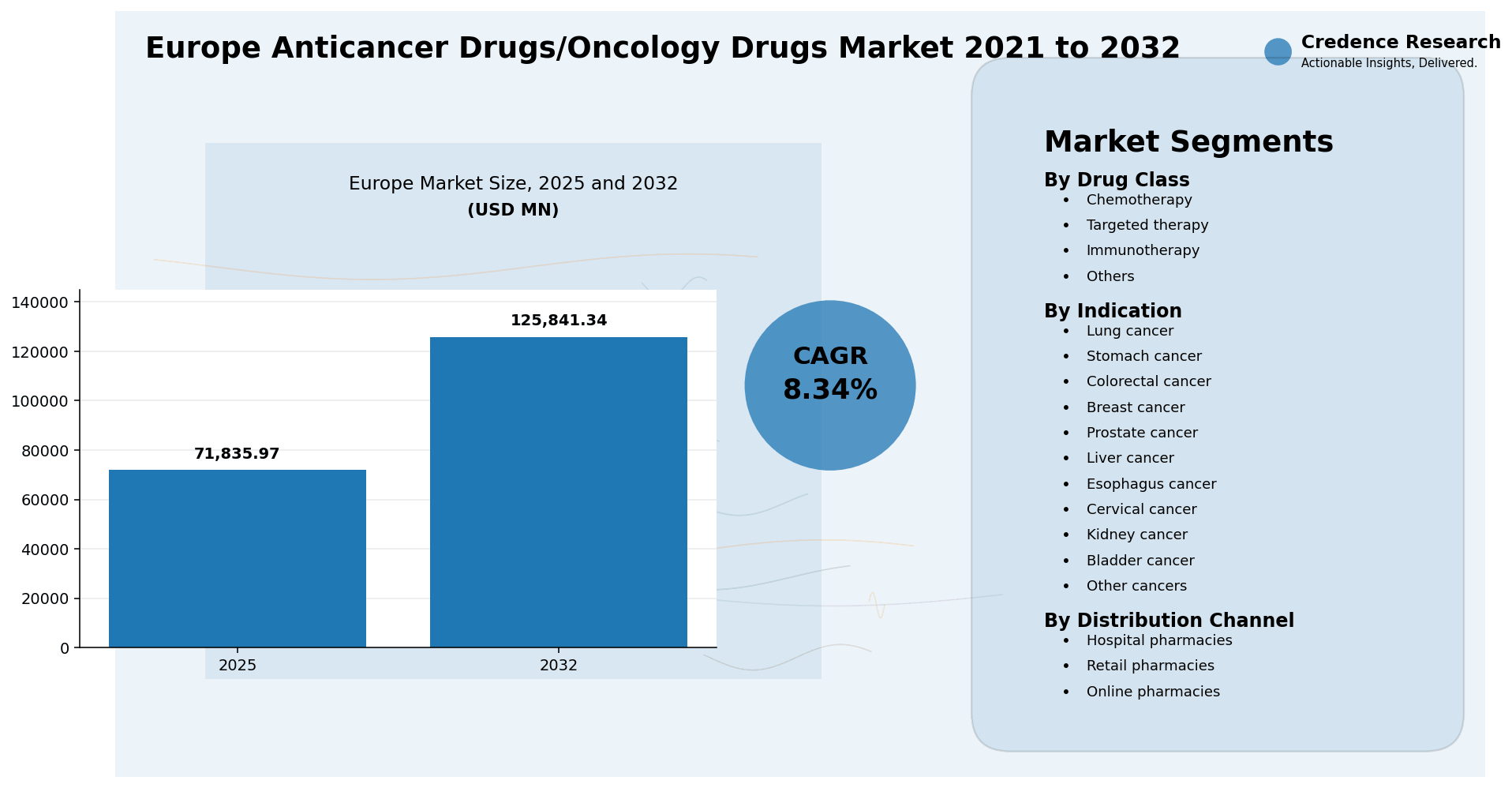
The Europe Anticancer Drugs/Oncology Drugs Market size was valued at USD 52,704.85 MN in 2021 and reached USD 71,835.97 MN in 2025. It is anticipated to reach USD 125,841.34 MN by 2032, growing at a CAGR of 8.34% during the forecast period.
| REPORT ATTRIBUTE |
DETAILS |
| Historical Period |
2021-2024 |
| Base Year |
2025 |
| Forecast Period |
2025-2032 |
| c Size 2025 |
USD 71,835.97 million |
| Europe Anticancer Drugs/Oncology Drugs Market, CAGR |
8.34% |
| Europe Anticancer Drugs/Oncology Drugs Market Size 2032 |
USD 125,841.34 million |
Europe Anticancer Drugs/Oncology Drugs Market Insights
- Market growth is supported by rising cancer burden, broader oncology drug approvals, precision medicine adoption, immunotherapy expansion and growing use of targeted therapies across major tumor types.
- Targeted Therapy holds a strong position because European oncology treatment is increasingly shaped by biomarker testing, molecular profiling and patient-specific treatment selection.
- Immunotherapy continues to gain share as PD-1, PD-L1 and CTLA-4 therapies expand across lung cancer, melanoma, kidney cancer, bladder cancer and gastrointestinal tumors.
- Hospital Pharmacies remain the leading distribution channel because complex oncology therapies require specialist administration, cold-chain handling, reimbursement coordination and adverse-event monitoring.
Europe Anticancer Drugs/Oncology Drugs Market Segment Insights
By drug class
By drug class, Targeted Therapy held a strong position in 2025 because European oncology treatment increasingly depends on molecular diagnostics, companion biomarkers and mutation-specific therapies. Targeted therapies are widely used across Lung Cancer, Breast Cancer, Colorectal Cancer, Prostate Cancer, Kidney Cancer and other tumor types. Immunotherapy continues to expand as checkpoint inhibitors and immune-based combinations move across more cancer indications and treatment lines. Chemotherapy remains relevant because it continues to serve as a backbone in several regimens and is used in combination with targeted and immunotherapy agents. Others include hormonal therapies, radiopharmaceuticals, antibody-drug conjugates and emerging cell-based or tumor-agnostic oncology treatments.
Access crucial information at unmatched prices!
Request your sample report today & start making informed decisions powered by Credence Research Inc.!
Download Sample
By indication
By indication, Lung Cancer held a strong position in 2025 because it is one of the largest areas for targeted therapy, immunotherapy and chemotherapy combinations. Breast Cancer and Prostate Cancer also account for strong demand due to large patient pools, biomarker-led treatment and long-term systemic therapy use. Colorectal Cancer, Stomach Cancer and Liver Cancer are gaining importance as immunotherapy and targeted options expand into more defined patient populations. Kidney Cancer and Bladder Cancer benefit from immune-oncology regimens and newer combinations. Cervical Cancer, Esophagus Cancer and Other Cancers create additional demand as oncology innovation broadens across tumor types and earlier treatment settings.
By distribution channel
By distribution channel, Hospital Pharmacies held the strongest position in 2025 because many oncology drugs require infusion, specialist prescribing, cold-chain storage and close monitoring. Hospital-based dispensing supports biologics, antibody-drug conjugates, chemotherapy, immunotherapy and radiopharmaceuticals that require controlled handling and clinical supervision. Retail Pharmacies remain relevant for oral oncology medicines, supportive care drugs and maintenance therapies used outside inpatient settings. Online Pharmacies are gaining gradual traction due to digital refill management, specialty medication fulfillment and home delivery. However, high-value oncology therapies still depend heavily on integrated hospital and specialty pharmacy models that connect oncologists, payers and patients.
Key market drivers
Rising cancer burden and treatment volume
Rising cancer burden and treatment volume represent a major growth driver for the Europe Anticancer Drugs/Oncology Drugs Market. Higher diagnosis volumes create sustained demand for chemotherapy, targeted therapy, immunotherapy and supportive oncology medicines across hospitals and outpatient care. The indication mix is broad, with Lung Cancer, Breast Cancer, Colorectal Cancer, Prostate Cancer, Cervical Cancer and gastric cancers contributing major treatment demand. The European Commission’s European Cancer Information System reported that breast, colorectal, cervical, prostate, lung and gastric cancers accounted for 54.2% of all new cancer cases and 50.2% of cancer deaths in the EU in 2022. This burden supports continued use of hospital-based oncology drugs, oral targeted medicines and long-term systemic therapy across Europe.
Precision oncology and biomarker-based prescribing
Precision oncology and biomarker-based prescribing support strong market growth because European treatment pathways increasingly use genomic testing, receptor status, PD-L1 expression and molecular markers to guide therapy. Biomarker-led care improves patient selection for targeted therapy, immunotherapy, antibody-drug conjugates and radiopharmaceuticals. It also allows manufacturers to define narrower but higher-value patient populations with measurable treatment benefit. EMA notes that cancer medicines are a priority area and that the EU authorized 25 new cancer medicines in 2023, while the agency supports development and approval pathways for personalized oncology medicines. This driver will remain central as clinical guidelines and reimbursement systems require stronger evidence for patient-specific treatment.
Immunotherapy and combination regimen expansion
Immunotherapy and combination regimen expansion continue to strengthen market demand across Europe. PD-1, PD-L1 and CTLA-4 therapies are now embedded across multiple tumor types, including Lung Cancer, Melanoma, Kidney Cancer, Bladder Cancer, Esophagus Cancer and Hodgkin Lymphoma. Combination approaches with chemotherapy, targeted therapy, CTLA-4 inhibition and antibody-drug conjugates are expanding treatment duration and drug utilization. EMA’s Opdivo product information lists indications across advanced melanoma, non-small cell lung cancer, renal cell carcinoma, classical Hodgkin lymphoma, urothelial carcinoma, MSI-H/dMMR colorectal cancer, esophageal cancer and hepatocellular carcinoma. This supports broad immunotherapy adoption through hospital pharmacies and specialist oncology networks.
Oncology portfolio expansion by key companies
Oncology portfolio expansion by key companies is strengthening the Europe Anticancer Drugs/Oncology Drugs Market. Leading companies are increasing oncology revenue through targeted therapies, immunotherapies, antibody-drug conjugates, radiopharmaceuticals and novel combinations. AstraZeneca reported that oncology medicines comprised 41% of Europe product sales in 2025, with Europe oncology product sales rising 20% to USD 4,880 million, driven by Tagrisso, Imfinzi, Calquence and Lynparza. Novartis also reported 2025 oncology product momentum, including Kisqali net sales of USD 4,783 million, up 58%, and Pluvicto net sales of USD 1,994 million, up 43%. This driver supports premium growth as companies scale differentiated oncology products across Europe.
Key Trends and Opportunities
Antibody-drug conjugates gain stronger adoption
Antibody-drug conjugates are becoming a major opportunity because they combine targeted delivery with cytotoxic payloads and can improve outcomes in defined tumor types. These therapies are expanding across Breast Cancer, Lung Cancer, Bladder Cancer and other solid tumors. EMA authorized Datroway for use in adults with HR-positive, HER2-negative breast cancer that is unresectable or metastatic after endocrine therapy and another cancer treatment, with EU marketing authorization issued on April 4, 2025. This trend supports demand for Targeted Therapy, Hospital Pharmacies and biomarker-led treatment pathways. It also creates opportunities for companies that can manage infusion logistics, safety monitoring and premium reimbursement.
Radiopharmaceuticals expand in prostate cancer
Radiopharmaceuticals are gaining importance in Europe as targeted radiation therapies move into prostate cancer and selected advanced tumors. These treatments require specialized manufacturing, isotope supply, nuclear medicine infrastructure and trained clinical teams. Novartis reported that Pluvicto net sales reached USD 1,994 million in 2025, up 43%, reflecting strong commercial momentum in a radioligand oncology therapy. Europe’s established hospital networks and nuclear medicine centers can support adoption, but capacity and reimbursement will shape rollout. The opportunity is strongest where diagnostics, therapy selection and treatment site readiness align.
Retail and online access for oral oncology expands
Retail and online access for oral oncology is expanding as more targeted therapies and maintenance regimens move outside infusion-only settings. Oral oncology drugs require ongoing prescription management, adherence support, adverse event counseling and payer coordination. Retail Pharmacies can support patients receiving long-term therapy, while Online Pharmacies can improve refill convenience in countries with mature e-pharmacy infrastructure. However, oncology medication management still requires specialist oversight due to toxicity, interactions and dose adjustment needs. This opportunity will favor integrated specialty pharmacy models that link hospitals, oncologists and outpatient channels.
Key Market Challenges
High drug cost and reimbursement scrutiny
High drug cost and reimbursement scrutiny remain key challenges for the Europe Anticancer Drugs/Oncology Drugs Market. Many immunotherapies, targeted therapies, antibody-drug conjugates and radiopharmaceuticals carry premium prices. European payers and health technology assessment bodies require evidence of survival benefit, quality-of-life improvement and cost-effectiveness before broad reimbursement. Delays in national reimbursement can also slow patient access after regulatory approval. Manufacturers must generate real-world evidence and risk-sharing strategies to support pricing. This challenge will remain central as oncology innovation shifts toward narrower biomarker-defined populations.
Uneven access across European countries
Uneven access across European countries creates a major barrier to consistent oncology drug uptake. EMA approval allows EU-wide authorization, but actual patient access depends on national reimbursement, procurement systems, oncology infrastructure and diagnostic testing availability. Wealthier markets often adopt premium therapies faster, while some Central and Eastern European countries face access delays. Biomarker testing and molecular profiling availability also vary across health systems. This can reduce use of targeted therapies and immunotherapies even when products are clinically approved. Companies must align access strategies with country-specific payer and provider requirements.
Safety management and treatment complexity
Safety management and treatment complexity create operational challenges for oncology providers. Immunotherapies can cause immune-related adverse events, while antibody-drug conjugates and chemotherapy can create hematologic, pulmonary, gastrointestinal and ocular toxicities. Radiopharmaceuticals require radiation safety and specialized handling. Combination regimens can increase monitoring burden and complicate treatment sequencing. Hospital Pharmacies and oncology centers need trained staff, infusion capacity and patient education systems. Companies that provide clear safety guidance, clinical support and monitoring resources will be better positioned.
Regional Analysis
Western Europe
Western Europe leads the Europe Anticancer Drugs/Oncology Drugs Market due to strong oncology infrastructure, high therapy adoption, broad reimbursement systems and advanced cancer center networks. Germany, France, the U.K., Italy, Spain and the Benelux markets support strong demand for Targeted Therapy, Immunotherapy, chemotherapy and radiopharmaceuticals. Hospital Pharmacies dominate because many oncology treatments require infusion, specialist monitoring and controlled handling. Western Europe also benefits from broader access to biomarker testing and clinical trials. The region is expected to remain the primary revenue contributor through 2032.
Northern Europe
Northern Europe represents a strong oncology market supported by advanced health systems, high screening coverage, strong patient registries and early adoption of innovative medicines. Countries such as Sweden, Denmark, Norway, Finland and Ireland support demand for targeted oncology drugs, immunotherapies and precision medicine. Hospital Pharmacies remain central due to specialist oncology administration and reimbursement-linked dispensing. The region’s health systems often emphasize evidence-based adoption and outcomes tracking. Growth will remain steady as cancer treatment pathways continue to integrate biomarker testing and combination regimens.
Southern Europe
Southern Europe supports significant oncology drug demand across Italy, Spain, Portugal and Greece. Lung Cancer, Breast Cancer, Colorectal Cancer and Prostate Cancer remain major therapy areas across the region. Hospital Pharmacies dominate distribution due to infusion therapy, public procurement and specialist oncology networks. Targeted Therapy and Immunotherapy adoption continues to rise, though reimbursement timelines and budget pressure can affect speed of access. The region offers growth opportunities for oral oncology, biosimilars, antibody-drug conjugates and hospital-based specialty therapies. Demand will remain steady through 2032.
Central and Eastern Europe
Central and Eastern Europe is an expanding market where demand is supported by rising cancer treatment needs, oncology infrastructure investment and gradual access to newer therapies. Chemotherapy remains widely used, while Targeted Therapy and Immunotherapy are gaining adoption as reimbursement improves. Access gaps remain important due to budget constraints, biomarker testing availability and slower reimbursement cycles. Hospital Pharmacies remain central because oncology treatment is concentrated in public hospitals and specialist cancer centers. The region offers long-term opportunities as health systems expand access to innovative cancer medicines and diagnostic testing.
Report Attribute Details
| Report Attribute |
Details |
| Historical Period |
2021–2024 |
| Base Year |
2025 |
| Forecast Period |
2025–2032 |
| Market Size in 2021 |
USD 52,704.85 MN |
| Market Size in 2025 |
USD 71,835.97 MN |
| Market Size in 2032 |
USD 125,841.34 MN |
| CAGR |
8.34% |
| Segments Covered |
Drug Class, Indication, Distribution Channel and Geography |
| Key Companies Covered |
AstraZeneca plc, Novartis AG, Merck & Co., Inc., Amgen, Pfizer Inc., AbbVie Inc., Astellas Pharma Inc., F. Hoffmann-La Roche Ltd., Johnson & Johnson and Bristol-Myers Squibb Company |
Market Segmentations
By Drug Class
- Chemotherapy
- Targeted Therapy
- Immunotherapy
- Others
By Indication
- Lung Cancer
- Stomach Cancer
- Colorectal Cancer
- Breast Cancer
- Prostate Cancer
- Liver Cancer
- Esophagus Cancer
- Cervical Cancer
- Kidney Cancer
- Bladder Cancer
- Other Cancers
By Distribution Channel
- Hospital Pharmacies
- Retail Pharmacies
- Online Pharmacies
Key Players
- AstraZeneca plc
- Novartis AG
- Merck & Co., Inc.
- Amgen
- Pfizer Inc.
- AbbVie Inc.
- Astellas Pharma Inc.
- F. Hoffmann-La Roche Ltd.
- Johnson & Johnson
- Bristol-Myers Squibb Company
Recent Developments
- In April 2025, EMA issued EU marketing authorization for Datroway for adults with HR-positive, HER2-negative unresectable or metastatic breast cancer after endocrine therapy and one additional cancer treatment.
- In 2025, AstraZeneca reported that its Europe oncology product sales increased 20% to USD 4,880 million, driven by Tagrisso, Imfinzi, Calquence and Lynparza.
- In 2025, Novartis reported strong oncology product momentum, with Kisqali net sales up 58% to USD 4,783 million and Pluvicto net sales up 43% to USD 1,994 million.
- In 2026, EMA’s Opdivo product information reflected broad oncology indications across melanoma, non-small cell lung cancer, renal cell carcinoma, Hodgkin lymphoma, urothelial carcinoma, MSI-H/dMMR colorectal cancer, esophageal cancer and hepatocellular carcinoma.
Shape Your Report to Specific Countries or Regions & Enjoy 30% Off!
Report Coverage
The research report offers an in-depth analysis based on drug class, indication, distribution channel and geography. It details leading market players, providing an overview of their business positioning, oncology portfolios, regulatory activity, market access strategies and strategic role in the Europe Anticancer Drugs/Oncology Drugs Market. The report includes insights into the competitive environment, market trends, growth drivers, restraints and opportunities. It also examines rising cancer burden, precision oncology, immunotherapy expansion, targeted therapy adoption, oncology portfolio growth and hospital pharmacy distribution as major factors shaping market development. The report assesses the impact of reimbursement scrutiny, uneven country-level access, safety management and treatment complexity on market growth. It provides strategic recommendations for pharmaceutical companies, hospital systems, payers, specialty pharmacies, distributors, investors and new entrants seeking to navigate Europe’s oncology drugs ecosystem.
Future Outlook
- Demand for oncology drugs in Europe will continue to rise as cancer diagnosis volume, survival duration and treatment complexity increase.
- Targeted Therapy will remain a major drug class because biomarker testing and molecular profiling are becoming central to treatment selection.
- Immunotherapy will gain further adoption across earlier treatment lines and broader cancer indications.
- Chemotherapy will remain relevant as a treatment backbone in several regimens and combination protocols.
- Lung Cancer will remain a leading indication due to high clinical burden and broad use of targeted and immune-oncology regimens.
- Breast Cancer and Prostate Cancer will continue to support strong demand due to large patient pools and expanding targeted therapy use.
- Hospital Pharmacies will remain the leading distribution channel because complex oncology drugs require clinical supervision and controlled handling.
- Retail Pharmacies and Online Pharmacies will gain relevance as oral oncology drugs and maintenance therapies expand.
- Antibody-drug conjugates and radiopharmaceuticals will create high-value growth opportunities.
- Competitive intensity will increase as companies compete on clinical outcomes, biomarker strategy, dosing convenience, reimbursement access and real-world evidence.



