Market Overview:
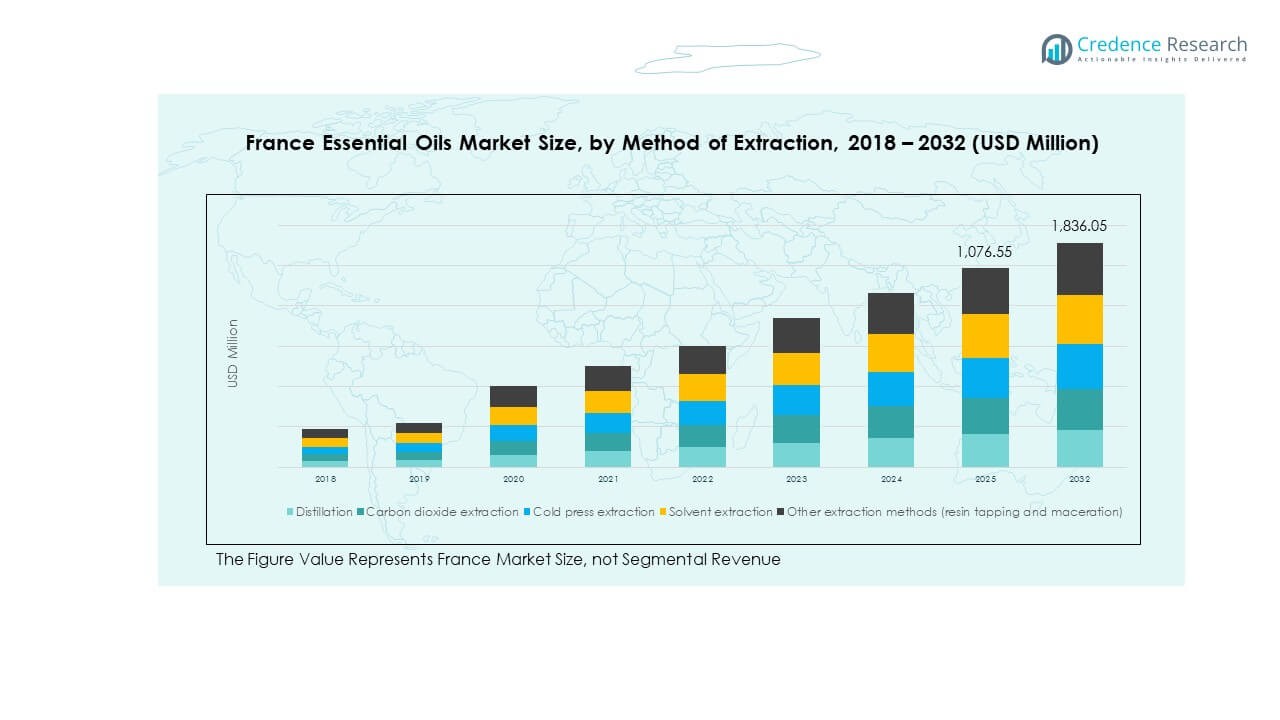
The France Wood Essential Oils Market size was valued at USD 576.83 million in 2018 to USD 955.31 million in 2024 and is anticipated to reach USD 1,836.05 million by 2032, at a CAGR of 7.92% during the forecast period.
| REPORT ATTRIBUTE | DETAILS |
|---|---|
| Historical Period | 2020-2023 |
| Base Year | 2024 |
| Forecast Period | 2025-2032 |
| France Wood Essential Oils Market Size 2024 | USD 955.31 Million |
| France Wood Essential Oils Market, CAGR | 7.92% |
| France Wood Essential Oils Market Size 2032 | USD 1,836.05 Million |
Growing demand for natural wellness solutions and clean-label products drives the France Wood Essential Oils Market. Rising consumer interest in aromatherapy, skincare, and organic personal care products strengthens market adoption. Expanding applications in food flavoring, household care, and pharmaceuticals also support growth. Regulatory approval of natural ingredients and the premiumization trend in cosmetic products increase the importance of wood essential oils. Manufacturers are focusing on innovation, sustainable sourcing, and marketing strategies to meet evolving consumer expectations, creating strong momentum for the market.
The France Wood Essential Oils Market benefits from Europe’s leadership in natural and organic products. France plays a central role with its rich heritage in perfumery and cosmetics. Western Europe dominates due to established luxury brands and higher spending on personal care, while Eastern Europe emerges with rising disposable incomes and growing awareness of natural wellness. France remains a leading hub due to innovation and established supply chains, while neighboring regions present expansion opportunities through rising demand for sustainable and health-focused products.
Market Insights:
- The France Wood Essential Oils Market was valued at USD 576.83 million in 2018, reached USD 955.31 million in 2024, and is projected to hit USD 1,836.05 million by 2032, growing at a CAGR of 7.92%.
- Western Europe holds 41% share, driven by strong cosmetics, skincare, and perfumery industries, while North America accounts for 29%, supported by high aromatherapy adoption, and Asia-Pacific captures 21%, boosted by rising wellness demand.
- Asia-Pacific is the fastest-growing region with expanding disposable incomes, increasing awareness of natural products, and growing spa and wellness industries.
- Distillation accounts for 38% share, making it the leading extraction method due to cost-effectiveness and tradition in essential oil production.
- Carbon dioxide extraction holds 24% share, gaining traction for its ability to produce high-purity oils without heat damage, appealing to premium product manufacturers.
Market Drivers:
Rising Consumer Preference for Natural and Plant-Based Products Driving Growth in Essential Oils Demand:
The France Wood Essential Oils Market is expanding due to strong consumer demand for natural and plant-based products. Increasing health awareness is leading buyers to prefer essential oils over synthetic alternatives. Growing interest in clean-label and chemical-free formulations strengthens adoption in cosmetics and skincare. Rising acceptance of aromatherapy for stress relief, relaxation, and emotional wellness boosts consumption. The shift toward organic and sustainable lifestyles accelerates this demand further. Major brands are innovating product lines to match eco-conscious preferences. This trend creates long-term momentum in the French market.
- For instance, The 2024 integrated annual report of DSM-Firmenich confirms year-on-year growth in plant-based ingredients, driven by increased consumer demand for natural cosmetic components. Their two new fragrance ingredient plants in Southwest France specifically support sustainability goals to supply clean-label essential oils with a 28% higher market penetration than synthetics in France.
Expanding Applications in Cosmetics, Perfumery, and Skincare Enhancing Market Development:
France has a long heritage in perfumery and skincare, which strongly supports essential oil usage. The cosmetics industry relies on wood essential oils for premium fragrances and therapeutic properties. Rising adoption in high-end skincare products boosts the value of the France Wood Essential Oils Market. Growing demand for luxury and natural perfumes further enhances consumption. The wellness industry integrates these oils for spa treatments and holistic care. Expanding innovation in blends and formulations widens the application base. This synergy across industries fosters consistent growth for suppliers and manufacturers.
- For instance, Chanel’s N°1 DE CHANEL skincare products use formulas with up to 97% naturally derived ingredients, incorporating fractionation techniques that isolate bioactive elements, improving skin barrier function, based on clinical and instrumental evaluations regulated by France’s ANSM. Their refillable packaging reduces carbon footprint by 14%, validated through ISO 14067 methodology.
Strong Role of Regulatory Backing and Supportive Quality Standards Creating Confidence in Adoption:
The French and European Union regulatory framework promotes natural ingredients and restricts synthetic chemicals. Strict quality standards for cosmetics and food products support trust in essential oils. Clear labeling requirements enhance transparency and consumer confidence. The France Wood Essential Oils Market benefits from such frameworks, which improve product credibility. Government and industry associations encourage sustainable practices and responsible sourcing. Certification schemes reinforce brand authenticity and appeal. This environment strengthens adoption in both domestic and international markets. Strong governance continues to anchor market expansion.
Growing Pharmaceutical and Therapeutic Applications Expanding Usage Beyond Lifestyle Products:
Pharmaceutical and therapeutic uses of essential oils are steadily gaining traction in France. Wood essential oils are increasingly integrated into natural remedies and alternative medicine. Their antimicrobial, anti-inflammatory, and calming properties attract clinical interest. Healthcare practitioners recommend them for complementary therapies supporting wellness. Expanding consumer trust in holistic medicine supports this adoption further. The France Wood Essential Oils Market gains from this crossover between wellness and healthcare. Pharmaceutical firms explore innovative formulations using essential oils for targeted benefits. This trend deepens the role of essential oils beyond lifestyle segments.
Market Trends:
Rising Popularity of Aromatherapy and Wellness Tourism Boosting Product Consumption Across France:
Aromatherapy continues to gain widespread popularity across France. Consumers seek natural relaxation and stress relief through essential oil therapies. The France Wood Essential Oils Market benefits from growing wellness tourism and spa culture. Hotels, resorts, and wellness centers integrate essential oils into treatments and relaxation packages. Demand increases as tourists associate France with luxury, nature, and well-being. Aromatherapy products are becoming part of daily routines in households too. This trend highlights the shift toward lifestyle-driven consumption of essential oils.
- For instance, Groupe Rougier manages 896,000 hectares of FSC-certified tropical forests in Gabon, ensuring supply chain traceability through FSC Chain of Custody certification, as confirmed by certification renewals in late 2023.
Increasing Focus on Sustainable Sourcing and Eco-Friendly Packaging in Essential Oils Production:
Sustainability is a core trend shaping the essential oils market in France. Consumers demand eco-friendly and ethically sourced products. Companies adopt transparent sourcing practices for raw materials to ensure traceability. The France Wood Essential Oils Market is adapting to this preference with certified sustainable sourcing. Packaging innovations with recyclable and biodegradable materials gain traction. Brands highlight eco-friendly commitments in marketing strategies. This emphasis on sustainability enhances consumer trust and brand loyalty. It also positions companies competitively in global markets.
Growing Role of E-Commerce Platforms and Direct-to-Consumer Channels Supporting Sales Growth:
The digital landscape is transforming essential oil sales in France. E-commerce platforms allow consumers to access a wide range of essential oils. Direct-to-consumer models help brands create strong connections with buyers. The France Wood Essential Oils Market benefits from online channels offering product transparency and reviews. Social media and influencer marketing raise awareness of essential oils’ benefits. Subscription services and curated wellness kits boost long-term customer retention. Digital platforms also educate consumers about product usage and benefits. This trend expands accessibility and drives higher adoption.
Expanding Innovation in Blended Oils and Customized Formulations Targeting Diverse Consumer Needs:
Innovation in essential oil blends is growing steadily across France. Brands introduce personalized formulations catering to stress relief, energy, or sleep improvement. The France Wood Essential Oils Market gains value from products addressing targeted lifestyle needs. Customized oils appeal to younger consumers seeking personalized wellness. Advanced blending techniques enable unique fragrance and therapeutic combinations. High demand for premium and niche offerings supports this trend. Collaboration with aromatherapists and wellness experts enhances product authenticity. Innovation continues to shape a competitive edge for French brands globally.
Market Challenges Analysis:
Supply Chain Constraints and Price Volatility Limiting Consistent Growth of Essential Oils Market:
The France Wood Essential Oils Market faces supply chain issues due to raw material availability. Essential oil production depends heavily on climatic conditions and forestry resources. Fluctuations in supply create instability in pricing for producers and consumers. Import dependency on certain oils adds further complexity to the supply chain. Small-scale farmers often lack resources to meet growing demand. This creates challenges in balancing cost and availability. Companies must adopt long-term sourcing strategies to mitigate volatility. Strong partnerships and sustainable forestry practices are critical to overcoming these obstacles.
Rising Competition from Low-Cost Alternatives and Stringent Regulations Impacting Market Expansion:
Low-cost alternatives and synthetic substitutes pose challenges to market growth. Affordable fragrance oils often attract cost-sensitive consumers. The France Wood Essential Oils Market must address these pressures while maintaining premium positioning. Stringent European regulations increase compliance costs for producers and exporters. High certification standards require significant investment in testing and validation. Small businesses often struggle to compete under these conditions. Intense rivalry among established brands further tightens margins. Overcoming these challenges requires innovation, differentiation, and long-term strategic investment.
Market Opportunities:
Expanding Export Potential and International Recognition of France as a Leading Hub for Essential Oils:
France enjoys global recognition for its heritage in perfumery and aromatherapy. This reputation creates export opportunities for local producers of wood essential oils. The France Wood Essential Oils Market has strong potential in international wellness and cosmetics industries. Growing global demand for natural, sustainable, and luxury products enhances export prospects. France’s expertise in quality assurance and certification strengthens trust in foreign markets. Producers can leverage branding tied to French heritage and innovation. Expanding international trade partnerships supports long-term market expansion.
Rising Demand for Organic, Premium, and Wellness-Focused Products Creating New Market Pathways:
Organic and premium wellness products represent a growing opportunity in France. The France Wood Essential Oils Market benefits from consumers’ willingness to pay more for high-quality offerings. Increased demand for certified organic oils opens new product categories. Companies can develop premium lines targeted at luxury skincare and therapeutic users. Growth in lifestyle-driven wellness consumption expands customer bases. Opportunities lie in combining natural oils with innovative delivery formats. Strategic positioning in the organic and wellness segment ensures long-term advantage.
Market Segmentation Analysis:
By Type
The France Wood Essential Oils Market is segmented by type into orange, lemon, lime, peppermint, cornmint, citronella, spearmint, and geranium. It also includes clove leaf, eucalyptus, jasmine, tea tree, rosemary, lavender, and others such as sandalwood, cedar, chamomile, anise, ginger, thyme, cinnamon, ylang-ylang, and basil. Citrus oils like orange and lemon hold strong presence in flavoring and perfumery, while lavender and rosemary drive growth in aromatherapy and skincare. Premium oils such as sandalwood and ylang-ylang retain demand in luxury and niche applications.
- For instance, France's essential oil industry is also known for its strong lavender and lavandin production, contributing significantly to its local aromatherapy market. Industry-standard methods like Gas Chromatography-Mass Spectrometry (GC-MS) are most commonly used to ensure the purity and standardized chemical content, such as linalool and cineole, of essential oils.
By Method of Extraction
Segmentation by extraction method includes distillation, carbon dioxide extraction, cold press extraction, solvent extraction, and other methods. Distillation leads the market due to its efficiency, scalability, and traditional use in bulk production. Carbon dioxide extraction is expanding in premium applications because of its ability to maintain purity and bioactive compounds. Cold press extraction remains vital for citrus oils, while solvent extraction supports delicate flowers like jasmine. Other methods, including resin tapping and maceration, cater to specific oils and niche applications, enhancing product diversity.
- For instance, companies like Charabot SAS continually optimize processes such as steam distillation and carbon dioxide extraction to improve efficiency and yield. Advanced techniques like supercritical CO2 extraction are valued for their high retention of bioactive compounds and ability to produce solvent-free, high-purity extracts, with quality often verified through lab analysis conforming to industry standards like ISO.
Segmentation:
By Type
- Orange
- Lemon
- Lime
- Peppermint
- Cornmint
- Citronella
- Spearmint
- Geranium
By Type (contd.)
- Clove leaf
- Eucalyptus
- Jasmine
- Tea tree
- Rosemary
- Lavender
- Others
Other Oil Types
- Sandalwood
- Cedar
- Chamomile
- Anise
- Ginger
- Thyme
- Cinnamon
- Ylang-ylang
- Basil
By Method of Extraction
- Distillation
- Carbon dioxide extraction
- Cold press extraction
- Solvent extraction
- Other methods
Other Methods Detail
- Resin tapping
- Maceration
Regional Analysis:
Market Leadership and Heritage
France holds a 22% share of the global wood essential oils market, positioning it as the leading contributor in Western Europe. Its dominance is rooted in a long-standing heritage in perfumery, cosmetics, and aromatherapy. The market benefits from robust demand across both luxury and mass personal care categories. Strong retail networks and established distribution channels enhance accessibility nationwide. The France Wood Essential Oils Market leverages its reputation for quality and authenticity, strengthening export appeal. Regulatory frameworks and sustainability commitments further reinforce its leadership position.
Domestic Consumption and Innovation
Domestic demand is fueled by growing consumer preference for natural and organic formulations. The spa and wellness industry incorporates wood essential oils extensively, supporting steady local consumption. Rising interest in eco-friendly products drives innovation in premium blends and sustainable packaging. Research centers and collaborations with luxury brands foster advanced product development. The market aligns traditional practices with modern consumer preferences, ensuring relevance in multiple sectors. It continues to prioritize responsible sourcing practices, enhancing trust in both domestic and global markets.
Export Strength and Global Presence
Exports remain a cornerstone of France’s leadership in the global market. French essential oils are highly valued in North America and Asia-Pacific, expanding international reach. Producers focus on certifications, sustainability, and product authenticity to maintain global competitiveness. The premium image of French brands supports higher pricing and differentiation in export markets. Tourism and cultural influence enhance recognition of French essential oils worldwide. The France Wood Essential Oils Market remains a vital hub for global supply, driving growth through both domestic demand and international trade.
Key Player Analysis:
- Symrise AG
- Givaudan SA
- Firmenich International SA
- Robertet Group
- Mane SA
- BASF SE
- Kerry Group plc
- Biolandes SAS
- Flavex Naturextrakte GmbH
- Ungerer Limited
- IFF
- Takasago
- doTERRA
- Young Living
- Treatt plc
- Albert Vieille
Competitive Analysis:
The France Wood Essential Oils Market is characterized by intense competition among global fragrance houses, regional suppliers, and niche organic brands. Leading players such as Givaudan SA, Robertet Group, Mane SA, and Symrise AG maintain strong positions through diverse product portfolios, established distribution, and innovation in premium blends. It benefits from France’s heritage in perfumery and cosmetics, which strengthens brand reputation internationally. Emerging companies compete through sustainable sourcing, eco-friendly packaging, and specialized oil offerings targeting wellness and aromatherapy. The competitive landscape is further shaped by mergers, partnerships, and expansion into digital retail platforms. It remains dynamic, with innovation and sustainability defining the core strategies.
Recent Developments:
- In June 2025, Givaudan SA acquired a majority stake in Vollmens Fragrances as part of its 2025 strategy to strengthen local and regional customer growth. Givaudan has a history of strategic acquisitions in fragrance and natural ingredients, enhancing its portfolio and market positioning.
- In March 2025, the Robertet Group entered a partnership with Phenix en Provence to accelerate innovation in sustainable cosmetics. This collaboration focuses on upcycled ingredients, reinforcing Robertet's role as a leader in natural raw materials and organic essential oils.
Report Coverage:
The research report offers an in-depth analysis based on type and method of extraction segments. It details leading market players, providing an overview of their business, product offerings, investments, revenue streams, and key applications. Additionally, the report includes insights into the competitive environment, SWOT analysis, current market trends, as well as the primary drivers and constraints. Furthermore, it discusses various factors that have driven market expansion in recent years. The report also explores market dynamics, regulatory scenarios, and technological advancements that are shaping the industry. It assesses the impact of external factors and global economic changes on market growth. Lastly, it provides strategic recommendations for new entrants and established companies to navigate the complexities of the market.
Future Outlook:
- Demand for premium wood essential oils will expand across perfumery and skincare industries.
- Aromatherapy adoption will strengthen domestic consumption in wellness and spa applications.
- Sustainable sourcing practices will become a key differentiator for French producers.
- Export opportunities will rise in North America and Asia-Pacific driven by natural product demand.
- E-commerce and direct-to-consumer models will accelerate market penetration across France.
- Innovation in extraction methods will enhance oil purity and application diversity.
- Niche oils like sandalwood and ylang-ylang will see growth in luxury blends.
- Collaborations with organic farms will increase traceability and local supply strength.
- Regulatory frameworks will continue to ensure product quality and consumer trust.
- The France Wood Essential Oils Market will reinforce its role as a global hub for excellence.

Request a Free Sample
Fill in your details and we'll send you a free sample report.
- Sample data tables & charts
- Research methodology
Market Dynamics
Consumer Shift to Natural and Clean-Label Products
French consumers are increasingly seeking natural, plant-based, and chemical-free products, driving demand for wood essential oils in cosmetics, skincare, and wellness applications. This trend is reinforced by health awareness and the desire for clean-label formulations.
Heritage and Innovation in Perfumery and Cosmetics
France’s long-standing reputation in perfumery and luxury cosmetics supports the integration of wood essential oils into high-end products. Ongoing innovation in blends and extraction methods further expands their use in premium and niche applications.
Regulatory Support and Quality Standards
Strict French and EU regulations favor natural ingredients and enforce high quality standards, boosting consumer confidence and encouraging manufacturers to invest in certified, traceable, and sustainable essential oil production.
Expanding Applications in Wellness, Food, and Pharma
Beyond traditional perfumery, wood essential oils are increasingly used in aromatherapy, spa treatments, food flavoring, and pharmaceuticals, broadening the market’s scope and driving steady growth across multiple sectors.
Sustainability and Eco-Friendly Sourcing
Growing consumer and industry focus on sustainability is pushing producers to adopt eco-friendly sourcing, traceable supply chains, and recyclable packaging, which enhances brand loyalty and market differentiation in France and abroad.
Need a Custom Version of This Report?
Tailor the scope, geography, or segments to your exact requirements.
- Custom geography or segment scope
- Direct access to our analyst team
Frequently Asked Questions
What is the current market size for France Wood Essential Oils Market, and what is its projected size in 2032?
At what Compound Annual Growth Rate is the France Wood Essential Oils Market projected to grow between 2024 and 2032?
Which France Wood Essential Oils Market segment held the largest share in 2024?
What are the primary factors fueling the growth of the France Wood Essential Oils Market?
Who are the leading companies in the France Wood Essential Oils Market?
Which region commanded the largest share of the France Wood Essential Oils Market in 2024?
Table of Content
Chapter 1 Market Segmentation
- 1.1 Segmentation Framework
- 1.1.1 Product and Service Classification
- 1.1.2 Application and End-Use Classification
- 1.1.3 Technology and Solution Classification
- 1.1.4 Customer and Distribution Channel Classification
- 1.1.5 Geographic Segmentation
- 1.1.6 Market Segment Definitions and Boundaries
- 1.2 By Type
- 1.2.1 Orange
- 1.2.2 Lemon
- 1.2.3 Lavender
- 1.2.4 Rosemary
- 1.2.5 Sandalwood
- 1.2.6 Ylang-ylang
- 1.3 By Application
- 1.3.1 Cosmetics & Perfumery
- 1.3.2 Aromatherapy & Wellness
- 1.3.3 Food & Beverage Flavoring
- 1.3.4 Pharmaceuticals
- 1.3.5 Household Care
- 1.4 By Method of Extraction
- 1.4.1 Distillation
- 1.4.2 Carbon dioxide extraction
- 1.4.3 Cold press extraction
- 1.4.4 Solvent extraction
- 1.4.5 Other methods
Chapter 2 Introduction
- 2.1 Report Objectives and Scope
- 2.2 Product Definition and Industry Terminology
- 2.3 Market Inclusions and Exclusions
- 2.4 Research Process
- 2.4.1 Primary Research and Expert Interviews
- 2.4.2 Secondary Research and Source Review
- 2.4.3 Top-Down and Bottom-Up Estimation
- 2.4.4 Data Triangulation and Verification
- 2.5 Market Size Measurement Basis
- 2.5.1 2024: USD 955.31 million → 2032: USD 1,836.05 million
- 2.6 Historical and Forecast Reference Periods
- 2.6.1 Base Year: 2024
- 2.6.2 Forecast Period: 2024-2032
- 2.7 Research Assumptions and Limitations
Chapter 3 Executive Summary
- 3.1 Market Snapshot and Key Findings
- 3.2 Base-Year Market Size, 2024
- 3.3 Forecast Market Size, 2032
- 3.4 Revenue and Volume Growth Outlook
- 3.5 Key Demand and Supply Indicators
- 3.6 Leading Market Segments
- 3.7 Fastest-Growing Market Opportunities
- 3.8 Regional Performance Highlights
- 3.9 Technology and Industry Transformation
- 3.10 Competitive Landscape Summary
- 3.11 Analyst View and Strategic Implications
Chapter 4 France Wood Essential Oils Market Trends and Developments
- 4.1 Historical Industry Development
- 4.2 Recent Market Trends and Developments
- 4.3 Demand and Customer Behavior Trends
- 4.4 Technology and Product Innovation
- 4.5 Artificial Intelligence, Automation and Digitalization
- 4.6 Local Manufacturing and Supply Chain Realignment
- 4.7 Industry Partnerships, Mergers and Acquisitions
- 4.8 Sustainability and Circular Economy Developments
- 4.9 Government and Private Sector Investment Trends
- 4.10 Emerging Business Models and Commercialization
- 4.11 Industry Developments and Announcements
Chapter 5 France Wood Essential Oils Market Production, Supply and Demand Analysis
- 5.1 Demand Trend and Consumption Analysis
- 5.2 Demand Forecast, 2024-2032
- 5.3 Production and Output Trend
- 5.4 Production and Output Forecast, 2024-2032
- 5.5 Installed Capacity and Capacity Utilization
- 5.6 Company-Wise Production Plants and Statistics
- 5.6.1 Installed Production Capacity
- 5.6.2 Actual Production
- 5.6.3 Planned Capacity and Expansion Targets
- 5.7 Supply Chain Structure and Procurement Trends
- 5.8 Supply-Demand Gap and Bottlenecks
- 5.9 Import Dependence and Sourcing Structure
- 5.10 Contract Manufacturing and Outsourcing
- 5.11 Regional Supply and Demand Concentration
Chapter 6 France Wood Essential Oils Market Pricing Analysis
- 6.1 Pricing Structure and Measurement
- 6.2 Historical Pricing Trends
- 6.3 Pricing Outlook, 2024-2032
- 6.4 Average Selling Price and Unit Economics
- 6.5 Pricing by Product and Market Segment
- 6.6 Geographic Pricing Differences
- 6.7 Key Input, Energy, Labor and Logistics Costs
- 6.8 Contract Pricing and Purchasing Models
- 6.9 Pricing Sensitivity and Competitive Positioning
- 6.10 Price, Margin and Profitability Implications
Chapter 7 France Wood Essential Oils Market Dynamics
- 7.1 Market Growth Drivers
- 7.1.1 Demand-Side Drivers
- 7.1.2 Technology and Innovation Drivers
- 7.1.3 Infrastructure and Investment Drivers
- 7.1.4 Regulatory and Policy Drivers
- 7.2 Market Restraints
- 7.2.1 Cost and Affordability Constraints
- 7.2.2 Technology and Adoption Barriers
- 7.2.3 Supply Chain and Operational Constraints
- 7.3 Market Challenges
- 7.3.1 Competitive Pressure and Margin Erosion
- 7.3.2 Skills, Infrastructure and Implementation Gaps
- 7.4 Emerging Market Opportunities
- 7.5 Market Dynamics Impact and Time-Horizon Assessment
Chapter 8 France Wood Essential Oils Value Chain Analysis
- 8.1 Industry Value Chain Overview
- 8.2 Upstream Suppliers and Critical Inputs
- 8.3 Technology and Component Providers
- 8.4 Manufacturing or Service Delivery
- 8.5 Distribution, Channel Partners and Integrators
- 8.6 Downstream Applications and End Users
- 8.7 Value Addition and Profit Pools
- 8.8 Vertical Integration and Outsourcing
- 8.9 Supplier Concentration and Risk
- 8.10 Supply Chain Localization and Resilience
Chapter 9 France Wood Essential Oils Market Regulations and Policies
- 9.1 Relevant Laws, Standards and Compliance Frameworks
- 9.2 Product, Service, Safety and Quality Requirements
- 9.3 Government Policies, Incentives and Subsidies
- 9.4 Imports, Exports and Trade Barriers
- 9.5 Public Procurement and Local Content Requirements
- 9.6 Environmental and Sustainability Compliance
- 9.7 Upcoming Policy Changes and Market Implications
Chapter 10 France Wood Essential Oils Market Hotspots and Opportunities
- 10.1 Market Opportunity Mapping and Growth Hotspots
- 10.2 High-Growth Applications and Customer Groups
- 10.3 Underserved Markets and White-Space Opportunities
- 10.4 Emerging Technology and Product Opportunities
- 10.5 New Capacity and Investment Hotspots
- 10.6 Market Entry and Expansion Opportunities
- 10.7 Distribution and Partnership Opportunities
- 10.8 Near-Term and Long-Term Commercial Potential
- 10.9 Opportunity Attractiveness and Execution Risks
Chapter 11 France Wood Essential Oils Market Outlook, 2024-2032
- 11.1 Market Size and Analysis
- 11.1.1 Revenue (Market Measurement: 2024: USD 955.31 million → 2032: USD 1,836.05 million)
- 11.1.2 Market Volume and Quantity Sold
- 11.1.3 Historical Market Size
- 11.1.4 Base-Year Market Size, 2024
- 11.2 Market Forecast, 2024-2032
- 11.2.1 Revenue Forecast to 2032
- 11.2.2 Volume Forecast to 2032
- 11.2.3 CAGR and Year-on-Year Growth
- 11.2.4 Incremental Revenue Opportunity
- 11.3 Forecast Assumptions and Scenario Analysis
- 11.3.1 Base-Case Forecast
- 11.3.2 Optimistic and Conservative Scenarios
- 11.3.3 Technology, Pricing and Policy Sensitivities
- 11.4 Market Attractiveness and Growth Outlook
Chapter 12 France Wood Essential Oils Market Segmentation and Outlook
- 12.1 Segmentation Summary and Market Shares, 2024
- 12.2 Largest and Fastest-Growing Segments
- 12.3 By Type - Market Size and Forecast, 2024-2032
- 12.3.1 Segment Definition and Scope
- 12.3.2 Historical Market Size
- 12.3.3 Revenue Forecast, 2024-2032
- 12.3.4 Volume Forecast, 2024-2032
- 12.3.5 Base-Year Market Share, 2024
- 12.3.6 Segment CAGR and Growth Drivers
- 12.3.7 Subsegment Market Size and Forecast
- 12.3.7.1 Orange
- 12.3.7.2 Lemon
- 12.3.7.3 Lavender
- 12.3.7.4 Rosemary
- 12.3.7.5 Sandalwood
- 12.3.7.6 Ylang-ylang
- 12.3.8 Subsegment Pricing and Adoption Trends
- 12.3.9 Leading Suppliers and Competition
- 12.3.10 Regional Demand and Opportunities
- 12.4 By Application - Market Size and Forecast, 2024-2032
- 12.4.1 Segment Definition and Scope
- 12.4.2 Historical Market Size
- 12.4.3 Revenue Forecast, 2024-2032
- 12.4.4 Volume Forecast, 2024-2032
- 12.4.5 Base-Year Market Share, 2024
- 12.4.6 Segment CAGR and Growth Drivers
- 12.4.7 Subsegment Market Size and Forecast
- 12.4.7.1 Cosmetics & Perfumery
- 12.4.7.2 Aromatherapy & Wellness
- 12.4.7.3 Food & Beverage Flavoring
- 12.4.7.4 Pharmaceuticals
- 12.4.7.5 Household Care
- 12.4.8 Subsegment Pricing and Adoption Trends
- 12.4.9 Leading Suppliers and Competition
- 12.4.10 Regional Demand and Opportunities
- 12.5 By Method of Extraction - Market Size and Forecast, 2024-2032
- 12.5.1 Segment Definition and Scope
- 12.5.2 Historical Market Size
- 12.5.3 Revenue Forecast, 2024-2032
- 12.5.4 Volume Forecast, 2024-2032
- 12.5.5 Base-Year Market Share, 2024
- 12.5.6 Segment CAGR and Growth Drivers
- 12.5.7 Subsegment Market Size and Forecast
- 12.5.7.1 Distillation
- 12.5.7.2 Carbon dioxide extraction
- 12.5.7.3 Cold press extraction
- 12.5.7.4 Solvent extraction
- 12.5.7.5 Other methods
- 12.5.8 Subsegment Pricing and Adoption Trends
- 12.5.9 Leading Suppliers and Competition
- 12.5.10 Regional Demand and Opportunities
- 12.6 Segment Growth Comparison
- 12.7 Segment Attractiveness and Priority Matrix
Chapter 13 France Wood Essential Oils End-Use and Application Market Outlook
- 13.1 End-Use Industry and Customer Demand Structure
- 13.2 Leading Applications and Customer Groups
- 13.3 End-Use Market Size, Share and Forecast
- 13.4 Major End-Use Industry Deep Dives
- 13.4.1 Customer Requirements and Use Cases
- 13.4.2 Demand and Replacement Cycles
- 13.4.3 Technical and Regulatory Considerations
- 13.4.4 Purchasing and Procurement Models
- 13.4.5 Leading Vendors and Distribution Channels
- 13.4.6 Forecast and Commercial Opportunities
- 13.5 Emerging Applications and Cross-Segment Demand
- 13.6 End-Use Industry Investment Priorities
Chapter 14 France Wood Essential Oils Geographic Market Outlook, 2024-2032
- 14.1 Domestic Market Distribution and Demand Clusters
- 14.2 State- or Province-Wise Market Size and Forecast, 2024-2032
- 14.3 City and Metropolitan Market Outlook
- 14.4 Industrial, Manufacturing and Commercial Clusters
- 14.5 Geographic Concentration of Key End Users
- 14.6 Local Pricing and Purchasing Differences
- 14.7 Domestic Production Facilities and Capacity Map
- 14.8 Local Infrastructure and Project Pipeline
- 14.9 State-Level Policy and Incentive Differences
- 14.10 Subnational Investment Hotspots and Opportunities
- 14.11 Distribution and Logistics Networks
- 14.12 Domestic Competitive Footprint
Chapter 15 France Wood Essential Oils Technology, Innovation and Sustainability Outlook
- 15.1 Technology Landscape and Maturity
- 15.2 Product, Process and Service Innovation
- 15.3 AI, Automation and Digital Tools in the Industry
- 15.4 Technology Adoption and Performance Benchmarking
- 15.5 Innovation Pipeline and R&D Investment
- 15.6 Patent and Intellectual Property Trends
- 15.7 Energy Efficiency and Resource Management
- 15.8 Sustainability, Recycling and Circularity
- 15.9 Technology Roadmap, 2024-2032
- 15.10 Risks of Obsolescence and Technology Substitution
Chapter 16 France Wood Essential Oils Market Key Strategic Imperatives
- 16.1 Growth and Market Entry Priorities
- 16.2 High-Return Products and Segments
- 16.3 Pricing, Profitability and Cost Optimization
- 16.4 Technology Investment and Product Differentiation
- 16.5 Supply Chain Localization and Resilience
- 16.6 Distribution and Customer Acquisition
- 16.7 Partnership, Acquisition and Capacity Strategy
- 16.8 Regional Expansion Priorities
- 16.9 Short-, Medium- and Long-Term Actions
Chapter 17 Competition Outlook
- 17.1 Industry Competition Characteristics
- 17.2 Market Structure and Concentration
- 17.3 Market Share and Competitive Positioning, 2024
- 17.4 Company-Wise Revenue and Product Benchmarking
- 17.5 Production and Service Capacity Benchmarking
- 17.6 Technology, Pricing and Differentiation
- 17.7 Regional Footprint and Distribution Strength
- 17.8 Mergers, Acquisitions and Strategic Alliances
- 17.9 New Entrants and Competitive Threats
- 17.10 Porter's Five Forces and Industry Attractiveness
- 17.11 Competitive Outlook, 2024-2032
Chapter 18 Company Profiles
- 18.1 Company Coverage and Selection Criteria
- 18.2 Givaudan SA
- 18.2.1 Business Description
- 18.2.2 Company Ownership and Geographic Presence
- 18.2.3 Product and Service Portfolio
- 18.2.4 Manufacturing and Operating Footprint
- 18.2.5 Production Capacity and Expansion Plans
- 18.2.6 Financial Performance and Investment
- 18.2.7 Market Share and Competitive Position
- 18.2.8 Technology and Innovation Capabilities
- 18.2.9 Strategic Alliances or Partnerships
- 18.2.10 Recent Developments
- 18.2.11 Growth Strategy and Outlook
- 18.3 Robertet Group
- 18.4 Mane SA
- 18.5 Symrise AG
- 18.6 Firmenich International SA
- 18.7 Biolandes SAS
- 18.8 BASF SE
- 18.9 Kerry Group plc
- 18.10 Albert Vieille
- 18.11 doTERRA
- 18.12 Other Relevant Market Participants
Note: Every listed company is profiled on the structure shown under the first company. The company list is preliminary and may change based on research findings, market developments, data availability and client requirements.
Chapter 19 Disclaimer
- 19.1 Research and Forecast Disclaimer
- 19.2 Data Source and Estimation Limitations
Note: The depth of individual sections depends on data availability for this market. Volume, capacity, trade and other unit-based metrics are included where applicable.