
Custom Nail Polish Market Overview:
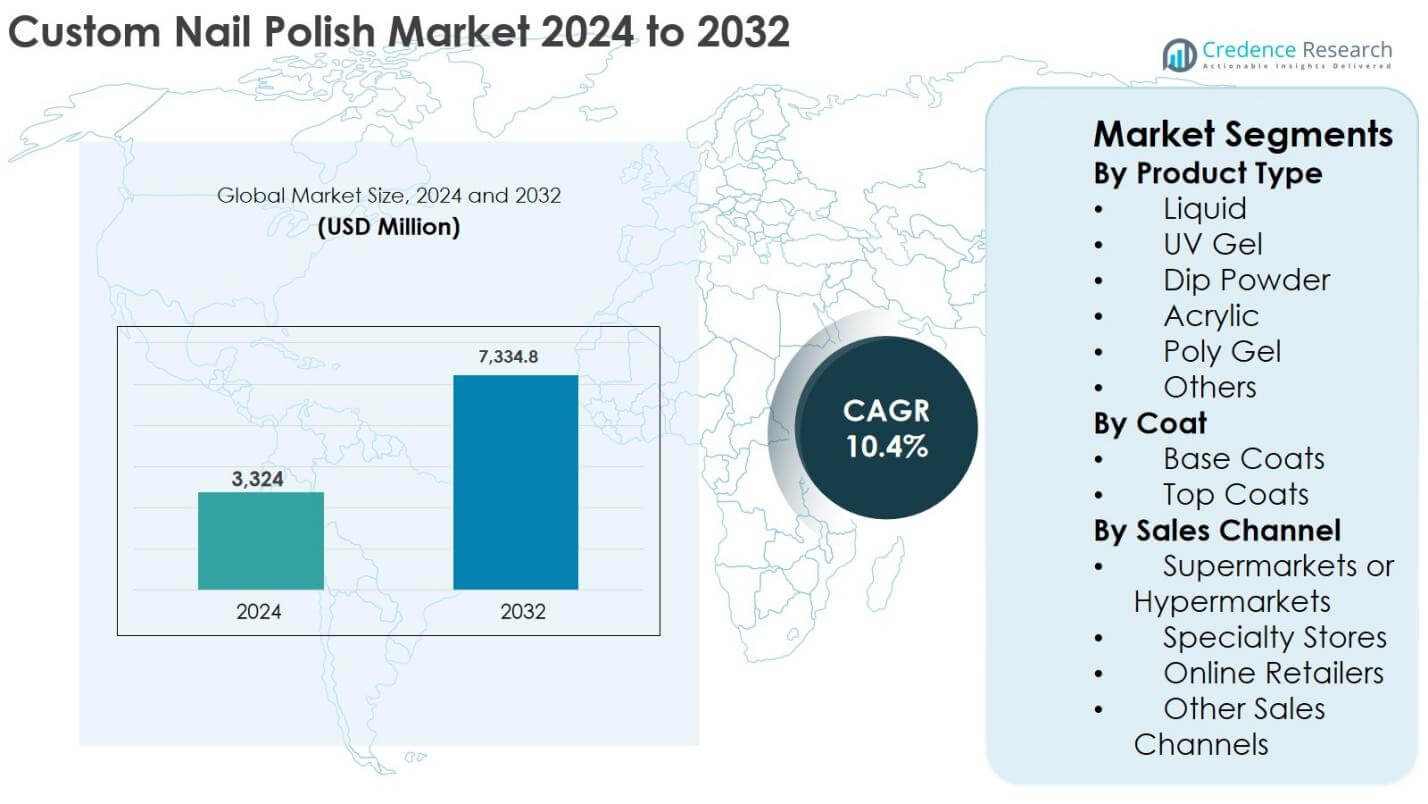
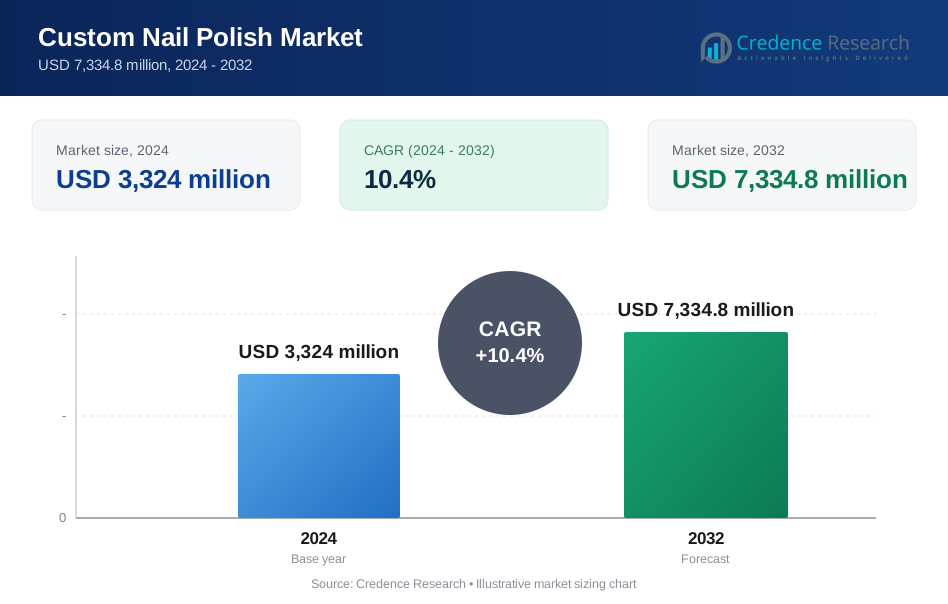
The Custom Nail Polish Market size was valued at USD 3,324 million in 2024 and is anticipated to reach USD 7,334.8 million by 2032, growing at a CAGR of 10.4% during the forecast period.
| REPORT ATTRIBUTE | DETAILS |
|---|---|
| Historical Period | 2020-2023 |
| Base Year | 2024 |
| Forecast Period | 2025-2032 |
| Custom Nail Polish Market Size 2024 | USD 3,324 million |
| Custom Nail Polish Market, CAGR | 10.4% |
| Custom Nail Polish Market Size 2032 | USD 7,334.8 million |
Custom Nail Polish Market Insights
- Market growth is driven by rising demand for personalization, self-expression, and at-home manicure solutions, with liquid nail polish leading the product segment at 38.6% share due to ease of use and wide customization options.
- Increasing preference for clean, vegan, and non-toxic formulations, along with influencer-driven nail art trends and digital shade customization tools, is accelerating product innovation and premiumization across the market.
- The market remains highly fragmented, with indie brands competing through limited editions, specialty finishes, and direct-to-consumer models, while top coats dominate the coat segment with 56.8% share driven by long-wear demand.
- Regionally, North America led with 34.8% share in 2024, followed by Europe at 27.6% and Asia Pacific at 24.1%, while online retailers dominated sales channels with a 42.9% share supported by strong e-commerce adoption.
Custom Nail Polish Market Segmentation Analysis:
By Product Type:
The Custom Nail Polish market by product type is led by Liquid nail polish, which accounted for 38.6% market share in 2024, driven by its wide color customization, ease of application, and strong compatibility with home-use and salon settings. Liquid formulations benefit from faster drying times, affordability, and broad availability across retail and online platforms. UV Gel followed with a 27.4% share, supported by long-lasting wear and rising salon demand, while Dip Powder and Acrylic gained traction due to durability preferences. Growing experimentation, DIY nail trends, and influencer-driven nail art continue to reinforce liquid nail polish dominance.
- For instance, OPI’s Nail Lacquer line offers hundreds of custom shades and seasonal collaborations that are widely distributed through professional salons and mass retailers.
By Coat:
By coat type, Top Coats dominated the Custom Nail Polish market with a 56.8% share in 2024, owing to their essential role in enhancing shine, extending wear life, and protecting customized nail colors. The growing preference for long-lasting, chip-resistant manicures and premium finishing solutions strongly supports top coat demand. Base Coats held a 43.2% share, driven by increased awareness of nail health, stain prevention, and smoother color application. Rising consumer spending on complete manicure systems and professional-grade at-home nail care solutions continues to accelerate growth across both coat categories.
- For instance, Essie’s Gel-Setter Top Coat is marketed to deliver gel-like shine and extended wear without a UV lamp, supporting consumers who want professional-looking results at home.
By Sales Channel:
In terms of sales channels, Online Retailers emerged as the dominant sub-segment with a 42.9% market share in 2024, supported by wide product variety, direct-to-consumer brands, and customization tools such as shade selectors and subscription kits. Specialty Stores followed with a 31.6% share, benefiting from personalized consultations and premium brand availability. Supermarkets and Hypermarkets accounted for 18.2%, driven by convenience and impulse purchases. Expanding e-commerce penetration, social media marketing, and global shipping capabilities remain key drivers strengthening online channel leadership.
Key Growth Drivers
Rising Demand for Personalization and Self-Expression
The Custom Nail Polish market is strongly driven by rising consumer demand for personalization and self-expression, particularly among millennials and Gen Z consumers. Custom color blending, finish selection, and personalized naming options allow consumers to align nail products with individual identities, fashion preferences, and seasonal trends. Social media platforms and influencer culture amplify this demand by encouraging unique nail aesthetics and limited-edition shades. Consumers increasingly view nail polish as an extension of personal style rather than a commodity cosmetic, driving repeat purchases and experimentation. This shift toward customization is further supported by advances in digital shade-matching tools and direct-to-consumer platforms, enabling brands to offer tailored products at scale while maintaining premium pricing and strong customer engagement.
- For instance, Sally Hansen’s collaboration with Perfect Corp has enabled AR-powered virtual try-on for nail colors, helping consumers match shades to skin tone and outfits through mobile apps
Expansion of At-Home Manicure and DIY Nail Care Culture
The growing preference for at-home beauty routines significantly supports the Custom Nail Polish market. Consumers increasingly invest in professional-quality nail products to achieve salon-like results at home, driven by convenience, cost efficiency, and time savings. Custom nail polish kits, including base coats, top coats, and personalized shades, appeal to DIY users seeking control over color, finish, and formulation. This trend accelerated during recent years and continues due to sustained interest in self-care routines. Brands offering easy-to-use formulas, quick-dry technology, and long-wear performance benefit from this shift, while subscription models and refill options further encourage customer retention and recurring revenue.
- For instance, Olive & June’s Mani System bundles polish, tools, and top coats specifically designed to help consumers replicate salon-quality manicures at home, supported by tutorials and online classes.
Growth of E-Commerce and Direct-to-Consumer Distribution
The rapid expansion of e-commerce and direct-to-consumer channels is a major growth driver for the Custom Nail Polish market. Online platforms enable brands to bypass traditional retail limitations and offer extensive customization options, shade libraries, and interactive tools. Consumers benefit from global access, doorstep delivery, and personalized recommendations, while brands gain valuable consumer data to refine offerings. Social commerce, influencer partnerships, and targeted digital marketing further accelerate product discovery and conversion rates. The scalability of online sales models supports rapid product launches, limited editions, and international expansion, reinforcing long-term market growth.
Key Trends & Opportunities
Clean Beauty, Vegan, and Non-Toxic Formulations
A major trend shaping the Custom Nail Polish market is the growing demand for clean beauty, vegan, and non-toxic formulations. Consumers increasingly seek products free from harmful chemicals such as formaldehyde, toluene, and DBP, prioritizing health-conscious and environmentally responsible choices. This trend presents significant opportunities for brands to differentiate through “free-from” labeling, cruelty-free certifications, and sustainable ingredient sourcing. Customization combined with clean formulations enhances brand trust and attracts premium buyers. As regulatory scrutiny increases and consumer awareness rises, brands investing in safer formulations and transparent labeling gain long-term competitive advantages and stronger customer loyalty.
- For instance, Zoya markets its nail polishes as “10-free,” vegan, and cruelty-free, emphasizing the absence of common solvents and toxic additives to appeal to ingredient-conscious users.
Limited Editions, Collaborations, and Digital Customization Tools
Limited-edition collections and brand collaborations represent a key opportunity within the Custom Nail Polish market. Partnerships with influencers, designers, and entertainment franchises drive excitement and exclusivity while encouraging impulse purchases. Additionally, digital customization tools such as virtual try-ons, AI-based shade recommendations, and color-mixing interfaces enhance the online shopping experience. These innovations reduce purchase hesitation and increase conversion rates. Brands leveraging technology-driven customization and experiential marketing can strengthen differentiation, expand average order value, and deepen consumer engagement across digital channels.
- For instance, OPI and other leading brands employ digital shade finders and visualization tools on their websites, guiding consumers to tailored color choices and boosting engagement.
Key Challenges
High Production Complexity and Cost Pressures
The Custom Nail Polish market faces challenges related to production complexity and cost management. Offering personalized shades, finishes, and packaging increases formulation, inventory, and operational costs compared to mass-produced products. Small batch manufacturing and customization workflows require advanced systems and skilled labor, which can pressure margins. Additionally, fluctuations in raw material prices and packaging costs further strain profitability. Brands must balance customization depth with operational efficiency to remain competitive, making process optimization and scalable production models critical to long-term sustainability.
Intense Competition and Brand Differentiation Difficulties
Intense competition from indie brands, established cosmetic companies, and private-label offerings poses a significant challenge in the Custom Nail Polish market. Low entry barriers enable frequent new launches, increasing product saturation and consumer choice. Differentiating based solely on color becomes difficult, pushing brands to invest heavily in branding, marketing, and innovation. Maintaining customer loyalty requires continuous engagement, trend responsiveness, and product innovation. Without strong brand identity and consistent quality, companies risk commoditization and pricing pressure in an increasingly crowded market.
Regional Analysis
North America
North America accounted for 34.8% of the Custom Nail Polish market share in 2024, supported by strong consumer spending on premium beauty products and high adoption of personalization trends. The region benefits from a well-established indie nail polish ecosystem, strong e-commerce penetration, and widespread influence of social media and beauty influencers. Demand for clean-label, vegan, and cruelty-free formulations further strengthens market growth. The presence of direct-to-consumer brands offering advanced customization tools and subscription models drives repeat purchases. High awareness of nail care, frequent product launches, and innovation in finishes and textures continue to sustain North America’s leading position.
Europe
Europe held 27.6% of the Custom Nail Polish market share in 2024, driven by strong fashion consciousness and growing demand for sustainable and eco-friendly beauty products. Consumers in the region increasingly prefer non-toxic, vegan, and ethically sourced formulations, supporting premium and customized offerings. Specialty beauty stores and online platforms play a significant role in product distribution, while collaborations with fashion brands enhance product visibility. Regulatory emphasis on cosmetic safety also encourages innovation in safer formulations. Rising DIY manicure trends and increasing personalization across Western and Northern Europe continue to support steady market expansion.
Asia Pacific
Asia Pacific captured 24.1% of the Custom Nail Polish market share in 2024 and represents the fastest-growing regional market. Growth is driven by expanding middle-class populations, rising beauty awareness, and strong influence of K-beauty and J-beauty trends. Increasing urbanization and digital adoption fuel online sales of customized nail products, particularly among younger consumers. Social media-driven nail art culture and affordability of customized solutions further accelerate demand. Countries such as China, Japan, South Korea, and India are witnessing strong traction for gel-based and long-wear formulations, supporting sustained regional growth.
Latin America
Latin America accounted for 7.2% of the Custom Nail Polish market share in 2024, supported by growing beauty consciousness and rising adoption of nail art trends. Increasing penetration of online retail platforms enables access to customized nail polish brands beyond major urban centers. Consumers show growing interest in vibrant colors and expressive nail designs, aligning well with customization offerings. Economic recovery in key markets such as Brazil and Mexico supports discretionary spending on beauty products. While price sensitivity remains a factor, demand for affordable customization and influencer-driven marketing continues to create growth opportunities.
Middle East & Africa
The Middle East & Africa region held 6.3% of the Custom Nail Polish market share in 2024, driven by rising disposable incomes and expanding beauty and personal care industries. Demand is particularly strong in urban areas and among younger consumers influenced by global beauty trends. Premium nail salons and growing e-commerce adoption support the availability of customized nail products. Cultural emphasis on grooming and appearance, especially in the Middle East, boosts demand for long-lasting and high-gloss finishes. Although market penetration remains moderate, increasing digital access and brand entry continue to support gradual growth.
Custom Nail Polish Market Segmentations:
By Product Type
- Liquid
- UV Gel
- Dip Powder
- Acrylic
- Poly Gel
- Others
By Coat
- Base Coats
- Top Coats
By Sales Channel
- Supermarkets or Hypermarkets
- Specialty Stores
- Online Retailers
- Other Sales Channels
By Geography
- North America
- U.S.
- Canada
- Mexico
- Europe
- Germany
- France
- U.K.
- Italy
- Spain
- Rest of Europe
- Asia Pacific
- China
- Japan
- India
- South Korea
- South-east Asia
- Rest of Asia Pacific
- Latin America
- Brazil
- Argentina
- Rest of Latin America
- Middle East & Africa
- GCC Countries
- South Africa
- Rest of the Middle East and Africa
Competitive Landscape
The competitive landscape of the Custom Nail Polish market is characterized by the strong presence of indie brands and niche players that compete on personalization depth, formulation quality, and brand identity. Companies such as ILNP (I Love Nail Polish), KBShimmer, Cirque Colors, and Emily de Molly focus on wide shade libraries, specialty finishes, and limited-edition launches to attract repeat customers. Brands including Picture Polish, Glam Polish, and F.U.N Lacquer emphasize global online reach and influencer-led marketing. Meanwhile, players such as SuperChic Lacquer, Ethereal Lacquer, and Native War Paints strengthen differentiation through clean formulations and unique pigments. Competition remains intense, with innovation speed, digital engagement, and customer loyalty serving as key success factors, while rapid trend cycles, community-driven product feedback, and direct-to-consumer pricing strategies further shape competitive positioning across regional and international markets.
Key Player Analysis
- Emily de Molly
- Serum No. 5
- F.U.N Lacquer
- Native War Paints
- Different Dimension
- Glam Polish
- ILNP (I Love Nail Polish)
- Colores de Carol
- SuperChic Lacquer
- KBShimmer
Recent Developments
- In August 2025, Sally Hansen introduced new product innovations across its Miracle Gel®, Insta-Dri®, and Salon Effects® Perfect Press-Ons lines, adding special effect top coats and expanded shade options that empower custom looks without salon tools.
- In May 2025, Otrix unveiled its True Colors vibrant nail polish collection in key markets, emphasizing bold hues and long-lasting formula to support self-expression.
- In March 2025, Nails.INC launched “It’s Topless,” the first 4-in-1 nail polish combining treatment, base, color, and top coat for a streamlined custom manicure experience.
Report Coverage
The research report offers an in-depth analysis based on Product Type, Coat, Sales Channel and Geography. It details leading market players, providing an overview of their business, product offerings, investments, revenue streams, and key applications. Additionally, the report includes insights into the competitive environment, SWOT analysis, current market trends, as well as the primary drivers and constraints. Furthermore, it discusses various factors that have driven market expansion in recent years. The report also explores market dynamics, regulatory scenarios, and technological advancements that are shaping the industry. It assesses the impact of external factors and global economic changes on market growth. Lastly, it provides strategic recommendations for new entrants and established companies to navigate the complexities of the market.
Future Outlook
- The Custom Nail Polish market will continue expanding as personalization becomes a core consumer expectation in beauty products.
- Digital shade customization tools and virtual try-on technologies will increasingly shape purchasing decisions.
- Demand for clean, vegan, and non-toxic formulations will strengthen product innovation and regulatory compliance efforts.
- Online and direct-to-consumer channels will further dominate sales as e-commerce penetration deepens globally.
- Indie and niche brands will gain visibility through social media, influencer collaborations, and limited-edition launches.
- At-home manicure and DIY nail care trends will sustain long-term product demand.
- Premium finishes such as gel-like, long-wear, and high-gloss solutions will see higher adoption rates.
- Asia Pacific will experience the fastest growth driven by urbanization and rising beauty awareness.
- Custom packaging and subscription-based models will improve customer retention and brand loyalty.
- Continuous innovation in pigments, textures, and durability will remain critical for market competitiveness.
Request a Free Sample
Fill in your details and we'll send you a free sample report.
- Sample data tables & charts
- Research methodology
Need a Custom Version of This Report?
Tailor the scope, geography, or segments to your exact requirements.
- Custom geography or segment scope
- Direct access to our analyst team
Frequently Asked Questions
What is the current market size for Custom Nail Polish market, and what is its projected size in 2032?
At what Compound Annual Growth Rate is the Custom Nail Polish market projected to grow between 2024 and 2032?
Which Custom Nail Polish market segment held the largest share in 2024?
What are the primary factors fueling the growth of the Custom Nail Polish market?
Who are the leading companies in the Custom Nail Polish market?
Which region commanded the largest share of the Custom Nail Polish market in 2024?
Table of Content
Chapter 1. Report Introduction
- 1.1 Report Description & Purpose
- 1.1.1 Report Title & Market Definition
- 1.1.2 Unique Selling Propositions (USP) & Key Differentiators
- 1.1.3 Value Proposition for Stakeholders
- 1.2 Research Objectives
- 1.2.1 Market Sizing Objectives (Volume & Revenue)
- 1.2.2 Segmentation Objectives
- 1.2.3 Competitive Intelligence Objectives
- 1.2.4 Forecast & Scenario Objectives
- 1.3 Report Scope
- 1.3.1 Custom Nail Polish Scope – Types & Subtypes Covered
- 1.3.2 Geographic Scope – Regions & Countries Covered
- 1.3.3 Historical Period, Base Year & Forecast Period (2024; forecast to 2032)
- 1.3.4 Inclusions & Exclusions
- 1.4 HS Code & Classification Framework
- 1.5 Currency, Units & Pricing Basis
- 1.6 Target Stakeholders
- 1.7 Limitations & Assumptions
Chapter 2. Executive Summary
- 2.1 Global Custom Nail Polish Market Snapshot
- 2.1.1 Market Size – Historical (2024) & Forecast (2024-2032) (2024: USD 3,324 million → 2032: USD 7,334.8 million)
- 2.1.2 Volume & Revenue – Global Totals
- 2.1.3 Key Market Highlights – Top Five Facts
- 2.2 Custom Nail Polish Market Segmentation Snapshot
- 2.2.1 Market Split by Region – 2024 vs. 2032
- 2.3 Competitive Snapshot
- 2.3.1 Top 10 Players by Revenue Share – 2024
- 2.3.2 Top 10 Players by Volume Share – 2024
- 2.3.3 Recent Strategic Developments (18-Month Summary)
- 2.4 Key Investment Highlights & Strategic Conclusions
Chapter 3. Custom Nail Polish Market Dynamics & Industry Analysis
- 3.1 Market Overview & Context
- 3.1.1 Custom Nail Polish Market Position in the Broader Automotive Value Chain
- 3.1.2 OEM vs. Replacement Market Dynamics
- 3.1.3 Market Maturity & Development Stage by Region
- 3.2 Custom Nail Polish Market Drivers
- 3.3 Custom Nail Polish Market Restraints & Challenges
- 3.4 Custom Nail Polish Market Opportunities
- 3.5 Porter's Five Forces Analysis
- 3.5.1 Threat of New Entrants
- 3.5.2 Bargaining Power of Suppliers
- 3.5.3 Bargaining Power of Buyers
- 3.5.4 Threat of Substitutes
- 3.5.5 Competitive Rivalry – Intensity Assessment
- 3.6 Custom Nail Polish Value Chain Analysis
- 3.6.1 Upstream – Raw Material/Input Suppliers
- 3.6.1.1 Raw Material/Input 1
- 3.6.1.2 Raw Material/Input 2
- 3.6.1.3 Raw Material/Input 3
- 3.6.2 Midstream – Production/Manufacturing/Service Delivery
- 3.6.2.1 Production/Process Overview
- 3.6.2.2 Key Facility Locations & Capacity by Manufacturer
- 3.6.3 Downstream – Distribution & End Consumer
- 3.6.3.1 Primary Channel – B2B/OEM
- 3.6.3.2 Secondary Channels – Dealer, Retail, Online, Direct
- 3.6.4 Value Chain Profitability Analysis
- 3.6.1 Upstream – Raw Material/Input Suppliers
- 3.7 PESTEL Analysis
- 3.7.1 Political Factors
- 3.7.2 Economic Factors
- 3.7.3 Social Factors
- 3.7.4 Technological Factors
- 3.7.5 Environmental Factors
- 3.7.6 Legal Factors
- 3.8 Custom Nail Polish Supply Chain Analysis
- 3.8.1 Raw Material/Input Supply Risk Assessment
- 3.8.2 Manufacturing Concentration Risk (Geographic Exposure)
- 3.8.3 Trade Disruption Impact Analysis
- 3.9 Regulatory & Policy Landscape
Note: The regulatory and policy landscape section covers regulations based on their applicability to the market, Custom Nail Polish category, geography, and scope of the study. Only regulatory frameworks with a material impact on operations, compliance, trade, sustainability, or market access are analyzed in detail.
Chapter 4. Key Investment Pockets & Opportunity Analysis
- 4.1 Custom Nail Polish Market Attractiveness Analysis
- 4.1.1 By Region – Investment Attractiveness Matrix (Volume × CAGR)
- 4.2 Absolute Revenue Growth Opportunity
- 4.2.1 By Region – Absolute USD Growth Through 2032
- 4.3 Incremental Volume Opportunity
- 4.3.1 By Region – Incremental Volume Through 2032
- 4.3.2 Segment – Incremental Volume
- 4.4 Emerging Submarket Opportunity Deep Dive (Subject to Applicability)
- 4.5 Emerging Market Opportunity Scorecards
- 4.5.1 United States
- 4.5.2 Europe
- 4.5.3 Asia
- 4.5.4 Middle East & Africa
Note: Emerging Market Opportunity Scorecards will be included based on relevance and strategic importance. Regions listed are indicative and may vary depending on data availability and market dynamics.
Chapter 5. Custom Nail Polish Import-Export Analysis & Trade Flows
- 5.1 Global Trade Overview
- 5.1.1 Global Export Value by Country (2024)
- 5.1.2 Global Export Volume by Country (2024)
- 5.1.3 Global Import Value by Country (2024)
- 5.1.4 Global Import Volume by Country (2024)
- 5.1.5 Net Trade Balance by Country (2024)
- 5.2 Export Analysis – Segment
- 5.2.1 Type 1 (HS Code)
- 5.2.2 Type 2 (HS Code)
- 5.2.3 Type 3 (HS Code)
- 5.2.4 Type 4 (HS Code)
- 5.2.5 Type 5 (HS Code)
- 5.3 Import Analysis – Segment
- 5.3.1 Type 1 (HS Code)
- 5.3.2 Type 2 (HS Code)
- 5.3.3 Type 3 (HS Code)
- 5.3.4 Type 4 (HS Code)
- 5.3.5 Type 5 (HS Code)
- 5.4 Average Unit Trade Prices
- 5.4.1 Average Export Price – Segment & Country
- 5.4.2 Average Import Price – Segment & Source Country
- 5.4.3 Price Trends (2024)
- 5.5 Key Trade Route Analysis
- 5.5.1 Trade Route 1
- 5.5.2 Trade Route 2
- 5.5.3 Trade Route 3
- 5.5.4 Trade Route 4
- 5.5.5 Trade Route 5
- 5.6 Trade Policy Impact Assessment
- 5.6.1 US Anti-Dumping & Section 301 Tariffs
- 5.6.2 EU Customs Union Impact
- 5.6.3 Major Free Trade Agreements
- 5.6.4 USMCA Rules of Origin
Note: Trade policy analysis will be included only where relevant to the Custom Nail Polish market.
Chapter 6. Competitive Landscape & Company Benchmarking
- 6.1 Custom Nail Polish Market Concentration & Structure
- 6.1.1 Herfindahl-Hirschman Index (HHI) – vs. 2024
- 6.1.2 Tier 1, Tier 2 & Tier 3 Market Structure
- 6.1.3 Global, Regional & Local Player Dynamics
- 6.2 Custom Nail Polish Market Share Analysis – 2024
- 6.2.1 Global Revenue Share by Company
- 6.2.2 Global Volume Share by Company
- 6.2.3 Regional Revenue Share
- 6.2.4 Market Share Evolution ( vs. 2024)
- 6.2.5 OEM Segment Share by Company
- 6.2.6 Replacement Segment Share by Company
- 6.3 Production/Delivery Capacity & Facility Analysis
- 6.3.1 Global Installed Capacity
- 6.3.2 Capacity Utilization Rates
- 6.3.3 Production/Output Volume
- 6.3.4 Facility Locations & Capacity Map
- 6.3.5 Planned Capacity Additions
- 6.4 Custom Nail Polish Competitive Benchmarking Matrix
- 6.4.1 Revenue, Volume, CAGR & Profitability Comparison
- 6.4.2 Channel Revenue Mix
- 6.4.3 Geographic Revenue Exposure
- 6.4.4 R&D Intensity
- 6.4.5 Sustainability Maturity
- 6.5 Strategic Developments in Custom Nail Polish (Last 24 Months)
- 6.5.1 Mergers, Acquisitions & Divestments
- 6.5.2 New Custom Nail Polish Launches
- 6.5.3 Facility Expansions
- 6.5.4 Strategic Alliances, Joint Ventures & Partnerships
- 6.5.5 Distribution Expansion & Market Entry
- 6.5.6 Sustainability & ESG Initiatives
- 6.6 Competitive Strategy Mapping
- 6.6.1 Leader, Challenger, Follower & Niche Classification
- 6.6.2 Pricing Strategy Comparison
- 6.6.3 Channel Strategy Matrix
Note: Strategic developments are included based on their materiality and the availability of reliable information.
Chapter 7. Global Custom Nail Polish Market – By Distribution Channel
- 7.1 Segment Overview
- 7.1.1 Volume & Revenue Split by Channel (2024 & 2032)
- 7.1.2 Channel Mix Evolution (2024-2032)
Chapter 8. Regional Market Analysis – Global Overview
- 8.1 Global Regional Overview
- 8.1.1 Regional Volume Share
- 8.1.2 Regional Revenue Share
- 8.1.3 Regional Volume by Region
- 8.1.4 Regional Revenue by Region
- 8.1.5 Regional Forecast Through 2032
- 8.2 Cross-Regional Segment Analysis
- 8.2.1 By Distribution Channel
- 8.2.2 By Brand/Price Tier
Chapter 9. North America Custom Nail Polish Market
- 9.1 United States
- 9.2 Canada
- 9.3 Mexico
Chapter 10. Europe Custom Nail Polish Market
- 10.1 Germany
- 10.2 France
- 10.3 Italy
- 10.4 United Kingdom
- 10.5 Spain
- 10.6 Poland
- 10.7 Russia
- 10.8 Netherlands
- 10.9 Belgium
- 10.10 Sweden
- 10.11 Denmark
- 10.12 Norway
- 10.13 Rest of Europe
Chapter 11. Asia Pacific Custom Nail Polish Market
- 11.1 China
- 11.2 India
- 11.3 Japan
- 11.4 South Korea
- 11.5 Thailand
- 11.6 Indonesia
- 11.7 Vietnam
- 11.8 Malaysia
- 11.9 Australia
- 11.10 Rest of Asia Pacific
Chapter 12. Latin America Custom Nail Polish Market
- 12.1 Brazil
- 12.2 Argentina
- 12.3 Colombia
- 12.4 Chile
- 12.5 Rest of Latin America
Chapter 13. Middle East Custom Nail Polish Market
- 13.1 Saudi Arabia
- 13.2 United Arab Emirates
- 13.3 Turkey
- 13.4 Israel
- 13.5 Iran
- 13.6 Rest of the Middle East
Chapter 14. Africa Custom Nail Polish Market
- 14.1 South Africa
- 14.2 Egypt
- 14.3 Nigeria
- 14.4 Morocco
- 14.5 Rest of Africa
Chapter 15. Custom Nail Polish Company Profiles
- 15.1 [Company 01]
- 15.1.1 Company Overview
- 15.1.2 Key Management Personnel
- 15.1.3 Products & Services Portfolio
- 15.1.4 Financial Performance
- 15.1.5 Key Market Focus & Geographic Presence
- 15.1.6 Recent Developments & Strategic Initiatives
Note: The company profile list is preliminary and may change based on research findings, market developments, data availability, and client requirements.
Chapter 16. Appendices
- Appendix A – List of Abbreviations & Acronyms
- Appendix B – Industry Classification Code Reference – Full Series
- Appendix C – Production & Capacity Data Tables
- Appendix D – End-Use & Demand Base Tables
- Appendix E – Consumption & Replacement Rate Assumptions
- Appendix F – ASP Reference Tables
- Appendix G – Manufacturing & Facility Database
- Appendix H – Import-Export Data Tables
- Appendix I – Regulatory Summary Tables
- Appendix J – Primary Research Participant List (Anonymized)
- Appendix K – Primary Research Questionnaire Framework
- Appendix L – Data Sources & Bibliography
- Appendix M – Market Size Divergence & Source Comparison
Chapter 17. Research Methodology
- 17.1 Research Framework & Philosophy
- 17.2 Secondary Research – Sources, Hierarchy & Data Extraction
- 17.3 Data Modeling – Bottom-Up & Top-Down Market Sizing
- 17.4 Primary Research – Stakeholder Framework, LOI & Sample Sizes
- 17.5 Forecast Methodology – Regression, Scenario & Sensitivity Analysis
- 17.6 Quality Control – Four-Layer Validation Framework
- 17.7 Limitations & Standard Assumptions
- 17.8 Disclaimer
