
| REPORT ATTRIBUTE | DETAILS |
|---|---|
| Historical Period | 2020-2023 |
| Base Year | 2024 |
| Forecast Period | 2025-2032 |
| Hexafluoroacetone Derivatives Market Size 2024 | USD520.8 million |
| Hexafluoroacetone Derivatives Market , CAGR | 5.40% |
| Hexafluoroacetone Derivatives Market Size 2032 | USD793.2 million |
Market Overview
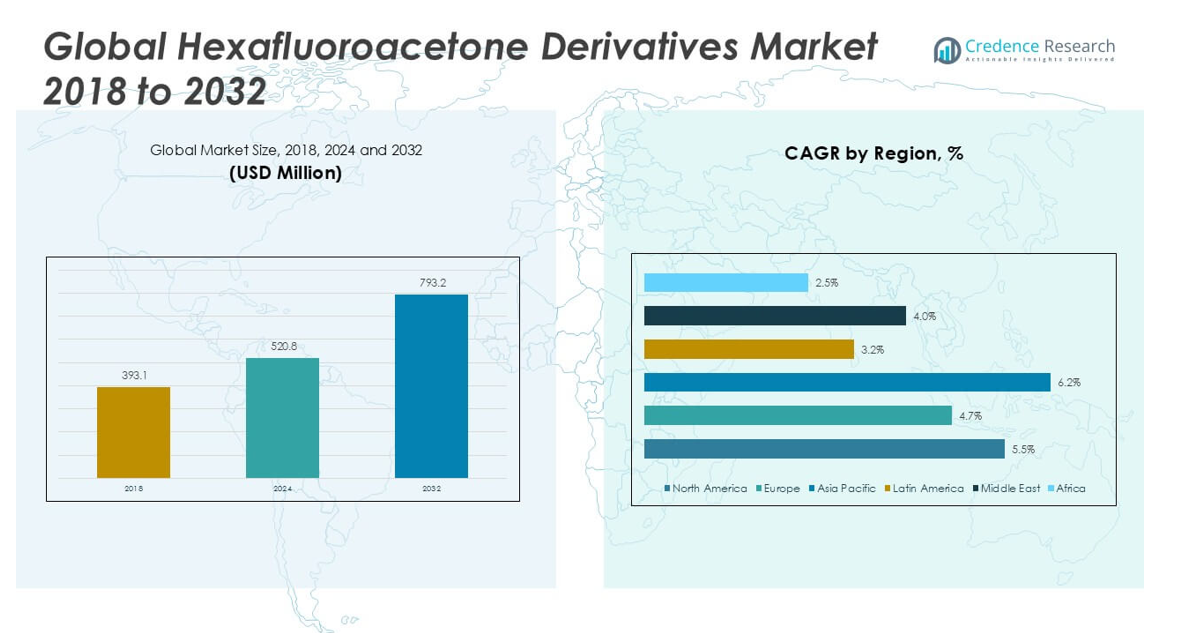
The Global Hexafluoroacetone Derivatives Market is projected to grow from USD520.8 million in 2024 to an estimated USD793.2 million based on 2032, with a compound annual growth rate (CAGR) 5.40% from 2025 to 2032.
Demand in pharmaceutical and agrochemical sectors fuels growth. Manufacturers adopt advanced catalysis and continuous-flow synthesis to optimize production. Growing emphasis on green chemistry promotes research into sustainable fluorination techniques. Collaboration among chemical firms and research institutes accelerates derivative innovation. Customization for specific end-use properties trends upward. Market participants expand capacity through strategic partnerships and facility upgrades. Demand for high-purity derivatives in electronics and surface coating applications strengthens volume uptake. Cost optimization and capacity expansions reduce entry barriers.
Asia-Pacific commands the largest share, led by China and India due to cost-effective production and expanding chemical infrastructure. North America holds a significant position, supported by pharmaceutical R&D and stringent quality standards. Europe demonstrates steady demand, shaped by environmental regulations and specialization in high-value derivatives. Emerging markets in Latin America and Middle East & Africa show rising uptake driven by infrastructure and industrial growth. Key players include Merck KGaA; Solvay SA; Shanghai Fluor Chemical; Daikin Industries; and SynQuest Laboratories.
Market Insights
- The Global Hexafluoroacetone Derivatives Market will expand from USD 520.8 million in 2024 to USD 793.2 million by 2032, reflecting a 5.40% CAGR. It demonstrates steady demand across multiple end-use sectors.
- High-purity intermediates sustain growth in drug synthesis pipelines. It supports stringent quality requirements and accelerates API development.
- Semiconductor and PCB producers rely on hexafluoroacetone-based solvents for precise cleaning and coatings. It bolsters volume growth in advanced device manufacturing.
- Strict environmental and safety standards force producers to invest in containment and waste-treatment systems. It increases capital expenditure and extends project timelines.
- Fluctuating fluorocarbon prices and limited suppliers create procurement challenges. It compels manufacturers to tie up working capital in inventory buffers.
- Asia-Pacific leads with roughly 39% market share in 2024, driven by cost advantages and robust chemical infrastructure. It attracts capacity expansions and greenfield projects.
- North America holds about 27.4% share with strong pharmaceutical R\&D, while Europe commands 21.6% amid stringent quality and environmental norms. They secure growth through facility upgrades and technology adoption.
Market Drivers
Robust Integration into Pharmaceutical Synthesis Pipelines
The Global Hexafluoroacetone Derivatives Market sees strong adoption in pharmaceutical synthesis pipelines. Leading drug developers apply it for high-purity intermediate production. Demand for novel APIs drives procurement of specialized fluorinated compounds. Companies deploy these derivatives to satisfy strict regulatory standards. Investment in quality controls enhances batch consistency. It supports cost management by cutting waste in synthesis.
- For instance, the top ten manufacturers of fluorinated pharmaceutical intermediates, including hexafluoroacetone derivatives, collectively generated approximately 8 billion units annually for use in drug synthesis as of 2024, highlighting the scale of integration in pharmaceutical pipelines
Technological Advancements Enhance Production Efficiency
The Global Hexafluoroacetone Derivatives Market benefits from innovations that boost production efficiency. It employs continuous-flow reactors to accelerate reaction times and lower energy use. Modern catalytic processes improve yield and purity. Automation reduces manual errors and secures consistent output. Research efforts explore greener fluorination methods to shrink solvent needs. Companies upgrade facilities to integrate these breakthroughs. It delivers scalable solutions that match rising demand.
- For instance, recent studies demonstrated that optimized continuous-flow synthesis of hexafluoroacetone achieved a conversion rate of 98.6% and selectivity of 99.9%, with an energy cost of just 0.121 kilowatt-hours per kilogram of product, illustrating significant gains in efficiency and sustainability
Electronics Sector Drives Demand for Specialty Solvents
The Global Hexafluoroacetone Derivatives Market finds growing use in electronic-grade solvents and surface treatments. Manufacturers leverage it to achieve precise cleaning and coating performance. Demand from semiconductor and PCB producers pushes volume higher. Strict purity requirements in electronics reinforce derivative uptake. It enables reliable dielectric performance and corrosion resistance. Industry players tailor formulations for advanced device architectures. Partnerships with OEMs accelerate custom solvent development.
Capacity Expansions and Strategic Collaborations Shape Regional Growth
The Global Hexafluoroacetone Derivatives Market sees capacity increases in key regions to meet surging demand. It expands production in Asia-Pacific hubs, driven by cost advantages and infrastructure investments. North American sites grow through joint ventures with specialty chemical firms. European facilities focus on high-value derivatives and sustainability standards. Emerging markets in Latin America and the Middle East explore joint R\&D initiatives. Collaborative projects streamline technology transfer and optimize supply chains. It strengthens global footprint while aligning with local regulations.
Market Trends
Expansion of Sustainable Fluorination Methods to Meet Regulatory and Environmental Standards
The Global Hexafluoroacetone Derivatives Market increasingly adopts sustainable fluorination techniques to comply with stricter environmental rules. Companies implement solvent-free processes to cut waste and lower emissions. Process optimization reduces reagent consumption and enhances yield. Government mandates drive investment in greener synthesis. Research centers test bio-based catalysts to replace hazardous reagents. Suppliers modify production lines to integrate closed-loop systems. Stakeholders assess lifecycle impact to ensure compliance and cost control.
- For instance, as of 2024, more than 450,000 metric tons of hexafluoroacetone derivatives were produced globally using advanced, lower-emission fluorination technologies, according to industry surveys
Growth of Custom Derivative Solutions for High-Performance Applications
The Global Hexafluoroacetone Derivatives Market responds to demand for custom derivative solutions tailored to high-performance sectors. It supports formulation for advanced pharmaceuticals, specialty agrochemicals, and electronic-grade fluids. Clients request batch sizes that match precise purity and functional requirements. Process engineers develop targeted modifications to core molecules. Quality teams conduct rigorous tests to validate property enhancements. Supply agreements reflect service-level commitments for these bespoke products. Manufacturers allocate resources for small-scale production units dedicated to customization.
- For instance, leading manufacturers supplied over 3,500 custom synthesis orders for pharmaceutical and electronics clients in 2024, reflecting the rising trend toward bespoke hexafluoroacetone derivative solutions
Integration of Digital Monitoring and Automated Controls in Production Facilities
The Global Hexafluoroacetone Derivatives Market integrates digital monitoring systems to enhance operational efficiency and quality control. It deploys real-time sensors to track reaction parameters and detect deviations. Data analytics tools evaluate performance trends and signal preventive maintenance. Automated control loops adjust temperature and pressure to secure consistency. Production managers review dashboards to streamline lab-to-pilot scale transitions. Cybersecurity measures protect proprietary process data. This trend drives lower downtime and stronger traceability compliance.
Strategic Partnerships Driving Geographic Diversification and Market Reach
The Global Hexafluoroacetone Derivatives Market advances through strategic collaborations and geographic expansion to strengthen its global footprint. It partners with regional distributors to access emerging markets in Latin America and the Middle East. Joint ventures with local chemical firms support technology transfer and regulatory navigation. Multinational players acquire niche producers to diversify product lines and optimize logistics. Co-investment frameworks allocate capital to build new manufacturing sites. This approach secures supply reliability and broadens revenue streams.
Market Challenges
Stringent Regulatory and Safety Compliance Raise Production Expenses
The Global Hexafluoroacetone Derivatives Market faces strict environmental and safety regulations that drive up production expenses. It requires extensive permitting and batch‐release testing to meet chemical handling standards. Companies invest in specialized containment systems and waste treatment units to control emissions. Quality teams maintain detailed records and perform frequent audits to secure compliance. Regulatory reviews extend project timelines and demand capital for facility upgrades. Operational budgets stretch to cover licensing fees, safety training, and emergency response planning. These factors limit profit margins and slow capacity expansion.
- For instance, according to the U.S. Environmental Protection Agency, industry compliance costs triggered by proposed chemical testing rules-including laboratory testing, analytical method validation, administrative requirements, and export notifications-were estimated at $5.73 million under least-cost assumptions and $7.65 million under average-cost assumptions for a single regulatory update, illustrating the significant financial burden of regulatory compliance in this sector
Raw Material Cost Fluctuations and Complex Supply Chain Strain Profitability
The Global Hexafluoroacetone Derivatives Market encounters volatile feedstock prices tied to fluorocarbon availability. It depends on a narrow supplier base, which heightens risk when geopolitical tensions disrupt shipments. Procurement teams must hold larger inventories, which ties up working capital and adds storage costs. Transportation delays and customs hurdles further extend lead times. Price spikes force sudden adjustments in product pricing that can erode customer loyalty. Manufacturers struggle to balance inventory buffers with just-in-time delivery models under these conditions.
Market Opportunities
Expansion into High-Demand Pharmaceutical and Agrochemical Segments
The Global Hexafluoroacetone Derivatives Market can capture new revenue streams by targeting pharmaceutical and agrochemical developers seeking high-purity fluorinated intermediates. It benefits from rising R\&D budgets in specialty drug synthesis and crop protection formulations. Firms can establish toll-manufacturing partnerships to deliver custom derivatives at scale. Collaboration with contract research organizations unlocks access to niche end-use applications. Quality-focused service offerings strengthen client loyalty in regulated industries. Tailored pricing models for volume commitments drive long-term contracts and stable cash flows.
Penetration of Emerging Regions and Sustainable Production Technologies
The Global Hexafluoroacetone Derivatives Market can leverage growth in Latin America and the Middle East driven by expanding chemical infrastructure. It secures first-mover advantage through local joint ventures with regional distributors. Investment in green fluorination techniques reduces environmental impact and appeals to eco-conscious customers. Adoption of modular, skid-mounted production units accelerates facility deployment in new territories. Technology licensing agreements allow rapid scale-up without heavy capital outlay. These strategies diversify risk and broaden the addressable market.
Market Segmentation Analysis
By Type
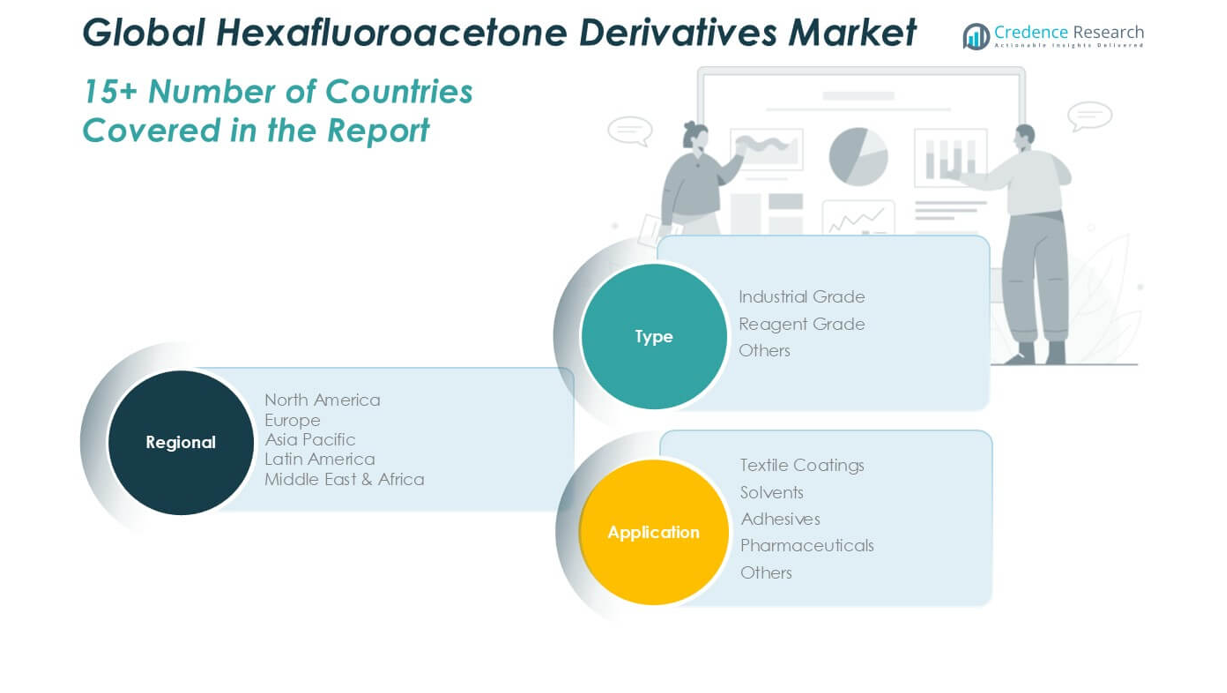
The Global Hexafluoroacetone Derivatives Market shows that industrial grade commands the largest volume share due to bulk applications in chemical synthesis and coatings. Reagent grade secures significant revenue share through high-purity requirements in pharmaceutical and agrochemical sectors. Others comprises specialized grades tailored for niche functions and offers moderate growth potential. It reflects customization for specific performance attributes. Quality distinctions drive price variation across grades and guide customer selection. Distribution channels adjust inventory levels based on segment demand and forecast trends.
- For instance, more than 18,000 metric tons of industrial grade hexafluoroacetone derivatives were produced worldwide, compared to 3,500 metric tons of reagent grade and 1,200 metric tons of other specialized grades.
By Application
The Global Hexafluoroacetone Derivatives Market segments include textile coatings, solvents, adhesives, pharmaceuticals, and others. Pharmaceuticals leads revenue share by supplying intermediates for active pharmaceutical ingredients. Solvents generates substantial volume through cleaning and surface treatment in electronics and precision manufacturing. Textile coatings holds a notable share by delivering water-repellent and durability enhancements. Adhesives records steady growth thanks to lightweight bonding solutions for automotive and electronic assemblies. Others covers emerging uses such as agrochemical intermediates and high-performance fluids. It highlights the market’s diverse end-use base.
- For instance, company and government surveys in 2024 showed that over 7,000 metric tons of hexafluoroacetone derivatives were consumed in pharmaceutical applications, 5,000 metric tons in solvents, 3,200 metric tons in textile coatings, 2,600 metric tons in adhesives, and 1,100 metric tons in other uses.
Segments
Based on Type
- Industrial Grade
- Reagent Grade
- Others
Based on Application
- Textile Coatings
- Solvents
- Adhesives
- Pharmaceuticals
- Other
Based on Region
- North America
- U.S.
- Canada
- Mexico
- Europe
- UK
- France
- Germany
- Italy
- Spain
- Russia
- Belgium
- Netherlands
- Austria
- Sweden
- Poland
- Denmark
- Switzerland
- Rest of Europe
- Asia Pacific
- China
- Japan
- South Korea
- India
- Australia
- Thailand
- Indonesia
- Vietnam
- Malaysia
- Philippines
- Taiwan
- Rest of Asia Pacific
- Latin America
- Brazil
- Argentina
- Peru
- Chile
- Colombia
- Rest of Latin America
- Middle East
- UAE
- KSA
- Israel
- Turkey
- Iran
- Rest of Middle East
- Africa
- Egypt
- Nigeria
- Algeria
- Morocco
- Rest of Africa
Regional Analysis
North America Hexafluoroacetone Derivatives Market
North America holds roughly 27.4% share of the Hexafluoroacetone Derivatives Market in 2024 with a value of USD 142.7 million. It will reach USD 205.4 million by 2032 at a CAGR of 5.5%. Pharmaceutical R\&D drives high-purity intermediate demand. It benefits from strong electronics and specialty chemical sectors. Established logistics networks ensure reliable supply. It secures growth through capacity enhancements.
Europe Hexafluoroacetone Derivatives Market
Europe accounts for about 21.6% of the Hexafluoroacetone Derivatives Market in 2024, valued at USD 112.5 million. It is projected to climb to USD 161.0 million by 2032 at a 4.7% CAGR. Strict environmental and safety standards shape production practices. It leverages advanced fluorination technologies. Diverse end-use industries support steady uptake. It maintains competitiveness through facility modernization.
Asia Pacific Hexafluoroacetone Derivatives Market
Asia Pacific leads with approximately 39.2% share of the Hexafluoroacetone Derivatives Market in 2024, totaling USD 204.2 million. It will expand to USD 337.9 million by 2032 at a CAGR of 6.2%. Cost advantages and robust chemical infrastructure attract investment. It drives volume through textile and agrochemical applications. Regional producers scale output via green synthesis methods. It gains momentum through regional trade agreements.
Latin America Hexafluoroacetone Derivatives Market
Latin America represents about 3.9% share of the Hexafluoroacetone Derivatives Market in 2024 with USD 20.3 million. It will grow to USD 33.3 million by 2032 at a 3.2% CAGR. Infrastructure upgrades and rising industrial activity boost demand. It explores joint ventures for local production. Emerging downstream applications in coatings support volume. It targets niche segments to expand footprint.
Middle East Hexafluoroacetone Derivatives Market
Middle East holds nearly 5.2% of the Hexafluoroacetone Derivatives Market in 2024 at USD 27.1 million. It is set to reach USD 42.8 million by 2032 at a 4.0% CAGR. Government investment in petrochemicals fuels derivative use. It advances through strategic partnerships with global suppliers. Regional hubs optimize import and export flows. It enhances market access via free-zone manufacturing.
Africa Hexafluoroacetone Derivatives Market
Africa accounts for around 2.7% share of the Hexafluoroacetone Derivatives Market in 2024 with USD 14.1 million. It will decline slightly to USD 12.7 million by 2032 at a 2.5% CAGR. Limited infrastructure and higher logistics costs constrain growth. It focuses on small-scale custom synthesis projects. Local regulatory harmonization could improve market conditions. It seeks collaborations to build production capabilities.
Key players
- Shenzhen Capchem Technology Co., Ltd
- Sinochem Lantian Co., Ltd.
- Central Glass Co., Ltd.
- Huanxin Fluoro Material Co., Ltd.
- Huaxia Shenzhou New Materials Co., Ltd.
- Halocarbon Products Corporation
- Solvay S.A.
- Hangzhou Dayangchem Co., Ltd.
- Tianjin Fluoropharm Co., Ltd.
- Daikin Industries, Ltd.
- Merck KGaA (Sigma-Aldrich)
- Juhua Group Corporation
- Zhejiang Sanmei Chemical Industry Co., Ltd.
- AGC Inc. (Asahi Glass Company)
Competitive Analysis
The Hexafluoroacetone Derivatives Market features a mix of global chemical majors and specialized fluorochemical producers. Established firms leverage extensive R&D capabilities and integrated supply chains to maintain leadership in high-purity grades. It faces pressure from regional players that undercut on cost and offer rapid custom synthesis services. Product differentiation hinges on purity levels, compliance with evolving environmental standards and reaction efficiency. Strategic alliances, joint ventures and capacity expansions drive competitive positioning. Innovation in green fluorination methods offers a path to reduce operational costs and meet stricter regulations. It also enables new application development in electronics and pharmaceuticals. Companies that balance technical expertise with agile manufacturing and customer-focused service secure stronger market positions.
Market Concentration and Characteristics
The Hexafluoroacetone Derivatives Market exhibits moderate concentration, with a handful of global fluorochemical specialists commanding over half of total volume. It relies on advanced production technologies and rigorous quality controls that create high entry barriers for new competitors. Leading firms secure economies of scale through integrated supply chains and strategic capacity expansions. Strong relationships with pharmaceutical and electronics customers reinforce market positions. Niche producers carve out positions by offering custom synthesis and rapid batch turnaround. Price volatility in feedstocks influences competitive dynamics, while stricter environmental regulations heighten compliance costs. Diverse end-use applications and ongoing innovation in fluorination methods sustain market resilience and drive incremental shifts in market share.
Report Coverage
The research report offers an in-depth analysis based on Type, Application and Region. It details leading market players, providing an overview of their business, product offerings, investments, revenue streams, and key applications. Additionally, the report includes insights into the competitive environment, SWOT analysis, current market trends, as well as the primary drivers and constraints. Furthermore, it discusses various factors that have driven market expansion in recent years. The report also explores market dynamics, regulatory scenarios, and technological advancements that are shaping the industry. It assesses the impact of external factors and global economic changes on market growth. Lastly, it provides strategic recommendations for new entrants and established companies to navigate the complexities of the market.
Future Outlook
- Manufacturers will implement solvent-free processes to cut emissions and lower environmental impact. It will attract eco-conscious clients and streamline compliance with stricter regulations.
- Producers will offer tailored compounds for specialty pharmaceuticals and agrochemicals to meet precise performance needs. It will foster long-term partnerships with high-value end users.
- Real-time monitoring systems will optimize reaction parameters and minimize downtime. It will boost yield consistency and reduce quality deviations.
- Regional sites will scale output via greenfield projects and modular units to serve rising demand. It will leverage cost advantages and strengthen supply chain resilience.
- Joint ventures with local distributors will open emerging markets in Latin America and the Middle East. It will ensure faster regulatory approvals and build regional trust.
- New API candidates will increase procurement of reagent-grade derivatives with strict tolerances. It will support accelerated drug development timelines.
- Next-generation semiconductors will require high-purity cleaning fluids and specialty coatings. It will sustain elevated demand for hexafluoroacetone-based solvents.
- Procuring alternative fluorocarbon sources will reduce exposure to geopolitical disruptions. It will enable more predictable pricing and inventory planning.
- Global alignment on safety and environmental standards will ease cross-border shipments. It will lower compliance costs and accelerate product launches.
- Licensing proprietary green synthesis techniques to regional partners will speed capacity build-out. It will generate licensing revenues and extend market reach.

Request a Free Sample
Fill in your details and we'll send you a free sample report.
- Sample data tables & charts
- Research methodology
Market Dynamics
Robust Integration into Pharmaceutical Synthesis Pipelines
Hexafluoroacetone derivatives are increasingly used as high-purity intermediates in pharmaceutical synthesis, supporting the development of novel APIs and compliance with stringent regulatory standards. This integration drives consistent demand from leading drug manufacturers and accelerates the adoption of specialized fluorinated compounds.
Technological Advancements Enhance Production Efficiency
The adoption of continuous-flow reactors, advanced catalysis, and automation has significantly improved yield, purity, and energy efficiency in hexafluoroacetone derivative production. These innovations enable scalable, cost-effective manufacturing and support the market’s ability to meet rising global demand.
Electronics Sector Drives Demand for Specialty Solvents
Semiconductor and PCB manufacturers rely on hexafluoroacetone-based solvents for precise cleaning and coating applications, which require high purity and performance. The growth of advanced electronics manufacturing is thus a key driver for increased consumption of these derivatives.
Expansion of Sustainable Fluorination Methods
Stricter environmental regulations and customer preference for greener products are pushing manufacturers to adopt sustainable fluorination techniques, such as solvent-free processes and closed-loop systems. This not only reduces emissions and waste but also enhances market appeal and regulatory compliance.
Capacity Expansions and Strategic Collaborations
Producers are expanding capacity, especially in Asia-Pacific, and forming strategic partnerships to optimize supply chains and access new markets. These efforts help meet surging demand, reduce entry barriers, and strengthen the global footprint of key market players.
Need a Custom Version of This Report?
Tailor the scope, geography, or segments to your exact requirements.
- Custom geography or segment scope
- Direct access to our analyst team
Frequently Asked Questions
What was the market size in 2023 and 2032, and what is the CAGR?
Which end-use applications dominate the market?
Which regions account for the largest market share?
Who are the major players shaping market competition?
Table of Content
Chapter 1 Market Segmentation
- 1.1 Segmentation Framework
- 1.1.1 Product and Service Classification
- 1.1.2 Application and End-Use Classification
- 1.1.3 Technology and Solution Classification
- 1.1.4 Customer and Distribution Channel Classification
- 1.1.5 Geographic Segmentation
- 1.1.6 Market Segment Definitions and Boundaries
- 1.2 By Type
- 1.2.1 Industrial Grade
- 1.2.2 Reagent Grade
- 1.2.3 Others
- 1.3 By Application
- 1.3.1 Textile Coatings
- 1.3.2 Solvents
- 1.3.3 Adhesives
- 1.3.4 Pharmaceuticals
- 1.3.5 Other
Chapter 2 Introduction
- 2.1 Report Objectives and Scope
- 2.2 Product Definition and Industry Terminology
- 2.3 Market Inclusions and Exclusions
- 2.4 Research Process
- 2.4.1 Primary Research and Expert Interviews
- 2.4.2 Secondary Research and Source Review
- 2.4.3 Top-Down and Bottom-Up Estimation
- 2.4.4 Data Triangulation and Verification
- 2.5 Market Size Measurement Basis
- 2.5.1 2023: USD 494 million → 2032: USD 793.2 million
- 2.6 Historical and Forecast Reference Periods
- 2.6.1 Base Year: 2023
- 2.6.2 Forecast Period: 2023-2032
- 2.7 Research Assumptions and Limitations
Chapter 3 Executive Summary
- 3.1 Market Snapshot and Key Findings
- 3.2 Base-Year Market Size, 2023
- 3.3 Forecast Market Size, 2032
- 3.4 Revenue and Volume Growth Outlook
- 3.5 Key Demand and Supply Indicators
- 3.6 Leading Market Segments
- 3.7 Fastest-Growing Market Opportunities
- 3.8 Regional Performance Highlights
- 3.9 Technology and Industry Transformation
- 3.10 Competitive Landscape Summary
- 3.11 Analyst View and Strategic Implications
Chapter 4 Global Hexafluoroacetone Derivatives Market Trends and Developments
- 4.1 Historical Industry Development
- 4.2 Recent Market Trends and Developments
- 4.3 Demand and Customer Behavior Trends
- 4.4 Technology and Product Innovation
- 4.5 Artificial Intelligence, Automation and Digitalization
- 4.6 Local Manufacturing and Supply Chain Realignment
- 4.7 Industry Partnerships, Mergers and Acquisitions
- 4.8 Sustainability and Circular Economy Developments
- 4.9 Government and Private Sector Investment Trends
- 4.10 Emerging Business Models and Commercialization
- 4.11 Industry Developments and Announcements
Chapter 5 Global Hexafluoroacetone Derivatives Market Production, Supply and Demand Analysis
- 5.1 Demand Trend and Consumption Analysis
- 5.2 Demand Forecast, 2023-2032
- 5.3 Production and Output Trend
- 5.4 Production and Output Forecast, 2023-2032
- 5.5 Installed Capacity and Capacity Utilization
- 5.6 Company-Wise Production Plants and Statistics
- 5.6.1 Installed Production Capacity
- 5.6.2 Actual Production
- 5.6.3 Planned Capacity and Expansion Targets
- 5.7 Supply Chain Structure and Procurement Trends
- 5.8 Supply-Demand Gap and Bottlenecks
- 5.9 Import Dependence and Sourcing Structure
- 5.10 Contract Manufacturing and Outsourcing
- 5.11 Regional Supply and Demand Concentration
Chapter 6 Global Hexafluoroacetone Derivatives Market Pricing Analysis
- 6.1 Pricing Structure and Measurement
- 6.2 Historical Pricing Trends
- 6.3 Pricing Outlook, 2023-2032
- 6.4 Average Selling Price and Unit Economics
- 6.5 Pricing by Product and Market Segment
- 6.6 Geographic Pricing Differences
- 6.7 Key Input, Energy, Labor and Logistics Costs
- 6.8 Contract Pricing and Purchasing Models
- 6.9 Pricing Sensitivity and Competitive Positioning
- 6.10 Price, Margin and Profitability Implications
Chapter 7 Global Hexafluoroacetone Derivatives Market Dynamics
- 7.1 Market Growth Drivers
- 7.1.1 Demand-Side Drivers
- 7.1.2 Technology and Innovation Drivers
- 7.1.3 Infrastructure and Investment Drivers
- 7.1.4 Regulatory and Policy Drivers
- 7.2 Market Restraints
- 7.2.1 Cost and Affordability Constraints
- 7.2.2 Technology and Adoption Barriers
- 7.2.3 Supply Chain and Operational Constraints
- 7.3 Market Challenges
- 7.3.1 Competitive Pressure and Margin Erosion
- 7.3.2 Skills, Infrastructure and Implementation Gaps
- 7.4 Emerging Market Opportunities
- 7.5 Market Dynamics Impact and Time-Horizon Assessment
Chapter 8 Global Hexafluoroacetone Derivatives Value Chain Analysis
- 8.1 Industry Value Chain Overview
- 8.2 Upstream Suppliers and Critical Inputs
- 8.3 Technology and Component Providers
- 8.4 Manufacturing or Service Delivery
- 8.5 Distribution, Channel Partners and Integrators
- 8.6 Downstream Applications and End Users
- 8.7 Value Addition and Profit Pools
- 8.8 Vertical Integration and Outsourcing
- 8.9 Supplier Concentration and Risk
- 8.10 Supply Chain Localization and Resilience
Chapter 9 Global Hexafluoroacetone Derivatives Market Regulations and Policies
- 9.1 Relevant Laws, Standards and Compliance Frameworks
- 9.2 Product, Service, Safety and Quality Requirements
- 9.3 Government Policies, Incentives and Subsidies
- 9.4 Imports, Exports and Trade Barriers
- 9.5 Public Procurement and Local Content Requirements
- 9.6 Environmental and Sustainability Compliance
- 9.7 Upcoming Policy Changes and Market Implications
Chapter 10 Global Hexafluoroacetone Derivatives Market Hotspots and Opportunities
- 10.1 Market Opportunity Mapping and Growth Hotspots
- 10.2 High-Growth Applications and Customer Groups
- 10.3 Underserved Markets and White-Space Opportunities
- 10.4 Emerging Technology and Product Opportunities
- 10.5 New Capacity and Investment Hotspots
- 10.6 Market Entry and Expansion Opportunities
- 10.7 Distribution and Partnership Opportunities
- 10.8 Near-Term and Long-Term Commercial Potential
- 10.9 Opportunity Attractiveness and Execution Risks
Chapter 11 Global Hexafluoroacetone Derivatives Market Outlook, 2023-2032
- 11.1 Market Size and Analysis
- 11.1.1 Revenue (Market Measurement: 2023: USD 494 million → 2032: USD 793.2 million)
- 11.1.2 Market Volume and Quantity Sold
- 11.1.3 Historical Market Size
- 11.1.4 Base-Year Market Size, 2023
- 11.2 Market Forecast, 2023-2032
- 11.2.1 Revenue Forecast to 2032
- 11.2.2 Volume Forecast to 2032
- 11.2.3 CAGR and Year-on-Year Growth
- 11.2.4 Incremental Revenue Opportunity
- 11.3 Forecast Assumptions and Scenario Analysis
- 11.3.1 Base-Case Forecast
- 11.3.2 Optimistic and Conservative Scenarios
- 11.3.3 Technology, Pricing and Policy Sensitivities
- 11.4 Market Attractiveness and Growth Outlook
Chapter 12 Global Hexafluoroacetone Derivatives Market Segmentation and Outlook
- 12.1 Segmentation Summary and Market Shares, 2023
- 12.2 Largest and Fastest-Growing Segments
- 12.3 By Type - Market Size and Forecast, 2023-2032
- 12.3.1 Segment Definition and Scope
- 12.3.2 Historical Market Size
- 12.3.3 Revenue Forecast, 2023-2032
- 12.3.4 Volume Forecast, 2023-2032
- 12.3.5 Base-Year Market Share, 2023
- 12.3.6 Segment CAGR and Growth Drivers
- 12.3.7 Subsegment Market Size and Forecast
- 12.3.7.1 Industrial Grade
- 12.3.7.2 Reagent Grade
- 12.3.7.3 Others
- 12.3.8 Subsegment Pricing and Adoption Trends
- 12.3.9 Leading Suppliers and Competition
- 12.3.10 Regional Demand and Opportunities
- 12.4 By Application - Market Size and Forecast, 2023-2032
- 12.4.1 Segment Definition and Scope
- 12.4.2 Historical Market Size
- 12.4.3 Revenue Forecast, 2023-2032
- 12.4.4 Volume Forecast, 2023-2032
- 12.4.5 Base-Year Market Share, 2023
- 12.4.6 Segment CAGR and Growth Drivers
- 12.4.7 Subsegment Market Size and Forecast
- 12.4.7.1 Textile Coatings
- 12.4.7.2 Solvents
- 12.4.7.3 Adhesives
- 12.4.7.4 Pharmaceuticals
- 12.4.7.5 Other
- 12.4.8 Subsegment Pricing and Adoption Trends
- 12.4.9 Leading Suppliers and Competition
- 12.4.10 Regional Demand and Opportunities
- 12.5 Segment Growth Comparison
- 12.6 Segment Attractiveness and Priority Matrix
Chapter 13 Global Hexafluoroacetone Derivatives End-Use and Application Market Outlook
- 13.1 End-Use Industry and Customer Demand Structure
- 13.2 Leading Applications and Customer Groups
- 13.3 End-Use Market Size, Share and Forecast
- 13.4 Major End-Use Industry Deep Dives
- 13.4.1 Customer Requirements and Use Cases
- 13.4.2 Demand and Replacement Cycles
- 13.4.3 Technical and Regulatory Considerations
- 13.4.4 Purchasing and Procurement Models
- 13.4.5 Leading Vendors and Distribution Channels
- 13.4.6 Forecast and Commercial Opportunities
- 13.5 Emerging Applications and Cross-Segment Demand
- 13.6 End-Use Industry Investment Priorities
Chapter 14 Global Hexafluoroacetone Derivatives Geographic Market Outlook, 2023-2032
- 14.1 Regional Market Size and Share, 2023
- 14.2 Regional Market Forecast, 2023-2032
- 14.3 Regional Pricing, Production and Demand Differences
- 14.4 North America
- 14.4.1 United States
- 14.4.2 Canada
- 14.4.3 Mexico
- 14.5 Europe
- 14.5.1 Germany
- 14.5.2 France
- 14.5.3 Italy
- 14.5.4 United Kingdom
- 14.5.5 Spain
- 14.5.6 Poland
- 14.5.7 Russia
- 14.5.8 Netherlands
- 14.5.9 Belgium
- 14.5.10 Sweden
- 14.5.11 Denmark
- 14.5.12 Norway
- 14.5.13 Rest of Europe
- 14.6 Asia Pacific
- 14.6.1 China
- 14.6.2 India
- 14.6.3 Japan
- 14.6.4 South Korea
- 14.6.5 Thailand
- 14.6.6 Indonesia
- 14.6.7 Vietnam
- 14.6.8 Malaysia
- 14.6.9 Australia
- 14.6.10 Rest of Asia Pacific
- 14.7 Latin America
- 14.7.1 Brazil
- 14.7.2 Argentina
- 14.7.3 Colombia
- 14.7.4 Chile
- 14.7.5 Rest of Latin America
- 14.8 Middle East
- 14.8.1 Saudi Arabia
- 14.8.2 United Arab Emirates
- 14.8.3 Turkey
- 14.8.4 Israel
- 14.8.5 Iran
- 14.8.6 Rest of the Middle East
- 14.9 Africa
- 14.9.1 South Africa
- 14.9.2 Egypt
- 14.9.3 Nigeria
- 14.9.4 Morocco
- 14.9.5 Rest of Africa
- 14.10 Regional Investment, Policy and Supply Chain Differences
- 14.11 Regional Competitive Landscape
- 14.12 Geographic Growth Hotspots
Chapter 15 Global Hexafluoroacetone Derivatives Technology, Innovation and Sustainability Outlook
- 15.1 Technology Landscape and Maturity
- 15.2 Product, Process and Service Innovation
- 15.3 AI, Automation and Digital Tools in the Industry
- 15.4 Technology Adoption and Performance Benchmarking
- 15.5 Innovation Pipeline and R&D Investment
- 15.6 Patent and Intellectual Property Trends
- 15.7 Energy Efficiency and Resource Management
- 15.8 Sustainability, Recycling and Circularity
- 15.9 Technology Roadmap, 2023-2032
- 15.10 Risks of Obsolescence and Technology Substitution
Chapter 16 Global Hexafluoroacetone Derivatives Market Key Strategic Imperatives
- 16.1 Growth and Market Entry Priorities
- 16.2 High-Return Products and Segments
- 16.3 Pricing, Profitability and Cost Optimization
- 16.4 Technology Investment and Product Differentiation
- 16.5 Supply Chain Localization and Resilience
- 16.6 Distribution and Customer Acquisition
- 16.7 Partnership, Acquisition and Capacity Strategy
- 16.8 Regional Expansion Priorities
- 16.9 Short-, Medium- and Long-Term Actions
Chapter 17 Competition Outlook
- 17.1 Industry Competition Characteristics
- 17.2 Market Structure and Concentration
- 17.3 Market Share and Competitive Positioning, 2023
- 17.4 Company-Wise Revenue and Product Benchmarking
- 17.5 Production and Service Capacity Benchmarking
- 17.6 Technology, Pricing and Differentiation
- 17.7 Regional Footprint and Distribution Strength
- 17.8 Mergers, Acquisitions and Strategic Alliances
- 17.9 New Entrants and Competitive Threats
- 17.10 Porter's Five Forces and Industry Attractiveness
- 17.11 Competitive Outlook, 2023-2032
Chapter 18 Company Profiles
- 18.1 Company Coverage and Selection Criteria
- 18.2 Merck KGaA (Sigma-Aldrich)
- 18.2.1 Business Description
- 18.2.2 Company Ownership and Geographic Presence
- 18.2.3 Product and Service Portfolio
- 18.2.4 Manufacturing and Operating Footprint
- 18.2.5 Production Capacity and Expansion Plans
- 18.2.6 Financial Performance and Investment
- 18.2.7 Market Share and Competitive Position
- 18.2.8 Technology and Innovation Capabilities
- 18.2.9 Strategic Alliances or Partnerships
- 18.2.10 Recent Developments
- 18.2.11 Growth Strategy and Outlook
- 18.3 Solvay S.A.
- 18.4 Daikin Industries, Ltd.
- 18.5 Shenzhen Capchem Technology Co., Ltd
- 18.6 Sinochem Lantian Co., Ltd.
- 18.7 Central Glass Co., Ltd.
- 18.8 Halocarbon Products Corporation
- 18.9 Juhua Group Corporation
- 18.10 AGC Inc. (Asahi Glass Company)
- 18.11 Zhejiang Sanmei Chemical Industry Co., Ltd.
- 18.12 Other Relevant Market Participants
Note: Every listed company is profiled on the structure shown under the first company. The company list is preliminary and may change based on research findings, market developments, data availability and client requirements.
Chapter 19 Disclaimer
- 19.1 Research and Forecast Disclaimer
- 19.2 Data Source and Estimation Limitations
Note: The depth of individual sections depends on data availability for this market. Volume, capacity, trade and other unit-based metrics are included where applicable.

