
Market Overview:
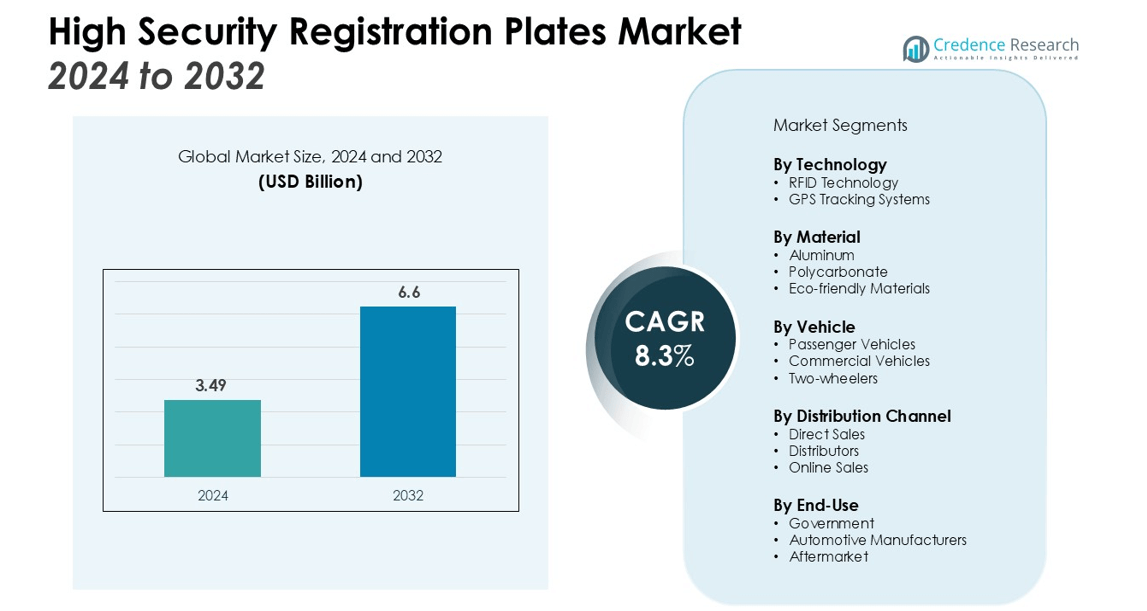
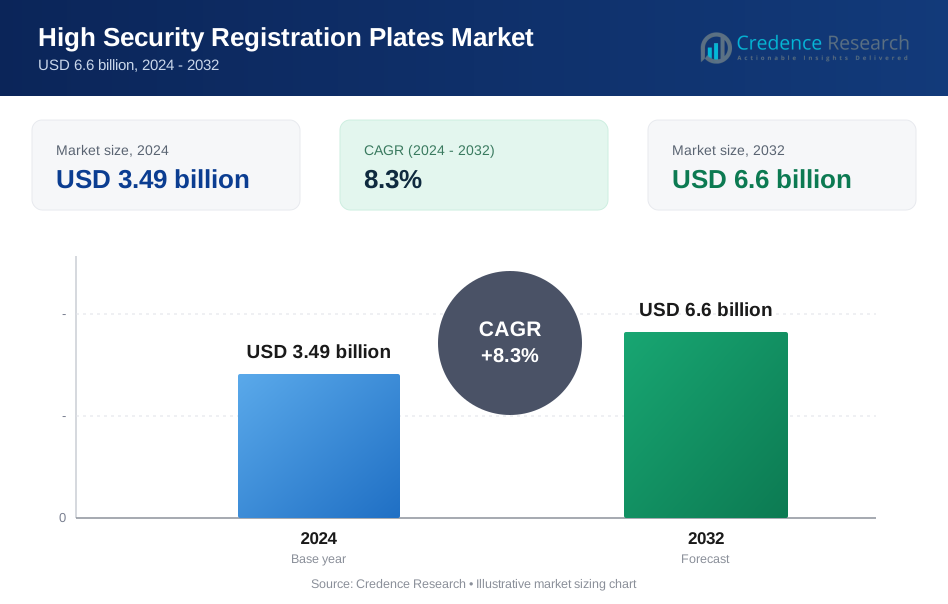
The High Security Registration Plates Market size was valued at USD 3.49 billion in 2024 and is anticipated to reach USD 6.6 billion by 2032, at a CAGR of 8.3% during the forecast period (2024-2032).
| REPORT ATTRIBUTE | DETAILS |
|---|---|
| Historical Period | 2020-2023 |
| Base Year | 2024 |
| Forecast Period | 2025-2032 |
| High Security Registration Plates Market Size 2024 | USD 3.49 billion |
| High Security Registration Plates Market, CAGR | 8.3% |
| High Security Registration Plates Market Size 2032 | USD 6.6 billion |
Key drivers of the HSRP market include the rising concerns over vehicle theft, counterfeiting, and fraudulent activities. The introduction of standardized plates with enhanced security features such as holograms, micro-text, and tamper-proof materials has fueled demand. Governments' stringent regulations for vehicle identification and registration, alongside a growing push towards road safety and traffic management, are further boosting market growth. Additionally, advancements in technologies like RFID and GPS tracking integrated into HSRP are contributing to a rise in adoption rates. The integration of these advanced technologies has not only enhanced security but also streamlined vehicle management for authorities.
Regionally, North America and Europe hold substantial market shares due to established regulatory frameworks and high adoption rates of advanced vehicle security technologies. However, the Asia-Pacific region is expected to experience the highest growth during the forecast period, driven by rapid industrialization, increasing vehicle sales, and government initiatives to improve road safety in countries like India and China. Furthermore, the increasing urbanization in emerging economies is further accelerating the adoption of high-security registration plates in the region.
Market Insights:
- The High Security Registration Plates (HSRP) market was valued at USD 3.49 billion in 2024 and is expected to reach USD 6.6 billion by 2032, with a CAGR of 8.3% during the forecast period (2024-2032).
- Rising concerns over vehicle theft, counterfeiting, and fraudulent activities are key drivers of HSRP market growth. The introduction of tamper-proof features like holograms and micro-text enhances vehicle security.
- Government regulations and mandates are playing a significant role in driving demand for HSRPs. Countries like India and Brazil have implemented legislation requiring the use of high-security plates for vehicle registration.
- Technological advancements, such as the integration of RFID and GPS tracking systems into HSRPs, contribute to the increased adoption of these plates. These technologies enable real-time tracking, enhancing vehicle security and law enforcement efforts.
- Rapid urbanization and increasing vehicle ownership in emerging economies, especially in China and India, are fueling the demand for HSRPs. Governments are taking proactive measures to improve road safety by introducing advanced vehicle registration systems.
- High production costs, due to the integration of advanced security features, and manufacturing complexities present challenges for market growth. This increases operational pressures on manufacturers and governments, particularly in developing countries.
- The global lack of standardization in HSRP designs and regulations is hindering market expansion. Variations in security features and materials across different countries create challenges for implementation and interoperability.
Market Drivers:
Rising Concerns Over Vehicle Theft and Fraud
The increasing prevalence of vehicle theft and fraudulent activities is a significant driver for the High Security Registration Plates (HSRP) market. Criminals often exploit traditional registration plates to alter vehicle identities, making it challenging for authorities to track stolen vehicles. HSRPs, designed with tamper-proof features like holograms and micro-text, address this issue by providing unique identifiers that are hard to replicate. These security features help combat the rising problem of vehicle-related crimes, thereby boosting the adoption of HSRPs.
- For instance, in India, each HSRP is secured with a non-reusable snap-on lock and features a laser-etched 10-digit permanent identification number (PIN), which makes it significantly harder for criminals to tamper with or create counterfeit plates.
Government Mandates and Regulatory Frameworks
Governments across various regions are enforcing stringent regulations for vehicle registration and identification, which is significantly driving the High Security Registration Plates market. These regulations require the use of tamper-resistant and standardized plates to ensure accurate tracking and reduce the scope for illegal activities. Legislative actions, such as the enforcement of the use of HSRPs in countries like India and Brazil, are further driving demand. These mandates provide a clear framework that makes the implementation of HSRPs crucial for regulatory compliance.
Technological Advancements in Security Features
Technological innovations play a pivotal role in the growth of the High Security Registration Plates market. The integration of RFID and GPS tracking systems into HSRPs enhances vehicle security and management. These technologies allow authorities to track vehicles in real-time, improving law enforcement efficiency and facilitating better traffic management. The adoption of such features is gaining momentum, as it offers enhanced functionality while maintaining security.
- For instance, the German company Tönnjes International Group produces an HSRP called IDePLATE, which contains a passive RAIN RFID chip that allows for vehicle identification from a distance of 15 meters, even in moving traffic.
Increasing Urbanization and Vehicle Ownership in Emerging Economies
The rapid pace of urbanization and growing vehicle ownership in emerging economies are key factors driving the HSRP market. Countries like India and China are witnessing significant increases in vehicle sales, which in turn are pushing the demand for high-security registration plates. As the number of vehicles on the roads increases, governments in these regions are taking proactive measures to implement advanced security features in registration plates, boosting the market for HSRPs.
Market Trends:
Integration of Smart Technologies in High Security Registration Plates
One of the key trends in the High Security Registration Plates (HSRP) market is the integration of smart technologies. The incorporation of RFID (Radio Frequency Identification) and GPS (Global Positioning System) into HSRPs has transformed vehicle tracking and management. These technologies enable real-time tracking of vehicles, ensuring better law enforcement and traffic monitoring. Governments and law enforcement agencies benefit from the ability to track vehicle movements with ease, enhancing security. RFID tags and GPS systems are also being integrated to offer additional functionalities such as road toll management and congestion charge payments. This technological integration is gaining traction as it increases the utility of HSRPs beyond basic identification, contributing to greater adoption.
- For instance, Tönnjes International Group's IDePLATE features an integrated RFID chip that allows for secure and automatic vehicle identification from a distance of up to 15 meters.
Shift Towards Eco-Friendly Materials in HSRP Manufacturing
Another significant trend in the High Security Registration Plates market is the growing shift towards eco-friendly and sustainable materials. Manufacturers are increasingly adopting recyclable and biodegradable materials to produce registration plates that align with environmental regulations and sustainability initiatives. This trend is particularly prevalent in regions where environmental concerns are driving policy changes. The use of eco-friendly materials not only helps reduce the carbon footprint but also addresses growing consumer demand for environmentally responsible products. These innovations are making HSRPs more sustainable, reducing the environmental impact of vehicle registration systems while maintaining high-security features.
- For instance, Erich Utsch AG developed a unique automatic embossing press for the Casa de Moneda de Argentina that can personalize up to 700 license plates per hour, a system designed to handle multiple plate formats without costly retooling.
Market Challenges Analysis:
High Production Costs and Manufacturing Complexities
One of the key challenges facing the High Security Registration Plates (HSRP) market is the high production cost and manufacturing complexities. The integration of advanced security features, such as holograms, micro-text, and RFID, significantly raises the cost of manufacturing. These features require specialized materials, precise production techniques, and advanced technology, which can increase overall production costs. Manufacturers also face challenges in scaling up production to meet growing demand while maintaining quality and security standards. This creates financial and operational pressures on both suppliers and governments, particularly in developing countries with budget constraints.
Challenges in Standardization and Implementation
The lack of global standardization in HSRPs presents another challenge for the market. Different countries have varying regulations regarding the design, materials, and security features of registration plates. This lack of uniformity can lead to delays in implementation, especially when governments need to align security protocols with existing infrastructure. Coordinating the adoption of standardized solutions across regions and ensuring interoperability between different systems often proves difficult, further hindering widespread adoption. These challenges require significant investment in technology and collaboration between governments, manufacturers, and law enforcement agencies.
Market Opportunities:
Expanding Vehicle Registration Systems in Emerging Economies
A significant opportunity in the High Security Registration Plates (HSRP) market lies in the rapid expansion of vehicle registration systems in emerging economies. Countries in Asia-Pacific, Latin America, and Africa are experiencing rising vehicle ownership and urbanization. Governments in these regions are increasingly adopting HSRPs to combat vehicle-related crimes and improve road safety. With growing government investments in road infrastructure and safety regulations, there is a substantial demand for high-security registration plates. This trend presents a unique opportunity for manufacturers to tap into these markets by offering affordable, scalable solutions tailored to the local regulatory frameworks and security requirements.
Integration with Advanced Traffic Management and Smart City Initiatives
The integration of HSRPs with advanced traffic management and smart city initiatives represents another promising market opportunity. As cities worldwide embrace smart technologies, the demand for integrated vehicle management systems that enhance traffic control, law enforcement, and toll collection is growing. HSRPs can play a crucial role in these systems by providing accurate vehicle identification for automated tracking and monitoring. The development of infrastructure to support such systems creates new opportunities for HSRP manufacturers to collaborate with government agencies, urban planners, and technology providers to create seamless, integrated solutions for smart cities.
Market Segmentation Analysis:
By Technology
The High Security Registration Plates (HSRP) market is driven by advancements in technology, especially the integration of RFID and GPS systems. These technologies enhance vehicle security by enabling real-time tracking, improving law enforcement’s ability to manage and monitor vehicles. RFID tags are embedded in registration plates, allowing for seamless identification and automated processes such as toll collection and parking management. The use of smart technologies in HSRPs is expected to grow, driven by the demand for smarter traffic management systems and the need for increased security.
- For instance, Nedap Identification Systems offers the uPASS Target, an RFID reader capable of identifying vehicles with compliant HSRPs from a distance of up to 10 meters, facilitating streamlined vehicle access control.
By Material
The material used in HSRPs plays a crucial role in enhancing the security and durability of the plates. Common materials include aluminum and polycarbonate, which are lightweight yet resistant to damage and tampering. These materials are often combined with tamper-proof features such as micro-text, holograms, and UV-reactive inks to prevent counterfeiting. The increasing adoption of eco-friendly and recyclable materials is also a growing trend, driven by the global push for sustainability and compliance with environmental regulations.
By Vehicle
The High Security Registration Plates market is segmented by vehicle type, including passenger vehicles, commercial vehicles, and two-wheelers. Passenger vehicles dominate the market due to their large volume on the road. However, the demand for HSRPs in commercial vehicles and two-wheelers is increasing as governments implement stricter regulations for vehicle identification and road safety. The rising adoption of HSRPs in these segments is driven by the need for enhanced security, especially in regions with high vehicle theft rates.
- For instance, a key manufacturer, Real Mazon, supports this extensive demand across all vehicle types with a production capacity of over 26.5 million HSRPs annually.
Segmentations:
By Technology- RFID Technology
- GPS Tracking Systems
- Aluminum
- Polycarbonate
- Eco-friendly Materials
- Passenger Vehicles
- Commercial Vehicles
- Two-wheelers'
- Direct Sales
- Distributors
- Online Sales
- Government
- Automotive Manufacturers
- Aftermarket
- North America
- U.S.
- Canada
- Mexico
- Europe
- UK
- France
- Germany
- Italy
- Spain
- Russia
- Belgium
- Netherlands
- Austria
- Sweden
- Poland
- Denmark
- Switzerland
- Rest of Europe
- Asia Pacific
- China
- Japan
- South Korea
- India
- Australia
- Thailand
- Indonesia
- Vietnam
- Malaysia
- Philippines
- Taiwan
- Rest of Asia Pacific
- Latin America
- Brazil
- Argentina
- Peru
- Chile
- Colombia
- Rest of Latin America
- Middle East
- UAE
- KSA
- Israel
- Turkey
- Iran
- Rest of Middle East
- Africa
- Egypt
- Nigeria
- Algeria
- Morocco
- Rest of Africa
Regional Analysis:
North America: Mature Market with Strong Regulatory Frameworks
North America holds a significant share of the High Security Registration Plates (HSRP) market, accounting for 35% of the global market. This dominance is driven by established regulatory frameworks and advanced vehicle security systems. The United States and Canada have implemented stringent regulations requiring all vehicles to use high-security registration plates to prevent fraud and improve road safety. The region’s high level of vehicle ownership, coupled with strong law enforcement, drives demand for HSRPs. Furthermore, the adoption of smart technologies such as RFID and GPS tracking in HSRPs enhances security, contributing to the market’s steady growth in North America.
Europe: Technologically Advanced with Stringent Standards
Europe holds a prominent share of the HSRP market, contributing 28% to the global total. The region’s robust vehicle registration systems and strict regulations on road safety and vehicle identification drive the market. Countries like Germany, the UK, and France have adopted high-security plates to reduce crime and enhance law enforcement efficiency. The European market is characterized by the use of advanced materials and security features in HSRPs, including tamper-proof holograms and micro-text. Government initiatives aimed at enhancing road safety and improving vehicle traceability continue to drive the market. The region is also witnessing the integration of HSRPs with emerging technologies, such as automated toll collection systems and vehicle tracking.
Asia-Pacific: Rapid Growth Driven by Urbanization and Vehicle Sales
The Asia-Pacific region accounts for 25% of the High Security Registration Plates market and is experiencing the fastest growth globally. This expansion is primarily driven by rapid urbanization, increasing vehicle sales, and government initiatives focused on road safety. Countries like China and India are seeing a surge in vehicle ownership, prompting governments to implement HSRPs to curb vehicle theft and improve traffic management. As urban infrastructure develops and vehicle security regulations tighten, the demand for HSRPs is expected to rise significantly. The region’s growing focus on smart city initiatives and advanced traffic management systems further contributes to the adoption of HSRPs.
Key Player Analysis:
- Jepson
- 3M Company
- JH Toennjes
- Utsch Group
- Fuwong
- SAMAR’T
- Rosmerta Technologies
- Shimnit India
- Hills Numberplates
- UTAL
Competitive Analysis:
The High Security Registration Plates (HSRP) market is highly competitive, with key players focusing on innovation, security features, and strategic partnerships. Companies such as 3M, Utsch, and Zöllner act as major contributors to the market, offering advanced HSRP solutions with embedded technologies like RFID and micro-text. These companies continuously enhance the security features in HSRPs to address increasing concerns over vehicle theft and fraud. Competition is also driven by the adoption of eco-friendly materials and the integration of new technologies like GPS for better tracking and management. Regional players are focusing on expanding their market presence by aligning with local regulations and enhancing product offerings to meet evolving demands. The increasing need for tamper-proof and standardized registration systems presents a growth opportunity for companies with advanced technical capabilities and strong distribution networks.
Recent Developments:
- In August 2025, 3M introduced its new Performance Spray Gun 2, an enhanced version of its predecessor designed to improve productivity and efficiency for painters.
- In January 2025, Rosmerta Technologies announced it would showcase a live demonstration of its automated testing station at the Bharat Mobility Exhibition, which took place from January 17-22, 2025.
Report Coverage:
The research report offers an in-depth analysis based on Technology, Material, Vehicle, Distribution Channel, End-Use and Region. It details leading market players, providing an overview of their business, product offerings, investments, revenue streams, and key applications. Additionally, the report includes insights into the competitive environment, SWOT analysis, current market trends, as well as the primary drivers and constraints. Furthermore, it discusses various factors that have driven market expansion in recent years. The report also explores market dynamics, regulatory scenarios, and technological advancements that are shaping the industry. It assesses the impact of external factors and global economic changes on market growth. Lastly, it provides strategic recommendations for new entrants and established companies to navigate the complexities of the market.
Future Outlook:
- The demand for High Security Registration Plates (HSRP) will continue to rise as vehicle theft and fraud concerns grow globally.
- Integration of advanced technologies such as RFID and GPS tracking will drive further adoption in both developed and developing regions.
- Governments will increasingly mandate the use of HSRPs to meet regulatory standards for vehicle identification and enhance road safety.
- The use of eco-friendly materials in HSRP manufacturing will gain momentum, driven by sustainability initiatives and environmental regulations.
- The market will see significant growth in emerging economies like India and China, fueled by rapid urbanization and rising vehicle ownership.
- The integration of HSRPs with smart city infrastructure and automated traffic management systems will increase, creating new opportunities.
- Technological advancements will lead to more sophisticated and tamper-resistant security features in HSRPs.
- Increased investment in infrastructure and vehicle security will support the adoption of HSRPs, especially in regions with high vehicle-related crimes.
- The adoption of HSRPs in commercial vehicles and two-wheelers will grow, driven by stricter regulations in emerging markets.
- Market competition will intensify as companies innovate and expand their product offerings to meet the evolving security and regulatory needs.
Request a Free Sample
Fill in your details and we'll send you a free sample report.
- Sample data tables & charts
- Research methodology
Need a Custom Version of This Report?
Tailor the scope, geography, or segments to your exact requirements.
- Custom geography or segment scope
- Direct access to our analyst team
Frequently Asked Questions
What is the current market size for High Security Registration Plates, and what is its projected size in 2032?
At what Compound Annual Growth Rate is the High Security Registration Plates market projected to grow between 2024 and 2032?
Which High Security Registration Plates market segment held the largest share in 2024?
What are the primary factors fueling the growth of the High Security Registration Plates market?
Who are the leading companies in the High Security Registration Plates market?
Table of Content
Chapter 1. Report Introduction
- 1.1 Report Description & Purpose
- 1.1.1 Report Title & Market Definition
- 1.1.2 Unique Selling Propositions (USP) & Key Differentiators
- 1.1.3 Value Proposition for Stakeholders
- 1.2 Research Objectives
- 1.2.1 Market Sizing Objectives (Volume & Revenue)
- 1.2.2 Segmentation Objectives
- 1.2.3 Competitive Intelligence Objectives
- 1.2.4 Forecast & Scenario Objectives
- 1.3 Report Scope
- 1.3.1 High Security Registration Plates Scope – Types & Subtypes Covered
- 1.3.2 Geographic Scope – Regions & Countries Covered
- 1.3.3 Historical Period, Base Year & Forecast Period (2024; forecast to 2032)
- 1.3.4 Inclusions & Exclusions
- 1.4 HS Code & Classification Framework
- 1.5 Currency, Units & Pricing Basis
- 1.6 Target Stakeholders
- 1.7 Limitations & Assumptions
Chapter 2. Executive Summary
- 2.1 Global High Security Registration Plates Market Snapshot
- 2.1.1 Market Size – Historical (2024) & Forecast (2024-2032) (2024: USD 3.49 billion → 2032: USD 6.6 billion)
- 2.1.2 Volume & Revenue – Global Totals
- 2.1.3 Key Market Highlights – Top Five Facts
- 2.2 High Security Registration Plates Market Segmentation Snapshot
- 2.2.1 Market Split by Region – 2024 vs. 2032
- 2.3 Competitive Snapshot
- 2.3.1 Top 10 Players by Revenue Share – 2024
- 2.3.2 Top 10 Players by Volume Share – 2024
- 2.3.3 Recent Strategic Developments (18-Month Summary)
- 2.4 Key Investment Highlights & Strategic Conclusions
Chapter 3. High Security Registration Plates Market Dynamics & Industry Analysis
- 3.1 Market Overview & Context
- 3.1.1 High Security Registration Plates Market Position in the Broader Automotive Value Chain
- 3.1.2 OEM vs. Replacement Market Dynamics
- 3.1.3 Market Maturity & Development Stage by Region
- 3.2 High Security Registration Plates Market Drivers
- 3.3 High Security Registration Plates Market Restraints & Challenges
- 3.4 High Security Registration Plates Market Opportunities
- 3.5 Porter's Five Forces Analysis
- 3.5.1 Threat of New Entrants
- 3.5.2 Bargaining Power of Suppliers
- 3.5.3 Bargaining Power of Buyers
- 3.5.4 Threat of Substitutes
- 3.5.5 Competitive Rivalry – Intensity Assessment
- 3.6 High Security Registration Plates Value Chain Analysis
- 3.6.1 Upstream – Raw Material/Input Suppliers
- 3.6.1.1 Raw Material/Input 1
- 3.6.1.2 Raw Material/Input 2
- 3.6.1.3 Raw Material/Input 3
- 3.6.2 Midstream – Production/Manufacturing/Service Delivery
- 3.6.2.1 Production/Process Overview
- 3.6.2.2 Key Facility Locations & Capacity by Manufacturer
- 3.6.3 Downstream – Distribution & End Consumer
- 3.6.3.1 Primary Channel – B2B/OEM
- 3.6.3.2 Secondary Channels – Dealer, Retail, Online, Direct
- 3.6.4 Value Chain Profitability Analysis
- 3.6.1 Upstream – Raw Material/Input Suppliers
- 3.7 PESTEL Analysis
- 3.7.1 Political Factors
- 3.7.2 Economic Factors
- 3.7.3 Social Factors
- 3.7.4 Technological Factors
- 3.7.5 Environmental Factors
- 3.7.6 Legal Factors
- 3.8 High Security Registration Plates Supply Chain Analysis
- 3.8.1 Raw Material/Input Supply Risk Assessment
- 3.8.2 Manufacturing Concentration Risk (Geographic Exposure)
- 3.8.3 Trade Disruption Impact Analysis
- 3.9 Regulatory & Policy Landscape
Note: The regulatory and policy landscape section covers regulations based on their applicability to the market, High Security Registration Plates category, geography, and scope of the study. Only regulatory frameworks with a material impact on operations, compliance, trade, sustainability, or market access are analyzed in detail.
Chapter 4. Key Investment Pockets & Opportunity Analysis
- 4.1 High Security Registration Plates Market Attractiveness Analysis
- 4.1.1 By Region – Investment Attractiveness Matrix (Volume × CAGR)
- 4.2 Absolute Revenue Growth Opportunity
- 4.2.1 By Region – Absolute USD Growth Through 2032
- 4.3 Incremental Volume Opportunity
- 4.3.1 By Region – Incremental Volume Through 2032
- 4.3.2 Segment – Incremental Volume
- 4.4 Emerging Submarket Opportunity Deep Dive (Subject to Applicability)
- 4.5 Emerging Market Opportunity Scorecards
- 4.5.1 United States
- 4.5.2 Europe
- 4.5.3 Asia
- 4.5.4 Middle East & Africa
Note: Emerging Market Opportunity Scorecards will be included based on relevance and strategic importance. Regions listed are indicative and may vary depending on data availability and market dynamics.
Chapter 5. High Security Registration Plates Import-Export Analysis & Trade Flows
- 5.1 Global Trade Overview
- 5.1.1 Global Export Value by Country (2024)
- 5.1.2 Global Export Volume by Country (2024)
- 5.1.3 Global Import Value by Country (2024)
- 5.1.4 Global Import Volume by Country (2024)
- 5.1.5 Net Trade Balance by Country (2024)
- 5.2 Export Analysis – Segment
- 5.2.1 Type 1 (HS Code)
- 5.2.2 Type 2 (HS Code)
- 5.2.3 Type 3 (HS Code)
- 5.2.4 Type 4 (HS Code)
- 5.2.5 Type 5 (HS Code)
- 5.3 Import Analysis – Segment
- 5.3.1 Type 1 (HS Code)
- 5.3.2 Type 2 (HS Code)
- 5.3.3 Type 3 (HS Code)
- 5.3.4 Type 4 (HS Code)
- 5.3.5 Type 5 (HS Code)
- 5.4 Average Unit Trade Prices
- 5.4.1 Average Export Price – Segment & Country
- 5.4.2 Average Import Price – Segment & Source Country
- 5.4.3 Price Trends (2024)
- 5.5 Key Trade Route Analysis
- 5.5.1 Trade Route 1
- 5.5.2 Trade Route 2
- 5.5.3 Trade Route 3
- 5.5.4 Trade Route 4
- 5.5.5 Trade Route 5
- 5.6 Trade Policy Impact Assessment
- 5.6.1 US Anti-Dumping & Section 301 Tariffs
- 5.6.2 EU Customs Union Impact
- 5.6.3 Major Free Trade Agreements
- 5.6.4 USMCA Rules of Origin
Note: Trade policy analysis will be included only where relevant to the High Security Registration Plates market.
Chapter 6. Competitive Landscape & Company Benchmarking
- 6.1 High Security Registration Plates Market Concentration & Structure
- 6.1.1 Herfindahl-Hirschman Index (HHI) – vs. 2024
- 6.1.2 Tier 1, Tier 2 & Tier 3 Market Structure
- 6.1.3 Global, Regional & Local Player Dynamics
- 6.2 High Security Registration Plates Market Share Analysis – 2024
- 6.2.1 Global Revenue Share by Company
- 6.2.2 Global Volume Share by Company
- 6.2.3 Regional Revenue Share
- 6.2.4 Market Share Evolution ( vs. 2024)
- 6.2.5 OEM Segment Share by Company
- 6.2.6 Replacement Segment Share by Company
- 6.3 Production/Delivery Capacity & Facility Analysis
- 6.3.1 Global Installed Capacity
- 6.3.2 Capacity Utilization Rates
- 6.3.3 Production/Output Volume
- 6.3.4 Facility Locations & Capacity Map
- 6.3.5 Planned Capacity Additions
- 6.4 High Security Registration Plates Competitive Benchmarking Matrix
- 6.4.1 Revenue, Volume, CAGR & Profitability Comparison
- 6.4.2 Channel Revenue Mix
- 6.4.3 Geographic Revenue Exposure
- 6.4.4 R&D Intensity
- 6.4.5 Sustainability Maturity
- 6.5 Strategic Developments in High Security Registration Plates (Last 24 Months)
- 6.5.1 Mergers, Acquisitions & Divestments
- 6.5.2 New High Security Registration Plates Launches
- 6.5.3 Facility Expansions
- 6.5.4 Strategic Alliances, Joint Ventures & Partnerships
- 6.5.5 Distribution Expansion & Market Entry
- 6.5.6 Sustainability & ESG Initiatives
- 6.6 Competitive Strategy Mapping
- 6.6.1 Leader, Challenger, Follower & Niche Classification
- 6.6.2 Pricing Strategy Comparison
- 6.6.3 Channel Strategy Matrix
Note: Strategic developments are included based on their materiality and the availability of reliable information.
Chapter 7. Global High Security Registration Plates Market – By Distribution Channel
- 7.1 Segment Overview
- 7.1.1 Volume & Revenue Split by Channel (2024 & 2032)
- 7.1.2 Channel Mix Evolution (2024-2032)
Chapter 8. Regional Market Analysis – Global Overview
- 8.1 Global Regional Overview
- 8.1.1 Regional Volume Share
- 8.1.2 Regional Revenue Share
- 8.1.3 Regional Volume by Region
- 8.1.4 Regional Revenue by Region
- 8.1.5 Regional Forecast Through 2032
- 8.2 Cross-Regional Segment Analysis
- 8.2.1 By Distribution Channel
- 8.2.2 By Brand/Price Tier
Chapter 9. North America High Security Registration Plates Market
- 9.1 United States
- 9.2 Canada
- 9.3 Mexico
Chapter 10. Europe High Security Registration Plates Market
- 10.1 Germany
- 10.2 France
- 10.3 Italy
- 10.4 United Kingdom
- 10.5 Spain
- 10.6 Poland
- 10.7 Russia
- 10.8 Netherlands
- 10.9 Belgium
- 10.10 Sweden
- 10.11 Denmark
- 10.12 Norway
- 10.13 Rest of Europe
Chapter 11. Asia Pacific High Security Registration Plates Market
- 11.1 China
- 11.2 India
- 11.3 Japan
- 11.4 South Korea
- 11.5 Thailand
- 11.6 Indonesia
- 11.7 Vietnam
- 11.8 Malaysia
- 11.9 Australia
- 11.10 Rest of Asia Pacific
Chapter 12. Latin America High Security Registration Plates Market
- 12.1 Brazil
- 12.2 Argentina
- 12.3 Colombia
- 12.4 Chile
- 12.5 Rest of Latin America
Chapter 13. Middle East High Security Registration Plates Market
- 13.1 Saudi Arabia
- 13.2 United Arab Emirates
- 13.3 Turkey
- 13.4 Israel
- 13.5 Iran
- 13.6 Rest of the Middle East
Chapter 14. Africa High Security Registration Plates Market
- 14.1 South Africa
- 14.2 Egypt
- 14.3 Nigeria
- 14.4 Morocco
- 14.5 Rest of Africa
Chapter 15. High Security Registration Plates Company Profiles
- 15.1 [Company 01]
- 15.1.1 Company Overview
- 15.1.2 Key Management Personnel
- 15.1.3 Products & Services Portfolio
- 15.1.4 Financial Performance
- 15.1.5 Key Market Focus & Geographic Presence
- 15.1.6 Recent Developments & Strategic Initiatives
Note: The company profile list is preliminary and may change based on research findings, market developments, data availability, and client requirements.
Chapter 16. Appendices
- Appendix A – List of Abbreviations & Acronyms
- Appendix B – Industry Classification Code Reference – Full Series
- Appendix C – Production & Capacity Data Tables
- Appendix D – End-Use & Demand Base Tables
- Appendix E – Consumption & Replacement Rate Assumptions
- Appendix F – ASP Reference Tables
- Appendix G – Manufacturing & Facility Database
- Appendix H – Import-Export Data Tables
- Appendix I – Regulatory Summary Tables
- Appendix J – Primary Research Participant List (Anonymized)
- Appendix K – Primary Research Questionnaire Framework
- Appendix L – Data Sources & Bibliography
- Appendix M – Market Size Divergence & Source Comparison
Chapter 17. Research Methodology
- 17.1 Research Framework & Philosophy
- 17.2 Secondary Research – Sources, Hierarchy & Data Extraction
- 17.3 Data Modeling – Bottom-Up & Top-Down Market Sizing
- 17.4 Primary Research – Stakeholder Framework, LOI & Sample Sizes
- 17.5 Forecast Methodology – Regression, Scenario & Sensitivity Analysis
- 17.6 Quality Control – Four-Layer Validation Framework
- 17.7 Limitations & Standard Assumptions
- 17.8 Disclaimer
