
Market Overview:
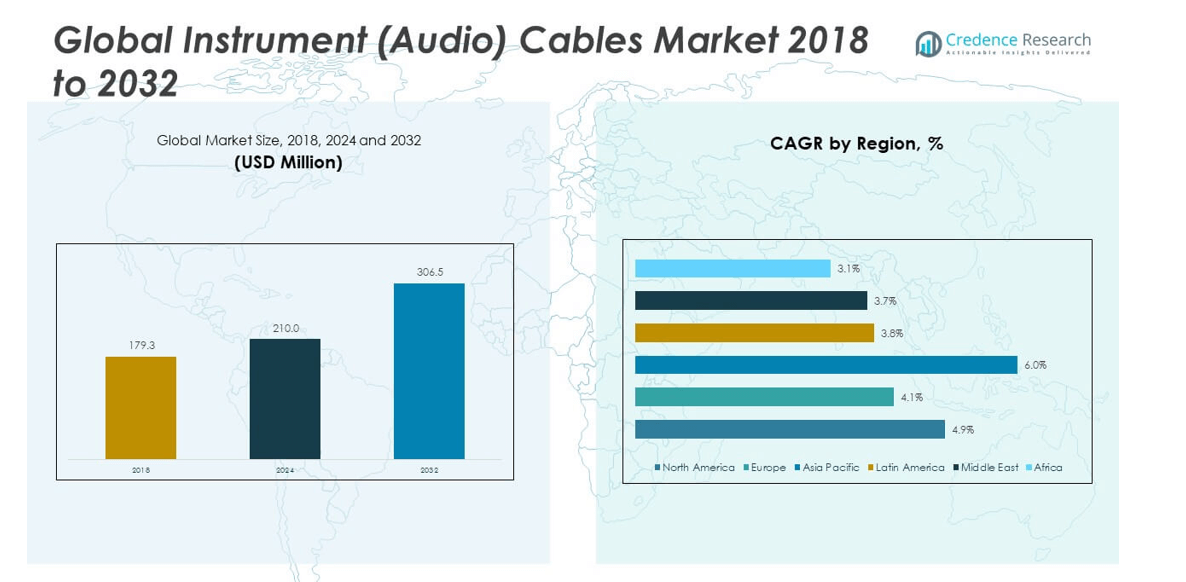
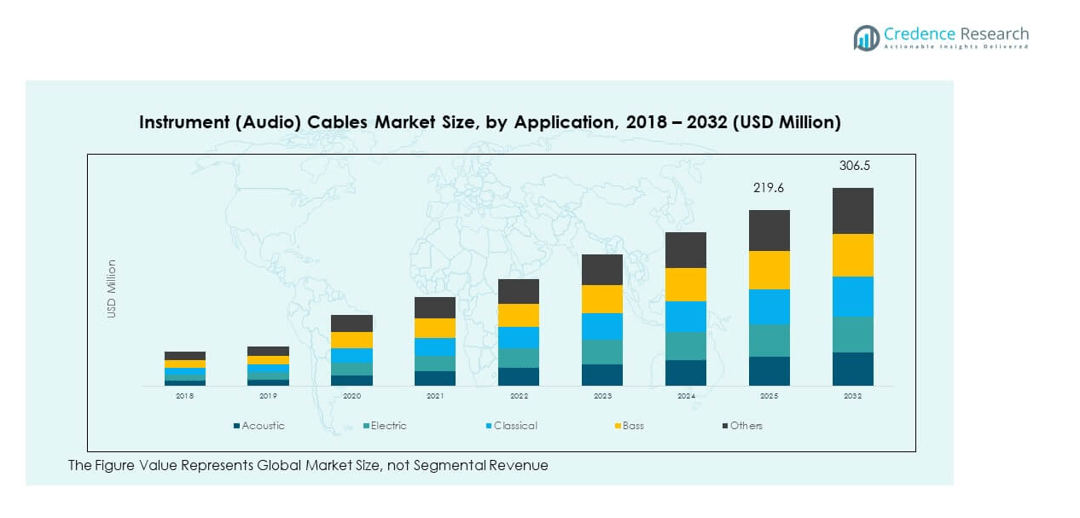
The Global Instrument (Audio) Cables Market size was valued at USD 179.3 million in 2018 to USD 210.0 million in 2024 and is anticipated to reach USD 306.5 million by 2032, at a CAGR of 4.9% during the forecast period.
| REPORT ATTRIBUTE | DETAILS |
|---|---|
| Historical Period | 2020-2023 |
| Base Year | 2024 |
| Forecast Period | 2025-2032 |
| Instrument (Audio) Cables Market Size 2024 | USD 210.0 million |
| Instrument (Audio) Cables Market, CAGR | 4.9% |
| Instrument (Audio) Cables Market Size 2032 | USD 306.5 million |
Growth in the Global Instrument (Audio) Cables Market is driven by the rising demand for professional audio equipment across live performances, recording studios, and broadcasting applications. The increasing adoption of high-quality audio devices in home entertainment systems, coupled with the need for durable and noise-resistant cables, further supports expansion. Additionally, technological advancements in cable materials and connectors are enhancing sound fidelity and durability, while the surge in music production and the popularity of online streaming platforms are encouraging consistent investments in superior instrument cable solutions.
Regionally, North America leads the market due to its large base of professional musicians, advanced music production infrastructure, and high consumer spending on premium audio solutions. Europe follows closely, supported by its strong cultural emphasis on live performances and recording studios. Emerging markets in Asia-Pacific are showing significant growth as rising disposable incomes and expanding entertainment industries drive demand for affordable yet reliable audio equipment. Latin America and the Middle East & Africa are gradually catching up, benefiting from increasing event culture and investments in music production facilities.
Market Insights:
- The Global Instrument (Audio) Cables Market size was valued at USD 179.3 million in 2018, reached USD 210.0 million in 2024, and is projected to attain USD 306.5 million by 2032, growing at a CAGR of 4.9%.
- Strong demand from professional studios, live events, and broadcasting continues to drive market expansion with high-performance cables supporting reliability and sound clarity.
- Rising consumer interest in premium home entertainment systems supports growth, as households increasingly adopt advanced audio setups requiring durable cables.
- Market growth faces pressure from wireless alternatives, with Bluetooth-enabled instruments and systems reducing reliance on traditional wired solutions.
- Price sensitivity in developing regions and saturation in mature markets create challenges for manufacturers competing on differentiation and profitability.
- North America leads with 36.9% share in 2024, followed by Asia Pacific at 27.6% and Europe at 23.3%, reflecting both mature and emerging demand bases.
- Latin America, the Middle East, and Africa show steady growth potential, supported by rising cultural events, expanding digital music adoption, and increasing affordability of instrument cables.
Market Drivers
Rising Demand for Professional Audio Solutions in Live Performances and Studios
The Global Instrument (Audio) Cables Market is experiencing strong demand from live music events, recording studios, and broadcasting facilities. It benefits from rising investments in professional-grade audio equipment that requires high-performance connectivity. Musicians and sound engineers prioritize cables that ensure minimal signal loss and high durability. The popularity of live concerts and events across regions drives consistent sales of instrument cables. It gains momentum from the expansion of music festivals and stage shows that require reliable setups. Streaming services and digital platforms encourage more music production globally. Growth in independent recording studios further supports steady cable consumption. It is influenced by the continuous modernization of professional sound infrastructure.
Expanding Adoption of Premium Home Entertainment and Audio Systems
Consumer preference for immersive audio experiences drives growth in the Global Instrument (Audio) Cables Market. Households increasingly invest in advanced home entertainment systems that require high-quality cables. It benefits from strong interest in noise-free connectivity to achieve clear sound output. Premium home theater setups rely on durable and shielded instrument cables to enhance user experience. The market expands with rising adoption of audiophile-grade solutions among enthusiasts. It is reinforced by consumer focus on sound clarity, durability, and compatibility with multiple devices. Manufacturers respond with innovative product lines offering improved conductivity and strength. Growing awareness about the importance of cables in audio quality ensures lasting demand.
- For instance, AudioQuest offers the “Cinnamon” HDMI 48 cable, featuring silver-plated copper conductors, 48 Gbps bandwidth, and advanced noise-dissipation technology, designed to deliver enhanced performance for premium home entertainment setups.
Technological Advancements in Materials and Cable Design
Continuous innovations in cable materials and design strengthen the Global Instrument (Audio) Cables Market. It evolves through improvements in shielding technology, which reduces interference and enhances audio clarity. Copper and hybrid alloys are widely used to improve conductivity and durability. Braided and multi-layer designs help reduce external noise in professional environments. Cable manufacturers emphasize user-friendly features such as flexible outer layers and reinforced connectors. It adapts to emerging performance needs by incorporating corrosion-resistant materials. Smart designs support both professional musicians and hobbyists by ensuring longer product lifespans. The focus on consistent upgrades in design fuels competitive advantage for established players.
Growth in Music Production and Independent Artist Communities
The Global Instrument (Audio) Cables Market is driven by the rising population of independent musicians and small-scale recording studios. It benefits from growing accessibility of affordable digital recording tools that encourage self-production. The popularity of social media platforms and video-sharing websites drives higher engagement in music creation. Independent artists increasingly seek reliable cables that offer consistency during frequent use. The trend of remote music collaboration across geographies further boosts demand for dependable products. It thrives on the culture of music creation at home, supported by compact studio setups. The increase in online tutorials motivates beginners to adopt quality instrument cables early. Demand from music education institutions also reinforces steady market growth.
- For instance, Hosa Technology introduced a Limited Edition Pro Series Guitar Cable in 2024 to celebrate its 40th anniversary, combining premium design with support for the Save the Music Foundation.
Market Trends
Integration of Eco-Friendly and Sustainable Cable Solutions
The Global Instrument (Audio) Cables Market reflects a growing emphasis on sustainability, with manufacturers focusing on eco-friendly materials. It evolves through the adoption of recyclable packaging and lead-free components. Green initiatives are shaping production processes, reducing environmental impact across the value chain. Companies highlight energy-efficient manufacturing practices to align with consumer preferences. Biodegradable insulation layers are gaining traction as a sustainable alternative. It is shaped by regulatory pressure encouraging reduced waste in electronic goods. Eco-label certifications and transparency in sourcing help build consumer trust. The move toward environmentally conscious cables is expected to influence purchasing decisions.
Rising Popularity of Customizable and Aesthetic Cable Designs
The Global Instrument (Audio) Cables Market is influenced by demand for personalized and visually appealing cable solutions. It benefits from musicians and performers seeking cables that match stage aesthetics. Colored jackets, unique textures, and branded patterns are becoming part of product differentiation. The trend of customization allows consumers to select cable lengths, connectors, and features suited to their setups. It reflects a shift from purely functional products to lifestyle-oriented accessories. Retailers highlight cables as both technical necessities and fashion statements for performers. Growing competition motivates manufacturers to experiment with design flexibility. This trend reinforces consumer engagement and brand loyalty.
- For instance, custom cable services allow musicians to build Mogami‑based cables with a choice of connectors, lengths, color boots, and optional labels, supporting unique stage or studio needs.
Expansion of E-Commerce and Direct-to-Consumer Sales Models
The Global Instrument (Audio) Cables Market benefits from rapid expansion of online retail channels. It experiences strong traction from musicians and hobbyists who prefer direct purchases from brand websites. E-commerce platforms enable convenient access to a wide range of cable options. Brands leverage digital platforms for targeted advertising and bundled product promotions. It gains visibility through customer reviews and influencer endorsements in music communities. Distribution networks are being redesigned to prioritize online sales over traditional retail. Small manufacturers use digital platforms to compete with global brands. The dominance of e-commerce is reshaping distribution dynamics across regions.
Increasing Interest in Hybrid and Multi-Functional Cable Solutions
The Global Instrument (Audio) Cables Market is impacted by rising demand for hybrid cables offering multiple functionalities. It adapts to consumer needs by combining power transmission with signal transfer in one product. Multi-functional designs support compact setups for both professionals and hobbyists. Cable innovation emphasizes convenience for traveling musicians who seek fewer accessories. It demonstrates strong adoption in portable studio equipment and modern gigging environments. The focus on integration reduces clutter and simplifies audio setups. Hybrid models also appeal to consumers seeking cost-effective solutions. The shift toward multifunctionality highlights the growing importance of versatility in audio equipment.
- For instance, Roland Corporation’s Black Series MIDI cables feature high-density shielding and commercial-grade connectors, ensuring reliable signal transfer and durability for professional synthesizer and studio setups.
Market Challenges Analysis
Rising Competition from Wireless Audio Alternatives
The Global Instrument (Audio) Cables Market faces significant challenges from the rapid adoption of wireless technologies. It is impacted by musicians and consumers shifting to Bluetooth-enabled instruments and audio systems. The convenience of cordless setups reduces dependence on traditional cables. Rising investments in wireless signal stability further reduce the need for wired connectivity. It pressures manufacturers to innovate and differentiate their cable offerings. Strong marketing of wireless solutions creates a perception of modernity, drawing younger consumers away from cables. The challenge lies in convincing buyers of the superior reliability and audio fidelity of wired products. The competitive threat of wireless solutions continues to weigh on market performance.
Market Saturation and Pressure on Price Differentiation
The Global Instrument (Audio) Cables Market struggles with saturation in mature regions where established brands dominate. It is influenced by the availability of low-cost alternatives from regional players, which create pricing pressures. Product commoditization reduces opportunities for differentiation among cable manufacturers. Intense competition often forces companies to compete on discounts, reducing profitability. It limits smaller brands that lack resources to sustain aggressive marketing strategies. Consumers in price-sensitive regions prioritize affordability over performance, affecting premium product adoption. Sustaining growth requires continuous innovation in design and material quality. This pricing challenge remains a critical barrier to long-term expansion.
Market Opportunities
Expanding Role of Online Learning and Music Education Platforms
The Global Instrument (Audio) Cables Market gains opportunities from the rise of online music learning and education platforms. It benefits from increased enrollment in digital courses that encourage students to invest in quality instrument accessories. Growing availability of affordable recording software motivates beginners to set up personal studios. It creates demand for reliable and durable cables to support consistent practice. Institutions focusing on blended learning models also require professional-grade cables for training. The market experiences wider reach through collaborations with music schools and e-learning platforms. It is supported by the trend of hobbyists taking structured lessons at home.
Rising Growth Potential in Emerging Markets with Expanding Music Industries
The Global Instrument (Audio) Cables Market unlocks opportunities in developing regions with growing music culture and expanding entertainment industries. It benefits from rising disposable incomes that allow consumers to spend on personal and professional audio setups. Urbanization encourages the popularity of live concerts, festivals, and recording facilities. The spread of digital music platforms boosts demand for independent music creation in emerging economies. It thrives where governments and private investors promote cultural industries. Market growth in these regions is supported by expanding retail infrastructure and online accessibility. The potential for untapped consumer bases makes emerging markets highly attractive.
Market Segmentation Analysis:
The Global Instrument (Audio) Cables Market is segmented
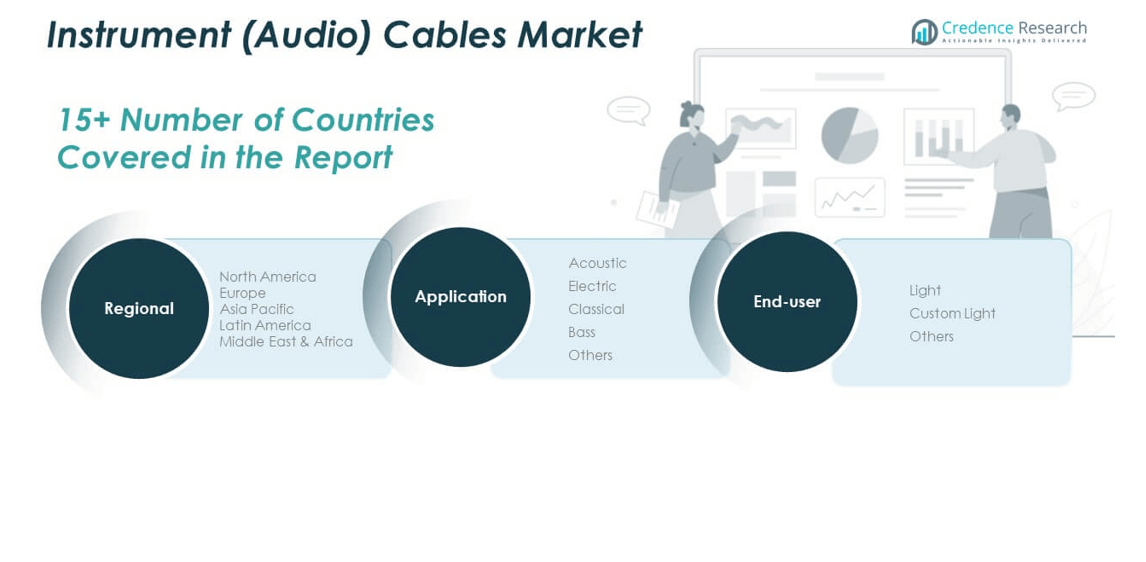
By application into acoustic, electric, classical, bass, and others. Acoustic instrument cables remain significant due to their widespread use among live performers and hobbyists seeking durable yet affordable solutions. Electric instrument cables account for a strong share, supported by their essential role in professional studios and concert setups. Classical instrument cables maintain a niche presence, appealing to traditional musicians who value clarity and minimal interference. Bass cables hold steady demand as they require robust construction to handle lower frequency ranges. The “others” category includes specialized and hybrid cables that cater to emerging needs in modern audio setups.
- For instance, Fender’s Deluxe Series Instrument Cables feature 95% oxygen-free braided shielding, 20 AWG wire, and gold-plated connectors, offering durability and consistent tone quality for both stage and studio use.
By end-user, the Global Instrument (Audio) Cables Market is categorized into light, custom light, and others. Light cables appeal to casual players and entry-level musicians seeking cost-effective solutions with reliable performance. Custom light cables serve professionals and enthusiasts who demand tailored specifications, higher durability, and enhanced tonal fidelity. The “others” category consists of cables designed for unique or specialized applications, including hybrid models used in home studios and portable setups. It benefits from rising interest in personalization and the growing preference for performance-driven solutions across both consumer and professional segments.
- For instance, Ernie Ball introduced a new braided instrument cable line featuring over 30 color and length combinations in early 2025, catering to musicians seeking both visual appeal and performance reliability.
Segmentation:
By Application
- Acoustic
- Electric
- Classical
- Bass
- Others
By End-User
- Light
- Custom Light
- Others
By Region
- North America
- U.S.
- Canada
- Mexico
- Europe
- UK
- France
- Germany
- Italy
- Spain
- Russia
- Belgium
- Netherlands
- Austria
- Sweden
- Poland
- Denmark
- Switzerland
- Rest of Europe
- Asia Pacific
- China
- Japan
- South Korea
- India
- Australia
- Thailand
- Indonesia
- Vietnam
- Malaysia
- Philippines
- Taiwan
- Rest of Asia Pacific
- Latin America
- Brazil
- Argentina
- Peru
- Chile
- Colombia
- Rest of Latin America
- Middle East
- UAE
- KSA
- Israel
- Turkey
- Iran
- Rest of Middle East
- Africa
- Egypt
- Nigeria
- Algeria
- Morocco
- Rest of Africa
Regional Analysis:
North America
The North America Global Instrument (Audio) Cables Market size was valued at USD 67.1 million in 2018 to USD 77.6 million in 2024 and is anticipated to reach USD 113.1 million by 2032, at a CAGR of 4.9% during the forecast period. North America holds 36.9% of the global share in 2024, supported by strong demand from professional musicians, recording studios, and live event industries. The region benefits from advanced music production infrastructure and high consumer spending on premium audio equipment. The U.S. dominates due to its established entertainment industry and cultural affinity for live performances. Canada contributes steadily with rising adoption of home studios and independent music production. Mexico is witnessing growth driven by expanding event culture and affordability of cable solutions. It is further supported by strong retail and e-commerce presence that ensures wide accessibility. North America continues to lead innovation with early adoption of durable and technologically advanced cables.
Europe
The Europe Global Instrument (Audio) Cables Market size was valued at USD 43.6 million in 2018 to USD 48.9 million in 2024 and is anticipated to reach USD 67.0 million by 2032, at a CAGR of 4.1% during the forecast period. Europe represents 23.3% of the global share in 2024, anchored by a strong cultural tradition of music and established classical and modern performance segments. Germany, France, and the UK remain key contributors with robust recording industries and steady live concert activities. Italy and Spain provide significant support with their rich music heritage and demand for both classical and modern instrument cables. Russia adds growth momentum through its expanding entertainment and live performance sector. It benefits from consumer demand for premium solutions that emphasize sound clarity and reliability. Strong conservatory programs and academic training in music further reinforce demand. The region maintains stable growth with emphasis on quality-driven purchases across professional and consumer categories.
Asia Pacific
The Asia Pacific Global Instrument (Audio) Cables Market size was valued at USD 47.6 million in 2018 to USD 58.0 million in 2024 and is anticipated to reach USD 92.5 million by 2032, at a CAGR of 6.0% during the forecast period. Asia Pacific accounts for 27.6% of the global share in 2024, driven by expanding entertainment industries and rising disposable incomes. China leads with large-scale manufacturing capabilities and rapid adoption of modern music systems. Japan and South Korea showcase strong demand from technology-driven consumers and vibrant music cultures. India contributes significantly with a growing population of independent artists and live events. Australia and Southeast Asia strengthen the region with rising music festivals and expanding e-commerce platforms. It benefits from a young demographic actively engaged in music creation and consumption. Demand for both affordable and premium cables positions Asia Pacific as the fastest-growing regional market.
Latin America
The Latin America Global Instrument (Audio) Cables Market size was valued at USD 9.8 million in 2018 to USD 11.4 million in 2024 and is anticipated to reach USD 15.2 million by 2032, at a CAGR of 3.8% during the forecast period. Latin America holds 5.4% of the global share in 2024, supported by the popularity of regional music genres and rising live performance culture. Brazil leads with strong demand from both professional musicians and local festivals. Argentina contributes with growing adoption of professional sound systems across entertainment venues. The rest of Latin America is witnessing gradual growth through increasing digital music consumption and small-scale studio setups. It gains momentum from cultural diversity that drives demand for both traditional and modern audio solutions. Affordability remains a key factor influencing consumer preferences across the region. Latin America reflects stable growth supported by expanding event-driven demand and local industry investments.
Middle East
The Middle East Global Instrument (Audio) Cables Market size was valued at USD 7.4 million in 2018 to USD 8.1 million in 2024 and is anticipated to reach USD 10.8 million by 2032, at a CAGR of 3.7% during the forecast period. The Middle East represents 3.9% of the global share in 2024, with demand largely concentrated in GCC countries and Turkey. Growth is supported by rising investments in cultural events, concerts, and entertainment venues. Israel contributes with a steady market driven by professional studios and modern music adoption. Expanding tourism and luxury entertainment complexes add further momentum across GCC economies. It benefits from government-led initiatives that promote cultural and creative industries. Affluent consumers drive preference for premium cables with advanced durability and sound quality. The Middle East market grows steadily with increased adoption of modern audio systems in both personal and professional settings.
Africa
The Africa Global Instrument (Audio) Cables Market size was valued at USD 3.91 million in 2018 to USD 6.01 million in 2024 and is anticipated to reach USD 7.85 million by 2032, at a CAGR of 3.1% during the forecast period. Africa accounts for 2.9% of the global share in 2024, supported by expanding urban entertainment sectors and rising event culture. South Africa remains the largest contributor due to its established music industry and cultural festivals. Egypt supports steady demand with a growing interest in modern performance setups. The rest of Africa is showing early growth potential through independent artist communities and small recording studios. It is shaped by increasing consumer interest in affordable yet reliable cables. Limited infrastructure and price sensitivity remain challenges but growing digital connectivity supports steady adoption. Africa offers opportunities for long-term growth with rising youth-driven music culture.
Key Player Analysis:
Competitive Analysis:
The Global Instrument (Audio) Cables Market is characterized by the presence of established brands such as Mogami, Klotz, Fender, Ernie Ball, Shure, Boss, Line 6, Lava, and Monster. It is defined by intense competition where companies focus on product innovation, durability, and enhanced sound quality to differentiate themselves. Strategic initiatives include new product launches, partnerships with artists, and expansion into emerging regions. Leading firms emphasize advanced materials, corrosion resistance, and customizable designs to capture professional and consumer segments. Smaller players compete by offering cost-effective solutions with reliable performance. The market reflects a balance between premium players that dominate high-end segments and regional firms that address affordability. Competitive intensity remains high as companies continuously invest in branding and distribution networks to expand reach.
Recent Developments:
- In January 2025, Fender unveiled a wide range of new cables and gigging essentials at the NAMM show, expanding their accessory portfolio. These additions included upgraded cables designed to enhance sound quality and playability for musicians. Fender also highlighted fresh cable models among other accessory innovations tailored for diverse musical applications.
- In January 2025, Ernie Ball announced a new release of Braided Instrument Cables in a Pumpkin Pie colorway, as well as an updated Flex Cable Collection with straight-to-angle plugs. The company also launched the Silent Cable for noiseless performance and added Tim Henson Signature cables to its premium lineup.
- In August 2024, Shure formed a strategic alliance with TD SYNNEX to improve market access to its premium audio solutions across the United States. This partnership leverages Shure’s audio expertise and TD SYNNEX’s distribution capabilities, ensuring broader customer reach for conferencing, presentation, and educational audio technologies.
- In January 2024, Klotz introduced a redesigned LaGrange Supreme Guitar Cable. The new edition celebrates its 45th anniversary, now with laser-engraved metal jack plugs and improved handling, while retaining its reputation for high-purity copper conductors, triple shielding, and classic performance.
Market Concentration & Characteristics:
The Global Instrument (Audio) Cables Market demonstrates moderate concentration with a mix of global leaders and regional players. It is dominated by established brands that command strong loyalty in professional audio segments. Consumer preference for durability and clarity reinforces demand for premium products, while price-sensitive regions encourage growth of mid-tier and low-cost options. The market exhibits characteristics of steady innovation, with continuous upgrades in cable materials and design. It is further shaped by diverse distribution models, including e-commerce, retail outlets, and direct-to-consumer channels. It continues to evolve as hybrid and eco-friendly solutions gain attention among both professionals and hobbyists. Market concentration reflects a balance between innovation-driven growth and the need for accessible, cost-effective solutions across global regions.
Report Coverage:
The research report offers an in-depth analysis based on Application and End-User. It details leading market players, providing an overview of their business, product offerings, investments, revenue streams, and key applications. Additionally, the report includes insights into the competitive environment, SWOT analysis, current market trends, as well as the primary drivers and constraints. Furthermore, it discusses various factors that have driven market expansion in recent years. The report also explores market dynamics, regulatory scenarios, and technological advancements that are shaping the industry. It assesses the impact of external factors and global economic changes on market growth. Lastly, it provides strategic recommendations for new entrants and established companies to navigate the complexities of the market.
Future Outlook:
- The Global Instrument (Audio) Cables Market will expand with sustained demand from professional studios and live performances.
- It will gain traction from independent musicians and small-scale recording setups seeking reliable connectivity.
- Growth will be supported by innovations in materials that enhance durability and signal clarity.
- Rising consumer preference for premium audio experiences in home entertainment will strengthen adoption.
- Expansion of e-commerce channels will improve product accessibility across developed and emerging regions.
- It will witness growing interest in eco-friendly and recyclable cable solutions aligning with sustainability trends.
- Hybrid and multifunctional cable designs will appeal to users seeking versatility in modern setups.
- Strong market opportunities will emerge in Asia Pacific driven by rising disposable incomes and music culture.
- Established players will continue to dominate premium categories while regional firms focus on affordability.
- It will evolve through strategic collaborations between manufacturers, artists, and distributors to broaden global reach.

Request a Free Sample
Fill in your details and we'll send you a free sample report.
- Sample data tables & charts
- Research methodology
Market Dynamics
Professional Audio Demand in Studios and Live Events
The market is propelled by ongoing investments in professional-grade audio equipment for live performances, recording studios, and broadcasting, where reliable, high-performance cables are essential for sound clarity and minimal signal loss.
Growth of Premium Home Entertainment Systems
Increasing consumer adoption of advanced home audio and theater systems is driving demand for high-quality, durable, and noise-resistant instrument cables that enhance the listening experience.
Technological Advancements in Cable Materials and Design
Continuous innovation in cable materials, shielding, and connectors is improving durability and audio fidelity, making instrument cables more attractive to both professionals and enthusiasts.
Expansion of Music Production and Independent Artist Communities
The rise of independent musicians, small-scale studios, and online music creation platforms is fueling steady demand for reliable and affordable instrument cables, especially among new entrants and hobbyists.
E-Commerce and Direct-to-Consumer Sales Growth
The rapid expansion of online retail channels and direct-to-consumer sales models is increasing accessibility and variety for buyers, supporting market growth across both developed and emerging regions.
Need a Custom Version of This Report?
Tailor the scope, geography, or segments to your exact requirements.
- Custom geography or segment scope
- Direct access to our analyst team
Frequently Asked Questions
What is the current market size for Global Instrument (Audio) Cables Market, and what is its projected size in 2032?
Which Global Instrument (Audio) Cables Market segment held the largest share in 2024?
What are the primary factors fueling the growth of the Global Instrument (Audio) Cables Market?
Who are the leading companies in the Global Instrument (Audio) Cables Market?
Table of Content
Chapter 1 Market Segmentation
- 1.1 Segmentation Framework
- 1.1.1 Product and Service Classification
- 1.1.2 Application and End-Use Classification
- 1.1.3 Technology and Solution Classification
- 1.1.4 Customer and Distribution Channel Classification
- 1.1.5 Geographic Segmentation
- 1.1.6 Market Segment Definitions and Boundaries
- 1.2 By End-User
- 1.2.1 Light
- 1.2.2 Custom Light
- 1.2.3 Others
- 1.3 By Application
- 1.3.1 Acoustic
- 1.3.2 Electric
- 1.3.3 Classical
- 1.3.4 Bass
- 1.3.5 Others
Chapter 2 Introduction
- 2.1 Report Objectives and Scope
- 2.2 Product Definition and Industry Terminology
- 2.3 Market Inclusions and Exclusions
- 2.4 Research Process
- 2.4.1 Primary Research and Expert Interviews
- 2.4.2 Secondary Research and Source Review
- 2.4.3 Top-Down and Bottom-Up Estimation
- 2.4.4 Data Triangulation and Verification
- 2.5 Market Size Measurement Basis
- 2.5.1 2024: USD 210.0 million → 2032: USD 306.5 million
- 2.6 Historical and Forecast Reference Periods
- 2.6.1 Base Year: 2024
- 2.6.2 Forecast Period: 2024-2032
- 2.7 Research Assumptions and Limitations
Chapter 3 Executive Summary
- 3.1 Market Snapshot and Key Findings
- 3.2 Base-Year Market Size, 2024
- 3.3 Forecast Market Size, 2032
- 3.4 Revenue and Volume Growth Outlook
- 3.5 Key Demand and Supply Indicators
- 3.6 Leading Market Segments
- 3.7 Fastest-Growing Market Opportunities
- 3.8 Regional Performance Highlights
- 3.9 Technology and Industry Transformation
- 3.10 Competitive Landscape Summary
- 3.11 Analyst View and Strategic Implications
Chapter 4 Global Instrument (Audio) Cables Market Trends and Developments
- 4.1 Historical Industry Development
- 4.2 Recent Market Trends and Developments
- 4.3 Demand and Customer Behavior Trends
- 4.4 Technology and Product Innovation
- 4.5 Artificial Intelligence, Automation and Digitalization
- 4.6 Local Manufacturing and Supply Chain Realignment
- 4.7 Industry Partnerships, Mergers and Acquisitions
- 4.8 Sustainability and Circular Economy Developments
- 4.9 Government and Private Sector Investment Trends
- 4.10 Emerging Business Models and Commercialization
- 4.11 Industry Developments and Announcements
Chapter 5 Global Instrument (Audio) Cables Market Production, Supply and Demand Analysis
- 5.1 Demand Trend and Consumption Analysis
- 5.2 Demand Forecast, 2024-2032
- 5.3 Production and Output Trend
- 5.4 Production and Output Forecast, 2024-2032
- 5.5 Installed Capacity and Capacity Utilization
- 5.6 Company-Wise Production Plants and Statistics
- 5.6.1 Installed Production Capacity
- 5.6.2 Actual Production
- 5.6.3 Planned Capacity and Expansion Targets
- 5.7 Supply Chain Structure and Procurement Trends
- 5.8 Supply-Demand Gap and Bottlenecks
- 5.9 Import Dependence and Sourcing Structure
- 5.10 Contract Manufacturing and Outsourcing
- 5.11 Regional Supply and Demand Concentration
Chapter 6 Global Instrument (Audio) Cables Market Pricing Analysis
- 6.1 Pricing Structure and Measurement
- 6.2 Historical Pricing Trends
- 6.3 Pricing Outlook, 2024-2032
- 6.4 Average Selling Price and Unit Economics
- 6.5 Pricing by Product and Market Segment
- 6.6 Geographic Pricing Differences
- 6.7 Key Input, Energy, Labor and Logistics Costs
- 6.8 Contract Pricing and Purchasing Models
- 6.9 Pricing Sensitivity and Competitive Positioning
- 6.10 Price, Margin and Profitability Implications
Chapter 7 Global Instrument (Audio) Cables Market Dynamics
- 7.1 Market Growth Drivers
- 7.1.1 Demand-Side Drivers
- 7.1.2 Technology and Innovation Drivers
- 7.1.3 Infrastructure and Investment Drivers
- 7.1.4 Regulatory and Policy Drivers
- 7.2 Market Restraints
- 7.2.1 Cost and Affordability Constraints
- 7.2.2 Technology and Adoption Barriers
- 7.2.3 Supply Chain and Operational Constraints
- 7.3 Market Challenges
- 7.3.1 Competitive Pressure and Margin Erosion
- 7.3.2 Skills, Infrastructure and Implementation Gaps
- 7.4 Emerging Market Opportunities
- 7.5 Market Dynamics Impact and Time-Horizon Assessment
Chapter 8 Global Instrument (Audio) Cables Value Chain Analysis
- 8.1 Industry Value Chain Overview
- 8.2 Upstream Suppliers and Critical Inputs
- 8.3 Technology and Component Providers
- 8.4 Manufacturing or Service Delivery
- 8.5 Distribution, Channel Partners and Integrators
- 8.6 Downstream Applications and End Users
- 8.7 Value Addition and Profit Pools
- 8.8 Vertical Integration and Outsourcing
- 8.9 Supplier Concentration and Risk
- 8.10 Supply Chain Localization and Resilience
Chapter 9 Global Instrument (Audio) Cables Market Regulations and Policies
- 9.1 Relevant Laws, Standards and Compliance Frameworks
- 9.2 Product, Service, Safety and Quality Requirements
- 9.3 Government Policies, Incentives and Subsidies
- 9.4 Imports, Exports and Trade Barriers
- 9.5 Public Procurement and Local Content Requirements
- 9.6 Environmental and Sustainability Compliance
- 9.7 Upcoming Policy Changes and Market Implications
Chapter 10 Global Instrument (Audio) Cables Market Hotspots and Opportunities
- 10.1 Market Opportunity Mapping and Growth Hotspots
- 10.2 High-Growth Applications and Customer Groups
- 10.3 Underserved Markets and White-Space Opportunities
- 10.4 Emerging Technology and Product Opportunities
- 10.5 New Capacity and Investment Hotspots
- 10.6 Market Entry and Expansion Opportunities
- 10.7 Distribution and Partnership Opportunities
- 10.8 Near-Term and Long-Term Commercial Potential
- 10.9 Opportunity Attractiveness and Execution Risks
Chapter 11 Global Instrument (Audio) Cables Market Outlook, 2024-2032
- 11.1 Market Size and Analysis
- 11.1.1 Revenue (Market Measurement: 2024: USD 210.0 million → 2032: USD 306.5 million)
- 11.1.2 Market Volume and Quantity Sold
- 11.1.3 Historical Market Size
- 11.1.4 Base-Year Market Size, 2024
- 11.2 Market Forecast, 2024-2032
- 11.2.1 Revenue Forecast to 2032
- 11.2.2 Volume Forecast to 2032
- 11.2.3 CAGR and Year-on-Year Growth
- 11.2.4 Incremental Revenue Opportunity
- 11.3 Forecast Assumptions and Scenario Analysis
- 11.3.1 Base-Case Forecast
- 11.3.2 Optimistic and Conservative Scenarios
- 11.3.3 Technology, Pricing and Policy Sensitivities
- 11.4 Market Attractiveness and Growth Outlook
Chapter 12 Global Instrument (Audio) Cables Market Segmentation and Outlook
- 12.1 Segmentation Summary and Market Shares, 2024
- 12.2 Largest and Fastest-Growing Segments
- 12.3 By End-User - Market Size and Forecast, 2024-2032
- 12.3.1 Segment Definition and Scope
- 12.3.2 Historical Market Size
- 12.3.3 Revenue Forecast, 2024-2032
- 12.3.4 Volume Forecast, 2024-2032
- 12.3.5 Base-Year Market Share, 2024
- 12.3.6 Segment CAGR and Growth Drivers
- 12.3.7 Subsegment Market Size and Forecast
- 12.3.7.1 Light
- 12.3.7.2 Custom Light
- 12.3.7.3 Others
- 12.3.8 Subsegment Pricing and Adoption Trends
- 12.3.9 Leading Suppliers and Competition
- 12.3.10 Regional Demand and Opportunities
- 12.4 By Application - Market Size and Forecast, 2024-2032
- 12.4.1 Segment Definition and Scope
- 12.4.2 Historical Market Size
- 12.4.3 Revenue Forecast, 2024-2032
- 12.4.4 Volume Forecast, 2024-2032
- 12.4.5 Base-Year Market Share, 2024
- 12.4.6 Segment CAGR and Growth Drivers
- 12.4.7 Subsegment Market Size and Forecast
- 12.4.7.1 Acoustic
- 12.4.7.2 Electric
- 12.4.7.3 Classical
- 12.4.7.4 Bass
- 12.4.7.5 Others
- 12.4.8 Subsegment Pricing and Adoption Trends
- 12.4.9 Leading Suppliers and Competition
- 12.4.10 Regional Demand and Opportunities
- 12.5 Segment Growth Comparison
- 12.6 Segment Attractiveness and Priority Matrix
Chapter 13 Global Instrument (Audio) Cables End-Use and Application Market Outlook
- 13.1 End-Use Industry and Customer Demand Structure
- 13.2 Leading Applications and Customer Groups
- 13.3 End-Use Market Size, Share and Forecast
- 13.4 Major End-Use Industry Deep Dives
- 13.4.1 Customer Requirements and Use Cases
- 13.4.2 Demand and Replacement Cycles
- 13.4.3 Technical and Regulatory Considerations
- 13.4.4 Purchasing and Procurement Models
- 13.4.5 Leading Vendors and Distribution Channels
- 13.4.6 Forecast and Commercial Opportunities
- 13.5 Emerging Applications and Cross-Segment Demand
- 13.6 End-Use Industry Investment Priorities
Chapter 14 Global Instrument (Audio) Cables Geographic Market Outlook, 2024-2032
- 14.1 Regional Market Size and Share, 2024
- 14.2 Regional Market Forecast, 2024-2032
- 14.3 Regional Pricing, Production and Demand Differences
- 14.4 North America
- 14.4.1 United States
- 14.4.2 Canada
- 14.4.3 Mexico
- 14.5 Europe
- 14.5.1 Germany
- 14.5.2 France
- 14.5.3 Italy
- 14.5.4 United Kingdom
- 14.5.5 Spain
- 14.5.6 Poland
- 14.5.7 Russia
- 14.5.8 Netherlands
- 14.5.9 Belgium
- 14.5.10 Sweden
- 14.5.11 Denmark
- 14.5.12 Norway
- 14.5.13 Rest of Europe
- 14.6 Asia Pacific
- 14.6.1 China
- 14.6.2 India
- 14.6.3 Japan
- 14.6.4 South Korea
- 14.6.5 Thailand
- 14.6.6 Indonesia
- 14.6.7 Vietnam
- 14.6.8 Malaysia
- 14.6.9 Australia
- 14.6.10 Rest of Asia Pacific
- 14.7 Latin America
- 14.7.1 Brazil
- 14.7.2 Argentina
- 14.7.3 Colombia
- 14.7.4 Chile
- 14.7.5 Rest of Latin America
- 14.8 Middle East
- 14.8.1 Saudi Arabia
- 14.8.2 United Arab Emirates
- 14.8.3 Turkey
- 14.8.4 Israel
- 14.8.5 Iran
- 14.8.6 Rest of the Middle East
- 14.9 Africa
- 14.9.1 South Africa
- 14.9.2 Egypt
- 14.9.3 Nigeria
- 14.9.4 Morocco
- 14.9.5 Rest of Africa
- 14.10 Regional Investment, Policy and Supply Chain Differences
- 14.11 Regional Competitive Landscape
- 14.12 Geographic Growth Hotspots
Chapter 15 Global Instrument (Audio) Cables Technology, Innovation and Sustainability Outlook
- 15.1 Technology Landscape and Maturity
- 15.2 Product, Process and Service Innovation
- 15.3 AI, Automation and Digital Tools in the Industry
- 15.4 Technology Adoption and Performance Benchmarking
- 15.5 Innovation Pipeline and R&D Investment
- 15.6 Patent and Intellectual Property Trends
- 15.7 Energy Efficiency and Resource Management
- 15.8 Sustainability, Recycling and Circularity
- 15.9 Technology Roadmap, 2024-2032
- 15.10 Risks of Obsolescence and Technology Substitution
Chapter 16 Global Instrument (Audio) Cables Market Key Strategic Imperatives
- 16.1 Growth and Market Entry Priorities
- 16.2 High-Return Products and Segments
- 16.3 Pricing, Profitability and Cost Optimization
- 16.4 Technology Investment and Product Differentiation
- 16.5 Supply Chain Localization and Resilience
- 16.6 Distribution and Customer Acquisition
- 16.7 Partnership, Acquisition and Capacity Strategy
- 16.8 Regional Expansion Priorities
- 16.9 Short-, Medium- and Long-Term Actions
Chapter 17 Competition Outlook
- 17.1 Industry Competition Characteristics
- 17.2 Market Structure and Concentration
- 17.3 Market Share and Competitive Positioning, 2024
- 17.4 Company-Wise Revenue and Product Benchmarking
- 17.5 Production and Service Capacity Benchmarking
- 17.6 Technology, Pricing and Differentiation
- 17.7 Regional Footprint and Distribution Strength
- 17.8 Mergers, Acquisitions and Strategic Alliances
- 17.9 New Entrants and Competitive Threats
- 17.10 Porter's Five Forces and Industry Attractiveness
- 17.11 Competitive Outlook, 2024-2032
Chapter 18 Company Profiles
- 18.1 Company Coverage and Selection Criteria
- 18.2 Mogami
- 18.2.1 Business Description
- 18.2.2 Company Ownership and Geographic Presence
- 18.2.3 Product and Service Portfolio
- 18.2.4 Manufacturing and Operating Footprint
- 18.2.5 Production Capacity and Expansion Plans
- 18.2.6 Financial Performance and Investment
- 18.2.7 Market Share and Competitive Position
- 18.2.8 Technology and Innovation Capabilities
- 18.2.9 Strategic Alliances or Partnerships
- 18.2.10 Recent Developments
- 18.2.11 Growth Strategy and Outlook
- 18.3 Klotz
- 18.4 Fender
- 18.5 Ernie Ball
- 18.6 Shure
- 18.7 Boss
- 18.8 Line 6
- 18.9 Lava
- 18.10 Monster
- 18.11 Other Relevant Market Participants
Note: Every listed company is profiled on the structure shown under the first company. The company list is preliminary and may change based on research findings, market developments, data availability and client requirements.
Chapter 19 Disclaimer
- 19.1 Research and Forecast Disclaimer
- 19.2 Data Source and Estimation Limitations
Note: The depth of individual sections depends on data availability for this market. Volume, capacity, trade and other unit-based metrics are included where applicable.

