
| REPORT ATTRIBUTE | DETAILS |
|---|---|
| Historical Period | 2020-2023 |
| Base Year | 2024 |
| Forecast Period | 2025-2032 |
| Medical Imaging ASIC Market Size 2024 | USD 2,213.56 million |
| Medical Imaging ASIC Market, CAGR | 8.23% |
| Medical Imaging ASIC Market Size 2032 | USD 4,359.23 million |
Market Overview
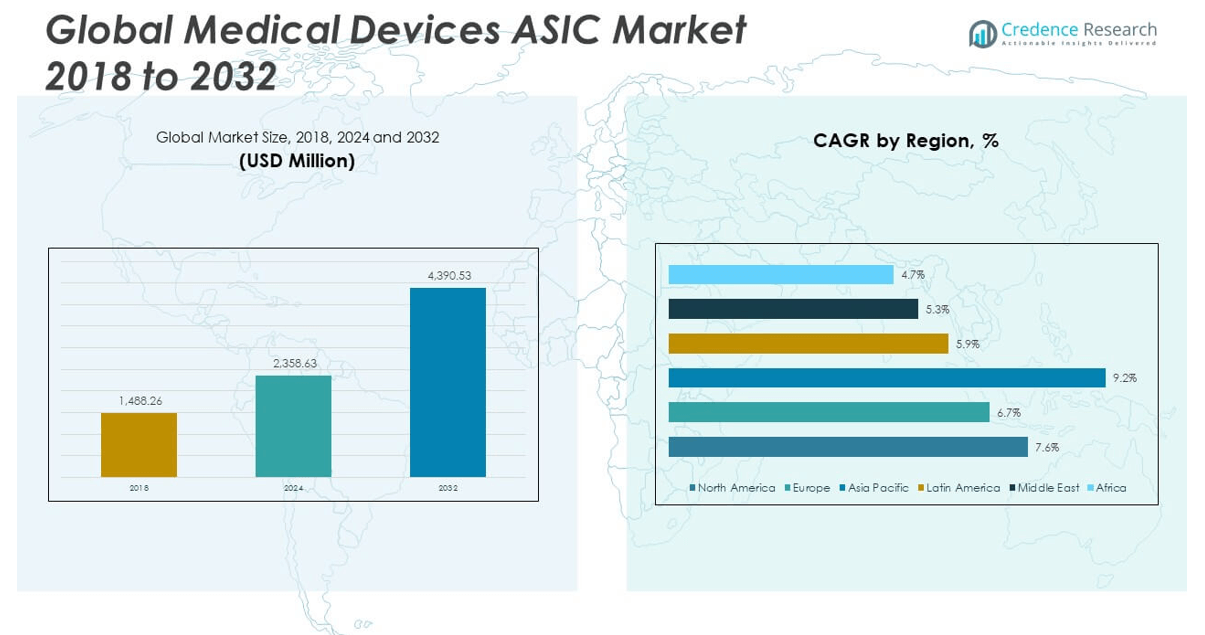
The Medical Imaging ASIC market size was valued at USD 1,355.46 million in 2018, increased to USD 2,213.56 million in 2024, and is anticipated to reach USD 4,359.23 million by 2032, at a CAGR of 8.23% during the forecast period.
The Medical Imaging ASIC market is highly competitive, with key players including GE Healthcare, Siemens Healthineers, Bracco Imaging S.p.A., Bayer AG, Guerbet Group, Lantheus Holdings Inc., Jubilant Radiopharma, Cardinal Health Inc., Nordion (Canada) Inc., and Curium Pharma. These companies drive market growth through continuous innovation in imaging technologies, integration of AI, and strategic collaborations with semiconductor manufacturers. In 2024, North America emerged as the leading region, accounting for 41.9% of the global market share, supported by advanced healthcare infrastructure and high adoption of diagnostic imaging systems. Asia Pacific followed with 30.2%, driven by rapid healthcare expansion and increasing demand for portable imaging solutions.
Market Insights
- The Medical Imaging ASIC market was valued at USD 2,213.56 million in 2024 and is projected to reach USD 4,359.23 million by 2032, growing at a CAGR of 8.23% during the forecast period.
- Rising demand for advanced diagnostic imaging and increasing prevalence of chronic diseases such as cancer and cardiovascular conditions are driving the adoption of ASIC-integrated imaging systems.
- Trends such as AI-enabled imaging, miniaturization of devices, and the shift toward portable and wearable diagnostic equipment are transforming the market landscape.
- The market is competitive with major players including GE Healthcare, Siemens Healthineers, and Bayer AG, who focus on product innovation and strategic collaborations to expand their global presence.
- North America held the largest regional share at 41.9% in 2024, followed by Asia Pacific at 30.2%, while the mixed-signal ASIC segment led by product type due to its superior integration capabilities across imaging platforms.
Market Segmentation Analysis:
By Product Type
In the Medical Imaging ASIC market, Mixed-Signal ASIC holds the dominant share due to its ability to integrate both analog and digital functions on a single chip, enhancing imaging precision and performance. In 2024, this sub-segment accounted for the largest market share, driven by the rising demand for real-time signal processing and compact device architectures. The increasing adoption of portable and wearable imaging devices further fuels demand for mixed-signal ASICs, as they offer higher integration, lower power consumption, and improved diagnostic efficiency compared to separate analog and digital solutions.
- For instance, Texas Instruments’ latest mixed-signal ASIC design integrates over 150 million transistors on a single die, enabling ultra-low power consumption of less than 5 milliwatts during continuous operation in portable ultrasound devices.
By Imaging Device
Magnetic Resonance Imaging (MRI) Systems emerged as the leading sub-segment in 2024, capturing the highest market share within the imaging device segment. This dominance is attributed to the growing prevalence of neurological and musculoskeletal disorders and the need for high-resolution, non-invasive diagnostic imaging. MRI systems benefit from ASIC integration, which enhances image clarity, reduces noise, and improves system speed. The increasing investments in advanced MRI technologies and the development of compact, mobile MRI units are further propelling ASIC demand in this category.
- For instance, Siemens Healthineers’ newly developed MRI ASIC chip operates with a sampling rate of 500 mega-samples per second (MSPS), significantly reducing signal noise and enhancing image resolution in their 3T MRI scanners.
By Application
Among applications, Oncology accounted for the largest share in the Medical Imaging ASIC market in 2024. The segment's growth is driven by the rising global cancer burden and the critical role of advanced imaging technologies in early detection, staging, and treatment monitoring. ASICs enhance image quality and data acquisition speed, enabling more accurate tumor localization and therapy planning. The ongoing development of precision medicine and personalized oncology care continues to elevate the demand for high-performance ASIC-enabled imaging solutions in cancer diagnostics.
Market Overiew
Increasing Demand for Advanced Diagnostic Imaging
The growing prevalence of chronic diseases such as cancer, cardiovascular, and neurological disorders has fueled the demand for precise diagnostic imaging. ASICs (Application-Specific Integrated Circuits) enhance image quality, speed, and resolution, making them critical in modern imaging equipment like MRI, CT, and PET systems. Healthcare providers are increasingly adopting high-performance, compact, and energy-efficient devices, which rely heavily on ASIC-based architectures. This trend is particularly strong in developed regions with established healthcare infrastructures and in emerging economies investing in diagnostic advancements.
- For instance, GE Healthcare’s latest PET imaging ASIC processes over 200,000 coincidence events per second, enabling faster and more accurate detection of cancerous lesions.
Technological Advancements in Miniaturization and Integration
Continuous advancements in semiconductor technology have led to the development of highly compact and power-efficient ASICs tailored for imaging applications. The miniaturization of ASICs enables the integration of complex functionalities in smaller devices, facilitating the growth of portable and point-of-care imaging solutions. These innovations support high-resolution imaging with reduced latency and better thermal management. Medical OEMs increasingly rely on custom ASICs to meet specific imaging requirements, promoting innovation and accelerating the development of next-generation diagnostic equipment.
- For instance, Analog Devices developed an ASIC chip with a die size of 5 mm² that integrates 64 channels of analog front-end processing, enabling handheld ultrasound systems with a thermal dissipation under 500 milliwatts.
Rising Investments in Healthcare Infrastructure
Global investments in healthcare infrastructure, particularly in Asia-Pacific and Latin America, are significantly boosting the adoption of advanced imaging systems. Government initiatives and public-private partnerships aimed at improving diagnostic capabilities are leading to higher demand for sophisticated medical equipment. This translates into increased demand for ASICs that enhance equipment performance and reduce operational costs. Additionally, the trend toward digital healthcare transformation and AI-powered diagnostics further amplifies the role of ASICs in supporting efficient and accurate imaging.
Key Trends & Opportunities
Integration of AI and Deep Learning in Imaging Systems
The integration of artificial intelligence (AI) and deep learning algorithms in imaging diagnostics presents a significant growth opportunity for ASIC manufacturers. AI applications require fast and efficient data processing, which ASICs are well-equipped to handle due to their customized architecture and low power consumption. These chips enhance real-time data analysis and support features like anomaly detection, segmentation, and classification in imaging systems. The convergence of ASICs and AI is expected to redefine diagnostic workflows, improving speed, accuracy, and clinical outcomes.
- For example, NVIDIA’s AI inference ASIC delivers over 130 TOPS (tera operations per second) with power efficiency optimized to 10 TOPS per watt, enabling real-time image processing for advanced radiology diagnostics.
Growing Focus on Portable and Wearable Imaging Devices
The market is witnessing a shift toward compact, portable, and wearable imaging solutions to meet the needs of remote diagnostics and point-of-care services. This trend is especially prominent in underserved and rural areas where access to traditional hospital infrastructure is limited. ASICs enable such devices by offering compactness, energy efficiency, and high computational capability. As telemedicine expands and demand for home-based healthcare grows, manufacturers are increasingly investing in ASIC-powered imaging technologies tailored for mobility and continuous monitoring.
- For instance, Butterfly Network’s handheld ultrasound device utilizes a custom-designed ASIC with 256 ultrasound channels and supports real-time image processing at 20 frames per second, all within a device weighing less than 0.5 kilograms and powered by a 3,000 mAh battery enabling over 90 minutes of continuous use.
Key Challenges
High Development and Manufacturing Costs
The development of custom ASICs requires significant investment in design, prototyping, and fabrication, often involving lengthy development cycles. The initial costs can be prohibitively high, especially for small and mid-sized medical device manufacturers. Moreover, the complex validation and compliance processes required for medical applications further add to the cost burden. These financial barriers can limit market entry for new players and slow the adoption of ASICs in budget-constrained healthcare settings, despite their long-term efficiency benefits.
Complex Regulatory Compliance and Safety Standards
Medical imaging devices must comply with stringent regulatory standards set by bodies such as the FDA, CE, and ISO. ASICs, as integral components of these systems, must also undergo rigorous testing and validation to ensure patient safety and system reliability. Meeting these regulations can delay product development timelines and increase costs. Furthermore, continuous updates to regulatory frameworks and cybersecurity standards pose additional compliance challenges for ASIC developers and medical device manufacturers alike.
Limited Technical Expertise and Design Complexity
Designing high-performance ASICs for medical imaging applications demands specialized technical knowledge in both semiconductor engineering and biomedical imaging. The shortage of skilled professionals with interdisciplinary expertise limits the pace of innovation and customization. Additionally, any design flaw can lead to costly re-fabrication and time-to-market delays. As medical imaging systems become more sophisticated, the complexity of ASIC architecture grows, necessitating collaboration between chip designers, system integrators, and clinical stakeholders to meet performance and safety expectations.
Regional Analysis
North America
North America dominated the Medical Imaging ASIC market in 2024, accounting for the largest regional share of approximately 41.9%, with a market value of USD 926.81 million, up from USD 573.67 million in 2018. The market is projected to reach USD 1,830.42 million by 2032, expanding at a CAGR of 8.3%. This growth is driven by the region's advanced healthcare infrastructure, high adoption of diagnostic imaging technologies, and significant investments in AI-powered medical devices. The presence of leading medical device manufacturers and strong reimbursement policies further support regional growth.
Europe
Europe held a market share of around 18.7% in 2024, with the market valued at USD 414.19 million, growing from USD 267.49 million in 2018. The market is forecasted to reach USD 745.92 million by 2032, at a CAGR of 7.0%. Growth in this region is supported by increasing healthcare digitization, rising demand for early diagnostic imaging, and supportive government funding in research and development. The region's focus on personalized healthcare and chronic disease management continues to fuel the adoption of ASIC-integrated imaging technologies.
Asia Pacific
Asia Pacific emerged as the fastest-growing region in the Medical Imaging ASIC market, with a CAGR of 9.4% and a 2024 market share of approximately 30.2%, valued at USD 669.56 million, up from USD 388.13 million in 2018. The market is expected to reach USD 1,439.07 million by 2032. This robust growth is attributed to increasing healthcare expenditure, expanding diagnostic imaging infrastructure, and a rising burden of chronic diseases in countries like China, India, and Japan. Government initiatives to improve access to healthcare and promote medical technology innovation are also key growth drivers.
Latin America
Latin America accounted for 4.7% of the global Medical Imaging ASIC market in 2024, with a market value of USD 103.00 million, growing from USD 63.87 million in 2018. The market is projected to reach USD 179.48 million by 2032, at a CAGR of 6.6%. The region’s growth is supported by improving public and private healthcare investments, rising awareness about early disease diagnosis, and increasing adoption of advanced medical devices. However, limited access to high-end diagnostic infrastructure in some areas may slightly hinder widespread adoption of ASIC-based imaging systems.
Middle East
The Medical Imaging ASIC market in the Middle East was valued at USD 52.73 million in 2024, up from USD 35.55 million in 2018, holding a 2.4% share of the global market. It is forecasted to grow at a CAGR of 5.7%, reaching USD 86.42 million by 2032. Growth in the region is driven by ongoing healthcare modernization efforts, particularly in countries like the UAE and Saudi Arabia, where investments in diagnostic and imaging infrastructure are increasing. However, the market faces challenges due to uneven access to medical technologies across the region.
Africa
Africa held a 2.1% share of the global Medical Imaging ASIC market in 2024, with a valuation of USD 47.27 million, up from USD 26.75 million in 2018. The market is anticipated to reach USD 77.93 million by 2032, growing at a CAGR of 5.8%. Market growth is gradually gaining momentum due to expanding healthcare access, increasing prevalence of chronic conditions, and growing investments in diagnostic imaging. However, limited technological infrastructure and low adoption of advanced medical devices remain key barriers to faster market development in the region.
Market Segmentations:
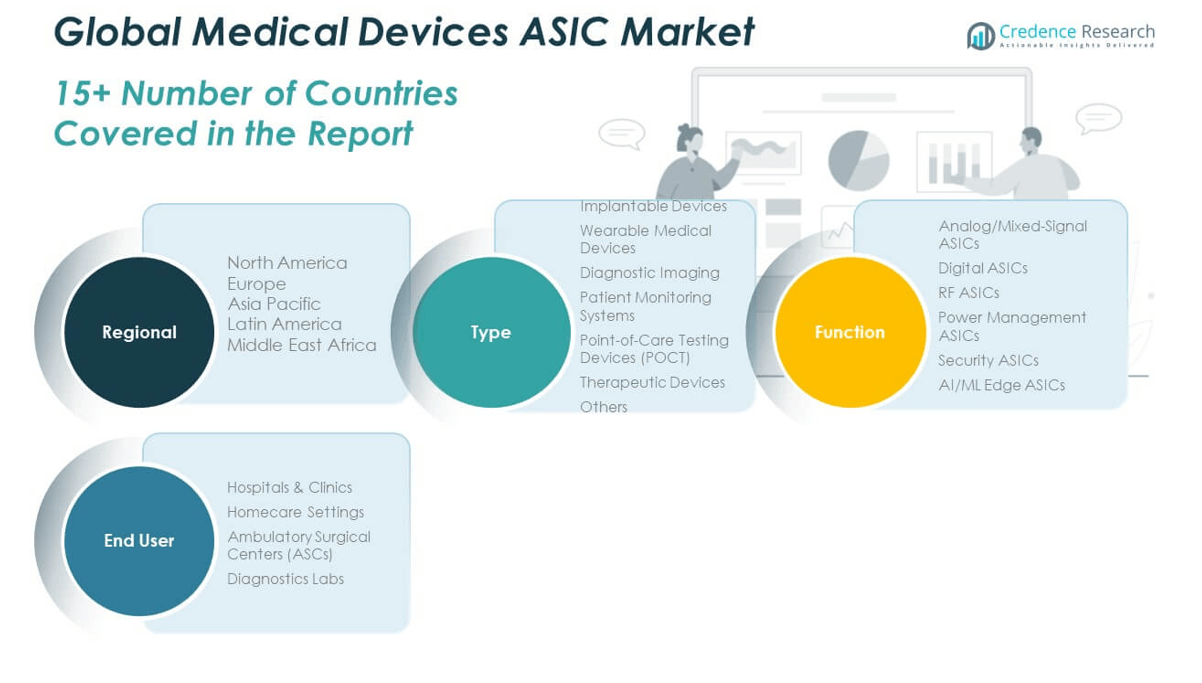
By Product Type
- Analog ASIC
- Digital ASIC
- Mixed-Signal ASIC
By Imaging Device
- X-ray Systems
- Ultrasound Devices
- Magnetic Resonance Imaging (MRI) Systems
- Computed Tomography (CT) Systems
- Nuclear Imaging Equipment (PET, SPECT)
- Others
By Application
- Oncology
- Cardiology
- Neurology
- Orthopedics
- Gastroenterology
- Others
By End User
- Hospitals
- Diagnostic Imaging Centers
- Specialty Clinics
- Ambulatory Surgical Centers
- Research Institutes
- Others
By Geography
- North America
- U.S.
- Canada
- Mexico
- Europe
- Germany
- France
- U.K.
- Italy
- Spain
- Rest of Europe
- Asia Pacific
- China
- Japan
- India
- South Korea
- South-east Asia
- Rest of Asia Pacific
- Latin America
- Brazil
- Argentina
- Rest of Latin America
- Middle East & Africa
- GCC Countries
- South Africa
- Rest of the Middle East and Africa
Competitive Landscape
The Medical Imaging ASIC market is characterized by intense competition among key players focused on technological innovation, strategic partnerships, and product differentiation. Leading companies such as GE Healthcare, Siemens Healthineers, and Bracco Imaging S.p.A. leverage strong R&D capabilities to develop custom ASICs that enhance imaging precision and system performance. These firms prioritize integration with AI, miniaturization, and power efficiency to meet the growing demand for compact and high-performance imaging devices. Strategic collaborations with semiconductor companies and healthcare OEMs further drive innovation. Mid-tier players like Lantheus Holdings Inc., Guerbet Group, and Jubilant Radiopharma are expanding their footprint through targeted acquisitions and regional market penetration. Additionally, companies such as Nordion (Canada) Inc. and Curium Pharma focus on specialized applications and radiopharmaceutical imaging, carving out niche strengths. As the market evolves, competition is expected to intensify, prompting firms to invest in next-generation technologies, global expansion, and cost-optimized production to gain a sustainable competitive edge.
Key Player Analysis
- GE Healthcare
- Siemens Healthineers
- Bracco Imaging S.p.A.
- Bayer AG
- Guerbet Group
- Lantheus Holdings Inc.
- Jubilant Radiopharma
- Cardinal Health Inc.
- Nordion (Canada) Inc.
- Curium Pharma
Recent Developments
- In May 2025, GE HealthCare announced advancements in enterprise imaging focusing on improving workflow efficiency across their medical imaging platforms. While the announcement didn't explicitly mention new ASICs, the improvements involve leveraging advanced hardware and AI-driven solutions, which frequently incorporate custom ASICs for faster image reconstruction and processing, to streamline the overall enterprise imaging process.
- In March 2024, GE Healthcare developed its latest research model, SonoSAMTrack1, utilizing NVIDIA technology. This innovative model is built upon a promptable foundational model known as SonoSAM1, which is designed for object segmentation in ultrasound imagery. The primary function of SonoSAMTrack is to delineate anatomical structures, lesions, and other critical regions within ultrasound images. Additionally, a more simplified iteration of this model, dubbed SonoSAMLite, has been introduced.
- In January 2024, Canon introduced Aplio me, a cutting-edge shared-service ultrasound system engineered to address the varied needs of everyday users in a broad range of medical environments. This exceptionally portable and light system is ideal for ultrasound experts who prioritize high efficiency in their workflow and seek sophisticated standard solutions, from smaller clinics to major hospitals.
- In January 2024, Canon Medical Systems Corporation along with Olympus Corporation declared their partnership to work together on Endoscopic Ultrasound Systems. Under this agreement, Canon Medical is tasked with the development and manufacturing of diagnostic ultrasound systems for use in Endoscopic Ultrasonography, while Olympus will handle the sales and marketing activities. This partnership aims to merge the capabilities of Canon's Aplio i800 diagnostic ultrasound system for EUS with Olympus' Ultrasound Endoscope, aiming to supply advanced EUS equipment to the market, ensuring high-quality imaging diagnostics.
- In February 2023, Bayer completed the acquisition of Blackford Analysis, a specialist in imaging AI. This move bolsters Bayer’s digital and computational imaging portfolio, aimed at integrating AI-based image analysis into clinical workflows. While this centers on software, it can drive adoption of hardware solutions often including ASIC-powered platforms for advanced imaging diagnostics.
Market Concentration & Characteristics
The Medical Imaging ASIC market demonstrates a moderately concentrated competitive landscape dominated by a few key players such as GE Healthcare, Siemens Healthineers, and Bracco Imaging S.p.A. These companies possess extensive technological expertise and strong R&D capabilities, allowing them to develop highly specialized ASIC solutions tailored to advanced imaging systems. It maintains a high entry barrier due to the significant capital investment, complex design requirements, and strict regulatory compliance associated with medical-grade semiconductor components. The market’s characteristics include rapid innovation cycles driven by the need for higher imaging resolution, lower power consumption, and integration of AI functionalities. Firms emphasize strategic partnerships with semiconductor manufacturers and healthcare equipment OEMs to enhance product offerings and expand market reach. The focus on miniaturization and customization promotes demand for mixed-signal ASICs, which support diverse imaging modalities such as MRI, CT, and ultrasound. Regional market dominance by North America and Asia Pacific reflects disparities in healthcare infrastructure, technology adoption, and investment capacity. Market players invest in localized production and service capabilities to address regional needs and regulatory environments. Despite high development costs, continuous advancements in ASIC design and manufacturing processes enable companies to improve device performance and reduce time to market, reinforcing their competitive position within the Medical Imaging ASIC market.
Report Coverage
The research report offers an in-depth analysis based on Product Type, Imaging Device, Application, End-User and Geography. It details leading market players, providing an overview of their business, product offerings, investments, revenue streams, and key applications. Additionally, the report includes insights into the competitive environment, SWOT analysis, current market trends, as well as the primary drivers and constraints. Furthermore, it discusses various factors that have driven market expansion in recent years. The report also explores market dynamics, regulatory scenarios, and technological advancements that are shaping the industry. It assesses the impact of external factors and global economic changes on market growth. Lastly, it provides strategic recommendations for new entrants and established companies to navigate the complexities of the market.
Future Outlook
- The Medical Imaging ASIC market will experience steady growth driven by increasing demand for high-resolution imaging devices.
- Integration of artificial intelligence will enhance diagnostic accuracy and workflow efficiency.
- Miniaturization of ASICs will support the development of portable and wearable imaging equipment.
- Expansion in emerging markets will boost adoption due to improved healthcare infrastructure.
- Advances in semiconductor technology will reduce power consumption and increase processing speed.
- Custom ASIC designs will become more prevalent to meet specific imaging modality requirements.
- Strategic partnerships between medical device manufacturers and semiconductor firms will intensify.
- Regulatory frameworks will evolve, prompting higher standards for safety and performance.
- The rise of personalized medicine will increase the need for advanced imaging diagnostics.
- Market competition will drive innovation, focusing on cost-effective and scalable ASIC solutions.

Request a Free Sample
Fill in your details and we'll send you a free sample report.
- Sample data tables & charts
- Research methodology
Market Dynamics
Technological Advancements in Miniaturization and Integration
Continuous improvements in semiconductor technology have enabled the development of compact, power-efficient ASICs, supporting the trend toward portable and wearable imaging devices. This miniaturization allows for higher integration of complex functionalities, enhancing diagnostic precision and enabling new point-of-care applications.
Integration of AI and Deep Learning in Imaging Systems
The adoption of AI and deep learning in medical imaging requires fast, efficient data processing, which ASICs are well-suited to provide. Custom ASICs enable real-time image analysis, anomaly detection, and advanced diagnostic features, driving demand for specialized chips in next-generation imaging equipment.
Rising Prevalence of Chronic Diseases
Increasing global incidence of cancer, cardiovascular, and neurological disorders is fueling the need for advanced diagnostic imaging. ASICs enhance image quality, speed, and resolution in modalities such as MRI, CT, and PET, making them essential for accurate disease detection and monitoring.
Expansion of Healthcare Infrastructure in Emerging Markets
Significant investments in healthcare infrastructure, particularly in Asia Pacific and Latin America, are boosting the adoption of advanced imaging systems. Government initiatives and public-private partnerships are increasing access to diagnostic technologies, driving demand for ASIC-enabled imaging devices.
Demand for High-Resolution and Energy-Efficient Imaging Devices
Healthcare providers are prioritizing high-performance, energy-efficient imaging equipment to improve diagnostic outcomes and reduce operational costs. ASICs offer superior integration, lower power consumption, and enhanced imaging capabilities, making them critical components in modern medical imaging systems.
Need a Custom Version of This Report?
Tailor the scope, geography, or segments to your exact requirements.
- Custom geography or segment scope
- Direct access to our analyst team
Frequently Asked Questions
What is the current size of the Global Medical Devices ASIC Market?
What are the key segments within the Global Medical Devices ASIC Market?
What are some challenges faced by the Global Medical Devices ASIC Market?
Who are the major players in the Global Medical Devices ASIC Market?
Table of Content
Chapter 1 Market Segmentation
- 1.1 Segmentation Framework
- 1.1.1 Product and Service Classification
- 1.1.2 Application and End-Use Classification
- 1.1.3 Technology and Solution Classification
- 1.1.4 Customer and Distribution Channel Classification
- 1.1.5 Geographic Segmentation
- 1.1.6 Market Segment Definitions and Boundaries
- 1.2 By End User
- 1.2.1 Hospitals
- 1.2.2 Diagnostic Imaging Centers
- 1.2.3 Specialty Clinics
- 1.2.4 Ambulatory Surgical Centers
- 1.2.5 Research Institutes
- 1.2.6 Others
- 1.3 By Application
- 1.3.1 Oncology
- 1.3.2 Cardiology
- 1.3.3 Neurology
- 1.3.4 Orthopedics
- 1.3.5 Gastroenterology
- 1.3.6 Others
- 1.4 By Product Type
- 1.4.1 Analog ASIC
- 1.4.2 Digital ASIC
- 1.4.3 Mixed-Signal ASIC
- 1.5 By Imaging Device
- 1.5.1 X-ray Systems
- 1.5.2 Ultrasound Devices
- 1.5.3 Magnetic Resonance Imaging (MRI) Systems
- 1.5.4 Computed Tomography (CT) Systems
- 1.5.5 Nuclear Imaging Equipment (PET, SPECT)
- 1.5.6 Others
Chapter 2 Introduction
- 2.1 Report Objectives and Scope
- 2.2 Product Definition and Industry Terminology
- 2.3 Market Inclusions and Exclusions
- 2.4 Research Process
- 2.4.1 Primary Research and Expert Interviews
- 2.4.2 Secondary Research and Source Review
- 2.4.3 Top-Down and Bottom-Up Estimation
- 2.4.4 Data Triangulation and Verification
- 2.5 Market Size Measurement Basis
- 2.5.1 2024: USD 2,213.56 million → 2032: USD 4,359.23 million
- 2.6 Historical and Forecast Reference Periods
- 2.6.1 Base Year: 2024
- 2.6.2 Forecast Period: 2024-2032
- 2.7 Research Assumptions and Limitations
Chapter 3 Executive Summary
- 3.1 Market Snapshot and Key Findings
- 3.2 Base-Year Market Size, 2024
- 3.3 Forecast Market Size, 2032
- 3.4 Revenue and Volume Growth Outlook
- 3.5 Key Demand and Supply Indicators
- 3.6 Leading Market Segments
- 3.7 Fastest-Growing Market Opportunities
- 3.8 Regional Performance Highlights
- 3.9 Technology and Industry Transformation
- 3.10 Competitive Landscape Summary
- 3.11 Analyst View and Strategic Implications
Chapter 4 Global Medical Devices ASIC Market Trends and Developments
- 4.1 Historical Industry Development
- 4.2 Recent Market Trends and Developments
- 4.3 Demand and Customer Behavior Trends
- 4.4 Technology and Product Innovation
- 4.5 Artificial Intelligence, Automation and Digitalization
- 4.6 Local Manufacturing and Supply Chain Realignment
- 4.7 Industry Partnerships, Mergers and Acquisitions
- 4.8 Sustainability and Circular Economy Developments
- 4.9 Government and Private Sector Investment Trends
- 4.10 Emerging Business Models and Commercialization
- 4.11 Industry Developments and Announcements
Chapter 5 Global Medical Devices ASIC Market Production, Supply and Demand Analysis
- 5.1 Demand Trend and Consumption Analysis
- 5.2 Demand Forecast, 2024-2032
- 5.3 Production and Output Trend
- 5.4 Production and Output Forecast, 2024-2032
- 5.5 Installed Capacity and Capacity Utilization
- 5.6 Company-Wise Production Plants and Statistics
- 5.6.1 Installed Production Capacity
- 5.6.2 Actual Production
- 5.6.3 Planned Capacity and Expansion Targets
- 5.7 Supply Chain Structure and Procurement Trends
- 5.8 Supply-Demand Gap and Bottlenecks
- 5.9 Import Dependence and Sourcing Structure
- 5.10 Contract Manufacturing and Outsourcing
- 5.11 Regional Supply and Demand Concentration
Chapter 6 Global Medical Devices ASIC Market Pricing Analysis
- 6.1 Pricing Structure and Measurement
- 6.2 Historical Pricing Trends
- 6.3 Pricing Outlook, 2024-2032
- 6.4 Average Selling Price and Unit Economics
- 6.5 Pricing by Product and Market Segment
- 6.6 Geographic Pricing Differences
- 6.7 Key Input, Energy, Labor and Logistics Costs
- 6.8 Contract Pricing and Purchasing Models
- 6.9 Pricing Sensitivity and Competitive Positioning
- 6.10 Price, Margin and Profitability Implications
Chapter 7 Global Medical Devices ASIC Market Dynamics
- 7.1 Market Growth Drivers
- 7.1.1 Demand-Side Drivers
- 7.1.2 Technology and Innovation Drivers
- 7.1.3 Infrastructure and Investment Drivers
- 7.1.4 Regulatory and Policy Drivers
- 7.2 Market Restraints
- 7.2.1 Cost and Affordability Constraints
- 7.2.2 Technology and Adoption Barriers
- 7.2.3 Supply Chain and Operational Constraints
- 7.3 Market Challenges
- 7.3.1 Competitive Pressure and Margin Erosion
- 7.3.2 Skills, Infrastructure and Implementation Gaps
- 7.4 Emerging Market Opportunities
- 7.5 Market Dynamics Impact and Time-Horizon Assessment
Chapter 8 Global Medical Devices ASIC Value Chain Analysis
- 8.1 Industry Value Chain Overview
- 8.2 Upstream Suppliers and Critical Inputs
- 8.3 Technology and Component Providers
- 8.4 Manufacturing or Service Delivery
- 8.5 Distribution, Channel Partners and Integrators
- 8.6 Downstream Applications and End Users
- 8.7 Value Addition and Profit Pools
- 8.8 Vertical Integration and Outsourcing
- 8.9 Supplier Concentration and Risk
- 8.10 Supply Chain Localization and Resilience
Chapter 9 Global Medical Devices ASIC Market Regulations and Policies
- 9.1 Relevant Laws, Standards and Compliance Frameworks
- 9.2 Product, Service, Safety and Quality Requirements
- 9.3 Government Policies, Incentives and Subsidies
- 9.4 Imports, Exports and Trade Barriers
- 9.5 Public Procurement and Local Content Requirements
- 9.6 Environmental and Sustainability Compliance
- 9.7 Upcoming Policy Changes and Market Implications
Chapter 10 Global Medical Devices ASIC Market Hotspots and Opportunities
- 10.1 Market Opportunity Mapping and Growth Hotspots
- 10.2 High-Growth Applications and Customer Groups
- 10.3 Underserved Markets and White-Space Opportunities
- 10.4 Emerging Technology and Product Opportunities
- 10.5 New Capacity and Investment Hotspots
- 10.6 Market Entry and Expansion Opportunities
- 10.7 Distribution and Partnership Opportunities
- 10.8 Near-Term and Long-Term Commercial Potential
- 10.9 Opportunity Attractiveness and Execution Risks
Chapter 11 Global Medical Devices ASIC Market Outlook, 2024-2032
- 11.1 Market Size and Analysis
- 11.1.1 Revenue (Market Measurement: 2024: USD 2,213.56 million → 2032: USD 4,359.23 million)
- 11.1.2 Market Volume and Quantity Sold
- 11.1.3 Historical Market Size
- 11.1.4 Base-Year Market Size, 2024
- 11.2 Market Forecast, 2024-2032
- 11.2.1 Revenue Forecast to 2032
- 11.2.2 Volume Forecast to 2032
- 11.2.3 CAGR and Year-on-Year Growth
- 11.2.4 Incremental Revenue Opportunity
- 11.3 Forecast Assumptions and Scenario Analysis
- 11.3.1 Base-Case Forecast
- 11.3.2 Optimistic and Conservative Scenarios
- 11.3.3 Technology, Pricing and Policy Sensitivities
- 11.4 Market Attractiveness and Growth Outlook
Chapter 12 Global Medical Devices ASIC Market Segmentation and Outlook
- 12.1 Segmentation Summary and Market Shares, 2024
- 12.2 Largest and Fastest-Growing Segments
- 12.3 By End User - Market Size and Forecast, 2024-2032
- 12.3.1 Segment Definition and Scope
- 12.3.2 Historical Market Size
- 12.3.3 Revenue Forecast, 2024-2032
- 12.3.4 Volume Forecast, 2024-2032
- 12.3.5 Base-Year Market Share, 2024
- 12.3.6 Segment CAGR and Growth Drivers
- 12.3.7 Subsegment Market Size and Forecast
- 12.3.7.1 Hospitals
- 12.3.7.2 Diagnostic Imaging Centers
- 12.3.7.3 Specialty Clinics
- 12.3.7.4 Ambulatory Surgical Centers
- 12.3.7.5 Research Institutes
- 12.3.7.6 Others
- 12.3.8 Subsegment Pricing and Adoption Trends
- 12.3.9 Leading Suppliers and Competition
- 12.3.10 Regional Demand and Opportunities
- 12.4 By Application - Market Size and Forecast, 2024-2032
- 12.4.1 Segment Definition and Scope
- 12.4.2 Historical Market Size
- 12.4.3 Revenue Forecast, 2024-2032
- 12.4.4 Volume Forecast, 2024-2032
- 12.4.5 Base-Year Market Share, 2024
- 12.4.6 Segment CAGR and Growth Drivers
- 12.4.7 Subsegment Market Size and Forecast
- 12.4.7.1 Oncology
- 12.4.7.2 Cardiology
- 12.4.7.3 Neurology
- 12.4.7.4 Orthopedics
- 12.4.7.5 Gastroenterology
- 12.4.7.6 Others
- 12.4.8 Subsegment Pricing and Adoption Trends
- 12.4.9 Leading Suppliers and Competition
- 12.4.10 Regional Demand and Opportunities
- 12.5 By Product Type - Market Size and Forecast, 2024-2032
- 12.5.1 Segment Definition and Scope
- 12.5.2 Historical Market Size
- 12.5.3 Revenue Forecast, 2024-2032
- 12.5.4 Volume Forecast, 2024-2032
- 12.5.5 Base-Year Market Share, 2024
- 12.5.6 Segment CAGR and Growth Drivers
- 12.5.7 Subsegment Market Size and Forecast
- 12.5.7.1 Analog ASIC
- 12.5.7.2 Digital ASIC
- 12.5.7.3 Mixed-Signal ASIC
- 12.5.8 Subsegment Pricing and Adoption Trends
- 12.5.9 Leading Suppliers and Competition
- 12.5.10 Regional Demand and Opportunities
- 12.6 By Imaging Device - Market Size and Forecast, 2024-2032
- 12.6.1 Segment Definition and Scope
- 12.6.2 Historical Market Size
- 12.6.3 Revenue Forecast, 2024-2032
- 12.6.4 Volume Forecast, 2024-2032
- 12.6.5 Base-Year Market Share, 2024
- 12.6.6 Segment CAGR and Growth Drivers
- 12.6.7 Subsegment Market Size and Forecast
- 12.6.7.1 X-ray Systems
- 12.6.7.2 Ultrasound Devices
- 12.6.7.3 Magnetic Resonance Imaging (MRI) Systems
- 12.6.7.4 Computed Tomography (CT) Systems
- 12.6.7.5 Nuclear Imaging Equipment (PET, SPECT)
- 12.6.7.6 Others
- 12.6.8 Subsegment Pricing and Adoption Trends
- 12.6.9 Leading Suppliers and Competition
- 12.6.10 Regional Demand and Opportunities
- 12.7 Segment Growth Comparison
- 12.8 Segment Attractiveness and Priority Matrix
Chapter 13 Global Medical Devices ASIC End-Use and Application Market Outlook
- 13.1 End-Use Industry and Customer Demand Structure
- 13.2 Leading Applications and Customer Groups
- 13.3 End-Use Market Size, Share and Forecast
- 13.4 Major End-Use Industry Deep Dives
- 13.4.1 Customer Requirements and Use Cases
- 13.4.2 Demand and Replacement Cycles
- 13.4.3 Technical and Regulatory Considerations
- 13.4.4 Purchasing and Procurement Models
- 13.4.5 Leading Vendors and Distribution Channels
- 13.4.6 Forecast and Commercial Opportunities
- 13.5 Emerging Applications and Cross-Segment Demand
- 13.6 End-Use Industry Investment Priorities
Chapter 14 Global Medical Devices ASIC Geographic Market Outlook, 2024-2032
- 14.1 Regional Market Size and Share, 2024
- 14.2 Regional Market Forecast, 2024-2032
- 14.3 Regional Pricing, Production and Demand Differences
- 14.4 North America
- 14.4.1 United States
- 14.4.2 Canada
- 14.4.3 Mexico
- 14.5 Europe
- 14.5.1 Germany
- 14.5.2 France
- 14.5.3 Italy
- 14.5.4 United Kingdom
- 14.5.5 Spain
- 14.5.6 Poland
- 14.5.7 Russia
- 14.5.8 Netherlands
- 14.5.9 Belgium
- 14.5.10 Sweden
- 14.5.11 Denmark
- 14.5.12 Norway
- 14.5.13 Rest of Europe
- 14.6 Asia Pacific
- 14.6.1 China
- 14.6.2 India
- 14.6.3 Japan
- 14.6.4 South Korea
- 14.6.5 Thailand
- 14.6.6 Indonesia
- 14.6.7 Vietnam
- 14.6.8 Malaysia
- 14.6.9 Australia
- 14.6.10 Rest of Asia Pacific
- 14.7 Latin America
- 14.7.1 Brazil
- 14.7.2 Argentina
- 14.7.3 Colombia
- 14.7.4 Chile
- 14.7.5 Rest of Latin America
- 14.8 Middle East
- 14.8.1 Saudi Arabia
- 14.8.2 United Arab Emirates
- 14.8.3 Turkey
- 14.8.4 Israel
- 14.8.5 Iran
- 14.8.6 Rest of the Middle East
- 14.9 Africa
- 14.9.1 South Africa
- 14.9.2 Egypt
- 14.9.3 Nigeria
- 14.9.4 Morocco
- 14.9.5 Rest of Africa
- 14.10 Regional Investment, Policy and Supply Chain Differences
- 14.11 Regional Competitive Landscape
- 14.12 Geographic Growth Hotspots
Chapter 15 Global Medical Devices ASIC Technology, Innovation and Sustainability Outlook
- 15.1 Technology Landscape and Maturity
- 15.2 Product, Process and Service Innovation
- 15.3 AI, Automation and Digital Tools in the Industry
- 15.4 Technology Adoption and Performance Benchmarking
- 15.5 Innovation Pipeline and R&D Investment
- 15.6 Patent and Intellectual Property Trends
- 15.7 Energy Efficiency and Resource Management
- 15.8 Sustainability, Recycling and Circularity
- 15.9 Technology Roadmap, 2024-2032
- 15.10 Risks of Obsolescence and Technology Substitution
Chapter 16 Global Medical Devices ASIC Market Key Strategic Imperatives
- 16.1 Growth and Market Entry Priorities
- 16.2 High-Return Products and Segments
- 16.3 Pricing, Profitability and Cost Optimization
- 16.4 Technology Investment and Product Differentiation
- 16.5 Supply Chain Localization and Resilience
- 16.6 Distribution and Customer Acquisition
- 16.7 Partnership, Acquisition and Capacity Strategy
- 16.8 Regional Expansion Priorities
- 16.9 Short-, Medium- and Long-Term Actions
Chapter 17 Competition Outlook
- 17.1 Industry Competition Characteristics
- 17.2 Market Structure and Concentration
- 17.3 Market Share and Competitive Positioning, 2024
- 17.4 Company-Wise Revenue and Product Benchmarking
- 17.5 Production and Service Capacity Benchmarking
- 17.6 Technology, Pricing and Differentiation
- 17.7 Regional Footprint and Distribution Strength
- 17.8 Mergers, Acquisitions and Strategic Alliances
- 17.9 New Entrants and Competitive Threats
- 17.10 Porter's Five Forces and Industry Attractiveness
- 17.11 Competitive Outlook, 2024-2032
Chapter 18 Company Profiles
- 18.1 Company Coverage and Selection Criteria
- 18.2 GE Healthcare
- 18.2.1 Business Description
- 18.2.2 Company Ownership and Geographic Presence
- 18.2.3 Product and Service Portfolio
- 18.2.4 Manufacturing and Operating Footprint
- 18.2.5 Production Capacity and Expansion Plans
- 18.2.6 Financial Performance and Investment
- 18.2.7 Market Share and Competitive Position
- 18.2.8 Technology and Innovation Capabilities
- 18.2.9 Strategic Alliances or Partnerships
- 18.2.10 Recent Developments
- 18.2.11 Growth Strategy and Outlook
- 18.3 Siemens Healthineers
- 18.4 Bracco Imaging S.p.A.
- 18.5 Bayer AG
- 18.6 Guerbet Group
- 18.7 Lantheus Holdings Inc.
- 18.8 Jubilant Radiopharma
- 18.9 Cardinal Health Inc.
- 18.10 Nordion (Canada) Inc.
- 18.11 Curium Pharma
- 18.12 Other Relevant Market Participants
Note: Every listed company is profiled on the structure shown under the first company. The company list is preliminary and may change based on research findings, market developments, data availability and client requirements.
Chapter 19 Disclaimer
- 19.1 Research and Forecast Disclaimer
- 19.2 Data Source and Estimation Limitations
Note: The depth of individual sections depends on data availability for this market. Volume, capacity, trade and other unit-based metrics are included where applicable.
