Market Overview:
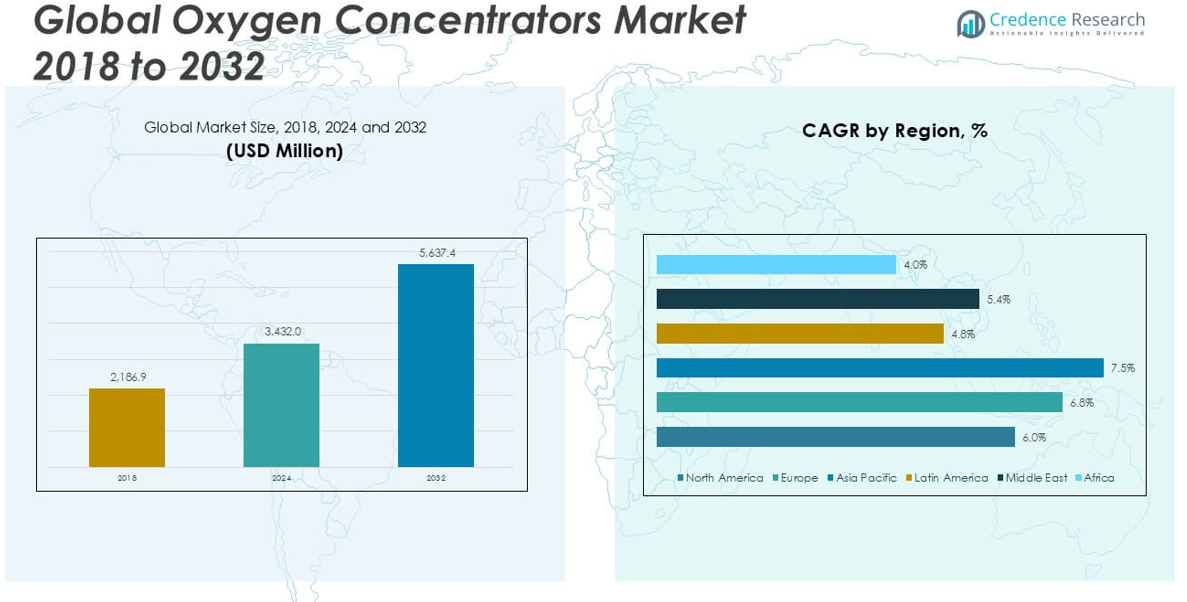
The Oxygen Concentrators Market size was valued at USD 2,186.9 million in 2018, reached USD 3,432.0 million in 2024, and is anticipated to reach USD 5,637.4 million by 2032, growing at a CAGR of 6.40% during the forecast period.
| REPORT ATTRIBUTE | DETAILS |
|---|---|
| Historical Period | 2020-2023 |
| Base Year | 2024 |
| Forecast Period | 2025-2032 |
| Oxygen Concentrators Market Size 2024 | USD 3,432.0 million |
| Oxygen Concentrators Market, CAGR | 6.40% |
| Oxygen Concentrators Market Size 2032 | USD 5,637.4 million |
The Oxygen Concentrators market is led by prominent players such as Philips Respironics, Inogen Inc., Drive DeVilbiss Healthcare, Invacare Corporation, CAIRE Inc., Nidek Medical, and ResMed, all competing through advanced product offerings and global reach. These companies focus on developing lightweight, portable, and energy-efficient oxygen concentrators to meet rising demand, particularly for homecare applications. North America is the leading region, holding approximately 36.5% of the global market share in 2024, driven by high adoption rates, advanced healthcare infrastructure, and increasing prevalence of chronic respiratory diseases. Europe and Asia Pacific follow, supported by growing awareness and improving healthcare accessibility.
Market Insights
- The Oxygen Concentrators market was valued at USD 2,186.9 million in 2018, reached USD 3,432.0 million in 2024, and is projected to reach USD 5,637.4 million by 2032, growing at a CAGR of 6.40% during the forecast period.
- The market is driven by the rising prevalence of chronic respiratory diseases, increasing demand for home-based oxygen therapy, and a growing aging population requiring long-term respiratory support.
- Key trends include the rapid adoption of portable oxygen concentrators due to their mobility and convenience, along with technological advancements focusing on compact, lightweight, and energy-efficient devices.
- The market is highly competitive, with major players like Philips Respironics, Inogen Inc., and CAIRE Inc. focusing on product innovation, strategic partnerships, and global expansion to strengthen their market positions.
- North America holds the largest regional share at approximately 36.5%, while the portable oxygen concentrators segment dominates the product category with around 60% share in 2024.
Market Segmentation Analysis:
By Product:
In the Oxygen Concentrators market, the Portable Oxygen Concentrators segment holds the dominant market share, accounting for approximately 60% in 2024. The growing preference for portable devices is driven by increasing demand for mobility among patients with chronic respiratory conditions. These devices offer greater convenience and independence, particularly for the aging population and individuals requiring long-term oxygen therapy. Continuous technological advancements, including lighter designs and longer battery life, further support segment growth. Additionally, the rising focus on home-based healthcare and post-operative recovery boosts the adoption of portable oxygen concentrators across global markets.
- For instance, Inogen’s G5 portable oxygen concentrator weighs only 2.2 kg and offers up to 13 hours of battery life on a double battery, significantly enhancing patient mobility.
By End User:
The Homecare segment leads the Oxygen Concentrators market, capturing nearly 65% of the market share in 2024. The rising shift towards home-based medical care, driven by the need to reduce hospital stays and lower healthcare costs, significantly fuels this segment. Patients with chronic obstructive pulmonary disease (COPD) and other long-term respiratory issues prefer homecare settings for comfort and convenience. Additionally, increasing awareness of home oxygen therapies and the growing availability of compact, user-friendly oxygen concentrators contribute to the segment’s dominance. The homecare trend is expected to continue expanding, especially in developed regions.
- For instance, Philips Respironics’ SimplyGo Mini, designed for home and portable use, provides a maximum oxygen output of 1,000 ml per minute, making it highly suitable for homecare patients requiring flexible oxygen therapy.
Market Overview
Rising Prevalence of Chronic Respiratory Diseases
The increasing prevalence of chronic respiratory diseases, such as Chronic Obstructive Pulmonary Disease (COPD), asthma, and pulmonary fibrosis, is a major driver of the Oxygen Concentrators market. These conditions often require long-term oxygen therapy, significantly boosting the demand for oxygen concentrators globally. The aging population, particularly in developed regions, is more susceptible to these ailments, further supporting market growth. Additionally, rising air pollution levels and tobacco use contribute to the growing incidence of respiratory disorders, which in turn drives the consistent need for oxygen therapy solutions.
- For instance, Drive DeVilbiss Healthcare’s 10L Compact Oxygen Concentrator can deliver up to 10 liters per minute of continuous oxygen flow, catering to patients with advanced respiratory conditions.
Growing Demand for Home-Based Healthcare
The global shift towards home-based healthcare is propelling the Oxygen Concentrators market forward. Patients and healthcare providers increasingly prefer oxygen therapy administered in home settings due to the cost-effectiveness, convenience, and improved patient comfort. Homecare oxygen concentrators are particularly beneficial for long-term treatment and chronic disease management. The preference for portable devices has risen alongside this trend, driven by the need for mobility and uninterrupted therapy. Government initiatives supporting home-based medical care further accelerate this segment, offering growth opportunities for manufacturers and service providers.
- For instance, CAIRE Inc.’s FreeStyle Comfort concentrator offers five pulse flow settings and operates at a sound level of only 43 decibels, making it ideal for quiet, home-based use.
Technological Advancements in Oxygen Concentrators
Continuous innovations in oxygen concentrator technology are significantly boosting market growth. Advances such as lighter, quieter, and more energy-efficient portable devices are increasing their adoption among both patients and healthcare professionals. Features like extended battery life, improved oxygen delivery systems, and smart connectivity for remote monitoring are enhancing patient outcomes and therapy compliance. These advancements not only improve the efficiency of oxygen therapy but also expand the usability of the devices across various settings, from homecare to emergency response, thereby widening the market scope.
Key Trends & Opportunities
Increasing Adoption of Portable Oxygen Concentrators
The growing demand for mobility and convenience is driving the widespread adoption of portable oxygen concentrators (POCs). These lightweight, compact devices are becoming the preferred choice for patients who require oxygen therapy during travel or daily activities. Manufacturers are focusing on improving portability, battery performance, and design aesthetics to cater to this trend. The expansion of travel and outdoor lifestyles among oxygen-dependent patients offers significant market opportunities, positioning POCs as a critical growth area within the overall oxygen concentrators market.
- For instance, ResMed’s Mobi portable oxygen concentrator offers up to 8.6 hours of battery life on a single charge and is FAA-approved for in-flight use, enabling patients to maintain therapy while traveling.
Expansion in Emerging Markets
Emerging economies in Asia-Pacific, Latin America, and the Middle East present lucrative growth opportunities for the Oxygen Concentrators market. Rapid urbanization, rising healthcare awareness, and improving medical infrastructure are fueling demand in these regions. Additionally, the growing middle-class population and increasing healthcare expenditure support wider adoption of oxygen therapy devices. Companies focusing on affordable, durable, and easy-to-use oxygen concentrators can capitalize on this untapped potential. Expanding distribution networks and local partnerships in these markets will further strengthen the growth trajectory.
- For instance, Longfian Scitech has expanded its presence in over 120 countries and offers the Jay-5AW model, which delivers up to 5 liters per minute and is widely adopted in emerging markets due to its low maintenance design and affordability.
Key Challenges
High Cost of Advanced Oxygen Concentrators
The high initial cost of technologically advanced oxygen concentrators presents a significant barrier to market growth, especially in low- and middle-income regions. Portable devices with extended battery life and smart features are often expensive, limiting accessibility for a large patient base. Although some healthcare systems and insurance plans provide reimbursement, out-of-pocket expenses remain a challenge for many. This cost sensitivity restricts wider adoption, particularly in emerging markets where price plays a critical role in purchase decisions.
Stringent Regulatory Approvals
Navigating the complex regulatory landscape is a major challenge for oxygen concentrator manufacturers. Regulatory bodies in different countries impose strict quality and safety standards, requiring extensive testing and lengthy approval processes. Delays in product launches and market entry often result from stringent compliance requirements. Additionally, manufacturers must continuously update their products to meet evolving regulatory norms, which increases operational costs. These regulatory hurdles can slow down the pace of innovation and limit the speed at which new technologies reach patients.
Limited Awareness in Developing Regions
A significant challenge for the Oxygen Concentrators market is the limited awareness and low diagnosis rates of chronic respiratory conditions in developing regions. Many patients remain undiagnosed or untreated due to lack of education, insufficient healthcare access, and inadequate screening programs. This directly impacts the demand for oxygen concentrators, as potential patients either do not recognize the need for therapy or cannot access the necessary medical resources. Increasing public health education and improving healthcare infrastructure are essential to overcoming this challenge.
Regional Analysis
North America
North America holds the largest share in the Oxygen Concentrators market, accounting for approximately 36.5% in 2024. The market size in the region grew from USD 852.9 million in 2018 to USD 1,252.7 million in 2024 and is projected to reach USD 1,871.6 million by 2032, expanding at a CAGR of 6.0%. The high prevalence of chronic respiratory diseases, well-established healthcare infrastructure, and growing demand for home-based oxygen therapy drive the regional market. Additionally, rising awareness and access to advanced oxygen concentrators contribute to North America’s continued market dominance.
Europe
Europe represents a significant share of approximately 26.0% in the Oxygen Concentrators market in 2024. The market size increased from USD 601.4 million in 2018 to USD 892.3 million in 2024 and is expected to reach USD 1,358.6 million by 2032, growing at a CAGR of 6.8%. Increasing adoption of portable oxygen concentrators and government-backed healthcare initiatives support market expansion. Additionally, the rising elderly population and growing incidence of respiratory ailments across European countries further fuel demand for oxygen therapy solutions, reinforcing the region’s strong position in the global market.
Asia Pacific
Asia Pacific is the fastest-growing region in the Oxygen Concentrators market, holding a market share of approximately 22.5% in 2024. The market surged from USD 419.9 million in 2018 to USD 772.2 million in 2024 and is anticipated to reach USD 1,567.2 million by 2032, registering a CAGR of 7.5%. Rapid urbanization, increasing air pollution, and a growing elderly population significantly drive market growth in countries like China, India, and Japan. Rising healthcare investments and growing awareness of respiratory care further strengthen Asia Pacific's position as a key growth region.
Latin America
Latin America captures a moderate share of approximately 5.0% in the Oxygen Concentrators market in 2024. The market grew from USD 105.0 million in 2018 to USD 171.6 million in 2024 and is projected to reach USD 327.0 million by 2032, progressing at a CAGR of 4.8%. Increasing respiratory disease cases, improving healthcare access, and the rising adoption of homecare medical devices drive the market. However, limited awareness and affordability constraints in some areas slow down market penetration. Despite these challenges, the region holds growth potential supported by gradual healthcare advancements.
Middle East
The Middle East holds a market share of approximately 6.4% in the Oxygen Concentrators market in 2024. The market size rose from USD 135.6 million in 2018 to USD 219.6 million in 2024 and is expected to reach USD 389.0 million by 2032, growing at a CAGR of 5.4%. Rising healthcare expenditure, an increasing prevalence of chronic diseases, and the growing adoption of advanced medical technologies are key growth drivers. Countries like the UAE and Saudi Arabia lead the regional market, supported by improving healthcare infrastructure and an expanding base of homecare oxygen therapy users.
Africa
Africa holds the smallest market share of approximately 4.0% in the Oxygen Concentrators market in 2024. The market expanded from USD 72.2 million in 2018 to USD 123.6 million in 2024 and is expected to reach USD 124.0 million by 2032, reflecting minimal growth with a CAGR of 4.0%. The market faces challenges such as limited healthcare access, low awareness, and financial constraints. Despite these barriers, rising efforts to improve healthcare infrastructure and increasing demand for affordable oxygen therapy solutions in key urban centers offer limited but steady growth opportunities in the region.
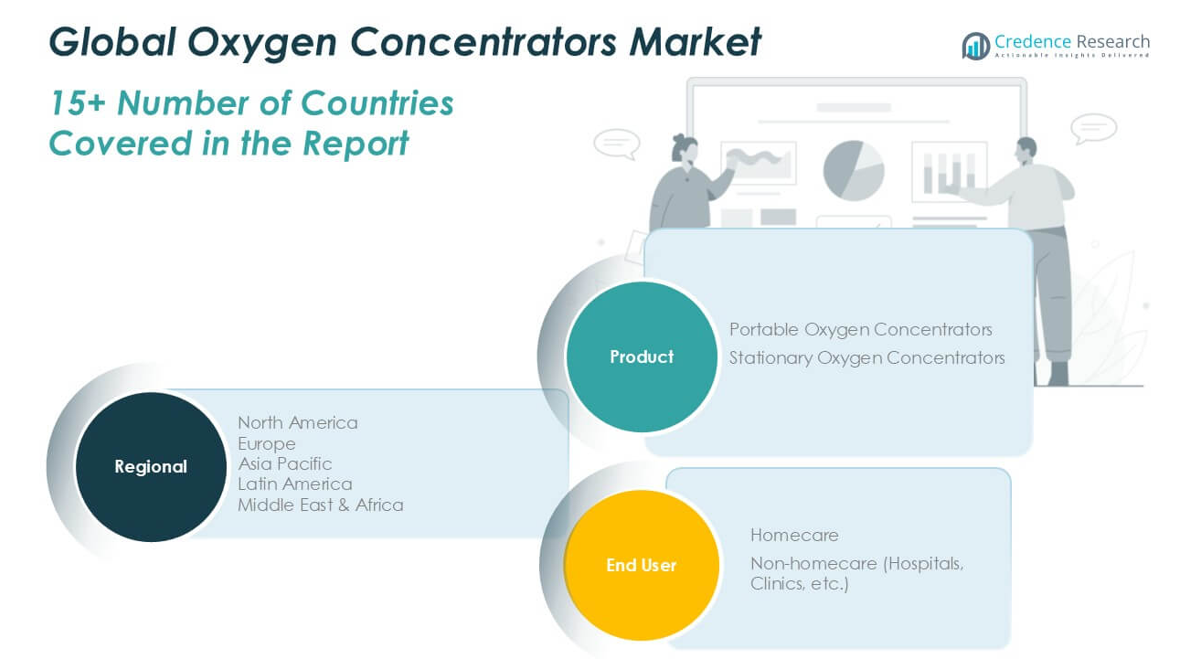
Market Segmentations:
By Product
- Portable Oxygen Concentrators
- Stationary Oxygen Concentrators
By End User
- Homecare
- Non-homecare (Hospitals, Clinics, etc.)
By Geography
- North America
- U.S.
- Canada
- Mexico
- Europe
- Germany
- France
- U.K.
- Italy
- Spain
- Rest of Europe
- Asia Pacific
- China
- Japan
- India
- South Korea
- South-east Asia
- Rest of Asia Pacific
- Latin America
- Brazil
- Argentina
- Rest of Latin America
- Middle East & Africa
- GCC Countries
- South Africa
- Rest of the Middle East and Africa
Competitive Landscape
The Oxygen Concentrators market is highly competitive, with key players focusing on innovation, product expansion, and strategic collaborations to strengthen their market positions. Leading companies such as Philips Respironics, Inogen Inc., Drive DeVilbiss Healthcare, and Invacare Corporation dominate the landscape through extensive product portfolios and global distribution networks. Continuous advancements in portable oxygen concentrator technologies and the integration of smart features are central to gaining a competitive edge. Companies like CAIRE Inc., Nidek Medical, and O2 Concepts are actively investing in research and development to deliver more compact, energy-efficient, and user-friendly devices. Strategic mergers, acquisitions, and partnerships are also shaping the market dynamics, enabling firms to expand their geographic presence and meet growing demand in emerging regions. Additionally, price competitiveness and after-sales service quality remain critical factors influencing customer preferences. As the market evolves, companies that effectively balance technological innovation with affordability and regulatory compliance are likely to secure long-term growth and competitive advantage.
Key Player Analysis
- Philips Respironics
- Inogen Inc.
- Drive DeVilbiss Healthcare
- Invacare Corporation
- CAIRE Inc.
- Nidek Medical
- O2 Concepts
- GCE Group
- Precision Medical Inc.
- Chart Industries
- Besco Medical
- ResMed
- Teijin Pharma
- Longfian Scitech
Recent Developments
- In October 2024, Inogen, Inc. launched Inogen Rove 4 Portable Oxygen Concentrator in the U.S. market. Offering innovative respiratory products for use in the homecare setting.
- In July 2023, VARON launched the VP-2 portable oxygen concentrator. This portable oxygen concentrator incorporates innovative technology and advanced features, aiming to provide efficient and reliable oxygen therapy to patients in need wherever they go.
- In February 2023, React Health acquired Invacare's Respiratory line, strengthening its market position and expanding its product offerings in the respiratory care segment.
- In January 2023, Inogen, Inc. received European Medical Device Regulation (EU MDR) certification from the British Standards Institution (BSI) for its portable oxygen concentrator products in the U.S. and EU markets.
- In February 2023, React Health, a company specializing in the development, manufacturing, and distribution of medical devices for treating sleep-disordered breathing and providing oxygen therapy, successfully acquired Invacare's Respiratory line. This strategic acquisition will enable React Health to further enhance its position in the market and expand its product portfolio to cater to a broader range of customers.
- In January 2023, CAIRE Inc., a global manufacturer of oxygen therapy and on-site generation systems, acquired MGC Diagnostics Holdings, Inc., a company headquartered in St. Paul, Minnesota. The acquisition strengthened CAIRE's presence and commitment to diagnostic technologies, further enhancing its proficiency in catering to patients at all stages of pulmonary disease progression.
Market Concentration & Characteristics
The Oxygen Concentrators Market demonstrates moderate to high market concentration, with a few key players holding significant shares and driving product innovation. It is characterized by strong competition among established companies focused on expanding their product portfolios and improving device portability, efficiency, and user convenience. The market favors companies that offer advanced, compact, and energy-efficient oxygen concentrators that meet the growing demand for homecare solutions. Pricing, regulatory approvals, and technological differentiation strongly influence buyer decisions. It is shaped by a rising preference for portable devices, steady technological advancements, and increasing awareness of respiratory care solutions in both developed and emerging regions. The market continues to see expansion driven by aging populations, chronic disease prevalence, and the growing shift toward home-based healthcare. Companies compete through strategic partnerships, geographical expansion, and robust after-sales support to secure customer loyalty. The Oxygen Concentrators Market remains sensitive to regulatory changes, pricing pressures, and patient preferences for mobility and ease of use.
Report Coverage
The research report offers an in-depth analysis based on Product, End User and Geography. It details leading market players, providing an overview of their business, product offerings, investments, revenue streams, and key applications. Additionally, the report includes insights into the competitive environment, SWOT analysis, current market trends, as well as the primary drivers and constraints. Furthermore, it discusses various factors that have driven market expansion in recent years. The report also explores market dynamics, regulatory scenarios, and technological advancements that are shaping the industry. It assesses the impact of external factors and global economic changes on market growth. Lastly, it provides strategic recommendations for new entrants and established companies to navigate the complexities of the market.
Future Outlook
- The Oxygen Concentrators market is expected to experience steady growth driven by the rising incidence of chronic respiratory diseases.
- The demand for portable oxygen concentrators will continue to increase due to patient preference for mobility and home-based therapy.
- Technological advancements will focus on lighter, quieter, and energy-efficient devices to improve user convenience.
- Asia Pacific will emerge as a key growth region supported by improving healthcare infrastructure and increasing disease awareness.
- Market players are likely to expand their global presence through strategic partnerships and distribution agreements.
- The adoption of smart oxygen concentrators with remote monitoring capabilities is expected to grow in the coming years.
- Government initiatives promoting home healthcare will further support the expansion of the oxygen concentrators market.
- Price sensitivity in developing regions may drive demand for low-cost, durable, and easy-to-use devices.
- The market will face regulatory challenges requiring continuous product updates and compliance with safety standards.
- Companies will focus on after-sales service and technical support to strengthen customer loyalty and competitive positioning.

Request a Free Sample
Fill in your details and we'll send you a free sample report.
- Sample data tables & charts
- Research methodology
Need a Custom Version of This Report?
Tailor the scope, geography, or segments to your exact requirements.
- Custom geography or segment scope
- Direct access to our analyst team
Frequently Asked Questions
What was the market size of the Global Oxygen Concentrators Market in 2023, and what is its expected size by 2032?
What are the main factors driving the growth of the Oxygen Concentrators Market?
Which regions dominate the Oxygen Concentrators Market and why?
Who are the key players operating in the Global Oxygen Concentrators Market?
Table of Content
Chapter 1. Report Introduction
- 1.1 Report Description & Purpose
- 1.1.1 Report Title & Market Definition
- 1.1.2 Unique Selling Propositions (USP) & Key Differentiators
- 1.1.3 Value Proposition for Stakeholders
- 1.2 Research Objectives
- 1.2.1 Market Sizing Objectives (Volume & Revenue)
- 1.2.2 Segmentation Objectives
- 1.2.3 Competitive Intelligence Objectives
- 1.2.4 Forecast & Scenario Objectives
- 1.3 Report Scope
- 1.3.1 Oxygen Concentrators Scope – Types & Subtypes Covered
- 1.3.2 Geographic Scope – Regions & Countries Covered
- 1.3.3 Historical Period, Base Year & Forecast Period (2024; forecast to 2032)
- 1.3.4 Inclusions & Exclusions
- 1.4 HS Code & Classification Framework
- 1.5 Currency, Units & Pricing Basis
- 1.6 Target Stakeholders
- 1.7 Limitations & Assumptions
Chapter 2. Executive Summary
- 2.1 Global Oxygen Concentrators Market Snapshot
- 2.1.1 Market Size – Historical (2024) & Forecast (2024-2032) (2024: USD 3,432.0 million → 2032: USD 5,637.4 million)
- 2.1.2 Volume & Revenue – Global Totals
- 2.1.3 Key Market Highlights – Top Five Facts
- 2.2 Oxygen Concentrators Market Segmentation Snapshot
- 2.2.1 Market Split by Region – 2024 vs. 2032
- 2.3 Competitive Snapshot
- 2.3.1 Top 10 Players by Revenue Share – 2024
- 2.3.2 Top 10 Players by Volume Share – 2024
- 2.3.3 Recent Strategic Developments (18-Month Summary)
- 2.4 Key Investment Highlights & Strategic Conclusions
Chapter 3. Oxygen Concentrators Market Dynamics & Industry Analysis
- 3.1 Market Overview & Context
- 3.1.1 Oxygen Concentrators Market Position in the Broader Automotive Value Chain
- 3.1.2 OEM vs. Replacement Market Dynamics
- 3.1.3 Market Maturity & Development Stage by Region
- 3.2 Oxygen Concentrators Market Drivers
- 3.3 Oxygen Concentrators Market Restraints & Challenges
- 3.4 Oxygen Concentrators Market Opportunities
- 3.5 Porter's Five Forces Analysis
- 3.5.1 Threat of New Entrants
- 3.5.2 Bargaining Power of Suppliers
- 3.5.3 Bargaining Power of Buyers
- 3.5.4 Threat of Substitutes
- 3.5.5 Competitive Rivalry – Intensity Assessment
- 3.6 Oxygen Concentrators Value Chain Analysis
- 3.6.1 Upstream – Raw Material/Input Suppliers
- 3.6.1.1 Raw Material/Input 1
- 3.6.1.2 Raw Material/Input 2
- 3.6.1.3 Raw Material/Input 3
- 3.6.2 Midstream – Production/Manufacturing/Service Delivery
- 3.6.2.1 Production/Process Overview
- 3.6.2.2 Key Facility Locations & Capacity by Manufacturer
- 3.6.3 Downstream – Distribution & End Consumer
- 3.6.3.1 Primary Channel – B2B/OEM
- 3.6.3.2 Secondary Channels – Dealer, Retail, Online, Direct
- 3.6.4 Value Chain Profitability Analysis
- 3.6.1 Upstream – Raw Material/Input Suppliers
- 3.7 PESTEL Analysis
- 3.7.1 Political Factors
- 3.7.2 Economic Factors
- 3.7.3 Social Factors
- 3.7.4 Technological Factors
- 3.7.5 Environmental Factors
- 3.7.6 Legal Factors
- 3.8 Oxygen Concentrators Supply Chain Analysis
- 3.8.1 Raw Material/Input Supply Risk Assessment
- 3.8.2 Manufacturing Concentration Risk (Geographic Exposure)
- 3.8.3 Trade Disruption Impact Analysis
- 3.9 Regulatory & Policy Landscape
Note: The regulatory and policy landscape section covers regulations based on their applicability to the market, Oxygen Concentrators category, geography, and scope of the study. Only regulatory frameworks with a material impact on operations, compliance, trade, sustainability, or market access are analyzed in detail.
Chapter 4. Key Investment Pockets & Opportunity Analysis
- 4.1 Oxygen Concentrators Market Attractiveness Analysis
- 4.1.1 By Region – Investment Attractiveness Matrix (Volume × CAGR)
- 4.2 Absolute Revenue Growth Opportunity
- 4.2.1 By Region – Absolute USD Growth Through 2032
- 4.3 Incremental Volume Opportunity
- 4.3.1 By Region – Incremental Volume Through 2032
- 4.3.2 Segment – Incremental Volume
- 4.4 Emerging Submarket Opportunity Deep Dive (Subject to Applicability)
- 4.5 Emerging Market Opportunity Scorecards
- 4.5.1 United States
- 4.5.2 Europe
- 4.5.3 Asia
- 4.5.4 Middle East & Africa
Note: Emerging Market Opportunity Scorecards will be included based on relevance and strategic importance. Regions listed are indicative and may vary depending on data availability and market dynamics.
Chapter 5. Oxygen Concentrators Import-Export Analysis & Trade Flows
- 5.1 Global Trade Overview
- 5.1.1 Global Export Value by Country (2024)
- 5.1.2 Global Export Volume by Country (2024)
- 5.1.3 Global Import Value by Country (2024)
- 5.1.4 Global Import Volume by Country (2024)
- 5.1.5 Net Trade Balance by Country (2024)
- 5.2 Export Analysis – Segment
- 5.2.1 Type 1 (HS Code)
- 5.2.2 Type 2 (HS Code)
- 5.2.3 Type 3 (HS Code)
- 5.2.4 Type 4 (HS Code)
- 5.2.5 Type 5 (HS Code)
- 5.3 Import Analysis – Segment
- 5.3.1 Type 1 (HS Code)
- 5.3.2 Type 2 (HS Code)
- 5.3.3 Type 3 (HS Code)
- 5.3.4 Type 4 (HS Code)
- 5.3.5 Type 5 (HS Code)
- 5.4 Average Unit Trade Prices
- 5.4.1 Average Export Price – Segment & Country
- 5.4.2 Average Import Price – Segment & Source Country
- 5.4.3 Price Trends (2024)
- 5.5 Key Trade Route Analysis
- 5.5.1 Trade Route 1
- 5.5.2 Trade Route 2
- 5.5.3 Trade Route 3
- 5.5.4 Trade Route 4
- 5.5.5 Trade Route 5
- 5.6 Trade Policy Impact Assessment
- 5.6.1 US Anti-Dumping & Section 301 Tariffs
- 5.6.2 EU Customs Union Impact
- 5.6.3 Major Free Trade Agreements
- 5.6.4 USMCA Rules of Origin
Note: Trade policy analysis will be included only where relevant to the Oxygen Concentrators market.
Chapter 6. Competitive Landscape & Company Benchmarking
- 6.1 Oxygen Concentrators Market Concentration & Structure
- 6.1.1 Herfindahl-Hirschman Index (HHI) – vs. 2024
- 6.1.2 Tier 1, Tier 2 & Tier 3 Market Structure
- 6.1.3 Global, Regional & Local Player Dynamics
- 6.2 Oxygen Concentrators Market Share Analysis – 2024
- 6.2.1 Global Revenue Share by Company
- 6.2.2 Global Volume Share by Company
- 6.2.3 Regional Revenue Share
- 6.2.4 Market Share Evolution ( vs. 2024)
- 6.2.5 OEM Segment Share by Company
- 6.2.6 Replacement Segment Share by Company
- 6.3 Production/Delivery Capacity & Facility Analysis
- 6.3.1 Global Installed Capacity
- 6.3.2 Capacity Utilization Rates
- 6.3.3 Production/Output Volume
- 6.3.4 Facility Locations & Capacity Map
- 6.3.5 Planned Capacity Additions
- 6.4 Oxygen Concentrators Competitive Benchmarking Matrix
- 6.4.1 Revenue, Volume, CAGR & Profitability Comparison
- 6.4.2 Channel Revenue Mix
- 6.4.3 Geographic Revenue Exposure
- 6.4.4 R&D Intensity
- 6.4.5 Sustainability Maturity
- 6.5 Strategic Developments in Oxygen Concentrators (Last 24 Months)
- 6.5.1 Mergers, Acquisitions & Divestments
- 6.5.2 New Oxygen Concentrators Launches
- 6.5.3 Facility Expansions
- 6.5.4 Strategic Alliances, Joint Ventures & Partnerships
- 6.5.5 Distribution Expansion & Market Entry
- 6.5.6 Sustainability & ESG Initiatives
- 6.6 Competitive Strategy Mapping
- 6.6.1 Leader, Challenger, Follower & Niche Classification
- 6.6.2 Pricing Strategy Comparison
- 6.6.3 Channel Strategy Matrix
Note: Strategic developments are included based on their materiality and the availability of reliable information.
Chapter 7. Global Oxygen Concentrators Market – By Distribution Channel
- 7.1 Segment Overview
- 7.1.1 Volume & Revenue Split by Channel (2024 & 2032)
- 7.1.2 Channel Mix Evolution (2024-2032)
Chapter 8. Regional Market Analysis – Global Overview
- 8.1 Global Regional Overview
- 8.1.1 Regional Volume Share
- 8.1.2 Regional Revenue Share
- 8.1.3 Regional Volume by Region
- 8.1.4 Regional Revenue by Region
- 8.1.5 Regional Forecast Through 2032
- 8.2 Cross-Regional Segment Analysis
- 8.2.1 By Distribution Channel
- 8.2.2 By Brand/Price Tier
Chapter 9. North America Oxygen Concentrators Market
- 9.1 United States
- 9.2 Canada
- 9.3 Mexico
Chapter 10. Europe Oxygen Concentrators Market
- 10.1 Germany
- 10.2 France
- 10.3 Italy
- 10.4 United Kingdom
- 10.5 Spain
- 10.6 Poland
- 10.7 Russia
- 10.8 Netherlands
- 10.9 Belgium
- 10.10 Sweden
- 10.11 Denmark
- 10.12 Norway
- 10.13 Rest of Europe
Chapter 11. Asia Pacific Oxygen Concentrators Market
- 11.1 China
- 11.2 India
- 11.3 Japan
- 11.4 South Korea
- 11.5 Thailand
- 11.6 Indonesia
- 11.7 Vietnam
- 11.8 Malaysia
- 11.9 Australia
- 11.10 Rest of Asia Pacific
Chapter 12. Latin America Oxygen Concentrators Market
- 12.1 Brazil
- 12.2 Argentina
- 12.3 Colombia
- 12.4 Chile
- 12.5 Rest of Latin America
Chapter 13. Middle East Oxygen Concentrators Market
- 13.1 Saudi Arabia
- 13.2 United Arab Emirates
- 13.3 Turkey
- 13.4 Israel
- 13.5 Iran
- 13.6 Rest of the Middle East
Chapter 14. Africa Oxygen Concentrators Market
- 14.1 South Africa
- 14.2 Egypt
- 14.3 Nigeria
- 14.4 Morocco
- 14.5 Rest of Africa
Chapter 15. Oxygen Concentrators Company Profiles
- 15.1 [Company 01]
- 15.1.1 Company Overview
- 15.1.2 Key Management Personnel
- 15.1.3 Products & Services Portfolio
- 15.1.4 Financial Performance
- 15.1.5 Key Market Focus & Geographic Presence
- 15.1.6 Recent Developments & Strategic Initiatives
Note: The company profile list is preliminary and may change based on research findings, market developments, data availability, and client requirements.
Chapter 16. Appendices
- Appendix A – List of Abbreviations & Acronyms
- Appendix B – Industry Classification Code Reference – Full Series
- Appendix C – Production & Capacity Data Tables
- Appendix D – End-Use & Demand Base Tables
- Appendix E – Consumption & Replacement Rate Assumptions
- Appendix F – ASP Reference Tables
- Appendix G – Manufacturing & Facility Database
- Appendix H – Import-Export Data Tables
- Appendix I – Regulatory Summary Tables
- Appendix J – Primary Research Participant List (Anonymized)
- Appendix K – Primary Research Questionnaire Framework
- Appendix L – Data Sources & Bibliography
- Appendix M – Market Size Divergence & Source Comparison
Chapter 17. Research Methodology
- 17.1 Research Framework & Philosophy
- 17.2 Secondary Research – Sources, Hierarchy & Data Extraction
- 17.3 Data Modeling – Bottom-Up & Top-Down Market Sizing
- 17.4 Primary Research – Stakeholder Framework, LOI & Sample Sizes
- 17.5 Forecast Methodology – Regression, Scenario & Sensitivity Analysis
- 17.6 Quality Control – Four-Layer Validation Framework
- 17.7 Limitations & Standard Assumptions
- 17.8 Disclaimer