Market Overview:
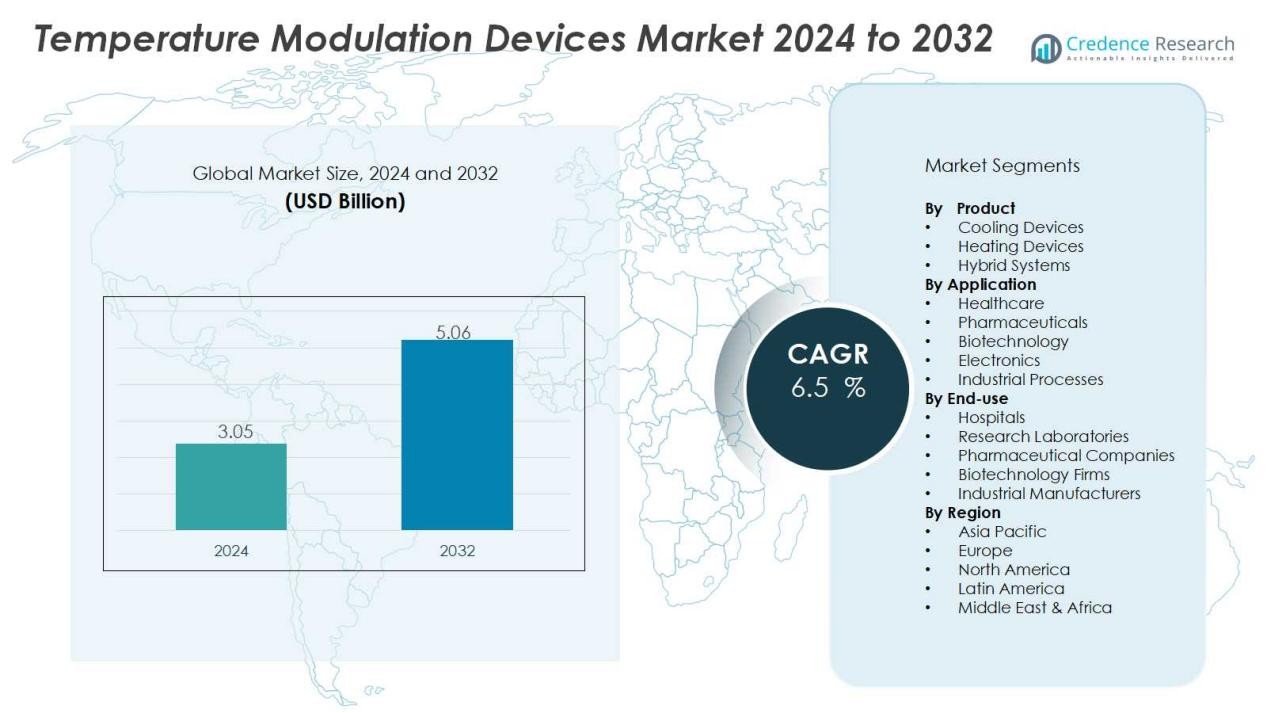
The temperature modulation devices market size was valued at USD 3.05 billion in 2024 and is anticipated to reach USD 5.06 billion by 2032, at a CAGR of 6.5% during the forecast period.
| REPORT ATTRIBUTE | DETAILS |
|---|---|
| Historical Period | 2020-2023 |
| Base Year | 2024 |
| Forecast Period | 2025-2032 |
| Temperature Modulation Devices Market Size 2024 | USD 3.05 Billion |
| Temperature Modulation Devices Market, CAGR | 6.5 % |
| Temperature Modulation Devices Market Size 2032 | USD 5.06 Billion |
Key growth drivers include increasing adoption in medical devices, pharmaceutical storage, and biotechnology research. Advancements in thermal management technologies, coupled with growing investments in healthcare infrastructure, further enhance adoption. The market also benefits from rising demand in electronics manufacturing, laboratory applications, and energy systems where reliable temperature regulation is critical.
Regionally, North America leads the market, supported by advanced healthcare facilities, strong R&D investments, and established industry players. Europe follows closely, driven by stringent regulatory standards, technological adoption, and strong pharmaceutical demand. Asia-Pacific is expected to record the fastest growth, fueled by rapid industrialization, healthcare expansion, and increasing R&D activities in countries like China, India, and Japan. Meanwhile, Latin America and the Middle East & Africa show emerging opportunities as infrastructure modernization and healthcare investments continue to grow.
Market Insights:
- The temperature modulation devices market was valued at USD 3.05 billion in 2024 and is projected to reach USD 5.06 billion by 2032, growing at a CAGR of 6.5%.
- Rising demand in healthcare applications such as diagnostics, blood storage, cryotherapy, and organ preservation drives adoption.
- Pharmaceutical and biotechnology sectors rely on precise temperature control for vaccine preservation, genetic research, and drug development.
- Electronics and industrial manufacturing depend on advanced systems to ensure reliability in semiconductor fabrication and cleanroom processes.
- High upfront costs, complex installations, and maintenance needs create barriers in smaller facilities and developing economies.
- North America led with 38% share in 2024, supported by advanced healthcare infrastructure and strong R&D investments.
- Asia-Pacific is set to grow fastest, driven by industrialization, healthcare expansion, and increasing research activities in China, India, and Japan.
Market Drivers:
Rising Demand for Precision in Healthcare Applications:
The temperature modulation devices market benefits from increasing adoption in healthcare settings. Hospitals and laboratories require accurate thermal control for diagnostics, blood storage, and advanced treatment equipment. It ensures reliability in processes such as cryotherapy and organ preservation. The growing incidence of chronic diseases further strengthens demand for these devices in patient care and life sciences.
- For instance, Johns Hopkins biomedical engineering students developed a non-invasive ParaMetric sensor in May 2024 that can measure a patient's core body temperature in 63 seconds, significantly improving emergency care protocols.
Expanding Role in Pharmaceutical and Biotechnology Research:
Pharmaceutical and biotechnology companies rely heavily on precise temperature control for drug development and storage. The temperature modulation devices market supports critical applications, including vaccine preservation and genetic research. It addresses strict regulatory standards on stability and safety, ensuring product quality throughout the supply chain. Growing investments in biopharma R&D accelerate the need for advanced temperature solutions.
- For Instance, Pfizer and BioNTech’s COVID-19 vaccine initially required ultra-low temperature storage, typically between -80°C and -60°C, presenting a major logistical challenge for distribution.
Growing Importance in Electronics and Industrial Manufacturing:
Industrial and electronics manufacturing sectors drive demand for advanced thermal management solutions. The temperature modulation devices market plays a vital role in ensuring consistent performance of sensitive components. It supports semiconductor fabrication, cleanroom operations, and chemical processing where controlled environments are essential. Rising focus on energy efficiency and operational safety boosts deployment across these industries.
Rising Investments in Infrastructure and Technology Advancements:
Government initiatives and private sector investments are strengthening infrastructure for healthcare and research globally. The temperature modulation devices market benefits from this momentum, supported by technology upgrades and automation. It leverages digital integration and IoT-based monitoring for improved accuracy and remote control. Growing awareness of energy-efficient solutions enhances adoption, particularly in emerging economies.
Market Trends:
Integration of Smart Technologies and Connected Systems:
The temperature modulation devices market is witnessing a strong shift toward digital integration and smart connectivity. Manufacturers are embedding IoT-enabled sensors, AI-based controls, and real-time monitoring features to improve precision and reliability. It allows healthcare providers and research labs to remotely track performance, ensuring compliance with safety standards. The demand for automation in pharmaceutical storage, laboratory operations, and industrial manufacturing accelerates this adoption. Integration with cloud platforms also supports predictive maintenance and reduces downtime. These advancements enhance operational efficiency while meeting the rising need for transparency and accountability across industries.
- For Instance, Thermo Fisher Scientific provides remote monitoring for its laboratory equipment, including chillers, through systems such as Smart-Vue Pro and the InstrumentConnect platform, enabling continuous monitoring and remote diagnostics.
Focus on Energy Efficiency and Sustainable Solutions:
The temperature modulation devices market is shaped by the growing focus on eco-friendly and energy-efficient technologies. Companies are investing in designs that reduce energy consumption while maintaining performance accuracy. It supports sustainability goals of healthcare, biopharma, and electronics sectors that face increasing regulatory pressures. Adoption of recyclable materials and low-emission cooling systems reflects this commitment. Global demand for green technology solutions pushes suppliers to innovate in compact and efficient models. Customers now prioritize devices that lower operational costs while aligning with environmental objectives. This trend strengthens the long-term positioning of advanced thermal management solutions.
- For instance, in May 2024, Panasonic Healthcare released its MDF-DU702VH-PE VIP ECO freezer, featuring a recyclable vacuum insulation panel and reducing CO2 emissions by 43 kg annually in typical lab use.
Market Challenges Analysis:
High Costs and Complex Installation Requirements:
The temperature modulation devices market faces challenges related to high upfront costs and complex installation processes. Advanced systems require specialized infrastructure and trained personnel, limiting adoption in smaller facilities. It creates barriers for developing economies where healthcare and industrial budgets remain constrained. The expense of maintenance and calibration further adds to operational challenges. Limited awareness among end users also slows investment in innovative solutions. These factors restrict broader penetration across cost-sensitive markets.
Regulatory Compliance and Technical Limitations:
Strict regulatory standards pose another significant challenge for the temperature modulation devices market. Compliance with healthcare, pharmaceutical, and industrial safety regulations demands continuous testing and certification. It increases costs for manufacturers and extends product development timelines. Technical limitations such as power consumption, system integration issues, and inconsistent performance under extreme conditions add to the difficulties. Supply chain disruptions and component shortages further affect timely product availability. These obstacles hinder rapid scaling of advanced solutions across industries.
Market Opportunities:
Expansion in Emerging Economies and Healthcare Infrastructure:
The temperature modulation devices market holds strong opportunities in emerging economies where healthcare infrastructure is expanding rapidly. Rising government investments in hospitals, laboratories, and pharmaceutical facilities increase the demand for advanced temperature solutions. It enables providers to improve patient care, drug storage, and research outcomes. The growing medical tourism industry in Asia-Pacific and the Middle East further supports adoption. Affordable models tailored for cost-sensitive regions can accelerate penetration. These markets create long-term growth potential for global manufacturers.
Growth Through Technological Innovation and Industry Collaboration:
Innovation in IoT-enabled, AI-driven, and energy-efficient systems creates new opportunities for the temperature modulation devices market. It helps industries achieve precision, reduce energy costs, and comply with environmental regulations. Partnerships between manufacturers, research institutions, and healthcare providers foster product development and customized solutions. Rising demand from biotechnology, semiconductor, and food processing sectors broadens application scope. Integration with remote monitoring platforms strengthens value propositions for end users. These advancements open pathways for differentiation and competitive advantage across global markets.
Market Segmentation Analysis:
By Product:
The temperature modulation devices market is segmented into cooling devices, heating devices, and hybrid systems. Cooling devices dominate demand, driven by applications in healthcare diagnostics, biotechnology research, and semiconductor manufacturing. It ensures precision in maintaining sample integrity and sensitive component stability. Heating devices support processes in pharmaceutical testing, food processing, and industrial laboratories. Hybrid systems, offering both cooling and heating functions, are gaining traction for multi-application environments. Rising preference for compact and energy-efficient models supports adoption across industries.
- For Instance, Memmert GmbH manufactures the IF260m heating incubator, which offers a temperature setting accuracy of 0.1 °C within a range of +20 to +80 °C. As a Class I medical device, it is used in the medical and pharmaceutical fields for applications such as warming infusion solutions
By Application:
The market covers applications in healthcare, pharmaceuticals, biotechnology, electronics, and industrial processes. Healthcare remains the leading application area due to strong reliance on thermal control for patient care and laboratory needs. It plays a key role in preserving blood, vaccines, and biological samples. The pharmaceutical and biotechnology sectors demand advanced systems for drug development and genetic engineering. Electronics manufacturing depends on precise temperature control to protect semiconductors and critical components. Industrial use spans cleanrooms, chemical processing, and food preservation.
- For Instance, Haier Biomedical offers the ultra-low temperature freezer model DW-86L578, which provides reliable storage at -86°C for up to 578 liters of vaccines and biologicals in major hospitals.
By End Use:
The temperature modulation devices market serves hospitals, research laboratories, pharmaceutical companies, biotechnology firms, and industrial manufacturers. Hospitals and labs remain the largest end users, supported by rising investments in healthcare infrastructure. It contributes significantly to the safety and efficiency of diagnostic and therapeutic systems. Pharmaceutical and biotechnology companies depend on advanced devices for research and large-scale production. Industrial users adopt these solutions to ensure quality control, safety, and regulatory compliance. Expansion of end-user industries supports long-term market growth.
Segmentations:
By Product:
- Cooling Devices
- Heating Devices
- Hybrid Systems
By Application:
- Healthcare
- Pharmaceuticals
- Biotechnology
- Electronics
- Industrial Processes
By End Use:
- Hospitals
- Research Laboratories
- Pharmaceutical Companies
- Biotechnology Firms
- Industrial Manufacturers
By Region:
- North America
- U.S.
- Canada
- Mexico
- Europe
- Germany
- France
- U.K.
- Italy
- Spain
- Rest of Europe
- Asia Pacific
- China
- Japan
- India
- South Korea
- South-east Asia
- Rest of Asia Pacific
- Latin America
- Brazil
- Argentina
- Rest of Latin America
- Middle East & Africa
- GCC Countries
- South Africa
- Rest of the Middle East and Africa
Regional Analysis:
North America:
North America held 38% market share in the temperature modulation devices market in 2024. The region benefits from advanced healthcare infrastructure and strong investments in biotechnology and pharmaceutical research. It is supported by early adoption of smart technologies, regulatory compliance, and established industry players. Hospitals and research labs in the United States lead demand for precision thermal control systems. Canada also contributes through expanding healthcare access and medical research facilities. Continuous funding in clinical trials and technological innovation strengthens the regional outlook.
Europe:
Europe accounted for 29% market share in the temperature modulation devices market in 2024. The region emphasizes compliance with strict regulatory frameworks and sustainability standards. It supports adoption of eco-friendly and energy-efficient solutions across healthcare, life sciences, and manufacturing. Germany, France, and the United Kingdom lead demand through strong pharmaceutical industries and R&D investments. It is further boosted by modernization of hospitals and laboratories across the region. Partnerships between manufacturers and academic institutions encourage innovation and localized product development.
Asia-Pacific
Asia-Pacific captured 24% market share in the temperature modulation devices market in 2024. The region shows the fastest growth driven by rapid industrialization and healthcare expansion. China, India, and Japan lead demand with large patient pools, pharmaceutical hubs, and rising medical tourism. It benefits from government funding, private investments, and increasing focus on research capabilities. Latin America and the Middle East & Africa also display steady adoption supported by infrastructure upgrades. Growing awareness of advanced medical and industrial equipment fosters opportunities across these emerging regions.
Key Player Analysis:
- 3M Company
- Smiths Medical
- Stryker Corporation
- ThermoTek, Inc.
- Geratherm Medical AG
- Medtronic
- Enthermics
- Althera
- Belmont Instrument
Competitive Analysis:
The temperature modulation devices market is highly competitive, with global and regional players driving innovation. Key companies include 3M Company, Smiths Medical, Stryker Corporation, ThermoTek, Inc., ZOLL Medical Corporation, Geratherm Medical AG, and Medtronic. These firms focus on expanding product portfolios, advancing digital integration, and improving energy efficiency to strengthen market presence. It is shaped by continuous investments in research and development, enabling the introduction of precise and connected solutions. Strategic collaborations with healthcare providers and research institutions enhance adoption across critical applications. Companies also prioritize compliance with regulatory standards and sustainability goals, ensuring long-term competitiveness. Strong distribution networks and targeted partnerships support deeper penetration into emerging markets.
Recent Developments:
- In September 2025, Stryker expanded its R&D footprint with the opening of a new facility in India, highlighting its commitment to global innovation.
- In October 2024, ZOLL Medical Corporation closed the acquisition of select ventilator product lines from Vyaire Medical, including bellavista®, fabian®, LTV®, and 3100 HFOV ventilators, enhancing its critical care respiratory offerings.
Report Coverage:
The research report offers an in-depth analysis based on Product, Application, End Use and Region. It details leading Market players, providing an overview of their business, product offerings, investments, revenue streams, and key applications. Additionally, the report includes insights into the competitive environment, SWOT analysis, current Market trends, as well as the primary drivers and constraints. Furthermore, it discusses various factors that have driven Market expansion in recent years. The report also explores Market dynamics, regulatory scenarios, and technological advancements that are shaping the industry. It assesses the impact of external factors and global economic changes on Market growth. Lastly, it provides strategic recommendations for new entrants and established companies to navigate the complexities of the Market.
Future Outlook:
- Growing demand for advanced thermal management solutions will continue to support expansion of the temperature modulation devices market.
- Healthcare applications such as diagnostics, cryotherapy, and organ preservation will remain major growth drivers.
- Pharmaceutical and biotechnology sectors will increase reliance on precision systems for drug storage and genetic research.
- Integration of IoT-enabled sensors and AI-driven controls will improve accuracy, monitoring, and efficiency.
- Energy-efficient and eco-friendly models will gain traction as sustainability regulations tighten globally.
- Industrial sectors including electronics and semiconductor manufacturing will expand adoption of temperature modulation solutions.
- Remote monitoring and predictive maintenance capabilities will enhance user confidence and operational reliability.
- Emerging economies will offer growth potential due to healthcare expansion and rising investments in R&D.
- Collaborations between manufacturers, research institutions, and healthcare providers will accelerate innovation and customized offerings.
- Rising competition will push companies to focus on product differentiation, affordability, and broader global reach.

Request a Free Sample
Fill in your details and we'll send you a free sample report.
- Sample data tables & charts
- Research methodology
Need a Custom Version of This Report?
Tailor the scope, geography, or segments to your exact requirements.
- Custom geography or segment scope
- Direct access to our analyst team
Frequently Asked Questions
What is the current market size for the Temperature Modulation Devices Market, and what is its projected size in 2032?
At what Compound Annual Growth Rate is the Temperature Modulation Devices Market projected to grow between 2024 and 2032?
Which Temperature Modulation Devices Market segment held the largest share in 2024?
What are the primary factors fueling the growth of the Temperature Modulation Devices Market?
Who are the leading companies in the Temperature Modulation Devices Market?
Which region commanded the largest share of the Temperature Modulation Devices Market in 2024?
Table of Content
Chapter 1. Report Introduction
- 1.1 Report Description & Purpose
- 1.1.1 Report Title & Market Definition
- 1.1.2 Unique Selling Propositions (USP) & Key Differentiators
- 1.1.3 Value Proposition for Stakeholders
- 1.2 Research Objectives
- 1.2.1 Market Sizing Objectives (Volume & Revenue) (Volume Where Applicable)
- 1.2.2 Segmentation Objectives
- 1.2.3 Competitive Intelligence Objectives
- 1.2.4 Forecast & Scenario Objectives
- 1.3 Report Scope
- 1.3.1 Temperature Modulation Devices Scope – Segments & Subsegments Covered
- 1.3.2 Geographic Scope – Regions & Countries Covered
- 1.3.3 Historical Period, Base Year & Forecast Period (2024; forecast to 2032)
- 1.3.4 Inclusions & Exclusions
- 1.4 Industry Classification & Applicable Codes
- 1.5 Currency, Measurement Units & Valuation Basis
- 1.6 Target Stakeholders
- 1.7 Limitations & Assumptions
Chapter 2. Executive Summary
- 2.1 Global Temperature Modulation Devices Market Snapshot
- 2.1.1 Market Size – Historical (2024) & Forecast (2024-2032) (2024: USD 3.05 billion → 2032: USD 5.06 billion)
- 2.1.2 Volume & Revenue – Global Totals (Volume Where Applicable)
- 2.1.3 Key Market Highlights – Top Five Facts
- 2.2 Temperature Modulation Devices Market Segmentation Snapshot
- 2.2.1 Market Split by Region – 2024 vs. 2032
- 2.3 Competitive Snapshot
- 2.3.1 Top 10 Players by Revenue Share – 2024
- 2.3.2 Top 10 Players by Volume Share – 2024 (Volume Where Applicable)
- 2.3.3 Recent Strategic Developments (18-Month Summary)
- 2.4 Key Investment Highlights & Strategic Conclusions
Chapter 3. Temperature Modulation Devices Market Dynamics & Industry Analysis
- 3.1 Market Overview & Context
- 3.1.1 Temperature Modulation Devices Market Position in the Broader Industry Value Chain
- 3.1.2 Demand Structure & Purchasing Dynamics
- 3.1.3 Market Maturity & Development Stage by Region
- 3.2 Temperature Modulation Devices Market Drivers
- 3.3 Temperature Modulation Devices Market Restraints & Challenges
- 3.4 Temperature Modulation Devices Market Opportunities
- 3.5 Porter's Five Forces Analysis
- 3.5.1 Threat of New Entrants
- 3.5.2 Bargaining Power of Suppliers
- 3.5.3 Bargaining Power of Buyers
- 3.5.4 Threat of Substitutes
- 3.5.5 Competitive Rivalry – Intensity Assessment
- 3.6 Temperature Modulation Devices Value Chain Analysis
- 3.6.1 Upstream – Key Inputs, Resources & Suppliers
- 3.6.1.1 Key Input/Resource 1
- 3.6.1.2 Key Input/Resource 2
- 3.6.1.3 Key Input/Resource 3
- 3.6.2 Midstream – Core Operations & Value Creation
- 3.6.2.1 Operating Model & Process Overview
- 3.6.2.2 Key Operating Locations & Capabilities by Company
- 3.6.3 Downstream – Market Channels & End Users
- 3.6.3.1 Direct Sales & Customer Engagement Channels
- 3.6.3.2 Indirect Sales, Intermediaries & Partner Channels
- 3.6.4 Value Chain Profitability Analysis
- 3.6.1 Upstream – Key Inputs, Resources & Suppliers
- 3.7 PESTEL Analysis
- 3.7.1 Political Factors
- 3.7.2 Economic Factors
- 3.7.3 Social Factors
- 3.7.4 Technological Factors
- 3.7.5 Environmental Factors
- 3.7.6 Legal Factors
- 3.8 Temperature Modulation Devices Supply Chain Analysis
- 3.8.1 Critical Input & Resource Availability Risk Assessment
- 3.8.2 Supplier & Operational Concentration Risk (Geographic Exposure)
- 3.8.3 Supply & Service Disruption Impact Analysis
- 3.9 Regulatory & Policy Landscape
Note: The regulatory and policy landscape section covers regulations based on their applicability to the market, Temperature Modulation Devices category, geography, and scope of the study. Only regulatory frameworks with a material impact on operations, compliance, trade, sustainability, or market access are analyzed in detail.
Chapter 4. Key Investment Pockets & Opportunity Analysis
- 4.1 Temperature Modulation Devices Market Attractiveness Analysis
- 4.1.1 By Region – Investment Attractiveness Matrix (Market Size × CAGR)
- 4.2 Absolute Revenue Growth Opportunity
- 4.2.1 By Region – Absolute Revenue Growth Through 2032
- 4.3 Incremental Demand Opportunity
- 4.3.1 By Region – Incremental Demand Through 2032
- 4.3.2 Segment – Incremental Demand
- 4.4 Emerging Submarket Opportunity Deep Dive (Subject to Applicability)
- 4.5 Priority Market Opportunity Scorecards
- 4.5.1 United States
- 4.5.2 Europe
- 4.5.3 Asia
- 4.5.4 Middle East & Africa
Note: Priority market opportunity scorecards reflect the geographic scope and strategic relevance of the study. Listed markets are indicative and may be adapted to the industry.
Chapter 5. Temperature Modulation Devices Cross-Border Trade & Market Access Analysis
- 5.1 International Trade & Cross-Border Activity Overview
- 5.1.1 Global Export Value by Country (2024)
- 5.1.2 Global Export Volume by Country (2024) (Volume Where Applicable)
- 5.1.3 Global Import Value by Country (2024)
- 5.1.4 Global Import Volume by Country (2024) (Volume Where Applicable)
- 5.1.5 Net Trade Balance by Country (2024)
- 5.2 Export Analysis – Segment
- 5.2.1 Category 1 (Applicable Classification Code)
- 5.2.2 Category 2 (Applicable Classification Code)
- 5.2.3 Category 3 (Applicable Classification Code)
- 5.2.4 Category 4 (Applicable Classification Code)
- 5.2.5 Category 5 (Applicable Classification Code)
- 5.3 Import Analysis – Segment
- 5.3.1 Category 1 (Applicable Classification Code)
- 5.3.2 Category 2 (Applicable Classification Code)
- 5.3.3 Category 3 (Applicable Classification Code)
- 5.3.4 Category 4 (Applicable Classification Code)
- 5.3.5 Category 5 (Applicable Classification Code)
- 5.4 Cross-Border Pricing & Transaction Benchmarks
- 5.4.1 Export Pricing – Segment & Country
- 5.4.2 Import Pricing – Segment & Source Country
- 5.4.3 Price Trends (2024)
- 5.5 Key Cross-Border Trade & Delivery Routes
- 5.5.1 Cross-Border Trade/Delivery Route 1
- 5.5.2 Cross-Border Trade/Delivery Route 2
- 5.5.3 Cross-Border Trade/Delivery Route 3
- 5.5.4 Cross-Border Trade/Delivery Route 4
- 5.5.5 Cross-Border Trade/Delivery Route 5
- 5.6 Trade Policy & Market Access Impact Assessment
- 5.6.1 Tariff & Non-Tariff Barriers
- 5.6.2 Regional Trade & Economic Integration Frameworks
- 5.6.3 Bilateral & Multilateral Trade Agreements
- 5.6.4 Cross-Border Operating, Licensing & Localization Requirements
Note: This chapter applies where cross-border trade or delivery is relevant to Temperature Modulation Devices. Goods, services, and digital offerings are assessed using applicable classifications and transaction measures. Import-export volumes, trade balances, and route analyses are included only where meaningful to the market.
Chapter 6. Competitive Landscape & Company Benchmarking
- 6.1 Temperature Modulation Devices Market Concentration & Structure
- 6.1.1 Herfindahl-Hirschman Index (HHI) – the historical period vs. 2024
- 6.1.2 Leading, Mid-Sized & Emerging Player Structure
- 6.1.3 Global, Regional & Local Player Dynamics
- 6.2 Temperature Modulation Devices Market Share Analysis – 2024
- 6.2.1 Global Revenue Share by Company
- 6.2.2 Global Volume Share by Company (Volume Where Applicable)
- 6.2.3 Regional Revenue Share
- 6.2.4 Market Share Evolution (the historical period vs. 2024)
- 6.2.5 Company Market Share by Key Segment
- 6.2.6 Company Market Share by Customer Group
- 6.3 Operating Scale, Capacity & Infrastructure Analysis
- 6.3.1 Global Operating Scale & Supply Capacity
- 6.3.2 Resource Utilization & Operating Efficiency
- 6.3.3 Output, Service Delivery & Activity Metrics
- 6.3.4 Operating Footprint & Infrastructure Map
- 6.3.5 Planned Operational & Capacity Expansion
- 6.4 Temperature Modulation Devices Competitive Benchmarking Matrix
- 6.4.1 Revenue, Growth, Profitability & Operating Metric Comparison
- 6.4.2 Channel Revenue Mix
- 6.4.3 Geographic Revenue Exposure
- 6.4.4 R&D Intensity
- 6.4.5 Sustainability Maturity
- 6.5 Strategic Developments in Temperature Modulation Devices (Last 24 Months)
- 6.5.1 Mergers, Acquisitions & Divestments
- 6.5.2 New Products, Services & Solutions in Temperature Modulation Devices
- 6.5.3 Operational & Infrastructure Expansions
- 6.5.4 Strategic Alliances, Joint Ventures & Partnerships
- 6.5.5 Distribution Expansion & Market Entry
- 6.5.6 Sustainability & ESG Initiatives
- 6.6 Competitive Strategy Mapping
- 6.6.1 Leader, Challenger, Follower & Niche Classification
- 6.6.2 Pricing Strategy Comparison
- 6.6.3 Channel Strategy Matrix
Note: Strategic developments are included based on their materiality and the availability of reliable information.
Chapter 7. Global Temperature Modulation Devices Market – By Sales & Delivery Channel
- 7.1 Segment Overview
- 7.1.1 Volume & Revenue Split by Channel (2024 & 2032) (Volume Where Applicable)
- 7.1.2 Channel Mix Evolution (2024-2032)
Chapter 8. Regional Market Analysis – Global Overview
- 8.1 Global Regional Overview
- 8.1.1 Regional Volume Share (Volume Where Applicable)
- 8.1.2 Regional Revenue Share
- 8.1.3 Regional Volume by Region (Volume Where Applicable)
- 8.1.4 Regional Revenue by Region
- 8.1.5 Regional Forecast Through 2032
- 8.2 Cross-Regional Segment Analysis
- 8.2.1 By Sales & Delivery Channel
- 8.2.2 By Competitive Positioning & Price Tier
Chapter 9. North America Temperature Modulation Devices Market
- 9.1 United States
- 9.2 Canada
- 9.3 Mexico
Chapter 10. Europe Temperature Modulation Devices Market
- 10.1 Germany
- 10.2 France
- 10.3 Italy
- 10.4 United Kingdom
- 10.5 Spain
- 10.6 Poland
- 10.7 Russia
- 10.8 Netherlands
- 10.9 Belgium
- 10.10 Sweden
- 10.11 Denmark
- 10.12 Norway
- 10.13 Rest of Europe
Chapter 11. Asia Pacific Temperature Modulation Devices Market
- 11.1 China
- 11.2 India
- 11.3 Japan
- 11.4 South Korea
- 11.5 Thailand
- 11.6 Indonesia
- 11.7 Vietnam
- 11.8 Malaysia
- 11.9 Australia
- 11.10 Rest of Asia Pacific
Chapter 12. Latin America Temperature Modulation Devices Market
- 12.1 Brazil
- 12.2 Argentina
- 12.3 Colombia
- 12.4 Chile
- 12.5 Rest of Latin America
Chapter 13. Middle East Temperature Modulation Devices Market
- 13.1 Saudi Arabia
- 13.2 United Arab Emirates
- 13.3 Turkey
- 13.4 Israel
- 13.5 Iran
- 13.6 Rest of the Middle East
Chapter 14. Africa Temperature Modulation Devices Market
- 14.1 South Africa
- 14.2 Egypt
- 14.3 Nigeria
- 14.4 Morocco
- 14.5 Rest of Africa
Chapter 15. Temperature Modulation Devices Company Profiles
- 15.1 [Company 01]
- 15.1.1 Company Overview
- 15.1.2 Key Management Personnel
- 15.1.3 Products & Services Portfolio
- 15.1.4 Financial Performance
- 15.1.5 Key Market Focus & Geographic Presence
- 15.1.6 Recent Developments & Strategic Initiatives
Note: The company profile list is preliminary and may change based on research findings, market developments, data availability, and client requirements.
Chapter 16. Appendices
- Appendix A – List of Abbreviations & Acronyms
- Appendix B – Industry Classification Code Reference – Full Series
- Appendix C – Supply, Output & Operating Capacity Data Tables
- Appendix D – End-Use & Demand Base Tables
- Appendix E – Demand, Adoption & Usage Assumptions
- Appendix F – Pricing & Revenue Metric Reference Tables
- Appendix G – Company Operations & Infrastructure Database
- Appendix H – Cross-Border Trade & Activity Data Tables (Where Applicable)
- Appendix I – Regulatory Summary Tables
- Appendix J – Primary Research Participant List (Anonymized)
- Appendix K – Primary Research Questionnaire Framework
- Appendix L – Data Sources & Bibliography
- Appendix M – Market Size Divergence & Source Comparison
Chapter 17. Research Methodology
- 17.1 Research Framework & Philosophy
- 17.2 Secondary Research – Sources, Hierarchy & Data Extraction
- 17.3 Data Modeling – Bottom-Up & Top-Down Market Sizing
- 17.4 Primary Research – Stakeholder Framework, LOI & Sample Sizes
- 17.5 Forecast Methodology – Regression, Scenario & Sensitivity Analysis
- 17.6 Quality Control – Four-Layer Validation Framework
- 17.7 Limitations & Standard Assumptions
- 17.8 Disclaimer