
| REPORT ATTRIBUTE | DETAILS |
|---|---|
| Historical Period | 2019-2022 |
| Base Year | 2023 |
| Forecast Period | 2024-2032 |
| Thermal Spray Coating Market Size 2023 | USD 10581.2 million |
| Thermal Spray Coating Market, CAGR | 5.00% |
| Thermal Spray Coating Market Size 2032 | USD 16414.9 million |
Market Insights
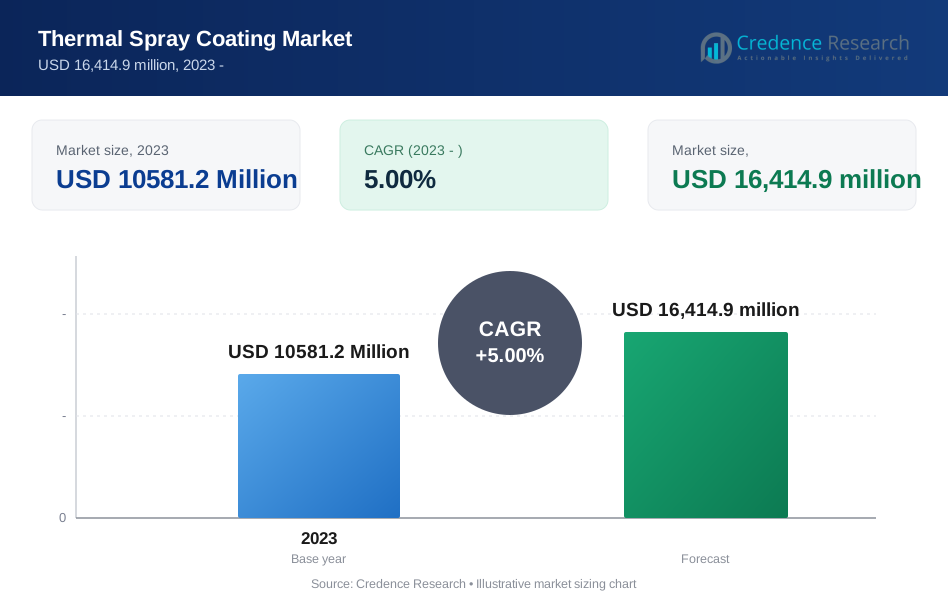
- The Thermal Spray Coating Market has demonstrated consistent expansion and is projected to maintain a robust CAGR of 5.00% from 2024 to 2032. Valued at USD 10581.2 million in 2023, this market is expected to reach USD 16414.9 million by 2032.
- Among the key segments, JPlasma Spray Coating currently hold the largest market share approx 35-40% in 2023 owing to its ability to cover a wide range of surfaces and the resulting high quality coatings. However, High-Velocity Oxy-Fuel (HVOF) Coating is projected to witness the highest CAGR during the forecast period.
- Aerospace and Defense dominate the market by application, holding around 35-38% of the market share in 2023, driven by the increasing demand for durable and protective coatings in critical space systems.
- Metallic Coatings currently hold the largest market share approx 40-45% in 2023. It is commonly used in materials subjected to high loading, thermal and abrasive environments, especially in the aerospace, automotive and industrial industries.
- North America accounts for the largest share of the market in 2023, followed by Asia Pacific and Europe with a collective share of just under 55%.
- The rise in demand for thermal spray coatings, driven by increasing investments in aerospace, automotive, and energy systems, expanding applications across various industries, and rising awareness of advanced coating technologies, fuels the growth of the Thermal Spray Coating Market.
- Key opportunities in the market include significant growth potential in healthcare, increased adoption across various applications and end-users, and continuous advancements in coating technologies, fostering market expansion.
Executive Summary
Market Definition
Thermal Spray Coatings Market includes industries engaged in the application of coatings to surfaces using thermal spraying methods. Hot spraying refers to a group of processes in which a molten or heated material is sprayed onto a substrate to form a coating. The market serves a variety of industries, including aviation, automotive, energy, and industrial equipment. In the thermal spray coating market, temperature-based spray coating methods are used. This is a diverse industry that offers protective and functional coatings across a wide range of products. Thermal spray coatings are known for their durability, corrosion resistance and ability to enhance surface properties. It is used to improve product performance and durability in harsh environments. Generally, thermal spraying uses a heat source, such as a flame or plasma, to melt or heat the coating. Common coating materials include metals, composites, ceramics and polymers. These materials are placed in a spray gun, heated and accelerated to the spray to form a coating.
Market Overview
The Thermal Spray Coating Market has demonstrated consistent expansion and is projected to maintain a robust CAGR of 5.00% from 2024 to 2032. Valued at USD 10581.2 million in 2023, this market is expected to reach USD 16414.9 million by 2032.
Among the primary segments, Plasma Spray Coating currently hold the largest market share approx 35-40% in 2023. However, High-Velocity Oxy-Fuel (HVOF) Coating is projected to witness the highest CAGR during the forecast period.
Metallic Coatings currently hold the largest market share approx 40-45% in 2023. However, Ceramic Coatings is projected to witness the highest CAGR during the forecast period.
Aerospace and Defense emerged as the leading application segment in 2023, with a market share of about 35-38%, primarily due to the increasing demand for durable and protective coatings in critical space systems.
North America constituted a significant portion of the market in 2023, followed by Asia Pacific and Europe, collectively representing just under 55% of the market share.
The rise in demand for thermal spray coatings is driven by factors such as increasing investments in aerospace, automotive, and energy systems, expanding applications across various industries, and rising awareness of advanced coating technologies, particularly in regions like North America and Europe.
Continuous advancements in coating technologies, including improved application methods and material compositions, are further driving the demand for thermal spray coatings, especially in industries requiring high-performance and durable coating solutions.
Segmentation by Type of Thermal Spray Processes
- Plasma Spray Coating currently hold the largest market share approx 35-40% in 2023. Plasma spray coating is widely used due to its versatility, its ability to cover a wide range of surfaces and the resulting high quality coatings.
- High-Velocity Oxy-Fuel (HVOF) Coating is projected to witness the highest CAGR during the forecast period. The increasing demand for HVOF coatings can be attributed to their excellent performance in harsh environments, making them ideal for applications in the aerospace, industrial and automotive industries.
Segmentation by Material Composition
- Metallic Coatings currently hold the largest market share approx 40-45% in 2023. Metal coatings are widely used for their excellent strength, durability, wear and corrosion resistance. It is commonly used in materials subjected to high loading, thermal and abrasive environments, especially in the aerospace, automotive and industrial industries.
- Ceramic Coatings is projected to witness the highest CAGR during the forecast period. The growing demand for ceramic coatings that offer exceptional advantages such as warmth and conductivity can be attributed to their special lightweight, non-conductive performance characteristics.
Segmentation by Application
- Aerospace and Defense currently hold the largest market share approx 35-38% in 2023. These coatings provide protection from extreme heat strength, corrosion and degradation resistance, ensuring the safety and durability of critical space systems.
- Medical and Healthcare is projected to witness the highest CAGR during the forecast period owing to providing anti-damage properties, lubricants and longevity of medical devices, prosthetics and implants.
Segmentation by Region
- North America held significant share around 32-35% of the market in 2023. This dominance is primarily due to well-established aerospace, defense, and automotive industries in the region, which are major consumers of thermal spray coatings. Additionally, the presence of leading coating manufacturers and advanced coating technologies contributes to North America's dominance.
- Asia Pacific and Europe collectively account for just under 55% share in 2023, with Europe holding over 20% share in the same year.
- The rest of the world, including Latin America, the Middle East, and Africa, supplies the remaining demand for Thermal Spray Coating.
Increasing investments in aerospace, automotive and energy systems are driving demand for thermal sprays. Furthermore, increasing disposable income and increasing awareness of advanced coating technologies contribute to the strong growth of the sector.
The North America region continues to dominate the Thermal Spray Coatings market. One of the key drivers of the dominance is the increasing industry demand for high quality and durable coatings for various applications Aerospace, automotive, energy and other industries rely heavily on thermal spray coatings and enhance the performance, life and reliability of their products and features. For instance, in April 2024, Castolin Eutectic introduced XupersoniClad, a thermal spraying service using supersonic technology for superior protection against abrasion, erosion, and wear. This innovative process, derived from HVAF, applies metal, carbide, and alloy powders. It offers high-entropy alloy coatings, enhancing performance in various industries, including recycling, concrete, and pump systems, while also mitigating cavitation damage.Furthermore, the region benefits from well-developed infrastructure, extensive research and development activities, and skilled workforce dedicated to the advancement of thermal spray technology. These factors contribute to the continued growth of the market growth and expansion, attracting investments and fostering innovation. Moreover, stringent regulations and environmental standards in North America have led to the development of durable coating solutions that are environmentally friendly, and boost market growth. Companies in the region are developing more environmentally friendly innovations to meet the evolving needs of their customers.
The Europe is hold prominent share in the Thermal Spray Coating Market. Several factors contribute to Europe’s strong position in this market. The region has a long history of technological development, especially in aerospace, automotive, construction, etc., being major suppliers of thermal sprays Established technological base and variety provides a solid basis for the requirement for thermal spray coverage in Europe. In addition, Europe is known for its technological progress and innovative spirit. There are many leading coating manufacturers and research institutes in the region, driving the development and adoption of cutting-edge thermal spray coating technologies. For instance, in August 2023, Greenkote and Duroc N.V. partnered to bring Greenkote's advanced anticorrosion coating capabilities to Europe. By installing Greenkote equipment in Duroc's Antwerp facility, they aim to serve the European Union and surrounding regions with innovative thermal diffusion coatings, enhancing corrosion protection.The existence of a strong R&D infrastructure further strengthens Europe’s position in the market. For instance, in June 2023, Castolin Eutectic introduced XupersoniClad, a novel thermal spraying service in Europe. This innovative technology applies supersonic spraying for superior protection against abrasion, erosion, and wear. XupersoniClad enhances the durability of components, vessels, and structures, marking a significant advancement in protective coatings.

Key Highlights of the Report
The Thermal Spray Coating Market is segmented by Type of Thermal Spray Processes, Material Composition, Application, and Region. The growing demand for thermal spray coatings is driven by factors such as increasing investments in aerospace, automotive, and energy systems, expanding applications across various industries, and rising awareness of advanced coating technologies.
Plasma Spray Coating currently hold the largest market share by Type of Thermal Spray Processes due to its versatility, its ability to cover a wide range of surfaces and the resulting high quality coatings. High-Velocity Oxy-Fuel (HVOF) Coating is projected to witness the highest CAGR during the forecast period.
Metallic Coatings currently hold the largest market share by Material Composition owing to their excellent strength, durability, wear and corrosion resistance. While, Ceramic Coatings is projected to witness the highest CAGR during the forecast period. The growing demand for ceramic coatings that offer exceptional advantages such as warmth and conductivity can be attributed to their special lightweight, non-conductive performance characteristics.
Automotive holds a significant market share in the application segment, utilizing thermal spray coatings to improve performance and durability in automotive components. The aerospace and defense application segment is witnessing rapid growth, driven by the increasing demand for durable and protective coatings in critical space systems.
North America held the largest share of the Thermal Spray Coating market, supported by well-established aerospace, defense, and automotive industries and the presence of key players such as Praxair Surface Technologies, Inc. and H.C. Starck Inc. These players focus on product innovation and strategic collaborations to maintain their market position and competitiveness.
What Are The Main Drivers Of The Global Thermal Spray Coating Market?
Global Thermal Spray Coating Market is primarily driven by increasing demand from various end-use sectors such as aerospace, automotive, energy and healthcare. These industries require thermal spray coatings to enhance the performance, durability and life of their products and self-appliers, adopting the thermal spray technology. Technological advancements and innovations in coatings and application methods play an important role in the continued growth of the market. Manufacturers continue to invest in research and development to develop advanced coating solutions that provide improved work characteristics, reduced environmental impact and increased performance.
What Are The Major Challenges Faced By The Global Thermal Spray Coating Market?
The global Thermal Spray Coating market faces challenges fluctuating raw material prices, which can affect production and profitability of manufacturers. Furthermore, the complexity of the infrastructure and skilled labor needed can be a challenge to maintain consistent quality and performance. Regulatory compliance and environmental standards present challenges, requiring companies to be flexible and innovative to meet changing regulations. Finally, competition from new coating technologies and products may affect the market share and demand for hot spray coatings.
What Are The Growth Opportunities In The Global Thermal Spray Coating Market?
The global Thermal Spray Coating market presents growth opportunities driven by including technological advancements to develop new and more efficient Thermal Spray Coating. Various region invest in infrastructure and manufacturing, the demand for hot sprays is expected to increase, opening up new market opportunities for industry players. Furthermore, strategic partnerships and collaboration among Thermal Spray Coating suppliers, manufacturers and retailers can facilitate the market growth.
Market Drivers
Increasing Demand Of Robotics Thermal Spray Coating
Increasing demand of robotics thermal spray coating drive the Thermal Spray Coating Market. Robotics offer several advantages, including high accuracy, precision and efficiency when applying thermal spray coatings. They can also help reduce the time and cost associated with manual processing. The use of robotic controls allows for precise control of coating, improves uniformity, and reduces waste. Furthermore, robots can handle complex geometry and large-scale manufacturing processes, making them versatile and valuable in industries as diverse as aerospace, automotive and construction.
Market Restraints
Competition From New Coating Technologies
Competition from new coating technologies restraints the Thermal Spray Coating market growth. One example is the development of advanced powder coatings, which can cause wear and tear just like thermal spray coatings. This powder coating can be applied either electrically or with a water-mixed bed, for uniform and long-lasting results. In addition, technologies such as physical vapor deposition (PVD) and chemical vapor deposition (CVD) lead to the production of thin film coatings with good adhesion and performance characteristics for PVD and CVD coatings its widespread use in the electronics and optical industries, providing a competitive alternative to heat replacement sprays.
Opportunities
Adoption Of Various Strategies Among Market Players
Adoption of various strategies among market players create significant opportunity. The major companies serving the global Thermal Spray Coating Market are Kymera International, Ziccum Praxair Surface Technologies, Inc.; Höganäs AB; H.C. Starck Inc.; Castolin Eutectic, among others. The market players are considerably contributing to the market growth by the adoption of various strategies including mergers & acquisitions, collaborations, funding, and new product launches, to stay competitive in the market. For instance, in May 2023, Kymera International, a specialty materials company, has acquired Thermal Spray Solutions, Inc. (TSS), expanding its surface technology capabilities. The acquisition adds strategic defense-focused capabilities to Kymera's product range, enhancing its corrosion and wear resistance offerings.
Competitive Landscape
Key Players
The global Thermal Spray Coating market is highly competitive, with several key players. Some of the major players in the market and their market share are as follows:
- Praxair Surface Technologies, Inc.
- Höganäs AB
- H.C. Starck Inc.
- Castolin Eutectic
- Wall Colmonoy Corp.
- Powder Alloy Corp.
- Saint-Gobain
- Carpenter Technology Corp.
- Fujimi Inc.
- Durum Verschleiss-Schutz GmbH
- Montreal Carbide Co. Ltd.
- Kennametal Stellite
- Oerlikon Metco
- Hardide plc
- GTV Verschleißschutz GmbH (GTV Wear Protection GmbH)
- Others
These organizations prioritize product innovation, distribution channel expansion, and mergers and acquisitions to stay competitive.
The global Thermal Spray Coating market's key players continually seek to stay ahead by offering new products and developments.
In March 2024, Hardide plc, a specialist in advanced surface coating technology, has introduced a new range of ready-coated components, including copper nozzles for High-Velocity Oxy Fuel (HVOF) thermal spray coating applications. The Hardide coating significantly extends the operational life of these nozzles, reducing downtime and improving efficiency in the HVOF thermal spray process.
In March 2020, Praxair Surface Technologies and Siemens AG have strengthened their partnership with a new contract for coating services across Siemens' products. The agreement includes aerospace and industrial gas turbine components, such as blades, vanes, casings, and discs, which will be coated using various processes, including aluminising, platinum aluminising, slurry, and thermal spray. Coating applications will take place at Praxair's facilities in Germany, Italy, the UK, and the US.
Summary of Key Findings
- The Thermal Spray Coating Market is witnessing significant growth, driven by increasing investments in aerospace, automotive, and energy systems, and expanding applications across various industries. Key drivers contributing to this growth include rising awareness of advanced coating technologies, the need for durable and protective coatings, and the trend towards high-performance solutions.
- Market segmentation within the thermal spray coating market encompasses various factors including type of thermal spray processes, application, material composition, and region, reflecting the diverse uses and applications of thermal spray coatings.
- Plasma Spray Coating currently hold the largest market share by Type of Thermal Spray Processes due to its versatility, its ability to cover a wide range of surfaces and the resulting high quality coatings. High-Velocity Oxy-Fuel (HVOF) Coating is projected to witness the highest CAGR during the forecast period.
- Metallic Coatings currently hold the largest market share by Material Composition owing to their excellent strength, durability, wear and corrosion resistance. While, Ceramic Coatings is projected to witness the highest CAGR during the forecast period. The growing demand for ceramic coatings that offer exceptional advantages such as warmth and conductivity can be attributed to their special lightweight, non-conductive performance characteristics.
- Automotive holds a significant market share in the application segment, utilizing thermal spray coatings to improve performance and durability in automotive components. The aerospace and defense application segment is witnessing rapid growth, driven by the increasing demand for durable and protective coatings in critical space systems.
- Geographically, North America holds the largest market share, supported by well-established aerospace, defense, and automotive industries, and the presence of key industry players. Asia Pacific and Europe collectively account for a substantial share of the market, with Asia Pacific witnessing growth due to increasing investments in infrastructure and manufacturing.
Future Outlook
- The future outlook for the Thermal Spray Coating Market indicates promising growth opportunities, particularly within sectors such as aerospace, automotive, and energy systems, driven by the increasing demand for durable and protective coatings. However, anticipated challenges include fluctuating raw material prices, competition from alternative coating technologies, and the need for regulatory compliance and product standardization.
- To maintain competitiveness in the Thermal Spray Coating Market, industry players should adopt various strategies such as continuous product innovation, strategic collaborations, securing funding for research and development, and expanding market presence. It is crucial for companies to prioritize addressing industry needs, improving coating quality, and exploring untapped opportunities in emerging markets to ensure sustained growth amidst the evolving market landscape.
How CXOs Can Benefit from the Credence Research Thermal Spray Coating Market Report
The Credence Research Thermal Spray Coating Market Report provides CXOs with a comprehensive overview of the market, including:
- Market size and growth forecast:The report provides detailed estimates of the global Thermal Spray Coating market size, segmented by type of thermal spray processes, application, material composition, and region. It also includes forecasts for the market through 2032, based on key trends and drivers.
- Market segmentation:The report segments the Thermal Spray Coating market by type of thermal spray processes, application, material composition, and region. The increasing demand for advanced solutions is driven. This segmentation provides CXOs with a granular understanding of the market and the opportunities in each segment.
- Competitive landscape:The report profiles the key players in the Thermal Spray Coating market and provides insights into their strategies, product offerings, and financial performance. This information can help CXOs to identify and assess their competition.
- Key trends and drivers:The report identifies and analyzes the key trends and drivers that are shaping the Thermal Spray Coating market. This information can help CXOs to make informed decisions about their investments and strategies.
CXOs can use the insights from the Credence Research Thermal Spray Coating Market Report to:
- Identify growth opportunities:The report can help CXOs to identify new growth opportunities in the Thermal Spray Coating market. For example, the report identifies the growing demand for Thermal Spray Coating from cloud computing providers and telecom companies as a key opportunity.
- Make informed investment decisions:The report can help CXOs to make informed investment decisions about Thermal Spray Coating. For example, the report provides insights into the key factors to consider when evaluating Thermal Spray Coating providers and selecting Thermal Spray Coating solutions.
- Develop competitive strategies:The report can help CXOs to develop competitive strategies for their Thermal Spray Coating businesses. For example, the report identifies the key strategies that Thermal Spray Coating providers are using to differentiate themselves from their competitors.
- Track market developments:The report can help CXOs to track market developments and stay ahead of the curve. For example, the report provides insights into the latest trends and innovations in the Thermal Spray Coating market.
Overall, the Credence Research Thermal Spray Coating Market Report is a valuable resource for CXOs who are looking to gain a deeper understanding of the market and identify opportunities for growth.
Segmentation
-
Type of Thermal Spray Processes:
- Plasma Spray Coating
- High-Velocity Oxy-Fuel (HVOF) Coating
- Wire Arc Spray Coating
- Flame Spray Coating
- Cold Spray Coating
-
Material Composition:
- Ceramic Coatings
- Metallic Coatings
- Composite Coatings
-
Application Segmentation:
- Aerospace and Defense
- Automotive
- Energy and Power Generation
- Oil and Gas
- Industrial and Manufacturing
- Medical and Healthcare
-
By Region
- North America
- US
- Canada
- Mexico
- Europe
- Germany
- France
- UK.
- Italy
- Spain
- Rest of Europe
- Asia Pacific
- China
- Japan
- India
- South Korea
- South-east Asia
- Rest of Asia Pacific
- Latin America
- Brazil
- Argentina
- Rest of Latin America
- Middle East & Africa
- GCC Countries
- South Africa
- Rest of Middle East and Africa
- North America
Adjacent Markets
In the Thermal Spray Coating market, there are several adjacent markets which has high revenue growth opportunities. The key adjacent markets for Thermal Spray Coating market -
Adjacent Markets |
||
| Aerospace Coatings Market | Marine Coatings Market | Power Generation Coatings Market |
| Automotive Coatings Market | Electronics Coatings Market | Construction Coatings Market |
| Oil and Gas Coatings Market | Medical Device Coatings Market | Industrial Equipment Coatings Market |
Request a Free Sample
Fill in your details and we'll send you a free sample report.
- Sample data tables & charts
- Research methodology
Market Dynamics
Expansion of Aerospace and Defense Industries
The aerospace and defense sectors require advanced, durable coatings for critical components exposed to extreme environments. Increasing investments and production in these industries are driving demand for high-performance thermal spray coatings.
Technological Advancements in Coating Processes
Continuous innovation in thermal spray technologies, such as improved plasma and HVOF processes, is enabling higher quality, more efficient, and environmentally friendly coatings, expanding their applicability across industries.
Growth in Automotive and Energy Applications
Automotive and energy sectors are increasingly adopting thermal spray coatings to enhance component lifespan, reduce maintenance, and improve performance under high-stress conditions, fueling market growth.
Rising Need for Corrosion and Wear Resistance
Industries such as oil & gas, manufacturing, and power generation are seeking solutions to extend equipment life and reduce downtime. Thermal spray coatings offer superior protection against corrosion, abrasion, and thermal degradation, making them a preferred choice.
Need a Custom Version of This Report?
Tailor the scope, geography, or segments to your exact requirements.
- Custom geography or segment scope
- Direct access to our analyst team
Frequently Asked Questions
What is the current size of the global Thermal Spray Coating market?
What is the expected growth rate of the Thermal Spray Coating market between 2024 and 2032?
Which segment is leading the market share in terms of Type of Thermal Spray Processes?
Which Material Composition Segments governs the demand for Thermal Spray Coatings in the world?
Which Thermal Spray Application Specific Thermal Spray Coating segment is expected to post the highest CAGR during the forecast period?
Which region is fueling the growth of the Thermal Spray Coating industry?
Who are the major players in the global Thermal Spray Coating market?
What are the major market drivers of the Thermal Spray Coating industry?
What are the major market restraints of the Thermal Spray Coating industry?
What are the major market opportunities of the Thermal Spray Coating industry?
Table of Content
Chapter 1 Market Segmentation
- 1.1 Segmentation Framework
- 1.1.1 Product and Service Classification
- 1.1.2 Application and End-Use Classification
- 1.1.3 Technology and Solution Classification
- 1.1.4 Customer and Distribution Channel Classification
- 1.1.5 Geographic Segmentation
- 1.1.6 Market Segment Definitions and Boundaries
- 1.2 By Application
- 1.2.1 Aerospace and Defense
- 1.2.2 Automotive
- 1.2.3 Energy and Power Generation
- 1.2.4 Oil and Gas
- 1.2.5 Industrial and Manufacturing
- 1.2.6 Medical and Healthcare
- 1.3 By Material Composition
- 1.3.1 Metallic Coatings
- 1.3.2 Ceramic Coatings
- 1.3.3 Composite Coatings
- 1.4 By Type of Thermal Spray Processes
- 1.4.1 Plasma Spray Coating
- 1.4.2 High-Velocity Oxy-Fuel (HVOF) Coating
- 1.4.3 Wire Arc Spray Coating
- 1.4.4 Flame Spray Coating
- 1.4.5 Cold Spray Coating
Chapter 2 Introduction
- 2.1 Report Objectives and Scope
- 2.2 Product Definition and Industry Terminology
- 2.3 Market Inclusions and Exclusions
- 2.4 Research Process
- 2.4.1 Primary Research and Expert Interviews
- 2.4.2 Secondary Research and Source Review
- 2.4.3 Top-Down and Bottom-Up Estimation
- 2.4.4 Data Triangulation and Verification
- 2.5 Market Size Measurement Basis
- 2.5.1 2023: USD 10581.2 Million → 2032: USD 16,414.9 million
- 2.6 Historical and Forecast Reference Periods
- 2.6.1 Base Year: 2023
- 2.6.2 Forecast Period: 2023-2032
- 2.7 Research Assumptions and Limitations
Chapter 3 Executive Summary
- 3.1 Market Snapshot and Key Findings
- 3.2 Base-Year Market Size, 2023
- 3.3 Forecast Market Size, 2032
- 3.4 Revenue and Volume Growth Outlook
- 3.5 Key Demand and Supply Indicators
- 3.6 Leading Market Segments
- 3.7 Fastest-Growing Market Opportunities
- 3.8 Regional Performance Highlights
- 3.9 Technology and Industry Transformation
- 3.10 Competitive Landscape Summary
- 3.11 Analyst View and Strategic Implications
Chapter 4 Global Thermal Spray Coating Market Trends and Developments
- 4.1 Historical Industry Development
- 4.2 Recent Market Trends and Developments
- 4.3 Demand and Customer Behavior Trends
- 4.4 Technology and Product Innovation
- 4.5 Artificial Intelligence, Automation and Digitalization
- 4.6 Local Manufacturing and Supply Chain Realignment
- 4.7 Industry Partnerships, Mergers and Acquisitions
- 4.8 Sustainability and Circular Economy Developments
- 4.9 Government and Private Sector Investment Trends
- 4.10 Emerging Business Models and Commercialization
- 4.11 Industry Developments and Announcements
Chapter 5 Global Thermal Spray Coating Market Production, Supply and Demand Analysis
- 5.1 Demand Trend and Consumption Analysis
- 5.2 Demand Forecast, 2023-2032
- 5.3 Production and Output Trend
- 5.4 Production and Output Forecast, 2023-2032
- 5.5 Installed Capacity and Capacity Utilization
- 5.6 Company-Wise Production Plants and Statistics
- 5.6.1 Installed Production Capacity
- 5.6.2 Actual Production
- 5.6.3 Planned Capacity and Expansion Targets
- 5.7 Supply Chain Structure and Procurement Trends
- 5.8 Supply-Demand Gap and Bottlenecks
- 5.9 Import Dependence and Sourcing Structure
- 5.10 Contract Manufacturing and Outsourcing
- 5.11 Regional Supply and Demand Concentration
Chapter 6 Global Thermal Spray Coating Market Pricing Analysis
- 6.1 Pricing Structure and Measurement
- 6.2 Historical Pricing Trends
- 6.3 Pricing Outlook, 2023-2032
- 6.4 Average Selling Price and Unit Economics
- 6.5 Pricing by Product and Market Segment
- 6.6 Geographic Pricing Differences
- 6.7 Key Input, Energy, Labor and Logistics Costs
- 6.8 Contract Pricing and Purchasing Models
- 6.9 Pricing Sensitivity and Competitive Positioning
- 6.10 Price, Margin and Profitability Implications
Chapter 7 Global Thermal Spray Coating Market Dynamics
- 7.1 Market Growth Drivers
- 7.1.1 Demand-Side Drivers
- 7.1.2 Technology and Innovation Drivers
- 7.1.3 Infrastructure and Investment Drivers
- 7.1.4 Regulatory and Policy Drivers
- 7.2 Market Restraints
- 7.2.1 Cost and Affordability Constraints
- 7.2.2 Technology and Adoption Barriers
- 7.2.3 Supply Chain and Operational Constraints
- 7.3 Market Challenges
- 7.3.1 Competitive Pressure and Margin Erosion
- 7.3.2 Skills, Infrastructure and Implementation Gaps
- 7.4 Emerging Market Opportunities
- 7.5 Market Dynamics Impact and Time-Horizon Assessment
Chapter 8 Global Thermal Spray Coating Value Chain Analysis
- 8.1 Industry Value Chain Overview
- 8.2 Upstream Suppliers and Critical Inputs
- 8.3 Technology and Component Providers
- 8.4 Manufacturing or Service Delivery
- 8.5 Distribution, Channel Partners and Integrators
- 8.6 Downstream Applications and End Users
- 8.7 Value Addition and Profit Pools
- 8.8 Vertical Integration and Outsourcing
- 8.9 Supplier Concentration and Risk
- 8.10 Supply Chain Localization and Resilience
Chapter 9 Global Thermal Spray Coating Market Regulations and Policies
- 9.1 Relevant Laws, Standards and Compliance Frameworks
- 9.2 Product, Service, Safety and Quality Requirements
- 9.3 Government Policies, Incentives and Subsidies
- 9.4 Imports, Exports and Trade Barriers
- 9.5 Public Procurement and Local Content Requirements
- 9.6 Environmental and Sustainability Compliance
- 9.7 Upcoming Policy Changes and Market Implications
Chapter 10 Global Thermal Spray Coating Market Hotspots and Opportunities
- 10.1 Market Opportunity Mapping and Growth Hotspots
- 10.2 High-Growth Applications and Customer Groups
- 10.3 Underserved Markets and White-Space Opportunities
- 10.4 Emerging Technology and Product Opportunities
- 10.5 New Capacity and Investment Hotspots
- 10.6 Market Entry and Expansion Opportunities
- 10.7 Distribution and Partnership Opportunities
- 10.8 Near-Term and Long-Term Commercial Potential
- 10.9 Opportunity Attractiveness and Execution Risks
Chapter 11 Global Thermal Spray Coating Market Outlook, 2023-2032
- 11.1 Market Size and Analysis
- 11.1.1 Revenue (Market Measurement: 2023: USD 10581.2 Million → 2032: USD 16,414.9 million)
- 11.1.2 Market Volume and Quantity Sold
- 11.1.3 Historical Market Size
- 11.1.4 Base-Year Market Size, 2023
- 11.2 Market Forecast, 2023-2032
- 11.2.1 Revenue Forecast to 2032
- 11.2.2 Volume Forecast to 2032
- 11.2.3 CAGR and Year-on-Year Growth
- 11.2.4 Incremental Revenue Opportunity
- 11.3 Forecast Assumptions and Scenario Analysis
- 11.3.1 Base-Case Forecast
- 11.3.2 Optimistic and Conservative Scenarios
- 11.3.3 Technology, Pricing and Policy Sensitivities
- 11.4 Market Attractiveness and Growth Outlook
Chapter 12 Global Thermal Spray Coating Market Segmentation and Outlook
- 12.1 Segmentation Summary and Market Shares, 2023
- 12.2 Largest and Fastest-Growing Segments
- 12.3 By Application - Market Size and Forecast, 2023-2032
- 12.3.1 Segment Definition and Scope
- 12.3.2 Historical Market Size
- 12.3.3 Revenue Forecast, 2023-2032
- 12.3.4 Volume Forecast, 2023-2032
- 12.3.5 Base-Year Market Share, 2023
- 12.3.6 Segment CAGR and Growth Drivers
- 12.3.7 Subsegment Market Size and Forecast
- 12.3.7.1 Aerospace and Defense
- 12.3.7.2 Automotive
- 12.3.7.3 Energy and Power Generation
- 12.3.7.4 Oil and Gas
- 12.3.7.5 Industrial and Manufacturing
- 12.3.7.6 Medical and Healthcare
- 12.3.8 Subsegment Pricing and Adoption Trends
- 12.3.9 Leading Suppliers and Competition
- 12.3.10 Regional Demand and Opportunities
- 12.4 By Material Composition - Market Size and Forecast, 2023-2032
- 12.4.1 Segment Definition and Scope
- 12.4.2 Historical Market Size
- 12.4.3 Revenue Forecast, 2023-2032
- 12.4.4 Volume Forecast, 2023-2032
- 12.4.5 Base-Year Market Share, 2023
- 12.4.6 Segment CAGR and Growth Drivers
- 12.4.7 Subsegment Market Size and Forecast
- 12.4.7.1 Metallic Coatings
- 12.4.7.2 Ceramic Coatings
- 12.4.7.3 Composite Coatings
- 12.4.8 Subsegment Pricing and Adoption Trends
- 12.4.9 Leading Suppliers and Competition
- 12.4.10 Regional Demand and Opportunities
- 12.5 By Type of Thermal Spray Processes - Market Size and Forecast, 2023-2032
- 12.5.1 Segment Definition and Scope
- 12.5.2 Historical Market Size
- 12.5.3 Revenue Forecast, 2023-2032
- 12.5.4 Volume Forecast, 2023-2032
- 12.5.5 Base-Year Market Share, 2023
- 12.5.6 Segment CAGR and Growth Drivers
- 12.5.7 Subsegment Market Size and Forecast
- 12.5.7.1 Plasma Spray Coating
- 12.5.7.2 High-Velocity Oxy-Fuel (HVOF) Coating
- 12.5.7.3 Wire Arc Spray Coating
- 12.5.7.4 Flame Spray Coating
- 12.5.7.5 Cold Spray Coating
- 12.5.8 Subsegment Pricing and Adoption Trends
- 12.5.9 Leading Suppliers and Competition
- 12.5.10 Regional Demand and Opportunities
- 12.6 Segment Growth Comparison
- 12.7 Segment Attractiveness and Priority Matrix
Chapter 13 Global Thermal Spray Coating End-Use and Application Market Outlook
- 13.1 End-Use Industry and Customer Demand Structure
- 13.2 Leading Applications and Customer Groups
- 13.3 End-Use Market Size, Share and Forecast
- 13.4 Major End-Use Industry Deep Dives
- 13.4.1 Customer Requirements and Use Cases
- 13.4.2 Demand and Replacement Cycles
- 13.4.3 Technical and Regulatory Considerations
- 13.4.4 Purchasing and Procurement Models
- 13.4.5 Leading Vendors and Distribution Channels
- 13.4.6 Forecast and Commercial Opportunities
- 13.5 Emerging Applications and Cross-Segment Demand
- 13.6 End-Use Industry Investment Priorities
Chapter 14 Global Thermal Spray Coating Geographic Market Outlook, 2023-2032
- 14.1 Regional Market Size and Share, 2023
- 14.2 Regional Market Forecast, 2023-2032
- 14.3 Regional Pricing, Production and Demand Differences
- 14.4 North America
- 14.4.1 United States
- 14.4.2 Canada
- 14.4.3 Mexico
- 14.5 Europe
- 14.5.1 Germany
- 14.5.2 France
- 14.5.3 Italy
- 14.5.4 United Kingdom
- 14.5.5 Spain
- 14.5.6 Poland
- 14.5.7 Russia
- 14.5.8 Netherlands
- 14.5.9 Belgium
- 14.5.10 Sweden
- 14.5.11 Denmark
- 14.5.12 Norway
- 14.5.13 Rest of Europe
- 14.6 Asia Pacific
- 14.6.1 China
- 14.6.2 India
- 14.6.3 Japan
- 14.6.4 South Korea
- 14.6.5 Thailand
- 14.6.6 Indonesia
- 14.6.7 Vietnam
- 14.6.8 Malaysia
- 14.6.9 Australia
- 14.6.10 Rest of Asia Pacific
- 14.7 Latin America
- 14.7.1 Brazil
- 14.7.2 Argentina
- 14.7.3 Colombia
- 14.7.4 Chile
- 14.7.5 Rest of Latin America
- 14.8 Middle East
- 14.8.1 Saudi Arabia
- 14.8.2 United Arab Emirates
- 14.8.3 Turkey
- 14.8.4 Israel
- 14.8.5 Iran
- 14.8.6 Rest of the Middle East
- 14.9 Africa
- 14.9.1 South Africa
- 14.9.2 Egypt
- 14.9.3 Nigeria
- 14.9.4 Morocco
- 14.9.5 Rest of Africa
- 14.10 Regional Investment, Policy and Supply Chain Differences
- 14.11 Regional Competitive Landscape
- 14.12 Geographic Growth Hotspots
Chapter 15 Global Thermal Spray Coating Technology, Innovation and Sustainability Outlook
- 15.1 Technology Landscape and Maturity
- 15.2 Product, Process and Service Innovation
- 15.3 AI, Automation and Digital Tools in the Industry
- 15.4 Technology Adoption and Performance Benchmarking
- 15.5 Innovation Pipeline and R&D Investment
- 15.6 Patent and Intellectual Property Trends
- 15.7 Energy Efficiency and Resource Management
- 15.8 Sustainability, Recycling and Circularity
- 15.9 Technology Roadmap, 2023-2032
- 15.10 Risks of Obsolescence and Technology Substitution
Chapter 16 Global Thermal Spray Coating Market Key Strategic Imperatives
- 16.1 Growth and Market Entry Priorities
- 16.2 High-Return Products and Segments
- 16.3 Pricing, Profitability and Cost Optimization
- 16.4 Technology Investment and Product Differentiation
- 16.5 Supply Chain Localization and Resilience
- 16.6 Distribution and Customer Acquisition
- 16.7 Partnership, Acquisition and Capacity Strategy
- 16.8 Regional Expansion Priorities
- 16.9 Short-, Medium- and Long-Term Actions
Chapter 17 Competition Outlook
- 17.1 Industry Competition Characteristics
- 17.2 Market Structure and Concentration
- 17.3 Market Share and Competitive Positioning, 2023
- 17.4 Company-Wise Revenue and Product Benchmarking
- 17.5 Production and Service Capacity Benchmarking
- 17.6 Technology, Pricing and Differentiation
- 17.7 Regional Footprint and Distribution Strength
- 17.8 Mergers, Acquisitions and Strategic Alliances
- 17.9 New Entrants and Competitive Threats
- 17.10 Porter's Five Forces and Industry Attractiveness
- 17.11 Competitive Outlook, 2023-2032
Chapter 18 Company Profiles
- 18.1 Company Coverage and Selection Criteria
- 18.2 Praxair Surface Technologies, Inc.
- 18.2.1 Business Description
- 18.2.2 Company Ownership and Geographic Presence
- 18.2.3 Product and Service Portfolio
- 18.2.4 Manufacturing and Operating Footprint
- 18.2.5 Production Capacity and Expansion Plans
- 18.2.6 Financial Performance and Investment
- 18.2.7 Market Share and Competitive Position
- 18.2.8 Technology and Innovation Capabilities
- 18.2.9 Strategic Alliances or Partnerships
- 18.2.10 Recent Developments
- 18.2.11 Growth Strategy and Outlook
- 18.3 Höganäs AB
- 18.4 H.C. Starck Inc.
- 18.5 Castolin Eutectic
- 18.6 Oerlikon Metco
- 18.7 Saint-Gobain
- 18.8 Carpenter Technology Corp.
- 18.9 Wall Colmonoy Corp.
- 18.10 Kennametal Stellite
- 18.11 Fujimi Inc.
- 18.12 Other Relevant Market Participants
Note: Every listed company is profiled on the structure shown under the first company. The company list is preliminary and may change based on research findings, market developments, data availability and client requirements.
Chapter 19 Disclaimer
- 19.1 Research and Forecast Disclaimer
- 19.2 Data Source and Estimation Limitations
Note: The depth of individual sections depends on data availability for this market. Volume, capacity, trade and other unit-based metrics are included where applicable.

