
| REPORT ATTRIBUTE | DETAILS |
|---|---|
| Historical Period | 2019-2022 |
| Base Year | 2023 |
| Forecast Period | 2024-2032 |
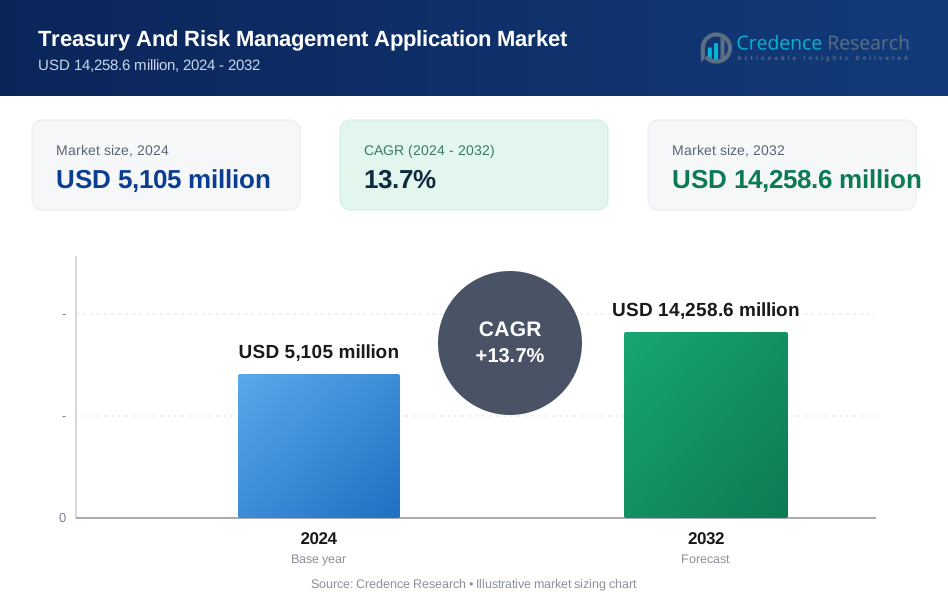
| Treasury and Risk Management Application Market Size 2024 | USD 5,105 Million |
| Treasury and Risk Management Application Market, CAGR | 13.7% |
| Treasury and Risk Management Application Market Size 2032 | USD 14,258.6 Million |
Market Overview
The Treasury and Risk Management Application Market is projected to grow from USD 5,105 million in 2024 to USD 14,258.6 million by 2032, registering a CAGR of 13.7% during the forecast period.
The Treasury and Risk Management Application market is driven by increasing demand for real-time financial monitoring and risk mitigation across industries. Advancements in automation, AI, and machine learning are enhancing decision-making processes, allowing companies to streamline cash management and optimize liquidity. The growing need for compliance with regulatory standards is pushing organizations to adopt more robust risk management solutions. Additionally, the shift towards cloud-based platforms is offering greater flexibility and scalability, enabling businesses to better manage financial operations. These trends are collectively accelerating the adoption of treasury and risk management applications globally.
The Treasury and Risk Management Application market is experiencing robust growth across diverse regions, driven by increasing demand for efficient financial management and compliance tools. North America dominates due to advanced financial infrastructure and high adoption rates of innovative technologies. Europe follows closely, supported by stringent regulatory frameworks and expanding multinational enterprises. The market is also gaining momentum in Asia-Pacific, propelled by rapid economic growth and digital transformation in emerging economies. Key players, including SAP SE, Oracle Corporation, FIS, Kyriba Corporation, and ION Treasury, leverage technological advancements to offer scalable solutions tailored to the dynamic needs of global organizations.
Market Drivers
Increasing Complexity of Financial Markets
As financial markets grow increasingly complex, organizations require more advanced tools to manage their risks effectively. For instance, Treasury and Risk Management (TRM) applications are designed to address this complexity by helping organizations identify, assess, and mitigate various financial risks, including market, credit, liquidity, and operational risks. With sophisticated analytics and forecasting capabilities, these applications enable businesses to stay ahead of evolving financial challenges, enhancing risk management strategies and minimizing exposure.
Regulatory Compliance
With regulatory requirements becoming more stringent, such as Basel III, Solvency II, and Dodd-Frank, organizations must ensure full compliance to avoid penalties and maintain operational integrity. For instance, TRM applications play a crucial role in helping businesses meet these regulations by providing real-time insights and comprehensive tools to manage financial risks. By enabling the tracking and reporting of compliance metrics, these applications support organizations in adhering to both domestic and international regulatory standards.
Globalization
Globalization has added layers of complexity to financial risk management, as organizations operate across multiple regions and currencies. TRM applications assist in managing these risks by providing tools to handle foreign exchange risk, interest rate risk, and country-specific risks. With global operations increasingly common, TRM solutions allow businesses to assess and mitigate these risks efficiently, ensuring that multinational operations remain financially stable and well-managed.
Technological Advancements
Technological innovations are making it possible for organizations to develop more sophisticated and efficient TRM applications. Automation, artificial intelligence, and machine learning have enabled these applications to streamline financial processes, improve decision-making, and reduce operational costs. As these technologies continue to evolve, TRM solutions are becoming increasingly effective at managing complex financial risks and offering real-time data analysis, empowering businesses to optimize their financial strategies and respond proactively to challenges.
Market Trends
Increasing Focus on Digital Transformation:
The growing adoption of cloud-based solutions in Treasury and Risk Management (TRM) is a significant market trend, driven by the scalability, cost-effectiveness, and accessibility these platforms provide. For instance, a survey by Deloitte highlights that 49% of corporate treasurers are prioritizing scalable digital solutions. Cloud-based TRM applications allow businesses to streamline operations and access financial data remotely, improving decision-making flexibility. Furthermore, Artificial Intelligence (AI) and Machine Learning (ML) are becoming integral to TRM systems, enhancing decision-making capabilities, automating routine tasks, and improving risk assessment accuracy. Another key technological advancement is the integration of blockchain technology, which promises to revolutionize the TRM space by offering secure, transparent transaction records. Blockchain enhances process efficiency, reduces operational risks, and ensures better tracking of financial transactions, making it a vital component of modern TRM applications.
Enhanced Risk Management and Regulatory Compliance:
Advanced risk analytics tools are gaining traction in TRM applications, enabling businesses to identify, assess, and mitigate a wide range of financial risks, including market, credit, liquidity, and operational risks. These tools are enhanced by stress testing and scenario analysis, which evaluate the resilience of financial portfolios under various economic conditions, helping businesses prepare for potential financial shocks. In addition, the rising focus on counterparty risk management, especially amid volatile market conditions, is driving demand for robust TRM solutions. On the regulatory front, organizations are facing increasingly stringent compliance standards. As a result, TRM applications are becoming essential for automating regulatory reporting processes, ensuring accuracy and timeliness in compliance. Additionally, TRM solutions are being integrated with other enterprise systems such as ERP, CRM, and supply chain management systems, providing seamless data flow and enabling real-time decision-making. Finally, the growing emphasis on sustainability and Environmental, Social, and Governance (ESG) factors is prompting the use of TRM solutions to assess ESG risks and support sustainable finance initiatives, further expanding the role of TRM applications in modern business operations.
Market Challenges Analysis
Data Quality and Integration Challenges:
Organizations in Treasury and Risk Management (TRM) often face difficulties with data integration due to data silos, which hinder the consolidation and analysis of information from different sources. This fragmentation can lead to inconsistencies in data formats and quality, impacting the accuracy of risk assessments and decision-making. Additionally, ensuring real-time access to up-to-date, accurate data is challenging, especially in volatile market conditions. Inaccurate or delayed data can significantly impair the ability to manage risks effectively, resulting in potential financial losses. For organizations that rely on timely, precise data for decision-making, these issues highlight the critical need for integrated, real-time data solutions that can address the complexities of managing data across different systems and sources.
Regulatory Compliance and Security Risks:
The constantly evolving regulatory landscape presents a major challenge for organizations in the TRM sector. New rules and standards frequently emerge, requiring businesses to adapt their systems and processes to remain compliant. This challenge becomes more complicated when dealing with cross-border regulations, where organizations with international operations must navigate the complexities of adhering to multiple jurisdictions simultaneously. For instance, a report by the U.S. Department of the Treasury outlines how financial institutions must stay agile in adapting to evolving standards while ensuring compliance with various regulatory requirements. In addition, cybersecurity threats pose a significant risk, with data breaches and advanced threats such as ransomware and phishing attacks putting sensitive financial data at risk. Compliance with data privacy regulations, such as GDPR and CCPA, further adds to the complexity. Finally, TRM organizations face challenges in model risk management, as ensuring the accuracy of financial models and establishing robust governance frameworks are essential to mitigate potential risks. These combined challenges make effective risk management and compliance increasingly complex and resource-intensive.
Market Segmentation Analysis:
By Component:
The Treasury and Risk Management (TRM) market is segmented by components, including TRM application software, services, and consulting. TRM software forms the backbone of this market, offering specialized tools for risk analytics, cash flow forecasting, and transaction management. As organizations increasingly prioritize real-time decision-making and robust financial oversight, demand for advanced TRM software continues to rise. Treasury and Risk Management Services, including professional and consulting services, complement the software segment by providing expert guidance for software integration, training, and ongoing support. Consulting services are especially significant for organizations navigating complex regulatory requirements or seeking to implement best practices in TRM. This segmentation highlights how organizations benefit from comprehensive TRM solutions that combine software with tailored professional expertise.
By Application:
In terms of application, TRM solutions support various essential financial functions, including account management, cash and liquidity management, compliance and risk management, and financial resource management. Cash and liquidity management applications are crucial for optimizing cash flow and mitigating liquidity risks, especially in fluctuating economic climates. Compliance and risk management applications address the need for adherence to regulatory frameworks, offering tools that help organizations identify, monitor, and manage financial and operational risks. Financial resource management enables organizations to efficiently allocate capital, manage investments, and support overall financial stability. By catering to these critical financial needs, TRM applications deliver versatile tools that enhance operational efficiency and resilience across diverse business environments.
Segments:
Based on Component:
- Treasury and Risk Management Application Software
- Treasury and Risk Management Application Services
- Professional Services
- Consulting Services
Based on Application:
- Account Management
- Cash and Liquidity Management
- Compliance and Risk Management
- Financial Resource Management
Based on Deployment Type:
- On-premise Treasury and Risk Management Applications
- Cloud Treasury and Risk Management Applications
Based on End User:
- Retail Banks
- Investment Banks
- Clearing Banks & CCP
- Corporates
- Others
Based on the Geography:
- North America
- U.S.
- Canada
- Mexico
- Europe
- Germany
- France
- U.K.
- Italy
- Spain
- Rest of Europe
- Asia Pacific
- China
- Japan
- India
- South Korea
- South-east Asia
- Rest of Asia Pacific
- Latin America
- Brazil
- Argentina
- Rest of Latin America
- Middle East & Africa
- GCC Countries
- South Africa
- Rest of the Middle East and Africa
Regional Analysis
North America
North America commands a significant share in the Treasury and Risk Management (TRM) application market, accounting for over 35% of the global market in 2024. This dominance is attributed to the advanced financial services infrastructure, early adoption of innovative technology, and strict regulatory frameworks like Dodd-Frank and Basel III. Major corporations and financial institutions in the U.S. and Canada drive the demand for robust TRM applications to ensure compliance, manage liquidity, and mitigate risks effectively. The growing reliance on cloud-based and AI-driven solutions further fuels market growth, enabling real-time risk assessment and operational efficiency. As North American firms continue to invest in advanced analytics and automation, the region is expected to maintain its stronghold in the market through 2032, solidifying its position as a hub for financial innovation and stability.
Asia-Pacific
Asia-Pacific (APAC) is another prominent region, capturing approximately 25% of the global TRM application market in 2024. The region’s rapid economic growth, coupled with increasing globalization and expanding trade networks, drives the demand for sophisticated risk management solutions. Countries like China, India, Japan, and South Korea are leading contributors, as businesses in these markets navigate complex challenges such as foreign exchange risks and varying regulatory standards. The rise of digital transformation initiatives, including the adoption of cloud-based and AI-powered TRM applications, has made it easier for organizations to manage liquidity and enhance risk management processes. Furthermore, APAC's focus on strengthening regulatory frameworks and fostering cross-border trade has amplified the importance of compliance-focused TRM solutions. With its dynamic economic landscape and increasing investment in financial technology, the APAC region is poised for robust growth, further solidifying its position as a vital contributor to the global TRM application market.
Key Player Analysis
- Oracle Corporation
- SAP SE
- FIS (formerly SunGard)
- Kyriba Corporation
- TreasuryXpress
- Reval (acquired by ION)
- Openlink (acquired by ION)
- ION Treasury
- Fiserv Inc.
- GTreasury
- Wallstreet Systems (acquired by ION)
- Chatham Financial
- Calypso Technology
- Numerix
- SAS Institute Inc.
- MORS Software
Competitive Analysis
The Treasury and Risk Management Application market is highly competitive, with major players focusing on innovation, technological integration, and strategic partnerships to strengthen their market presence. Companies like SAP SE, Oracle Corporation, FIS, Kyriba Corporation, TreasuryXpress, ION Treasury, Fiserv Inc., MORS Software, Chatham Financial, GTreasury, Calypso Technology, Numerix, and SAS Institute Inc. offer comprehensive solutions tailored to diverse organizational needs. These players emphasize automation, real-time analytics, and compliance support to address the complexities of financial operations. Their strategies include expanding cloud-based offerings, integrating AI and machine learning for advanced risk analytics, and enhancing global accessibility. Continuous investments in research and development, coupled with targeted acquisitions and collaborations, enable these companies to maintain competitive advantages in a rapidly evolving market. As the demand for efficient and scalable solutions grows, competition intensifies, driving further innovation and differentiation in product offerings.
Recent Developments
- In May 2023, Hg invested in Chicago-based GTreasury, a treasury and risk management software provider. The transaction, advised by William Blair & Company and Skadden, involved former majority owner Mainsail Partners. Hg's investment aimed to fuel GTreasury's growth in serving over 700 customers globally.
- In September 2023, Monzo Bank implemented the MORS Treasury Management System, enhancing its operations with comprehensive financial software solutions. Chosen earlier that year, the system successfully streamlined Monzo's treasury operations, including Deal Capture, Limit Management, and Risk Management, within the agreed-upon 4-month timeframe.
- In December 2023, Treasury Prime announced its partnership with Effectiv, enabling customers to utilize Effectiv's Transaction Monitoring solution. This collaboration aimed to reduce fraudulent activities and enhance risk management within financial institutions and fintech companies.
Market Concentration & Characteristics
The Treasury and Risk Management Application market exhibits a moderate to high level of concentration, with a mix of well-established players and niche providers catering to diverse industry needs. Leading companies dominate the market with comprehensive solutions that integrate advanced technologies such as AI, machine learning, and blockchain to address complex financial and risk management challenges. The market is characterized by continuous innovation, driven by regulatory compliance demands and the increasing complexity of global financial operations. Cloud-based solutions have gained significant traction due to their scalability and cost-effectiveness, encouraging wider adoption among organizations of various sizes. Additionally, the market features a dynamic competitive environment, with frequent mergers, acquisitions, and strategic partnerships aimed at expanding portfolios and enhancing global reach. While larger players maintain a stronghold with extensive resources and global networks, emerging firms are carving out niches by offering specialized, flexible, and cost-effective solutions tailored to specific market demands.
Report Coverage
The research report offers an in-depth analysis based on Component, Application, Deployment Type, End User and Geography. It details leading market players, providing an overview of their business, product offerings, investments, revenue streams, and key applications. Additionally, the report includes insights into the competitive environment, SWOT analysis, current market trends, as well as the primary drivers and constraints. Furthermore, it discusses various factors that have driven market expansion in recent years. The report also explores market dynamics, regulatory scenarios, and technological advancements that are shaping the industry. It assesses the impact of external factors and global economic changes on market growth. Lastly, it provides strategic recommendations for new entrants and established companies to navigate the complexities of the market.
Future Outlook
- Treasury and Risk Management applications will increasingly leverage AI and machine learning for predictive analytics and automated decision-making.
- Cloud-based solutions will continue to dominate, providing scalability, cost efficiency, and remote accessibility.
- Blockchain integration will enhance transparency and security in financial transactions and reporting processes.
- Demand for real-time data analytics will grow as organizations seek immediate insights for risk mitigation and strategic planning.
- Regulatory compliance tools will evolve to address stricter global and regional financial regulations.
- Integration with enterprise systems like ERP and CRM will streamline workflows and improve data consistency.
- Environmental, social, and governance (ESG) considerations will influence the development of sustainability-focused financial management tools.
- Enhanced cybersecurity features will become a priority to combat rising cyber threats targeting financial data.
- Customization and modular solutions will cater to the unique needs of various industries and organizations.
- Emerging markets will witness accelerated adoption of Treasury and Risk Management applications due to economic expansion and digital transformation initiatives.
Request a Free Sample
Fill in your details and we'll send you a free sample report.
- Sample data tables & charts
- Research methodology
Need a Custom Version of This Report?
Tailor the scope, geography, or segments to your exact requirements.
- Custom geography or segment scope
- Direct access to our analyst team
Frequently Asked Questions
What is the current size of the Treasury and Risk Management Application Market?
What factors are driving the growth of the Treasury and Risk Management Application Market?
What are the key segments within the Treasury and Risk Management Application Market?
What are some challenges faced by the Treasury and Risk Management Application Market?
Who are the major players in the Treasury and Risk Management Application Market?
Table of Content
Chapter 1. Report Introduction
- 1.1 Report Description & Purpose
- 1.1.1 Report Title & Market Definition
- 1.1.2 Unique Selling Propositions (USP) & Key Differentiators
- 1.1.3 Value Proposition for Stakeholders
- 1.2 Research Objectives
- 1.2.1 Market Sizing Objectives (Volume & Revenue)
- 1.2.2 Segmentation Objectives
- 1.2.3 Competitive Intelligence Objectives
- 1.2.4 Forecast & Scenario Objectives
- 1.3 Report Scope
- 1.3.1 Treasury And Risk Management Application Scope – Types & Subtypes Covered
- 1.3.2 Geographic Scope – Regions & Countries Covered
- 1.3.3 Historical Period, Base Year & Forecast Period (2024; forecast to 2032)
- 1.3.4 Inclusions & Exclusions
- 1.4 HS Code & Classification Framework
- 1.5 Currency, Units & Pricing Basis
- 1.6 Target Stakeholders
- 1.7 Limitations & Assumptions
Chapter 2. Executive Summary
- 2.1 Global Treasury And Risk Management Application Market Snapshot
- 2.1.1 Market Size – Historical (2024) & Forecast (2024-2032) (2024: USD 5,105 million → 2032: USD 14,258.6 million)
- 2.1.2 Volume & Revenue – Global Totals
- 2.1.3 Key Market Highlights – Top Five Facts
- 2.2 Treasury And Risk Management Application Market Segmentation Snapshot
- 2.2.1 Market Split by Region – 2024 vs. 2032
- 2.3 Competitive Snapshot
- 2.3.1 Top 10 Players by Revenue Share – 2024
- 2.3.2 Top 10 Players by Volume Share – 2024
- 2.3.3 Recent Strategic Developments (18-Month Summary)
- 2.4 Key Investment Highlights & Strategic Conclusions
Chapter 3. Treasury And Risk Management Application Market Dynamics & Industry Analysis
- 3.1 Market Overview & Context
- 3.1.1 Treasury And Risk Management Application Market Position in the Broader Automotive Value Chain
- 3.1.2 OEM vs. Replacement Market Dynamics
- 3.1.3 Market Maturity & Development Stage by Region
- 3.2 Treasury And Risk Management Application Market Drivers
- 3.3 Treasury And Risk Management Application Market Restraints & Challenges
- 3.4 Treasury And Risk Management Application Market Opportunities
- 3.5 Porter's Five Forces Analysis
- 3.5.1 Threat of New Entrants
- 3.5.2 Bargaining Power of Suppliers
- 3.5.3 Bargaining Power of Buyers
- 3.5.4 Threat of Substitutes
- 3.5.5 Competitive Rivalry – Intensity Assessment
- 3.6 Treasury And Risk Management Application Value Chain Analysis
- 3.6.1 Upstream – Raw Material/Input Suppliers
- 3.6.1.1 Raw Material/Input 1
- 3.6.1.2 Raw Material/Input 2
- 3.6.1.3 Raw Material/Input 3
- 3.6.2 Midstream – Production/Manufacturing/Service Delivery
- 3.6.2.1 Production/Process Overview
- 3.6.2.2 Key Facility Locations & Capacity by Manufacturer
- 3.6.3 Downstream – Distribution & End Consumer
- 3.6.3.1 Primary Channel – B2B/OEM
- 3.6.3.2 Secondary Channels – Dealer, Retail, Online, Direct
- 3.6.4 Value Chain Profitability Analysis
- 3.6.1 Upstream – Raw Material/Input Suppliers
- 3.7 PESTEL Analysis
- 3.7.1 Political Factors
- 3.7.2 Economic Factors
- 3.7.3 Social Factors
- 3.7.4 Technological Factors
- 3.7.5 Environmental Factors
- 3.7.6 Legal Factors
- 3.8 Treasury And Risk Management Application Supply Chain Analysis
- 3.8.1 Raw Material/Input Supply Risk Assessment
- 3.8.2 Manufacturing Concentration Risk (Geographic Exposure)
- 3.8.3 Trade Disruption Impact Analysis
- 3.9 Regulatory & Policy Landscape
Note: The regulatory and policy landscape section covers regulations based on their applicability to the market, Treasury And Risk Management Application category, geography, and scope of the study. Only regulatory frameworks with a material impact on operations, compliance, trade, sustainability, or market access are analyzed in detail.
Chapter 4. Key Investment Pockets & Opportunity Analysis
- 4.1 Treasury And Risk Management Application Market Attractiveness Analysis
- 4.1.1 By Region – Investment Attractiveness Matrix (Volume × CAGR)
- 4.2 Absolute Revenue Growth Opportunity
- 4.2.1 By Region – Absolute USD Growth Through 2032
- 4.3 Incremental Volume Opportunity
- 4.3.1 By Region – Incremental Volume Through 2032
- 4.3.2 Segment – Incremental Volume
- 4.4 Emerging Submarket Opportunity Deep Dive (Subject to Applicability)
- 4.5 Emerging Market Opportunity Scorecards
- 4.5.1 United States
- 4.5.2 Europe
- 4.5.3 Asia
- 4.5.4 Middle East & Africa
Note: Emerging Market Opportunity Scorecards will be included based on relevance and strategic importance. Regions listed are indicative and may vary depending on data availability and market dynamics.
Chapter 5. Treasury And Risk Management Application Import-Export Analysis & Trade Flows
- 5.1 Global Trade Overview
- 5.1.1 Global Export Value by Country (2024)
- 5.1.2 Global Export Volume by Country (2024)
- 5.1.3 Global Import Value by Country (2024)
- 5.1.4 Global Import Volume by Country (2024)
- 5.1.5 Net Trade Balance by Country (2024)
- 5.2 Export Analysis – Segment
- 5.2.1 Type 1 (HS Code)
- 5.2.2 Type 2 (HS Code)
- 5.2.3 Type 3 (HS Code)
- 5.2.4 Type 4 (HS Code)
- 5.2.5 Type 5 (HS Code)
- 5.3 Import Analysis – Segment
- 5.3.1 Type 1 (HS Code)
- 5.3.2 Type 2 (HS Code)
- 5.3.3 Type 3 (HS Code)
- 5.3.4 Type 4 (HS Code)
- 5.3.5 Type 5 (HS Code)
- 5.4 Average Unit Trade Prices
- 5.4.1 Average Export Price – Segment & Country
- 5.4.2 Average Import Price – Segment & Source Country
- 5.4.3 Price Trends (2024)
- 5.5 Key Trade Route Analysis
- 5.5.1 Trade Route 1
- 5.5.2 Trade Route 2
- 5.5.3 Trade Route 3
- 5.5.4 Trade Route 4
- 5.5.5 Trade Route 5
- 5.6 Trade Policy Impact Assessment
- 5.6.1 US Anti-Dumping & Section 301 Tariffs
- 5.6.2 EU Customs Union Impact
- 5.6.3 Major Free Trade Agreements
- 5.6.4 USMCA Rules of Origin
Note: Trade policy analysis will be included only where relevant to the Treasury And Risk Management Application market.
Chapter 6. Competitive Landscape & Company Benchmarking
- 6.1 Treasury And Risk Management Application Market Concentration & Structure
- 6.1.1 Herfindahl-Hirschman Index (HHI) – vs. 2024
- 6.1.2 Tier 1, Tier 2 & Tier 3 Market Structure
- 6.1.3 Global, Regional & Local Player Dynamics
- 6.2 Treasury And Risk Management Application Market Share Analysis – 2024
- 6.2.1 Global Revenue Share by Company
- 6.2.2 Global Volume Share by Company
- 6.2.3 Regional Revenue Share
- 6.2.4 Market Share Evolution ( vs. 2024)
- 6.2.5 OEM Segment Share by Company
- 6.2.6 Replacement Segment Share by Company
- 6.3 Production/Delivery Capacity & Facility Analysis
- 6.3.1 Global Installed Capacity
- 6.3.2 Capacity Utilization Rates
- 6.3.3 Production/Output Volume
- 6.3.4 Facility Locations & Capacity Map
- 6.3.5 Planned Capacity Additions
- 6.4 Treasury And Risk Management Application Competitive Benchmarking Matrix
- 6.4.1 Revenue, Volume, CAGR & Profitability Comparison
- 6.4.2 Channel Revenue Mix
- 6.4.3 Geographic Revenue Exposure
- 6.4.4 R&D Intensity
- 6.4.5 Sustainability Maturity
- 6.5 Strategic Developments in Treasury And Risk Management Application (Last 24 Months)
- 6.5.1 Mergers, Acquisitions & Divestments
- 6.5.2 New Treasury And Risk Management Application Launches
- 6.5.3 Facility Expansions
- 6.5.4 Strategic Alliances, Joint Ventures & Partnerships
- 6.5.5 Distribution Expansion & Market Entry
- 6.5.6 Sustainability & ESG Initiatives
- 6.6 Competitive Strategy Mapping
- 6.6.1 Leader, Challenger, Follower & Niche Classification
- 6.6.2 Pricing Strategy Comparison
- 6.6.3 Channel Strategy Matrix
Note: Strategic developments are included based on their materiality and the availability of reliable information.
Chapter 7. Global Treasury And Risk Management Application Market – By Distribution Channel
- 7.1 Segment Overview
- 7.1.1 Volume & Revenue Split by Channel (2024 & 2032)
- 7.1.2 Channel Mix Evolution (2024-2032)
Chapter 8. Regional Market Analysis – Global Overview
- 8.1 Global Regional Overview
- 8.1.1 Regional Volume Share
- 8.1.2 Regional Revenue Share
- 8.1.3 Regional Volume by Region
- 8.1.4 Regional Revenue by Region
- 8.1.5 Regional Forecast Through 2032
- 8.2 Cross-Regional Segment Analysis
- 8.2.1 By Distribution Channel
- 8.2.2 By Brand/Price Tier
Chapter 9. North America Treasury And Risk Management Application Market
- 9.1 United States
- 9.2 Canada
- 9.3 Mexico
Chapter 10. Europe Treasury And Risk Management Application Market
- 10.1 Germany
- 10.2 France
- 10.3 Italy
- 10.4 United Kingdom
- 10.5 Spain
- 10.6 Poland
- 10.7 Russia
- 10.8 Netherlands
- 10.9 Belgium
- 10.10 Sweden
- 10.11 Denmark
- 10.12 Norway
- 10.13 Rest of Europe
Chapter 11. Asia Pacific Treasury And Risk Management Application Market
- 11.1 China
- 11.2 India
- 11.3 Japan
- 11.4 South Korea
- 11.5 Thailand
- 11.6 Indonesia
- 11.7 Vietnam
- 11.8 Malaysia
- 11.9 Australia
- 11.10 Rest of Asia Pacific
Chapter 12. Latin America Treasury And Risk Management Application Market
- 12.1 Brazil
- 12.2 Argentina
- 12.3 Colombia
- 12.4 Chile
- 12.5 Rest of Latin America
Chapter 13. Middle East Treasury And Risk Management Application Market
- 13.1 Saudi Arabia
- 13.2 United Arab Emirates
- 13.3 Turkey
- 13.4 Israel
- 13.5 Iran
- 13.6 Rest of the Middle East
Chapter 14. Africa Treasury And Risk Management Application Market
- 14.1 South Africa
- 14.2 Egypt
- 14.3 Nigeria
- 14.4 Morocco
- 14.5 Rest of Africa
Chapter 15. Treasury And Risk Management Application Company Profiles
- 15.1 [Company 01]
- 15.1.1 Company Overview
- 15.1.2 Key Management Personnel
- 15.1.3 Products & Services Portfolio
- 15.1.4 Financial Performance
- 15.1.5 Key Market Focus & Geographic Presence
- 15.1.6 Recent Developments & Strategic Initiatives
Note: The company profile list is preliminary and may change based on research findings, market developments, data availability, and client requirements.
Chapter 16. Appendices
- Appendix A – List of Abbreviations & Acronyms
- Appendix B – Industry Classification Code Reference – Full Series
- Appendix C – Production & Capacity Data Tables
- Appendix D – End-Use & Demand Base Tables
- Appendix E – Consumption & Replacement Rate Assumptions
- Appendix F – ASP Reference Tables
- Appendix G – Manufacturing & Facility Database
- Appendix H – Import-Export Data Tables
- Appendix I – Regulatory Summary Tables
- Appendix J – Primary Research Participant List (Anonymized)
- Appendix K – Primary Research Questionnaire Framework
- Appendix L – Data Sources & Bibliography
- Appendix M – Market Size Divergence & Source Comparison
Chapter 17. Research Methodology
- 17.1 Research Framework & Philosophy
- 17.2 Secondary Research – Sources, Hierarchy & Data Extraction
- 17.3 Data Modeling – Bottom-Up & Top-Down Market Sizing
- 17.4 Primary Research – Stakeholder Framework, LOI & Sample Sizes
- 17.5 Forecast Methodology – Regression, Scenario & Sensitivity Analysis
- 17.6 Quality Control – Four-Layer Validation Framework
- 17.7 Limitations & Standard Assumptions
- 17.8 Disclaimer
