
| REPORT ATTRIBUTE | DETAILS |
|---|---|
| Historical Period | 2020-2023 |
| Base Year | 2024 |
| Forecast Period | 2025-2032 |
| UK Animal Bedding Market Size 2024 | USD 53.79 million |
| UK Animal Bedding Market, CAGR | 4.37% |
| UK Animal Bedding Market Size 2032 | USD 77.66 million |
Market Overview:
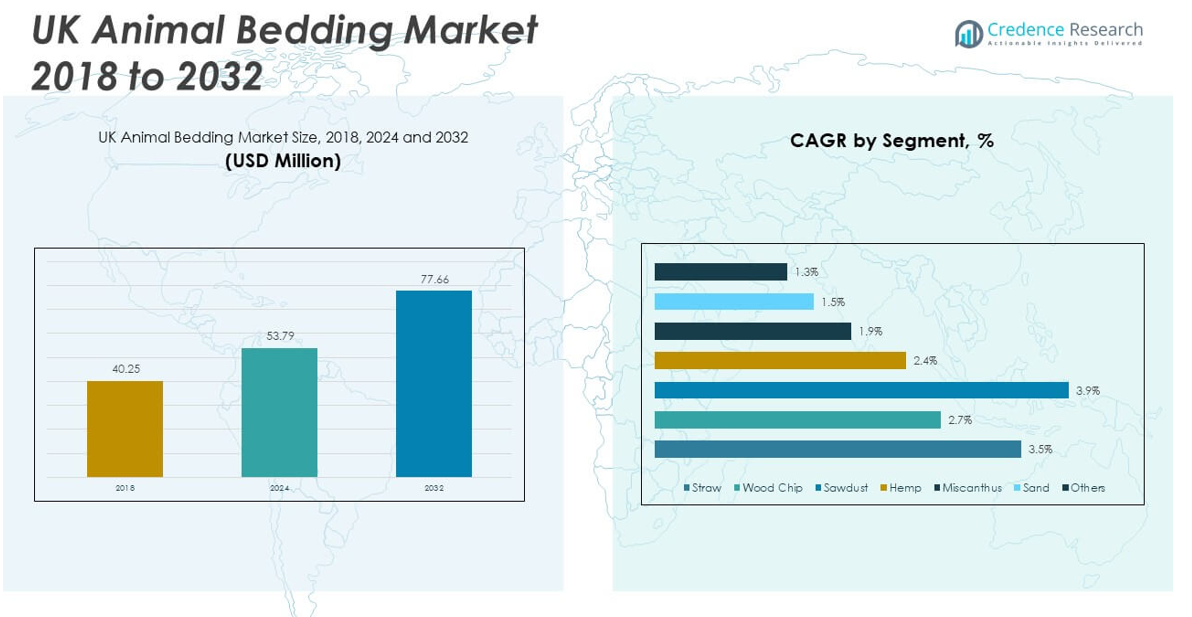
The UK Animal Bedding Market size was valued at USD 40.25 million in 2018 to USD 53.79 million in 2024 and is anticipated to reach USD 77.66 million by 2032, at a CAGR of 4.37% during the forecast period.
One of the key drivers propelling market growth is the significant rise in pet ownership across the UK, especially after the COVID-19 pandemic. As more households include small animals like rabbits, guinea pigs, hamsters, and reptiles, the demand for safe, absorbent, and low-dust bedding has surged. Consumers are increasingly inclined towards premium and sustainable options that ensure comfort and odor control. In parallel, the livestock sector continues to emphasize biosecurity and animal welfare, especially in dairy, poultry, and pig farming. Bedding is critical in reducing infections, maintaining temperature control, and supporting productivity. Farmers are adopting absorbent and low-moisture retention materials such as wood pellets and chopped straw to comply with regulatory standards. Additionally, the growing focus on environmental sustainability is shaping the market, with manufacturers introducing biodegradable, compostable, and recycled-material bedding products.
Regionally, England dominates the UK animal bedding market due to its high concentration of pet-owning households and extensive livestock operations. Urban centers such as London, Birmingham, and Manchester show strong retail and e-commerce demand for small animal bedding products, while rural regions in Yorkshire, the West Midlands, and the South West exhibit consistent demand from cattle, sheep, and equine farms. Scotland, Wales, and Northern Ireland also contribute significantly to the market, particularly in livestock-intensive areas such as the Scottish Highlands and Welsh uplands. These regions often require seasonally intensive bedding use during indoor housing periods, such as lambing or winter calving. Moreover, interest in natural and local materials is growing in these areas, driven by environmental awareness and support for regional suppliers. The distribution landscape is well-developed, with national chains like Pets at Home, regional farm supply cooperatives, and online platforms catering to a diverse set of customers.
Market Insights:
- The UK Animal Bedding Market was valued at USD 53.79 million in 2024 and is projected to reach USD 77.66 million by 2032, expanding at a CAGR of 4.37%.
- Surge in pet ownership post-COVID-19 continues to drive strong demand for absorbent, low-dust, and comfortable bedding for small mammals and exotic pets.
- Livestock farms are increasingly adopting high-performance bedding materials like wood pellets and chopped straw to meet hygiene and welfare regulations.
- Sustainability is a major market trend, with growing consumer preference for biodegradable, compostable, and recycled bedding made from hemp, paper, and straw.
- Product innovation is enhancing market competitiveness, with bedding tailored by species and function, improving hygiene, labor efficiency, and animal comfort.
- Rising costs of raw materials and ongoing supply chain disruptions challenge producers to balance quality and pricing, especially in agricultural segments.
- Regionally, England leads the market with 65% share, followed by Scotland (15%), Wales (12%), and Northern Ireland (8%), each shaped by local livestock density and pet ownership trends.
Market Drivers:
Surge in Pet Ownership and Emphasis on Animal Comfort Accelerates Bedding Demand
rising number of pet-owning households in the UK significantly drives demand for high-quality animal bedding. Small mammals such as rabbits, guinea pigs, hamsters, and reptiles require specific bedding types that support hygiene, comfort, and health. Consumers increasingly prefer absorbent, dust-free, and odor-controlling products to ensure optimal living conditions for their pets. Retailers are expanding their product ranges to meet expectations of convenience, quality, and sustainability. The UK Animal Bedding Market benefits from growing awareness about pet welfare and an emotional connection between owners and their animals. It continues to expand as consumers view pets as family members and invest in premium care products.
- For example, Small Pet Select UKoffers premium soft paper bedding made from 100% virgin fiber, specifically engineered to be 99% dust-free and free from additives, dyes, or irritants, directly addressing respiratory health concerns in small mammals. Their product absorbs moisture efficiently, reducing odor without artificial scent blockers.
Livestock Industry Adopts High-Performance Bedding to Support Hygiene and Welfare Compliance
The UK’s livestock sector relies on consistent bedding use to maintain animal health and comply with stringent welfare regulations. Dairy, poultry, and swine farms use bedding to manage waste, reduce disease risk, and improve comfort for animals in enclosed environments. Bedding products such as wood shavings, chopped straw, and paper pellets offer absorbency and moisture control, which help limit bacterial growth. Farmers adopt advanced bedding materials to align with regulatory requirements under farm assurance schemes and government guidelines. The UK Animal Bedding Market gains traction in rural regions where intensive farming demands large-scale, cost-effective bedding solutions. It responds to these needs with performance-oriented materials designed to enhance operational efficiency and herd wellbeing.
Sustainability Goals Push Demand for Eco-Friendly Bedding Alternatives
Environmental responsibility shapes purchasing behavior across both pet and livestock sectors. Consumers and commercial users seek biodegradable, compostable, and recycled bedding products that align with low-carbon practices. Manufacturers respond by introducing natural fiber-based bedding made from hemp, recycled paper, or straw, minimizing the ecological footprint. It reflects a shift toward ethical sourcing, waste reduction, and product transparency in the UK Animal Bedding Market. Retailers and distributors promote sustainable lines as part of their broader environmental strategies. The market gains momentum from this shift toward green product innovation and consumer preference for low-impact materials.
- For instance, Bearaby’s Pupper Podpet bed, launched in December 2022, is made from 100% natural organic rubber (melofoam) and features an OEKO-TEX-certified cotton cover, ensuring the product is biodegradable, cruelty-free, and free from harmful chemicals. The design provides deep touch pressure for stress reduction and includes a removable, machine-washable cover with a waterproof inner foam for easy cleaning.
Innovation in Product Performance and Customization Enhances Market Appeal
Product development plays a crucial role in supporting growth by meeting diverse customer requirements. Manufacturers invest in advanced formulations that improve absorbency, reduce dust, and extend usage intervals between replacements. Bedding products tailored for specific animal types-whether equine, poultry, or small pets-offer targeted features and superior performance. It allows users to select products that match their species-specific needs, housing conditions, and hygiene standards. The UK Animal Bedding Market evolves with innovations that add value, reduce labor, and elevate animal care standards. The presence of customizable and multifunctional solutions strengthens long-term adoption across domestic and agricultural applications.
Market Trends:
Expansion of E-Commerce Channels Is Redefining Consumer Access and Convenience
The rapid growth of online retail platforms has significantly influenced how consumers purchase animal bedding across the UK. Pet owners and livestock managers now explore a broader range of brands, materials, and pack sizes from online stores. E-commerce enables direct-to-door delivery, subscription services, and price comparisons that enhance purchasing efficiency. It supports niche suppliers and start-ups in reaching a national audience without relying on physical distribution. The UK Animal Bedding Market has adapted to this shift by strengthening its presence across digital marketplaces and enhancing mobile ordering capabilities. It continues to benefit from evolving digital behavior and rising consumer expectations for convenience and variety.
Growth in Specialty Bedding Categories Is Creating New Revenue Streams
Manufacturers are introducing specialized bedding lines designed to cater to specific needs of animals with allergies, respiratory conditions, or orthopedic requirements. These products often feature hypoallergenic, antibacterial, or therapeutic properties that provide comfort and support health. Specialty categories also include color-coded bedding for lab animals and enriched textures for behavioral enrichment. It encourages consumers to explore functional products beyond standard materials, increasing brand differentiation. The UK Animal Bedding Market sees rising interest in this segment among both pet owners and research facilities seeking superior performance. It supports premiumization by offering targeted solutions that justify higher price points.
Private Label Expansion by Retail Chains Is Intensifying Competition
Leading UK retailers are launching their own private-label animal bedding products to capture value-conscious segments and reinforce brand loyalty. These offerings often match the quality of branded alternatives while offering competitive pricing and in-store promotions. Supermarkets, pet care chains, and farm supply outlets are allocating shelf space to store brands that feature recyclable packaging and consumer-trusted claims. It places pressure on national and niche manufacturers to innovate and differentiate through features, packaging, or eco-certifications. The UK Animal Bedding Market reflects this trend with a growing number of private labels competing across all price tiers. It adds complexity to purchasing decisions and reshapes brand positioning strategies.
- For example, fine Bedding Company, a major private label supplier, operates a state-of-the-art eco-factory in Estonia powered entirely by renewable energy and certified as a B Corporation, reflecting a verified commitment to sustainability.
Rising Integration of Smart Packaging and QR Codes Enhances Transparency
Technology is increasingly being integrated into product packaging to offer traceability, usage instructions, and real-time information access. Brands are embedding QR codes on bedding packs that direct consumers to educational content, sourcing details, and recycling instructions. This approach supports transparency, engages tech-savvy customers, and aligns with modern marketing strategies. It enables brands to build trust while reinforcing claims around sustainability or product safety. The UK Animal Bedding Market is witnessing gradual adoption of such features in both premium and mid-range segments. It signals a shift toward smarter consumer interaction and digitally supported brand communication.
- For example, Metsä Board, a key supplier, began incorporating QR codes on all paperboard deliveries in November 2024, allowing customers to access detailed recycling guidance via a dedicated app.
Market Challenges Analysis:
Rising Raw Material Costs and Supply Chain Instability Disrupt Market Dynamics
Volatility in raw material costs poses a significant challenge for manufacturers and suppliers in the UK animal bedding sector. Fluctuations in prices of wood shavings, straw, paper pulp, and hemp affect production expenses and compress profit margins. Supply chain disruptions-driven by weather-related crop failures, global trade instability, or regional shortages-make consistent sourcing difficult. It increases reliance on imports or alternative materials, which may not meet the same performance or sustainability standards. The UK Animal Bedding Market faces pressure to maintain price competitiveness while preserving product quality, especially in cost-sensitive livestock segments. Manufacturers must navigate these challenges through procurement strategies, material innovation, or closer supplier collaboration.
Waste Management and Disposal Regulations Add Operational Complexity
Stringent environmental regulations surrounding waste disposal and compostability of used bedding create compliance burdens for farms and consumers. Bedding materials, especially those mixed with animal waste, require proper handling and disposal to prevent pollution or biohazards. It increases the demand for clear labelling, waste management solutions, and on-site composting guidance. Some regions enforce specific rules on waste bedding from livestock, complicating logistics and increasing costs. The UK Animal Bedding Market must align with evolving environmental standards without compromising performance or affordability. Producers need to ensure product compatibility with current waste infrastructure while educating end-users on responsible disposal practices.
Market Opportunities:
Product Diversification for Species-Specific and Medical Use Offers New Growth Avenues
There is growing demand for animal bedding tailored to specific species and medical needs. Products designed for animals with respiratory sensitivities, orthopedic conditions, or post-operative recovery create room for premium and functional bedding solutions. Brands can capitalize by offering targeted variants for horses, reptiles, birds, and laboratory animals. The UK Animal Bedding Market can expand its consumer base by serving underserved niches with specialized features. It enables better alignment with veterinary advice, welfare standards, and owner expectations. Custom formulations enhance perceived value and support brand differentiation in a crowded marketplace.
Export Potential for Eco-Friendly Bedding Strengthens Long-Term Outlook
Global markets show rising interest in sustainable animal care products, creating export opportunities for UK-based bedding manufacturers. Products made from locally sourced, biodegradable, or recycled materials appeal to buyers in Europe and beyond. It positions UK suppliers as reliable partners in the growing green economy. The UK Animal Bedding Market can leverage its regulatory alignment, product quality, and innovation to build a stronger export presence. Government support for green manufacturing and international trade can further enable this expansion. Strategic partnerships and certifications will help UK firms scale responsibly into new markets.
Market Segmentation Analysis:
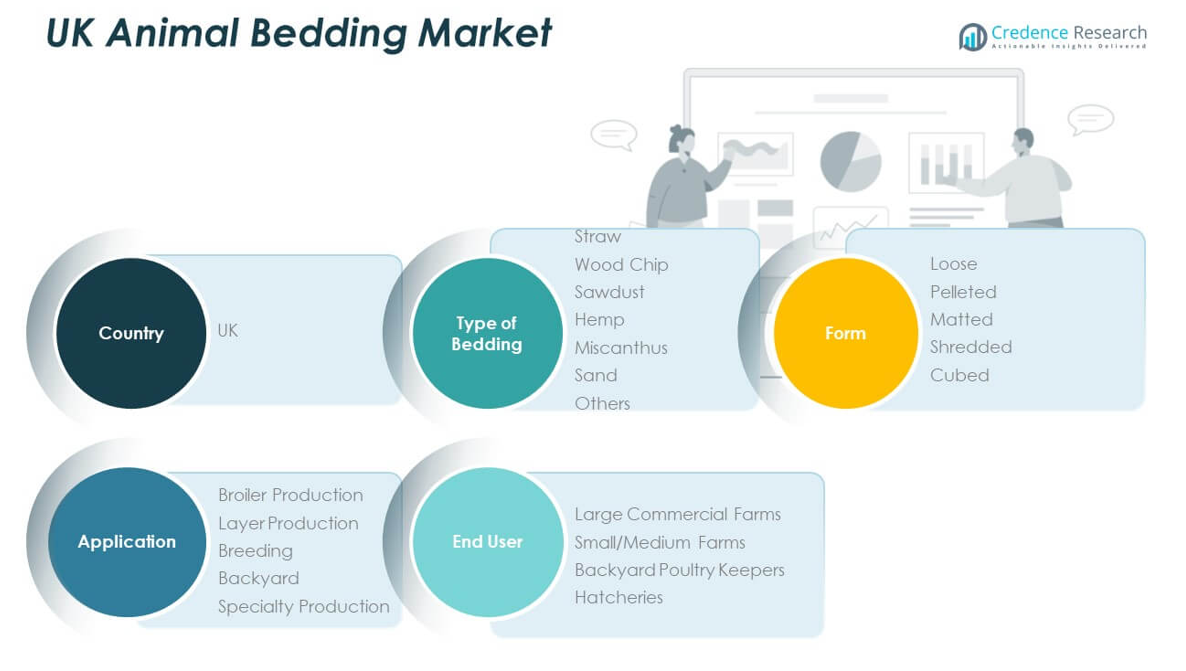
The UK Animal Bedding Market is segmented by type of bedding, form, application, and end user, reflecting its diverse usage across pet care and livestock management.
By type of bedding, straw, wood chip, and sawdust dominate the market due to their availability, absorbency, and cost-effectiveness. Hemp and miscanthus are gaining interest as sustainable alternatives, while sand and other materials cater to niche or specialized requirements.
- For example, Miscanthus bedding, produced by Terravesta, is now supplied to over 350 UK poultry and equine farms, with documented ammonia reduction rates of up to 40% compared to straw, as detailed in their 2024 technical datasheet.
By form, loose bedding remains the most widely used across both pet and farm applications, supported by its ease of handling and cost efficiency. Pelleted and shredded forms are popular in urban pet settings and equine care for their low dust and convenience. Matted and cubed forms serve smaller but growing segments such as specialty animal care and laboratory use.
- For example, Sorbeo’s wood pellet horse bedding, made from 100% Scottish spruce pine, now represents 20% of the UK horse bedding marketdue to its high absorbency, virtually dust-free nature, and ease of use; each 18kg bag expands to three times its volume and is favored for its consistent quality and environmental credentials.
By application, broiler and layer production drive demand in poultry operations, while breeding and specialty production support usage in high-care environments. Backyard use remains steady, driven by hobbyists and smallholders.
By end user, large commercial farms represent the dominant share, followed by small and medium farms. Backyard poultry keepers and hatcheries contribute steadily, supported by targeted product offerings and retail accessibility. The UK Animal Bedding Market continues to diversify across these segments to meet changing user demands.
Segmentation:
By Type of Bedding
- Straw
- Wood Chip
- Sawdust
- Hemp
- Miscanthus
- Sand
- Others
By Form
- Loose
- Pelleted
- Matted
- Shredded
- Cubed
By Application
- Broiler Production
- Layer Production
- Breeding
- Backyard
- Specialty Production
By End User
- Large Commercial Farms
- Small/Medium Farms
- Backyard Poultry Keepers
- Hatcheries
Regional Analysis:
England holds the largest share of the UK Animal Bedding Market, accounting for 65% of the total market value. It leads in both pet and livestock bedding demand due to a high concentration of pet-owning households and intensive farming operations. Regions such as Yorkshire, the West Midlands, and the South West contribute significantly through large-scale cattle, sheep, and equine farms. Urban centers like London, Manchester, and Birmingham drive pet bedding sales through retail and e-commerce channels. The presence of national chains and specialty suppliers strengthens product availability and consumer reach. It benefits from infrastructure, dense population, and established distribution networks, reinforcing its market leadership.
Scotland represents 15% of the UK Animal Bedding Market, with strong demand from sheep farming and dairy operations, particularly in the Highlands and Southern Uplands. Seasonal bedding use during lambing and indoor winter housing supports volume demand. Local preferences for natural and bulk materials influence product selection, with straw and wood shavings being widely used. Equestrian activities and hobby farming also contribute to steady sales in rural communities. It shows rising interest in sustainable alternatives sourced from local materials. Regional distributors play a key role in reaching remote farms and pet owners.
Wales contributes 12% to the overall market, driven by upland livestock farming and growing small-animal ownership in semi-urban areas. Farmers prioritize absorbent and cost-effective bedding for cattle and sheep kept indoors during colder months. The equine sector, especially in South Wales, supports demand for low-dust and therapeutic bedding products. It faces logistical challenges in remote areas, but ongoing expansion of rural supply chains improves access to specialized products. Consumer behavior increasingly aligns with national trends favoring sustainability and animal welfare.
Northern Ireland holds an 8% market share, supported by cattle farming, poultry production, and a stable equestrian segment. Bedding usage is closely linked to livestock housing practices and farm scale. Pet bedding sales remain modest but show growth in urban centers such as Belfast and Derry. It benefits from strong ties to both UK and Irish suppliers, creating a competitive distribution environment. Demand for compostable and low-waste options continues to rise, especially among environmentally conscious users in both commercial and domestic sectors.
Key Player Analysis:
- Arden Wood Shavings
- Animal Comfort Ltd
- Bodens Group
- Bomford Turner Ltd
- Capper Animal Feeds
- Easichick
- EnviroSystems
- Janbor Ltd
- H. Winterton & Son
- Wynnstay Group Plc
Competitive Analysis:
The UK Animal Bedding Market features a mix of established manufacturers, private label brands, and regional suppliers competing across pet and livestock segments. Key players focus on product performance, eco-friendliness, and pricing to gain competitive advantage. Leading companies offer wood shavings, paper-based bedding, straw pellets, and niche variants tailored to species-specific needs. Private label expansion by retail chains intensifies competition in the budget and mid-range categories. Local suppliers maintain strong positions in rural markets through bulk supply and regional distribution networks. It sees innovation in sustainable materials and packaging, which supports brand differentiation. Digital engagement and e-commerce integration help firms strengthen customer retention and expand reach across diverse consumer groups.
Market Concentration & Characteristics:
The UK Animal Bedding Market is moderately fragmented, with a combination of national brands, private labels, and local suppliers catering to distinct consumer needs. It supports diverse product offerings across pet, equine, and livestock applications, with no single player dominating the entire market. The presence of private label products from large retail chains has increased competition in price-sensitive segments. Regional suppliers hold strong positions in agricultural zones by offering bulk and customizable solutions. The market emphasizes product functionality, hygiene, sustainability, and species compatibility. It shows seasonal demand fluctuations, particularly in livestock farming during colder months. Branding, packaging, and regulatory compliance remain key characteristics influencing purchasing decisions.
Report Coverage:
The research report offers an in-depth analysis based on type of bedding, form, application, and end user. It details leading market players, providing an overview of their business, product offerings, investments, revenue streams, and key applications. Additionally, the report includes insights into the competitive environment, SWOT analysis, current market trends, as well as the primary drivers and constraints. Furthermore, it discusses various factors that have driven market expansion in recent years. The report also explores market dynamics, regulatory scenarios, and technological advancements that are shaping the industry. It assesses the impact of external factors and global economic changes on market growth. Lastly, it provides strategic recommendations for new entrants and established companies to navigate the complexities of the market.
Future Outlook:
- Demand for premium pet bedding will rise with increasing pet humanization and health-conscious consumer behavior.
- Livestock farms will adopt more hygienic and absorbent bedding to meet welfare and biosecurity standards.
- Growth of e-commerce platforms will enhance product accessibility and broaden customer reach nationwide.
- Manufacturers will invest in eco-friendly materials such as recycled paper, hemp, and biodegradable fibers.
- Expansion of private label bedding by major retailers will intensify price competition across categories.
- Innovation in odor control, dust reduction, and antimicrobial properties will drive product differentiation.
- Smart packaging with traceability and user engagement features will improve brand transparency.
- Seasonal demand shifts, especially in livestock housing, will continue to shape supply strategies.
- Export potential for sustainable UK-made bedding products will increase across European markets.
- Strategic partnerships with veterinary professionals and farm cooperatives will strengthen product positioning.

Request a Free Sample
Fill in your details and we'll send you a free sample report.
- Sample data tables & charts
- Research methodology
Market Dynamics
Surge in Pet Ownership and Animal Comfort
The significant increase in pet-owning households in the UK, especially post-pandemic, is driving demand for high-quality, absorbent, and low-dust bedding for small mammals and exotic pets. Consumers are prioritizing products that ensure hygiene, comfort, and odor control for their animals.
Livestock Welfare and Regulatory Compliance
UK livestock farms are increasingly adopting advanced bedding materials such as wood pellets and chopped straw to meet strict hygiene and animal welfare regulations. Bedding is essential for reducing infection risk, maintaining temperature, and supporting productivity in dairy, poultry, and pig farming.
Sustainability and Eco-Friendly Materials
Growing environmental awareness is pushing both pet owners and farmers to seek biodegradable, compostable, and recycled bedding options. Manufacturers are responding with innovative products made from hemp, recycled paper, and straw, aligning with consumer values and regulatory trends.
Product Innovation and Customization
Manufacturers are developing bedding tailored to specific animal species and needs, such as hypoallergenic or orthopedic bedding, which enhances animal welfare and meets diverse customer requirements. This innovation supports premiumization and market differentiation.
Expansion of E-Commerce and Private Label Offerings
The rise of online retail and private label bedding by major retailers is making animal bedding more accessible and affordable, broadening the customer base and intensifying competition across all price tiers.
Need a Custom Version of This Report?
Tailor the scope, geography, or segments to your exact requirements.
- Custom geography or segment scope
- Direct access to our analyst team
Frequently Asked Questions
What is the current size of the UK Animal Bedding Market?
What are the key segments within the UK Animal Bedding Market?
What are some challenges faced by the UK Animal Bedding Market?
Who are the major players in the UK Animal Bedding Market?
Table of Content
Chapter 1 Market Segmentation
- 1.1 Segmentation Framework
- 1.1.1 Product and Service Classification
- 1.1.2 Application and End-Use Classification
- 1.1.3 Technology and Solution Classification
- 1.1.4 Customer and Distribution Channel Classification
- 1.1.5 Geographic Segmentation
- 1.1.6 Market Segment Definitions and Boundaries
- 1.2 By Form
- 1.2.1 Loose
- 1.2.2 Pelleted
- 1.2.3 Matted
- 1.2.4 Shredded
- 1.2.5 Cubed
- 1.3 By End User
- 1.3.1 Large Commercial Farms
- 1.3.2 Small/Medium Farms
- 1.3.3 Backyard Poultry Keepers
- 1.3.4 Hatcheries
- 1.4 By Application
- 1.4.1 Broiler Production
- 1.4.2 Layer Production
- 1.4.3 Breeding
- 1.4.4 Backyard
- 1.4.5 Specialty Production
- 1.5 By Type of Bedding
- 1.5.1 Straw
- 1.5.2 Wood Chip
- 1.5.3 Sawdust
- 1.5.4 Hemp
- 1.5.5 Miscanthus
- 1.5.6 Sand
- 1.5.7 Others
Chapter 2 Introduction
- 2.1 Report Objectives and Scope
- 2.2 Product Definition and Industry Terminology
- 2.3 Market Inclusions and Exclusions
- 2.4 Research Process
- 2.4.1 Primary Research and Expert Interviews
- 2.4.2 Secondary Research and Source Review
- 2.4.3 Top-Down and Bottom-Up Estimation
- 2.4.4 Data Triangulation and Verification
- 2.5 Market Size Measurement Basis
- 2.5.1 2024: USD 53.79 million → 2032: USD 77.66 million
- 2.6 Historical and Forecast Reference Periods
- 2.6.1 Base Year: 2024
- 2.6.2 Forecast Period: 2024-2032
- 2.7 Research Assumptions and Limitations
Chapter 3 Executive Summary
- 3.1 Market Snapshot and Key Findings
- 3.2 Base-Year Market Size, 2024
- 3.3 Forecast Market Size, 2032
- 3.4 Revenue and Volume Growth Outlook
- 3.5 Key Demand and Supply Indicators
- 3.6 Leading Market Segments
- 3.7 Fastest-Growing Market Opportunities
- 3.8 Regional Performance Highlights
- 3.9 Technology and Industry Transformation
- 3.10 Competitive Landscape Summary
- 3.11 Analyst View and Strategic Implications
Chapter 4 UK Animal Bedding Market Trends and Developments
- 4.1 Historical Industry Development
- 4.2 Recent Market Trends and Developments
- 4.3 Demand and Customer Behavior Trends
- 4.4 Technology and Product Innovation
- 4.5 Artificial Intelligence, Automation and Digitalization
- 4.6 Local Manufacturing and Supply Chain Realignment
- 4.7 Industry Partnerships, Mergers and Acquisitions
- 4.8 Sustainability and Circular Economy Developments
- 4.9 Government and Private Sector Investment Trends
- 4.10 Emerging Business Models and Commercialization
- 4.11 Industry Developments and Announcements
Chapter 5 UK Animal Bedding Market Production, Supply and Demand Analysis
- 5.1 Demand Trend and Consumption Analysis
- 5.2 Demand Forecast, 2024-2032
- 5.3 Production and Output Trend
- 5.4 Production and Output Forecast, 2024-2032
- 5.5 Installed Capacity and Capacity Utilization
- 5.6 Company-Wise Production Plants and Statistics
- 5.6.1 Installed Production Capacity
- 5.6.2 Actual Production
- 5.6.3 Planned Capacity and Expansion Targets
- 5.7 Supply Chain Structure and Procurement Trends
- 5.8 Supply-Demand Gap and Bottlenecks
- 5.9 Import Dependence and Sourcing Structure
- 5.10 Contract Manufacturing and Outsourcing
- 5.11 Regional Supply and Demand Concentration
Chapter 6 UK Animal Bedding Market Pricing Analysis
- 6.1 Pricing Structure and Measurement
- 6.2 Historical Pricing Trends
- 6.3 Pricing Outlook, 2024-2032
- 6.4 Average Selling Price and Unit Economics
- 6.5 Pricing by Product and Market Segment
- 6.6 Geographic Pricing Differences
- 6.7 Key Input, Energy, Labor and Logistics Costs
- 6.8 Contract Pricing and Purchasing Models
- 6.9 Pricing Sensitivity and Competitive Positioning
- 6.10 Price, Margin and Profitability Implications
Chapter 7 UK Animal Bedding Market Dynamics
- 7.1 Market Growth Drivers
- 7.1.1 Demand-Side Drivers
- 7.1.2 Technology and Innovation Drivers
- 7.1.3 Infrastructure and Investment Drivers
- 7.1.4 Regulatory and Policy Drivers
- 7.2 Market Restraints
- 7.2.1 Cost and Affordability Constraints
- 7.2.2 Technology and Adoption Barriers
- 7.2.3 Supply Chain and Operational Constraints
- 7.3 Market Challenges
- 7.3.1 Competitive Pressure and Margin Erosion
- 7.3.2 Skills, Infrastructure and Implementation Gaps
- 7.4 Emerging Market Opportunities
- 7.5 Market Dynamics Impact and Time-Horizon Assessment
Chapter 8 UK Animal Bedding Value Chain Analysis
- 8.1 Industry Value Chain Overview
- 8.2 Upstream Suppliers and Critical Inputs
- 8.3 Technology and Component Providers
- 8.4 Manufacturing or Service Delivery
- 8.5 Distribution, Channel Partners and Integrators
- 8.6 Downstream Applications and End Users
- 8.7 Value Addition and Profit Pools
- 8.8 Vertical Integration and Outsourcing
- 8.9 Supplier Concentration and Risk
- 8.10 Supply Chain Localization and Resilience
Chapter 9 UK Animal Bedding Market Regulations and Policies
- 9.1 Relevant Laws, Standards and Compliance Frameworks
- 9.2 Product, Service, Safety and Quality Requirements
- 9.3 Government Policies, Incentives and Subsidies
- 9.4 Imports, Exports and Trade Barriers
- 9.5 Public Procurement and Local Content Requirements
- 9.6 Environmental and Sustainability Compliance
- 9.7 Upcoming Policy Changes and Market Implications
Chapter 10 UK Animal Bedding Market Hotspots and Opportunities
- 10.1 Market Opportunity Mapping and Growth Hotspots
- 10.2 High-Growth Applications and Customer Groups
- 10.3 Underserved Markets and White-Space Opportunities
- 10.4 Emerging Technology and Product Opportunities
- 10.5 New Capacity and Investment Hotspots
- 10.6 Market Entry and Expansion Opportunities
- 10.7 Distribution and Partnership Opportunities
- 10.8 Near-Term and Long-Term Commercial Potential
- 10.9 Opportunity Attractiveness and Execution Risks
Chapter 11 UK Animal Bedding Market Outlook, 2024-2032
- 11.1 Market Size and Analysis
- 11.1.1 Revenue (Market Measurement: 2024: USD 53.79 million → 2032: USD 77.66 million)
- 11.1.2 Market Volume and Quantity Sold
- 11.1.3 Historical Market Size
- 11.1.4 Base-Year Market Size, 2024
- 11.2 Market Forecast, 2024-2032
- 11.2.1 Revenue Forecast to 2032
- 11.2.2 Volume Forecast to 2032
- 11.2.3 CAGR and Year-on-Year Growth
- 11.2.4 Incremental Revenue Opportunity
- 11.3 Forecast Assumptions and Scenario Analysis
- 11.3.1 Base-Case Forecast
- 11.3.2 Optimistic and Conservative Scenarios
- 11.3.3 Technology, Pricing and Policy Sensitivities
- 11.4 Market Attractiveness and Growth Outlook
Chapter 12 UK Animal Bedding Market Segmentation and Outlook
- 12.1 Segmentation Summary and Market Shares, 2024
- 12.2 Largest and Fastest-Growing Segments
- 12.3 By Form - Market Size and Forecast, 2024-2032
- 12.3.1 Segment Definition and Scope
- 12.3.2 Historical Market Size
- 12.3.3 Revenue Forecast, 2024-2032
- 12.3.4 Volume Forecast, 2024-2032
- 12.3.5 Base-Year Market Share, 2024
- 12.3.6 Segment CAGR and Growth Drivers
- 12.3.7 Subsegment Market Size and Forecast
- 12.3.7.1 Loose
- 12.3.7.2 Pelleted
- 12.3.7.3 Matted
- 12.3.7.4 Shredded
- 12.3.7.5 Cubed
- 12.3.8 Subsegment Pricing and Adoption Trends
- 12.3.9 Leading Suppliers and Competition
- 12.3.10 Regional Demand and Opportunities
- 12.4 By End User - Market Size and Forecast, 2024-2032
- 12.4.1 Segment Definition and Scope
- 12.4.2 Historical Market Size
- 12.4.3 Revenue Forecast, 2024-2032
- 12.4.4 Volume Forecast, 2024-2032
- 12.4.5 Base-Year Market Share, 2024
- 12.4.6 Segment CAGR and Growth Drivers
- 12.4.7 Subsegment Market Size and Forecast
- 12.4.7.1 Large Commercial Farms
- 12.4.7.2 Small/Medium Farms
- 12.4.7.3 Backyard Poultry Keepers
- 12.4.7.4 Hatcheries
- 12.4.8 Subsegment Pricing and Adoption Trends
- 12.4.9 Leading Suppliers and Competition
- 12.4.10 Regional Demand and Opportunities
- 12.5 By Application - Market Size and Forecast, 2024-2032
- 12.5.1 Segment Definition and Scope
- 12.5.2 Historical Market Size
- 12.5.3 Revenue Forecast, 2024-2032
- 12.5.4 Volume Forecast, 2024-2032
- 12.5.5 Base-Year Market Share, 2024
- 12.5.6 Segment CAGR and Growth Drivers
- 12.5.7 Subsegment Market Size and Forecast
- 12.5.7.1 Broiler Production
- 12.5.7.2 Layer Production
- 12.5.7.3 Breeding
- 12.5.7.4 Backyard
- 12.5.7.5 Specialty Production
- 12.5.8 Subsegment Pricing and Adoption Trends
- 12.5.9 Leading Suppliers and Competition
- 12.5.10 Regional Demand and Opportunities
- 12.6 By Type of Bedding - Market Size and Forecast, 2024-2032
- 12.6.1 Segment Definition and Scope
- 12.6.2 Historical Market Size
- 12.6.3 Revenue Forecast, 2024-2032
- 12.6.4 Volume Forecast, 2024-2032
- 12.6.5 Base-Year Market Share, 2024
- 12.6.6 Segment CAGR and Growth Drivers
- 12.6.7 Subsegment Market Size and Forecast
- 12.6.7.1 Straw
- 12.6.7.2 Wood Chip
- 12.6.7.3 Sawdust
- 12.6.7.4 Hemp
- 12.6.7.5 Miscanthus
- 12.6.7.6 Sand
- 12.6.7.7 Others
- 12.6.8 Subsegment Pricing and Adoption Trends
- 12.6.9 Leading Suppliers and Competition
- 12.6.10 Regional Demand and Opportunities
- 12.7 Segment Growth Comparison
- 12.8 Segment Attractiveness and Priority Matrix
Chapter 13 UK Animal Bedding End-Use and Application Market Outlook
- 13.1 End-Use Industry and Customer Demand Structure
- 13.2 Leading Applications and Customer Groups
- 13.3 End-Use Market Size, Share and Forecast
- 13.4 Major End-Use Industry Deep Dives
- 13.4.1 Customer Requirements and Use Cases
- 13.4.2 Demand and Replacement Cycles
- 13.4.3 Technical and Regulatory Considerations
- 13.4.4 Purchasing and Procurement Models
- 13.4.5 Leading Vendors and Distribution Channels
- 13.4.6 Forecast and Commercial Opportunities
- 13.5 Emerging Applications and Cross-Segment Demand
- 13.6 End-Use Industry Investment Priorities
Chapter 14 UK Animal Bedding Geographic Market Outlook, 2024-2032
- 14.1 Domestic Market Distribution and Demand Clusters
- 14.2 State- or Province-Wise Market Size and Forecast, 2024-2032
- 14.3 City and Metropolitan Market Outlook
- 14.4 Industrial, Manufacturing and Commercial Clusters
- 14.5 Geographic Concentration of Key End Users
- 14.6 Local Pricing and Purchasing Differences
- 14.7 Domestic Production Facilities and Capacity Map
- 14.8 Local Infrastructure and Project Pipeline
- 14.9 State-Level Policy and Incentive Differences
- 14.10 Subnational Investment Hotspots and Opportunities
- 14.11 Distribution and Logistics Networks
- 14.12 Domestic Competitive Footprint
Chapter 15 UK Animal Bedding Technology, Innovation and Sustainability Outlook
- 15.1 Technology Landscape and Maturity
- 15.2 Product, Process and Service Innovation
- 15.3 AI, Automation and Digital Tools in the Industry
- 15.4 Technology Adoption and Performance Benchmarking
- 15.5 Innovation Pipeline and R&D Investment
- 15.6 Patent and Intellectual Property Trends
- 15.7 Energy Efficiency and Resource Management
- 15.8 Sustainability, Recycling and Circularity
- 15.9 Technology Roadmap, 2024-2032
- 15.10 Risks of Obsolescence and Technology Substitution
Chapter 16 UK Animal Bedding Market Key Strategic Imperatives
- 16.1 Growth and Market Entry Priorities
- 16.2 High-Return Products and Segments
- 16.3 Pricing, Profitability and Cost Optimization
- 16.4 Technology Investment and Product Differentiation
- 16.5 Supply Chain Localization and Resilience
- 16.6 Distribution and Customer Acquisition
- 16.7 Partnership, Acquisition and Capacity Strategy
- 16.8 Regional Expansion Priorities
- 16.9 Short-, Medium- and Long-Term Actions
Chapter 17 Competition Outlook
- 17.1 Industry Competition Characteristics
- 17.2 Market Structure and Concentration
- 17.3 Market Share and Competitive Positioning, 2024
- 17.4 Company-Wise Revenue and Product Benchmarking
- 17.5 Production and Service Capacity Benchmarking
- 17.6 Technology, Pricing and Differentiation
- 17.7 Regional Footprint and Distribution Strength
- 17.8 Mergers, Acquisitions and Strategic Alliances
- 17.9 New Entrants and Competitive Threats
- 17.10 Porter's Five Forces and Industry Attractiveness
- 17.11 Competitive Outlook, 2024-2032
Chapter 18 Company Profiles
- 18.1 Company Coverage and Selection Criteria
- 18.2 Arden Wood Shavings
- 18.2.1 Business Description
- 18.2.2 Company Ownership and Geographic Presence
- 18.2.3 Product and Service Portfolio
- 18.2.4 Manufacturing and Operating Footprint
- 18.2.5 Production Capacity and Expansion Plans
- 18.2.6 Financial Performance and Investment
- 18.2.7 Market Share and Competitive Position
- 18.2.8 Technology and Innovation Capabilities
- 18.2.9 Strategic Alliances or Partnerships
- 18.2.10 Recent Developments
- 18.2.11 Growth Strategy and Outlook
- 18.3 Animal Comfort Ltd
- 18.4 Bodens Group
- 18.5 Bomford Turner Ltd
- 18.6 Capper Animal Feeds
- 18.7 Easichick
- 18.8 EnviroSystems
- 18.9 Janbor Ltd
- 18.10 H. Winterton & Son
- 18.11 Wynnstay Group Plc
- 18.12 Other Relevant Market Participants
Note: Every listed company is profiled on the structure shown under the first company. The company list is preliminary and may change based on research findings, market developments, data availability and client requirements.
Chapter 19 Disclaimer
- 19.1 Research and Forecast Disclaimer
- 19.2 Data Source and Estimation Limitations
Note: The depth of individual sections depends on data availability for this market. Volume, capacity, trade and other unit-based metrics are included where applicable.

