
Utility Scale Mineral-Based Electrical Bushing Market Overview:
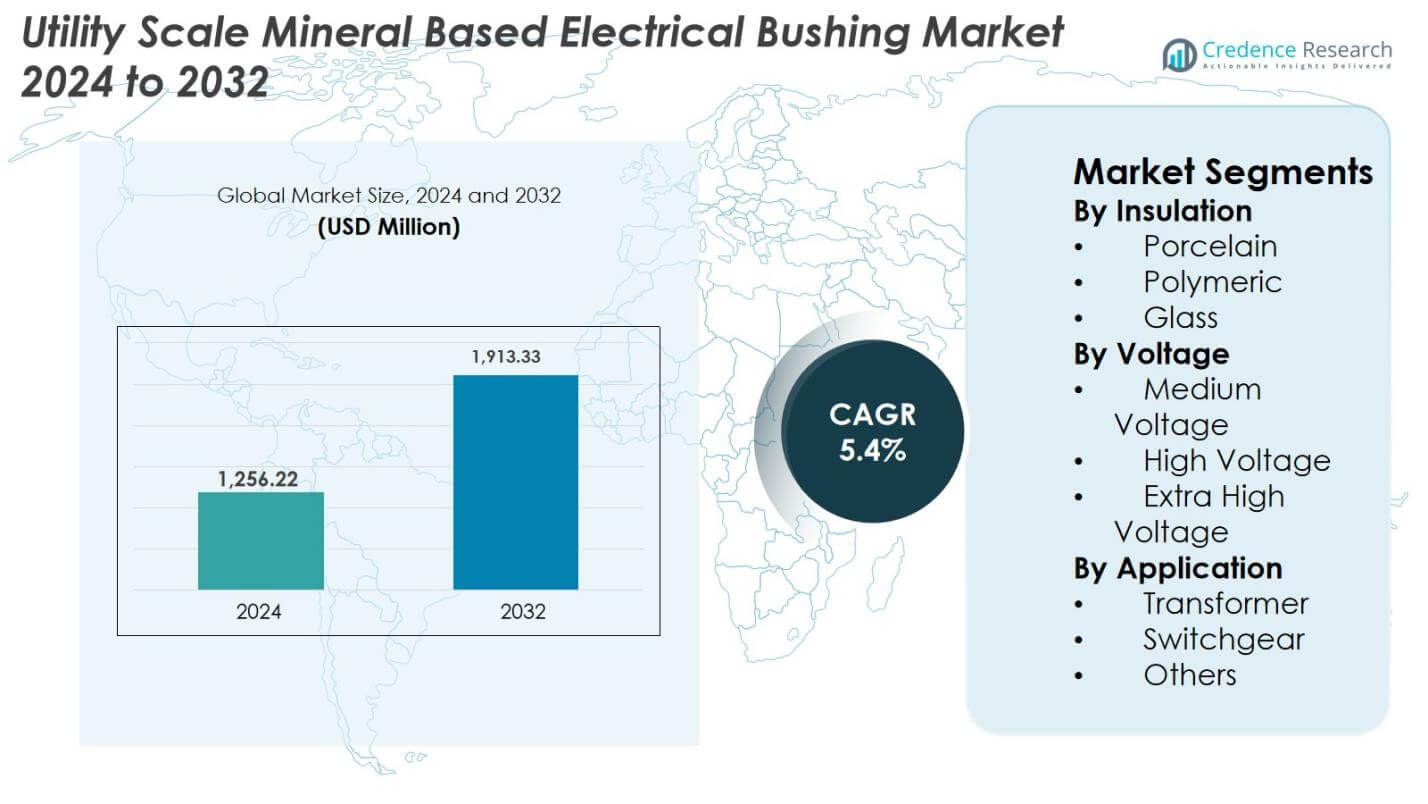
Utility Scale Mineral Based Electrical Bushing market size was valued at USD 1,256.22 million in 2024 and is anticipated to reach USD 1,913.33 million by 2032, growing at a CAGR of 5.4% during the forecast period.
| REPORT ATTRIBUTE | DETAILS |
|---|---|
| Historical Period | 2020-2024 |
| Base Year | 2025 |
| Forecast Period | 2026-2032 |
| Utility Scale Mineral-Based Electrical Bushing Market Size 2024 | USD 1,256.22 million |
| Utility Scale Mineral-Based Electrical Bushing Market, CAGR | 5.4% |
| Utility Scale Mineral-Based Electrical Bushing Market Size 2032 | USD 1,913.33 million |
Utility Scale Mineral-Based Electrical Bushing Market Insights
- Market growth is primarily driven by expansion and modernization of transmission and distribution infrastructure, rising renewable energy integration, and large-scale replacement of aging transformers and substations requiring reliable mineral-based insulation solutions.
- A key market trend is the rising demand for high-voltage applications, which account for nearly 44.2% segment share, supported by long-distance transmission projects, grid interconnections, and increased focus on system reliability and operational safety.
- The competitive landscape is characterized by the presence of global electrical equipment manufacturers competing on product reliability, compliance with utility standards, and strong after-sales support for long-life grid assets.
- Regionally, Asia-Pacific leads with 34.6% market share, followed by North America at 28.4% and Europe at 25.1%, while Latin America and the Middle East & Africa collectively represent steady growth markets driven by grid expansion and electrification initiatives.
Utility Scale Mineral-Based Electrical Bushing Market Segmentation Analysis
By Insulation
The Utility Scale Mineral Based Electrical Bushing market, by insulation type, is dominated by porcelain, which accounts for approximately 48.6% market share. Porcelain bushings remain widely adopted due to their proven mechanical strength, excellent thermal stability, and long service life in high-voltage outdoor environments. Utilities continue to prefer porcelain for large power transformers and substations operating under harsh climatic conditions. Polymeric bushings are gaining traction because of their lighter weight and pollution resistance, while glass insulation maintains niche adoption in specific grid applications. However, reliability, cost efficiency, and established standards continue to sustain porcelain’s leadership.
- For instance, Hitachi Energy supplies oil-impregnated porcelain bushings for extra-high-voltage transformers, designed for continuous operation above 400 kV with proven performance in extreme temperature and seismic conditions across global transmission projects.
By Voltage
Based on voltage rating, the Utility Scale Mineral Based Electrical Bushing market is led by the high voltage segment, holding around 44.2% market share. High voltage bushings are essential for transmission substations and step-up transformers supporting expanding power grids and renewable energy integration. Rising investments in grid modernization, cross-border transmission lines, and replacement of aging infrastructure strongly drive this segment. Medium voltage bushings support distribution networks and industrial substations, while extra high voltage bushings are witnessing steady growth due to ultra-high-voltage transmission projects. Nevertheless, the scale and frequency of high voltage installations reinforce its dominant position.
- For instance, ABB has deployed high voltage condenser bushings for power transformers exceeding 245 kV, engineered to meet IEC and IEEE standards and validated for long-term operation in grid modernization and cross-border transmission programs.
By Application
By application, transformers represent the dominant sub-segment in the Utility Scale Mineral Based Electrical Bushing market, accounting for nearly 57.8% market share. Transformer bushings are critical components enabling safe electrical insulation and current transfer in power generation and transmission systems. Growth in utility-scale transformers for renewable integration, grid expansion, and capacity upgrades directly supports this segment. Switchgear applications follow, driven by substation automation and grid reliability initiatives, while other applications include reactors and specialized equipment. The central role of transformers in power networks and their high bushing replacement demand underpin sustained dominance.
Key Growth Drivers
Expansion of Power Transmission & Distribution Infrastructure
The Utility Scale Mineral Based Electrical Bushing market is strongly driven by ongoing expansion and modernization of power transmission and distribution networks. Rapid urbanization, industrialization, and rising electricity demand are compelling utilities to invest in new substations and upgrade existing ones. Mineral-based electrical bushings are critical components in high-voltage transformers and switchgear, ensuring safe insulation and long-term operational reliability. Replacement of aging grid infrastructure in developed regions, along with new grid installations in emerging economies, continues to generate consistent demand. Their proven durability, thermal stability, and compliance with established utility standards support sustained adoption.
- For instance, GE Vernova (formerly GE Grid Solutions) manufactures RIP, OIP, and hybrid bushings for AC and DC electrical transmission systems designed for high reliability and long service life, with a product portfolio developed at its high-voltage competence center in Sesto San Giovanni, Italy.
Rising Integration of Renewable Energy Sources
The increasing integration of renewable energy sources such as wind, solar, and hydropower is a major growth driver for the Utility Scale Mineral Based Electrical Bushing market. Utility-scale renewable projects require step-up transformers and high-voltage substations to connect generation assets to transmission grids. Mineral-based bushings deliver reliable insulation performance under variable load and voltage conditions common in renewable power systems. Government policies supporting clean energy expansion and grid interconnection further stimulate demand, particularly for high-voltage and extra-high-voltage bushings used in long-distance power transmission.
- For instance, Yash Highvoltage Ltd. manufactures Oil Impregnated Paper (OIP) and Resin Impregnated Paper (RIP) bushings that meet IEC/IEEE standards for high-current and high-voltage use, supporting transformer connections in expanding power systems including renewable project substations.
Grid Modernization and Asset Replacement Programs
Grid modernization and asset replacement initiatives are significantly supporting growth in the Utility Scale Mineral Based Electrical Bushing market. Many utilities operate aging transformers and substations that pose higher failure risks and efficiency losses. Mineral-based bushings are widely used in retrofit and replacement projects due to their compatibility with existing equipment and long service life. Utilities prioritize upgrades to improve reliability, reduce outages, and enhance thermal performance. Long-term asset management strategies and preventive replacement programs ensure stable demand for mineral-based bushings across global power markets.
Key Trends & Opportunities
Growing Demand for High-Voltage and Extra-High-Voltage Applications
A prominent trend in the Utility Scale Mineral Based Electrical Bushing market is the rising demand for high-voltage and extra-high-voltage applications. Expansion of long-distance transmission lines, interregional power exchange, and cross-border grid connections requires equipment capable of operating reliably at elevated voltage levels. Mineral-based bushings remain widely adopted in these applications due to their strong dielectric properties and proven field performance. This trend creates opportunities for manufacturers to develop advanced designs with enhanced insulation systems, improved sealing technologies, and extended operational life to support next-generation transmission projects.
- For instance, Weidmann Electrical Technology AG offers high-voltage oil-impregnated paper bushings rated up to 245 kV with up to 25 kA current capacity for utility and infrastructure transformers, providing robust insulation in demanding electrical environments
Increasing Focus on Reliability and Preventive Maintenance Solutions
Utilities are increasingly emphasizing reliability and preventive maintenance to minimize unplanned outages and transformer failures. This trend presents opportunities for mineral-based electrical bushing suppliers to offer improved designs that support condition monitoring, oil quality stability, and extended maintenance intervals. Bushings engineered for easier inspection and long-term performance are gaining preference in utility procurement. As asset health monitoring becomes more integrated into grid operations, demand grows for high-quality mineral-based bushings that support stable, predictable performance and strengthen long-term utility relationships.
- For instance, Trench Group manufactures oil-filled condenser bushings with long-established field performance records, widely used by utilities seeking high reliability and reduced lifecycle maintenance in critical transmission assets.
Key Challenges
Competition from Alternative Insulation Technologies
The Utility Scale Mineral Based Electrical Bushing market faces increasing competition from alternative insulation technologies, including polymeric and hybrid bushings. These alternatives offer advantages such as lower weight, enhanced pollution resistance, and simplified installation. In certain applications, utilities favor non-mineral solutions to address environmental constraints or space limitations. This competitive pressure can limit adoption of traditional mineral-based bushings, particularly in regions with high contamination levels. Manufacturers must focus on performance enhancements and cost optimization to sustain market competitiveness.
High Installation and Replacement Costs
High installation and replacement costs represent a key challenge for the Utility Scale Mineral Based Electrical Bushing market. Utility-scale bushing replacement often requires planned outages, specialized equipment, and skilled labor, increasing total project costs. Utilities may defer replacements to manage capital expenditure, especially in cost-sensitive regions. Additionally, transportation and handling risks associated with heavy mineral-based bushings add operational complexity. These factors place pressure on suppliers to improve logistics, offer value-added services, and develop cost-efficient installation solutions.
Regional Analysis
North America
North America holds a significant position in the Utility Scale Mineral Based Electrical Bushing market, accounting for approximately 28.4% market share. The region benefits from extensive replacement of aging transmission and distribution infrastructure across the United States and Canada. Utilities continue to invest in substation upgrades, grid hardening, and reliability improvement programs, supporting steady demand for mineral-based bushings. Integration of renewable energy projects and cross-state transmission networks further drives high-voltage bushing adoption. Strict safety standards and preference for proven insulation technologies reinforce the continued use of mineral-based electrical bushings in utility-scale applications.
Europe
Europe represents nearly 25.1% market share in the Utility Scale Mineral Based Electrical Bushing market, supported by strong grid modernization initiatives and renewable energy integration. Countries such as Germany, France, and the UK are upgrading substations to accommodate offshore wind, solar, and cross-border power exchange. Mineral-based bushings remain widely used due to their compliance with established IEC standards and long operational life. Replacement of legacy transformers, combined with investments in high-voltage and extra-high-voltage transmission corridors, sustains demand. Emphasis on grid reliability and asset lifecycle management continues to support steady market growth.
Asia-Pacific
Asia-Pacific dominates the Utility Scale Mineral Based Electrical Bushing market with around 34.6% market share, driven by rapid expansion of power infrastructure in China, India, and Southeast Asia. Rising electricity demand, urbanization, and industrial growth are accelerating investments in new substations and transmission lines. Large-scale renewable energy deployment and ultra-high-voltage transmission projects significantly boost demand for high-performance mineral-based bushings. Government-led grid expansion programs and increasing electrification across emerging economies further strengthen the region’s leadership.
Latin America
Latin America accounts for approximately 7.1% market share in the Utility Scale Mineral Based Electrical Bushing market. Growth is driven by investments in power transmission networks supporting renewable energy projects, particularly hydropower, wind, and solar installations in Brazil, Chile, and Mexico. Utilities are upgrading substations to improve grid reliability and reduce transmission losses. Mineral-based bushings are commonly used due to their durability and suitability for high-voltage outdoor applications. Although infrastructure investment cycles can be uneven, long-term electrification and renewable integration plans continue to generate moderate but stable demand.
Middle East & Africa
The Middle East & Africa region holds close to 4.8% market share in the Utility Scale Mineral Based Electrical Bushing market. Demand is supported by power infrastructure expansion, grid reinforcement, and large-scale energy projects in Gulf countries and parts of Africa. Utilities invest in high-voltage substations to support urban development, industrial zones, and renewable energy initiatives. Mineral-based bushings are favored for their thermal stability and performance in extreme environmental conditions. While market size remains comparatively smaller, ongoing electrification programs and transmission network expansion create gradual growth opportunities across the region.
Utility Scale Mineral-Based Electrical Bushing Market Segmentations
By Insulation
- Porcelain
- Polymeric
- Glass
By Voltage
- Medium Voltage
- High Voltage
- Extra High Voltage
By Application
- Transformer
- Switchgear
- Others
By Geography
- North America
- U.S.
- Canada
- Mexico
- Europe
- Germany
- France
- U.K.
- Italy
- Spain
- Rest of Europe
- Asia Pacific
- China
- Japan
- India
- South Korea
- South-east Asia
- Rest of Asia Pacific
- Latin America
- Brazil
- Argentina
- Rest of Latin America
- Middle East & Africa
- GCC Countries
- South Africa
- Rest of the Middle East and Africa
Competitive Landscape
The Utility Scale Mineral Based Electrical Bushing market features a well-established competitive landscape characterized by the presence of global electrical equipment manufacturers and specialized high-voltage component suppliers. Leading players such as ABB, Hitachi Energy, General Electric, Eaton, CG Power, Hubbell, GIPRO, Barberi, Elliot Industries, and Jiangxi Johnson Electric compete through strong engineering capabilities, extensive product portfolios, and long-standing relationships with utilities. Companies focus on product reliability, compliance with international standards, and customization for high-voltage and extra-high-voltage applications. Strategic priorities include expanding manufacturing capacity, strengthening regional service networks, and supporting grid modernization and renewable integration projects. Continuous investment in insulation performance improvements, durability enhancements, and quality assurance remains critical, as utilities prioritize long service life and operational safety. The market emphasizes technical expertise, proven field performance, and after-sales support as key differentiators among suppliers.
Key Player Analysis
- Elliot Industries
- ABB
- Hubbell
- CG Power
- Barberi
- Hitachi Energy
- GIPRO
- General Electric
- Jiangxi Johnson Electric
- Eaton
Recent Developments
- In December 2025, ABB completed the acquisition of Gamesa Electric’s power electronics business in Spain from Siemens Gamesa, expanding ABB’s renewable and utility-scale power conversion capabilities.
- In May 2025, Trench Group GmbH entered into long-term framework partnerships with Hitachi Energy, GE Vernova, and Siemens Energy for the development and supply of high-voltage grid technologies, strengthening alliances across the high-voltage transmission ecosystem.
- In May 2024, Hitachi Energy introduced its GOB+ range of oil-impregnated condenser transformer bushings featuring enhanced insulation technology, broader voltage/current handling, and simplified design boosting options for utility and industrial transformer applications globally.
Report Coverage
The research report offers an in-depth analysis based on Insulation, Voltage, Application, and Geography. It details leading market players, providing an overview of their business, product offerings, investments, revenue streams, and key applications. Additionally, the report includes insights into the competitive environment, SWOT analysis, current market trends, as well as the primary drivers and constraints. Furthermore, it discusses various factors that have driven market expansion in recent years. The report also explores market dynamics, regulatory scenarios, and technological advancements that are shaping the industry. It assesses the impact of external factors and global economic changes on market growth. Lastly, it provides strategic recommendations for new entrants and established companies to navigate the complexities of the market.
Future Outlook
- The Utility Scale Mineral Based Electrical Bushing market will continue to benefit from long-term investments in transmission and distribution infrastructure upgrades.
- Demand will remain strong for high-voltage and extra-high-voltage bushings as grid interconnections and long-distance transmission projects expand.
- Replacement of aging transformers and substations will sustain steady demand across mature power markets.
- Renewable energy integration will increase the need for reliable bushings capable of handling variable load conditions.
- Utilities will prioritize proven insulation technologies with long service life and high operational reliability.
- Manufacturers will focus on improving insulation performance, thermal stability, and durability.
- Preventive maintenance and condition monitoring requirements will influence future product design.
- Emerging economies will drive new installations through electrification and grid expansion programs.
- Competition from alternative insulation technologies will encourage continuous innovation and cost optimization.
- Strong after-sales service and technical support will become increasingly important in supplier selection.

Request a Free Sample
Fill in your details and we'll send you a free sample report.
- Sample data tables & charts
- Research methodology
Need a Custom Version of This Report?
Tailor the scope, geography, or segments to your exact requirements.
- Custom geography or segment scope
- Direct access to our analyst team
Frequently Asked Questions
What is the current market size for Utility Scale Mineral Based Electrical Bushing market, and what is its projected size in 2032?
At what Compound Annual Growth Rate is the Utility Scale Mineral Based Electrical Bushing market projected to grow between 2024 and 2032?
Which Utility Scale Mineral Based Electrical Bushing market segment held the largest share in 2024?
What are the primary factors fueling the growth of the Utility Scale Mineral Based Electrical Bushing market?
Who are the leading companies in the Utility Scale Mineral Based Electrical Bushing market?
Which region commanded the largest share of the Utility Scale Mineral Based Electrical Bushing market in 2024?
Table of Content
Chapter 1 Market Segmentation
- 1.1 Segmentation Framework
- 1.1.1 Product and Service Classification
- 1.1.2 Application and End-Use Classification
- 1.1.3 Technology and Solution Classification
- 1.1.4 Customer and Distribution Channel Classification
- 1.1.5 Geographic Segmentation
- 1.1.6 Market Segment Definitions and Boundaries
Chapter 2 Introduction
- 2.1 Report Objectives and Scope
- 2.2 Product Definition and Industry Terminology
- 2.3 Market Inclusions and Exclusions
- 2.4 Research Process
- 2.4.1 Primary Research and Expert Interviews
- 2.4.2 Secondary Research and Source Review
- 2.4.3 Top-Down and Bottom-Up Estimation
- 2.4.4 Data Triangulation and Verification
- 2.5 Market Size Measurement Basis
- 2.5.1 2024: USD 1,256.22 million → 2032: USD 1,913.33 million
- 2.6 Historical and Forecast Reference Periods
- 2.6.1 Base Year: 2024
- 2.6.2 Forecast Period: 2024-2032
- 2.7 Research Assumptions and Limitations
Chapter 3 Executive Summary
- 3.1 Market Snapshot and Key Findings
- 3.2 Base-Year Market Size, 2024
- 3.3 Forecast Market Size, 2032
- 3.4 Revenue and Volume Growth Outlook
- 3.5 Key Demand and Supply Indicators
- 3.6 Leading Market Segments
- 3.7 Fastest-Growing Market Opportunities
- 3.8 Regional Performance Highlights
- 3.9 Technology and Industry Transformation
- 3.10 Competitive Landscape Summary
- 3.11 Analyst View and Strategic Implications
Chapter 4 Global Utility Scale Mineral-Based Electrical Bushing Market Market Trends and Developments
- 4.1 Historical Industry Development
- 4.2 Recent Market Trends and Developments
- 4.3 Demand and Customer Behavior Trends
- 4.4 Technology and Product Innovation
- 4.5 Artificial Intelligence, Automation and Digitalization
- 4.6 Local Manufacturing and Supply Chain Realignment
- 4.7 Industry Partnerships, Mergers and Acquisitions
- 4.8 Sustainability and Circular Economy Developments
- 4.9 Government and Private Sector Investment Trends
- 4.10 Emerging Business Models and Commercialization
- 4.11 Industry Developments and Announcements
Chapter 5 Global Utility Scale Mineral-Based Electrical Bushing Market Market Production, Supply and Demand Analysis
- 5.1 Demand Trend and Consumption Analysis
- 5.2 Demand Forecast, 2024-2032
- 5.3 Production and Output Trend
- 5.4 Production and Output Forecast, 2024-2032
- 5.5 Installed Capacity and Capacity Utilization
- 5.6 Company-Wise Production Plants and Statistics
- 5.6.1 Installed Production Capacity
- 5.6.2 Actual Production
- 5.6.3 Planned Capacity and Expansion Targets
- 5.7 Supply Chain Structure and Procurement Trends
- 5.8 Supply-Demand Gap and Bottlenecks
- 5.9 Import Dependence and Sourcing Structure
- 5.10 Contract Manufacturing and Outsourcing
- 5.11 Regional Supply and Demand Concentration
Chapter 6 Global Utility Scale Mineral-Based Electrical Bushing Market Market Pricing Analysis
- 6.1 Pricing Structure and Measurement
- 6.2 Historical Pricing Trends
- 6.3 Pricing Outlook, 2024-2032
- 6.4 Average Selling Price and Unit Economics
- 6.5 Pricing by Product and Market Segment
- 6.6 Geographic Pricing Differences
- 6.7 Key Input, Energy, Labor and Logistics Costs
- 6.8 Contract Pricing and Purchasing Models
- 6.9 Pricing Sensitivity and Competitive Positioning
- 6.10 Price, Margin and Profitability Implications
Chapter 7 Global Utility Scale Mineral-Based Electrical Bushing Market Market Dynamics
- 7.1 Market Growth Drivers
- 7.1.1 Demand-Side Drivers
- 7.1.2 Technology and Innovation Drivers
- 7.1.3 Infrastructure and Investment Drivers
- 7.1.4 Regulatory and Policy Drivers
- 7.2 Market Restraints
- 7.2.1 Cost and Affordability Constraints
- 7.2.2 Technology and Adoption Barriers
- 7.2.3 Supply Chain and Operational Constraints
- 7.3 Market Challenges
- 7.3.1 Competitive Pressure and Margin Erosion
- 7.3.2 Skills, Infrastructure and Implementation Gaps
- 7.4 Emerging Market Opportunities
- 7.5 Market Dynamics Impact and Time-Horizon Assessment
Chapter 8 Global Utility Scale Mineral-Based Electrical Bushing Market Value Chain Analysis
- 8.1 Industry Value Chain Overview
- 8.2 Upstream Suppliers and Critical Inputs
- 8.3 Technology and Component Providers
- 8.4 Manufacturing or Service Delivery
- 8.5 Distribution, Channel Partners and Integrators
- 8.6 Downstream Applications and End Users
- 8.7 Value Addition and Profit Pools
- 8.8 Vertical Integration and Outsourcing
- 8.9 Supplier Concentration and Risk
- 8.10 Supply Chain Localization and Resilience
Chapter 9 Global Utility Scale Mineral-Based Electrical Bushing Market Market Regulations and Policies
- 9.1 Relevant Laws, Standards and Compliance Frameworks
- 9.2 Product, Service, Safety and Quality Requirements
- 9.3 Government Policies, Incentives and Subsidies
- 9.4 Imports, Exports and Trade Barriers
- 9.5 Public Procurement and Local Content Requirements
- 9.6 Environmental and Sustainability Compliance
- 9.7 Upcoming Policy Changes and Market Implications
Chapter 10 Global Utility Scale Mineral-Based Electrical Bushing Market Market Hotspots and Opportunities
- 10.1 Market Opportunity Mapping and Growth Hotspots
- 10.2 High-Growth Applications and Customer Groups
- 10.3 Underserved Markets and White-Space Opportunities
- 10.4 Emerging Technology and Product Opportunities
- 10.5 New Capacity and Investment Hotspots
- 10.6 Market Entry and Expansion Opportunities
- 10.7 Distribution and Partnership Opportunities
- 10.8 Near-Term and Long-Term Commercial Potential
- 10.9 Opportunity Attractiveness and Execution Risks
Chapter 11 Global Utility Scale Mineral-Based Electrical Bushing Market Market Outlook, 2024-2032
- 11.1 Market Size and Analysis
- 11.1.1 Revenue (Market Measurement: 2024: USD 1,256.22 million → 2032: USD 1,913.33 million)
- 11.1.2 Market Volume and Quantity Sold
- 11.1.3 Historical Market Size
- 11.1.4 Base-Year Market Size, 2024
- 11.2 Market Forecast, 2024-2032
- 11.2.1 Revenue Forecast to 2032
- 11.2.2 Volume Forecast to 2032
- 11.2.3 CAGR and Year-on-Year Growth
- 11.2.4 Incremental Revenue Opportunity
- 11.3 Forecast Assumptions and Scenario Analysis
- 11.3.1 Base-Case Forecast
- 11.3.2 Optimistic and Conservative Scenarios
- 11.3.3 Technology, Pricing and Policy Sensitivities
- 11.4 Market Attractiveness and Growth Outlook
Chapter 12 Global Utility Scale Mineral-Based Electrical Bushing Market Market Segmentation and Outlook
- 12.1 Segmentation Summary and Market Shares, 2024
- 12.2 Largest and Fastest-Growing Segments
- 12.3 Segment Growth Comparison
- 12.4 Segment Attractiveness and Priority Matrix
Chapter 13 Global Utility Scale Mineral-Based Electrical Bushing Market Geographic Market Outlook, 2024-2032
- 13.1 Regional Market Size and Share, 2024
- 13.2 Regional Market Forecast, 2024-2032
- 13.3 Regional Pricing, Production and Demand Differences
- 13.4 North America
- 13.4.1 United States
- 13.4.2 Canada
- 13.4.3 Mexico
- 13.5 Europe
- 13.5.1 Germany
- 13.5.2 France
- 13.5.3 Italy
- 13.5.4 United Kingdom
- 13.5.5 Spain
- 13.5.6 Poland
- 13.5.7 Russia
- 13.5.8 Netherlands
- 13.5.9 Belgium
- 13.5.10 Sweden
- 13.5.11 Denmark
- 13.5.12 Norway
- 13.5.13 Rest of Europe
- 13.6 Asia Pacific
- 13.6.1 China
- 13.6.2 India
- 13.6.3 Japan
- 13.6.4 South Korea
- 13.6.5 Thailand
- 13.6.6 Indonesia
- 13.6.7 Vietnam
- 13.6.8 Malaysia
- 13.6.9 Australia
- 13.6.10 Rest of Asia Pacific
- 13.7 Latin America
- 13.7.1 Brazil
- 13.7.2 Argentina
- 13.7.3 Colombia
- 13.7.4 Chile
- 13.7.5 Rest of Latin America
- 13.8 Middle East
- 13.8.1 Saudi Arabia
- 13.8.2 United Arab Emirates
- 13.8.3 Turkey
- 13.8.4 Israel
- 13.8.5 Iran
- 13.8.6 Rest of the Middle East
- 13.9 Africa
- 13.9.1 South Africa
- 13.9.2 Egypt
- 13.9.3 Nigeria
- 13.9.4 Morocco
- 13.9.5 Rest of Africa
- 13.10 Regional Investment, Policy and Supply Chain Differences
- 13.11 Regional Competitive Landscape
- 13.12 Geographic Growth Hotspots
Chapter 14 Global Utility Scale Mineral-Based Electrical Bushing Market Technology, Innovation and Sustainability Outlook
- 14.1 Technology Landscape and Maturity
- 14.2 Product, Process and Service Innovation
- 14.3 AI, Automation and Digital Tools in the Industry
- 14.4 Technology Adoption and Performance Benchmarking
- 14.5 Innovation Pipeline and R&D Investment
- 14.6 Patent and Intellectual Property Trends
- 14.7 Energy Efficiency and Resource Management
- 14.8 Sustainability, Recycling and Circularity
- 14.9 Technology Roadmap, 2024-2032
- 14.10 Risks of Obsolescence and Technology Substitution
Chapter 15 Global Utility Scale Mineral-Based Electrical Bushing Market Market Key Strategic Imperatives
- 15.1 Growth and Market Entry Priorities
- 15.2 High-Return Products and Segments
- 15.3 Pricing, Profitability and Cost Optimization
- 15.4 Technology Investment and Product Differentiation
- 15.5 Supply Chain Localization and Resilience
- 15.6 Distribution and Customer Acquisition
- 15.7 Partnership, Acquisition and Capacity Strategy
- 15.8 Regional Expansion Priorities
- 15.9 Short-, Medium- and Long-Term Actions
Chapter 16 Competition Outlook
- 16.1 Industry Competition Characteristics
- 16.2 Market Structure and Concentration
- 16.3 Market Share and Competitive Positioning, 2024
- 16.4 Company-Wise Revenue and Product Benchmarking
- 16.5 Production and Service Capacity Benchmarking
- 16.6 Technology, Pricing and Differentiation
- 16.7 Regional Footprint and Distribution Strength
- 16.8 Mergers, Acquisitions and Strategic Alliances
- 16.9 New Entrants and Competitive Threats
- 16.10 Porter's Five Forces and Industry Attractiveness
- 16.11 Competitive Outlook, 2024-2032
Chapter 17 Company Profiles
- 17.1 Company Coverage and Selection Criteria
- 17.2 Leading Market Participants – Standard Profile Structure
- 17.2.1 Business Description
- 17.2.2 Company Ownership and Geographic Presence
- 17.2.3 Product and Service Portfolio
- 17.2.4 Manufacturing and Operating Footprint
- 17.2.5 Production Capacity and Expansion Plans
- 17.2.6 Financial Performance and Investment
- 17.2.7 Market Share and Competitive Position
- 17.2.8 Technology and Innovation Capabilities
- 17.2.9 Strategic Alliances or Partnerships
- 17.2.10 Recent Developments
- 17.2.11 Growth Strategy and Outlook
- 17.3 Other Relevant Market Participants
Note: Every listed company is profiled on the structure shown under the first company. The company list is preliminary and may change based on research findings, market developments, data availability and client requirements.
Chapter 18 Disclaimer
- 18.1 Research and Forecast Disclaimer
- 18.2 Data Source and Estimation Limitations
Note: The depth of individual sections depends on data availability for this market. Volume, capacity, trade and other unit-based metrics are included where applicable.

