
Market Overview:
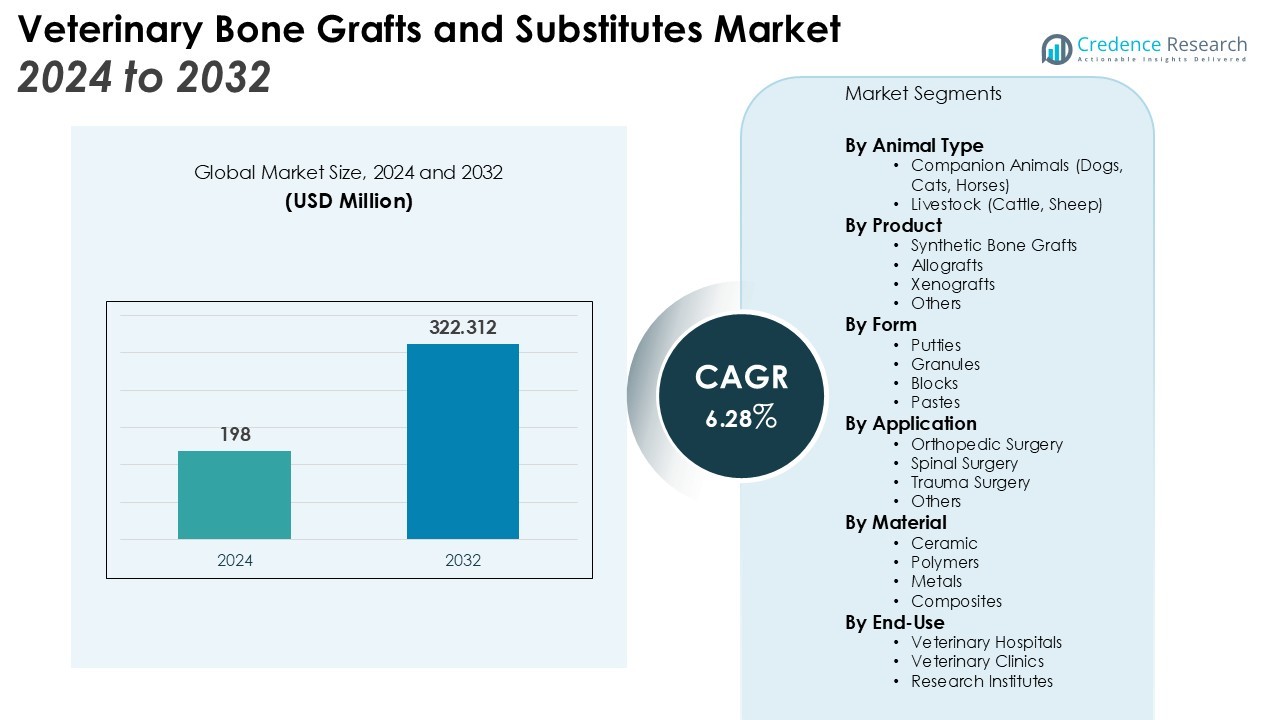
The Veterinary Bone Grafts and Substitutes Market size was valued at USD 198 million in 2024 and is anticipated to reach USD 322.312 million by 2032, at a CAGR of 6.28% during the forecast period (2024-2032).
| REPORT ATTRIBUTE | DETAILS |
|---|---|
| Historical Period | 2020-2024 |
| Base Year | 2024 |
| Forecast Period | 2025-2032 |
| Veterinary Bone Grafts and Substitutes Market Size 2024 | USD 198 Million |
| Veterinary Bone Grafts and Substitutes Market, CAGR | 6.28% |
| Veterinary Bone Grafts and Substitutes Market Size 2032 | USD 322.312 Million |
Key drivers for market expansion include the growing prevalence of orthopedic conditions and injuries among animals, particularly in companion animals like dogs and horses. The shift towards minimally invasive surgical techniques and the increasing use of bone grafts in veterinary surgeries are contributing to the market's growth. Additionally, technological advancements in bone grafting materials, such as the development of synthetic bone grafts and the rising focus on biologically derived substitutes, further accelerate the market's expansion. The increasing focus on improving the quality of life for injured or aging animals also plays a significant role in the market's growth.
Regionally, North America holds the largest share of the veterinary bone grafts and substitutes market, driven by the high adoption of advanced veterinary care and well-established healthcare infrastructure. Europe follows closely, with a growing number of veterinary hospitals and clinics adopting bone graft technologies. The Asia-Pacific region is expected to witness the highest growth rate due to increasing pet ownership, improving veterinary care, and expanding economies in countries like China and India. The rising focus on animal welfare in emerging economies also contributes to the market's positive trajectory in this region.
Market Insights:
- The Veterinary Bone Grafts and Substitutes Market is projected to grow from USD 198 million in 2024 to USD 322.312 million by 2032, at a CAGR of 6.28%, driven by rising orthopedic conditions and increased demand for advanced treatments.
- Minimally invasive surgical techniques are boosting bone graft adoption by offering faster recovery and reducing complications in animals undergoing surgery.
- Technological advancements in synthetic and biologically derived bone grafts are expanding treatment options and improving healing efficiency in veterinary orthopedics.
- Rising awareness about animal welfare and preventive healthcare is driving demand for early intervention and the use of bone grafts in veterinary practices.
- High costs and limited accessibility of advanced bone graft materials remain challenges, especially in regions with underdeveloped veterinary healthcare infrastructure.
- North America holds a 40% market share, driven by strong veterinary care infrastructure, high pet ownership, and widespread adoption of biologically derived bone grafts.
- The Asia-Pacific region, accounting for 20% of the market, is expected to experience the highest growth due to increasing pet ownership, improving veterinary care standards, and expanding economies in countries like China and India.
Market Drivers:
Rising Prevalence of Orthopedic Conditions in Animals
The growing prevalence of orthopedic conditions and injuries among animals, especially in companion animals like dogs, cats, and horses, is driving the demand for veterinary bone grafts and substitutes. Injuries caused by accidents, joint disorders, and age-related degenerative diseases are common, particularly in active or older pets. The need for advanced and effective solutions in treating these conditions, such as bone grafts, is contributing to market growth. Veterinary bone grafts and substitutes offer a viable solution for restoring bone function and enabling quicker recovery, increasing their adoption.
- For instance, in a clinical study involving dogs that underwent a type of knee surgery creating a bone gap, those treated with a Demineralized Bone Matrix (DBM) were able to resume normal exercise 2 weeks earlier than dogs that did not receive the graft.
Shift Toward Minimally Invasive Surgical Techniques
The trend toward minimally invasive surgical procedures in veterinary medicine is also accelerating the adoption of veterinary bone grafts and substitutes. These techniques are preferred due to their reduced recovery times and lower risk of complications. Bone grafts play an essential role in such procedures by aiding in bone regeneration and supporting tissue healing. This shift in surgical practices is fostering greater demand for innovative graft materials, further driving market expansion.
- For instance, a retrospective study of small dogs with radius and ulna fractures found that the median time to radiographic healing for fractures augmented with a free autogenous omental graft was 70 days, compared to 106 days for fractures without the graft.
Advancements in Bone Grafting Materials and Techniques
Advancements in bone grafting materials, including synthetic and biologically derived substitutes, are major contributors to the market’s growth. New materials are designed to mimic natural bone and offer superior osteoconductivity, promoting faster and more efficient healing. These innovations allow for a broader range of treatment options in veterinary orthopedics, enabling veterinarians to offer personalized solutions based on animal needs. The increasing research and development in this area are enhancing the market's prospects.
Growing Focus on Animal Welfare and Preventive Healthcare
Increasing awareness about animal welfare and the emphasis on preventive healthcare is also fueling the demand for veterinary bone grafts and substitutes. Pet owners are becoming more proactive in seeking advanced treatment options to ensure their pets' health and quality of life. Preventive measures, including early intervention and the use of bone grafts in orthopedic procedures, are gaining traction. This cultural shift toward better animal care further supports the market’s growth trajectory.
Market Trends:
Increasing Demand for Biologically Derived Bone Grafts and Substitutes
One of the key trends in the Veterinary Bone Grafts and Substitutes Market is the growing preference for biologically derived bone grafts, including those made from allografts and xenografts. These materials are increasingly favored for their ability to promote faster healing and greater biocompatibility with the animal’s natural tissue. Veterinary professionals are recognizing the advantages of biologically derived substitutes, particularly in complex surgeries requiring a natural healing environment. The growing trend toward using these advanced bone grafts is partly driven by their ability to reduce the risk of complications associated with synthetic materials. Additionally, these grafts are gaining acceptance due to their ability to promote osteointegration and accelerate recovery times in animals.
- For instance, in a clinical study evaluating BIOFAST-VET, a bone substitute derived from shark teeth, the biomaterial was successfully used in 18 out of 19 veterinary orthopedic cases involving fractures and joint fusions.
Expansion of Veterinary Orthopedic Procedures and Technological Advancements
Another significant trend shaping the Veterinary Bone Grafts and Substitutes Market is the expansion of veterinary orthopedic procedures, supported by technological advancements in medical devices and surgical techniques. Advancements such as robotic-assisted surgeries and 3D-printed scaffolds are improving the precision of bone grafting procedures, allowing for more customized treatments. The growing number of veterinary hospitals and clinics offering specialized orthopedic care further fuels this trend. These innovations not only improve the success rate of bone graft procedures but also increase the accessibility and affordability of treatments. This trend is expected to continue, with ongoing improvements in graft materials and surgical techniques, which will contribute to further market expansion.
- For instance, in one case series, surgeons used a 3D-printed anatomical model to pre-plan and prepare a complex Imex external fixator frame for a German Shepherd with a tibial deformity, which saved approximately 1 hour of operating room time.
Market Challenges Analysis:
High Cost and Limited Accessibility
One of the significant challenges in the Veterinary Bone Grafts and Substitutes Market is the high cost of advanced bone grafting materials and procedures. The price of biologically derived and synthetic bone grafts, along with specialized surgeries, can be prohibitive for many pet owners. This high cost often limits the accessibility of these treatments, particularly in developing regions where veterinary healthcare infrastructure may be underdeveloped. The limited availability of these advanced solutions in some geographical areas further exacerbates this challenge, hindering market growth in certain regions.
Regulatory Hurdles and Safety Concerns
Regulatory approval processes for veterinary bone grafts and substitutes present another challenge for the market. The complexity and length of regulatory procedures can delay the introduction of new products and technologies, especially in regions with stringent regulatory requirements. Additionally, concerns regarding the safety and long-term efficacy of certain graft materials, particularly synthetic substitutes, can deter adoption. Veterinary professionals and pet owners alike may have reservations about the risks associated with these materials, which could slow market expansion despite the demand for advanced solutions.
Market Opportunities:
Growth in Pet Ownership and Veterinary Care
The Veterinary Bone Grafts and Substitutes Market stands to benefit from the increasing global pet ownership and the growing demand for advanced veterinary care. As more people adopt pets, especially in emerging economies, the need for specialized treatments, including orthopedic care, is rising. This expansion in pet ownership creates a significant opportunity for market players to introduce innovative bone graft solutions tailored to different species. Enhanced awareness of animal health also encourages pet owners to seek preventive and advanced medical treatments, thus driving demand for bone grafts and substitutes.
Advancements in Regenerative Medicine and Personalized Veterinary Treatments
There is a significant opportunity for growth in the market due to the advancements in regenerative medicine and personalized veterinary treatments. The integration of stem cell therapies, growth factors, and customized 3D-printed scaffolds is creating new avenues for bone graft technologies. These innovations allow for more personalized treatment options, improving recovery rates and enhancing the efficacy of veterinary orthopedic surgeries. As veterinary medicine continues to evolve, incorporating these advanced techniques will open up new markets and offer growth potential for companies involved in bone grafting solutions.
Market Segmentation Analysis:
By Animal Type
The Veterinary Bone Grafts and Substitutes Market is segmented by animal type into companion animals (dogs, cats, horses) and livestock (cattle, sheep). Companion animals lead the market due to the increasing pet ownership and rising orthopedic conditions in pets. Veterinary bone grafts are primarily used for joint disorders, fractures, and age-related diseases in companion animals. The livestock segment is smaller but growing, especially in regions with improving veterinary care for farm animals.
By Product
The market is further divided by product into synthetic bone grafts, allografts, xenografts, and others. Synthetic bone grafts hold the largest market share due to their cost-effectiveness and ease of use. They can be customized for specific animal needs and are popular in veterinary procedures. Allografts and xenografts are gaining traction due to their superior osteoconductivity and biocompatibility, making them essential in complex orthopedic surgeries.
- For instance, the manufacturing process for Straumann's cerabone® xenograft involves heating the material to a temperature exceeding 1200°C to ensure the complete removal of all organic components.
By Form
The market is segmented by form into putties, granules, blocks, and pastes. Putties and granules are the most widely used due to their versatility and ease of application in a range of surgeries. Blocks and pastes are typically used in more complex surgeries, providing stable support for bone regeneration. The choice of form depends on the type of surgical procedure and the complexity of the bone defect being treated.
- For instance, the VertiGraft allograft from DePuy Synthes provides immediate structural support and is sterilized to an assurance level of 10^-6, a technological achievement ensuring the implant's safety.
Segmentations:
- By Animal Type
- Companion Animals (Dogs, Cats, Horses)
- Livestock (Cattle, Sheep)
- By Product
- Synthetic Bone Grafts
- Allografts
- Xenografts
- Others
- By Form
- Putties
- Granules
- Blocks
- Pastes
- By Application
- Orthopedic Surgery
- Spinal Surgery
- Trauma Surgery
- Others
- By Material
- Ceramic
- Polymers
- Metals
- Composites
- By End-Use
- Veterinary Hospitals
- Veterinary Clinics
- Research Institutes
- By Region
- North America
- U.S.
- Canada
- Mexico
- Europe
- Germany
- France
- U.K.
- Italy
- Spain
- Rest of Europe
- Asia Pacific
- China
- Japan
- India
- South Korea
- South-east Asia
- Rest of Asia Pacific
- Latin America
- Brazil
- Argentina
- Rest of Latin America
- Middle East & Africa
- GCC Countries
- South Africa
- Rest of the Middle East and Africa
- North America
Regional Analysis:
North America
North America holds a dominant share of 40% in the Veterinary Bone Grafts and Substitutes Market, driven by a well-established veterinary healthcare infrastructure and the high adoption of advanced animal care technologies. The region is home to numerous veterinary hospitals and clinics offering specialized orthopedic services for pets, particularly in the U.S. The strong demand for advanced treatments, such as bone grafts, is fueled by increasing pet ownership, along with a high rate of pet insurance coverage, which makes treatments more accessible. The growing awareness of animal welfare and the widespread use of biologically derived bone grafts further contribute to the region’s dominance.
Europe
Europe accounts for 30% of the Veterinary Bone Grafts and Substitutes Market, with strong growth driven by countries such as the U.K., Germany, and France. The increasing adoption of advanced veterinary practices and a high level of pet ownership support the market's expansion. Furthermore, the rise in veterinary clinics and hospitals providing specialized orthopedic care plays a crucial role in driving the demand for bone graft substitutes. The region is also seeing a growing trend in adopting minimally invasive surgical procedures, which fuels the need for effective bone grafting solutions, contributing to the market’s growth.
Asia-Pacific
The Asia-Pacific region commands 20% of the Veterinary Bone Grafts and Substitutes Market, with rapid growth anticipated due to increasing pet ownership, improving veterinary care standards, and expanding economies in countries like China and India. Rising disposable incomes in these regions have led to greater investments in animal health and wellness, further propelling the demand for advanced veterinary solutions. Additionally, the growing adoption of advanced veterinary surgeries and bone grafting technologies in emerging markets presents a significant opportunity for market players to tap into this region.
Key Player Analysis:
- Integra LifeSciences Corporation.
- Progenica Therapeutics, LLC
- Movora (Vimian Group AB)
- TheraVet SA
- RITA LEIBINGER GmbH & Co. KG
- VETEREGEN
- AlphaLogix, LLC
- Biomendex
- BioChange
- Nutramax Laboratories Veterinary Sciences, Inc.
Competitive Analysis:
The Veterinary Bone Grafts and Substitutes Market is highly competitive, with key players focused on technological advancements and product innovation. Leading companies like DePuy Synthes, Stryker Corporation, Zimmer Biomet, and Vetbone are major contributors, offering a range of synthetic and biologically derived bone graft solutions. These companies are enhancing their market positions by developing cost-effective, customizable products and expanding their distribution networks globally. The market is also witnessing the rise of regional players who offer specialized solutions tailored to local demands. Competition is further intensified by the increasing focus on minimally invasive surgical procedures, driving the need for advanced bone grafts that support faster healing. Companies are investing in research and development to introduce innovative products that improve osteoconductivity and biocompatibility. Strategic partnerships, acquisitions, and collaborations are commonly used to strengthen market presence and expand product portfolios, allowing companies to address diverse customer needs across veterinary care sectors.
Recent Developments:
- In September 2024, TheraVet announced a strategic transformation project in partnership with H4Orphan to pivot its focus toward developing treatments for human idiopathic pulmonary fibrosis.
- In July 2025, Integra LifeSciences announced its second-quarter financial results, reporting revenues of $415.6 million and a net loss primarily due to a goodwill impairment charge.
- In October 2024, Biomendex initiated a collaboration with the Mayo Clinic to advance the development and explore new applications for its synthetic bone graft material, Adaptos®.
Market Concentration & Characteristics:
The Veterinary Bone Grafts and Substitutes Market is moderately concentrated, with a few key players dominating the industry. Leading companies, such as DePuy Synthes, Stryker Corporation, and Zimmer Biomet, hold substantial market shares due to their advanced technological capabilities, strong distribution networks, and broad product portfolios. Smaller players and regional companies focus on niche markets and customized solutions, which helps diversify the competitive landscape. The market is characterized by significant investments in research and development, driving innovation in bone graft materials and surgical techniques. Companies aim to offer products with superior biocompatibility and enhanced osteoconductivity to meet the growing demand for advanced veterinary care. While large corporations maintain a strong presence, regional players are gaining traction by offering specialized products that cater to local veterinary needs. This dynamic competitive environment fosters continuous improvement and expansion within the market.
Report Coverage:
The research report offers an in-depth analysis based on Animal Type, Product, Form, Application, Material, End-Use and Region. It details leading market players, providing an overview of their business, product offerings, investments, revenue streams, and key applications. Additionally, the report includes insights into the competitive environment, SWOT analysis, current market trends, as well as the primary drivers and constraints. Furthermore, it discusses various factors that have driven market expansion in recent years. The report also explores market dynamics, regulatory scenarios, and technological advancements that are shaping the industry. It assesses the impact of external factors and global economic changes on market growth. Lastly, it provides strategic recommendations for new entrants and established companies to navigate the complexities of the market.
Future Outlook:
- The market for veterinary bone grafts and substitutes is expected to continue its growth as advancements in veterinary care and orthopedic treatments become more widespread.
- Increasing pet ownership, especially in emerging economies, will contribute to higher demand for veterinary orthopedic solutions.
- Technological innovations, such as 3D-printed bone grafts and regenerative medicine, will create new opportunities in the market.
- The shift toward minimally invasive surgeries will drive further adoption of bone grafts, as these procedures reduce recovery time and improve outcomes.
- Synthetic bone grafts are expected to dominate the market, with more cost-effective and customizable options becoming available.
- The focus on biologically derived bone grafts will grow, driven by their superior biocompatibility and osteoconductivity.
- Rising awareness of animal welfare will lead to more proactive approaches to pet healthcare, increasing the demand for advanced treatments.
- Growth in veterinary healthcare infrastructure, especially in developing regions, will boost access to bone grafting technologies.
- The increasing number of specialized veterinary hospitals and clinics will facilitate the use of bone grafts in complex surgeries.
- Regional markets, particularly in Asia-Pacific, will see rapid adoption of advanced veterinary bone grafting technologies due to rising pet ownership and improving veterinary care standards.

Request a Free Sample
Fill in your details and we'll send you a free sample report.
- Sample data tables & charts
- Research methodology
Market Dynamics
Rising Prevalence of Orthopedic Conditions in Animals
Increasing cases of fractures, joint disorders, and age-related bone diseases in companion animals and livestock are driving demand for advanced bone grafts and substitutes to restore mobility and improve recovery outcomes.
Shift Toward Minimally Invasive Surgical Techniques
Veterinary practices are increasingly adopting minimally invasive procedures, which require effective bone graft materials to support faster healing and reduce complications, thereby boosting market growth.
Technological Advancements in Bone Grafting Materials
Innovations such as synthetic and biologically derived bone grafts, as well as 3D-printed scaffolds, are expanding treatment options and improving the efficiency and success rates of veterinary orthopedic surgeries.
Growing Focus on Animal Welfare and Preventive Healthcare
Pet owners are becoming more proactive in seeking advanced treatments to enhance their animals' quality of life, leading to greater adoption of bone grafts for early intervention and preventive orthopedic care.
Expansion of Veterinary Healthcare Infrastructure
The growth of specialized veterinary hospitals and clinics, especially in emerging markets, is increasing access to advanced orthopedic procedures and driving the uptake of bone grafting technologies.
Need a Custom Version of This Report?
Tailor the scope, geography, or segments to your exact requirements.
- Custom geography or segment scope
- Direct access to our analyst team
Frequently Asked Questions
What is the current market size for Veterinary Bone Grafts and Substitutes, and what is its projected size in 2032?
At what Compound Annual Growth Rate is the Veterinary Bone Grafts and Substitutes market projected to grow between 2024 and 2032?
Which Veterinary Bone Grafts and Substitutes market segment held the largest share in 2024?
What are the primary factors fueling the growth of the Veterinary Bone Grafts and Substitutes market?
Who are the leading companies in the Veterinary Bone Grafts and Substitutes market?
Which region commanded the largest share of the Veterinary Bone Grafts and Substitutes market in 2024?
Table of Content
Chapter 1 Market Segmentation
- 1.1 Segmentation Framework
- 1.1.1 Product and Service Classification
- 1.1.2 Application and End-Use Classification
- 1.1.3 Technology and Solution Classification
- 1.1.4 Customer and Distribution Channel Classification
- 1.1.5 Geographic Segmentation
- 1.1.6 Market Segment Definitions and Boundaries
- 1.2 By Form
- 1.2.1 Putties
- 1.2.2 Granules
- 1.2.3 Blocks
- 1.2.4 Pastes
- 1.3 By Product
- 1.3.1 Synthetic Bone Grafts
- 1.3.2 Allografts
- 1.3.3 Xenografts
- 1.3.4 Others
- 1.4 By Animal Type
- 1.4.1 Companion Animals (Dogs, Cats, Horses)
- 1.4.2 Livestock (Cattle, Sheep)
- 1.5 By Application
- 1.5.1 Orthopedic Surgery
- 1.5.2 Spinal Surgery
- 1.5.3 Trauma Surgery
- 1.5.4 Others
Chapter 2 Introduction
- 2.1 Report Objectives and Scope
- 2.2 Product Definition and Industry Terminology
- 2.3 Market Inclusions and Exclusions
- 2.4 Research Process
- 2.4.1 Primary Research and Expert Interviews
- 2.4.2 Secondary Research and Source Review
- 2.4.3 Top-Down and Bottom-Up Estimation
- 2.4.4 Data Triangulation and Verification
- 2.5 Market Size Measurement Basis
- 2.5.1 2024: USD 198 million → 2032: USD 322.312 million
- 2.6 Historical and Forecast Reference Periods
- 2.6.1 Base Year: 2024
- 2.6.2 Forecast Period: 2024-2032
- 2.7 Research Assumptions and Limitations
Chapter 3 Executive Summary
- 3.1 Market Snapshot and Key Findings
- 3.2 Base-Year Market Size, 2024
- 3.3 Forecast Market Size, 2032
- 3.4 Revenue and Volume Growth Outlook
- 3.5 Key Demand and Supply Indicators
- 3.6 Leading Market Segments
- 3.7 Fastest-Growing Market Opportunities
- 3.8 Regional Performance Highlights
- 3.9 Technology and Industry Transformation
- 3.10 Competitive Landscape Summary
- 3.11 Analyst View and Strategic Implications
Chapter 4 Global Veterinary Bone Grafts and Substitutes Market Trends and Developments
- 4.1 Historical Industry Development
- 4.2 Recent Market Trends and Developments
- 4.3 Demand and Customer Behavior Trends
- 4.4 Technology and Product Innovation
- 4.5 Artificial Intelligence, Automation and Digitalization
- 4.6 Local Manufacturing and Supply Chain Realignment
- 4.7 Industry Partnerships, Mergers and Acquisitions
- 4.8 Sustainability and Circular Economy Developments
- 4.9 Government and Private Sector Investment Trends
- 4.10 Emerging Business Models and Commercialization
- 4.11 Industry Developments and Announcements
Chapter 5 Global Veterinary Bone Grafts and Substitutes Market Production, Supply and Demand Analysis
- 5.1 Demand Trend and Consumption Analysis
- 5.2 Demand Forecast, 2024-2032
- 5.3 Production and Output Trend
- 5.4 Production and Output Forecast, 2024-2032
- 5.5 Installed Capacity and Capacity Utilization
- 5.6 Company-Wise Production Plants and Statistics
- 5.6.1 Installed Production Capacity
- 5.6.2 Actual Production
- 5.6.3 Planned Capacity and Expansion Targets
- 5.7 Supply Chain Structure and Procurement Trends
- 5.8 Supply-Demand Gap and Bottlenecks
- 5.9 Import Dependence and Sourcing Structure
- 5.10 Contract Manufacturing and Outsourcing
- 5.11 Regional Supply and Demand Concentration
Chapter 6 Global Veterinary Bone Grafts and Substitutes Market Pricing Analysis
- 6.1 Pricing Structure and Measurement
- 6.2 Historical Pricing Trends
- 6.3 Pricing Outlook, 2024-2032
- 6.4 Average Selling Price and Unit Economics
- 6.5 Pricing by Product and Market Segment
- 6.6 Geographic Pricing Differences
- 6.7 Key Input, Energy, Labor and Logistics Costs
- 6.8 Contract Pricing and Purchasing Models
- 6.9 Pricing Sensitivity and Competitive Positioning
- 6.10 Price, Margin and Profitability Implications
Chapter 7 Global Veterinary Bone Grafts and Substitutes Market Dynamics
- 7.1 Market Growth Drivers
- 7.1.1 Demand-Side Drivers
- 7.1.2 Technology and Innovation Drivers
- 7.1.3 Infrastructure and Investment Drivers
- 7.1.4 Regulatory and Policy Drivers
- 7.2 Market Restraints
- 7.2.1 Cost and Affordability Constraints
- 7.2.2 Technology and Adoption Barriers
- 7.2.3 Supply Chain and Operational Constraints
- 7.3 Market Challenges
- 7.3.1 Competitive Pressure and Margin Erosion
- 7.3.2 Skills, Infrastructure and Implementation Gaps
- 7.4 Emerging Market Opportunities
- 7.5 Market Dynamics Impact and Time-Horizon Assessment
Chapter 8 Global Veterinary Bone Grafts and Substitutes Value Chain Analysis
- 8.1 Industry Value Chain Overview
- 8.2 Upstream Suppliers and Critical Inputs
- 8.3 Technology and Component Providers
- 8.4 Manufacturing or Service Delivery
- 8.5 Distribution, Channel Partners and Integrators
- 8.6 Downstream Applications and End Users
- 8.7 Value Addition and Profit Pools
- 8.8 Vertical Integration and Outsourcing
- 8.9 Supplier Concentration and Risk
- 8.10 Supply Chain Localization and Resilience
Chapter 9 Global Veterinary Bone Grafts and Substitutes Market Regulations and Policies
- 9.1 Relevant Laws, Standards and Compliance Frameworks
- 9.2 Product, Service, Safety and Quality Requirements
- 9.3 Government Policies, Incentives and Subsidies
- 9.4 Imports, Exports and Trade Barriers
- 9.5 Public Procurement and Local Content Requirements
- 9.6 Environmental and Sustainability Compliance
- 9.7 Upcoming Policy Changes and Market Implications
Chapter 10 Global Veterinary Bone Grafts and Substitutes Market Hotspots and Opportunities
- 10.1 Market Opportunity Mapping and Growth Hotspots
- 10.2 High-Growth Applications and Customer Groups
- 10.3 Underserved Markets and White-Space Opportunities
- 10.4 Emerging Technology and Product Opportunities
- 10.5 New Capacity and Investment Hotspots
- 10.6 Market Entry and Expansion Opportunities
- 10.7 Distribution and Partnership Opportunities
- 10.8 Near-Term and Long-Term Commercial Potential
- 10.9 Opportunity Attractiveness and Execution Risks
Chapter 11 Global Veterinary Bone Grafts and Substitutes Market Outlook, 2024-2032
- 11.1 Market Size and Analysis
- 11.1.1 Revenue (Market Measurement: 2024: USD 198 million → 2032: USD 322.312 million)
- 11.1.2 Market Volume and Quantity Sold
- 11.1.3 Historical Market Size
- 11.1.4 Base-Year Market Size, 2024
- 11.2 Market Forecast, 2024-2032
- 11.2.1 Revenue Forecast to 2032
- 11.2.2 Volume Forecast to 2032
- 11.2.3 CAGR and Year-on-Year Growth
- 11.2.4 Incremental Revenue Opportunity
- 11.3 Forecast Assumptions and Scenario Analysis
- 11.3.1 Base-Case Forecast
- 11.3.2 Optimistic and Conservative Scenarios
- 11.3.3 Technology, Pricing and Policy Sensitivities
- 11.4 Market Attractiveness and Growth Outlook
Chapter 12 Global Veterinary Bone Grafts and Substitutes Market Segmentation and Outlook
- 12.1 Segmentation Summary and Market Shares, 2024
- 12.2 Largest and Fastest-Growing Segments
- 12.3 By Form - Market Size and Forecast, 2024-2032
- 12.3.1 Segment Definition and Scope
- 12.3.2 Historical Market Size
- 12.3.3 Revenue Forecast, 2024-2032
- 12.3.4 Volume Forecast, 2024-2032
- 12.3.5 Base-Year Market Share, 2024
- 12.3.6 Segment CAGR and Growth Drivers
- 12.3.7 Subsegment Market Size and Forecast
- 12.3.7.1 Putties
- 12.3.7.2 Granules
- 12.3.7.3 Blocks
- 12.3.7.4 Pastes
- 12.3.8 Subsegment Pricing and Adoption Trends
- 12.3.9 Leading Suppliers and Competition
- 12.3.10 Regional Demand and Opportunities
- 12.4 By Product - Market Size and Forecast, 2024-2032
- 12.4.1 Segment Definition and Scope
- 12.4.2 Historical Market Size
- 12.4.3 Revenue Forecast, 2024-2032
- 12.4.4 Volume Forecast, 2024-2032
- 12.4.5 Base-Year Market Share, 2024
- 12.4.6 Segment CAGR and Growth Drivers
- 12.4.7 Subsegment Market Size and Forecast
- 12.4.7.1 Synthetic Bone Grafts
- 12.4.7.2 Allografts
- 12.4.7.3 Xenografts
- 12.4.7.4 Others
- 12.4.8 Subsegment Pricing and Adoption Trends
- 12.4.9 Leading Suppliers and Competition
- 12.4.10 Regional Demand and Opportunities
- 12.5 By Animal Type - Market Size and Forecast, 2024-2032
- 12.5.1 Segment Definition and Scope
- 12.5.2 Historical Market Size
- 12.5.3 Revenue Forecast, 2024-2032
- 12.5.4 Volume Forecast, 2024-2032
- 12.5.5 Base-Year Market Share, 2024
- 12.5.6 Segment CAGR and Growth Drivers
- 12.5.7 Subsegment Market Size and Forecast
- 12.5.7.1 Companion Animals (Dogs, Cats, Horses)
- 12.5.7.2 Livestock (Cattle, Sheep)
- 12.5.8 Subsegment Pricing and Adoption Trends
- 12.5.9 Leading Suppliers and Competition
- 12.5.10 Regional Demand and Opportunities
- 12.6 By Application - Market Size and Forecast, 2024-2032
- 12.6.1 Segment Definition and Scope
- 12.6.2 Historical Market Size
- 12.6.3 Revenue Forecast, 2024-2032
- 12.6.4 Volume Forecast, 2024-2032
- 12.6.5 Base-Year Market Share, 2024
- 12.6.6 Segment CAGR and Growth Drivers
- 12.6.7 Subsegment Market Size and Forecast
- 12.6.7.1 Orthopedic Surgery
- 12.6.7.2 Spinal Surgery
- 12.6.7.3 Trauma Surgery
- 12.6.7.4 Others
- 12.6.8 Subsegment Pricing and Adoption Trends
- 12.6.9 Leading Suppliers and Competition
- 12.6.10 Regional Demand and Opportunities
- 12.7 Segment Growth Comparison
- 12.8 Segment Attractiveness and Priority Matrix
Chapter 13 Global Veterinary Bone Grafts and Substitutes End-Use and Application Market Outlook
- 13.1 End-Use Industry and Customer Demand Structure
- 13.2 Leading Applications and Customer Groups
- 13.3 End-Use Market Size, Share and Forecast
- 13.4 Major End-Use Industry Deep Dives
- 13.4.1 Customer Requirements and Use Cases
- 13.4.2 Demand and Replacement Cycles
- 13.4.3 Technical and Regulatory Considerations
- 13.4.4 Purchasing and Procurement Models
- 13.4.5 Leading Vendors and Distribution Channels
- 13.4.6 Forecast and Commercial Opportunities
- 13.5 Emerging Applications and Cross-Segment Demand
- 13.6 End-Use Industry Investment Priorities
Chapter 14 Global Veterinary Bone Grafts and Substitutes Geographic Market Outlook, 2024-2032
- 14.1 Regional Market Size and Share, 2024
- 14.2 Regional Market Forecast, 2024-2032
- 14.3 Regional Pricing, Production and Demand Differences
- 14.4 North America
- 14.4.1 United States
- 14.4.2 Canada
- 14.4.3 Mexico
- 14.5 Europe
- 14.5.1 Germany
- 14.5.2 France
- 14.5.3 Italy
- 14.5.4 United Kingdom
- 14.5.5 Spain
- 14.5.6 Poland
- 14.5.7 Russia
- 14.5.8 Netherlands
- 14.5.9 Belgium
- 14.5.10 Sweden
- 14.5.11 Denmark
- 14.5.12 Norway
- 14.5.13 Rest of Europe
- 14.6 Asia Pacific
- 14.6.1 China
- 14.6.2 India
- 14.6.3 Japan
- 14.6.4 South Korea
- 14.6.5 Thailand
- 14.6.6 Indonesia
- 14.6.7 Vietnam
- 14.6.8 Malaysia
- 14.6.9 Australia
- 14.6.10 Rest of Asia Pacific
- 14.7 Latin America
- 14.7.1 Brazil
- 14.7.2 Argentina
- 14.7.3 Colombia
- 14.7.4 Chile
- 14.7.5 Rest of Latin America
- 14.8 Middle East
- 14.8.1 Saudi Arabia
- 14.8.2 United Arab Emirates
- 14.8.3 Turkey
- 14.8.4 Israel
- 14.8.5 Iran
- 14.8.6 Rest of the Middle East
- 14.9 Africa
- 14.9.1 South Africa
- 14.9.2 Egypt
- 14.9.3 Nigeria
- 14.9.4 Morocco
- 14.9.5 Rest of Africa
- 14.10 Regional Investment, Policy and Supply Chain Differences
- 14.11 Regional Competitive Landscape
- 14.12 Geographic Growth Hotspots
Chapter 15 Global Veterinary Bone Grafts and Substitutes Technology, Innovation and Sustainability Outlook
- 15.1 Technology Landscape and Maturity
- 15.2 Product, Process and Service Innovation
- 15.3 AI, Automation and Digital Tools in the Industry
- 15.4 Technology Adoption and Performance Benchmarking
- 15.5 Innovation Pipeline and R&D Investment
- 15.6 Patent and Intellectual Property Trends
- 15.7 Energy Efficiency and Resource Management
- 15.8 Sustainability, Recycling and Circularity
- 15.9 Technology Roadmap, 2024-2032
- 15.10 Risks of Obsolescence and Technology Substitution
Chapter 16 Global Veterinary Bone Grafts and Substitutes Market Key Strategic Imperatives
- 16.1 Growth and Market Entry Priorities
- 16.2 High-Return Products and Segments
- 16.3 Pricing, Profitability and Cost Optimization
- 16.4 Technology Investment and Product Differentiation
- 16.5 Supply Chain Localization and Resilience
- 16.6 Distribution and Customer Acquisition
- 16.7 Partnership, Acquisition and Capacity Strategy
- 16.8 Regional Expansion Priorities
- 16.9 Short-, Medium- and Long-Term Actions
Chapter 17 Competition Outlook
- 17.1 Industry Competition Characteristics
- 17.2 Market Structure and Concentration
- 17.3 Market Share and Competitive Positioning, 2024
- 17.4 Company-Wise Revenue and Product Benchmarking
- 17.5 Production and Service Capacity Benchmarking
- 17.6 Technology, Pricing and Differentiation
- 17.7 Regional Footprint and Distribution Strength
- 17.8 Mergers, Acquisitions and Strategic Alliances
- 17.9 New Entrants and Competitive Threats
- 17.10 Porter's Five Forces and Industry Attractiveness
- 17.11 Competitive Outlook, 2024-2032
Chapter 18 Company Profiles
- 18.1 Company Coverage and Selection Criteria
- 18.2 Integra LifeSciences Corporation
- 18.2.1 Business Description
- 18.2.2 Company Ownership and Geographic Presence
- 18.2.3 Product and Service Portfolio
- 18.2.4 Manufacturing and Operating Footprint
- 18.2.5 Production Capacity and Expansion Plans
- 18.2.6 Financial Performance and Investment
- 18.2.7 Market Share and Competitive Position
- 18.2.8 Technology and Innovation Capabilities
- 18.2.9 Strategic Alliances or Partnerships
- 18.2.10 Recent Developments
- 18.2.11 Growth Strategy and Outlook
- 18.3 Progenica Therapeutics, LLC
- 18.4 Movora (Vimian Group AB)
- 18.5 TheraVet SA
- 18.6 RITA LEIBINGER GmbH & Co. KG
- 18.7 VETEREGEN
- 18.8 AlphaLogix, LLC
- 18.9 Biomendex
- 18.10 BioChange
- 18.11 Nutramax Laboratories Veterinary Sciences, Inc.
- 18.12 Other Relevant Market Participants
Note: Every listed company is profiled on the structure shown under the first company. The company list is preliminary and may change based on research findings, market developments, data availability and client requirements.
Chapter 19 Disclaimer
- 19.1 Research and Forecast Disclaimer
- 19.2 Data Source and Estimation Limitations
Note: The depth of individual sections depends on data availability for this market. Volume, capacity, trade and other unit-based metrics are included where applicable.

