
Market Overview
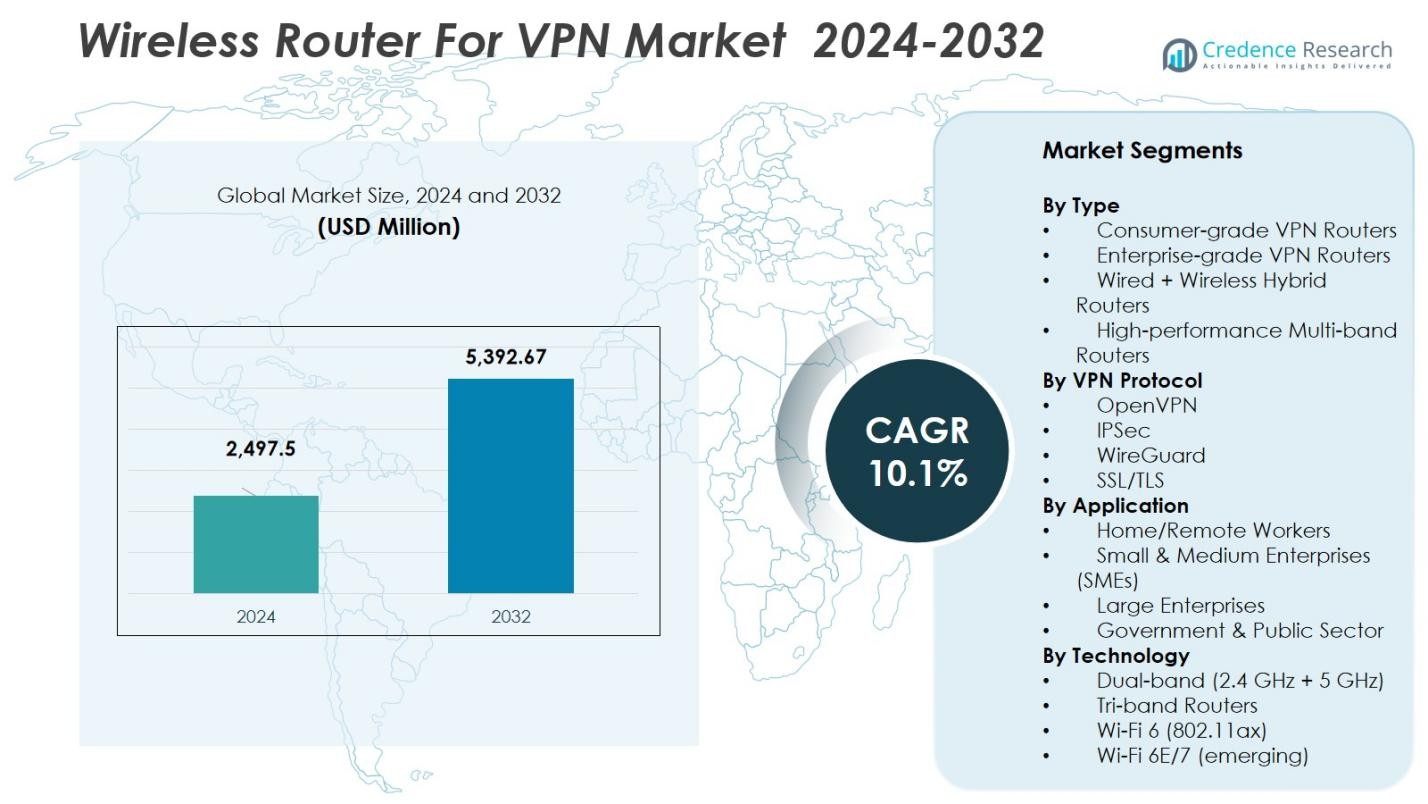
The Wireless Router For VPN Market size was valued at USD 2,497.5 million in 2024 and is anticipated to reach USD 5,392.67 million by 2032, at a CAGR of 10.1% during the forecast period.
| REPORT ATTRIBUTE | DETAILS |
|---|---|
| Historical Period | 2020-2023 |
| Base Year | 2024 |
| Forecast Period | 2025-2032 |
| Wireless Router For VPN Market Size 2024 | USD 2,497.5 Million |
| Wireless Router For VPN Market, CAGR | 10.1% |
| Wireless Router For VPN Market Size 2032 | USD 5,392.67 Million |
The Wireless Router for VPN Market is driven by prominent players including Cisco Systems, Netgear, TP-Link, ASUS, Ubiquiti, Juniper Networks, Huawei, D-Link, Fortinet and MikroTik, all of which continue to enhance their product portfolios with stronger encryption, multi-band performance and next-generation Wi-Fi technologies. These companies focus on delivering secure, high-speed connectivity solutions to support growing demand from remote workers, SMEs and large enterprises. Innovations such as cloud-managed routing, AI-enhanced security and mesh-enabled VPN systems further strengthen their market positioning. North America leads the global market with a 38% share, supported by advanced digital infrastructure, heightened cybersecurity awareness and widespread adoption of secure remote-access solutions across corporate and residential environments.
Market Insights
- The Wireless Router for VPN Market was valued at USD 2,497.5 million in 2024 and is projected to reach USD 5,392.67 million by 2032, registering a CAGR of 10.1% during the forecast period.
- The market is expanding due to strong drivers such as rising remote work adoption, growing cybersecurity awareness and increased demand for secure, high-bandwidth connectivity across both residential and enterprise settings.
- Key trends include rapid adoption of Wi-Fi 6, Wi-Fi 6E and Wi-Fi 7 routers, along with growing interest in cloud-managed and mesh-enabled VPN solutions that enhance network control and coverage.
- Major players such as Cisco, Netgear, TP-Link, ASUS, Ubiquiti and Fortinet strengthen the landscape by introducing advanced encryption, multi-band capabilities and AI-driven security, while high costs and configuration complexity remain notable restraints.
- Regionally, North America leads with a 38% share, while consumer-grade VPN routers dominate the type segment with 45%, supported by widespread remote-work setups and strong cybersecurity adoption.
Market Segmentation Analysis:
By Type
In the “By Type” segment of the wireless VPN-router market, the consumer-grade VPN routers currently dominate with an estimated market share of around 45%, driven by robust demand from remote workers and home offices. These devices are favoured for their ease of installation, lower cost and growing awareness of home-network security. Enterprise-grade VPN routers and hybrid wired + wireless variants follow, but the consumer segment leads thanks to the rapid proliferation of connected devices and increasing VPN adoption in residential settings.
- For instance, Linksys's NordVPN-configured WRT3200ACM router, favored for its 1.8 GHz dual-core processor and multiple antennas optimized for multiple home devices.
By VPN Protocol
Within the “By VPN Protocol” segmentation, the IPSec protocol takes the lead with an approximate share of 38%, as businesses and advanced users prefer its mature architecture, strong encryption and wide compatibility with existing hardware. OpenVPN and SSL/TLS protocols hold smaller portions of the market, while WireGuard is gaining traction because of its performance and simplicity. The dominance of IPSec is underpinned by its broad ecosystem support and compatibility across router vendors.
- For instance, the TP-Link TL-R605 router supports and manages up to 20 LAN-to-LAN IPSec VPN connections, simplifying secure site-to-site communication.
By Application
Looking at the market by application, the SME (Small & Medium Enterprises) segment is currently the largest, holding 40% of the market. SMEs are investing in VPN-enabled wireless routers to secure distributed workforces, enable remote access and comply with regulatory standards without the heavy cost of full enterprise infrastructure. Home/remote workers and large enterprises follow close behind, but the SME space leads due to a balance of budget, security needs and scalability.
 Key Growth Drivers
Rising Remote Work Adoption
The expansion of remote and hybrid work models continues to accelerate demand for wireless VPN routers, as households and businesses prioritize secure access to corporate networks. Organizations are deploying VPN-enabled routers to safeguard distributed teams and maintain data privacy across unsecured home networks. This shift has broadened the consumer and SME user base, increasing the need for reliable, encrypted connectivity. As cyber risks grow more sophisticated, businesses increasingly view secure wireless routing as a foundational digital-infrastructure investment, making remote-work adoption a long-term driver of market growth.
- For instance, LyconSys GmbH produces VPN routers used in critical infrastructures like railway and airport systems, providing secure remote network access essential for operational security.
Growing Cybersecurity Awareness
Heightened cybersecurity threats and a surge in data breaches have prompted users to adopt stronger network-level protection, driving wider acceptance of wireless VPN routers. These devices offer an additional security layer by encrypting traffic and limiting exposure to external attacks, making them essential for both personal and professional environments. Enterprises and SMEs are reinforcing their networks to comply with regulatory standards and internal security frameworks. This rising awareness, combined with stricter compliance requirements, is encouraging the upgrade to advanced VPN-enabled routers across sectors, boosting market expansion.
- For instance, GL.iNet’s Flint 2 and Flint 3 routers, popular among digital nomads and remote workers, support WireGuard VPN protocols and offer hardware-level encryption, enabling users to secure all connected devices with a single configuration and achieve speeds exceeding 500 Mbps.
Increasing Device Connectivity and Bandwidth Demands
The growing number of connected devices in homes and workplaces is pushing users toward high-performance VPN routers that can manage increased traffic loads without compromising security. As video conferencing, cloud computing and streaming become more bandwidth-intensive, users require routers capable of supporting simultaneous secure connections at high speeds. Multi-band and Wi-Fi 6/6E-enabled VPN routers address these requirements effectively. This surge in digital activity across consumer and enterprise environments is driving sustained demand for powerful, scalable and security-focused wireless routing solutions.
Key Trends & Opportunities
Adoption of Next-Generation Wi-Fi Technologies
A prominent trend in the market is the rapid adoption of Wi-Fi 6, Wi-Fi 6E and early Wi-Fi 7 technologies in VPN-enabled routers. These advancements present strong opportunities for manufacturers to offer devices with significantly improved throughput, reduced latency and enhanced support for encrypted traffic. Businesses and consumers increasingly prefer routers with next-generation capabilities to future-proof their networks. As data-heavy applications continue to expand, routers that combine advanced wireless performance with robust VPN functionalities are positioned for strong uptake across global markets.
- For instance, ASUS launched the RT-AXE7800 tri-band Wi-Fi 6E router delivering speeds up to 7.8 Gbps combined with comprehensive VPN features and enhanced network security, catering to high-demand users requiring both performance and privacy.
Growth of Cloud-Managed and Mesh-Enabled VPN Routers
Another emerging opportunity lies in cloud-managed and mesh-enabled VPN routers, which simplify network control and strengthen coverage. Cloud-based management allows IT teams to configure VPN access, monitor usage and apply security policies remotely, which appeals greatly to SMEs and multi-location businesses. Mesh systems also enhance performance for consumers by delivering seamless, secure coverage across larger spaces. As organizations seek scalable and easily deployable solutions, manufacturers that integrate VPN capabilities into cloud-first or mesh-network ecosystems stand to gain significant competitive advantage.
- For instance, Google Distributed Cloud offers cloud-managed VPN connections that integrate with Cloud Router, enabling IT teams to configure VPN access, manage routing dynamically, and monitor usage remotely, which is especially beneficial for organizations seeking scalable network solutions.
Key Challenges
High Implementation and Upgrade Costs
Despite growing demand, cost remains a significant barrier to adoption, especially for SMEs and budget-conscious consumers. High-performance VPN routers with advanced security features, multi-band support and enterprise-grade capabilities often come with premium price points. Additionally, ongoing expenses for firmware updates, security management and potential subscription-based VPN services add to the total cost of ownership. These financial constraints may slow adoption rates in emerging markets or smaller organizations, limiting broader penetration of advanced wireless VPN router solutions.
Complex Configuration and Compatibility Issues
Another challenge affecting market growth is the complexity associated with configuring VPN protocols and ensuring compatibility across various devices and network environments. Many users lack the technical expertise required to set up VPN routing securely, resulting in misconfigurations or incomplete protection. Enterprises also face integration challenges when aligning routers with legacy systems, authentication tools and multi-platform devices. As networks become more distributed, ensuring consistent performance and security across different hardware ecosystems becomes increasingly difficult, contributing to implementation barriers for both consumers and enterprises.
Regional Analysis
North America
North America holds the largest share of the wireless VPN router market, accounting for around 38% due to strong cybersecurity adoption, widespread remote-work infrastructure and early implementation of advanced Wi-Fi technologies. Enterprises across the United States and Canada invest heavily in secure networking solutions to support cloud applications, remote access and compliance requirements. The region’s mature digital ecosystem and high consumer awareness of cybersecurity further drive demand for VPN-enabled routers in both residential and commercial markets. Growing threats of cyberattacks continue to push organizations toward high-performance, multi-band and enterprise-grade VPN routers.
Europe
Europe represents around 28% of the wireless VPN router market, supported by stringent data protection regulations such as GDPR and increasing government initiatives promoting secure digital infrastructure. Businesses across Western and Northern Europe are adopting VPN-enabled routers to protect sensitive data and enable flexible work environments. The region shows strong demand from SMEs and public-sector organizations seeking reliable encrypted connectivity. Rising concerns over cyber espionage, combined with rapid digital transformation across industries, contribute to sustained market growth. Additionally, the expansion of smart homes and IoT ecosystems supports wider adoption of consumer-grade VPN routers.
Asia-Pacific
Asia-Pacific captures around 24% of the market and stands as the fastest-growing region due to rapid digitalization, increasing internet penetration and expanding SME sectors across China, India, Japan and Southeast Asia. The region benefits from rising investments in secure networking solutions to support cloud migration, remote operations and large-scale connected-device usage. Growing cybersecurity threats and government regulations on data protection are prompting organizations to deploy VPN-enabled routers. The surge in e-commerce, online education and remote work continues to accelerate demand for high-performance, cost-effective wireless VPN routers across emerging and developed markets in the region.
Latin America
Latin America holds around 6% of the wireless VPN router market, driven by growing digital adoption and increasing awareness of secure connectivity solutions among businesses and households. Countries such as Brazil, Mexico and Chile are experiencing rising demand for VPN-enabled routers as organizations modernize their IT infrastructure and address escalating cybersecurity challenges. Expansion of remote work, coupled with digital services growth, supports the need for encrypted wireless networks. Budget constraints and varied network infrastructure limit faster adoption, but ongoing government initiatives to enhance digital security frameworks continue to create opportunities for market penetration.
Middle East & Africa
The Middle East & Africa region accounts for around 4% of the market, supported by rising investments in secure communication networks across government, financial and enterprise sectors. GCC countries are driving adoption due to strong digital-transformation programs and heightened cybersecurity priorities. The region is experiencing increasing deployment of VPN-enabled routers to support remote operations, cloud services and secure data exchange. While adoption in Africa is still emerging due to infrastructure limitations, greater internet penetration and expanding SME activity are gradually boosting demand. Growing awareness of cyber threats is further encouraging uptake of secure wireless routing solutions.
Market Segmentations:
By Type
- Consumer-grade VPN Routers
- Enterprise-grade VPN Routers
- Wired + Wireless Hybrid Routers
- High-performance Multi-band Routers
By VPN Protocol
- OpenVPN
- IPSec
- WireGuard
- SSL/TLS
By Application
- Home/Remote Workers
- Small & Medium Enterprises (SMEs)
- Large Enterprises
- Government & Public Sector
By Technology
- Dual-band (2.4 GHz + 5 GHz)
- Tri-band Routers
- Wi-Fi 6 (802.11ax)
- Wi-Fi 6E/7 (emerging)
By Region
- North America
- U.S.
- Canada
- Mexico
- Europe
- Germany
- France
- U.K.
- Italy
- Spain
- Rest of Europe
- Asia Pacific
- China
- Japan
- India
- South Korea
- South-east Asia
- Rest of Asia Pacific
- Latin America
- Brazil
- Argentina
- Rest of Latin America
- Middle East & Africa
- GCC Countries
- South Africa
- Rest of the Middle East and Africa
Competitive Landscape
The competitive landscape of the wireless VPN router market is defined by major players such as Cisco, Netgear, TP-Link, ASUS, Ubiquiti, Juniper Networks, Huawei, D-Link, Fortinet and MikroTik, each contributing to a dynamic and innovation-driven environment. The market remains highly competitive as companies emphasize product differentiation through advanced security features, multi-band performance, next-generation Wi-Fi capabilities and cloud-managed network solutions. Established vendors focus on strengthening enterprise-grade portfolios, while consumer-focused brands target affordability and ease of use. Strategic partnerships, continuous firmware enhancements and expansion into mesh and Wi-Fi 6/6E ecosystems are shaping competitive strategies. The rise in cyber threats and remote work is fueling demand for VPN-centric solutions, prompting companies to enhance encryption protocols and improve management tools. New entrants face barriers due to high technology requirements and strong brand loyalty in both consumer and enterprise segments. As security and performance expectations increase, competition will intensify around innovation, scalability and user-friendly network management.
Key Player Analysis
- Cisco Systems, Inc.
- Netgear, Inc.
- TP-Link Technologies Co., Ltd.
- ASUS Tek Computer Inc.
- Ubiquiti Inc.
- Juniper Networks, Inc.
- Huawei Technologies Co., Ltd.
- D-Link Corporation
- Fortinet, Inc.
- MikroTik
Recent Developments
- In March 2024, ExpressVPN launched the portable VPN‑router “Aircove Go” - a palm‑sized WiFi 6 router with built‑in VPN protection for every device on the network.
- In August 2025, TP‑Link launched its “TL‑WR3602BE (BE3600)” WiFi‑7 travel router, which supports built‑in VPN client/server modes including OpenVPN & WireGuard.
- In September 2024, Netgear launched three new Wi‑Fi 7 routers (RS600, RS500, RS200) with enhanced security features for home networking.
Report Coverage
The research report offers an in-depth analysis based on Type, VPN Protocol, Application, Technology and Region. It details leading market players, providing an overview of their business, product offerings, investments, revenue streams, and key applications. Additionally, the report includes insights into the competitive environment, SWOT analysis, current market trends, as well as the primary drivers and constraints. Furthermore, it discusses various factors that have driven market expansion in recent years. The report also explores market dynamics, regulatory scenarios, and technological advancements that are shaping the industry. It assesses the impact of external factors and global economic changes on market growth. Lastly, it provides strategic recommendations for new entrants and established companies to navigate the complexities of the market.
Future Outlook
- The market will continue expanding as remote and hybrid work models remain a long-term structural trend.
- Demand for next-generation Wi-Fi technologies will rise, driving adoption of Wi-Fi 6, Wi-Fi 6E and Wi-Fi 7 VPN routers.
- Enterprises will increasingly prioritize hardware-level encryption and advanced VPN protocols for secure distributed operations.
- Cloud-managed VPN routers will gain strong traction as organizations seek simplified remote network administration.
- Mesh-enabled VPN systems will become more mainstream as users demand seamless, secure whole-home coverage.
- SMEs will remain a major growth engine due to rising cybersecurity awareness and digital-transformation efforts.
- Integration of AI-driven security analytics will enhance router threat detection and automated network protection.
- Consumer demand will grow as households adopt more connected devices and require secure, high-performance networks.
- Manufacturers will expand investments in firmware upgrades and long-term device security support.
- Competition will intensify as vendors focus on innovation, scalability and user-friendly VPN management tools.

Request a Free Sample
Fill in your details and we'll send you a free sample report.
- Sample data tables & charts
- Research methodology
Market Dynamics
Rising Remote Work Adoption
The shift toward remote and hybrid work models is fueling demand for wireless VPN routers, as organizations and households seek secure, encrypted access to corporate networks from distributed locations. This trend is expanding the user base for both consumer and SME-grade VPN routers.
Growing Cybersecurity Awareness
Increasing frequency and sophistication of cyber threats are prompting businesses and consumers to invest in wireless routers with built-in VPN capabilities, providing an essential layer of network-level encryption and protection against data breaches.
Increasing Device Connectivity and Bandwidth Demands
The proliferation of connected devices and bandwidth-intensive applications such as video conferencing and cloud computing is driving the need for high-performance, multi-band VPN routers that can maintain secure, high-speed connections for multiple users simultaneously.
Adoption of Next-Generation Wi-Fi Technologies
Rapid uptake of Wi-Fi 6, Wi-Fi 6E, and emerging Wi-Fi 7 standards is encouraging upgrades to newer VPN-enabled routers, as users seek improved throughput, lower latency, and enhanced support for encrypted traffic.
Regulatory Compliance and Data Protection Requirements
Stricter data protection regulations and compliance standards, especially in regions like Europe and North America, are compelling organizations to deploy VPN routers to safeguard sensitive information and meet legal obligations for secure network access.
Need a Custom Version of This Report?
Tailor the scope, geography, or segments to your exact requirements.
- Custom geography or segment scope
- Direct access to our analyst team
Frequently Asked Questions
What is the current market size for the Wireless Router for VPN Market, and what is its projected size in 2032?
At what Compound Annual Growth Rate is the Wireless Router for VPN Market projected to grow between 2025 and 2032?
Which Wireless Router for VPN Market segment held the largest share in 2024?
What are the primary factors fueling the growth of the Wireless Router for VPN Market?
Who are the leading companies in the Wireless Router for VPN Market?
Which region commanded the largest share of the Wireless Router for VPN Market in 2024?
Table of Content
Chapter 1 Market Segmentation
- 1.1 Segmentation Framework
- 1.1.1 Product and Service Classification
- 1.1.2 Application and End-Use Classification
- 1.1.3 Technology and Solution Classification
- 1.1.4 Customer and Distribution Channel Classification
- 1.1.5 Geographic Segmentation
- 1.1.6 Market Segment Definitions and Boundaries
- 1.2 By Type
- 1.2.1 Consumer-grade VPN Routers
- 1.2.2 Enterprise-grade VPN Routers
- 1.2.3 Wired + Wireless Hybrid Routers
- 1.2.4 High-performance Multi-band Routers
- 1.3 By Technology
- 1.3.1 Dual-band (2.4 GHz + 5 GHz)
- 1.3.2 Tri-band Routers
- 1.3.3 Wi-Fi 6 (802.11ax)
- 1.3.4 Wi-Fi 6E/7 (emerging)
- 1.4 By Application
- 1.4.1 Home/Remote Workers
- 1.4.2 Small & Medium Enterprises (SMEs)
- 1.4.3 Large Enterprises
- 1.4.4 Government & Public Sector
- 1.5 By VPN Protocol
- 1.5.1 OpenVPN
- 1.5.2 IPSec
- 1.5.3 WireGuard
- 1.5.4 SSL/TLS
Chapter 2 Introduction
- 2.1 Report Objectives and Scope
- 2.2 Product Definition and Industry Terminology
- 2.3 Market Inclusions and Exclusions
- 2.4 Research Process
- 2.4.1 Primary Research and Expert Interviews
- 2.4.2 Secondary Research and Source Review
- 2.4.3 Top-Down and Bottom-Up Estimation
- 2.4.4 Data Triangulation and Verification
- 2.5 Market Size Measurement Basis
- 2.5.1 2024: USD 2,497.5 million → 2032: USD 5,392.67 million
- 2.6 Historical and Forecast Reference Periods
- 2.6.1 Base Year: 2024
- 2.6.2 Forecast Period: 2024-2032
- 2.7 Research Assumptions and Limitations
Chapter 3 Executive Summary
- 3.1 Market Snapshot and Key Findings
- 3.2 Base-Year Market Size, 2024
- 3.3 Forecast Market Size, 2032
- 3.4 Revenue and Volume Growth Outlook
- 3.5 Key Demand and Supply Indicators
- 3.6 Leading Market Segments
- 3.7 Fastest-Growing Market Opportunities
- 3.8 Regional Performance Highlights
- 3.9 Technology and Industry Transformation
- 3.10 Competitive Landscape Summary
- 3.11 Analyst View and Strategic Implications
Chapter 4 Global Wireless Router for VPN Market Trends and Developments
- 4.1 Historical Industry Development
- 4.2 Recent Market Trends and Developments
- 4.3 Demand and Customer Behavior Trends
- 4.4 Technology and Product Innovation
- 4.5 Artificial Intelligence, Automation and Digitalization
- 4.6 Local Manufacturing and Supply Chain Realignment
- 4.7 Industry Partnerships, Mergers and Acquisitions
- 4.8 Sustainability and Circular Economy Developments
- 4.9 Government and Private Sector Investment Trends
- 4.10 Emerging Business Models and Commercialization
- 4.11 Industry Developments and Announcements
Chapter 5 Global Wireless Router for VPN Market Production, Supply and Demand Analysis
- 5.1 Demand Trend and Consumption Analysis
- 5.2 Demand Forecast, 2024-2032
- 5.3 Production and Output Trend
- 5.4 Production and Output Forecast, 2024-2032
- 5.5 Installed Capacity and Capacity Utilization
- 5.6 Company-Wise Production Plants and Statistics
- 5.6.1 Installed Production Capacity
- 5.6.2 Actual Production
- 5.6.3 Planned Capacity and Expansion Targets
- 5.7 Supply Chain Structure and Procurement Trends
- 5.8 Supply-Demand Gap and Bottlenecks
- 5.9 Import Dependence and Sourcing Structure
- 5.10 Contract Manufacturing and Outsourcing
- 5.11 Regional Supply and Demand Concentration
Chapter 6 Global Wireless Router for VPN Market Pricing Analysis
- 6.1 Pricing Structure and Measurement
- 6.2 Historical Pricing Trends
- 6.3 Pricing Outlook, 2024-2032
- 6.4 Average Selling Price and Unit Economics
- 6.5 Pricing by Product and Market Segment
- 6.6 Geographic Pricing Differences
- 6.7 Key Input, Energy, Labor and Logistics Costs
- 6.8 Contract Pricing and Purchasing Models
- 6.9 Pricing Sensitivity and Competitive Positioning
- 6.10 Price, Margin and Profitability Implications
Chapter 7 Global Wireless Router for VPN Market Dynamics
- 7.1 Market Growth Drivers
- 7.1.1 Demand-Side Drivers
- 7.1.2 Technology and Innovation Drivers
- 7.1.3 Infrastructure and Investment Drivers
- 7.1.4 Regulatory and Policy Drivers
- 7.2 Market Restraints
- 7.2.1 Cost and Affordability Constraints
- 7.2.2 Technology and Adoption Barriers
- 7.2.3 Supply Chain and Operational Constraints
- 7.3 Market Challenges
- 7.3.1 Competitive Pressure and Margin Erosion
- 7.3.2 Skills, Infrastructure and Implementation Gaps
- 7.4 Emerging Market Opportunities
- 7.5 Market Dynamics Impact and Time-Horizon Assessment
Chapter 8 Global Wireless Router for VPN Value Chain Analysis
- 8.1 Industry Value Chain Overview
- 8.2 Upstream Suppliers and Critical Inputs
- 8.3 Technology and Component Providers
- 8.4 Manufacturing or Service Delivery
- 8.5 Distribution, Channel Partners and Integrators
- 8.6 Downstream Applications and End Users
- 8.7 Value Addition and Profit Pools
- 8.8 Vertical Integration and Outsourcing
- 8.9 Supplier Concentration and Risk
- 8.10 Supply Chain Localization and Resilience
Chapter 9 Global Wireless Router for VPN Market Regulations and Policies
- 9.1 Relevant Laws, Standards and Compliance Frameworks
- 9.2 Product, Service, Safety and Quality Requirements
- 9.3 Government Policies, Incentives and Subsidies
- 9.4 Imports, Exports and Trade Barriers
- 9.5 Public Procurement and Local Content Requirements
- 9.6 Environmental and Sustainability Compliance
- 9.7 Data Protection, AI and Cybersecurity Compliance
- 9.8 Upcoming Policy Changes and Market Implications
Chapter 10 Global Wireless Router for VPN Market Hotspots and Opportunities
- 10.1 Market Opportunity Mapping and Growth Hotspots
- 10.2 High-Growth Applications and Customer Groups
- 10.3 Underserved Markets and White-Space Opportunities
- 10.4 Emerging Technology and Product Opportunities
- 10.5 New Capacity and Investment Hotspots
- 10.6 Market Entry and Expansion Opportunities
- 10.7 Distribution and Partnership Opportunities
- 10.8 Near-Term and Long-Term Commercial Potential
- 10.9 Opportunity Attractiveness and Execution Risks
Chapter 11 Global Wireless Router for VPN Market Outlook, 2024-2032
- 11.1 Market Size and Analysis
- 11.1.1 Revenue (Market Measurement: 2024: USD 2,497.5 million → 2032: USD 5,392.67 million)
- 11.1.2 Market Volume and Quantity Sold
- 11.1.3 Historical Market Size
- 11.1.4 Base-Year Market Size, 2024
- 11.2 Market Forecast, 2024-2032
- 11.2.1 Revenue Forecast to 2032
- 11.2.2 Volume Forecast to 2032
- 11.2.3 CAGR and Year-on-Year Growth
- 11.2.4 Incremental Revenue Opportunity
- 11.3 Forecast Assumptions and Scenario Analysis
- 11.3.1 Base-Case Forecast
- 11.3.2 Optimistic and Conservative Scenarios
- 11.3.3 Technology, Pricing and Policy Sensitivities
- 11.4 Market Attractiveness and Growth Outlook
Chapter 12 Global Wireless Router for VPN Market Segmentation and Outlook
- 12.1 Segmentation Summary and Market Shares, 2024
- 12.2 Largest and Fastest-Growing Segments
- 12.3 By Type - Market Size and Forecast, 2024-2032
- 12.3.1 Segment Definition and Scope
- 12.3.2 Historical Market Size
- 12.3.3 Revenue Forecast, 2024-2032
- 12.3.4 Volume Forecast, 2024-2032
- 12.3.5 Base-Year Market Share, 2024
- 12.3.6 Segment CAGR and Growth Drivers
- 12.3.7 Subsegment Market Size and Forecast
- 12.3.7.1 Consumer-grade VPN Routers
- 12.3.7.2 Enterprise-grade VPN Routers
- 12.3.7.3 Wired + Wireless Hybrid Routers
- 12.3.7.4 High-performance Multi-band Routers
- 12.3.8 Subsegment Pricing and Adoption Trends
- 12.3.9 Leading Suppliers and Competition
- 12.3.10 Regional Demand and Opportunities
- 12.4 By Technology - Market Size and Forecast, 2024-2032
- 12.4.1 Segment Definition and Scope
- 12.4.2 Historical Market Size
- 12.4.3 Revenue Forecast, 2024-2032
- 12.4.4 Volume Forecast, 2024-2032
- 12.4.5 Base-Year Market Share, 2024
- 12.4.6 Segment CAGR and Growth Drivers
- 12.4.7 Subsegment Market Size and Forecast
- 12.4.7.1 Dual-band (2.4 GHz + 5 GHz)
- 12.4.7.2 Tri-band Routers
- 12.4.7.3 Wi-Fi 6 (802.11ax)
- 12.4.7.4 Wi-Fi 6E/7 (emerging)
- 12.4.8 Subsegment Pricing and Adoption Trends
- 12.4.9 Leading Suppliers and Competition
- 12.4.10 Regional Demand and Opportunities
- 12.5 By Application - Market Size and Forecast, 2024-2032
- 12.5.1 Segment Definition and Scope
- 12.5.2 Historical Market Size
- 12.5.3 Revenue Forecast, 2024-2032
- 12.5.4 Volume Forecast, 2024-2032
- 12.5.5 Base-Year Market Share, 2024
- 12.5.6 Segment CAGR and Growth Drivers
- 12.5.7 Subsegment Market Size and Forecast
- 12.5.7.1 Home/Remote Workers
- 12.5.7.2 Small & Medium Enterprises (SMEs)
- 12.5.7.3 Large Enterprises
- 12.5.7.4 Government & Public Sector
- 12.5.8 Subsegment Pricing and Adoption Trends
- 12.5.9 Leading Suppliers and Competition
- 12.5.10 Regional Demand and Opportunities
- 12.6 By VPN Protocol - Market Size and Forecast, 2024-2032
- 12.6.1 Segment Definition and Scope
- 12.6.2 Historical Market Size
- 12.6.3 Revenue Forecast, 2024-2032
- 12.6.4 Volume Forecast, 2024-2032
- 12.6.5 Base-Year Market Share, 2024
- 12.6.6 Segment CAGR and Growth Drivers
- 12.6.7 Subsegment Market Size and Forecast
- 12.6.7.1 OpenVPN
- 12.6.7.2 IPSec
- 12.6.7.3 WireGuard
- 12.6.7.4 SSL/TLS
- 12.6.8 Subsegment Pricing and Adoption Trends
- 12.6.9 Leading Suppliers and Competition
- 12.6.10 Regional Demand and Opportunities
- 12.7 Segment Growth Comparison
- 12.8 Segment Attractiveness and Priority Matrix
Chapter 13 Global Wireless Router for VPN End-Use and Application Market Outlook
- 13.1 End-Use Industry and Customer Demand Structure
- 13.2 Leading Applications and Customer Groups
- 13.3 End-Use Market Size, Share and Forecast
- 13.4 Major End-Use Industry Deep Dives
- 13.4.1 Customer Requirements and Use Cases
- 13.4.2 Demand and Replacement Cycles
- 13.4.3 Technical and Regulatory Considerations
- 13.4.4 Purchasing and Procurement Models
- 13.4.5 Leading Vendors and Distribution Channels
- 13.4.6 Forecast and Commercial Opportunities
- 13.5 Emerging Applications and Cross-Segment Demand
- 13.6 End-Use Industry Investment Priorities
Chapter 14 Global Wireless Router for VPN Geographic Market Outlook, 2024-2032
- 14.1 Regional Market Size and Share, 2024
- 14.2 Regional Market Forecast, 2024-2032
- 14.3 Regional Pricing, Production and Demand Differences
- 14.4 North America
- 14.4.1 United States
- 14.4.2 Canada
- 14.4.3 Mexico
- 14.5 Europe
- 14.5.1 Germany
- 14.5.2 France
- 14.5.3 Italy
- 14.5.4 United Kingdom
- 14.5.5 Spain
- 14.5.6 Poland
- 14.5.7 Russia
- 14.5.8 Netherlands
- 14.5.9 Belgium
- 14.5.10 Sweden
- 14.5.11 Denmark
- 14.5.12 Norway
- 14.5.13 Rest of Europe
- 14.6 Asia Pacific
- 14.6.1 China
- 14.6.2 India
- 14.6.3 Japan
- 14.6.4 South Korea
- 14.6.5 Thailand
- 14.6.6 Indonesia
- 14.6.7 Vietnam
- 14.6.8 Malaysia
- 14.6.9 Australia
- 14.6.10 Rest of Asia Pacific
- 14.7 Latin America
- 14.7.1 Brazil
- 14.7.2 Argentina
- 14.7.3 Colombia
- 14.7.4 Chile
- 14.7.5 Rest of Latin America
- 14.8 Middle East
- 14.8.1 Saudi Arabia
- 14.8.2 United Arab Emirates
- 14.8.3 Turkey
- 14.8.4 Israel
- 14.8.5 Iran
- 14.8.6 Rest of the Middle East
- 14.9 Africa
- 14.9.1 South Africa
- 14.9.2 Egypt
- 14.9.3 Nigeria
- 14.9.4 Morocco
- 14.9.5 Rest of Africa
- 14.10 Regional Investment, Policy and Supply Chain Differences
- 14.11 Regional Competitive Landscape
- 14.12 Geographic Growth Hotspots
Chapter 15 Global Wireless Router for VPN Technology, Innovation and Sustainability Outlook
- 15.1 Technology Landscape and Maturity
- 15.2 Product, Process and Service Innovation
- 15.3 AI, Automation and Digital Tools in the Industry
- 15.4 Technology Adoption and Performance Benchmarking
- 15.5 Innovation Pipeline and R&D Investment
- 15.6 Patent and Intellectual Property Trends
- 15.7 Energy Efficiency and Resource Management
- 15.8 Sustainability, Recycling and Circularity
- 15.9 Technology Roadmap, 2024-2032
- 15.10 Risks of Obsolescence and Technology Substitution
Chapter 16 Global Wireless Router for VPN Market Key Strategic Imperatives
- 16.1 Growth and Market Entry Priorities
- 16.2 High-Return Products and Segments
- 16.3 Pricing, Profitability and Cost Optimization
- 16.4 Technology Investment and Product Differentiation
- 16.5 Supply Chain Localization and Resilience
- 16.6 Distribution and Customer Acquisition
- 16.7 Partnership, Acquisition and Capacity Strategy
- 16.8 Regional Expansion Priorities
- 16.9 Short-, Medium- and Long-Term Actions
Chapter 17 Competition Outlook
- 17.1 Industry Competition Characteristics
- 17.2 Market Structure and Concentration
- 17.3 Market Share and Competitive Positioning, 2024
- 17.4 Company-Wise Revenue and Product Benchmarking
- 17.5 Production and Service Capacity Benchmarking
- 17.6 Technology, Pricing and Differentiation
- 17.7 Regional Footprint and Distribution Strength
- 17.8 Mergers, Acquisitions and Strategic Alliances
- 17.9 New Entrants and Competitive Threats
- 17.10 Porter's Five Forces and Industry Attractiveness
- 17.11 Competitive Outlook, 2024-2032
Chapter 18 Company Profiles
- 18.1 Company Coverage and Selection Criteria
- 18.2 Cisco Systems, Inc.
- 18.2.1 Business Description
- 18.2.2 Company Ownership and Geographic Presence
- 18.2.3 Product and Service Portfolio
- 18.2.4 Manufacturing and Operating Footprint
- 18.2.5 Production Capacity and Expansion Plans
- 18.2.6 Financial Performance and Investment
- 18.2.7 Market Share and Competitive Position
- 18.2.8 Technology and Innovation Capabilities
- 18.2.9 Strategic Alliances or Partnerships
- 18.2.10 Recent Developments
- 18.2.11 Growth Strategy and Outlook
- 18.3 Netgear, Inc.
- 18.4 TP-Link Technologies Co., Ltd.
- 18.5 ASUS Tek Computer Inc.
- 18.6 Ubiquiti Inc.
- 18.7 Juniper Networks, Inc.
- 18.8 Huawei Technologies Co., Ltd.
- 18.9 D-Link Corporation
- 18.10 Fortinet, Inc.
- 18.11 MikroTik
- 18.12 Other Relevant Market Participants
Note: Every listed company is profiled on the structure shown under the first company. The company list is preliminary and may change based on research findings, market developments, data availability and client requirements.
Chapter 19 Disclaimer
- 19.1 Research and Forecast Disclaimer
- 19.2 Data Source and Estimation Limitations
Note: The depth of individual sections depends on data availability for this market. Volume, capacity, trade and other unit-based metrics are included where applicable.

