
| REPORT ATTRIBUTE | DETAILS |
|---|---|
| Historical Period | 2019-2022 |
| Base Year | 2023 |
| Forecast Period | 2024-2032 |
| Cardiac Monitoring and Diagnostic Market Size 2023 | USD 8158.2 Million |
| Cardiac Monitoring and Diagnostic Market, CAGR | 8.50% |
| Cardiac Monitoring and Diagnostic Market Size 2032 | USD 17000.51 Million |
Market Insights
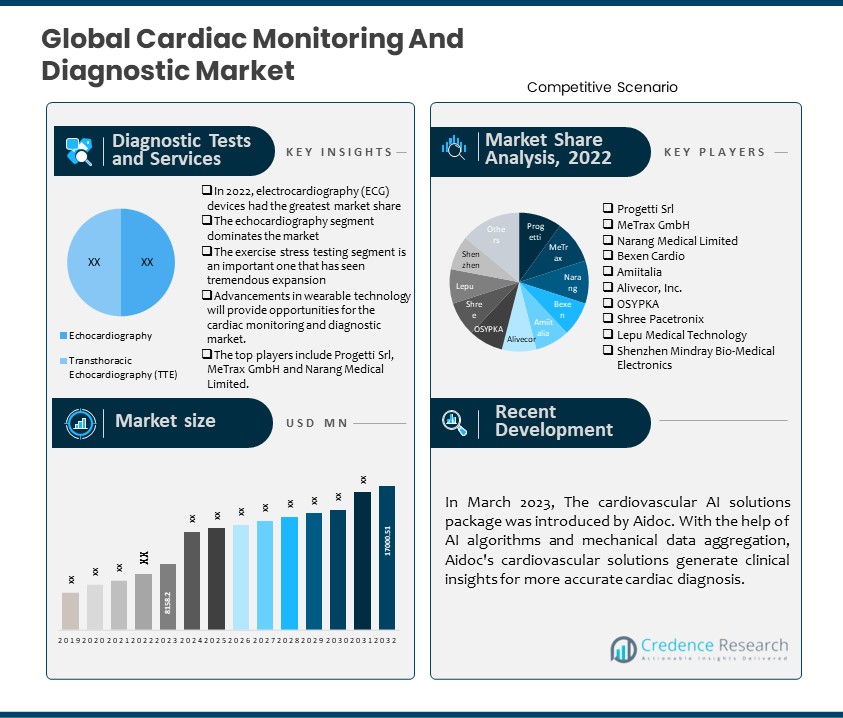
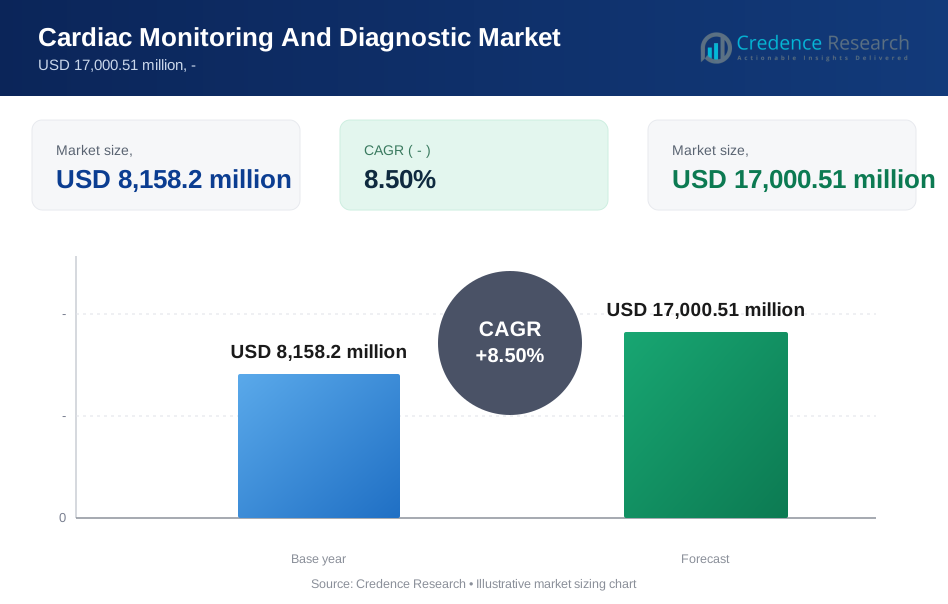
- The global market for cardiac monitoring and diagnostics is expected to develop at a compound annual growth rate (CAGR) of 8.50% between 2024 and 2032, from its estimated USD 8158.2 million in 2023 to USD 17000.51 million in 2032.
- The largest category is electrocardiography (ECG) devices. Cardiac rhythm management (CRM) devices, on the other hand, are expected to grow at a strong CAGR.
- The echocardiography category will expand at a rapid rate of growth.
- The CAGR for the exercise stress testing is expected to be the highest during the projection period.
- Coronary angiography will have the highest CAGR throughout the prediction period.
- North America dominated the cardiac monitoring and diagnostic market.
- Regarding the market share of cardiac monitoring and diagnostics, Europe is expected to come second.
- In the cardiac monitoring and diagnostic market, Asia Pacific is anticipated to grow fastest.
- As cardiovascular diseases become more commonplace worldwide and the aging population becomes more susceptible to cardiac disorders, the necessity for cardiac monitoring and diagnostics is directly impacted by the industry's expansion.
- The increasing focus on individualized treatment plans may affect the market for cardiac monitoring and diagnostics. This could lead to tailored cardiac monitoring solutions based on the needs of certain patients.
Executive Summary
Market Definition
The segment of the healthcare business that focuses on tools, services, and technologies for diagnosing and monitoring cardiac conditions is known as the cardiac monitoring and diagnostic market. This market includes a broad range of goods and services meant to identify, control, and treat anomalies and diseases of the cardiovascular system. It comprises gadgets like cardiac stress testing systems, Holter monitors, implantable cardiac monitors, event monitors, and electrocardiography (ECG) monitors, among others. The market also includes cardiac imaging modalities like MRIs and CT scans, cardiac catheterization, and echocardiography.
Market Overview
The cardiac monitoring and diagnostic sector is estimated to develop at an 8.50% compound annual growth rate (CAGR) between 2024 and 2032, maintaining its current upward trend. The market will continue to develop, rising from its estimated USD 8158.2 million in 2023 to USD 17000.51 million in 2032.
The global increase in the prevalence of cardiovascular diseases (CVDs) is a major factor propelling the cardiac monitoring and diagnostic market. Heart attacks, strokes, and other cardiovascular illnesses are among the world's leading causes of death. The incidence of CVDs is on the rise due to a number of factors, including smoking, poor dietary habits, lack of physical activity, unhealthy lifestyles, and increased stress. As the world's population ages, age-related cardiovascular diseases are becoming more common. Older people are more likely to experience heart-related problems, which makes routine monitoring and diagnostic services necessary in order to identify and treat these conditions. More sophisticated cardiac monitoring and diagnostic devices have been developed as a result of advancements in medical technology. Better accuracy, portability, and user-friendliness of these devices encourage their adoption for preventive as well as diagnostic purposes.
An increase in screening programs and regular check-ups has been attributed to growing awareness of the significance of early detection and treatment of cardiovascular diseases. The demand for monitoring and diagnostic devices has increased as a result of this, as well as improvements in diagnostic techniques, which have led to the more timely and accurate detection of heart conditions. As the prevalence of cardiovascular diseases rises, a large number of governments and healthcare institutions are investing in preventive healthcare initiatives. In order to make cardiac monitoring and diagnostic services more widely available, this involves providing funds for research, building healthcare infrastructure, and providing subsidies for medical devices.
Segmentation by Type of Monitoring Devices
- Electrocardiography (ECG) devices are the market leader in terms of the type of monitoring devices. The idea behind how ECG machines function is that when the heart contracts and relaxes, its electrical activity produces small electrical impulses. Electrodes applied to the skin can pick up these electrical impulses, and the ECG device interprets the signals after receiving them.
- The cardiac rhythm management (CRM) devices category will exhibit a sizable CAGR during the projected period. A class of medical devices known as cardiac rhythm management (CRM) devices is intended to monitor and treat heart rhythm abnormalities. Patients with arrhythmias, bradycardia (slow heart rhythm), tachycardia (fast heart rhythm), or heart failure are the main populations for which these devices are utilized.
Segmentation by Diagnostic Tests and Services
- Echocardiography is considered one of the best diagnostic tests and services. It involves placing a transducer on the chest that produces high-frequency sound waves. The transducer records the echoes produced when these sound waves reflect off the cardiac structures. Subsequently, images of the heart, including its chambers, valves, and blood flow patterns, are created from the echoes.
- The transthoracic echocardiography (TTE) category will likely register a significant CAGR during forecasting. TTE uses ultrasonic waves to produce real-time cardiac images. The transthoracic, or chest wall, is the location of a transducer that emits and receives ultrasonic waves that are directed toward the heart.
Segmentation by Stress Testing
- The exercise stress testing category is projected to grow faster over the projection period. Within a regulated clinical environment, a cardiac stress test assesses how the cardiovascular system reacts to outside stress. Exercise or intravenous medication stimulation of the heart rate can also cause this stress reaction.
- Other stress testing influences the need for cardiac monitoring and diagnosis, including pharmacological stress testing.
Segmentation by Cardiac Catheterization and Angiography
- The coronary angiography category will likely have the highest CAGR during the projection period. Coronary angiography is a medical procedure used to examine the heart's blood vessels, particularly the coronary arteries. The blood that is rich in oxygen is delivered to the heart muscle via these arteries. Coronary angiography is a vital diagnostic technique for evaluating a number of heart diseases, including coronary artery disease (CAD).
- Percutaneous coronary intervention (PCI), cardiac biomarker testing, electrophysiological studies (EPS), electrophysiology (EP) studies, and implantable device interrogation also contribute to the demand for cardiac monitoring and diagnostic market.
Segmentation by Region
- North America leads the cardiac monitoring and diagnostic industry. North America's advanced healthcare infrastructure and technological capabilities have enabled the development and application of cutting-edge cardiac monitoring and diagnostic devices.
- Europe is estimated to rank second in market size for cardiac monitoring and diagnostics.
- The cardiac monitoring and diagnostic industry is predicted to flourish rapidly in Asia Pacific.
- The remaining need for cardiac monitoring and diagnostics is covered by regions including Africa, the Middle East, and Latin America.
In cardiovascular care, cardiac monitoring devices are crucial because they can be used to assess the incidence and severity of heart failure as well as the effectiveness of medications, surgeries, and implanted devices as treatments. One of the main causes of death globally is cardiovascular disease (CVD), which is preventable. With pre-monitoring and pre-diagnosis, the majority of CVDs can be prevented. Early detection can help prevent arrhythmias or irregular heartbeats. Cardiac monitoring devices can help with diagnosis and heart disease monitoring, especially for patients who are at high risk of developing heart disease. In the near future, this is expected to increase demand for diagnostic and cardiovascular monitoring devices.
Based on projections, the cardiac monitoring and diagnostic market is anticipated to be controlled by North America. Cardiovascular diseases (CVDs), including hypertension and heart disease, are comparatively common in North America. Because of this, there is a noticeable need for cardiac monitoring and diagnostic services, which spurs the sector's innovation and investment. Modern hospitals, clinics, and diagnostic facilities with the newest equipment for cardiac monitoring and diagnosis can be found throughout North America's sophisticated healthcare network. Many of the top medical device companies and research institutes in the area are constantly developing new cardiac monitoring technologies. This includes developments in implantable technology, telemedicine, and wearable monitors, which improve patient care and data gathering. To ensure the safety and effectiveness of medical devices, regulatory agencies like the Food and Drug Administration (FDA) in the US set strict guidelines. This increases consumer confidence in cardiac monitoring devices.
The cardiac monitoring and diagnostic market in Asia Pacific is anticipated to expand fastest throughout the forecast. Asia Pacific's healthcare industry is quickly implementing cutting-edge technologies. The industry is expanding due to the increasing availability and affordability of wearable monitors and remote monitoring systems, which are examples of innovations in cardiac monitoring devices. The Asia Pacific region is seeing an increase in the incidence of cardiovascular diseases due to changing lifestyles, urbanization, and aging populations. Heart monitoring and diagnostic services are in high demand due to the increase in CVD cases. Numerous countries in the Asia-Pacific region are making significant investments in their hospital, clinic, and diagnostic center infrastructure. Better access to cardiac monitoring and diagnostic services is made possible by this expansion, which propels market expansion.
Key Highlights of the Report
The global cardiac monitoring and diagnostic market is segmented by type of monitoring devices, diagnostic tests and services, stress testing, cardiac catheterization and angiography, and region. As far as the type of monitoring devices are concerned, electrocardiography (ECG) devices are the market spearhead. Echocardiography is the top category. The exercise stress testing category is anticipated to increase at the highest CAGR throughout the projection period. The coronary angiography category will experience the highest CAGR during the forecast period. The cardiac monitoring and diagnostic market is expanding mostly in North America.
The cardiac monitoring and diagnostic market has grown significantly as a result of technological developments in cardiac monitoring devices. With the wireless connectivity features found in modern cardiac monitoring devices, medical professionals can remotely monitor patients' heart activity in real-time. Patients who need constant monitoring due to chronic heart conditions or who live in remote areas will benefit most from this capability. In the end, remote monitoring lowers the risk of adverse cardiac events and hospital readmissions by enabling early detection of cardiac abnormalities, prompt intervention, and customized treatment plans. With the wireless connectivity features found in modern cardiac monitoring devices, medical professionals can remotely monitor patients' heart activity in real-time. Patients who need constant monitoring due to chronic heart conditions or who live in remote areas will benefit most from this capability. In the end, remote monitoring lowers the risk of adverse cardiac events and hospital readmissions by enabling early detection of cardiac abnormalities, prompt intervention, and customized treatment plans.
North America is expected to account for the largest cardiac monitoring and diagnostic market globally. The area is fortunate to have a thriving network of colleges, research facilities, and hospitals carrying out innovative cardiology and related studies. This encourages industry and academic cooperation and pushes the boundaries of cardiac monitoring and diagnostics innovation. The Asia Pacific region is also assumed to have the market's sharpest growth. This is due to the various policies and initiatives being implemented by governments in the Asia Pacific region with the aim of enhancing healthcare quality and accessibility. This includes medical device subsidies and funding programs for preventive healthcare measures, which drive market expansion in the cardiac monitoring and diagnostic industry.
Which Key Factors Are Driving The Global Cardiac Monitoring And Diagnostic Market?
The market for cardiac monitoring and diagnostics is expanding due to several factors, such as the growing demand for personalized medicine in cardiology, the expansion of healthcare spending in developing economies, and the integration of artificial intelligence and machine learning in diagnostics.
What Are The Main Challenges Confronting The Cardiac Monitoring And Diagnostic Market Globally?
The cost of advanced cardiac monitoring devices and diagnostic procedures is considerable, and there are issues with reimbursement for these services. In addition, restricted access to medical institutions, especially in underserved and rural areas, also confronts the industry for cardiac monitoring and diagnostics.
What Market Opportunities Exist For Cardiac Monitoring And Diagnostic Globally?
The market for cardiac monitoring and diagnostics is expected to grow as a result of the increasing use of telemedicine, unrealized potential in developing nations, and rising healthcare system digitalization, which makes it easier to integrate cardiac monitoring data for improved patient management.
Market Drivers
Multiple factors propel the cardiac monitoring and diagnostic industry across the globe. The primary factors propelling the global cardiac monitoring and diagnostic market are as follows:
Development of Advanced ECG Monitoring Systems
Advanced ECG monitoring systems make use of cutting-edge technologies like cloud computing, wireless connectivity, and wearables. Heart monitoring is now more accurate, dependable, and convenient due to these developments. For example, wearable ECG monitors provide real-time data for improved diagnosis and treatment of cardiac conditions and provide continuous monitoring outside of clinical settings. Patients had to visit medical facilities for routine testing in order to participate in traditional ECG monitoring. Modern ECG monitoring systems, on the other hand, make remote monitoring possible, enabling medical professionals to keep an eye on patients' cardiac activity at all times. This ability allows for early detection of abnormalities and prompt intervention, which ultimately improves patient outcomes. It is especially important for patients with chronic conditions or those who are at risk of cardiac events. Electronic health records (EHRs) and healthcare management systems are frequently seamlessly integrated with modern ECG monitoring systems. This integration improves care coordination, speeds up data management, and makes it easier for healthcare providers to communicate with one another. Moreover, it makes automated analysis of ECG data possible, which eases the workload for medical professionals and expedites the interpretation of results.
Market Restraints
There are several obstacles that the global cardiac monitoring and diagnostic market must overcome to continue growing. Among them are the following:
High Expense of Cutting-Edge Cardiac Monitoring Equipment And Diagnostic Treatments
Modern technology is frequently incorporated into advanced cardiac monitoring devices to provide precise diagnosis and ongoing cardiac condition monitoring. Research, development, and production expenses are high in the process of creating and producing these devices. As a result, the cost of these devices is high, which limits their accessibility for patients and healthcare facilities with limited financial means. Accurately evaluating cardiac health and identifying anomalies depend on cardiac diagnostic procedures like cardiac catheterization, electrophysiology studies, and cardiac imaging methods like MRI and CT scans. However, because they require specialized personnel, infrastructure, and sophisticated equipment, these procedures can be costly. Furthermore, expenses may increase if more tests or follow-up procedures are required in light of preliminary results.
Opportunities
There are plenty of potential prospects in the global cardiac monitoring and diagnostic industry. Among these are the following:
Integration of Artificial Intelligence and Machine Learning in Diagnostics
Large volumes of data from different cardiac monitoring devices can be analyzed by AI algorithms very quickly and accurately. These systems can learn from data patterns and gradually increase their diagnostic accuracy by utilizing machine learning techniques. By doing so, the likelihood of false positives or negatives can be decreased, and cardiac anomalies and conditions can be detected with greater precision. Artificial intelligence (AI)-driven diagnostic systems are able to identify minute variations in heart health metrics that could point to the early onset of cardiovascular disorders. Timely intervention and treatment are made possible by early detection, which may even prevent fatalities or major complications. Predictive analytics is made possible by machine learning algorithms that examine patient data from the past to find patterns and trends related to cardiac conditions. Healthcare professionals can forecast the chance of upcoming cardiac events or exacerbations.
Competitive Landscape
Key Players
Several major competitors exist in the fiercely competitive global cardiac monitoring and diagnostic market. The followings are a few of the leading market participants and their market shares:
- Progetti Srl
- MeTrax GmbH
- Narang Medical Limited
- Bexen Cardio
- Amiitalia
- Alivecor, Inc.
- OSYPKA
- Shree Pacetronix
- Lepu Medical Technology
- Shenzhen Mindray Bio-Medical Electronics
- ACS Diagnostics
- BPL Medical Technologies
- BioTelemetry
- SCHILLER AG
- Nihon Kohden
- Hill-Rom Holdings
- MicroPort Scientific Corporation
- Asahi Kasei Corporation
- Koninklijke Philips
- BIOTRONIK
- GE Healthcare
- Abbott Laboratories
- Boston Scientific
- Medtronic
- Others
These companies prioritize product innovation, distribution channel expansion, mergers, and acquisitions to remain competitive.
The largest suppliers in the global cardiac monitoring and diagnostic market continuously work to stay one step ahead of the competition by developing innovative concepts and products.
In May 2023, FDA clearance was granted to Volta Medical's AI-enabled atrial fibrillation software solution, Volta AF-Xplorer. The program makes complicated atrial fibrillation procedures easier to understand.
In May 2023, Koninklijke Philips N.V. purchased the AI intelligence company Philips DiA Imaging Analysis. This acquisition would improve the company's position in the cardiac AI monitoring and diagnostics market.
In April 2023, The United States launch of HeartFlow, Inc.'s RoadMap analysis software solution was announced. The method aids in the identification of coronary artery narrowings in CT scans.
Summary of Key Findings
- A rise in the prevalence of atrial fibrillation and other arrhythmias could result from this industry's expansion.
- The market is segmented by type of monitoring devices, diagnostic tests and services, stress testing, cardiac catheterization and angiography, and region.
- In the market, electrocardiography (ECG) devices are the most widely used type of monitoring devices.
- Echocardiography is the foremost category.
- The exercise stress testing is expected to grow fastest in terms of CAGR during the forecast period.
- The coronary angiography category will likely see the highest CAGR during the anticipated time frame.
- North America is leading market development; the market is highly competitive with key players including Progetti Srl, MeTrax GmbH, Narang Medical Limited, Bexen Cardio, Amiitalia, Alivecor, Inc., OSYPKA, Shree Pacetronix, Lepu Medical Technology, Shenzhen Mindray Bio-Medical Electronics, ACS Diagnostics, BPL Medical Technologies, BioTelemetry, SCHILLER AG, Nihon Kohden, Hill-Rom Holdings, MicroPort Scientific Corporation, Asahi Kasei Corporation, Koninklijke Philips, BIOTRONIK, GE Healthcare, Abbott Laboratories, Boston Scientific, Medtronic, and Others.
Future Outlook
- The cardiac monitoring and diagnostic industry is expected to increase significantly in North America, and its outlook is positive worldwide.
- The rising acceptance of point-of-care testing for cardiac biomarkers
- may impact the market for cardiac monitoring and diagnostics.
- Restricted access to medical institutions, especially in underdeveloped and rural areas, might hinder the market for cardiac monitoring and diagnostics.
- To stay ahead of the competition, key enterprises must develop new products, expand their market reach, and keep their prices competitive.
How CXOs Can Benefit from the Credence Research Cardiac Monitoring And Diagnostic Market Report
CXOs may get a detailed picture of the market in the Credence Research Cardiac Monitoring And Diagnostic Market Report, which includes:
- Market size and growth forecast: The report provides detailed estimates of the global cardiac monitoring and diagnostic market size, segmented by type of monitoring devices, diagnostic tests and services, stress testing, cardiac catheterization and angiography, and region. It also includes forecasts for the market through 2032 based on key trends and drivers.
- Market segmentation: The research report breaks down the market for cardiac monitoring and diagnostics into segments based on the type of monitoring devices, diagnostic tests and services, stress testing, cardiac catheterization and angiography, and region. This provides CXOs with a granular understanding of the market and the opportunities in each segment.
- Competitive landscape: The research report offers a detailed analysis of the major companies in the cardiac monitoring and diagnostic industry, including information on their business plans, product lines, and earnings. CXOs can use this information to evaluate and identify their competitors.
- Key trends and drivers: The research report identifies and evaluates the main trends and factors influencing the cardiac monitoring and diagnostic market. CXOs can use this information to make well-informed choices regarding their plans and investments.
CXOs can use the insights from the Credence Research Cardiac Monitoring And Diagnostic Market Report to:
- Identify growth opportunities: This analysis may help CXOs identify new growth opportunities in the cardiac monitoring and diagnostic sector. For example, the report identifies the growing demand for cardiac monitoring and diagnostics from hospitals as a key opportunity.
- Make informed investment decisions: The report helps CXOs wisely choose cardiac monitoring and diagnostic solutions. For example, the research study provides information on the critical factors to consider when selecting solutions and evaluating suppliers.
- Develop competitive strategies: CXOs can use the research report to develop competitive strategies for their cardiac monitoring and diagnostic businesses. For example, the research paper outlines the main strategies that cardiac monitoring and diagnostic suppliers utilize to differentiate themselves from competitors.
- Track market developments: This research report may help CXOs stay ahead of the curve by tracking market developments. For instance, it offers insights into the most recent developments and trends in the cardiac monitoring and diagnostic market.
CXOs seeking to expand their industry knowledge and spot growth prospects will find the Credence Research Cardiac Monitoring And Diagnostic Market Report useful.
Segmentation
- By Type of Monitoring Devices
- Electrocardiography (ECG) Devices
- Resting ECG Devices
- Holter Monitors
- Event Monitors
- Implantable Loop Recorders (ILRs)
- Cardiac Event Monitoring Systems
- Cardiac Rhythm Management (CRM) Devices
- Implantable Cardioverter Defibrillators (ICDs)
- Cardiac Pacemakers
- Cardiac Resynchronization Therapy (CRT) Devices
- Remote Cardiac Monitoring Systems
- By Diagnostic Tests and Services
- Echocardiography
- Transthoracic Echocardiography (TTE)
- By Stress Testing
- Exercise Stress Testing
- Pharmacological Stress Testing
- By Cardiac Catheterization and Angiography
- Coronary Angiography
- Percutaneous Coronary Intervention (PCI)
- Cardiac Biomarker Testing
- Electrophysiological Studies (EPS)
- Electrophysiology (EP) Studies
- Implantable Device Interrogation
- By Region
- North America
- The U.S.
- Canada
- Mexico
- Europe
- Germany
- France
- The U.K.
- Italy
- Spain
- Rest of Europe
- Asia Pacific
- China
- Japan
- India
- South Korea
- South-east Asia
- Rest of Asia Pacific
- Latin America
- Brazil
- Argentina
- Rest of Latin America
- Middle East & Africa
- GCC Countries
- South Africa
- The Rest of the Middle East and Africa
- North America
- Electrocardiography (ECG) Devices
Request a Free Sample
Fill in your details and we'll send you a free sample report.
- Sample data tables & charts
- Research methodology
Need a Custom Version of This Report?
Tailor the scope, geography, or segments to your exact requirements.
- Custom geography or segment scope
- Direct access to our analyst team
Frequently Asked Questions
How much does the global market currently hold for cardiac monitoring and diagnostics?
What is the cardiac monitoring and diagnostic market's projected growth rate between 2024 and 2032?
In terms of the type of monitoring devices, which market category is leading?
Which cardiac catheterization and angiography segment is estimated to have the highest CAGR throughout the forecast period?
Who are the main players globally in the cardiac monitoring and diagnostic industry?
Table of Content
Chapter 1. Report Introduction
- 1.1 Report Description & Purpose
- 1.1.1 Report Title & Market Definition
- 1.1.2 Unique Selling Propositions (USP) & Key Differentiators
- 1.1.3 Value Proposition for Stakeholders
- 1.2 Research Objectives
- 1.2.1 Market Sizing Objectives (Volume & Revenue)
- 1.2.2 Segmentation Objectives
- 1.2.3 Competitive Intelligence Objectives
- 1.2.4 Forecast & Scenario Objectives
- 1.3 Report Scope
- 1.3.1 Cardiac Monitoring And Diagnostic Scope – Types & Subtypes Covered
- 1.3.2 Geographic Scope – Regions & Countries Covered
- 1.3.3 Historical Period, Base Year & Forecast Period (the historical period; forecast to the forecast period)
- 1.3.4 Inclusions & Exclusions
- 1.4 HS Code & Classification Framework
- 1.5 Currency, Units & Pricing Basis
- 1.6 Target Stakeholders
- 1.7 Limitations & Assumptions
Chapter 2. Executive Summary
- 2.1 Global Cardiac Monitoring And Diagnostic Market Snapshot
- 2.1.1 Market Size – Historical (the historical period) & Forecast (the forecast period) (base year: USD 8,158.2 million → forecast year: USD 17,000.51 million)
- 2.1.2 Volume & Revenue – Global Totals
- 2.1.3 Key Market Highlights – Top Five Facts
- 2.2 Cardiac Monitoring And Diagnostic Market Segmentation Snapshot
- 2.2.1 Market Split by Region – vs.
- 2.3 Competitive Snapshot
- 2.3.1 Top 10 Players by Revenue Share –
- 2.3.2 Top 10 Players by Volume Share –
- 2.3.3 Recent Strategic Developments (18-Month Summary)
- 2.4 Key Investment Highlights & Strategic Conclusions
Chapter 3. Cardiac Monitoring And Diagnostic Market Dynamics & Industry Analysis
- 3.1 Market Overview & Context
- 3.1.1 Cardiac Monitoring And Diagnostic Market Position in the Broader Automotive Value Chain
- 3.1.2 OEM vs. Replacement Market Dynamics
- 3.1.3 Market Maturity & Development Stage by Region
- 3.2 Cardiac Monitoring And Diagnostic Market Drivers
- 3.3 Cardiac Monitoring And Diagnostic Market Restraints & Challenges
- 3.4 Cardiac Monitoring And Diagnostic Market Opportunities
- 3.5 Porter's Five Forces Analysis
- 3.5.1 Threat of New Entrants
- 3.5.2 Bargaining Power of Suppliers
- 3.5.3 Bargaining Power of Buyers
- 3.5.4 Threat of Substitutes
- 3.5.5 Competitive Rivalry – Intensity Assessment
- 3.6 Cardiac Monitoring And Diagnostic Value Chain Analysis
- 3.6.1 Upstream – Raw Material/Input Suppliers
- 3.6.1.1 Raw Material/Input 1
- 3.6.1.2 Raw Material/Input 2
- 3.6.1.3 Raw Material/Input 3
- 3.6.2 Midstream – Production/Manufacturing/Service Delivery
- 3.6.2.1 Production/Process Overview
- 3.6.2.2 Key Facility Locations & Capacity by Manufacturer
- 3.6.3 Downstream – Distribution & End Consumer
- 3.6.3.1 Primary Channel – B2B/OEM
- 3.6.3.2 Secondary Channels – Dealer, Retail, Online, Direct
- 3.6.4 Value Chain Profitability Analysis
- 3.6.1 Upstream – Raw Material/Input Suppliers
- 3.7 PESTEL Analysis
- 3.7.1 Political Factors
- 3.7.2 Economic Factors
- 3.7.3 Social Factors
- 3.7.4 Technological Factors
- 3.7.5 Environmental Factors
- 3.7.6 Legal Factors
- 3.8 Cardiac Monitoring And Diagnostic Supply Chain Analysis
- 3.8.1 Raw Material/Input Supply Risk Assessment
- 3.8.2 Manufacturing Concentration Risk (Geographic Exposure)
- 3.8.3 Trade Disruption Impact Analysis
- 3.9 Regulatory & Policy Landscape
Note: The regulatory and policy landscape section covers regulations based on their applicability to the market, Cardiac Monitoring And Diagnostic category, geography, and scope of the study. Only regulatory frameworks with a material impact on operations, compliance, trade, sustainability, or market access are analyzed in detail.
Chapter 4. Key Investment Pockets & Opportunity Analysis
- 4.1 Cardiac Monitoring And Diagnostic Market Attractiveness Analysis
- 4.1.1 By Region – Investment Attractiveness Matrix (Volume × CAGR)
- 4.2 Absolute Revenue Growth Opportunity
- 4.2.1 By Region – Absolute USD Growth Through the forecast period
- 4.3 Incremental Volume Opportunity
- 4.3.1 By Region – Incremental Volume Through the forecast period
- 4.3.2 Segment – Incremental Volume
- 4.4 Emerging Submarket Opportunity Deep Dive (Subject to Applicability)
- 4.5 Emerging Market Opportunity Scorecards
- 4.5.1 United States
- 4.5.2 Europe
- 4.5.3 Asia
- 4.5.4 Middle East & Africa
Note: Emerging Market Opportunity Scorecards will be included based on relevance and strategic importance. Regions listed are indicative and may vary depending on data availability and market dynamics.
Chapter 5. Cardiac Monitoring And Diagnostic Import-Export Analysis & Trade Flows
- 5.1 Global Trade Overview
- 5.1.1 Global Export Value by Country (the historical period)
- 5.1.2 Global Export Volume by Country (the historical period)
- 5.1.3 Global Import Value by Country (the historical period)
- 5.1.4 Global Import Volume by Country (the historical period)
- 5.1.5 Net Trade Balance by Country (the historical period)
- 5.2 Export Analysis – Segment
- 5.2.1 Type 1 (HS Code)
- 5.2.2 Type 2 (HS Code)
- 5.2.3 Type 3 (HS Code)
- 5.2.4 Type 4 (HS Code)
- 5.2.5 Type 5 (HS Code)
- 5.3 Import Analysis – Segment
- 5.3.1 Type 1 (HS Code)
- 5.3.2 Type 2 (HS Code)
- 5.3.3 Type 3 (HS Code)
- 5.3.4 Type 4 (HS Code)
- 5.3.5 Type 5 (HS Code)
- 5.4 Average Unit Trade Prices
- 5.4.1 Average Export Price – Segment & Country
- 5.4.2 Average Import Price – Segment & Source Country
- 5.4.3 Price Trends (the historical period)
- 5.5 Key Trade Route Analysis
- 5.5.1 Trade Route 1
- 5.5.2 Trade Route 2
- 5.5.3 Trade Route 3
- 5.5.4 Trade Route 4
- 5.5.5 Trade Route 5
- 5.6 Trade Policy Impact Assessment
- 5.6.1 US Anti-Dumping & Section 301 Tariffs
- 5.6.2 EU Customs Union Impact
- 5.6.3 Major Free Trade Agreements
- 5.6.4 USMCA Rules of Origin
Note: Trade policy analysis will be included only where relevant to the Cardiac Monitoring And Diagnostic market.
Chapter 6. Competitive Landscape & Company Benchmarking
- 6.1 Cardiac Monitoring And Diagnostic Market Concentration & Structure
- 6.1.1 Herfindahl-Hirschman Index (HHI) – vs.
- 6.1.2 Tier 1, Tier 2 & Tier 3 Market Structure
- 6.1.3 Global, Regional & Local Player Dynamics
- 6.2 Cardiac Monitoring And Diagnostic Market Share Analysis –
- 6.2.1 Global Revenue Share by Company
- 6.2.2 Global Volume Share by Company
- 6.2.3 Regional Revenue Share
- 6.2.4 Market Share Evolution ( vs. )
- 6.2.5 OEM Segment Share by Company
- 6.2.6 Replacement Segment Share by Company
- 6.3 Production/Delivery Capacity & Facility Analysis
- 6.3.1 Global Installed Capacity
- 6.3.2 Capacity Utilization Rates
- 6.3.3 Production/Output Volume
- 6.3.4 Facility Locations & Capacity Map
- 6.3.5 Planned Capacity Additions
- 6.4 Cardiac Monitoring And Diagnostic Competitive Benchmarking Matrix
- 6.4.1 Revenue, Volume, CAGR & Profitability Comparison
- 6.4.2 Channel Revenue Mix
- 6.4.3 Geographic Revenue Exposure
- 6.4.4 R&D Intensity
- 6.4.5 Sustainability Maturity
- 6.5 Strategic Developments in Cardiac Monitoring And Diagnostic (Last 24 Months)
- 6.5.1 Mergers, Acquisitions & Divestments
- 6.5.2 New Cardiac Monitoring And Diagnostic Launches
- 6.5.3 Facility Expansions
- 6.5.4 Strategic Alliances, Joint Ventures & Partnerships
- 6.5.5 Distribution Expansion & Market Entry
- 6.5.6 Sustainability & ESG Initiatives
- 6.6 Competitive Strategy Mapping
- 6.6.1 Leader, Challenger, Follower & Niche Classification
- 6.6.2 Pricing Strategy Comparison
- 6.6.3 Channel Strategy Matrix
Note: Strategic developments are included based on their materiality and the availability of reliable information.
Chapter 7. Global Cardiac Monitoring And Diagnostic Market – By Distribution Channel
- 7.1 Segment Overview
- 7.1.1 Volume & Revenue Split by Channel ( & )
- 7.1.2 Channel Mix Evolution (the forecast period)
Chapter 8. Regional Market Analysis – Global Overview
- 8.1 Global Regional Overview
- 8.1.1 Regional Volume Share
- 8.1.2 Regional Revenue Share
- 8.1.3 Regional Volume by Region
- 8.1.4 Regional Revenue by Region
- 8.1.5 Regional Forecast Through the forecast period
- 8.2 Cross-Regional Segment Analysis
- 8.2.1 By Distribution Channel
- 8.2.2 By Brand/Price Tier
Chapter 9. North America Cardiac Monitoring And Diagnostic Market
- 9.1 United States
- 9.2 Canada
- 9.3 Mexico
Chapter 10. Europe Cardiac Monitoring And Diagnostic Market
- 10.1 Germany
- 10.2 France
- 10.3 Italy
- 10.4 United Kingdom
- 10.5 Spain
- 10.6 Poland
- 10.7 Russia
- 10.8 Netherlands
- 10.9 Belgium
- 10.10 Sweden
- 10.11 Denmark
- 10.12 Norway
- 10.13 Rest of Europe
Chapter 11. Asia Pacific Cardiac Monitoring And Diagnostic Market
- 11.1 China
- 11.2 India
- 11.3 Japan
- 11.4 South Korea
- 11.5 Thailand
- 11.6 Indonesia
- 11.7 Vietnam
- 11.8 Malaysia
- 11.9 Australia
- 11.10 Rest of Asia Pacific
Chapter 12. Latin America Cardiac Monitoring And Diagnostic Market
- 12.1 Brazil
- 12.2 Argentina
- 12.3 Colombia
- 12.4 Chile
- 12.5 Rest of Latin America
Chapter 13. Middle East Cardiac Monitoring And Diagnostic Market
- 13.1 Saudi Arabia
- 13.2 United Arab Emirates
- 13.3 Turkey
- 13.4 Israel
- 13.5 Iran
- 13.6 Rest of the Middle East
Chapter 14. Africa Cardiac Monitoring And Diagnostic Market
- 14.1 South Africa
- 14.2 Egypt
- 14.3 Nigeria
- 14.4 Morocco
- 14.5 Rest of Africa
Chapter 15. Cardiac Monitoring And Diagnostic Company Profiles
- 15.1 [Company 01]
- 15.1.1 Company Overview
- 15.1.2 Key Management Personnel
- 15.1.3 Products & Services Portfolio
- 15.1.4 Financial Performance
- 15.1.5 Key Market Focus & Geographic Presence
- 15.1.6 Recent Developments & Strategic Initiatives
Note: The company profile list is preliminary and may change based on research findings, market developments, data availability, and client requirements.
Chapter 16. Appendices
- Appendix A – List of Abbreviations & Acronyms
- Appendix B – Industry Classification Code Reference – Full Series
- Appendix C – Production & Capacity Data Tables
- Appendix D – End-Use & Demand Base Tables
- Appendix E – Consumption & Replacement Rate Assumptions
- Appendix F – ASP Reference Tables
- Appendix G – Manufacturing & Facility Database
- Appendix H – Import-Export Data Tables
- Appendix I – Regulatory Summary Tables
- Appendix J – Primary Research Participant List (Anonymized)
- Appendix K – Primary Research Questionnaire Framework
- Appendix L – Data Sources & Bibliography
- Appendix M – Market Size Divergence & Source Comparison
Chapter 17. Research Methodology
- 17.1 Research Framework & Philosophy
- 17.2 Secondary Research – Sources, Hierarchy & Data Extraction
- 17.3 Data Modeling – Bottom-Up & Top-Down Market Sizing
- 17.4 Primary Research – Stakeholder Framework, LOI & Sample Sizes
- 17.5 Forecast Methodology – Regression, Scenario & Sensitivity Analysis
- 17.6 Quality Control – Four-Layer Validation Framework
- 17.7 Limitations & Standard Assumptions
- 17.8 Disclaimer
