
| REPORT ATTRIBUTE | DETAILS |
|---|---|
| Historical Period | 2019-2022 |
| Base Year | 2023 |
| Forecast Period | 2024-2032 |
| Hospital Bed Market Size 2024 | USD 4565 Million |
| Hospital Bed Market, CAGR | 5.62% |
| Hospital Bed Market Size 2032 | USD 7069.848 Million |
Market Overview:
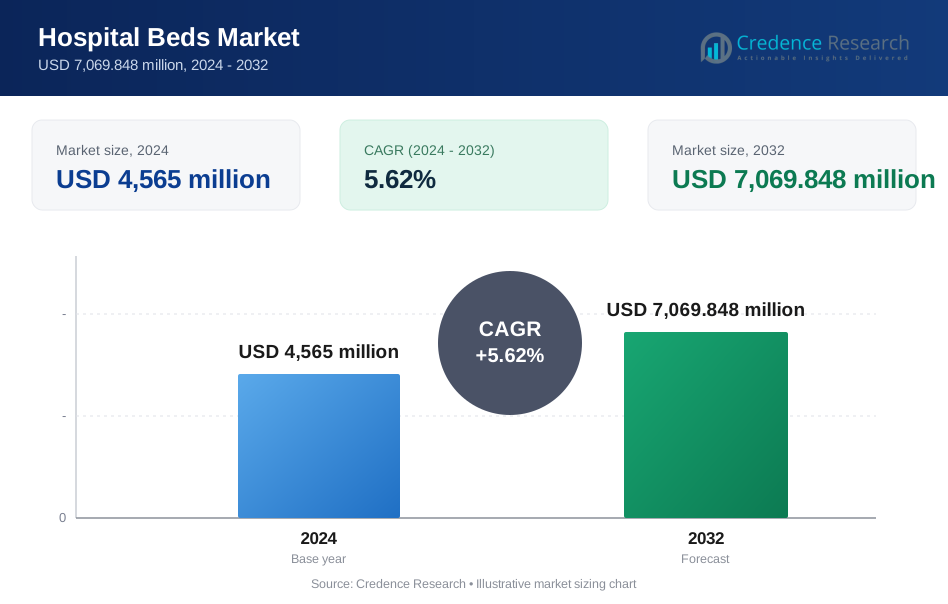
The Hospital Bed Market is projected to grow from USD 4565 million in 2024 to an estimated USD 7069.848 million by 2032, with a compound annual growth rate (CAGR) of 5.62% from 2024 to 2032.
The market drivers for hospital beds are multifaceted, with key factors including technological advancements, rising healthcare expenditure, and the increasing prevalence of chronic diseases. The incorporation of smart technologies into hospital beds, such as remote monitoring, adjustable settings, and integrated communication systems, has significantly improved patient care, making these beds more desirable for healthcare facilities. Additionally, the surge in healthcare spending globally, particularly in emerging markets, is fueling the demand for modern hospital beds equipped with advanced features. The growing elderly population, which is more prone to chronic conditions and requires prolonged hospitalization, is another critical driver. Furthermore, the COVID-19 pandemic highlighted the need for better healthcare preparedness, leading to increased investments in hospital infrastructure, including hospital beds.
Regionally, North America dominated the hospital bed market in 2023, accounting for a significant share due to its well-established healthcare infrastructure, high healthcare spending, and the presence of major market players. Europe followed closely, driven by the region’s aging population and strong healthcare policies. The Asia-Pacific region is anticipated to witness the fastest growth over the forecast period, supported by increasing healthcare investments, rapid urbanization, and a growing focus on improving healthcare services in countries like China and India. In contrast, the Middle East and Africa, though currently holding a smaller market share, are expected to see gradual growth due to improving healthcare infrastructure and increasing awareness about advanced patient care solutions.
Market Drivers:
Technological Advancements in Hospital Bed Design The hospital bed market is significantly influenced by ongoing technological advancements that enhance patient care and comfort. Modern hospital beds are now equipped with features such as electronic height adjustments, built-in patient monitoring systems, and smart sensors that alert healthcare providers to patient movements or changes in condition. For instance, a survey conducted by the National Institutes of Health (NIH) highlights the widespread use of smart medical beds in healthcare facilities, with over 70% of hospitals adopting these advanced technologies. These innovations are crucial in improving patient outcomes, reducing the risk of falls, and enhancing overall hospital efficiency. The integration of these technologies into hospital beds not only meets the growing demand for advanced healthcare solutions but also drives the market by attracting healthcare facilities aiming to offer superior patient care.
Rising Healthcare Expenditure and Investments The increase in global healthcare expenditure is another key driver of the hospital bed market. Governments and private sectors are investing heavily in healthcare infrastructure to meet the growing demands of an aging population and the rising prevalence of chronic diseases. For instance, the National Health Expenditure (NHE) data from the Centers for Medicare and Medicaid Services (CMS) show that U.S. healthcare spending grew by 4.1% to reach $4.5 trillion in 2022. These investments include the procurement of advanced hospital beds that cater to the specific needs of patients with varying conditions. The emphasis on enhancing healthcare facilities, especially in emerging economies, is propelling the demand for modern hospital beds that can accommodate a range of medical needs, from intensive care to long-term patient stays.
Aging Population and Prevalence of Chronic Diseases The growing aging population is a critical factor driving the demand for hospital beds globally. Older adults are more susceptible to chronic conditions such as cardiovascular diseases, diabetes, and arthritis, which often require prolonged hospital stays. As the global population continues to age, there is an increasing need for hospital beds that provide comfort and facilitate easier patient care. Additionally, the rising incidence of chronic diseases across all age groups has led to a higher demand for hospital beds in both acute and long-term care settings. This trend is expected to continue, driving the market growth as healthcare providers seek to accommodate the needs of this growing patient demographic.
Impact of the COVID-19 Pandemic The COVID-19 pandemic has had a profound impact on the hospital bed market, highlighting the importance of healthcare preparedness and the need for adequate hospital infrastructure. The surge in hospital admissions during the pandemic led to an unprecedented demand for hospital beds, particularly those equipped with advanced features for critical care. This situation prompted governments and healthcare institutions worldwide to invest in expanding their hospital capacities, including the procurement of additional beds. The experience of the pandemic has underscored the necessity for robust healthcare systems, leading to continued investments in hospital beds to ensure readiness for future healthcare crises. This has significantly contributed to the market's growth and is likely to influence its trajectory in the coming years.
Market Trends:
Increasing Demand for Adjustable and Customizable Beds A significant trend in the hospital bed market is the growing demand for adjustable and customizable beds. As healthcare providers seek to enhance patient comfort and improve outcomes, the preference for beds that can be tailored to individual patient needs is rising. For instance, a survey conducted by the National Institutes of Health (NIH) highlights the widespread use of adjustable beds in healthcare facilities, with over 70% of hospitals adopting these advanced technologies. Adjustable beds, which allow for modifications in height, backrest, and leg positioning, are increasingly popular in hospitals and home care settings. This trend is driven by the need to accommodate patients with diverse medical conditions, ranging from mobility issues to respiratory problems, which require specific bed configurations. The ability to customize beds not only improves patient care but also helps healthcare providers optimize space and resources in medical facilities.
Shift Towards Smart and Connected Beds The hospital bed market is also witnessing a shift towards smart and connected beds, a trend fueled by advancements in the Internet of Things (IoT) and healthcare technology. These beds are equipped with sensors and connectivity features that allow for real-time monitoring of patient vitals, movements, and other critical health parameters. The integration of smart technologies enables healthcare providers to remotely monitor patients, reduce the risk of bedsores, and enhance the overall efficiency of patient care. This trend is particularly relevant in intensive care units (ICUs) and other critical care settings, where continuous monitoring is essential. The adoption of smart beds is expected to grow as healthcare systems worldwide increasingly prioritize technology-driven solutions.
Growing Focus on Infection Control and Hygiene Another important trend in the hospital bed market is the increasing focus on infection control and hygiene. The COVID-19 pandemic has heightened awareness of the need for stringent hygiene standards in healthcare settings, leading to a greater emphasis on beds that are easy to clean and disinfect. Manufacturers are responding to this demand by developing hospital beds with antimicrobial surfaces, removable and washable components, and materials that resist the growth of bacteria and viruses. This trend is expected to persist as healthcare providers continue to prioritize infection control measures to prevent hospital-acquired infections (HAIs) and protect both patients and staff.
Expansion of Home Healthcare and Geriatric Care The expansion of home healthcare and geriatric care services is another key trend impacting the hospital bed market. As the global population ages, there is a growing demand for home-based care solutions, including hospital beds that can be used in residential settings. For instance, the U.S. Census Bureau reports that home health care services experienced a 50.5% increase in revenue from 2013 to 2020, driven by the aging population. This trend is driven by the preference of many elderly patients to receive care at home rather than in institutional settings. The market is responding with the development of hospital beds designed specifically for home use, which are often more compact, user-friendly, and aesthetically pleasing compared to traditional hospital beds. The increasing adoption of these beds in home care settings is expected to drive market growth, particularly in regions with aging populations and well-established healthcare infrastructure.
Market Restraints and Challenges:
High Costs of Advanced Hospital Beds One of the primary restraints in the hospital bed market is the high cost associated with advanced hospital beds. These beds, equipped with sophisticated features such as smart monitoring systems, electronic adjustments, and antimicrobial surfaces, can be prohibitively expensive for many healthcare facilities, particularly in emerging markets. The significant upfront investment required for these beds limits their adoption, especially in smaller hospitals and clinics that operate with constrained budgets. This cost barrier is a notable challenge, as it can slow the penetration of technologically advanced beds in regions where they are most needed.
Limited Reimbursement Policies Another challenge impacting the hospital bed market is the limited reimbursement policies for hospital equipment in various countries. In many regions, healthcare systems and insurance providers do not fully cover the costs of hospital beds, particularly those with advanced features. This lack of comprehensive reimbursement can deter healthcare facilities from investing in new or upgraded beds, as the financial burden falls on the institutions or patients themselves. Consequently, this challenge restricts the market’s growth potential, particularly in markets where healthcare funding is limited or unevenly distributed.
Supply Chain Disruptions and Raw Material Shortages The hospital bed market is also vulnerable to supply chain disruptions and raw material shortages, which have been exacerbated by global events such as the COVID-19 pandemic. These disruptions can lead to delays in manufacturing and delivery, increasing the overall cost of production and affecting the availability of hospital beds in the market. Furthermore, fluctuations in the prices of raw materials used in manufacturing hospital beds, such as metals and electronic components, can lead to increased costs for manufacturers, which are often passed on to consumers. Addressing these supply chain challenges is critical for ensuring the steady availability and affordability of hospital beds globally.
Market Segmentation Analysis:
By Type, the market is divided into general beds, pediatric beds, pressure relief beds, and birthing beds. General beds hold the largest share due to their widespread use across various healthcare settings, while pressure relief beds are gaining traction for their role in preventing bedsores in long-term care patients.
By Application, the market is segmented into acute care, long-term care, and critical care. Acute care beds dominate the market, driven by the high demand in hospitals and clinics for treating patients with severe and immediate health conditions. However, the demand for long-term care beds is also rising, particularly with the aging population requiring extended care.
By Usage, the market is categorized into electric, semi-electric, and manual beds. Electric beds are the most popular due to their advanced features, such as electronic adjustments and integrated monitoring systems, making them ideal for both acute and long-term care.
By End User, the market is segmented into hospitals, home care settings, and elderly care facilities. Hospitals remain the largest end user segment, given their high patient turnover and need for a variety of specialized beds. However, the home care and elderly care segments are growing rapidly as more patients and families opt for home-based care solutions.
Segmentation:
By Type,
- General beds,
- Pediatric beds,
- Pressure relief beds,
- Birthing beds.
By Application,
- Acute care,
- Long-term care,
- Critical care.
By Usage,
- Electric,
- Semi-electric,
- Manual beds.
By End User,
- Hospitals,
- Home care settings,
- Elderly care facilities.
- North America
- The U.S
- Canada
- Mexico
- Europe
- Germany
- France
- The U.K.
- Italy
- Spain
- Rest of Europe
- Asia Pacific
- China
- Japan
- India
- South Korea
- South-east Asia
- Rest of Asia Pacific
- Latin America
- Brazil
- Argentina
- Rest of Latin America
- Middle East & Africa
- GCC Countries
- South Africa
- Rest of Middle East and Africa
Regional Analysis:
North America North America holds the largest share of the hospital bed market, accounting for approximately 35% of the global market in 2023. This dominance is attributed to the region's well-established healthcare infrastructure, high healthcare expenditure, and the presence of major market players. The United States, in particular, is a key contributor to this market share, driven by the increasing demand for advanced medical technologies and a growing elderly population. Additionally, the strong focus on healthcare innovation and the adoption of smart hospital beds equipped with advanced features are further bolstering the market in this region. The ongoing investments in healthcare facilities and the expansion of home healthcare services are expected to sustain North America's leading position in the coming years.
Europe Europe is the second-largest market for hospital beds, capturing around 30% of the global market share. The region's significant share is driven by its aging population, which necessitates an increasing number of hospital beds for long-term care. Countries such as Germany, France, and the United Kingdom are leading the market, supported by their robust healthcare systems and government initiatives aimed at improving healthcare services. The European market is also characterized by a growing emphasis on patient safety and comfort, leading to the adoption of technologically advanced beds. Moreover, the rising prevalence of chronic diseases across the region is contributing to the sustained demand for hospital beds, particularly in acute care settings.
Asia-Pacific The Asia-Pacific region is experiencing the fastest growth in the hospital bed market, with a current market share of approximately 25%. This rapid expansion is fueled by increasing healthcare investments, particularly in emerging economies like China and India. The region's large and aging population, coupled with the rising prevalence of chronic diseases, is driving the demand for hospital beds. Additionally, governments in Asia-Pacific are actively investing in healthcare infrastructure development, further propelling market growth. The adoption of advanced healthcare technologies, along with the expansion of private healthcare facilities, is expected to continue boosting the market in this region, making it a key area of focus for manufacturers.
Middle East and Africa The Middle East and Africa currently hold a smaller share of the hospital bed market, accounting for around 10% of the global market. However, this region is expected to witness gradual growth due to improving healthcare infrastructure and increasing awareness about advanced medical care. Countries like Saudi Arabia, the UAE, and South Africa are leading the market in this region, driven by government initiatives to enhance healthcare services and the rising demand for modern hospital equipment. While challenges such as limited healthcare funding and supply chain issues remain, the growing focus on healthcare development and the expansion of private healthcare providers are likely to support market growth in the coming years.
Key Player Analysis:
- ARJO
- Baxter International (Hillrom)
- Gendron Inc.
- Invacare Corporation
- Joerns Healthcare LLC.
- Stiegelmeyer GmbH & Co. KG
- Linet
- Medline Industries, Inc.
- PARAMOUNT BED CO., LTD.
- Stryker Corporation
Competitive Analysis:
The Hospital Bed Market is moderately concentrated, with a few key players holding significant market share. Major companies such as Hill-Rom Holdings, Inc., Stryker Corporation, and Invacare Corporation dominate the market, benefiting from their extensive product portfolios, strong brand recognition, and global distribution networks. These companies focus on continuous innovation, offering technologically advanced beds with features like remote monitoring and integrated patient care systems, which cater to the growing demand for enhanced patient comfort and safety. The market is characterized by high entry barriers due to the substantial capital investment required for manufacturing and the need for compliance with stringent regulatory standards. Additionally, the ongoing trend towards home healthcare and the increasing preference for smart hospital beds are driving companies to innovate and expand their product offerings. As a result, the market is expected to witness steady growth, with established players continuing to lead the industry.
Recent Developments:
- In February 2023, GMG Medical Equipment, based in San Diego, began assisting hospitals by providing commercial-grade medical beds designed for outpatient care and post-hospitalization recovery.
- In August 2022, Dozee partnered with Midmark India to introduce a connected bed platform for non-ICU settings. This innovative bed integrates Dozee's AI-powered contactless sensor, placed beneath the mattress, to monitor vital parameters such as heart and respiratory rates, temperature, oxygen saturation, and ECG, among others.
Market Concentration & Characteristics:
The hospital bed market is characterized by intense competition, with several key players dominating the industry. Companies such as Hill-Rom Holdings, Inc., Stryker Corporation, Invacare Corporation, and Getinge AB are at the forefront, leveraging their extensive product portfolios and strong global presence. These market leaders focus on continuous innovation, introducing technologically advanced beds equipped with features like smart monitoring systems, electronic adjustments, and enhanced safety mechanisms. Additionally, strategic mergers, acquisitions, and partnerships are common strategies employed by these companies to expand their market share and strengthen their competitive edge. The market also sees competition from regional players who cater to specific markets with cost-effective solutions, particularly in emerging economies. As the demand for advanced and customizable hospital beds continues to grow, companies are increasingly investing in research and development to maintain their market positions and meet evolving customer needs.
Report Coverage:
The research report offers an in-depth analysis based on By Type , By Application, By Usage and By End User. It details leading market players, providing an overview of their business, product offerings, investments, revenue streams, and key applications. Additionally, the report includes insights into the competitive environment, SWOT analysis, current market trends, as well as the primary drivers and constraints. Furthermore, it discusses various factors that have driven market expansion in recent years. The report also explores market dynamics, regulatory scenarios, and technological advancements that are shaping the industry. It assesses the impact of external factors and global economic changes on market growth. Lastly, it provides strategic recommendations for new entrants and established companies to navigate the complexities of the market.
Future Outlook:
- Technological advancements will drive the adoption of smart hospital beds with integrated monitoring systems.
- Increasing healthcare investments globally will boost the demand for advanced hospital beds.
- The aging population will significantly contribute to the growing need for specialized hospital beds.
- Expansion of home healthcare services will lead to higher sales of compact, user-friendly hospital beds.
- Rising prevalence of chronic diseases will sustain the demand for long-term care beds.
- Emerging markets, particularly in Asia-Pacific, will see rapid growth due to healthcare infrastructure development.
- Infection control measures will continue to influence the design and material selection for hospital beds.
- Manufacturers will focus on cost-effective innovations to cater to budget-conscious healthcare facilities.
- Strategic partnerships and acquisitions will shape market dynamics and drive consolidation.
- The hospital bed market will remain resilient, with steady demand from both public and private healthcare sectors.
Request a Free Sample
Fill in your details and we'll send you a free sample report.
- Sample data tables & charts
- Research methodology
Need a Custom Version of This Report?
Tailor the scope, geography, or segments to your exact requirements.
- Custom geography or segment scope
- Direct access to our analyst team
Frequently Asked Questions
What is the projected growth of the Hospital Bed Market?
What are the main drivers of the Hospital Bed Market?
Which region currently dominates the Hospital Bed Market?
What are the main challenges facing the Hospital Bed Market?
Table of Content
Chapter 1. Report Introduction
- 1.1 Report Description & Purpose
- 1.1.1 Report Title & Market Definition
- 1.1.2 Unique Selling Propositions (USP) & Key Differentiators
- 1.1.3 Value Proposition for Stakeholders
- 1.2 Research Objectives
- 1.2.1 Market Sizing Objectives (Volume & Revenue)
- 1.2.2 Segmentation Objectives
- 1.2.3 Competitive Intelligence Objectives
- 1.2.4 Forecast & Scenario Objectives
- 1.3 Report Scope
- 1.3.1 Hospital Beds Scope – Types & Subtypes Covered
- 1.3.2 Geographic Scope – Regions & Countries Covered
- 1.3.3 Historical Period, Base Year & Forecast Period (2024; forecast to 2032)
- 1.3.4 Inclusions & Exclusions
- 1.4 HS Code & Classification Framework
- 1.5 Currency, Units & Pricing Basis
- 1.6 Target Stakeholders
- 1.7 Limitations & Assumptions
Chapter 2. Executive Summary
- 2.1 Global Hospital Beds Market Snapshot
- 2.1.1 Market Size – Historical (2024) & Forecast (2024-2032) (2024: USD 4,565 million → 2032: USD 7,069.848 million)
- 2.1.2 Volume & Revenue – Global Totals
- 2.1.3 Key Market Highlights – Top Five Facts
- 2.2 Hospital Beds Market Segmentation Snapshot
- 2.2.1 Market Split by Region – 2024 vs. 2032
- 2.3 Competitive Snapshot
- 2.3.1 Top 10 Players by Revenue Share – 2024
- 2.3.2 Top 10 Players by Volume Share – 2024
- 2.3.3 Recent Strategic Developments (18-Month Summary)
- 2.4 Key Investment Highlights & Strategic Conclusions
Chapter 3. Hospital Beds Market Dynamics & Industry Analysis
- 3.1 Market Overview & Context
- 3.1.1 Hospital Beds Market Position in the Broader Automotive Value Chain
- 3.1.2 OEM vs. Replacement Market Dynamics
- 3.1.3 Market Maturity & Development Stage by Region
- 3.2 Hospital Beds Market Drivers
- 3.3 Hospital Beds Market Restraints & Challenges
- 3.4 Hospital Beds Market Opportunities
- 3.5 Porter's Five Forces Analysis
- 3.5.1 Threat of New Entrants
- 3.5.2 Bargaining Power of Suppliers
- 3.5.3 Bargaining Power of Buyers
- 3.5.4 Threat of Substitutes
- 3.5.5 Competitive Rivalry – Intensity Assessment
- 3.6 Hospital Beds Value Chain Analysis
- 3.6.1 Upstream – Raw Material/Input Suppliers
- 3.6.1.1 Raw Material/Input 1
- 3.6.1.2 Raw Material/Input 2
- 3.6.1.3 Raw Material/Input 3
- 3.6.2 Midstream – Production/Manufacturing/Service Delivery
- 3.6.2.1 Production/Process Overview
- 3.6.2.2 Key Facility Locations & Capacity by Manufacturer
- 3.6.3 Downstream – Distribution & End Consumer
- 3.6.3.1 Primary Channel – B2B/OEM
- 3.6.3.2 Secondary Channels – Dealer, Retail, Online, Direct
- 3.6.4 Value Chain Profitability Analysis
- 3.6.1 Upstream – Raw Material/Input Suppliers
- 3.7 PESTEL Analysis
- 3.7.1 Political Factors
- 3.7.2 Economic Factors
- 3.7.3 Social Factors
- 3.7.4 Technological Factors
- 3.7.5 Environmental Factors
- 3.7.6 Legal Factors
- 3.8 Hospital Beds Supply Chain Analysis
- 3.8.1 Raw Material/Input Supply Risk Assessment
- 3.8.2 Manufacturing Concentration Risk (Geographic Exposure)
- 3.8.3 Trade Disruption Impact Analysis
- 3.9 Regulatory & Policy Landscape
Note: The regulatory and policy landscape section covers regulations based on their applicability to the market, Hospital Beds category, geography, and scope of the study. Only regulatory frameworks with a material impact on operations, compliance, trade, sustainability, or market access are analyzed in detail.
Chapter 4. Key Investment Pockets & Opportunity Analysis
- 4.1 Hospital Beds Market Attractiveness Analysis
- 4.1.1 By Region – Investment Attractiveness Matrix (Volume × CAGR)
- 4.2 Absolute Revenue Growth Opportunity
- 4.2.1 By Region – Absolute USD Growth Through 2032
- 4.3 Incremental Volume Opportunity
- 4.3.1 By Region – Incremental Volume Through 2032
- 4.3.2 Segment – Incremental Volume
- 4.4 Emerging Submarket Opportunity Deep Dive (Subject to Applicability)
- 4.5 Emerging Market Opportunity Scorecards
- 4.5.1 United States
- 4.5.2 Europe
- 4.5.3 Asia
- 4.5.4 Middle East & Africa
Note: Emerging Market Opportunity Scorecards will be included based on relevance and strategic importance. Regions listed are indicative and may vary depending on data availability and market dynamics.
Chapter 5. Hospital Beds Import-Export Analysis & Trade Flows
- 5.1 Global Trade Overview
- 5.1.1 Global Export Value by Country (2024)
- 5.1.2 Global Export Volume by Country (2024)
- 5.1.3 Global Import Value by Country (2024)
- 5.1.4 Global Import Volume by Country (2024)
- 5.1.5 Net Trade Balance by Country (2024)
- 5.2 Export Analysis – Segment
- 5.2.1 Type 1 (HS Code)
- 5.2.2 Type 2 (HS Code)
- 5.2.3 Type 3 (HS Code)
- 5.2.4 Type 4 (HS Code)
- 5.2.5 Type 5 (HS Code)
- 5.3 Import Analysis – Segment
- 5.3.1 Type 1 (HS Code)
- 5.3.2 Type 2 (HS Code)
- 5.3.3 Type 3 (HS Code)
- 5.3.4 Type 4 (HS Code)
- 5.3.5 Type 5 (HS Code)
- 5.4 Average Unit Trade Prices
- 5.4.1 Average Export Price – Segment & Country
- 5.4.2 Average Import Price – Segment & Source Country
- 5.4.3 Price Trends (2024)
- 5.5 Key Trade Route Analysis
- 5.5.1 Trade Route 1
- 5.5.2 Trade Route 2
- 5.5.3 Trade Route 3
- 5.5.4 Trade Route 4
- 5.5.5 Trade Route 5
- 5.6 Trade Policy Impact Assessment
- 5.6.1 US Anti-Dumping & Section 301 Tariffs
- 5.6.2 EU Customs Union Impact
- 5.6.3 Major Free Trade Agreements
- 5.6.4 USMCA Rules of Origin
Note: Trade policy analysis will be included only where relevant to the Hospital Beds market.
Chapter 6. Competitive Landscape & Company Benchmarking
- 6.1 Hospital Beds Market Concentration & Structure
- 6.1.1 Herfindahl-Hirschman Index (HHI) – vs. 2024
- 6.1.2 Tier 1, Tier 2 & Tier 3 Market Structure
- 6.1.3 Global, Regional & Local Player Dynamics
- 6.2 Hospital Beds Market Share Analysis – 2024
- 6.2.1 Global Revenue Share by Company
- 6.2.2 Global Volume Share by Company
- 6.2.3 Regional Revenue Share
- 6.2.4 Market Share Evolution ( vs. 2024)
- 6.2.5 OEM Segment Share by Company
- 6.2.6 Replacement Segment Share by Company
- 6.3 Production/Delivery Capacity & Facility Analysis
- 6.3.1 Global Installed Capacity
- 6.3.2 Capacity Utilization Rates
- 6.3.3 Production/Output Volume
- 6.3.4 Facility Locations & Capacity Map
- 6.3.5 Planned Capacity Additions
- 6.4 Hospital Beds Competitive Benchmarking Matrix
- 6.4.1 Revenue, Volume, CAGR & Profitability Comparison
- 6.4.2 Channel Revenue Mix
- 6.4.3 Geographic Revenue Exposure
- 6.4.4 R&D Intensity
- 6.4.5 Sustainability Maturity
- 6.5 Strategic Developments in Hospital Beds (Last 24 Months)
- 6.5.1 Mergers, Acquisitions & Divestments
- 6.5.2 New Hospital Beds Launches
- 6.5.3 Facility Expansions
- 6.5.4 Strategic Alliances, Joint Ventures & Partnerships
- 6.5.5 Distribution Expansion & Market Entry
- 6.5.6 Sustainability & ESG Initiatives
- 6.6 Competitive Strategy Mapping
- 6.6.1 Leader, Challenger, Follower & Niche Classification
- 6.6.2 Pricing Strategy Comparison
- 6.6.3 Channel Strategy Matrix
Note: Strategic developments are included based on their materiality and the availability of reliable information.
Chapter 7. Global Hospital Beds Market – By Distribution Channel
- 7.1 Segment Overview
- 7.1.1 Volume & Revenue Split by Channel (2024 & 2032)
- 7.1.2 Channel Mix Evolution (2024-2032)
Chapter 8. Regional Market Analysis – Global Overview
- 8.1 Global Regional Overview
- 8.1.1 Regional Volume Share
- 8.1.2 Regional Revenue Share
- 8.1.3 Regional Volume by Region
- 8.1.4 Regional Revenue by Region
- 8.1.5 Regional Forecast Through 2032
- 8.2 Cross-Regional Segment Analysis
- 8.2.1 By Distribution Channel
- 8.2.2 By Brand/Price Tier
Chapter 9. North America Hospital Beds Market
- 9.1 United States
- 9.2 Canada
- 9.3 Mexico
Chapter 10. Europe Hospital Beds Market
- 10.1 Germany
- 10.2 France
- 10.3 Italy
- 10.4 United Kingdom
- 10.5 Spain
- 10.6 Poland
- 10.7 Russia
- 10.8 Netherlands
- 10.9 Belgium
- 10.10 Sweden
- 10.11 Denmark
- 10.12 Norway
- 10.13 Rest of Europe
Chapter 11. Asia Pacific Hospital Beds Market
- 11.1 China
- 11.2 India
- 11.3 Japan
- 11.4 South Korea
- 11.5 Thailand
- 11.6 Indonesia
- 11.7 Vietnam
- 11.8 Malaysia
- 11.9 Australia
- 11.10 Rest of Asia Pacific
Chapter 12. Latin America Hospital Beds Market
- 12.1 Brazil
- 12.2 Argentina
- 12.3 Colombia
- 12.4 Chile
- 12.5 Rest of Latin America
Chapter 13. Middle East Hospital Beds Market
- 13.1 Saudi Arabia
- 13.2 United Arab Emirates
- 13.3 Turkey
- 13.4 Israel
- 13.5 Iran
- 13.6 Rest of the Middle East
Chapter 14. Africa Hospital Beds Market
- 14.1 South Africa
- 14.2 Egypt
- 14.3 Nigeria
- 14.4 Morocco
- 14.5 Rest of Africa
Chapter 15. Hospital Beds Company Profiles
- 15.1 [Company 01]
- 15.1.1 Company Overview
- 15.1.2 Key Management Personnel
- 15.1.3 Products & Services Portfolio
- 15.1.4 Financial Performance
- 15.1.5 Key Market Focus & Geographic Presence
- 15.1.6 Recent Developments & Strategic Initiatives
Note: The company profile list is preliminary and may change based on research findings, market developments, data availability, and client requirements.
Chapter 16. Appendices
- Appendix A – List of Abbreviations & Acronyms
- Appendix B – Industry Classification Code Reference – Full Series
- Appendix C – Production & Capacity Data Tables
- Appendix D – End-Use & Demand Base Tables
- Appendix E – Consumption & Replacement Rate Assumptions
- Appendix F – ASP Reference Tables
- Appendix G – Manufacturing & Facility Database
- Appendix H – Import-Export Data Tables
- Appendix I – Regulatory Summary Tables
- Appendix J – Primary Research Participant List (Anonymized)
- Appendix K – Primary Research Questionnaire Framework
- Appendix L – Data Sources & Bibliography
- Appendix M – Market Size Divergence & Source Comparison
Chapter 17. Research Methodology
- 17.1 Research Framework & Philosophy
- 17.2 Secondary Research – Sources, Hierarchy & Data Extraction
- 17.3 Data Modeling – Bottom-Up & Top-Down Market Sizing
- 17.4 Primary Research – Stakeholder Framework, LOI & Sample Sizes
- 17.5 Forecast Methodology – Regression, Scenario & Sensitivity Analysis
- 17.6 Quality Control – Four-Layer Validation Framework
- 17.7 Limitations & Standard Assumptions
- 17.8 Disclaimer
