
FDA approves Alcon's Brytly, first nonprescription apraclonidine eye drop for redness
Alcon has cleared the last regulatory hurdle to put a new kind of redness reliever on U.S. store shelves. The U.S. Food and Drug Administration on Oct. 16, 2026, approved Brytly (apraclonidine ophthalmic solution) 0.125%, a nonprescription eye drop for redness caused by minor irritations, making it the first over-the-counter product in the United States to contain apraclonidine. The Geneva-based eye care company said the drop should reach major U.S. retailers and online stores in the coming months.
Key developments
- The FDA approved Brytly 0.125% for the relief of eye redness due to minor eye irritations in adults and children 12 years and older, according to the agency's announcement.
- Labeling limits use to no more than two times a day and tells consumers to stop and ask a doctor if eye pain, vision changes or irritation occur, or if redness lasts more than three days or gets worse.
- Alcon says one drop starts reducing redness in about a minute and that the effect lasts up to 12 hours, compared with up to eight hours on the label of Bausch + Lomb's Lumify.
- Citing internal data, the company reports a low risk of rebound redness and tachyphylaxis, a loss of effect with repeated use, when Brytly is used as directed.
- Mike Davis, director of the FDA's Center for Drug Evaluation and Research, said expanding access to safe and effective nonprescription treatments is a priority for the agency.
How the drug works and why the approval stands out
Eye redness usually comes from swollen or dilated blood vessels on the surface of the eye, often triggered by dryness, dust, allergens, screen time or lack of sleep. Over-the-counter redness relievers shrink those vessels so the white of the eye looks clearer. For decades, the category relied on older vasoconstrictors such as tetrahydrozoline and naphazoline, which can lose effect with frequent use and cause rebound redness once they wear off.
Apraclonidine is an alpha-2 adrenergic agonist that has been used for years at higher strengths as a prescription drug. The FDA noted that higher-concentration apraclonidine products remain prescription-only and are used to lower eye pressure in patients with glaucoma or those undergoing certain laser eye procedures. Brytly brings the molecule to consumers at a much lower 0.125% strength, with a Drug Facts label designed for self-care.
The approval follows a path set by Bausch + Lomb, whose low-dose brimonidine drop Lumify opened a premium segment of redness relievers built on an alpha-2 agonist rather than a classic decongestant. Alcon is positioning Brytly as a longer-lasting alternative in that segment and stresses that the product contains no bleaches or dyes.
Industry implications
The decision fits a broader FDA push to widen consumer access to medicines without a doctor's visit. The agency tied the approval to its public health priorities on access to affordable medicines and said it is working to encourage competition and expand the availability of nonprescription drugs. For drugmakers, that signals a regulator open to moving established molecules into self-care when the safety profile and labeling support it.
The approval also shows how eye care companies are blending pharmaceutical science with consumer marketing. Alcon framed Brytly around beauty and wellness routines, citing published research suggesting visible eye redness can shape how healthy or attractive a person appears. That framing points to a launch aimed as much at everyday consumers in drugstores and online as at patients with medical complaints.
For eye care professionals, an approved over-the-counter option with labeled limits gives them a product to recommend while keeping clear warning signs that should send patients back for an exam. Selina McGee, an optometrist quoted by Alcon, said the drop gives practitioners a clinically proven option with long-lasting redness reduction from a single drop.
Competitive and supply chain implications
Brytly sets up a direct contest with Lumify, which has defined the premium end of U.S. redness relief. Alcon's label-to-label comparison of up to 12 hours against up to eight hours will likely anchor its marketing, while Bausch + Lomb is expected to defend its position through brand awareness, line extensions such as its preservative-free version and retail placement. Store brands built on older vasoconstrictors also face pressure if consumers trade up to newer formulas.
The product strengthens Alcon's Ocular Health and Pharmaceuticals unit, which already sells the Systane dry eye family and allergy drops such as Naphcon-A. Adding a branded redness reliever gives Alcon another product to sell through the same pharmacy, mass retail and e-commerce channels, which can improve shelf presence and bargaining power with retailers.
On the supply side, Alcon has not disclosed where Brytly will be made or what launch volumes it plans. The company runs a large global manufacturing network for eye drops and contact lens care solutions, which should help it scale a sterile ophthalmic product. Retail timing, pricing and inventory build will determine how quickly the drop reaches shelves nationwide.
Regional implications
The approval covers the United States only. Alcon said it plans to bring Brytly to additional markets in the future but did not name countries or dates. Any expansion will require separate decisions from regulators such as the European Medicines Agency or national authorities, and switch rules for nonprescription drugs differ widely across markets.
In the United States, the launch lands in a retail environment where eye care has become a busy aisle for consumer health brands. Alcon, which runs major U.S. operations in Fort Worth, Texas, is expected to lean on its existing relationships with national drugstore chains, mass merchants and online platforms. For international markets, the U.S. label and safety record will form a key reference point in future filings.
Credence Research analysis
Brytly matters less as a medical breakthrough than as a commercial and regulatory signal. It shows the FDA is willing to approve a familiar prescription molecule for consumer use at a lower dose when labeling sets clear limits, and it confirms that premium redness relief has become a contested segment rather than a single-brand niche. The claims Alcon highlights, such as onset in about a minute, a 12-hour duration and a low rebound risk, target the main weaknesses consumers associate with older drops.
Execution will decide the outcome. Alcon's rebound and tachyphylaxis claims rest on company data on file rather than published results, so independent clinical experience and professional recommendations will carry weight after launch. Price, shelf placement and how quickly Bausch + Lomb responds will shape adoption. The approval also adds to a pattern of eye care companies bringing new pharmaceutical options to consumers, a trend that could encourage more switch applications across ophthalmology.
What comes next
- Alcon expects Brytly to reach major U.S. retailers and online stores in the coming months.
- Pricing, pack sizes and launch marketing details have not yet been announced.
- Alcon plans to file in additional markets but has not named countries or timelines.
- Investors will watch Alcon's next quarterly update for commentary on the launch and the Ocular Health business.
- Bausch + Lomb's response in marketing and retail placement for Lumify will test how the segment divides.
Sources
- U.S. Food and Drug Administration: FDA Approves New Nonprescription Eye Drop for Relief of Eye Redness
- Alcon: FDA Approves Alcon's BRYTLY Redness Reliever Eye Drops for Up to 12 Hours of Whiter, Brighter-Looking Eyes
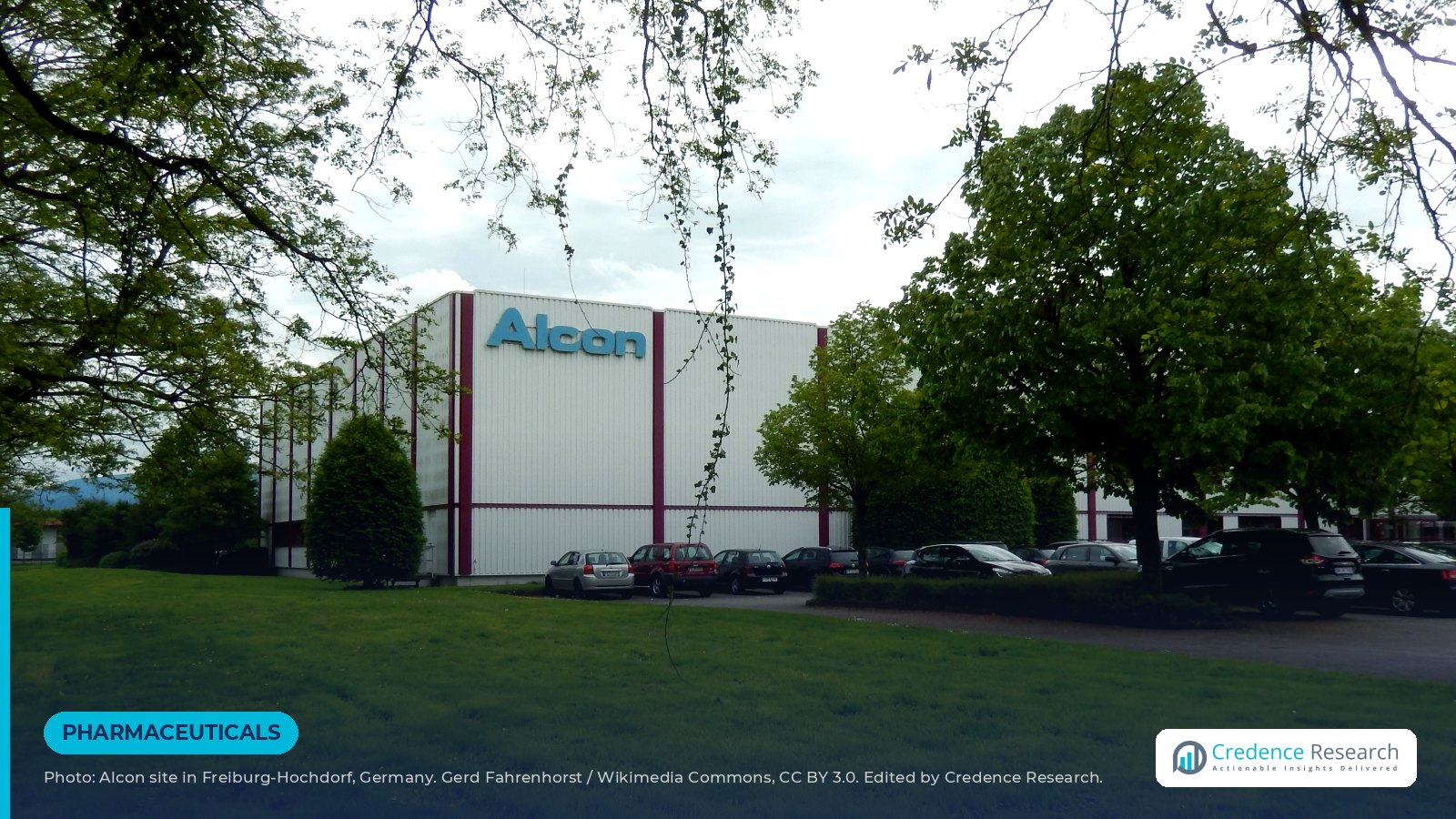
Image: Alcon site in Freiburg-Hochdorf, Germany, by Gerd Fahrenhorst via Wikimedia Commons, CC BY 3.0. Cropped and edited by Credence Research.
About the Author

Senior News Editor at Credence Research Inc