
PLS Approves A$1.9 Billion P2000 Expansion to Double Pilgangoora Lithium Output
PLS Group Ltd. has approved a A$1.9 billion expansion of its Pilgangoora lithium operation in Western Australia's Pilbara region, a project that will lift annual spodumene concentrate output to about 2 million tonnes. The Perth-based miner confirmed the final investment decision on Oct. 15 and disclosed it to the Australian Securities Exchange on Oct. 16, calling it the largest investment decision in the company's history. The project, known as P2000, centers on a new processing plant named Jimmagunya that will sit alongside the existing Pilgan plant, with first production targeted for the September quarter of 2029.
Key developments
- PLS approved P2000 at a capital cost of A$1.9 billion after completing the project's feasibility study, with early site preparation already underway.
- Annual spodumene concentrate capacity at Pilgangoora is set to rise to about 2 million tonnes, roughly double current capacity, according to the company.
- Construction is expected to take about two and a half years, with first production in the September quarter of 2029 followed by a ramp-up of about six months.
- The company plans up to A$650 million in supporting infrastructure, including a 1,200-bed permanent accommodation village, a mine services facility and an upgrade of about 24 kilometers of Wodgina Road East.
- PLS expects more than 1,000 construction jobs and about 500 ongoing operational roles.
Project and resource background
Pilgangoora, about 140 kilometers southeast of Port Hedland, is wholly owned by PLS and is one of the world's largest hard-rock lithium operations. The mine produces spodumene concentrate, a lithium-bearing mineral concentrate that converters process into lithium hydroxide or lithium carbonate for battery cathodes. P2000 follows the earlier P680 and P1000 expansions, which raised output in stages over the past several years.
The investment decision rests on an updated resource base. PLS said contained lithium in its Ore Reserve rose 31% to about 3.1 million tonnes of lithium oxide, with a total Ore Reserve of 249.2 million tonnes at 1.24% lithium oxide. The company also declared its first underground Ore Reserve, at 46.5 million tonnes grading 1.50%. PLS now cites a mine life of about 20 years from open-pit mining and more than 25 years when underground mining is included. About 67 million tonnes of material previously classified as waste becomes economically recoverable as ore under the new plan.
The Jimmagunya plant name was given by Nyamal Elders and, according to PLS, means "a spring country." The company says the plant will use advanced processing technology and describes it as housing the world's largest sensor-based ore sorter.
Industry implications
The decision stands out because it comes during a weak stretch for lithium raw material prices, when several producers have slowed or paused projects. PLS Managing Director and CEO Dale Henderson framed the project around cost rather than volume, saying that in a cyclical market scale matters but cost position matters more. The company said P2000 is designed to deliver materially greater production at lower unit costs, although the public release does not disclose unit cost figures.
For battery supply chains, a larger and lower-cost hard-rock source in Australia adds a long-dated supply option outside the brine operations of South America. The added ore sorting capacity and the reclassification of waste rock point to a broader industry push to extract more value from existing pits rather than open new greenfield mines, which typically face longer approval timelines.
Competitive and supply chain implications
Pilgangoora's expansion would place it alongside the Greenbushes mine in the state's south west as one of Australia's two largest hard-rock lithium operations, the Australian Broadcasting Corp. reported. Producers with smaller or higher-cost operations may find it harder to compete for offtake contracts if a larger share of supply comes from scaled, low-cost assets.
The logistics component matters as much as the plant. PLS said the Wodgina Road East upgrade is expected to cut daily concentrate haulage movements by about 35%. Lower trucking intensity between the mine and Port Hedland would reduce costs and congestion on a corridor shared with other Pilbara operations. Downstream, PLS already holds interests in conversion and chemical projects, including the P-PLS Chemical Facility in South Korea, which gives it a route to place concentrate with converters supplying cathode makers in Asia.
Regional implications
For Western Australia, the project adds a large construction program to the Pilbara at a time when the region's workforce is also stretched by iron ore and energy projects. Western Australian Premier Roger Cook welcomed the investment for the jobs it will create, and Pilbara Minister Amber-Jade Sanderson described it as a vote of confidence in the region, the ABC reported. The broadcaster also reported that the state government will co-fund upgraded access roads.
The 1,200-bed permanent village signals that PLS expects to house a large workforce on site for many years rather than rely only on temporary camps. PLS said the project will create procurement opportunities for Pilbara and Western Australian businesses and that it continues to engage with Traditional Owners. Nationally, the decision supports Australia's policy aim of capturing more of the critical minerals value chain, even as most Australian spodumene is still exported for refining in Asia.
Credence Research analysis
PLS is making a counter-cyclical bet, committing record capital while spodumene prices sit well below their earlier peaks. The logic is that the producers left standing after a downturn are those at the bottom of the cost curve, and P2000 combines a larger reserve, a new plant and lower haulage intensity to move Pilgangoora further in that direction. The timing also means construction proceeds while contractor and equipment markets are less crowded than during the last boom, which may help PLS hold to its schedule.
The risks are execution and timing. A two-and-a-half-year build in the remote Pilbara carries labor, cost and weather exposure, and first production in late 2029 means the project's returns depend on market conditions several years out. The reserve upgrade and the underground option give PLS flexibility to adjust mine sequencing, but investors will watch closely for evidence that the promised unit cost reductions materialize once Jimmagunya is running.
What comes next
- Award of main construction work packages for the Jimmagunya dry plant, wet plant and utilities.
- Start of construction on the 1,200-bed village, mine services facility and Wodgina Road East upgrade.
- Progress updates in PLS quarterly activities reports through the build.
- Further study work on underground mining following the first underground Ore Reserve.
- First production from Jimmagunya in the September quarter of 2029, followed by about six months of ramp-up.
Sources
- PLS: PLS gives green light to $1.9B P2000 expansion at Pilgangoora
- PLS: P2000 Expansion Project
- ABC News: WA government welcomes Pilgangoora lithium mine expansion
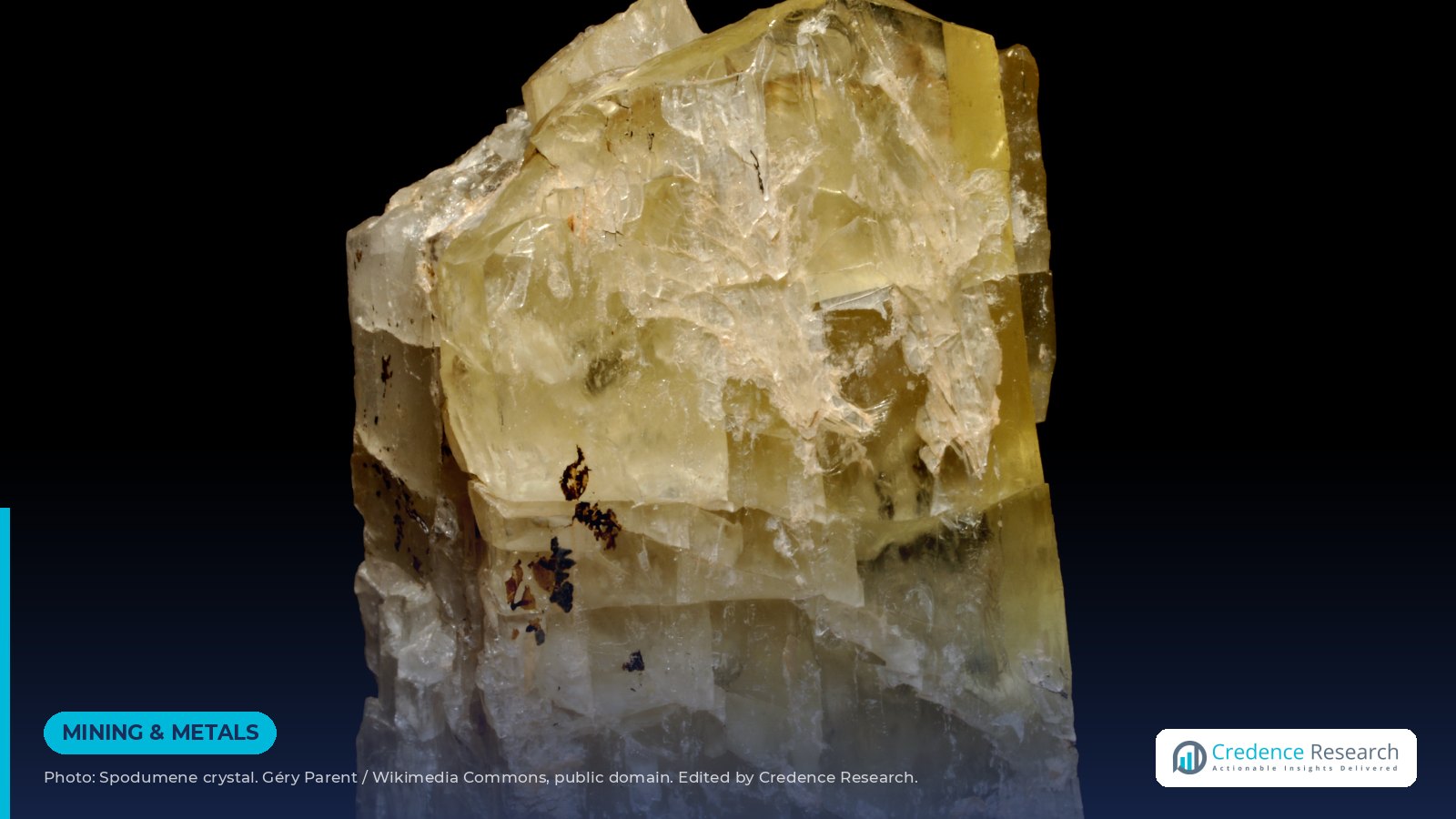
Image: Spodumene crystal specimen, by Géry Parent via Wikimedia Commons, public domain. Cropped and edited by Credence Research.

About the Author

Senior News Editor at Credence Research Inc