Home » Packaging » Anti-Counterfeit Packaging Market

Anti-Counterfeit Packaging Market By Packaging Type (Labels, Flexible Packaging, Rigid Packaging, Seals & Tapes, Shrink Sleeves, Cartons); By Application (Pharmaceuticals & Healthcare, Food & Beverages, Cosmetics & Personal Care, Consumer Electronics, Automotive, Luxury Goods, Others); By Technology (Holograms, RFID/NFC, Barcode & Serialization, QR Codes, Security Inks & Coatings, Tamper-Evident Features, Forensic Markers, Digital Watermarks) – Growth, Share, Opportunities & Competitive Analysis, 2024 – 2032

Report ID: 71544 | Report Format : Excel, PDF

Market Overview:

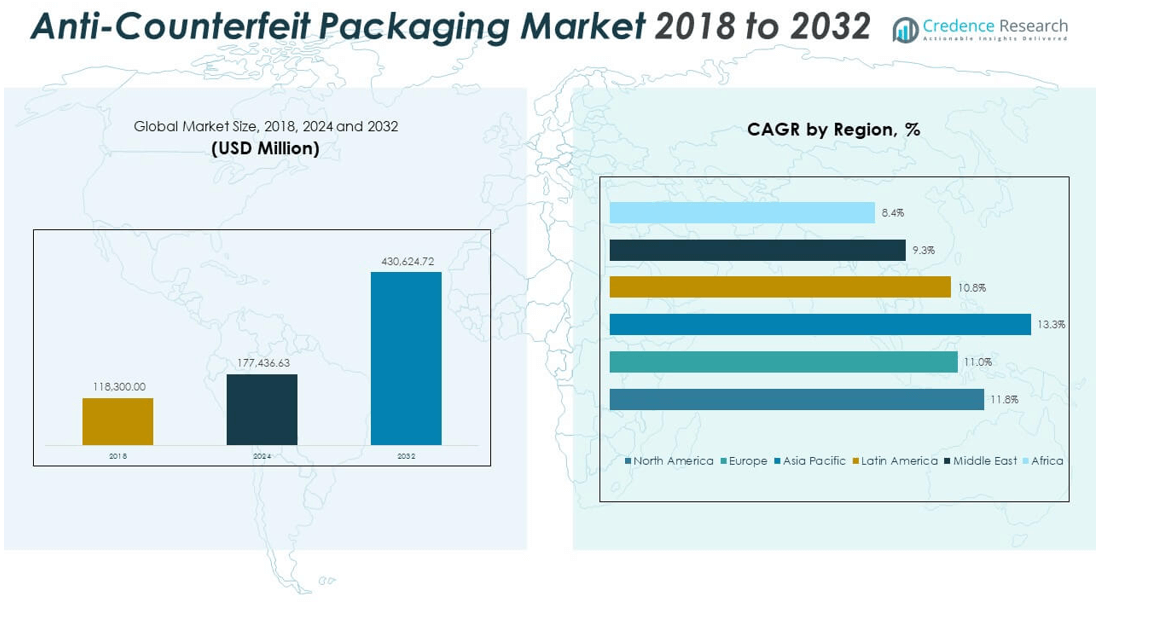
The Anti-Counterfeit Packaging Market size was valued at USD 1,18,300.00 million in 2018 to USD 1,77,436.63 million in 2024 and is anticipated to reach USD 4,30,624.72 million by 2032, at a CAGR of 11.80% during the forecast period.

REPORT ATTRIBUTE DETAILS
Historical Period 2020-2023
Base Year 2024
Forecast Period 2025-2032
Anti-Counterfeit Packaging Market Size 2024 USD 1,77,436.63 million
Anti-Counterfeit Packaging Market, CAGR 11.80%
Anti-Counterfeit Packaging Market Size 2032 USD 4,30,624.72 million


The market expands rapidly because manufacturers face rising incidents of product piracy and brand damage. Companies invest heavily in authentication technologies to safeguard their supply chains from counterfeiting. Growing e-commerce platforms heighten risk of fake goods entering the retail channel, demanding secure packaging solutions. Regulatory mandates require serialization, tamper-evident seals and traceability across many industries. Brands seek alternatives such as smart labels, holograms and RFID tags to enforce authenticity. Major sectors including pharmaceuticals, electronics and luxury goods drive demand for advanced innovations. Ongoing globalization of manufacturing amplifies the need for cross-border verification systems.

Regional dynamics highlight distinct growth patterns across geographies. North America remains a key leader due to mature regulatory frameworks and strong industry demand for secure packaging. Europe follows with strong uptake in luxury goods and pharmaceuticals, supported by robust brand protection efforts. Asia Pacific emerges as the fastest-growing market, driven by expanding consumer goods manufacturing, e-commerce growth and rising counterfeit risks. Latin America shows moderate growth through rising retail modernization and brand awareness in emerging markets. Middle East and Africa offer high-potential opportunities where regulatory infrastructure and supply-chain modernization gain traction.

Anti-Counterfeit Packaging Market size

Market Insights:

  • The Anti-Counterfeit Packaging Market was valued at USD 1,18,300.00 million in 2018, reached USD 1,77,436.63 million in 2024, and is projected to hit USD 4,30,624.72 million by 2032, growing at a CAGR of 11.80%.
  • North America held 35% of the global market in 2024 due to strong regulatory enforcement and advanced adoption of serialization and RFID solutions. Europe followed with 27% driven by stringent pharmaceutical rules and luxury goods protection requirements. Asia Pacific accounted for 22% with expanding manufacturing and e-commerce sectors boosting traceability demand.
  • Asia Pacific is the fastest-growing region with rising counterfeit concerns and supportive government policies promoting smart packaging and digital authentication technologies.
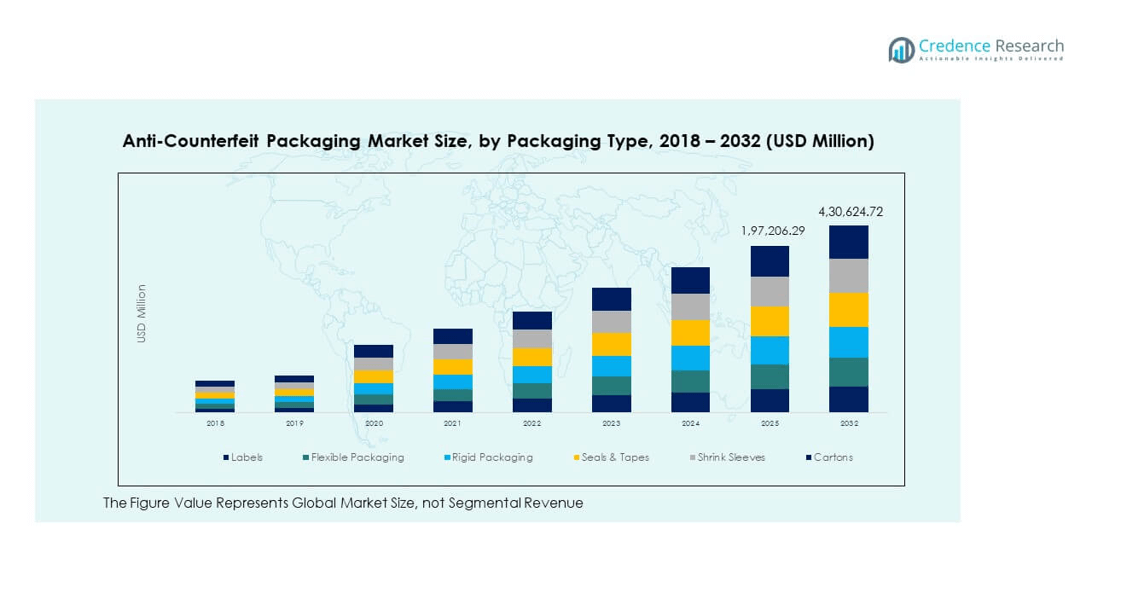
  • By packaging type, labels dominated the market in 2024 with over 33% share owing to broad usage in pharmaceutical and FMCG applications for easy verification and tracking.
  • Flexible packaging ranked second with around 24% share, favored for its cost efficiency and growing adoption in food, beverage, and healthcare segments requiring secure and lightweight formats.

Access crucial information at unmatched prices!

Request your sample report today & start making informed decisions powered by Credence Research Inc.!

Download Sample

Market Drivers

Rising Counterfeit Activities Across Consumer and Industrial Sectors

The Anti-Counterfeit Packaging Market grows rapidly due to the surge in counterfeit incidents across multiple industries. Pharmaceutical, electronics, and FMCG brands face mounting threats that damage brand trust and consumer health. Manufacturers introduce track-and-trace technologies to verify authenticity at every distribution stage. Governments enforce stricter labeling norms to curb product fraud. Retailers deploy serialized codes to confirm genuine products at checkout points. The rise of e-commerce channels increases counterfeit risks, prompting firms to integrate authentication labels. Blockchain and RFID-based systems strengthen transparency. These factors create steady momentum for technology adoption in global packaging lines.

Regulatory Support and Enforcement of Authentication Standards

Governments worldwide strengthen anti-counterfeiting standards to protect consumers and national revenues. The U.S. FDA’s DSCSA and the EU’s Falsified Medicines Directive enforce serialization in pharmaceutical packaging. The Anti-Counterfeit Packaging Market gains traction from compliance-driven investments by major producers. Food and beverage manufacturers adopt tamper-evident closures to meet safety mandates. International trade bodies coordinate efforts to standardize labeling systems. Stronger legal actions against counterfeit networks increase industry accountability. Retailers emphasize supply chain visibility to comply with new trade policies. These frameworks sustain the demand for reliable authentication systems.

  • For instance, Johnson & Johnson has implemented serialization and track-and-trace systems across its pharmaceutical packaging operations to align with the U.S. FDA’s Drug Supply Chain Security Act (DSCSA). These initiatives strengthen supply-chain transparency, enhance product authenticity, and improve the efficiency of recall and distribution processes.

Rapid Digitalization and Integration of Smart Packaging Technologies

Technology integration drives security improvement across supply chains. Companies adopt digital identifiers, invisible inks, and NFC-enabled packaging to verify origin. The Anti-Counterfeit Packaging Market benefits from fast implementation of cloud-based traceability. Manufacturers link packaging data to blockchain records for immutable validation. Real-time scanning enables instant consumer authentication through mobile devices. QR codes and smart labels connect customers to verified brand databases. Software platforms simplify compliance tracking for exporters. The push for digital visibility transforms packaging into a key security interface.

Growing Brand Protection Awareness Among Global Manufacturers

Rising awareness about counterfeit damage promotes proactive brand protection strategies. Companies invest in specialized packaging that deters duplication and restores consumer trust. The Anti-Counterfeit Packaging Market experiences growth through strategic brand initiatives. Luxury, healthcare, and automotive sectors integrate multi-layered protection methods. Enterprises deploy holographic seals and forensic taggants for differentiation. Education campaigns raise awareness about counterfeit risks in developing regions. Corporate responsibility programs promote safer consumer access. Heightened brand vigilance ensures long-term investment in anti-fraud packaging innovation.

  • For instance, Takeda partnered with Systech to implement a global serialization and aggregation solution across multiple packaging sites. The project standardized packaging line operations and improved compliance with pharmaceutical traceability regulations, enhancing visibility and brand protection across Takeda’s international supply chain.

Market Trends

Expansion of Smart and Connected Packaging Solutions

Smart technologies reshape product authentication with advanced connectivity. The Anti-Counterfeit Packaging Market evolves toward IoT-based packaging that enables real-time tracking. RFID and NFC chips allow item-level verification across logistics channels. Cloud-based dashboards collect data for predictive analysis. Brands apply dynamic QR codes to update traceability information after shipment. AI-enabled inspection tools detect irregularities in packaging consistency. Interactive features enhance customer confidence during purchase validation. The shift toward digital traceability defines the next phase of anti-counterfeiting innovation.

  • For instance, GAO RFID offers an NFC-enabled asset tracking system that uses RFID tags, readers, and cloud-based software to provide real-time asset visibility. The solution helps organizations in logistics and manufacturing improve inventory management, reduce losses, and enhance supply chain efficiency through automated data capture and monitoring.

Adoption of Blockchain for Supply Chain Transparency

Blockchain networks gain strong traction in product validation systems. The Anti-Counterfeit Packaging Market witnesses rising adoption of distributed ledgers to secure data. Each transaction creates a permanent record of movement, reducing manipulation risks. Companies in pharmaceuticals and luxury goods integrate blockchain with labeling systems. Smart contracts automate verification without intermediaries. Manufacturers share controlled data with customs for faster clearance. Transparency across stakeholders boosts accountability. This approach supports global standardization in authentication practices.

Emergence of Biometric and Forensic Tagging Technologies

Security firms develop advanced solutions for product-level verification. The Anti-Counterfeit Packaging Market incorporates DNA markers and isotope tagging in sensitive product categories. These technologies offer molecular-level identification impossible to replicate. Cosmetic, medical, and defense manufacturers rely on microscopic tagging systems for secure origin tracking. Forensic packaging techniques detect alteration or tampering attempts. Integration of biometric scanning strengthens distribution oversight. New developments in nanotechnology expand material-based protection. This trend deepens anti-counterfeit control through science-backed authentication.

  • For instance, Regula Forensics provides forensic authentication technologies that combine document and material analysis tools with microscopic inspection systems. Its solutions are widely used by government, law enforcement, and defense organizations worldwide to verify authenticity and detect counterfeiting in sensitive materials and identification documents.

Rising Consumer Participation in Authentication Processes

End-user engagement becomes a defining factor in modern packaging strategies. The Anti-Counterfeit Packaging Market integrates mobile-enabled validation features for direct customer use. Consumers scan QR codes or NFC tags to confirm authenticity instantly. Feedback systems allow brands to collect fraud reports from users. Awareness campaigns teach buyers how to identify genuine goods. Social media platforms amplify consumer vigilance in counterfeit detection. This shift democratizes authentication responsibility. Increased consumer interaction boosts transparency and reinforces brand credibility.

Anti-Counterfeit Packaging Market share

Market Challenges Analysis

High Implementation Costs and Complex Technology Integration

Cost barriers limit small manufacturers from deploying advanced anti-counterfeiting systems. The Anti-Counterfeit Packaging Market faces challenges linked to capital expenditure on sensors, labels, and tracking software. Integration with existing packaging lines demands technical expertise and system upgrades. Maintenance of blockchain and RFID infrastructures requires skilled staff. Developing economies struggle to justify large-scale adoption due to narrow margins. Hardware compatibility issues slow rollout across packaging types. Vendors must offer cost-efficient modular solutions. Financial constraints continue to restrain technology penetration in smaller markets.

Fragmented Regulations and Limited Global Standardization

Uneven enforcement of anti-counterfeiting laws hinders global consistency. The Anti-Counterfeit Packaging Market struggles with fragmented standards between regions. Manufacturers face duplication of compliance work due to differing serialization requirements. Weak customs coordination allows counterfeit shipments to bypass checkpoints. Lack of interoperability between digital tracking systems limits data exchange. Counterfeiters exploit gaps in enforcement between export and import nations. Developing economies often lack resources for full regulatory supervision. This fragmentation reduces the effectiveness of international protection efforts.

Market Opportunities

Growing Demand in E-Commerce and Cross-Border Trade Channels

E-commerce growth generates vast opportunities for secure product packaging. The Anti-Counterfeit Packaging Market benefits from rising demand for verifiable labeling in online retail. Cross-border trade expansion heightens the need for serialized tracking systems. Logistic service providers invest in scanning technologies for shipment validation. Global trade routes adopt QR and RFID tags to maintain transparency. Smart packaging improves confidence in long-distance delivery chains. The sector stands poised to capture long-term digital trade growth.

Innovation in Eco-Friendly and Recyclable Security Materials

Sustainability drives innovation in anti-counterfeit materials across packaging applications. The Anti-Counterfeit Packaging Market gains from companies developing eco-friendly holograms and biodegradable seals. Green printing inks and recyclable substrates reduce environmental impact. Regulations encouraging circular packaging models promote the shift toward sustainable designs. Vendors merge environmental compliance with security performance. This alignment opens new growth channels across regulated and eco-conscious industries.

Market Segmentation Analysis:

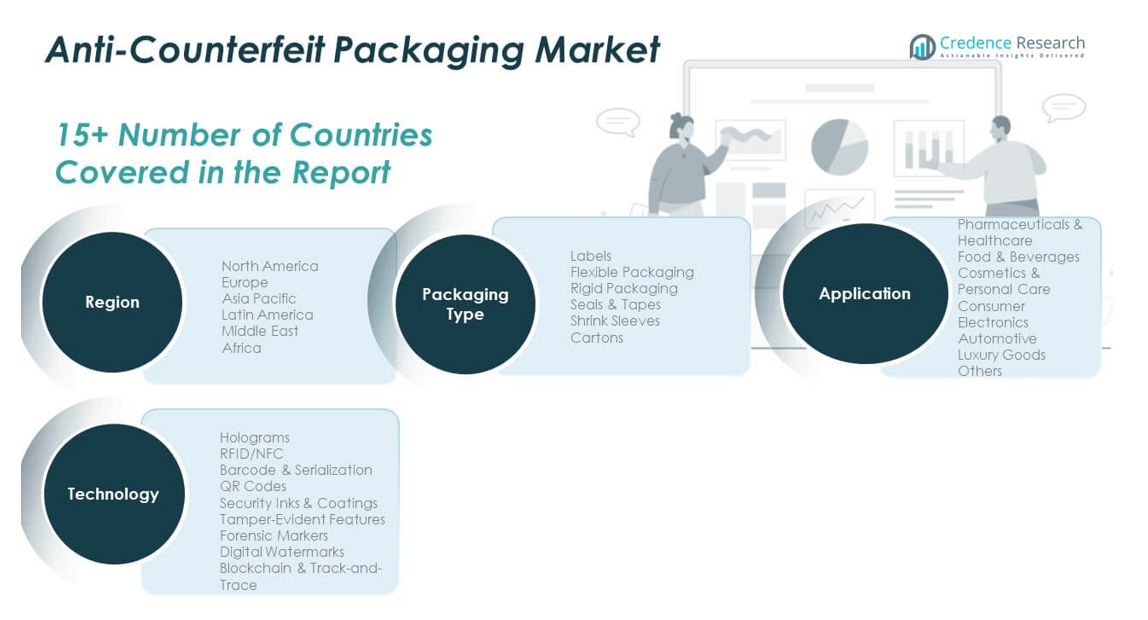
The Anti-Counterfeit Packaging Market features a diverse structure across packaging type, application, and technology segments.

By packaging type, labels lead due to their wide use across pharmaceuticals, food, and electronics for easy authentication. Flexible packaging gains strong traction in consumer goods and healthcare, driven by demand for lightweight and secure formats. Rigid packaging provides durability and visibility for premium products. Seals and tapes enhance tamper evidence in logistics operations. Shrink sleeves and cartons continue to grow with branding and product integrity benefits.

  • For instance, Avery Dennison’s AD MiniDose U9 RFID inlays are ARC Spec S-certified by Auburn University’s RFID Lab for pharmaceutical packaging applications. The inlays demonstrate high read reliability for small and curved items such as syringes and glass vials, supporting improved product authentication and supply-chain tracking.

By application, pharmaceuticals and healthcare dominate due to stringent regulatory controls and product traceability needs. Food and beverages follow with rising safety concerns and counterfeit risk mitigation. Cosmetics and personal care brands adopt visible security elements to maintain brand reputation. Consumer electronics and automotive sectors invest in serialization and tracking systems for high-value goods. Luxury goods utilize forensic and holographic technologies for authenticity. Other segments, including industrial goods, steadily expand across online retail channels.

  • For example, Hanmi Pharmaceutical employs Avery Dennison RFID solutions for unit-level traceability, achieving regulatory compliance and improving inventory accuracy by reducing shipment errors and monitoring product movement across the supply chain.

By technology, holograms retain leadership for their cost-effectiveness and visual security features. RFID and NFC technologies advance tracking accuracy across global supply chains. Barcode and serialization systems remain essential in compliance-driven industries. QR codes grow rapidly with digital verification through mobile devices. Security inks and coatings support covert identification. Tamper-evident features and forensic markers provide multi-layer protection. Digital watermarks emerge in modern packaging to link physical and digital authentication systems, driving the market’s technological evolution.\

Anti-Counterfeit Packaging Market segmentation

Segmentation:

By Packaging Type

  • Labels
  • Flexible Packaging
  • Rigid Packaging
  • Seals & Tapes
  • Shrink Sleeves
  • Cartons

By Application

  • Pharmaceuticals & Healthcare
  • Food & Beverages
  • Cosmetics & Personal Care
  • Consumer Electronics
  • Automotive
  • Luxury Goods
  • Others

By Technology

  • Holograms
  • RFID/NFC
  • Barcode & Serialization
  • QR Codes
  • Security Inks & Coatings
  • Tamper-Evident Features
  • Forensic Markers
  • Digital Watermarks

By Region

  • North America
    • U.S.
    • Canada
    • Mexico
  • Europe
    • Germany
    • France
    • U.K.
    • Italy
    • Spain
    • Rest of Europe
  • Asia Pacific
    • China
    • Japan
    • India
    • South Korea
    • South-east Asia
    • Rest of Asia Pacific
  • Latin America
    • Brazil
    • Argentina
    • Rest of Latin America
  • Middle East & Africa
    • GCC Countries
    • South Africa
    • Rest of the Middle East and Africa

Regional Analysis:

North America

The North America Anti-Counterfeit Packaging Market size was valued at USD 50,632.40 million in 2018 to USD 75,161.09 million in 2024 and is anticipated to reach USD 182,198.10 million by 2032, at a CAGR of 11.70% during the forecast period. North America holds the largest market share due to strong regulatory enforcement and mature industrial ecosystems. It benefits from the presence of key technology providers offering advanced labeling, RFID, and serialization solutions. The United States leads regional adoption with its established pharmaceutical, FMCG, and electronics industries that prioritize traceability. Canada and Mexico follow with expanding manufacturing sectors adopting tamper-evident and smart packaging. The region’s strong e-commerce infrastructure drives authentication demand in logistics. High investment in blockchain integration for product tracking strengthens supply chain visibility. The region’s innovation ecosystem continues to influence global anti-counterfeiting technology standards.

Europe

The Europe Anti-Counterfeit Packaging Market size was valued at USD 29,362.06 million in 2018 to USD 42,225.07 million in 2024 and is anticipated to reach USD 96,439.55 million by 2032, at a CAGR of 10.88% during the forecast period. Europe holds a significant market share supported by stringent consumer protection regulations and intellectual property laws. The EU’s Falsified Medicines Directive promotes serialized packaging across pharmaceutical supply chains. Germany, France, and the UK dominate demand with high integration of authentication technologies in industrial and retail applications. The luxury goods sector in Italy and France drives the need for holographic and forensic packaging. Expanding regulatory alignment across EU member states ensures standardization in product security features. Sustainability-focused packaging innovations also gain traction. The region remains a key adopter of digital and tamper-evident solutions.

Asia Pacific

The Asia Pacific Anti-Counterfeit Packaging Market size was valued at USD 26,475.54 million in 2018 to USD 41,634.76 million in 2024 and is anticipated to reach USD 112,436.46 million by 2032, at a CAGR of 13.22% during the forecast period. Asia Pacific exhibits the fastest growth rate due to rising counterfeit incidents and expanding industrialization. China, India, and Japan drive large-scale adoption of RFID, QR, and security inks across consumer goods and healthcare products. The region’s growing e-commerce sector intensifies traceability needs in logistics networks. Strong government initiatives for product authentication in pharmaceuticals strengthen local regulations. South Korea and Australia invest in digital watermark and forensic technology for premium segments. Expanding middle-class populations increase demand for branded and verified goods. Asia Pacific’s cost-effective manufacturing base accelerates adoption of secure, scalable packaging systems.

Latin America

The Latin America Anti-Counterfeit Packaging Market grows through gradual policy adoption and expanding retail networks. Brazil leads the region with strong enforcement in pharmaceuticals and beverages. Mexico and Argentina invest in serialization systems to strengthen export compliance. The growth of online retail platforms accelerates the need for verification technologies. Regional industries adopt low-cost holograms and barcodes to ensure authenticity. Counterfeit trade reduction programs enhance cross-border monitoring. Local packaging converters focus on affordable anti-fraud solutions. The region’s modernization of supply chains continues to drive steady demand for authentication tools.

Middle East

The Middle East Anti-Counterfeit Packaging Market gains traction from government-led anti-fraud initiatives and rising luxury product imports. GCC countries strengthen pharmaceutical and cosmetic labeling norms. The UAE and Saudi Arabia lead digital tracking deployments through QR-based verification systems. Israel and Turkey invest in technology development partnerships with global packaging firms. High-end consumer brands integrate holographic and tamper-evident features for protection. Expanding trade corridors enhance awareness of counterfeit risks. It benefits from modernization in logistics and strong policy support for secure commerce. The market reflects increasing alignment with international standards.

Africa

The Africa Anti-Counterfeit Packaging Market expands steadily through awareness campaigns and regulatory reforms. South Africa drives regional growth with packaging innovations targeting pharmaceuticals and agriculture. Egypt adopts serialization laws to ensure authenticity in imports and exports. Local industries prioritize affordable technologies such as barcodes and security inks. Counterfeit medicine control programs across East Africa improve public health protection. The market faces infrastructure challenges but shows improvement in compliance mechanisms. Partnerships with international packaging firms accelerate knowledge transfer. Rising awareness and policy support continue to improve security standards across the continent.

Shape Your Report to Specific Countries or Regions & Enjoy 30% Off!

Key Player Analysis:

  • Avery Dennison Corporation
  • CCL Industries Inc.
  • 3M Company
  • SICPA Holding SA
  • Zebra Technologies Corporation
  • DuPont de Nemours, Inc.
  • AlpVision SA
  • Applied DNA Sciences, Inc.
  • OPTEL Group
  • TraceLink Inc.
  • Authentix, Inc.
  • Sun Chemical Corporation
  • Uflex Ltd.
  • Prooftag SAS
  • SATO Holdings Corporation
  • Brady Corporation
  • Huhtamaki Oyj
  • Amcor plc
  • Berry Global Group, Inc.
  • Graphic Packaging International, LLC

Competitive Analysis:

The Anti-Counterfeit Packaging Market features intense competition among global and regional players focused on innovation and regulatory compliance. It includes leading companies such as Avery Dennison, CCL Industries, 3M, SICPA, Zebra Technologies, and DuPont, which hold strong portfolios in labeling, RFID, and security printing solutions. Firms invest in digital platforms and authentication technologies to strengthen brand protection. Collaboration with supply chain stakeholders supports integration of smart and connected packaging. Companies compete on scalability, pricing efficiency, and technological precision. It continues to see strategic mergers and product launches to expand regional presence. Growing adoption of blockchain, forensic markers, and tamper-evident features drives differentiation. The competitive landscape remains dynamic, with consistent emphasis on sustainability and digital traceability.

Recent Developments:

  • In September 2024, kdc/one completed the acquisition of an Italian packaging specialist (S.r.l.) focused on cosmetics packaging to enhance its anti-counterfeit offerings in beauty and personal care.
  • In April 2024, Avery Dennison Corporation announced the expansion of its AD Pure range of inlays and tags which are entirely plastic-free and utilize antenna manufacturing technology applied directly on paper.

Report Coverage:

The research report offers an in-depth analysis based on packaging type, application, and technology segments. It details leading market players, providing an overview of their business, product offerings, investments, revenue streams, and key applications. Additionally, the report includes insights into the competitive environment, SWOT analysis, current market trends, as well as the primary drivers and constraints. Furthermore, it discusses various factors that have driven market expansion in recent years. The report also explores market dynamics, regulatory scenarios, and technological advancements that are shaping the industry. It assesses the impact of external factors and global economic changes on market growth. Lastly, it provides strategic recommendations for new entrants and established companies to navigate the complexities of the market.

Future Outlook:

  • Rising global enforcement of product authentication standards will drive continuous adoption of secure packaging solutions.
  • Smart packaging technologies integrating RFID, NFC, and blockchain will redefine supply chain transparency and consumer verification.
  • Expanding e-commerce networks will increase demand for serialized labeling and tamper-evident formats.
  • Companies will focus on merging sustainability with security by developing recyclable and eco-certified anti-counterfeit materials.
  • The pharmaceutical and healthcare sectors will remain major users due to stringent serialization and patient safety regulations.
  • Investments in AI-driven tracking platforms will enhance predictive analytics for counterfeit detection.
  • Brand protection strategies will evolve toward multi-layered authentication combining visible and covert features.
  • Emerging economies will experience accelerated adoption due to regulatory reforms and growing export trade.
  • The luxury goods and electronics industries will increase use of forensic markers and digital watermarks.
  • Strategic alliances between packaging firms and tech providers will shape the market’s competitive direction.

CHAPTER NO. 1 :      GENESIS OF THE MARKET           

1.1 Market Prelude – Introduction & Scope

1.2 The Big Picture – Objectives & Vision

1.3 Strategic Edge – Unique Value Proposition

1.4 Stakeholder Compass – Key Beneficiaries

CHAPTER NO. 2 :      EXECUTIVE LENS

2.1 Pulse of the Industry – Market Snapshot

2.2 Growth Arc – Revenue Projections (USD Million)

2.3. Premium Insights – Based on Primary Interviews

CHAPTER NO. 3 :      ANTI-COUNTERFEIT PACKAGING MARKET FORCES & INDUSTRY PULSE   

3.1 Foundations of Change – Market Overview
3.2 Catalysts of Expansion – Key Market Drivers
3.2.1 Momentum Boosters – Growth Triggers
3.2.2 Innovation Fuel – Disruptive Technologies
3.3 Headwinds & Crosswinds – Market Restraints
3.3.1 Regulatory Tides – Compliance Challenges
3.3.2 Economic Frictions – Inflationary Pressures
3.4 Untapped Horizons – Growth Potential & Opportunities
3.5 Strategic Navigation – Industry Frameworks
3.5.1 Market Equilibrium – Porter’s Five Forces
3.5.2 Ecosystem Dynamics – Value Chain Analysis
3.5.3 Macro Forces – PESTEL Breakdown

3.6 Price Trend Analysis

3.6.1 Regional Price Trend
3.6.2 Price Trend by product

CHAPTER NO. 4 :      KEY INVESTMENT EPICENTER    

4.1 Regional Goldmines – High-Growth Geographies

4.2 Product Frontiers – Lucrative Product Categories

4.3 Application Sweet Spots – Emerging Demand Segments

CHAPTER NO. 5: REVENUE TRAJECTORY & WEALTH MAPPING

5.1 Momentum Metrics – Forecast & Growth Curves

5.2 Regional Revenue Footprint – Market Share Insights

5.3 Segmental Wealth Flow – Packaging Type & Application Revenue

CHAPTER NO. 6 :      TRADE & COMMERCE ANALYSIS

6.1.      Import Analysis by Region

6.1.1.    Global Anti-Counterfeit Packaging Market Import Revenue By Region

6.2.      Export Analysis by Region

6.2.1.    Global Anti-Counterfeit Packaging Market Export Revenue By Region

CHAPTER NO. 7 :      COMPETITION ANALYSIS 

7.1.      Company Market Share Analysis

7.1.1.    Global Anti-Counterfeit Packaging Market: Company Market Share

7.2.      Global Anti-Counterfeit Packaging Market Company Revenue Market Share

7.3.      Strategic Developments

7.3.1.    Acquisitions & Mergers

7.3.2.    New Product Launch

7.3.3.    Regional Expansion

7.4.      Competitive Dashboard

7.5.    Company Assessment Metrics, 2024

CHAPTER NO. 8 :      ANTI-COUNTERFEIT PACKAGING MARKET – BY PACKAGING TYPE SEGMENT ANALYSIS           

8.1.      Anti-Counterfeit Packaging Market Overview by Packaging Type Segment

8.1.1.    Anti-Counterfeit Packaging Market Revenue Share By Packaging Type

8.2.      Labels

8.3.      Flexible Packaging

8.4.      Rigid Packaging

8.5.      Seals & Tapes

8.6.      Shrink Sleeves

8.7.      Cartons

CHAPTER NO. 9 :      ANTI-COUNTERFEIT PACKAGING MARKET – BY APPLICATION SEGMENT ANALYSIS       

9.1.      Anti-Counterfeit Packaging Market Overview by Application Segment

9.1.1.    Anti-Counterfeit Packaging Market Revenue Share By Application

9.2.      Pharmaceuticals & Healthcare

9.3.      Food & Beverages

9.4.      Cosmetics & Personal Care

9.5.      Consumer Electronics

9.6.      Automotive

9.7.      Luxury Goods

9.8.      Others

CHAPTER NO. 10 :    ANTI-COUNTERFEIT PACKAGING MARKET – BY TECHNOLOGY SEGMENT ANALYSIS      

10.1.     Anti-Counterfeit Packaging Market Overview by Technology Segment

10.1.1.  Anti-Counterfeit Packaging Market Revenue Share By Technology

10.2.     Holograms

10.3.     RFID/NFC

10.4.     Barcode & Serialization

10.5.     QR Codes

10.6.     Security Inks & Coatings

10.7.     Tamper-Evident Features

10.8.     Forensic Markers

10.9.     Digital Watermarks

CHAPTER NO. 11 :    ANTI-COUNTERFEIT PACKAGING MARKET – REGIONAL ANALYSIS     

11.1.     Anti-Counterfeit Packaging Market Overview by Region Segment

11.1.1.  Global Anti-Counterfeit Packaging Market Revenue Share By Region

11.1.3.  Regions

11.1.4.  Global Anti-Counterfeit Packaging Market Revenue By Region

.1.6.     Packaging Type

11.1.7.  Global Anti-Counterfeit Packaging Market Revenue By Packaging Type

11.1.9.  Application

11.1.10. Global Anti-Counterfeit Packaging Market Revenue By Application

11.1.12. Technology

11.1.13. Global Anti-Counterfeit Packaging Market Revenue By Technology

CHAPTER NO. 12 :    NORTH AMERICA ANTI-COUNTERFEIT PACKAGING MARKET – COUNTRY ANALYSIS 

12.1.     North America Anti-Counterfeit Packaging Market Overview by Country Segment

12.1.1.  North America Anti-Counterfeit Packaging Market Revenue Share By Region

12.2.     North America

12.2.1.  North America Anti-Counterfeit Packaging Market Revenue By Country

12.2.2.  Packaging Type

12.2.3.  North America Anti-Counterfeit Packaging Market Revenue By Packaging Type

12.2.4.  Application

12.2.5.  North America Anti-Counterfeit Packaging Market Revenue By Application

2.2.6.    Technology

12.2.7.  North America Anti-Counterfeit Packaging Market Revenue By Technology

2.3.      U.S.

12.4.     Canada

12.5.     Mexico

CHAPTER NO. 13 :    EUROPE ANTI-COUNTERFEIT PACKAGING MARKET – COUNTRY ANALYSIS         

13.1.     Europe Anti-Counterfeit Packaging Market Overview by Country Segment

13.1.1.  Europe Anti-Counterfeit Packaging Market Revenue Share By Region

13.2.     Europe

13.2.1.  Europe Anti-Counterfeit Packaging Market Revenue By Country

13.2.2.  Packaging Type

13.2.3.  Europe Anti-Counterfeit Packaging Market Revenue By Packaging Type

13.2.4.  Application

13.2.5.  Europe Anti-Counterfeit Packaging Market Revenue By Application

13.2.6.  Technology

13.2.7.  Europe Anti-Counterfeit Packaging Market Revenue By Technology

13.3.     UK

13.4.     France

13.5.     Germany

13.6.     Italy

13.7.     Spain

13.8.     Russia

13.9.   Rest of Europe

CHAPTER NO. 14 :    ASIA PACIFIC ANTI-COUNTERFEIT PACKAGING MARKET – COUNTRY ANALYSIS 

14.1.     Asia Pacific Anti-Counterfeit Packaging Market Overview by Country Segment

14.1.1.  Asia Pacific Anti-Counterfeit Packaging Market Revenue Share By Region

14.2.     Asia Pacific

14.2.1.  Asia Pacific Anti-Counterfeit Packaging Market Revenue By Country

14.2.2.  Packaging Type

14.2.3.  Asia Pacific Anti-Counterfeit Packaging Market Revenue By Packaging Type

14.2.4.  Application

14.2.5.  Asia Pacific Anti-Counterfeit Packaging Market Revenue By Application

14.2.5.  Technology

14.2.7.  Asia Pacific Anti-Counterfeit Packaging Market Revenue By Technology

14.3.     China

14.4.     Japan

14.5.     South Korea

14.6.     India

14.7.     Australia

14.8.     Southeast Asia

14.9.     Rest of Asia Pacific

CHAPTER NO. 15 :    LATIN AMERICA ANTI-COUNTERFEIT PACKAGING MARKET – COUNTRY ANALYSIS

15.1.     Latin America Anti-Counterfeit Packaging Market Overview by Country Segment

15.1.1.  Latin America Anti-Counterfeit Packaging Market Revenue Share By Region

15.2.     Latin America

15.2.1.  Latin America Anti-Counterfeit Packaging Market Revenue By Country

15.2.2.  Packaging Type

15.2.3.  Latin America Anti-Counterfeit Packaging Market Revenue By Packaging Type

15.2.4.  Application

15.2.5.  Latin America Anti-Counterfeit Packaging Market Revenue By Application

15.2.6.  Technology

15.2.7.  Latin America Anti-Counterfeit Packaging Market Revenue By Technology

15.3.     Brazil

15.4.     Argentina

15.5.     Rest of Latin America

CHAPTER NO. 16 :    MIDDLE EAST ANTI-COUNTERFEIT PACKAGING MARKET – COUNTRY ANALYSIS

16.1.     Middle East Anti-Counterfeit Packaging Market Overview by Country Segment

16.1.1.  Middle East Anti-Counterfeit Packaging Market Revenue Share By Region

16.2.     Middle East

16.2.1.  Middle East Anti-Counterfeit Packaging Market Revenue By Country

16.2.2.  Packaging Type

16.2.3.  Middle East Anti-Counterfeit Packaging Market Revenue By Packaging Type

16.2.4.  Application

16.2.5.  Middle East Anti-Counterfeit Packaging Market Revenue By Application

16.2.6.  Technology

16.2.7.  Middle East Anti-Counterfeit Packaging Market Revenue By Technology

16.3.     GCC Countries

16.4.     Israel

16.5.     Turkey

16.6.     Rest of Middle East

CHAPTER NO. 17 :    AFRICA ANTI-COUNTERFEIT PACKAGING MARKET – COUNTRY ANALYSIS         

17.1.     Africa Anti-Counterfeit Packaging Market Overview by Country Segment

17.1.1.  Africa Anti-Counterfeit Packaging Market Revenue Share By Region

17.2.     Africa

17.2.1.  Africa Anti-Counterfeit Packaging Market Revenue By Country

17.2.2.  Packaging Type

17.2.3.  Africa Anti-Counterfeit Packaging Market Revenue By Packaging Type

17.2.4.  Application

17.2.5.  Africa Anti-Counterfeit Packaging Market Revenue By Application

17.2.6.  Technology

17.2.7.  Africa Anti-Counterfeit Packaging Market Revenue By Technology

17.3.     South Africa

17.4.     Egypt

17.5.     Rest of Africa

CHAPTER NO. 18 :    COMPANY PROFILES         

18.1.     Avery Dennison

18.1.1.  Company Overview

18.1.2.  Product Portfolio

18.1.3.  Financial Overview

18.1.4.  Recent Developments

18.1.5.  Growth Strategy

18.1.6.  SWOT Analysis

18.2.     CCL Industries

18.3.     3M

18.4.     SICPA

18.5.     Zebra Technologies

18.6.     DuPont

18.7.     AlpVision

18.8.     Applied DNA Sciences

18.9.     OPTEL Group

18.10.   TraceLink

18.11.   Authentix

18.12.   Sun Chemical

18.13.   Uflex

18.14.   Prooftag

18.15.   SATO Holdings

18.16.   Brady Corporation

18.17.   Huhtamaki

18.18.   Amcor

18.19.   Berry Global

18.20.   Graphic Packaging International

Request Free Sample

We prioritize the confidentiality and security of your data. Our promise: your information remains private.

Ready to Transform Data into Decisions?

Request Your Sample Report and Start Your Journey of Informed Choices


Providing the strategic compass for industry titans.

cr-clients-logos

Frequently Asked Questions

What is the current size of the Anti-Counterfeit Packaging Market?

The Anti-Counterfeit Packaging Market was valued at USD 177,436.63 million in 2024 and is projected to reach USD 430,624.72 million by 2032, reflecting strong industry expansion..

At what Compound Annual Growth Rate is the Anti-Counterfeit Packaging Market projected to grow between 2024 and 2032?

The Anti-Counterfeit Packaging Market is expected to grow at a CAGR of 11.80% during the forecast period, supported by regulatory adoption and technological advancement.

What factors are driving the growth of the Anti-Counterfeit Packaging Market?

The market is driven by increasing incidences of counterfeit goods across industries, rising consumer awareness regarding product authenticity and safety, regulatory mandates enforcing anti-counterfeiting measures, and advancements in technologies such as RFID, blockchain, and holograms.

What are the key segments within the Anti-Counterfeit Packaging Market?

The market is segmented by technology, including covert (security labels, invisible printing), overt (holograms, color-shifting inks), forensic, and track & trace solutions. Applications include pharmaceuticals, food and beverages, apparel, personal care, and electronics.

What are some challenges faced by the Anti-Counterfeit Packaging Market?

Challenges include high implementation costs of advanced technologies, complex integration into existing supply chains, lack of global standardization, and limited awareness in developing regions.

Who are the major players in the Anti-Counterfeit Packaging Market?

Key players include Avery Dennison Corporation, 3M, CCL Industries, SICPA Holding SA, SATO Holdings Corporation, DuPont, Zebra Technologies Corp., and Atlantic Zeiser GmbH.

About Author

Rajdeep Kumar Deb

Rajdeep Kumar Deb

Lead Analyst – Consumer & Finance

Rajdeep brings a decade of consumer goods and financial services insight to strategic market analysis.

View Profile

Related Reports

Fresh Meat Packaging Market

Fresh Meat Packaging Market size was valued at USD 3.08 Billion in 2024 and is anticipated to reach USD 4.18 Billion by 2032, at a CAGR of 3.9% during the forecast period.

Corrugated Fanfold Packaging Market

The corrugated fanfold packaging market was valued at USD 8.5 billion in 2024 and is projected to reach USD 16.93 billion by 2032, growing at a CAGR of 9% during the forecast period.

Recycled PET Bottles Market

The Recycled PET Bottles Market reached USD 2,418.75 million in 2024 and is expected to reach USD 5,013.87 million by 2032, expanding at a CAGR of 9.54% during the forecast period.

Recycled Paper Packaging Market

The Recycled Paper Packaging Market was valued at USD 238,969.97 million in 2024 and is projected to reach USD 350,386.4 million by 2032, growing at a CAGR of 4.9% during the forecast period.

Recycled Ocean Plastic Packaging Market

The Recycled Ocean Plastic Packaging Market was valued at USD 629.57 million in 2024. The market is projected to reach USD 1,514.81 million by 2032, recording a CAGR of 11.6% during the forecast period.

Recyclable HDPE Blister Packaging Market

The Recyclable HDPE Blister Packaging Market was valued at USD 2,024.8 million in 2024 and is projected to reach USD 2,625.33 million by 2032, expanding at a CAGR of 3.3% during the forecast period (2025–2032).

Flower Wrapping & Flexible PP Films Market

The Global Flower Wrapping & Flexible PP Films Market size was valued at USD 927.11 million in 2018 to USD 1,671.70 million in 2024 and is anticipated to reach USD 2,906.85 million by 2032, at a CAGR of 6.67% during the forecast period.

Polyethylene Thermoform Packaging Market

The global Polyethylene (PE) thermoform packaging market was valued at USD 10,387.6 million in 2024 and is projected to reach USD 14,885.68 million by 2032, registering a CAGR of 4.6% over the forecast period.

Industrial Packaging Market

Industrial Packaging Market was valued at USD 81.92 billion in 2024 and is anticipated to reach USD 133.65 billion by 2032, growing at a CAGR of 6.31 % during the forecast period.

Polyethylene Transparent Barrier Packaging Films Market

The global Polyethylene (PE) transparent barrier packaging films market was valued at USD 10,587.6 million in 2024 and is projected to reach USD 18,055.9 million by 2032, reflecting a robust CAGR of 6.9% during the forecast period (2025-2032).

Polybags Market

Polybags Market size was valued USD 24307.6 million in 2024 and is anticipated to reach USD 42806.64 million by 2032, at a CAGR of 7.33% during the forecast period.

Polybag Mailers Market

Polybag Mailers Market size was valued USD 9887.6 million in 2024 and is anticipated to reach USD 31098.35 million by 2032, at a CAGR of 15.4% during the forecast period.

Licence Option

The report comes as a view-only PDF document, optimized for individual clients. This version is recommended for personal digital use and does not allow printing. Use restricted to one purchaser only.
$4999

To meet the needs of modern corporate teams, our report comes in two formats: a printable PDF and a data-rich Excel sheet. This package is optimized for internal analysis. Unlimited users allowed within one corporate location (e.g., regional office).
$6999

The report will be delivered in printable PDF format along with the report’s data Excel sheet. This license offers 100 Free Analyst hours where the client can utilize Credence Research Inc. research team. Permitted for unlimited global use by all users within the purchasing corporation, such as all employees of a single company.
$12999

Report delivery within 24 to 48 hours

Europe

North America

Email

Smallform of Sample request
User Review

Thank you for the data! The numbers are exactly what we asked for and what we need to build our business case.

Materials Scientist
(privacy requested)

User Review

The report was an excellent overview of the Industrial Burners market. This report does a great job of breaking everything down into manageable chunks.

Imre Hof
Management Assistant, Bekaert

cr-clients-logos

Request Sample