
| REPORT ATTRIBUTE | DETAILS |
|---|---|
| Historical Period | 2020-2023 |
| Base Year | 2024 |
| Forecast Period | 2025-2032 |
| Automotive Cowl Screen Market Size 2024 | USD 696.68 million |
| Automotive Cowl Screen Market, CAGR | 5.24% |
| Automotive Cowl Screen Market Size 2032 | USD 1,079.52 million |
Market Overview:
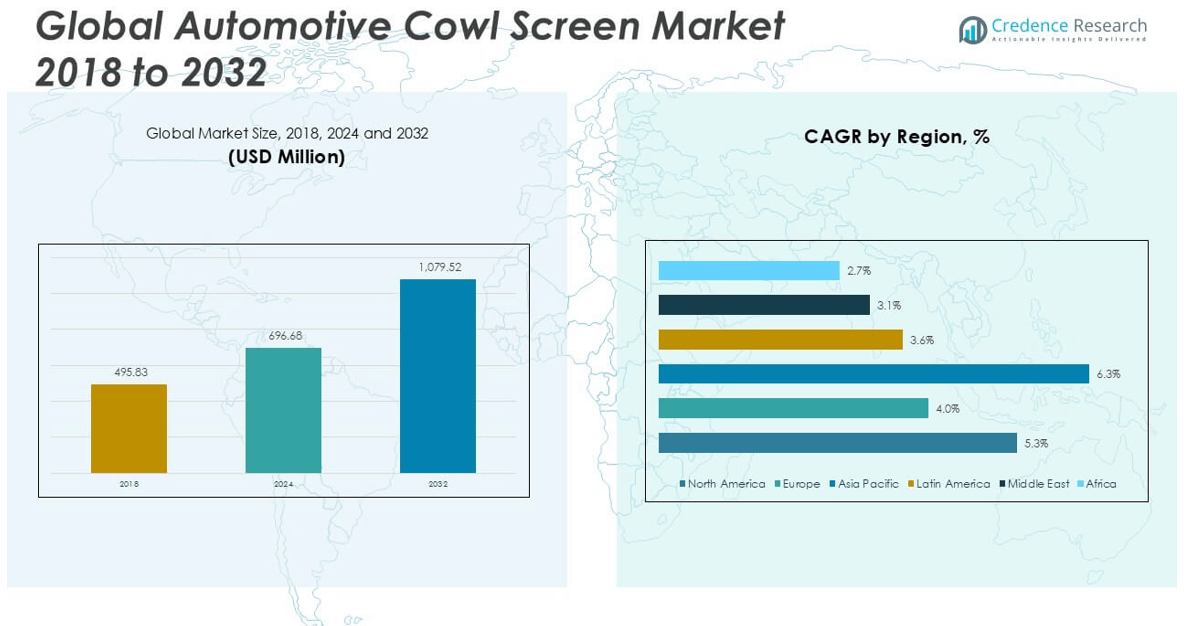
The Automotive Cowl Screen market size was valued at USD 495.83 million in 2018, increased to USD 696.68 million in 2024, and is anticipated to reach USD 1,079.52 million by 2032, at a CAGR of 5.24% during the forecast period.
The Automotive Cowl Screen market is driven by key players such as TS Tech Co., Ltd., Calsonic Kansei Corp, Toyo Seat Co., Ltd., Autoneum, Yanfeng Automotive Interiors, Compagnie Plastic Omnium, DuPont, Magna International Inc., Inergy Automotive Systems LLC, and Toyota Boshoku Corporation. These companies focus on lightweight materials, advanced manufacturing, and partnerships with major OEMs to maintain competitive advantage. Asia Pacific leads the market with a 31.8% share in 2024, supported by large-scale vehicle production and expanding automotive infrastructure in China and India. North America follows with 41.7%, driven by a strong aftermarket and technological innovation.
Market Insights
- The global Automotive Cowl Screen market was valued at USD 696.68 million in 2024 and is projected to reach USD 1,079.52 million by 2032, growing at a CAGR of 5.24% during the forecast period.
- Rising vehicle production, especially in Asia Pacific and North America, along with growing demand for lightweight and durable components, is driving market growth.
- Increasing use of polymer-based cowl screens and vented designs are key trends, reflecting automakers’ focus on fuel efficiency, sustainability, and thermal management.
- Asia Pacific held 31.8% of the market in 2024, followed by North America at 41.7%, while injection molded cowl screens led the product segment due to their precision and cost-effectiveness.
- Market growth may face restraints from fluctuating raw material costs and stringent regulatory compliance requirements, especially in regions with evolving automotive safety and environmental standards.
Market Segmentation Analysis:
By Product
In the Automotive Cowl Screen market, Injection Molded Cowl Screens emerged as the dominant sub-segment, accounting for the largest market share in 2024. This segment benefits from high precision, durability, and cost-effective mass production, making it a preferred choice among automotive manufacturers. The growing demand for lightweight components that maintain structural integrity is a key driver for injection molding. Additionally, the increasing adoption of thermoplastics in automotive design has supported this sub-segment’s growth, while Blow Molded and Thermoformed Cowl Screens continue to serve niche applications where flexibility and shape customization are required.
- For instance, 3M’s Glass Bubbles iM30K, incorporated into polypropylene intake panels, delivered a part density of 0.60 g/cm³ and withstood isostatic crush pressures up to 27,000 psi, enabling faster cooling and consistent mechanical integrity during injection molding.
By Type
Among the type segments, the Vented Cowl Screen holds the majority market share, driven by its superior functionality in facilitating air circulation and protecting internal components from debris and moisture. This type is increasingly favored in passenger and commercial vehicles due to its dual benefits of ventilation and filtration. Rising demand for improved HVAC system performance and vehicle cabin air quality supports its dominance. Non-Vented Cowl Screens, while still in use, are gradually declining in preference as OEMs focus more on thermal management and engine bay airflow efficiency.
- For instance, DuPont developed a vented polymer mesh using Zytel nylon, achieving tensile strength values around 1,500 N/50 mm and filtration efficiency above 80% for fine particulate matter.
By Material
Within the material segment, Polymer-based Cowl Screens dominate the market, capturing a significant share due to their lightweight nature, corrosion resistance, and cost-effectiveness. The automotive industry's shift toward fuel efficiency and sustainability has accelerated the adoption of polymer materials in exterior components. This trend is further reinforced by advancements in engineering plastics offering improved thermal and impact resistance. Other materials like Fiberglass and Carbon Fiber cater to high-performance or specialty vehicles, while traditional materials such as Aluminum, Stainless Steel, Rubber, and Glass serve more limited or specific functional roles in select vehicle segments.
Market Overview
Rising Vehicle Production and Aftermarket Demand
The global increase in vehicle production, especially in emerging economies, significantly drives demand for automotive cowl screens. As more vehicles enter the market, the need for essential components such as cowl screens grows in parallel. Additionally, the expanding automotive aftermarket sector contributes to sustained demand, particularly for replacement parts. Consumers increasingly prioritize routine maintenance and replacement of worn-out exterior components, further boosting market growth. This dual momentum from OEMs and aftermarket channels reinforces the positive outlook for cowl screen manufacturers globally.
- For instance, Yanfeng Automotive Interiors reportedly scaled up production capacity of polymer exterior components to 300,000 units per month in Southeast Asia to meet growing replacement and OEM demand, demonstrating strong aftermarket momentum.
Focus on Lightweight and Durable Components
Automakers continue to prioritize weight reduction to enhance fuel efficiency and meet stringent emission norms. This trend drives the adoption of lightweight materials such as polymers and composites in the production of cowl screens. These materials not only reduce vehicle weight but also offer high durability, corrosion resistance, and design flexibility. As fuel economy and environmental concerns dominate the automotive industry, manufacturers are heavily investing in advanced lightweight solutions, positioning polymer-based cowl screens as a critical component in achieving efficiency targets.
- For instance, DuPont’s Zytel nylon 66 resin 101L BKB080 delivers a tensile modulus of 3100 MPa and yield stress of 82 MPa when dry, offering exceptional stiffness and strength while reducing overall component weight.
Technological Advancements in Material and Manufacturing
Innovations in materials and manufacturing processes significantly influence the growth of the automotive cowl screen market. The integration of advanced thermoplastics and composite materials has improved the structural and thermal performance of cowl screens. Simultaneously, progress in injection molding and thermoforming technologies allows for precision manufacturing, reduced production time, and cost efficiency. These advancements enable manufacturers to meet both performance and aesthetic requirements, thereby increasing the appeal of cowl screens to OEMs seeking high-performance, customizable solutions.
Key Trends & Opportunities
Growing Adoption of Electric and Hybrid Vehicles
The transition to electric and hybrid vehicles presents new opportunities for cowl screen manufacturers. EVs and hybrids require efficient thermal management and airflow systems, where vented cowl screens play a critical role. Manufacturers are exploring designs tailored to these vehicles, focusing on weight optimization and integration with under-the-hood electronics. This shift encourages innovation in design and material use, opening new revenue streams and reinforcing the importance of cowl screens in evolving vehicle architectures.
- For instance, Magna International engineered a vented cowl assembly tailored for a major EV platform that integrates multiple airflow channels and structural ribs, achieving a weight reduction of nearly 2.7 kg per assembly while maintaining part rigidity and airflow efficiency through optimized channel design.
Increased Use of Recyclable and Sustainable Materials
Environmental sustainability is becoming a top priority in automotive manufacturing, influencing the selection of materials used in cowl screen production. The industry is witnessing a shift toward recyclable polymers and eco-friendly composites, aligning with global initiatives to reduce carbon emissions. This trend not only enhances brand value for automakers but also supports compliance with environmental regulations. Manufacturers investing in sustainable product development are likely to gain a competitive edge in both OEM and aftermarket segments.
Key Challenges
Fluctuating Raw Material Prices
Volatility in raw material prices, particularly for polymers and metals, poses a major challenge to manufacturers. Price fluctuations impact production costs and profit margins, especially for small and medium enterprises with limited purchasing power. Uncertainty in the supply chain due to geopolitical tensions or trade restrictions further complicates procurement strategies. To mitigate this, manufacturers must adopt cost-efficient sourcing practices and explore material alternatives without compromising product quality.
Stringent Regulatory Compliance Requirements
Meeting evolving regulatory standards related to emissions, recyclability, and vehicle safety imposes a burden on automotive component manufacturers. Compliance demands continuous updates in design, materials, and manufacturing practices. Non-compliance can lead to product recalls, fines, or loss of market access. This increases the cost of research and development and necessitates strategic investment in testing and certification, especially for companies operating in multiple regional markets with diverse regulatory frameworks.
Limited Product Differentiation and Pricing Pressure
The automotive cowl screen market faces intense competition, with limited room for product differentiation. As cowl screens are relatively standardized components, price becomes a key competitive factor. This often leads to pricing pressure among manufacturers, especially in cost-sensitive regions. Companies are challenged to balance cost efficiency with innovation while maintaining profitability. The focus on reducing unit costs can sometimes restrict the adoption of advanced materials and technologies, hindering product enhancement.
Regional Analysis
North America
North America held a prominent share of the global Automotive Cowl Screen market in 2024, accounting for approximately 41.7% with a market value of USD 290.30 million, up from USD 208.86 million in 2018. The market is projected to reach USD 451.13 million by 2032, growing at a CAGR of 5.3% during the forecast period. This growth is driven by strong vehicle production volumes, advanced automotive manufacturing infrastructure, and a mature aftermarket. The presence of major OEMs and growing demand for durable and lightweight components further enhance the region's leadership in the market.
Europe
Europe contributed around 17.4% to the global Automotive Cowl Screen market in 2024, with a market size of USD 121.23 million, up from USD 91.35 million in 2018. It is expected to reach USD 170.57 million by 2032, expanding at a CAGR of 4.0%. The region’s market is driven by increasing environmental regulations, which prompt the use of lightweight materials, and a strong emphasis on vehicle safety and design aesthetics. Leading European automakers' focus on component quality and sustainability continues to support moderate yet steady market growth in the region.
Asia Pacific
Asia Pacific dominates the global Automotive Cowl Screen market with the largest market share of approximately 31.8% in 2024, recording a value of USD 221.10 million, significantly up from USD 149.36 million in 2018. The market is projected to reach USD 372.44 million by 2032, exhibiting the highest CAGR of 6.3%. Rapid industrialization, rising vehicle ownership, and the expansion of automotive manufacturing hubs in China, India, and Southeast Asia drive this growth. Government incentives supporting electric vehicles and a growing preference for lightweight, cost-effective components further reinforce the region's dominance.
Latin America
Latin America accounted for about 4.6% of the global Automotive Cowl Screen market in 2024, with a value of USD 31.80 million, rising from USD 22.92 million in 2018. The market is forecasted to reach USD 43.49 million by 2032, growing at a CAGR of 3.6%. The region’s growth is supported by gradual increases in vehicle production and aftermarket demand. Brazil and Mexico are key contributors due to their established automotive sectors. However, limited investments in advanced manufacturing technologies pose a moderate constraint on rapid market development.
Middle East
The Middle East held a market share of approximately 2.7% in 2024, with a market size of USD 18.61 million, up from USD 14.44 million in 2018. The market is projected to grow to USD 24.52 million by 2032, at a CAGR of 3.1%. The region’s demand is primarily driven by high-end and utility vehicle sales, particularly in the Gulf countries. However, market expansion remains limited due to a relatively small automotive production base. Increased focus on regional assembly plants and import-driven demand continues to shape market dynamics.
Africa
Africa contributed around 2.0% to the global Automotive Cowl Screen market in 2024, with a value of USD 13.63 million, increasing from USD 8.90 million in 2018. The market is expected to reach USD 17.37 million by 2032, registering the lowest CAGR of 2.7% among all regions. Growth is constrained by limited automotive manufacturing capabilities and slower vehicle ownership rates. Nonetheless, gradual urbanization, improving economic conditions, and growing interest from global automakers in establishing regional operations offer long-term potential for market expansion in select African nations.
Market Segmentations:
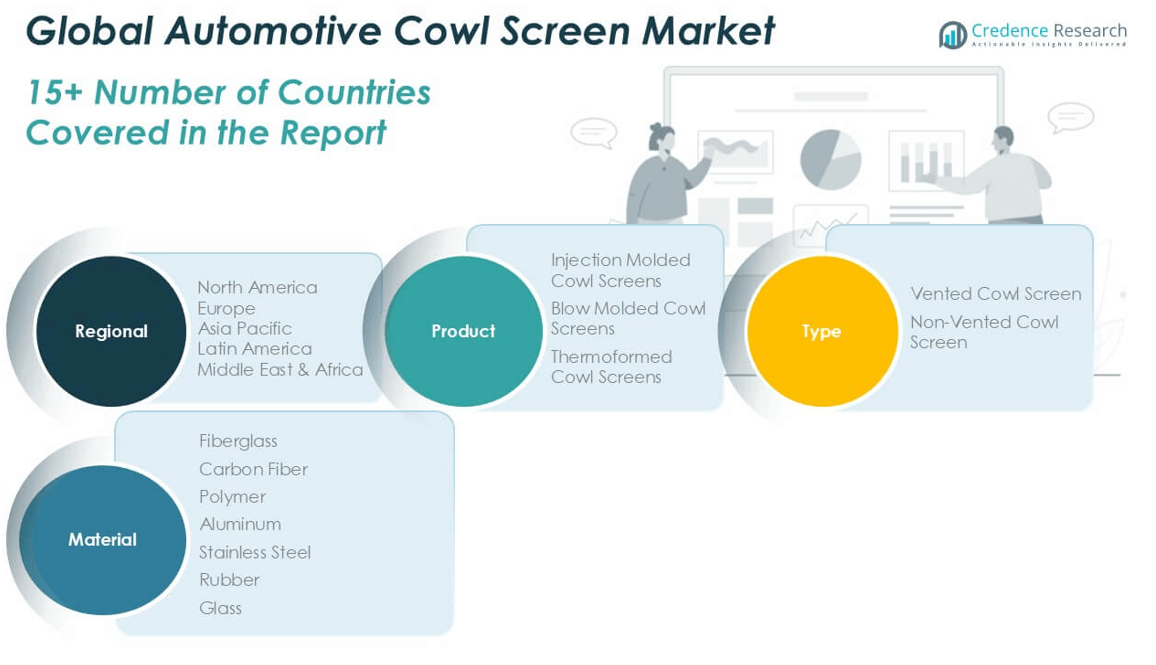
By Product
- Injection Molded Cowl Screens
- Blow Molded Cowl Screens
- Thermoformed Cowl Screens
By Type
- Vented Cowl Screen
- Non-Vented Cowl Screen
By Material
- Fiberglass
- Carbon Fiber
- Polymer
- Aluminum
- Stainless Steel
- Rubber
- Glass
By Geography
- North America
- U.S.
- Canada
- Mexico
- Europe
- Germany
- France
- U.K.
- Italy
- Spain
- Rest of Europe
- Asia Pacific
- China
- Japan
- India
- South Korea
- South-east Asia
- Rest of Asia Pacific
- Latin America
- Brazil
- Argentina
- Rest of Latin America
- Middle East & Africa
- GCC Countries
- South Africa
- Rest of the Middle East and Africa
Competitive Landscape
The competitive landscape of the Automotive Cowl Screen market is characterized by the presence of both global automotive component manufacturers and specialized suppliers. Key players such as TS Tech Co., Ltd., Magna International Inc., Yanfeng Automotive Interiors, and Toyota Boshoku Corporation lead the market with broad product portfolios, advanced manufacturing capabilities, and strong relationships with major OEMs. These companies invest significantly in R&D to enhance material performance, reduce weight, and improve durability. Firms like DuPont and Compagnie Plastic Omnium leverage their expertise in polymers and composites to offer innovative, lightweight solutions. Strategic partnerships, regional expansions, and mergers and acquisitions are common growth strategies adopted to strengthen market positions. In addition, players such as Calsonic Kansei Corp and Toyo Seat Co., Ltd. focus on product customization and technological advancement to meet evolving automotive standards. As demand for electric and hybrid vehicles rises, competitive intensity is expected to increase, driven by innovation and material optimization.
Key Player Analysis
- TS Tech Co., Ltd.
- Calsonic Kansei Corp
- Toyo Seat Co., Ltd.
- Autoneum
- Yanfeng Automotive Interiors
- Compagnie Plastic Omnium
- DuPont
- Magna International Inc.
- Inergy Automotive Systems LLC
- Toyota Boshoku Corporation
Recent Developments
- In April 2025, TS Tech, a Japanese automotive components manufacturer, established a joint venture, Krishna TS Tech Auto Pvt. Ltd., with the Krishna Group in India. This joint venture, focusing on seats and other automobile parts, is part of TS Tech's broader plan to expand its automotive components business, including cowl screens, in the rapidly growing Indian market. The move aligns with TS Tech's 15th Medium-Term Management Plan, which prioritizes strengthening its presence in emerging markets.
- In May 2024, Inergy Automotive Systems (a subsidiary of Plastic Omnium, now OPmobility) secured a contract with Audi to supply selective catalytic reduction (SCR) systemsfor their diesel vehicles. While this contract focuses on fuel systems, Inergy's broader expertise in plastic components, particularly their use of advanced polymers and composites, makes them relevant to the cowl screen market.
Market Concentration & Characteristics
The Automotive Cowl Screen Market exhibits a moderately consolidated structure, with a mix of global automotive component manufacturers and regional suppliers competing for market share. It features a balanced blend of large-scale enterprises with advanced production capabilities and smaller firms specializing in customized or region-specific products. Key players such as Magna International, TS Tech Co., Ltd., and Yanfeng Automotive Interiors lead through technological innovation, established OEM partnerships, and robust distribution networks. It is characterized by a growing preference for lightweight materials, precision manufacturing, and design adaptability. The market also reflects strong OEM-driven demand and rising aftermarket potential, particularly in regions with aging vehicle fleets. Innovation in polymers and thermoplastics, along with evolving vehicle designs, continues to influence product development and competitive dynamics.
Report Coverage
The research report offers an in-depth analysis based on Product, Type, Material and Geography. It details leading market players, providing an overview of their business, product offerings, investments, revenue streams, and key applications. Additionally, the report includes insights into the competitive environment, SWOT analysis, current market trends, as well as the primary drivers and constraints. Furthermore, it discusses various factors that have driven market expansion in recent years. The report also explores market dynamics, regulatory scenarios, and technological advancements that are shaping the industry. It assesses the impact of external factors and global economic changes on market growth. Lastly, it provides strategic recommendations for new entrants and established companies to navigate the complexities of the market.
Future Outlook
- The automotive cowl screen market will continue to grow steadily due to increasing global vehicle production.
- Lightweight and durable materials like polymers and composites will remain in high demand.
- Injection molded cowl screens will retain their dominance due to cost efficiency and precision.
- Vented cowl screens will see wider adoption to support thermal management and HVAC performance.
- Asia Pacific will remain the largest regional market due to expanding automotive manufacturing.
- North America will maintain strong aftermarket demand for replacement cowl screen components.
- Electric and hybrid vehicles will create new design opportunities for customized cowl screens.
- Sustainability trends will drive the adoption of recyclable and eco-friendly materials.
- Technological advancements in molding and forming techniques will improve product quality and reduce costs.
- Increasing regulatory requirements will push manufacturers toward innovation and compliance.

Request a Free Sample
Fill in your details and we'll send you a free sample report.
- Sample data tables & charts
- Research methodology
Need a Custom Version of This Report?
Tailor the scope, geography, or segments to your exact requirements.
- Custom geography or segment scope
- Direct access to our analyst team
Frequently Asked Questions
What is the current size of the Automotive Cowl Screen Market?
What are the key segments within the Automotive Cowl Screen Market?
What are some challenges faced by the Automotive Cowl Screen Market?
Who are the major players in the Automotive Cowl Screen Market?
Table of Content
Chapter 1. Report Introduction
- 1.1 Report Description & Purpose
- 1.1.1 Report Title & Market Definition
- 1.1.2 Unique Selling Propositions (USP) & Key Differentiators
- 1.1.3 Value Proposition for Stakeholders
- 1.2 Research Objectives
- 1.2.1 Market Sizing Objectives (Volume & Revenue) (Volume Where Applicable)
- 1.2.2 Segmentation Objectives
- 1.2.3 Competitive Intelligence Objectives
- 1.2.4 Forecast & Scenario Objectives
- 1.3 Report Scope
- 1.3.1 Automotive Cowl Screen Scope – Segments & Subsegments Covered
- 1.3.2 Geographic Scope – Regions & Countries Covered
- 1.3.3 Historical Period, Base Year & Forecast Period (2024; forecast to 2032)
- 1.3.4 Inclusions & Exclusions
- 1.4 Industry Classification & Applicable Codes
- 1.5 Currency, Measurement Units & Valuation Basis
- 1.6 Target Stakeholders
- 1.7 Limitations & Assumptions
Chapter 2. Executive Summary
- 2.1 Global Automotive Cowl Screen Market Snapshot
- 2.1.1 Market Size – Historical (2024) & Forecast (2024-2032) (2024: USD 696.68 million → 2032: USD 1,079.52 million)
- 2.1.2 Volume & Revenue – Global Totals (Volume Where Applicable)
- 2.1.3 Key Market Highlights – Top Five Facts
- 2.2 Automotive Cowl Screen Market Segmentation Snapshot
- 2.2.1 Market Split by Region – 2024 vs. 2032
- 2.3 Competitive Snapshot
- 2.3.1 Top 10 Players by Revenue Share – 2024
- 2.3.2 Top 10 Players by Volume Share – 2024 (Volume Where Applicable)
- 2.3.3 Recent Strategic Developments (18-Month Summary)
- 2.4 Key Investment Highlights & Strategic Conclusions
Chapter 3. Automotive Cowl Screen Market Dynamics & Industry Analysis
- 3.1 Market Overview & Context
- 3.1.1 Automotive Cowl Screen Market Position in the Broader Industry Value Chain
- 3.1.2 Demand Structure & Purchasing Dynamics
- 3.1.3 Market Maturity & Development Stage by Region
- 3.2 Automotive Cowl Screen Market Drivers
- 3.3 Automotive Cowl Screen Market Restraints & Challenges
- 3.4 Automotive Cowl Screen Market Opportunities
- 3.5 Porter's Five Forces Analysis
- 3.5.1 Threat of New Entrants
- 3.5.2 Bargaining Power of Suppliers
- 3.5.3 Bargaining Power of Buyers
- 3.5.4 Threat of Substitutes
- 3.5.5 Competitive Rivalry – Intensity Assessment
- 3.6 Automotive Cowl Screen Value Chain Analysis
- 3.6.1 Upstream – Key Inputs, Resources & Suppliers
- 3.6.1.1 Key Input/Resource 1
- 3.6.1.2 Key Input/Resource 2
- 3.6.1.3 Key Input/Resource 3
- 3.6.2 Midstream – Core Operations & Value Creation
- 3.6.2.1 Operating Model & Process Overview
- 3.6.2.2 Key Operating Locations & Capabilities by Company
- 3.6.3 Downstream – Market Channels & End Users
- 3.6.3.1 Direct Sales & Customer Engagement Channels
- 3.6.3.2 Indirect Sales, Intermediaries & Partner Channels
- 3.6.4 Value Chain Profitability Analysis
- 3.6.1 Upstream – Key Inputs, Resources & Suppliers
- 3.7 PESTEL Analysis
- 3.7.1 Political Factors
- 3.7.2 Economic Factors
- 3.7.3 Social Factors
- 3.7.4 Technological Factors
- 3.7.5 Environmental Factors
- 3.7.6 Legal Factors
- 3.8 Automotive Cowl Screen Supply Chain Analysis
- 3.8.1 Critical Input & Resource Availability Risk Assessment
- 3.8.2 Supplier & Operational Concentration Risk (Geographic Exposure)
- 3.8.3 Supply & Service Disruption Impact Analysis
- 3.9 Regulatory & Policy Landscape
Note: The regulatory and policy landscape section covers regulations based on their applicability to the market, Automotive Cowl Screen category, geography, and scope of the study. Only regulatory frameworks with a material impact on operations, compliance, trade, sustainability, or market access are analyzed in detail.
Chapter 4. Key Investment Pockets & Opportunity Analysis
- 4.1 Automotive Cowl Screen Market Attractiveness Analysis
- 4.1.1 By Region – Investment Attractiveness Matrix (Market Size × CAGR)
- 4.2 Absolute Revenue Growth Opportunity
- 4.2.1 By Region – Absolute Revenue Growth Through 2032
- 4.3 Incremental Demand Opportunity
- 4.3.1 By Region – Incremental Demand Through 2032
- 4.3.2 Segment – Incremental Demand
- 4.4 Emerging Submarket Opportunity Deep Dive (Subject to Applicability)
- 4.5 Priority Market Opportunity Scorecards
- 4.5.1 United States
- 4.5.2 Europe
- 4.5.3 Asia
- 4.5.4 Middle East & Africa
Note: Priority market opportunity scorecards reflect the geographic scope and strategic relevance of the study. Listed markets are indicative and may be adapted to the industry.
Chapter 5. Automotive Cowl Screen Cross-Border Trade & Market Access Analysis
- 5.1 International Trade & Cross-Border Activity Overview
- 5.1.1 Global Export Value by Country (2024)
- 5.1.2 Global Export Volume by Country (2024) (Volume Where Applicable)
- 5.1.3 Global Import Value by Country (2024)
- 5.1.4 Global Import Volume by Country (2024) (Volume Where Applicable)
- 5.1.5 Net Trade Balance by Country (2024)
- 5.2 Export Analysis – Segment
- 5.2.1 Category 1 (Applicable Classification Code)
- 5.2.2 Category 2 (Applicable Classification Code)
- 5.2.3 Category 3 (Applicable Classification Code)
- 5.2.4 Category 4 (Applicable Classification Code)
- 5.2.5 Category 5 (Applicable Classification Code)
- 5.3 Import Analysis – Segment
- 5.3.1 Category 1 (Applicable Classification Code)
- 5.3.2 Category 2 (Applicable Classification Code)
- 5.3.3 Category 3 (Applicable Classification Code)
- 5.3.4 Category 4 (Applicable Classification Code)
- 5.3.5 Category 5 (Applicable Classification Code)
- 5.4 Cross-Border Pricing & Transaction Benchmarks
- 5.4.1 Export Pricing – Segment & Country
- 5.4.2 Import Pricing – Segment & Source Country
- 5.4.3 Price Trends (2024)
- 5.5 Key Cross-Border Trade & Delivery Routes
- 5.5.1 Cross-Border Trade/Delivery Route 1
- 5.5.2 Cross-Border Trade/Delivery Route 2
- 5.5.3 Cross-Border Trade/Delivery Route 3
- 5.5.4 Cross-Border Trade/Delivery Route 4
- 5.5.5 Cross-Border Trade/Delivery Route 5
- 5.6 Trade Policy & Market Access Impact Assessment
- 5.6.1 Tariff & Non-Tariff Barriers
- 5.6.2 Regional Trade & Economic Integration Frameworks
- 5.6.3 Bilateral & Multilateral Trade Agreements
- 5.6.4 Cross-Border Operating, Licensing & Localization Requirements
Note: This chapter applies where cross-border trade or delivery is relevant to Automotive Cowl Screen. Goods, services, and digital offerings are assessed using applicable classifications and transaction measures. Import-export volumes, trade balances, and route analyses are included only where meaningful to the market.
Chapter 6. Competitive Landscape & Company Benchmarking
- 6.1 Automotive Cowl Screen Market Concentration & Structure
- 6.1.1 Herfindahl-Hirschman Index (HHI) – vs. 2024
- 6.1.2 Leading, Mid-Sized & Emerging Player Structure
- 6.1.3 Global, Regional & Local Player Dynamics
- 6.2 Automotive Cowl Screen Market Share Analysis – 2024
- 6.2.1 Global Revenue Share by Company
- 6.2.2 Global Volume Share by Company (Volume Where Applicable)
- 6.2.3 Regional Revenue Share
- 6.2.4 Market Share Evolution ( vs. 2024)
- 6.2.5 Company Market Share by Key Segment
- 6.2.6 Company Market Share by Customer Group
- 6.3 Operating Scale, Capacity & Infrastructure Analysis
- 6.3.1 Global Operating Scale & Supply Capacity
- 6.3.2 Resource Utilization & Operating Efficiency
- 6.3.3 Output, Service Delivery & Activity Metrics
- 6.3.4 Operating Footprint & Infrastructure Map
- 6.3.5 Planned Operational & Capacity Expansion
- 6.4 Automotive Cowl Screen Competitive Benchmarking Matrix
- 6.4.1 Revenue, Growth, Profitability & Operating Metric Comparison
- 6.4.2 Channel Revenue Mix
- 6.4.3 Geographic Revenue Exposure
- 6.4.4 R&D Intensity
- 6.4.5 Sustainability Maturity
- 6.5 Strategic Developments in Automotive Cowl Screen (Last 24 Months)
- 6.5.1 Mergers, Acquisitions & Divestments
- 6.5.2 New Products, Services & Solutions in Automotive Cowl Screen
- 6.5.3 Operational & Infrastructure Expansions
- 6.5.4 Strategic Alliances, Joint Ventures & Partnerships
- 6.5.5 Distribution Expansion & Market Entry
- 6.5.6 Sustainability & ESG Initiatives
- 6.6 Competitive Strategy Mapping
- 6.6.1 Leader, Challenger, Follower & Niche Classification
- 6.6.2 Pricing Strategy Comparison
- 6.6.3 Channel Strategy Matrix
Note: Strategic developments are included based on their materiality and the availability of reliable information.
Chapter 7. Global Automotive Cowl Screen Market – By Sales & Delivery Channel
- 7.1 Segment Overview
- 7.1.1 Volume & Revenue Split by Channel (2024 & 2032) (Volume Where Applicable)
- 7.1.2 Channel Mix Evolution (2024-2032)
Chapter 8. Regional Market Analysis – Global Overview
- 8.1 Global Regional Overview
- 8.1.1 Regional Volume Share (Volume Where Applicable)
- 8.1.2 Regional Revenue Share
- 8.1.3 Regional Volume by Region (Volume Where Applicable)
- 8.1.4 Regional Revenue by Region
- 8.1.5 Regional Forecast Through 2032
- 8.2 Cross-Regional Segment Analysis
- 8.2.1 By Sales & Delivery Channel
- 8.2.2 By Competitive Positioning & Price Tier
Chapter 9. North America Automotive Cowl Screen Market
- 9.1 United States
- 9.2 Canada
- 9.3 Mexico
Chapter 10. Europe Automotive Cowl Screen Market
- 10.1 Germany
- 10.2 France
- 10.3 Italy
- 10.4 United Kingdom
- 10.5 Spain
- 10.6 Poland
- 10.7 Russia
- 10.8 Netherlands
- 10.9 Belgium
- 10.10 Sweden
- 10.11 Denmark
- 10.12 Norway
- 10.13 Rest of Europe
Chapter 11. Asia Pacific Automotive Cowl Screen Market
- 11.1 China
- 11.2 India
- 11.3 Japan
- 11.4 South Korea
- 11.5 Thailand
- 11.6 Indonesia
- 11.7 Vietnam
- 11.8 Malaysia
- 11.9 Australia
- 11.10 Rest of Asia Pacific
Chapter 12. Latin America Automotive Cowl Screen Market
- 12.1 Brazil
- 12.2 Argentina
- 12.3 Colombia
- 12.4 Chile
- 12.5 Rest of Latin America
Chapter 13. Middle East Automotive Cowl Screen Market
- 13.1 Saudi Arabia
- 13.2 United Arab Emirates
- 13.3 Turkey
- 13.4 Israel
- 13.5 Iran
- 13.6 Rest of the Middle East
Chapter 14. Africa Automotive Cowl Screen Market
- 14.1 South Africa
- 14.2 Egypt
- 14.3 Nigeria
- 14.4 Morocco
- 14.5 Rest of Africa
Chapter 15. Automotive Cowl Screen Company Profiles
- 15.1 [Company 01]
- 15.1.1 Company Overview
- 15.1.2 Key Management Personnel
- 15.1.3 Products & Services Portfolio
- 15.1.4 Financial Performance
- 15.1.5 Key Market Focus & Geographic Presence
- 15.1.6 Recent Developments & Strategic Initiatives
Note: The company profile list is preliminary and may change based on research findings, market developments, data availability, and client requirements.
Chapter 16. Appendices
- Appendix A – List of Abbreviations & Acronyms
- Appendix B – Industry Classification Code Reference – Full Series
- Appendix C – Supply, Output & Operating Capacity Data Tables
- Appendix D – End-Use & Demand Base Tables
- Appendix E – Demand, Adoption & Usage Assumptions
- Appendix F – Pricing & Revenue Metric Reference Tables
- Appendix G – Company Operations & Infrastructure Database
- Appendix H – Cross-Border Trade & Activity Data Tables (Where Applicable)
- Appendix I – Regulatory Summary Tables
- Appendix J – Primary Research Participant List (Anonymized)
- Appendix K – Primary Research Questionnaire Framework
- Appendix L – Data Sources & Bibliography
- Appendix M – Market Size Divergence & Source Comparison
Chapter 17. Research Methodology
- 17.1 Research Framework & Philosophy
- 17.2 Secondary Research – Sources, Hierarchy & Data Extraction
- 17.3 Data Modeling – Bottom-Up & Top-Down Market Sizing
- 17.4 Primary Research – Stakeholder Framework, LOI & Sample Sizes
- 17.5 Forecast Methodology – Regression, Scenario & Sensitivity Analysis
- 17.6 Quality Control – Four-Layer Validation Framework
- 17.7 Limitations & Standard Assumptions
- 17.8 Disclaimer
