
Market Overview:
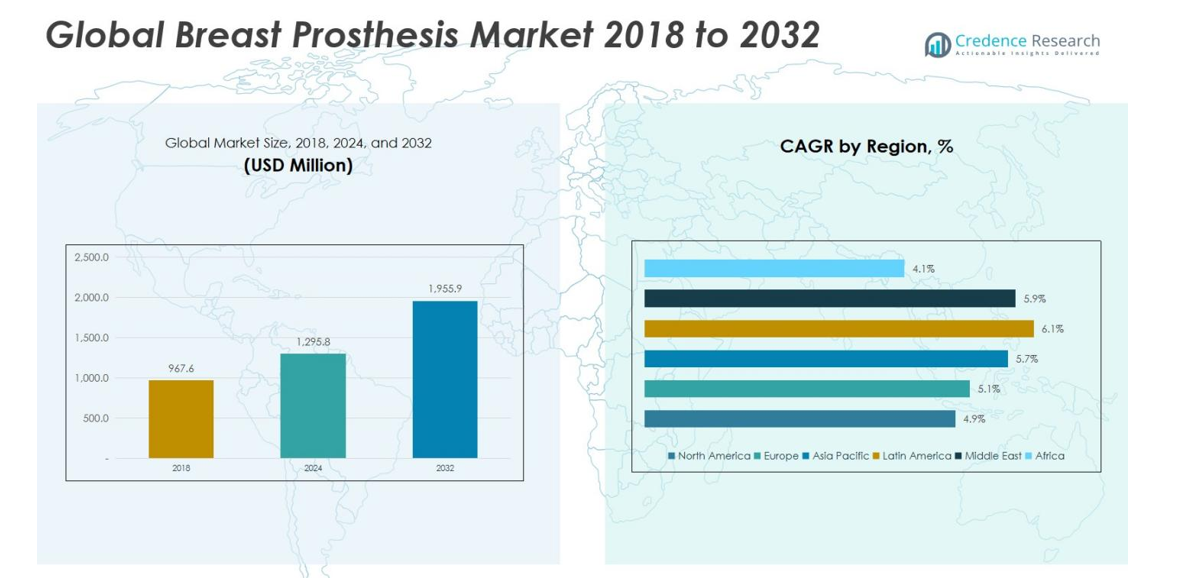
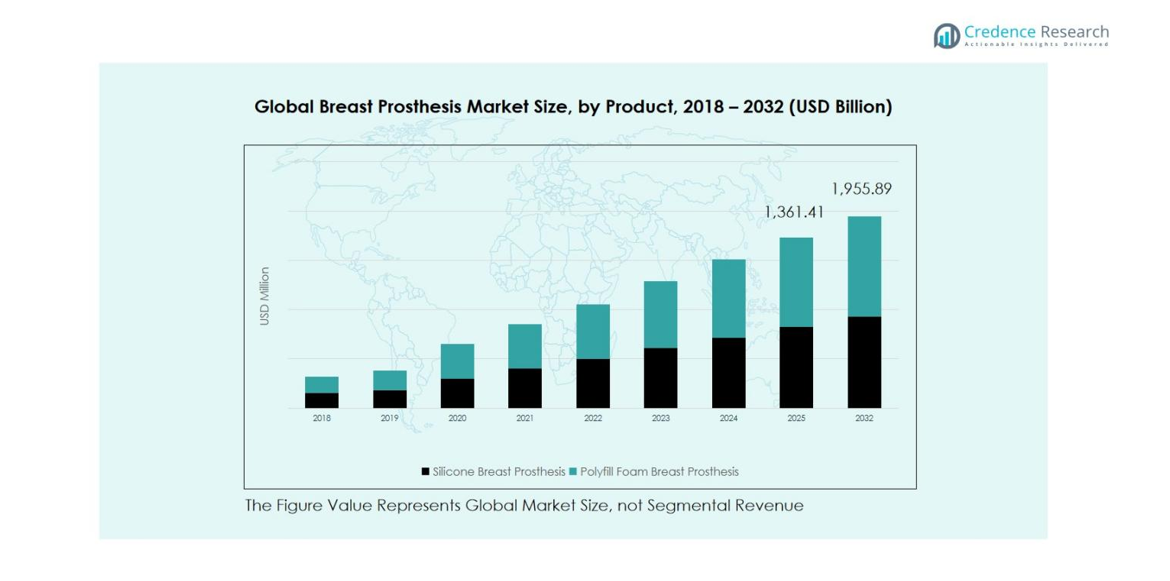
The Global Breast Prosthesis Market size was valued at USD 967.6 million in 2018, reaching USD 1,295.8 million in 2024, and is anticipated to attain USD 1,955.9 million by 2032, growing at a CAGR of 5.31% during the forecast period.
| REPORT ATTRIBUTE | DETAILS |
|---|---|
| Historical Period | 2020-2023 |
| Base Year | 2024 |
| Forecast Period | 2025-2032 |
| Breast Prosthesis Market Size 2024 | USD 1,295.8 million |
| Breast Prosthesis Market, CAGR | 5.31% |
| Breast Prosthesis Market Size 2032 | USD 1,955.9 million |
The Global Breast Prosthesis Market features strong competition among key players such as POLYTECH Health & Aesthetics GmbH, ContourMed, Trulife Breastcare (Trulife Group), American Breast Care, Nearly Me, Anita Dr. Helbig GmbH, Amoena, and Nicola Jane. These companies focus on innovation in silicone materials, lightweight designs, and personalized fitting solutions to enhance patient comfort and realism. Strategic collaborations with hospitals and clinics, alongside technological advancements, have strengthened their global presence. North America emerged as the leading region in 2024, capturing approximately 33.7% of the total market share, supported by high healthcare spending, strong distribution networks, and favorable reimbursement frameworks.
Market Insights
- The Global Breast Prosthesis Market was valued at USD 1,295.8 million in 2024 and is projected to reach USD 1,955.9 million by 2032, expanding at a CAGR of 5.31% during the forecast period.
- Rising breast cancer incidence, growing awareness about post-mastectomy reconstruction, and improved access to advanced prosthetic materials are major factors driving market growth.
- The market is witnessing a shift toward custom-fit and lightweight silicone prostheses, supported by innovations in 3D printing and temperature-adaptive materials that enhance comfort and natural appearance.
- Leading players such as Amoena, Trulife Breastcare, POLYTECH Health & Aesthetics GmbH, and American Breast Care dominate through product innovation, distribution expansion, and digital fitting solutions, though high product costs remain a restraint in developing markets.
- North America held the largest regional share of 7% in 2024, while the silicone segment led product adoption with over 72% share, supported by high demand for realistic and durable designs.
Market Segmentation Analysis:
By Product
The silicone breast prosthesis segment dominated the global market, accounting for 72.4% of total revenue in 2024. This dominance is attributed to its superior comfort, natural appearance, and durability compared to polyfill foam variants. Silicone prostheses closely mimic the weight and feel of natural breast tissue, enhancing patient satisfaction after mastectomy or reconstruction. Growing awareness of post-mastectomy rehabilitation and the availability of customizable silicone products are further driving adoption. The polyfill foam prosthesis segment, while smaller, is gaining traction due to its lightweight design and affordability, catering to short-term and comfort-oriented users.
- For instance, Amoena’s Contact Light 2S silicone prosthesis features temperature-equalizing technology designed to replicate the skin’s natural movement and comfort.
By Shape
The symmetrical breast prosthesis segment led the market with around 64.7% share in 2024, driven by its versatile fit and suitability for both single and double mastectomy patients. These prostheses offer balanced weight distribution and aesthetic uniformity, making them highly preferred for standard breast reconstruction. In contrast, the asymmetrical segment is expanding steadily due to increasing demand for customized anatomical designs that conform to individual body contours. Continuous product innovation in ergonomic shapes and advanced skin-friendly materials is expected to sustain market growth across both categories.
- For instance, Trulife’s Silk Encore Asymmetric prosthesis uses ergonomic curvature and temperature-regulating materials, reflecting the trend toward highly individualized comfort solutions.
Key Growth Drivers
Rising Prevalence of Breast Cancer and Mastectomy Procedures
The increasing global incidence of breast cancer remains a primary growth driver for the breast prosthesis market. As more women undergo mastectomy procedures, the demand for high-quality external prosthetic solutions continues to rise. Improved accessibility to post-surgical care, government awareness initiatives, and the psychological benefits of prosthetic restoration further boost adoption. In addition, advancements in reconstructive healthcare infrastructure and growing acceptance of breast prostheses as an integral part of recovery contribute significantly to market expansion worldwide.
- For instance, companies such as Amoena introduced the Adapt Air breast form series with adjustable air chambers to allow individualized comfort and fit, reflecting innovation in post-surgical recovery aids.
Advancements in Material and Design Technologies
Technological innovation in materials, such as medical-grade silicone, lightweight foam, and skin-friendly polymers, has significantly enhanced product performance. Modern breast prostheses now provide a more natural look, better breathability, and improved comfort for long-term wear. Custom-fit 3D scanning and adaptive shape technologies are revolutionizing product design, leading to higher patient satisfaction rates. Manufacturers are focusing on hypoallergenic, temperature-adaptive, and ergonomically balanced prostheses, which are encouraging more women to choose advanced external alternatives over surgical reconstruction.
- For instance, Amoena’s Energy prosthesis line, developed with patented Comfort+ temperature-equalizing material, helps reduce skin irritation and overheating during daily use.
Growing Awareness and Supportive Reimbursement Policies
Rising awareness about post-mastectomy recovery and supportive reimbursement frameworks across key regions are strengthening market growth. Health insurance providers and government programs increasingly cover prosthetic products, making them more affordable and accessible to patients. Advocacy groups and non-profit organizations are also promoting emotional well-being and body confidence after mastectomy. Together, these factors are driving higher adoption rates across hospitals, specialty clinics, and homecare settings, particularly in North America and Europe where reimbursement support and patient education programs are well established.
Key Trends & Opportunities
Emergence of Customizable and 3D-Printed Prostheses
The adoption of 3D printing and customization technologies is creating new growth opportunities in the breast prosthesis market. Personalized prostheses tailored to the user’s anatomy ensure enhanced comfort, fit, and appearance. These innovations allow precise control over weight, texture, and symmetry, improving both aesthetic and psychological outcomes. As customization becomes more affordable and manufacturing efficiency improves, key players are increasingly investing in personalized prosthesis solutions, catering to growing consumer demand for individualized post-surgical care.
- For instance, Lattice Medical developed the MATTISSE breast bioprosthesis using 3D printing and biomaterials, which supports new tissue growth after implantation and eventually dissolves, leaving behind regenerated tissue
Expansion in Emerging Markets and Online Distribution
Emerging economies across Asia Pacific, Latin America, and the Middle East present lucrative growth prospects due to rising healthcare expenditure and improved access to prosthetic care. The surge in e-commerce and direct-to-consumer distribution channels is also reshaping market dynamics. Online platforms enable manufacturers to reach a broader consumer base, offering convenience and discreet purchasing options. Increased adoption of digital sales strategies, coupled with regional healthcare reforms, is expected to accelerate market penetration in developing regions over the coming years.
- For instance, Ossur is strengthening its business in South Africa and the Middle East through partnerships and advanced bionic prosthetics such as microprocessor-controlled knees, aiming to provide technology-driven solutions to a broader patient population.
Key Challenges
High Cost of Advanced Prosthetic Solutions
The premium pricing of silicone and customized prostheses poses a major challenge, particularly in price-sensitive regions. Advanced materials, specialized fittings, and precision manufacturing processes elevate production costs, making these products less affordable for many patients. Limited reimbursement coverage in developing countries further restricts accessibility. As a result, patients often opt for low-cost alternatives with compromised quality, affecting overall market potential. Reducing production expenses and expanding insurance support remain critical to overcoming this financial barrier.
Limited Awareness and Social Stigma in Developing Regions
Despite medical advancements, awareness about breast prosthesis options remains low in several parts of Asia, Africa, and Latin America. Cultural taboos and social stigma surrounding mastectomy and body image discourage many women from seeking prosthetic solutions. Additionally, inadequate patient counseling and limited availability of specialized fitting centers hinder adoption. Strengthening awareness campaigns, expanding healthcare outreach, and improving education around post-surgical recovery are essential to overcoming these social and informational challenges.
Regional Analysis
North America:
North America dominated the global breast prosthesis market with a 33.7% revenue share in 2024, driven by strong healthcare infrastructure, early diagnosis rates, and high adoption of post-mastectomy care solutions. The market was valued at USD 326.84 million in 2018, reached USD 427.84 million in 2024, and is projected to attain USD 625.89 million by 2032, growing at a CAGR of 4.9%. Increasing awareness of breast reconstruction, advanced silicone prosthetic options, and favorable reimbursement policies in the U.S. and Canada continue to strengthen market penetration and patient accessibility across the region.
Europe:
Europe accounted for 27% of the global market share in 2024, supported by expanding healthcare access and rising adoption of customized breast prostheses. The market value grew from USD 258.63 million in 2018 to USD 342.87 million in 2024, and is projected to reach USD 510.49 million by 2032, registering a CAGR of 5.1%. Increasing prevalence of breast cancer in major economies such as Germany, France, and the UK, coupled with a growing emphasis on post-surgical quality of life, continues to drive regional demand for advanced silicone and lightweight prosthetic products.
Asia Pacific:
Asia Pacific held 23.4% market share in 2024 and is expected to emerge as the fastest-growing region, expanding at a CAGR of 5.7%. The market increased from USD 220.41 million in 2018 to USD 302.51 million in 2024, and is forecasted to reach USD 471.37 million by 2032. Rising breast cancer incidence, expanding healthcare expenditure, and improving patient awareness in China, Japan, and India are key growth drivers. The availability of affordable silicone prostheses and local manufacturing initiatives further enhance accessibility, making Asia Pacific a major growth hub for global market players.
Latin America:
Latin America represented about 10.2% of the global market share in 2024, with growing demand supported by better access to reconstructive healthcare. The market was valued at USD 93.56 million in 2018, reached USD 131.69 million in 2024, and is projected to hit USD 211.63 million by 2032, recording a CAGR of 6.1%. Countries such as Brazil and Argentina are driving regional expansion through awareness programs and enhanced distribution of cost-effective prosthetic products. Increasing acceptance of breast care solutions and medical advancements are expected to strengthen regional adoption in the coming years.
Middle East:
The Middle East breast prosthesis market accounted for nearly 5.3% of the global share in 2024, expanding steadily at a CAGR of 5.9%. Valued at USD 41.99 million in 2018, it reached USD 58.07 million in 2024 and is projected to attain USD 91.34 million by 2032. Growth is driven by improving healthcare facilities, rising breast cancer awareness, and increasing female health initiatives across GCC countries, Israel, and Turkey. The adoption of premium silicone prostheses and the introduction of international brands through regional distributors continue to accelerate market penetration.
Africa:
Africa captured around 3.4% of the global market share in 2024, with gradual progress supported by healthcare improvements and awareness programs. The market value rose from USD 26.12 million in 2018 to USD 32.82 million in 2024, and is anticipated to reach USD 45.18 million by 2032, growing at a CAGR of 4.1%. South Africa remains the leading country in regional adoption, followed by Egypt. However, limited access to advanced medical devices and social stigma regarding breast reconstruction continue to hinder faster growth across the African breast prosthesis market.
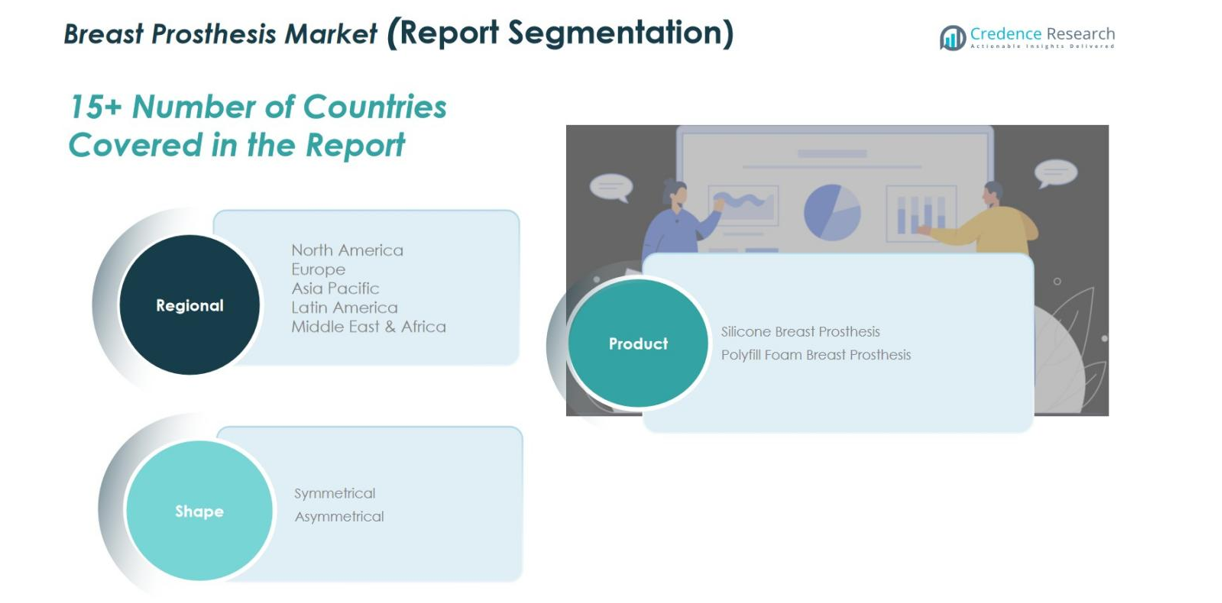
Market Segmentations:
By Product
- Silicone Breast Prosthesis
- Polyfill Foam Breast Prosthesis
By Shape
- Symmetrical
- Asymmetrical
By Region
- North America
- U.S.
- Canada
- Mexico
- Europe
- Germany
- France
- U.K.
- Italy
- Spain
- Rest of Europe
- Asia Pacific
- China
- Japan
- India
- South Korea
- South-east Asia
- Rest of Asia Pacific
- Latin America
- Brazil
- Argentina
- Rest of Latin America
- Middle East & Africa
- GCC Countries
- South Africa
- Rest of the Middle East and Africa
Competitive Landscape
The competitive landscape of the Global Breast Prosthesis Market is characterized by the presence of leading players such as POLYTECH Health & Aesthetics GmbH, ContourMed, Nicola Jane, Trulife Breastcare (Trulife Group), American Breast Care, Nearly Me, Anita Dr. Helbig GmbH, Poorti, and Amoena. These companies focus on innovation, quality enhancement, and product diversification to strengthen their market presence. Strategic initiatives such as mergers, partnerships, and product launches are common, aimed at expanding global reach and addressing evolving patient needs. Manufacturers are emphasizing lightweight materials, customizable designs, and advanced silicone technologies to improve comfort and realism. Increasing investment in R&D and adoption of digital fitting solutions have also enhanced patient satisfaction and brand differentiation. Furthermore, regional players are emerging in developing markets, offering cost-effective solutions that cater to growing local demand, thereby intensifying competition and broadening product accessibility across the breast prosthesis market.
Key Player Analysis
- POLYTECH Health & Aesthetics GmbH
- ContourMed
- Nicola Jane
- Trulife Breastcare (Trulife Group)
- American Breast Care
- Nearly Me
- Anita Dr. Helbig GmbH
- Poorti
- Amoena
- Other Key Players
Recent Developments
- In June 2025, Carle Illinois College of Medicine introduced an innovative 3D scanning and printing technology designed to create custom-fit breast prostheses directly in medical offices, enhancing comfort and personalization for patients.
- In July 2024, ARBURG and its 3D-printing partner Hashtagtwo received the TCT Healthcare Application Award for their “Personal Fit Breast Prosthesis” solution, which uses additive manufacturing to deliver custom-fitted prostheses for post-mastectomy patients.
- On July 9, 2024, ARBURG (with partner Hashtagtwo) won the TCT Healthcare Application Award for its “Personal Fit Breast Prosthesis” a 3-D printed, fully customized external breast form
Report Coverage
The research report offers an in-depth analysis based on Product, Shape and Region. It details leading market players, providing an overview of their business, product offerings, investments, revenue streams, and key applications. Additionally, the report includes insights into the competitive environment, SWOT analysis, current market trends, as well as the primary drivers and constraints. Furthermore, it discusses various factors that have driven market expansion in recent years. The report also explores market dynamics, regulatory scenarios, and technological advancements that are shaping the industry. It assesses the impact of external factors and global economic changes on market growth. Lastly, it provides strategic recommendations for new entrants and established companies to navigate the complexities of the market.
Future Outlook
- The global breast prosthesis market is expected to witness steady growth driven by rising mastectomy rates and post-surgical rehabilitation awareness.
- Advancements in silicone and polymer materials will enhance comfort, durability, and realism in breast prosthetic designs.
- Custom-fit and 3D-printed prostheses will gain traction as personalization becomes a key consumer preference.
- Increasing healthcare expenditure in emerging economies will expand access to quality breast prosthesis solutions.
- Online distribution and direct-to-consumer sales channels will continue to strengthen market penetration.
- Growing partnerships between hospitals and prosthesis manufacturers will improve product availability and fitting services.
- Awareness programs and NGO initiatives will play a vital role in reducing stigma and promoting adoption in developing regions.
- Integration of smart materials and temperature-regulating technologies will create new product opportunities.
- Expanding insurance coverage and reimbursement support will make advanced prostheses more affordable globally.
- Sustainable and eco-friendly manufacturing practices will emerge as a competitive differentiator among key players.

Request a Free Sample
Fill in your details and we'll send you a free sample report.
- Sample data tables & charts
- Research methodology
Market Dynamics
Rising Prevalence of Breast Cancer and Mastectomy Procedures
The increasing global incidence of breast cancer is leading to more mastectomy surgeries, directly boosting demand for breast prostheses as essential post-surgical rehabilitation aids.
Advancements in Material and Design Technologies
Innovations in medical-grade silicone, lightweight foams, and temperature-adaptive materials are making prostheses more comfortable, realistic, and durable, encouraging higher adoption among patients seeking natural appearance and long-term wear.
Growing Awareness and Supportive Reimbursement Policies
Enhanced patient education, government initiatives, and expanding insurance coverage are making breast prostheses more accessible and affordable, particularly in developed regions, thus driving market growth.
Emergence of Customizable and 3D-Printed Prostheses
The adoption of 3D scanning and printing technologies enables highly personalized prosthetic solutions, improving fit, comfort, and patient satisfaction, and opening new market opportunities for tailored post-mastectomy care.
Expansion in Emerging Markets and Online Distribution
Rising healthcare expenditure and the growth of e-commerce platforms in Asia Pacific, Latin America, and the Middle East are increasing access to quality breast prostheses, accelerating market penetration in previously underserved regions.
Need a Custom Version of This Report?
Tailor the scope, geography, or segments to your exact requirements.
- Custom geography or segment scope
- Direct access to our analyst team
Frequently Asked Questions
What is the current market size for the Global Breast Prosthesis Market, and what is its projected size in 2032?
At what Compound Annual Growth Rate is the Global Breast Prosthesis Market projected to grow between 2025 and 2032?
Which Global Breast Prosthesis Market segment held the largest share in 2024?
What are the primary factors fueling the growth of the Global Breast Prosthesis Market?
Who are the leading companies in the Global Breast Prosthesis Market?
Who are the major players in this market?
Table of Content
Chapter 1 Market Segmentation
- 1.1 Segmentation Framework
- 1.1.1 Product and Service Classification
- 1.1.2 Application and End-Use Classification
- 1.1.3 Technology and Solution Classification
- 1.1.4 Customer and Distribution Channel Classification
- 1.1.5 Geographic Segmentation
- 1.1.6 Market Segment Definitions and Boundaries
- 1.2 By Shape
- 1.2.1 Symmetrical
- 1.2.2 Asymmetrical
- 1.3 By Product
- 1.3.1 Silicone Breast Prosthesis
- 1.3.2 Polyfill Foam Breast Prosthesis
- 1.4 By End User
- 1.4.1 Post-Mastectomy Patients
- 1.4.2 Cosmetic Surgery Patients
- 1.4.3 Others
Chapter 2 Introduction
- 2.1 Report Objectives and Scope
- 2.2 Product Definition and Industry Terminology
- 2.3 Market Inclusions and Exclusions
- 2.4 Research Process
- 2.4.1 Primary Research and Expert Interviews
- 2.4.2 Secondary Research and Source Review
- 2.4.3 Top-Down and Bottom-Up Estimation
- 2.4.4 Data Triangulation and Verification
- 2.5 Market Size Measurement Basis
- 2.5.1 2024: USD 1,295.8 million → 2032: USD 1,955.9 million
- 2.6 Historical and Forecast Reference Periods
- 2.6.1 Base Year: 2024
- 2.6.2 Forecast Period: 2024-2032
- 2.7 Research Assumptions and Limitations
Chapter 3 Executive Summary
- 3.1 Market Snapshot and Key Findings
- 3.2 Base-Year Market Size, 2024
- 3.3 Forecast Market Size, 2032
- 3.4 Revenue and Volume Growth Outlook
- 3.5 Key Demand and Supply Indicators
- 3.6 Leading Market Segments
- 3.7 Fastest-Growing Market Opportunities
- 3.8 Regional Performance Highlights
- 3.9 Technology and Industry Transformation
- 3.10 Competitive Landscape Summary
- 3.11 Analyst View and Strategic Implications
Chapter 4 Global Breast Prosthesis Market Trends and Developments
- 4.1 Historical Industry Development
- 4.2 Recent Market Trends and Developments
- 4.3 Demand and Customer Behavior Trends
- 4.4 Technology and Product Innovation
- 4.5 Artificial Intelligence, Automation and Digitalization
- 4.6 Local Manufacturing and Supply Chain Realignment
- 4.7 Industry Partnerships, Mergers and Acquisitions
- 4.8 Sustainability and Circular Economy Developments
- 4.9 Government and Private Sector Investment Trends
- 4.10 Emerging Business Models and Commercialization
- 4.11 Industry Developments and Announcements
Chapter 5 Global Breast Prosthesis Market Production, Supply and Demand Analysis
- 5.1 Demand Trend and Consumption Analysis
- 5.2 Demand Forecast, 2024-2032
- 5.3 Production and Output Trend
- 5.4 Production and Output Forecast, 2024-2032
- 5.5 Installed Capacity and Capacity Utilization
- 5.6 Company-Wise Production Plants and Statistics
- 5.6.1 Installed Production Capacity
- 5.6.2 Actual Production
- 5.6.3 Planned Capacity and Expansion Targets
- 5.7 Supply Chain Structure and Procurement Trends
- 5.8 Supply-Demand Gap and Bottlenecks
- 5.9 Import Dependence and Sourcing Structure
- 5.10 Contract Manufacturing and Outsourcing
- 5.11 Regional Supply and Demand Concentration
Chapter 6 Global Breast Prosthesis Market Pricing Analysis
- 6.1 Pricing Structure and Measurement
- 6.2 Historical Pricing Trends
- 6.3 Pricing Outlook, 2024-2032
- 6.4 Average Selling Price and Unit Economics
- 6.5 Pricing by Product and Market Segment
- 6.6 Geographic Pricing Differences
- 6.7 Key Input, Energy, Labor and Logistics Costs
- 6.8 Contract Pricing and Purchasing Models
- 6.9 Pricing Sensitivity and Competitive Positioning
- 6.10 Price, Margin and Profitability Implications
Chapter 7 Global Breast Prosthesis Market Dynamics
- 7.1 Market Growth Drivers
- 7.1.1 Demand-Side Drivers
- 7.1.2 Technology and Innovation Drivers
- 7.1.3 Infrastructure and Investment Drivers
- 7.1.4 Regulatory and Policy Drivers
- 7.2 Market Restraints
- 7.2.1 Cost and Affordability Constraints
- 7.2.2 Technology and Adoption Barriers
- 7.2.3 Supply Chain and Operational Constraints
- 7.3 Market Challenges
- 7.3.1 Competitive Pressure and Margin Erosion
- 7.3.2 Skills, Infrastructure and Implementation Gaps
- 7.4 Emerging Market Opportunities
- 7.5 Market Dynamics Impact and Time-Horizon Assessment
Chapter 8 Global Breast Prosthesis Value Chain Analysis
- 8.1 Industry Value Chain Overview
- 8.2 Upstream Suppliers and Critical Inputs
- 8.3 Technology and Component Providers
- 8.4 Manufacturing or Service Delivery
- 8.5 Distribution, Channel Partners and Integrators
- 8.6 Downstream Applications and End Users
- 8.7 Value Addition and Profit Pools
- 8.8 Vertical Integration and Outsourcing
- 8.9 Supplier Concentration and Risk
- 8.10 Supply Chain Localization and Resilience
Chapter 9 Global Breast Prosthesis Market Regulations and Policies
- 9.1 Relevant Laws, Standards and Compliance Frameworks
- 9.2 Product, Service, Safety and Quality Requirements
- 9.3 Government Policies, Incentives and Subsidies
- 9.4 Imports, Exports and Trade Barriers
- 9.5 Public Procurement and Local Content Requirements
- 9.6 Environmental and Sustainability Compliance
- 9.7 Upcoming Policy Changes and Market Implications
Chapter 10 Global Breast Prosthesis Market Hotspots and Opportunities
- 10.1 Market Opportunity Mapping and Growth Hotspots
- 10.2 High-Growth Applications and Customer Groups
- 10.3 Underserved Markets and White-Space Opportunities
- 10.4 Emerging Technology and Product Opportunities
- 10.5 New Capacity and Investment Hotspots
- 10.6 Market Entry and Expansion Opportunities
- 10.7 Distribution and Partnership Opportunities
- 10.8 Near-Term and Long-Term Commercial Potential
- 10.9 Opportunity Attractiveness and Execution Risks
Chapter 11 Global Breast Prosthesis Market Outlook, 2024-2032
- 11.1 Market Size and Analysis
- 11.1.1 Revenue (Market Measurement: 2024: USD 1,295.8 million → 2032: USD 1,955.9 million)
- 11.1.2 Market Volume and Quantity Sold
- 11.1.3 Historical Market Size
- 11.1.4 Base-Year Market Size, 2024
- 11.2 Market Forecast, 2024-2032
- 11.2.1 Revenue Forecast to 2032
- 11.2.2 Volume Forecast to 2032
- 11.2.3 CAGR and Year-on-Year Growth
- 11.2.4 Incremental Revenue Opportunity
- 11.3 Forecast Assumptions and Scenario Analysis
- 11.3.1 Base-Case Forecast
- 11.3.2 Optimistic and Conservative Scenarios
- 11.3.3 Technology, Pricing and Policy Sensitivities
- 11.4 Market Attractiveness and Growth Outlook
Chapter 12 Global Breast Prosthesis Market Segmentation and Outlook
- 12.1 Segmentation Summary and Market Shares, 2024
- 12.2 Largest and Fastest-Growing Segments
- 12.3 By Shape - Market Size and Forecast, 2024-2032
- 12.3.1 Segment Definition and Scope
- 12.3.2 Historical Market Size
- 12.3.3 Revenue Forecast, 2024-2032
- 12.3.4 Volume Forecast, 2024-2032
- 12.3.5 Base-Year Market Share, 2024
- 12.3.6 Segment CAGR and Growth Drivers
- 12.3.7 Subsegment Market Size and Forecast
- 12.3.7.1 Symmetrical
- 12.3.7.2 Asymmetrical
- 12.3.8 Subsegment Pricing and Adoption Trends
- 12.3.9 Leading Suppliers and Competition
- 12.3.10 Regional Demand and Opportunities
- 12.4 By Product - Market Size and Forecast, 2024-2032
- 12.4.1 Segment Definition and Scope
- 12.4.2 Historical Market Size
- 12.4.3 Revenue Forecast, 2024-2032
- 12.4.4 Volume Forecast, 2024-2032
- 12.4.5 Base-Year Market Share, 2024
- 12.4.6 Segment CAGR and Growth Drivers
- 12.4.7 Subsegment Market Size and Forecast
- 12.4.7.1 Silicone Breast Prosthesis
- 12.4.7.2 Polyfill Foam Breast Prosthesis
- 12.4.8 Subsegment Pricing and Adoption Trends
- 12.4.9 Leading Suppliers and Competition
- 12.4.10 Regional Demand and Opportunities
- 12.5 By End User - Market Size and Forecast, 2024-2032
- 12.5.1 Segment Definition and Scope
- 12.5.2 Historical Market Size
- 12.5.3 Revenue Forecast, 2024-2032
- 12.5.4 Volume Forecast, 2024-2032
- 12.5.5 Base-Year Market Share, 2024
- 12.5.6 Segment CAGR and Growth Drivers
- 12.5.7 Subsegment Market Size and Forecast
- 12.5.7.1 Post-Mastectomy Patients
- 12.5.7.2 Cosmetic Surgery Patients
- 12.5.7.3 Others
- 12.5.8 Subsegment Pricing and Adoption Trends
- 12.5.9 Leading Suppliers and Competition
- 12.5.10 Regional Demand and Opportunities
- 12.6 Segment Growth Comparison
- 12.7 Segment Attractiveness and Priority Matrix
Chapter 13 Global Breast Prosthesis End-Use and Application Market Outlook
- 13.1 End-Use Industry and Customer Demand Structure
- 13.2 Leading Applications and Customer Groups
- 13.3 End-Use Market Size, Share and Forecast
- 13.4 Major End-Use Industry Deep Dives
- 13.4.1 Customer Requirements and Use Cases
- 13.4.2 Demand and Replacement Cycles
- 13.4.3 Technical and Regulatory Considerations
- 13.4.4 Purchasing and Procurement Models
- 13.4.5 Leading Vendors and Distribution Channels
- 13.4.6 Forecast and Commercial Opportunities
- 13.5 Emerging Applications and Cross-Segment Demand
- 13.6 End-Use Industry Investment Priorities
Chapter 14 Global Breast Prosthesis Geographic Market Outlook, 2024-2032
- 14.1 Regional Market Size and Share, 2024
- 14.2 Regional Market Forecast, 2024-2032
- 14.3 Regional Pricing, Production and Demand Differences
- 14.4 North America
- 14.4.1 United States
- 14.4.2 Canada
- 14.4.3 Mexico
- 14.5 Europe
- 14.5.1 Germany
- 14.5.2 France
- 14.5.3 Italy
- 14.5.4 United Kingdom
- 14.5.5 Spain
- 14.5.6 Poland
- 14.5.7 Russia
- 14.5.8 Netherlands
- 14.5.9 Belgium
- 14.5.10 Sweden
- 14.5.11 Denmark
- 14.5.12 Norway
- 14.5.13 Rest of Europe
- 14.6 Asia Pacific
- 14.6.1 China
- 14.6.2 India
- 14.6.3 Japan
- 14.6.4 South Korea
- 14.6.5 Thailand
- 14.6.6 Indonesia
- 14.6.7 Vietnam
- 14.6.8 Malaysia
- 14.6.9 Australia
- 14.6.10 Rest of Asia Pacific
- 14.7 Latin America
- 14.7.1 Brazil
- 14.7.2 Argentina
- 14.7.3 Colombia
- 14.7.4 Chile
- 14.7.5 Rest of Latin America
- 14.8 Middle East
- 14.8.1 Saudi Arabia
- 14.8.2 United Arab Emirates
- 14.8.3 Turkey
- 14.8.4 Israel
- 14.8.5 Iran
- 14.8.6 Rest of the Middle East
- 14.9 Africa
- 14.9.1 South Africa
- 14.9.2 Egypt
- 14.9.3 Nigeria
- 14.9.4 Morocco
- 14.9.5 Rest of Africa
- 14.10 Regional Investment, Policy and Supply Chain Differences
- 14.11 Regional Competitive Landscape
- 14.12 Geographic Growth Hotspots
Chapter 15 Global Breast Prosthesis Technology, Innovation and Sustainability Outlook
- 15.1 Technology Landscape and Maturity
- 15.2 Product, Process and Service Innovation
- 15.3 AI, Automation and Digital Tools in the Industry
- 15.4 Technology Adoption and Performance Benchmarking
- 15.5 Innovation Pipeline and R&D Investment
- 15.6 Patent and Intellectual Property Trends
- 15.7 Energy Efficiency and Resource Management
- 15.8 Sustainability, Recycling and Circularity
- 15.9 Technology Roadmap, 2024-2032
- 15.10 Risks of Obsolescence and Technology Substitution
Chapter 16 Global Breast Prosthesis Market Key Strategic Imperatives
- 16.1 Growth and Market Entry Priorities
- 16.2 High-Return Products and Segments
- 16.3 Pricing, Profitability and Cost Optimization
- 16.4 Technology Investment and Product Differentiation
- 16.5 Supply Chain Localization and Resilience
- 16.6 Distribution and Customer Acquisition
- 16.7 Partnership, Acquisition and Capacity Strategy
- 16.8 Regional Expansion Priorities
- 16.9 Short-, Medium- and Long-Term Actions
Chapter 17 Competition Outlook
- 17.1 Industry Competition Characteristics
- 17.2 Market Structure and Concentration
- 17.3 Market Share and Competitive Positioning, 2024
- 17.4 Company-Wise Revenue and Product Benchmarking
- 17.5 Production and Service Capacity Benchmarking
- 17.6 Technology, Pricing and Differentiation
- 17.7 Regional Footprint and Distribution Strength
- 17.8 Mergers, Acquisitions and Strategic Alliances
- 17.9 New Entrants and Competitive Threats
- 17.10 Porter's Five Forces and Industry Attractiveness
- 17.11 Competitive Outlook, 2024-2032
Chapter 18 Company Profiles
- 18.1 Company Coverage and Selection Criteria
- 18.2 Amoena
- 18.2.1 Business Description
- 18.2.2 Company Ownership and Geographic Presence
- 18.2.3 Product and Service Portfolio
- 18.2.4 Manufacturing and Operating Footprint
- 18.2.5 Production Capacity and Expansion Plans
- 18.2.6 Financial Performance and Investment
- 18.2.7 Market Share and Competitive Position
- 18.2.8 Technology and Innovation Capabilities
- 18.2.9 Strategic Alliances or Partnerships
- 18.2.10 Recent Developments
- 18.2.11 Growth Strategy and Outlook
- 18.3 Trulife Breastcare (Trulife Group)
- 18.4 POLYTECH Health & Aesthetics GmbH
- 18.5 American Breast Care
- 18.6 ContourMed
- 18.7 Nicola Jane
- 18.8 Anita Dr. Helbig GmbH
- 18.9 Nearly Me
- 18.10 Poorti
- 18.11 Lattice Medical
- 18.12 Other Relevant Market Participants
Note: Every listed company is profiled on the structure shown under the first company. The company list is preliminary and may change based on research findings, market developments, data availability and client requirements.
Chapter 19 Disclaimer
- 19.1 Research and Forecast Disclaimer
- 19.2 Data Source and Estimation Limitations
Note: The depth of individual sections depends on data availability for this market. Volume, capacity, trade and other unit-based metrics are included where applicable.

