
| REPORT ATTRIBUTE | DETAILS |
|---|---|
| Historical Period | 2020-2023 |
| Base Year | 2024 |
| Forecast Period | 2025-2032 |
| Brick Carton Packaging Market Size 2024 | USD 10,951.43 million |
| Brick Carton Packaging Market, CAGR | 4.88% |
| Brick Carton Packaging Market Size 2032 | USD 16,484.74 million |
Market Overview
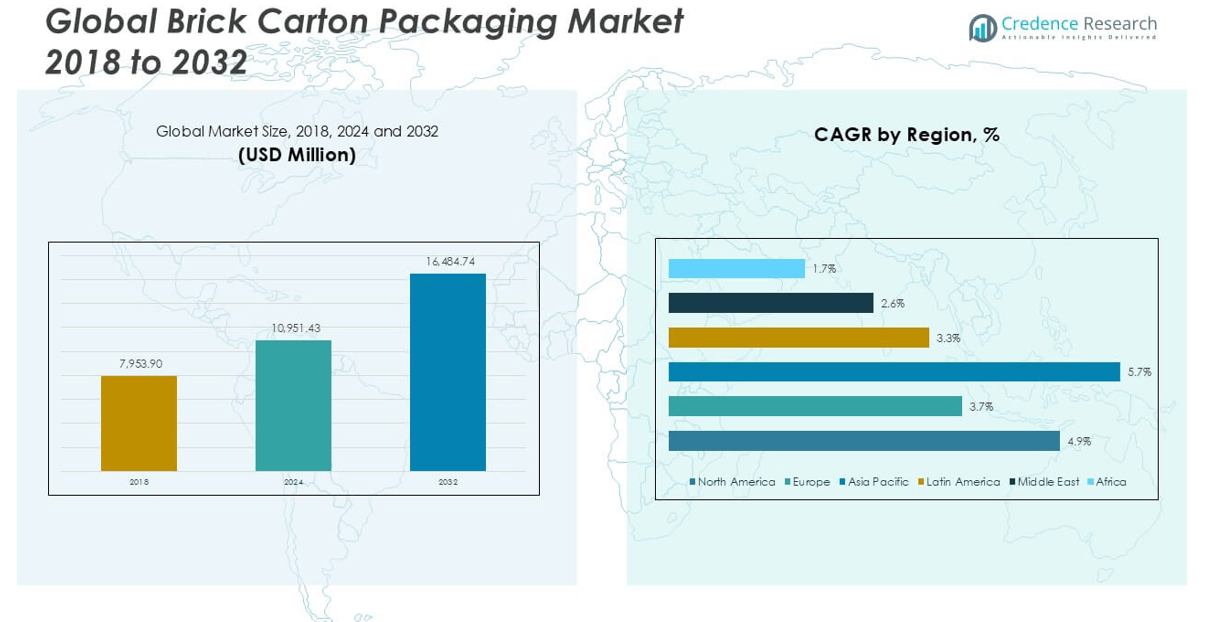
The Brick Carton Packaging market size was valued at USD 7,953.90 million in 2018, increased to USD 10,951.43 million in 2024, and is anticipated to reach USD 16,484.74 million by 2032, at a CAGR of 4.88% during the forecast period.
The Brick Carton Packaging market is led by prominent players such as Tetra Pak International S.A., SIG Combibloc Group Ltd., and Elopak AS, which collectively hold a significant share of the global market due to their advanced aseptic packaging technologies and strong distribution networks. These companies focus on sustainability, product innovation, and expanding operations in high-growth regions. Other notable participants include Greatview Aseptic Packaging, Evergreen Packaging LLC, and Nippon Paper Industries Co. Ltd., which are strengthening their positions through regional partnerships and diversified offerings. Asia Pacific emerges as the leading regional market, capturing 43.4% of the global market share in 2024, driven by rising demand in countries like China and India. North America and Europe follow, with strong adoption supported by established dairy and beverage industries. The competitive landscape remains moderately consolidated, with companies competing on material innovation, cost efficiency, and sustainability performance.
Market Insights
- The global Brick Carton Packaging market was valued at USD 10,951.43 million in 2024 and is projected to reach USD 16,484.74 million by 2032, growing at a CAGR of 4.88% during the forecast period.
- Increasing demand for sustainable, recyclable, and aseptic packaging solutions in the food and beverage sector is driving market growth, especially for dairy and juice applications.
- The market is witnessing trends like premiumization, bio-based material innovation, and adoption of advanced opening types such as twist caps and peel-back foil tabs.
- Key players including Tetra Pak, SIG Combibloc, and Elopak dominate the landscape through product innovation, sustainability initiatives, and global expansion, while smaller players are gaining ground in cost-sensitive regions.
- Asia Pacific leads with a 43.4% market share in 2024, followed by North America (29.3%) and Europe (18.6%); by segment, Straw Hole opening type and Uncoated Paperboard material hold the largest shares.
Market Segmentation Analysis:
By Opening Type:
The Brick Carton Packaging market, segmented by opening type, features several formats tailored for convenience and functionality. Among these, the Straw Hole sub-segment holds the dominant market share due to its widespread application in dairy and juice packaging, particularly for single-serve products. Its popularity stems from ease of access and hygienic consumption. Increasing demand for on-the-go beverages and rising consumption of packaged drinks among children have fueled its growth. Other formats like Twist and Peel Back Foil Tab are gaining traction in premium packaging, offering resealability and user-friendly design.
- For instance, Tetra Pak has delivered over 183 billion packages globally using straw hole and cap openings combined, with more than 5,000 operational filling machines supporting multiple opening types, including TwistCap OSO 34 and HeliCap 23.
By Material:
Within the material segment, Uncoated Paperboard leads the market, accounting for the largest revenue share. Its dominance is driven by its eco-friendly composition, recyclability, and compatibility with food-grade coatings. Rising consumer awareness around sustainable packaging and tightening regulations on plastic usage are boosting demand for paper-based alternatives. Low-Density Polyethylene (LDPE) and Aluminum follow as key barrier materials, providing structural strength and protection against moisture and oxygen. Folding cartons and solid boards are emerging in secondary applications, particularly in bulk packaging and extended shelf-life formats.
- For instance, Elopak reported using over 850,000 tonnes of renewable paperboard annually across its operations, while reducing its use of aluminum in cartons by 27% since 2014 through barrier innovation and downgauging.
By End Use Industry:
The Food & Beverage segment remains the leading end-use industry, holding the highest share in the Brick Carton Packaging market. This dominance is attributed to the extensive use of brick cartons in liquid food packaging, including juices, milk, and plant-based beverages. The segment benefits from the growing preference for aseptic packaging, which extends shelf life without refrigeration. Dairy Products also represent a significant portion, supported by demand in developing regions. Pharmaceuticals and Nutraceuticals are witnessing steady growth, driven by the need for sterile, tamper-evident packaging formats in sensitive product categories.
Market Overview
Rising Demand for Sustainable and Recyclable Packaging
The growing environmental awareness among consumers and regulatory bodies has driven a shift toward eco-friendly packaging solutions, boosting the adoption of brick carton packaging. Made primarily from renewable materials such as uncoated paperboard, brick cartons offer recyclability and a lower carbon footprint compared to plastic alternatives. Stringent environmental regulations and bans on single-use plastics in various countries are accelerating this trend. Brand owners and manufacturers are increasingly integrating sustainable practices into their supply chains, making brick cartons a preferred choice for environmentally conscious product packaging.
- For instance, SIG Combibloc reported that all of its carton packs are now manufactured using 100% FSCTM-certified liquid packaging board, and it has delivered over 1.9 billion packs of its SIGNATURE PACK, which uses aluminum-free, plant-based polymers derived from tall oil, significantly reducing its reliance on fossil-based materials and helping customers lower their environmental
Expansion of the Dairy and Beverage Industry
Brick carton packaging finds extensive application in the dairy and non-carbonated beverage segments, both of which are witnessing global expansion. Rising urbanization, changing dietary habits, and increasing consumption of milk, juice, and plant-based beverages are key factors driving this growth. The aseptic nature of brick cartons extends shelf life without refrigeration, which is particularly advantageous in regions with limited cold chain infrastructure. With manufacturers focusing on cost-effective and hygienic packaging, brick cartons are becoming essential in supporting distribution efficiency and product integrity across these industries.
- For instance, Greatview Aseptic Packaging supplied over 27 billion packs in 2022 across dairy and beverage applications and operates four fully automated production facilities that collectively serve more than 130 customers in over 40 countries.
Growth in Aseptic Packaging Adoption
Aseptic packaging technology is increasingly adopted for liquid food and pharmaceutical products due to its ability to preserve freshness, flavor, and nutritional value without preservatives. Brick cartons play a critical role in this market by enabling sterile packaging through advanced sealing techniques and multi-layered material structures. This demand is fueled by consumer preference for preservative-free products and convenience in storage. The growth of health-conscious product lines and increased awareness around food safety standards are expected to further enhance the adoption of brick carton formats in aseptic packaging.
Key Trends & Opportunities
Premiumization and Customization in Packaging
As brands seek to differentiate themselves in competitive markets, demand for premium and customized brick carton packaging is increasing. Custom shapes, printing, and opening mechanisms such as twist caps and peel-back tabs offer improved consumer engagement and brand identity. This trend is especially strong in health beverages, dairy alternatives, and organic products where packaging plays a vital role in brand perception. Companies investing in advanced design and printing technologies can capitalize on this shift by offering innovative packaging solutions that enhance both functionality and aesthetics.
- For instance, Tetra Pak has developed more than 200 opening solutions and implemented over 500 different package shapes and sizes globally, supporting customized and value-added packaging formats. The company also operates six global Packaging Material Converting Factories with advanced flexographic and rotogravure printing systems capable of producing up to 600 meters of packaging material per minute, enabling premium, high-resolution graphics and tailored designs for brand differentiation.
Emergence of Bio-based and Barrier-Coated Materials
Innovation in packaging materials is creating new opportunities in the brick carton market. Manufacturers are developing bio-based polymers and advanced barrier coatings to replace petroleum-based components like LDPE and aluminum, while maintaining product protection. These developments align with circular economy goals and help brands meet sustainability targets. As consumer and regulatory pressure for plastic-free and biodegradable options increases, companies adopting such materials are well-positioned to capture market share and improve their environmental impact metrics.
- For instance, Elopak introduced the Pure-Pak® eSense carton, which eliminates the aluminum barrier layer and uses a polyolefin-based barrier instead, reducing the carbon footprint of the carton by 46 grams of CO₂ per unit. The company also reported that over 80% of all cartons it produced in 2022 were made with renewable or plant-based materials, and it invested in R&D to support the development of fully renewable cartons across multiple product categories.
Key Challenges
Complex Recycling Infrastructure
Despite being recyclable, brick cartons pose challenges in waste management due to their multi-layer composition involving paper, plastic, and aluminum. In many regions, inadequate recycling infrastructure and lack of public awareness hinder effective material recovery. Municipal facilities often struggle to separate layers efficiently, limiting the recyclability of cartons and reducing their environmental benefits. Overcoming this issue requires substantial investment in recycling systems, consumer education, and standardized disposal protocols to ensure brick cartons contribute effectively to sustainability goals.
High Initial Cost of Aseptic Filling Equipment
The adoption of aseptic brick carton packaging often involves significant capital investment in specialized filling and sealing equipment. This cost barrier can deter small- and medium-sized enterprises (SMEs) from entering the market or expanding operations. Though aseptic packaging offers long-term operational savings, the high upfront costs limit its accessibility. Manufacturers and equipment providers must explore leasing models, partnerships, or modular systems to lower entry barriers and encourage broader market adoption across various regions and industries.
Regulatory Compliance and Packaging Standards
Brick carton manufacturers must adhere to a complex landscape of packaging regulations and food safety standards, which vary significantly across regions. Compliance with these requirements can lead to increased production costs and longer lead times. Regulatory updates around food contact materials, labeling requirements, and sustainability claims also necessitate constant adaptation. Companies must invest in robust quality assurance processes and monitoring systems to stay compliant and competitive, especially in export-oriented markets where adherence to international standards is critical.
Regional Analysis
North America
North America held a significant position in the global Brick Carton Packaging market, accounting for approximately 29.3% of the total market share in 2024. The market was valued at USD 2,365.05 million in 2018 and rose to USD 3,206.69 million in 2024, with expectations to reach USD 4,846.68 million by 2032, growing at a CAGR of 4.9%. Growth in the region is driven by rising demand for sustainable packaging in the food and dairy sectors. Strong investments in advanced packaging technologies and a well-established recycling infrastructure further support market expansion across the United States and Canada.
Europe
Europe accounted for around 18.6% of the global Brick Carton Packaging market in 2024. The regional market stood at USD 1,560.83 million in 2018, increased to USD 2,037.04 million in 2024, and is projected to reach USD 2,802.52 million by 2032, growing at a CAGR of 3.7%. The region's growth is supported by strict environmental regulations and rising consumer preference for eco-friendly packaging. Markets such as Germany, France, and the UK continue to favor brick cartons, especially in dairy and juice packaging. Regulatory support for paper-based packaging continues to drive product innovation and adoption across Europe.
Asia Pacific
Asia Pacific dominates the global Brick Carton Packaging market with the largest share of 43.4% in 2024. Valued at USD 3,319.52 million in 2018, the market reached USD 4,747.22 million in 2024, and is forecasted to grow to USD 7,601.44 million by 2032, registering the highest CAGR of 5.7%. Rapid urbanization, expanding dairy and beverage industries, and increasing demand for aseptic packaging drive market growth across China, India, and Southeast Asia. Rising disposable income and consumer awareness about sustainable packaging further accelerate adoption in the region, making Asia Pacific a key focus area for global manufacturers.
Latin America
Latin America held a modest 4.7% market share in 2024 in the global Brick Carton Packaging industry. The regional market increased from USD 375.69 million in 2018 to USD 510.85 million in 2024, and is projected to reach USD 680.60 million by 2032, expanding at a CAGR of 3.3%. Brazil and Mexico drive growth through increasing consumption of packaged milk, fruit juices, and other beverages. Economic development and improved retail infrastructure are supporting packaging modernization in the region. However, limited recycling infrastructure and fluctuating raw material prices present operational challenges for local manufacturers.
Middle East
The Middle East captured about 2.5% of the global Brick Carton Packaging market share in 2024. Valued at USD 216.62 million in 2018, it grew to USD 271.90 million in 2024, with expectations to reach USD 343.34 million by 2032, at a CAGR of 2.6%. The market growth is supported by rising demand for shelf-stable dairy and juice products, particularly in the Gulf Cooperation Council (GCC) countries. However, dependency on imports for raw materials and limited recycling awareness hamper faster adoption. Despite these barriers, urbanization and a growing retail sector contribute to moderate growth in the region.
Africa
Africa held the smallest share, approximately 1.6% of the global Brick Carton Packaging market in 2024. The regional market was valued at USD 116.19 million in 2018, reached USD 177.73 million in 2024, and is forecasted to attain USD 210.16 million by 2032, growing at a CAGR of 1.7%. Limited infrastructure and low consumer purchasing power remain key challenges. However, rising urban population, expansion of the beverage industry, and international investments in food processing offer gradual opportunities. Increased efforts toward packaging modernization and sustainability awareness are expected to contribute to slow but steady market development in the coming years.
Market Segmentations:
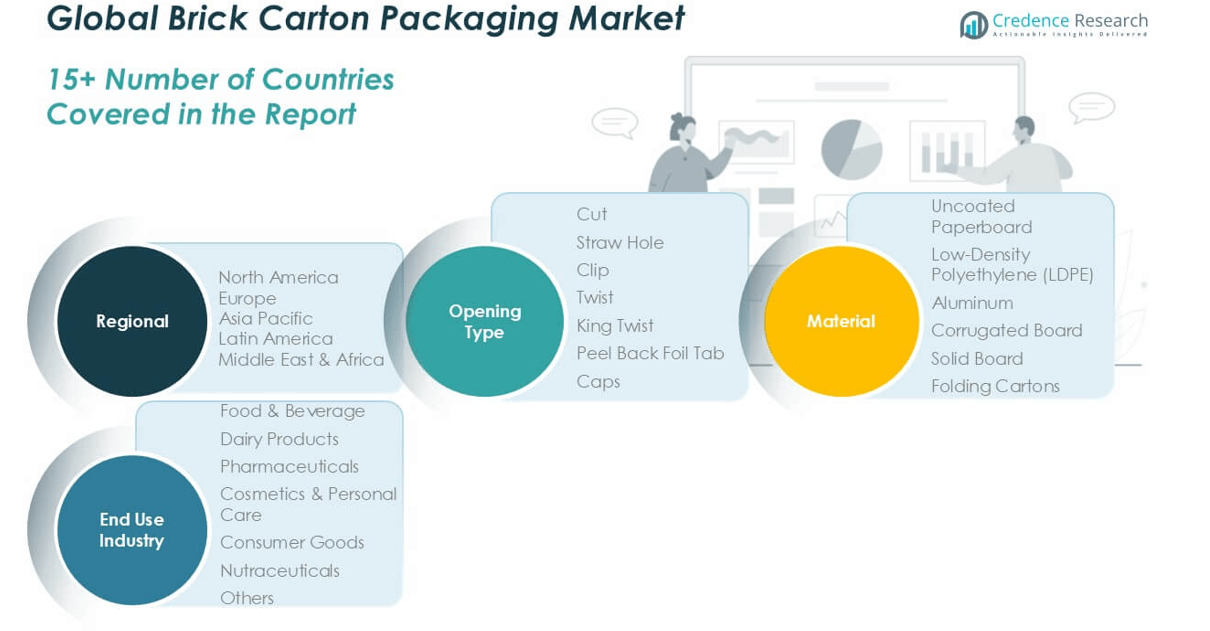
By Opening Type:
- Cut
- Straw Hole
- Clip
- Twist
- King Twist
- Peel Back Foil Tab
- Caps
By Material:
- Uncoated Paperboard
- Low-Density Polyethylene (LDPE)
- Aluminum
- Corrugated Board
- Solid Board
- Folding Cartons
By End Use Industry:
- Food & Beverage
- Dairy Products
- Pharmaceuticals
- Cosmetics & Personal Care
- Consumer Goods
- Nutraceuticals
- Others
By Geography:
- North America
- U.S.
- Canada
- Mexico
- Europe
- Germany
- France
- U.K.
- Italy
- Spain
- Rest of Europe
- Asia Pacific
- China
- Japan
- India
- South Korea
- South-east Asia
- Rest of Asia Pacific
- Latin America
- Brazil
- Argentina
- Rest of Latin America
- Middle East & Africa
- GCC Countries
- South Africa
- Rest of the Middle East and Africa
Competitive Landscape
The competitive landscape of the Brick Carton Packaging market is characterized by the presence of several established players focusing on innovation, sustainability, and global expansion. Key companies such as Tetra Pak International S.A., SIG Combibloc Group Ltd., and Elopak AS dominate the market through strong brand recognition, extensive product portfolios, and advanced aseptic packaging technologies. These players are investing in bio-based materials, smart packaging solutions, and improved recyclability to align with environmental regulations and evolving consumer preferences. Companies like Greatview Aseptic Packaging, Evergreen Packaging LLC, and Nippon Paper Industries Co. Ltd. are expanding their market reach through strategic partnerships, product diversification, and regional expansions, particularly in emerging markets across Asia Pacific and Latin America. Competitive intensity is further fueled by price competitiveness and differentiation in design, functionality, and end-use customization. The market remains moderately consolidated, with continuous efforts toward enhancing operational efficiency, sustainability credentials, and customer-centric innovation shaping long-term competitive advantage.
Key Player Analysis
- Tetra Pak International S.A.
- SIG Combibloc Group Ltd.
- Elopak AS
- Greatview Aseptic Packaging Company Ltd.
- Evergreen Packaging LLC
- Refresco Group N.V.
- Nippon Paper Industries Co. Ltd.
- Nampak Limited
- Mondi Group
Recent Developments
- In March 2024, Tetra Paklaunched a fully renewable carton packaging solution, emphasizing sustainability. This innovation utilizes plant-based and Forest Stewardship Council (FSC) certified materials, aiming to reduce the environmental impact of food and beverage packaging. The packaging incorporates a paper-based barrier, increasing the paper content from an average of 70% to approximately 80% and potentially up to 90% when combined with plant-based polymers. This initiative is part of Tetra Pak's broader efforts to promote low-carbon, circular solutions and responsible sourcing.
- In February 2024, Greatview Aseptic Packaging Company Ltd. released customizable aseptic cartons, offering brands unique design and packaging flexibility while maintaining the protective and eco-friendly aspects of brick cartons. This innovation addresses the growing demand for differentiated products and more flexible packaging solutions in the market
- In October 2023, Elopak AS expanded its high-barrier recyclable carton technology, emphasizing improved recyclability and reduced plastic content. This move aligns with the increasing demand for sustainable and lightweight packaging in the beverage and dairy industries.
- In July 2023, SIG Combibloc Group Ltd. introduced smart digital packaging solutions that utilize digital printing and coding. These solutions are designed to improve traceability, consumer engagement, and supply chain transparency. The technology enables enhanced tracking of products throughout the supply chain and provides opportunities for direct consumer interaction.
Market Concentration & Characteristics
The Brick Carton Packaging Market exhibits a moderately concentrated structure, dominated by a few key players such as Tetra Pak International S.A., SIG Combibloc Group Ltd., and Elopak AS. These companies maintain competitive advantage through proprietary aseptic packaging technologies, global distribution networks, and long-term partnerships with major beverage and dairy brands. It is characterized by high entry barriers due to the capital-intensive nature of aseptic filling equipment and strict regulatory requirements related to food safety and sustainability. Product standardization and strong brand loyalty among end users further reinforce the dominance of established firms. However, regional players are expanding their footprint in cost-sensitive and emerging markets by offering localized, affordable solutions. Innovation in bio-based materials, consumer-friendly designs, and automation technologies are shaping competitive differentiation. The market also displays strong alignment with sustainability goals, pushing manufacturers to invest in recyclable and renewable material development. It remains dynamic, shaped by consumer preferences, material availability, and evolving packaging standards.
Report Coverage
The research report offers an in-depth analysis based on Opening Type, Material, End Use Industry and Geography. It details leading market players, providing an overview of their business, product offerings, investments, revenue streams, and key applications. Additionally, the report includes insights into the competitive environment, SWOT analysis, current market trends, as well as the primary drivers and constraints. Furthermore, it discusses various factors that have driven market expansion in recent years. The report also explores market dynamics, regulatory scenarios, and technological advancements that are shaping the industry. It assesses the impact of external factors and global economic changes on market growth. Lastly, it provides strategic recommendations for new entrants and established companies to navigate the complexities of the market.
Future Outlook
- The demand for brick carton packaging will continue to rise due to increasing preference for eco-friendly and recyclable packaging solutions.
- Aseptic packaging formats will gain more traction in the food and beverage industry for extending shelf life without preservatives.
- Technological advancements in materials and opening mechanisms will enhance product convenience and functionality.
- Key players will focus on expanding in emerging markets to tap into growing consumption of packaged dairy and beverages.
- Investments in bio-based and plastic-free alternatives will support sustainability-driven product development.
- Automation in filling and sealing processes will improve production efficiency and reduce operational costs.
- Regional manufacturers will increase their market share by offering cost-effective solutions tailored to local needs.
- Consumer demand for safe, tamper-evident, and easy-to-use packaging will drive design innovation.
- Regulatory pressure around packaging waste and circular economy targets will influence material selection and design.
- Partnerships between packaging providers and FMCG brands will shape product customization and market penetration strategies.

Request a Free Sample
Fill in your details and we'll send you a free sample report.
- Sample data tables & charts
- Research methodology
Need a Custom Version of This Report?
Tailor the scope, geography, or segments to your exact requirements.
- Custom geography or segment scope
- Direct access to our analyst team
Frequently Asked Questions
What is the current size of the Brick Carton Packaging Market?
What are the key segments within the Brick Carton Packaging Market?
What are some challenges faced by the Brick Carton Packaging Market?
Who are the major players in the Brick Carton Packaging Market?
Table of Content
Chapter 1. Report Introduction
- 1.1 Report Description & Purpose
- 1.1.1 Report Title & Market Definition
- 1.1.2 Unique Selling Propositions (USP) & Key Differentiators
- 1.1.3 Value Proposition for Stakeholders
- 1.2 Research Objectives
- 1.2.1 Market Sizing Objectives (Volume & Revenue) (Volume Where Applicable)
- 1.2.2 Segmentation Objectives
- 1.2.3 Competitive Intelligence Objectives
- 1.2.4 Forecast & Scenario Objectives
- 1.3 Report Scope
- 1.3.1 Brick Carton Packaging Scope – Segments & Subsegments Covered
- 1.3.2 Geographic Scope – Regions & Countries Covered
- 1.3.3 Historical Period, Base Year & Forecast Period (2024; forecast to 2032)
- 1.3.4 Inclusions & Exclusions
- 1.4 Industry Classification & Applicable Codes
- 1.5 Currency, Measurement Units & Valuation Basis
- 1.6 Target Stakeholders
- 1.7 Limitations & Assumptions
Chapter 2. Executive Summary
- 2.1 Global Brick Carton Packaging Market Snapshot
- 2.1.1 Market Size – Historical (2024) & Forecast (2024-2032) (2024: USD 10,951.43 million → 2032: USD 16,484.74 million)
- 2.1.2 Volume & Revenue – Global Totals (Volume Where Applicable)
- 2.1.3 Key Market Highlights – Top Five Facts
- 2.2 Brick Carton Packaging Market Segmentation Snapshot
- 2.2.1 Market Split by Region – 2024 vs. 2032
- 2.3 Competitive Snapshot
- 2.3.1 Top 10 Players by Revenue Share – 2024
- 2.3.2 Top 10 Players by Volume Share – 2024 (Volume Where Applicable)
- 2.3.3 Recent Strategic Developments (18-Month Summary)
- 2.4 Key Investment Highlights & Strategic Conclusions
Chapter 3. Brick Carton Packaging Market Dynamics & Industry Analysis
- 3.1 Market Overview & Context
- 3.1.1 Brick Carton Packaging Market Position in the Broader Industry Value Chain
- 3.1.2 Demand Structure & Purchasing Dynamics
- 3.1.3 Market Maturity & Development Stage by Region
- 3.2 Brick Carton Packaging Market Drivers
- 3.3 Brick Carton Packaging Market Restraints & Challenges
- 3.4 Brick Carton Packaging Market Opportunities
- 3.5 Porter's Five Forces Analysis
- 3.5.1 Threat of New Entrants
- 3.5.2 Bargaining Power of Suppliers
- 3.5.3 Bargaining Power of Buyers
- 3.5.4 Threat of Substitutes
- 3.5.5 Competitive Rivalry – Intensity Assessment
- 3.6 Brick Carton Packaging Value Chain Analysis
- 3.6.1 Upstream – Key Inputs, Resources & Suppliers
- 3.6.1.1 Key Input/Resource 1
- 3.6.1.2 Key Input/Resource 2
- 3.6.1.3 Key Input/Resource 3
- 3.6.2 Midstream – Core Operations & Value Creation
- 3.6.2.1 Operating Model & Process Overview
- 3.6.2.2 Key Operating Locations & Capabilities by Company
- 3.6.3 Downstream – Market Channels & End Users
- 3.6.3.1 Direct Sales & Customer Engagement Channels
- 3.6.3.2 Indirect Sales, Intermediaries & Partner Channels
- 3.6.4 Value Chain Profitability Analysis
- 3.6.1 Upstream – Key Inputs, Resources & Suppliers
- 3.7 PESTEL Analysis
- 3.7.1 Political Factors
- 3.7.2 Economic Factors
- 3.7.3 Social Factors
- 3.7.4 Technological Factors
- 3.7.5 Environmental Factors
- 3.7.6 Legal Factors
- 3.8 Brick Carton Packaging Supply Chain Analysis
- 3.8.1 Critical Input & Resource Availability Risk Assessment
- 3.8.2 Supplier & Operational Concentration Risk (Geographic Exposure)
- 3.8.3 Supply & Service Disruption Impact Analysis
- 3.9 Regulatory & Policy Landscape
Note: The regulatory and policy landscape section covers regulations based on their applicability to the market, Brick Carton Packaging category, geography, and scope of the study. Only regulatory frameworks with a material impact on operations, compliance, trade, sustainability, or market access are analyzed in detail.
Chapter 4. Key Investment Pockets & Opportunity Analysis
- 4.1 Brick Carton Packaging Market Attractiveness Analysis
- 4.1.1 By Region – Investment Attractiveness Matrix (Market Size × CAGR)
- 4.2 Absolute Revenue Growth Opportunity
- 4.2.1 By Region – Absolute Revenue Growth Through 2032
- 4.3 Incremental Demand Opportunity
- 4.3.1 By Region – Incremental Demand Through 2032
- 4.3.2 Segment – Incremental Demand
- 4.4 Emerging Submarket Opportunity Deep Dive (Subject to Applicability)
- 4.5 Priority Market Opportunity Scorecards
- 4.5.1 United States
- 4.5.2 Europe
- 4.5.3 Asia
- 4.5.4 Middle East & Africa
Note: Priority market opportunity scorecards reflect the geographic scope and strategic relevance of the study. Listed markets are indicative and may be adapted to the industry.
Chapter 5. Brick Carton Packaging Cross-Border Trade & Market Access Analysis
- 5.1 International Trade & Cross-Border Activity Overview
- 5.1.1 Global Export Value by Country (2024)
- 5.1.2 Global Export Volume by Country (2024) (Volume Where Applicable)
- 5.1.3 Global Import Value by Country (2024)
- 5.1.4 Global Import Volume by Country (2024) (Volume Where Applicable)
- 5.1.5 Net Trade Balance by Country (2024)
- 5.2 Export Analysis – Segment
- 5.2.1 Category 1 (Applicable Classification Code)
- 5.2.2 Category 2 (Applicable Classification Code)
- 5.2.3 Category 3 (Applicable Classification Code)
- 5.2.4 Category 4 (Applicable Classification Code)
- 5.2.5 Category 5 (Applicable Classification Code)
- 5.3 Import Analysis – Segment
- 5.3.1 Category 1 (Applicable Classification Code)
- 5.3.2 Category 2 (Applicable Classification Code)
- 5.3.3 Category 3 (Applicable Classification Code)
- 5.3.4 Category 4 (Applicable Classification Code)
- 5.3.5 Category 5 (Applicable Classification Code)
- 5.4 Cross-Border Pricing & Transaction Benchmarks
- 5.4.1 Export Pricing – Segment & Country
- 5.4.2 Import Pricing – Segment & Source Country
- 5.4.3 Price Trends (2024)
- 5.5 Key Cross-Border Trade & Delivery Routes
- 5.5.1 Cross-Border Trade/Delivery Route 1
- 5.5.2 Cross-Border Trade/Delivery Route 2
- 5.5.3 Cross-Border Trade/Delivery Route 3
- 5.5.4 Cross-Border Trade/Delivery Route 4
- 5.5.5 Cross-Border Trade/Delivery Route 5
- 5.6 Trade Policy & Market Access Impact Assessment
- 5.6.1 Tariff & Non-Tariff Barriers
- 5.6.2 Regional Trade & Economic Integration Frameworks
- 5.6.3 Bilateral & Multilateral Trade Agreements
- 5.6.4 Cross-Border Operating, Licensing & Localization Requirements
Note: This chapter applies where cross-border trade or delivery is relevant to Brick Carton Packaging. Goods, services, and digital offerings are assessed using applicable classifications and transaction measures. Import-export volumes, trade balances, and route analyses are included only where meaningful to the market.
Chapter 6. Competitive Landscape & Company Benchmarking
- 6.1 Brick Carton Packaging Market Concentration & Structure
- 6.1.1 Herfindahl-Hirschman Index (HHI) – vs. 2024
- 6.1.2 Leading, Mid-Sized & Emerging Player Structure
- 6.1.3 Global, Regional & Local Player Dynamics
- 6.2 Brick Carton Packaging Market Share Analysis – 2024
- 6.2.1 Global Revenue Share by Company
- 6.2.2 Global Volume Share by Company (Volume Where Applicable)
- 6.2.3 Regional Revenue Share
- 6.2.4 Market Share Evolution ( vs. 2024)
- 6.2.5 Company Market Share by Key Segment
- 6.2.6 Company Market Share by Customer Group
- 6.3 Operating Scale, Capacity & Infrastructure Analysis
- 6.3.1 Global Operating Scale & Supply Capacity
- 6.3.2 Resource Utilization & Operating Efficiency
- 6.3.3 Output, Service Delivery & Activity Metrics
- 6.3.4 Operating Footprint & Infrastructure Map
- 6.3.5 Planned Operational & Capacity Expansion
- 6.4 Brick Carton Packaging Competitive Benchmarking Matrix
- 6.4.1 Revenue, Growth, Profitability & Operating Metric Comparison
- 6.4.2 Channel Revenue Mix
- 6.4.3 Geographic Revenue Exposure
- 6.4.4 R&D Intensity
- 6.4.5 Sustainability Maturity
- 6.5 Strategic Developments in Brick Carton Packaging (Last 24 Months)
- 6.5.1 Mergers, Acquisitions & Divestments
- 6.5.2 New Products, Services & Solutions in Brick Carton Packaging
- 6.5.3 Operational & Infrastructure Expansions
- 6.5.4 Strategic Alliances, Joint Ventures & Partnerships
- 6.5.5 Distribution Expansion & Market Entry
- 6.5.6 Sustainability & ESG Initiatives
- 6.6 Competitive Strategy Mapping
- 6.6.1 Leader, Challenger, Follower & Niche Classification
- 6.6.2 Pricing Strategy Comparison
- 6.6.3 Channel Strategy Matrix
Note: Strategic developments are included based on their materiality and the availability of reliable information.
Chapter 7. Global Brick Carton Packaging Market – By Sales & Delivery Channel
- 7.1 Segment Overview
- 7.1.1 Volume & Revenue Split by Channel (2024 & 2032) (Volume Where Applicable)
- 7.1.2 Channel Mix Evolution (2024-2032)
Chapter 8. Regional Market Analysis – Global Overview
- 8.1 Global Regional Overview
- 8.1.1 Regional Volume Share (Volume Where Applicable)
- 8.1.2 Regional Revenue Share
- 8.1.3 Regional Volume by Region (Volume Where Applicable)
- 8.1.4 Regional Revenue by Region
- 8.1.5 Regional Forecast Through 2032
- 8.2 Cross-Regional Segment Analysis
- 8.2.1 By Sales & Delivery Channel
- 8.2.2 By Competitive Positioning & Price Tier
Chapter 9. North America Brick Carton Packaging Market
- 9.1 United States
- 9.2 Canada
- 9.3 Mexico
Chapter 10. Europe Brick Carton Packaging Market
- 10.1 Germany
- 10.2 France
- 10.3 Italy
- 10.4 United Kingdom
- 10.5 Spain
- 10.6 Poland
- 10.7 Russia
- 10.8 Netherlands
- 10.9 Belgium
- 10.10 Sweden
- 10.11 Denmark
- 10.12 Norway
- 10.13 Rest of Europe
Chapter 11. Asia Pacific Brick Carton Packaging Market
- 11.1 China
- 11.2 India
- 11.3 Japan
- 11.4 South Korea
- 11.5 Thailand
- 11.6 Indonesia
- 11.7 Vietnam
- 11.8 Malaysia
- 11.9 Australia
- 11.10 Rest of Asia Pacific
Chapter 12. Latin America Brick Carton Packaging Market
- 12.1 Brazil
- 12.2 Argentina
- 12.3 Colombia
- 12.4 Chile
- 12.5 Rest of Latin America
Chapter 13. Middle East Brick Carton Packaging Market
- 13.1 Saudi Arabia
- 13.2 United Arab Emirates
- 13.3 Turkey
- 13.4 Israel
- 13.5 Iran
- 13.6 Rest of the Middle East
Chapter 14. Africa Brick Carton Packaging Market
- 14.1 South Africa
- 14.2 Egypt
- 14.3 Nigeria
- 14.4 Morocco
- 14.5 Rest of Africa
Chapter 15. Brick Carton Packaging Company Profiles
- 15.1 [Company 01]
- 15.1.1 Company Overview
- 15.1.2 Key Management Personnel
- 15.1.3 Products & Services Portfolio
- 15.1.4 Financial Performance
- 15.1.5 Key Market Focus & Geographic Presence
- 15.1.6 Recent Developments & Strategic Initiatives
Note: The company profile list is preliminary and may change based on research findings, market developments, data availability, and client requirements.
Chapter 16. Appendices
- Appendix A – List of Abbreviations & Acronyms
- Appendix B – Industry Classification Code Reference – Full Series
- Appendix C – Supply, Output & Operating Capacity Data Tables
- Appendix D – End-Use & Demand Base Tables
- Appendix E – Demand, Adoption & Usage Assumptions
- Appendix F – Pricing & Revenue Metric Reference Tables
- Appendix G – Company Operations & Infrastructure Database
- Appendix H – Cross-Border Trade & Activity Data Tables (Where Applicable)
- Appendix I – Regulatory Summary Tables
- Appendix J – Primary Research Participant List (Anonymized)
- Appendix K – Primary Research Questionnaire Framework
- Appendix L – Data Sources & Bibliography
- Appendix M – Market Size Divergence & Source Comparison
Chapter 17. Research Methodology
- 17.1 Research Framework & Philosophy
- 17.2 Secondary Research – Sources, Hierarchy & Data Extraction
- 17.3 Data Modeling – Bottom-Up & Top-Down Market Sizing
- 17.4 Primary Research – Stakeholder Framework, LOI & Sample Sizes
- 17.5 Forecast Methodology – Regression, Scenario & Sensitivity Analysis
- 17.6 Quality Control – Four-Layer Validation Framework
- 17.7 Limitations & Standard Assumptions
- 17.8 Disclaimer
