Micro Perforated Films Market Overview:
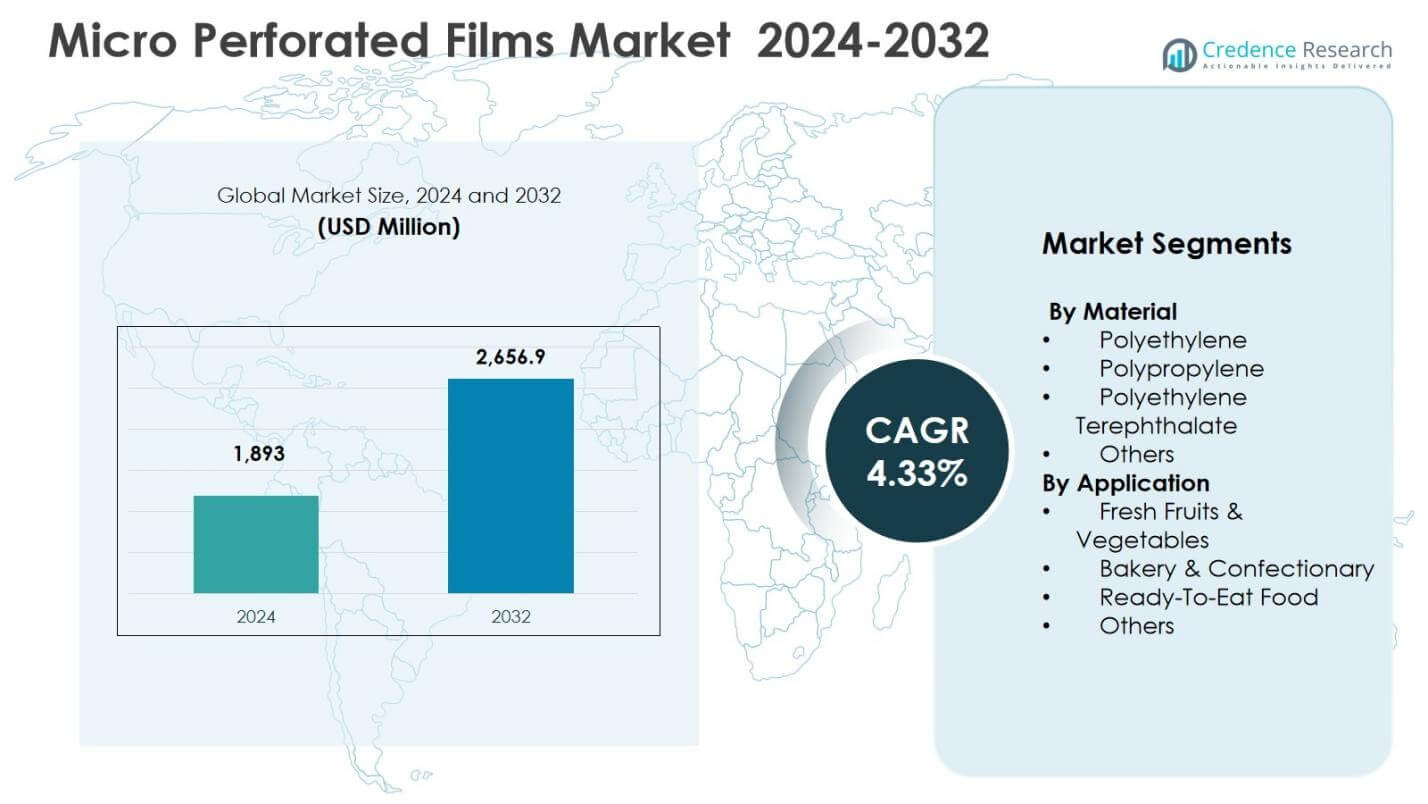
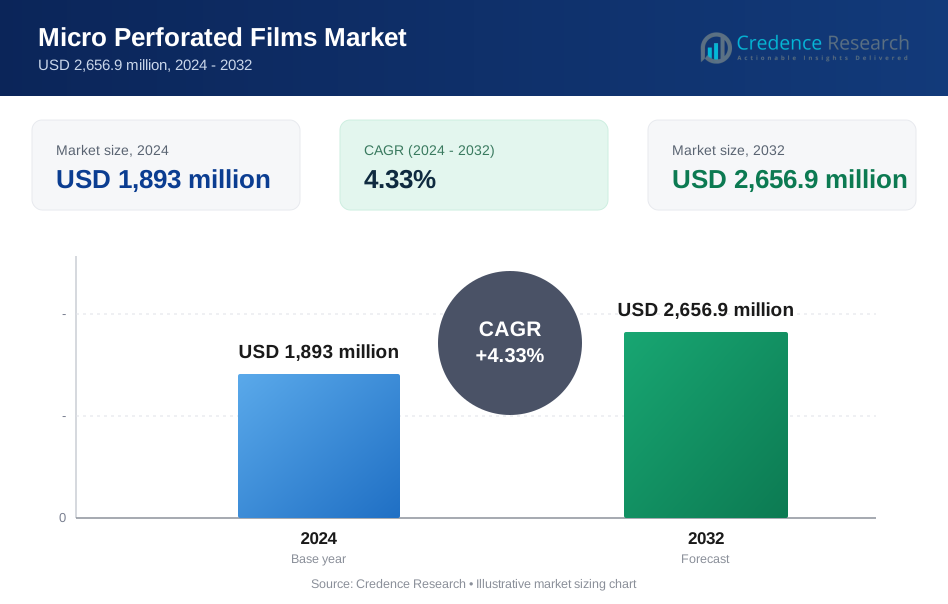
Micro Perforated Films Market size was valued at USD 1,893 million in 2024 and is anticipated to reach USD 2,656.9 million by 2032, registering a CAGR of 4.33% during the forecast period.
| REPORT ATTRIBUTE | DETAILS |
|---|---|
| Historical Period | 2020-2023 |
| Base Year | 2024 |
| Forecast Period | 2025-2032 |
| Micro Perforated Films Market Size 2024 | USD 1,893 million |
| Micro Perforated Films Market, CAGR | 4.33% |
| Micro Perforated Films Market Size 2032 | USD 2,656.9 million |
Micro Perforated Films Market Insights
- Market growth is driven by increasing demand for fresh produce and bakery packaging, with Fresh Fruits & Vegetables holding a 52.4% segment share in 2024, supported by shelf-life extension and food waste reduction requirements.
- Market trends highlight rising use of modified atmosphere packaging and sustainable films, while Polyethylene dominated the material segment with a 46.8% share in 2024 due to flexibility, cost efficiency, and moisture control properties.
- Market structure shows presence of major players focusing on advanced perforation technologies, lightweight materials, and recyclable film solutions to strengthen supply to food processors and retailers.
- Regionally, Asia Pacific led with a 34.2% share in 2024, followed by North America at 28.6% and Europe at 24.9%, driven by packaged food consumption, cold-chain expansion, and organized retail growth.
Micro Perforated Films Market Segmentation Analysis:
By Material:
The Micro Perforated Films Market by material is led by Polyethylene, which accounted for 46.8% market share in 2024, driven by its excellent flexibility, cost efficiency, moisture control properties, and widespread acceptance in food packaging applications. Polyethylene-based micro perforated films support controlled gas exchange, extending shelf life of fresh produce and bakery items while maintaining product freshness. Polypropylene follows due to higher stiffness and clarity, while polyethylene terephthalate gains traction in premium packaging. Strong demand from high-volume food processors and growing adoption in modified atmosphere packaging systems continue to reinforce polyethylene’s dominance.
- For instance, Amcor’s P-Plus polyethylene-based films use laser micro-perforation starting at 55 microns for tailored oxygen transmission rates in fresh fruits and vegetables. These films extend retail shelf life and freshness through precise gas permeability control.
By Application:
By application, Fresh Fruits & Vegetables emerged as the dominant sub-segment, holding 52.4% market share in 2024, supported by rising demand for extended shelf life, freshness retention, and reduced food waste. Micro perforated films enable optimal respiration rates for fruits and vegetables, making them essential for fresh produce packaging. Growth in organized retail, cold-chain expansion, and increasing exports of fresh produce further accelerate adoption. Bakery & confectionary and ready-to-eat food segments also contribute steadily, supported by convenience food consumption and hygiene-focused packaging trends.
- For instance, PerfoTec's laser micro-perforated bags extended spinach shelf life from 7 to 21 days by regulating air exchange and reducing condensation.
Key Growth Drivers
Rising Demand for Fresh and Extended-Shelf-Life Packaging
The Micro Perforated Films Market is strongly driven by the increasing need for packaging solutions that maintain freshness and extend shelf life of perishable food products. Micro perforated films allow controlled oxygen and moisture exchange, helping preserve the natural respiration of fresh fruits, vegetables, and bakery products. Growth in organized retail, supermarket chains, and cold-chain logistics has increased demand for packaging that reduces spoilage during transportation and storage. Food manufacturers are increasingly focused on minimizing food waste while meeting strict food safety and quality standards. As consumer preference shifts toward fresh and minimally processed foods, adoption of micro perforated films continues to expand across global food supply chains.
- For instance, Church Brothers Farms uses PerfoTec’s Fast Respiration Meter and micro perforation system to adjust packaging for fresh-cut vegetables and salads, improving organoleptic quality and postharvest life amid seasonal variations
Expansion of Ready-to-Eat and Convenience Food Consumption
Rapid growth in ready-to-eat and convenience food consumption remains a major driver for the Micro Perforated Films Market. Urbanization, changing lifestyles, and higher disposable incomes have significantly increased demand for packaged bakery items, snacks, and prepared meals. Micro perforated films help regulate internal moisture and gas levels, preserving texture, aroma, and taste throughout shelf life. Food processors rely on these films to maintain consistent product quality across extended distribution networks. Growth of food delivery platforms, quick-service restaurants, and packaged food brands further supports demand, positioning micro perforated films as a critical packaging component for modern convenience food markets.
- For instance, Tesco uses micro-perforated films for pre-packed bakery products like bread and pastries. These films prevent sogginess by controlling humidity, maintaining freshness and texture during retail display and transport.
Advancements in Perforation and Packaging Technologies
Technological advancements in perforation and packaging processes play a vital role in driving the Micro Perforated Films Market. Innovations in laser and mechanical perforation enable precise control over hole size, spacing, and density, allowing customized solutions for different food products. These improvements enhance compatibility with modified atmosphere packaging systems and improve shelf-life performance. Automation in film manufacturing improves production efficiency, consistency, and scalability. Additionally, advancements in polymer engineering improve film strength and clarity. Continuous investment in high-performance packaging technologies supports broader adoption across fresh produce, bakery, and ready-to-eat food applications.
Key Trends & Opportunities
Shift Toward Sustainable and Lightweight Packaging Solutions
The shift toward sustainable and lightweight packaging represents a significant trend and opportunity in the Micro Perforated Films Market. Packaging manufacturers are increasingly focusing on reducing material usage while maintaining functional performance. Micro perforated films support down gauging strategies by delivering effective gas control with thinner film structures. Regulatory pressure on plastic waste reduction and growing consumer awareness of environmentally responsible packaging accelerate this transition. Development of recyclable and mono-material micro perforated films aligns with circular economy initiatives. Food brands seeking to improve sustainability profiles are driving demand for eco-friendly packaging alternatives, creating long-term growth opportunities for advanced micro perforated film solutions.
- For instance, Amcor launched a recyclable PE-based micro-perforated film in mid-2023 for European bakery and snack markets, supporting thinner gauges with effective breathability. This aligns with their 2025 pledge for all packaging to be recyclable or reusable.
Growing Adoption in Modified Atmosphere Packaging Applications
Rising adoption of modified atmosphere packaging creates strong opportunities for the Micro Perforated Films Market. These films play a crucial role in regulating oxygen and carbon dioxide levels inside packages, ensuring optimal storage conditions for perishable foods. Demand is increasing across fresh fruits, vegetables, bakery products, and ready-to-eat foods as manufacturers aim to extend shelf life without chemical preservatives. Expansion of cold-chain infrastructure and cross-border food trade further supports adoption. Custom-engineered perforation patterns tailored to specific products enhance functionality, positioning micro perforated films as essential components in advanced food packaging systems.
- For instance, Apio Inc. employs its BreatheWay membrane technology, a microperforated packaging solution, for fresh produce like apples. This maintains 2% oxygen and 9% carbon dioxide levels, achieving a consistent 17-day shelf life while reducing dehydration.
Key Challenges
Raw Material Price Volatility
Volatility in prices of polymer raw materials presents a significant challenge for the Micro Perforated Films Market. Key materials such as polyethylene, polypropylene, and polyethylene terephthalate are derived from petrochemical feedstocks, making prices sensitive to fluctuations in crude oil markets. Rising raw material costs directly impact manufacturing expenses, profit margins, and pricing strategies. Manufacturers often face difficulty in passing cost increases to end users in price-sensitive food packaging markets. Smaller players are particularly affected by unstable input costs. Managing procurement efficiency and maintaining cost competitiveness while ensuring consistent product quality remains a critical challenge.
Recycling and Waste Management Limitations
Recycling and waste management limitations continue to hinder growth in the Micro Perforated Films Market. Thin, perforated plastic films are difficult to collect, sort, and recycle using existing infrastructure, particularly when contaminated with food residues. Many regions lack efficient recycling systems for flexible packaging, increasing regulatory and environmental pressures on manufacturers. Compliance with evolving plastic waste regulations requires ongoing material innovation and investment. Balancing recyclability with performance, cost efficiency, and shelf-life requirements remains complex. Addressing end-of-life challenges is essential for improving long-term sustainability and market acceptance.
Regional Analysis
North America
North America held a 28.6% market share in 2024 in the Micro Perforated Films Market, supported by strong demand from fresh produce, bakery, and ready-to-eat food packaging sectors. The region benefits from advanced food processing industries, well-established cold-chain infrastructure, and high penetration of organized retail. Stringent food safety regulations encourage adoption of packaging solutions that extend shelf life and reduce food waste. The presence of major packaging manufacturers and continuous innovation in modified atmosphere packaging further strengthen market growth. Rising consumer preference for fresh and minimally processed food continues to support sustained demand across the region.
Europe
Europe accounted for a 24.9% market share in 2024, driven by strong focus on food quality preservation, sustainability, and regulatory compliance. High consumption of packaged fresh fruits, vegetables, and bakery products supports adoption of micro perforated films. The region’s emphasis on reducing food waste and extending shelf life aligns well with controlled-atmosphere packaging solutions. Advanced recycling initiatives and demand for lightweight packaging also encourage innovation in film design. Countries with strong food exports and developed retail networks continue to drive steady growth across Western and Central Europe.
Asia Pacific
Asia Pacific dominated the Micro Perforated Films Market with a 34.2% market share in 2024, supported by rapid urbanization, population growth, and rising packaged food consumption. Expansion of modern retail, food delivery platforms, and cold-chain logistics significantly boosts demand. Increasing exports of fresh fruits and vegetables further accelerate adoption of shelf-life-enhancing packaging. Countries with strong manufacturing bases benefit from cost-effective production and rising domestic demand. Growing awareness of food safety and quality standards among consumers continues to position Asia Pacific as the fastest-growing regional market.
Latin America
Latin America captured a 7.1% market share in 2024, driven by increasing adoption of packaged fresh produce and bakery products. Growth in organized retail and improving cold-chain infrastructure support demand for micro perforated films. The region’s strong agricultural output, particularly fruits and vegetables, increases the need for packaging solutions that maintain freshness during transportation. Food processors increasingly adopt advanced packaging to reduce spoilage and meet export quality standards. Gradual modernization of food supply chains continues to support steady market expansion across key countries.
Middle East & Africa
The Middle East & Africa region accounted for a 5.2% market share in 2024, supported by growing food imports and expanding retail infrastructure. Harsh climatic conditions increase reliance on packaging solutions that extend shelf life and preserve food quality. Rising urban populations and demand for packaged fresh produce and bakery items drive adoption. Investment in cold storage facilities and food logistics improves market accessibility. Although adoption remains moderate, increasing focus on food security and waste reduction continues to create growth opportunities across the region.
Micro Perforated Films Market Segmentations:
By Material
- Polyethylene
- Polypropylene
- Polyethylene Terephthalate
- Others
By Application
- Fresh Fruits & Vegetables
- Bakery & Confectionary
- Ready-To-Eat Food
- Others
By Geography
- North America
- U.S.
- Canada
- Mexico
- Europe
- Germany
- France
- U.K.
- Italy
- Spain
- Rest of Europe
- Asia Pacific
- China
- Japan
- India
- South Korea
- South-east Asia
- Rest of Asia Pacific
- Latin America
- Brazil
- Argentina
- Rest of Latin America
- Middle East & Africa
- GCC Countries
- South Africa
- Rest of the Middle East and Africa
Competitive Landscape
Competitive landscape analysis of the Micro Perforated Films Market includes key players such as Amcor plc, Bemis Company, Inc., Mondi plc, Constantia Flexibles Group GmbH, Innovia Films, DuPont de Nemours, Inc., Exxon Mobil Corporation, Futamura Chemical Co., Ltd., Polyplex Corporation Limited, and Coveris Holdings S.A. The market is moderately consolidated, with leading companies focusing on product innovation, material optimization, and advanced perforation technologies to strengthen their market positions. Major players invest in laser perforation capabilities and customized film solutions to address diverse food packaging requirements, particularly for fresh produce and bakery applications. Strategic initiatives such as capacity expansion, sustainable packaging development, and collaborations with food processors support competitive differentiation. Companies also emphasize recyclable and lightweight film structures to align with evolving environmental regulations. Strong global distribution networks and long-term supply agreements with food manufacturers enable leading players to maintain stable demand and reinforce their presence across developed and emerging markets.
Key Player Analysis
- Innovia Films
- Polyplex Corporation Limited
- DuPont de Nemours, Inc.
- Coveris Holdings S.A.
- Futamura Chemical Co., Ltd.
- Amcor plc
- Mondi plc
- Exxon Mobil Corporation
- Constantia Flexibles Group GmbH
- Bemis Company, Inc.
Recent Developments
- In March 2025, Associated Lidding Film Technologies introduced micro-perforated lidding film solutions tailored for breathable, fresh-produce packaging applications, enhancing produce shelf-life through regulated gas exchange.
- In April 2025, Amcor completed its all-stock combination with Berry Global, forming a major packaging entity focused on micro-perforated innovations.
Report Coverage
The research report offers an in-depth analysis based on Material, Application and Geography. It details leading market players, providing an overview of their business, product offerings, investments, revenue streams, and key applications. Additionally, the report includes insights into the competitive environment, SWOT analysis, current market trends, as well as the primary drivers and constraints. Furthermore, it discusses various factors that have driven market expansion in recent years. The report also explores market dynamics, regulatory scenarios, and technological advancements that are shaping the industry. It assesses the impact of external factors and global economic changes on market growth. Lastly, it provides strategic recommendations for new entrants and established companies to navigate the complexities of the market.
Future Outlook
- Demand for micro perforated films will increase steadily with rising consumption of fresh and minimally processed food products.
- Expansion of organized retail and cold-chain infrastructure will support wider adoption across food packaging applications.
- Technological advancements in laser and mechanical perforation will enable more precise and customized film solutions.
- Growth of ready-to-eat and convenience foods will continue to drive consistent packaging demand.
- Sustainable and lightweight packaging development will gain stronger focus across manufacturers.
- Adoption of recyclable and mono-material film structures will accelerate due to regulatory pressure.
- Increased use of modified atmosphere packaging will strengthen functional demand for micro perforated films.
- Emerging markets will witness higher adoption due to urbanization and improving food supply chains.
- Strategic collaborations between packaging producers and food processors will enhance product innovation.
- Continuous improvement in film performance and shelf-life efficiency will support long-term market expansion.
Request a Free Sample
Fill in your details and we'll send you a free sample report.
- Sample data tables & charts
- Research methodology
Need a Custom Version of This Report?
Tailor the scope, geography, or segments to your exact requirements.
- Custom geography or segment scope
- Direct access to our analyst team
Frequently Asked Questions
What is the current market size for the Micro Perforated Films Market, and what is its projected size in 2032?
At what Compound Annual Growth Rate is the Micro Perforated Films Market projected to grow between 2024 and 2032?
Which Micro Perforated Films Market segment held the largest share in 2024?
What are the primary factors fueling the growth of the Micro Perforated Films Market?
Who are the leading companies in the Micro Perforated Films Market?
Which region commanded the largest share of the Micro Perforated Films Market in 2024?
Table of Content
Chapter 1 Market Segmentation
- 1.1 Segmentation Framework
- 1.1.1 Product and Service Classification
- 1.1.2 Application and End-Use Classification
- 1.1.3 Technology and Solution Classification
- 1.1.4 Customer and Distribution Channel Classification
- 1.1.5 Geographic Segmentation
- 1.1.6 Market Segment Definitions and Boundaries
Chapter 2 Introduction
- 2.1 Report Objectives and Scope
- 2.2 Product Definition and Industry Terminology
- 2.3 Market Inclusions and Exclusions
- 2.4 Research Process
- 2.4.1 Primary Research and Expert Interviews
- 2.4.2 Secondary Research and Source Review
- 2.4.3 Top-Down and Bottom-Up Estimation
- 2.4.4 Data Triangulation and Verification
- 2.5 Market Size Measurement Basis
- 2.5.1 2024: USD 1,893 million → 2032: USD 2,656.9 million
- 2.6 Historical and Forecast Reference Periods
- 2.6.1 Base Year: 2024
- 2.6.2 Forecast Period: 2024-2032
- 2.7 Research Assumptions and Limitations
Chapter 3 Executive Summary
- 3.1 Market Snapshot and Key Findings
- 3.2 Base-Year Market Size, 2024
- 3.3 Forecast Market Size, 2032
- 3.4 Revenue and Volume Growth Outlook
- 3.5 Key Demand and Supply Indicators
- 3.6 Leading Market Segments
- 3.7 Fastest-Growing Market Opportunities
- 3.8 Regional Performance Highlights
- 3.9 Technology and Industry Transformation
- 3.10 Competitive Landscape Summary
- 3.11 Analyst View and Strategic Implications
Chapter 4 Global Micro Perforated Films Market Trends and Developments
- 4.1 Historical Industry Development
- 4.2 Recent Market Trends and Developments
- 4.3 Demand and Customer Behavior Trends
- 4.4 Technology and Product Innovation
- 4.5 Artificial Intelligence, Automation and Digitalization
- 4.6 Local Manufacturing and Supply Chain Realignment
- 4.7 Industry Partnerships, Mergers and Acquisitions
- 4.8 Sustainability and Circular Economy Developments
- 4.9 Government and Private Sector Investment Trends
- 4.10 Emerging Business Models and Commercialization
- 4.11 Industry Developments and Announcements
Chapter 5 Global Micro Perforated Films Market Production, Supply and Demand Analysis
- 5.1 Demand Trend and Consumption Analysis
- 5.2 Demand Forecast, 2024-2032
- 5.3 Production and Output Trend
- 5.4 Production and Output Forecast, 2024-2032
- 5.5 Installed Capacity and Capacity Utilization
- 5.6 Company-Wise Production Plants and Statistics
- 5.6.1 Installed Production Capacity
- 5.6.2 Actual Production
- 5.6.3 Planned Capacity and Expansion Targets
- 5.7 Supply Chain Structure and Procurement Trends
- 5.8 Supply-Demand Gap and Bottlenecks
- 5.9 Import Dependence and Sourcing Structure
- 5.10 Contract Manufacturing and Outsourcing
- 5.11 Regional Supply and Demand Concentration
Chapter 6 Global Micro Perforated Films Market Pricing Analysis
- 6.1 Pricing Structure and Measurement
- 6.2 Historical Pricing Trends
- 6.3 Pricing Outlook, 2024-2032
- 6.4 Average Selling Price and Unit Economics
- 6.5 Pricing by Product and Market Segment
- 6.6 Geographic Pricing Differences
- 6.7 Key Input, Energy, Labor and Logistics Costs
- 6.8 Contract Pricing and Purchasing Models
- 6.9 Pricing Sensitivity and Competitive Positioning
- 6.10 Price, Margin and Profitability Implications
Chapter 7 Global Micro Perforated Films Market Dynamics
- 7.1 Market Growth Drivers
- 7.1.1 Demand-Side Drivers
- 7.1.2 Technology and Innovation Drivers
- 7.1.3 Infrastructure and Investment Drivers
- 7.1.4 Regulatory and Policy Drivers
- 7.2 Market Restraints
- 7.2.1 Cost and Affordability Constraints
- 7.2.2 Technology and Adoption Barriers
- 7.2.3 Supply Chain and Operational Constraints
- 7.3 Market Challenges
- 7.3.1 Competitive Pressure and Margin Erosion
- 7.3.2 Skills, Infrastructure and Implementation Gaps
- 7.4 Emerging Market Opportunities
- 7.5 Market Dynamics Impact and Time-Horizon Assessment
Chapter 8 Global Micro Perforated Films Value Chain Analysis
- 8.1 Industry Value Chain Overview
- 8.2 Upstream Suppliers and Critical Inputs
- 8.3 Technology and Component Providers
- 8.4 Manufacturing or Service Delivery
- 8.5 Distribution, Channel Partners and Integrators
- 8.6 Downstream Applications and End Users
- 8.7 Value Addition and Profit Pools
- 8.8 Vertical Integration and Outsourcing
- 8.9 Supplier Concentration and Risk
- 8.10 Supply Chain Localization and Resilience
Chapter 9 Global Micro Perforated Films Market Regulations and Policies
- 9.1 Relevant Laws, Standards and Compliance Frameworks
- 9.2 Product, Service, Safety and Quality Requirements
- 9.3 Government Policies, Incentives and Subsidies
- 9.4 Imports, Exports and Trade Barriers
- 9.5 Public Procurement and Local Content Requirements
- 9.6 Environmental and Sustainability Compliance
- 9.7 Upcoming Policy Changes and Market Implications
Chapter 10 Global Micro Perforated Films Market Hotspots and Opportunities
- 10.1 Market Opportunity Mapping and Growth Hotspots
- 10.2 High-Growth Applications and Customer Groups
- 10.3 Underserved Markets and White-Space Opportunities
- 10.4 Emerging Technology and Product Opportunities
- 10.5 New Capacity and Investment Hotspots
- 10.6 Market Entry and Expansion Opportunities
- 10.7 Distribution and Partnership Opportunities
- 10.8 Near-Term and Long-Term Commercial Potential
- 10.9 Opportunity Attractiveness and Execution Risks
Chapter 11 Global Micro Perforated Films Market Outlook, 2024-2032
- 11.1 Market Size and Analysis
- 11.1.1 Revenue (Market Measurement: 2024: USD 1,893 million → 2032: USD 2,656.9 million)
- 11.1.2 Market Volume and Quantity Sold
- 11.1.3 Historical Market Size
- 11.1.4 Base-Year Market Size, 2024
- 11.2 Market Forecast, 2024-2032
- 11.2.1 Revenue Forecast to 2032
- 11.2.2 Volume Forecast to 2032
- 11.2.3 CAGR and Year-on-Year Growth
- 11.2.4 Incremental Revenue Opportunity
- 11.3 Forecast Assumptions and Scenario Analysis
- 11.3.1 Base-Case Forecast
- 11.3.2 Optimistic and Conservative Scenarios
- 11.3.3 Technology, Pricing and Policy Sensitivities
- 11.4 Market Attractiveness and Growth Outlook
Chapter 12 Global Micro Perforated Films Market Segmentation and Outlook
- 12.1 Segmentation Summary and Market Shares, 2024
- 12.2 Largest and Fastest-Growing Segments
- 12.3 Segment Growth Comparison
- 12.4 Segment Attractiveness and Priority Matrix
Chapter 13 Global Micro Perforated Films Geographic Market Outlook, 2024-2032
- 13.1 Regional Market Size and Share, 2024
- 13.2 Regional Market Forecast, 2024-2032
- 13.3 Regional Pricing, Production and Demand Differences
- 13.4 North America
- 13.4.1 United States
- 13.4.2 Canada
- 13.4.3 Mexico
- 13.5 Europe
- 13.5.1 Germany
- 13.5.2 France
- 13.5.3 Italy
- 13.5.4 United Kingdom
- 13.5.5 Spain
- 13.5.6 Poland
- 13.5.7 Russia
- 13.5.8 Netherlands
- 13.5.9 Belgium
- 13.5.10 Sweden
- 13.5.11 Denmark
- 13.5.12 Norway
- 13.5.13 Rest of Europe
- 13.6 Asia Pacific
- 13.6.1 China
- 13.6.2 India
- 13.6.3 Japan
- 13.6.4 South Korea
- 13.6.5 Thailand
- 13.6.6 Indonesia
- 13.6.7 Vietnam
- 13.6.8 Malaysia
- 13.6.9 Australia
- 13.6.10 Rest of Asia Pacific
- 13.7 Latin America
- 13.7.1 Brazil
- 13.7.2 Argentina
- 13.7.3 Colombia
- 13.7.4 Chile
- 13.7.5 Rest of Latin America
- 13.8 Middle East
- 13.8.1 Saudi Arabia
- 13.8.2 United Arab Emirates
- 13.8.3 Turkey
- 13.8.4 Israel
- 13.8.5 Iran
- 13.8.6 Rest of the Middle East
- 13.9 Africa
- 13.9.1 South Africa
- 13.9.2 Egypt
- 13.9.3 Nigeria
- 13.9.4 Morocco
- 13.9.5 Rest of Africa
- 13.10 Regional Investment, Policy and Supply Chain Differences
- 13.11 Regional Competitive Landscape
- 13.12 Geographic Growth Hotspots
Chapter 14 Global Micro Perforated Films Technology, Innovation and Sustainability Outlook
- 14.1 Technology Landscape and Maturity
- 14.2 Product, Process and Service Innovation
- 14.3 AI, Automation and Digital Tools in the Industry
- 14.4 Technology Adoption and Performance Benchmarking
- 14.5 Innovation Pipeline and R&D Investment
- 14.6 Patent and Intellectual Property Trends
- 14.7 Energy Efficiency and Resource Management
- 14.8 Sustainability, Recycling and Circularity
- 14.9 Technology Roadmap, 2024-2032
- 14.10 Risks of Obsolescence and Technology Substitution
Chapter 15 Global Micro Perforated Films Market Key Strategic Imperatives
- 15.1 Growth and Market Entry Priorities
- 15.2 High-Return Products and Segments
- 15.3 Pricing, Profitability and Cost Optimization
- 15.4 Technology Investment and Product Differentiation
- 15.5 Supply Chain Localization and Resilience
- 15.6 Distribution and Customer Acquisition
- 15.7 Partnership, Acquisition and Capacity Strategy
- 15.8 Regional Expansion Priorities
- 15.9 Short-, Medium- and Long-Term Actions
Chapter 16 Competition Outlook
- 16.1 Industry Competition Characteristics
- 16.2 Market Structure and Concentration
- 16.3 Market Share and Competitive Positioning, 2024
- 16.4 Company-Wise Revenue and Product Benchmarking
- 16.5 Production and Service Capacity Benchmarking
- 16.6 Technology, Pricing and Differentiation
- 16.7 Regional Footprint and Distribution Strength
- 16.8 Mergers, Acquisitions and Strategic Alliances
- 16.9 New Entrants and Competitive Threats
- 16.10 Porter's Five Forces and Industry Attractiveness
- 16.11 Competitive Outlook, 2024-2032
Chapter 17 Company Profiles
- 17.1 Company Coverage and Selection Criteria
- 17.2 Leading Market Participants – Standard Profile Structure
- 17.2.1 Business Description
- 17.2.2 Company Ownership and Geographic Presence
- 17.2.3 Product and Service Portfolio
- 17.2.4 Manufacturing and Operating Footprint
- 17.2.5 Production Capacity and Expansion Plans
- 17.2.6 Financial Performance and Investment
- 17.2.7 Market Share and Competitive Position
- 17.2.8 Technology and Innovation Capabilities
- 17.2.9 Strategic Alliances or Partnerships
- 17.2.10 Recent Developments
- 17.2.11 Growth Strategy and Outlook
- 17.3 Other Relevant Market Participants
Note: Every listed company is profiled on the structure shown under the first company. The company list is preliminary and may change based on research findings, market developments, data availability and client requirements.
Chapter 18 Disclaimer
- 18.1 Research and Forecast Disclaimer
- 18.2 Data Source and Estimation Limitations
Note: The depth of individual sections depends on data availability for this market. Volume, capacity, trade and other unit-based metrics are included where applicable.