
Market Overview:
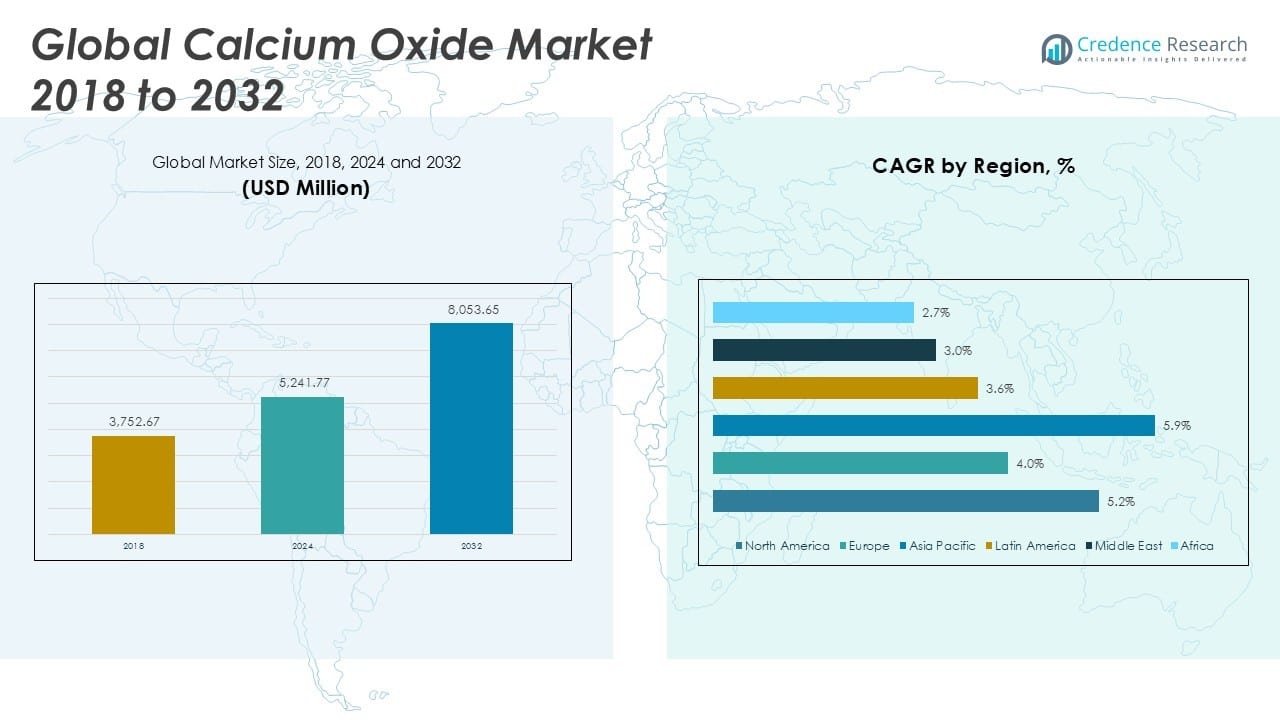
The Calcium Oxide Market size was valued at USD 3,752.67 million in 2018 to USD 5,241.77 million in 2024 and is anticipated to reach USD 8,053.65 million by 2032, at a CAGR of 5.13% during the forecast period.
| REPORT ATTRIBUTE | DETAILS |
|---|---|
| Historical Period | 2020-2024 |
| Base Year | 2024 |
| Forecast Period | 2025-2032 |
| Calcium Oxide Market Size 2024 | USD 5,241.77 Million |
| Calcium Oxide Market, CAGR | 5.13% |
| Calcium Oxide Market Size 2032 | USD 8,053.65 Million |
Key drivers fueling market growth include the increasing adoption of calcium oxide in the production of cement and steel, both of which are foundational to global infrastructure and manufacturing activities. The material’s superior chemical reactivity and cost-effectiveness make it indispensable for enhancing process efficiency in these industries. Additionally, heightened focus on environmental sustainability has driven demand for calcium oxide in flue gas desulfurization, wastewater treatment, and other pollution control applications, further enhancing its industrial relevance.
Regionally, Asia-Pacific dominates the global calcium oxide market, capturing the largest share due to rapid urbanization, infrastructural development, and the presence of major cement and steel manufacturing hubs in countries like China and India. The region also benefits from increasing government investments in industrial expansion and environmental management. North America and Europe follow, supported by technological advancements, regulatory emphasis on environmental protection, and established end-user industries. These regions continue to play a critical role in shaping the global market landscape.
Market Insights:
- The Global Calcium Oxide Market was valued at USD 3,752.67 million in 2018, reached USD 5,241.77 million in 2024, and is projected to grow to USD 8,053.65 million by 2032 at a CAGR of 5.13% during the forecast period.
- Rising demand in cement and steel manufacturing is a primary growth driver, with calcium oxide serving as a key ingredient for improved product quality and process efficiency.
- Environmental regulations and sustainability initiatives are accelerating adoption in flue gas desulfurization and wastewater treatment, strengthening its role in pollution control.
- Asia-Pacific dominates the global market, capturing the highest share due to rapid urbanization, industrial growth, and government investments in China and India.
- North America and Europe contribute significant revenue, supported by technological innovation, strong regulatory standards, and mature end-user industries.
- Market expansion is challenged by stringent environmental regulations, compliance costs, and volatility in limestone prices, affecting operational stability.
- Continuous technological advancements, strategic partnerships, and broader applications in agriculture and chemicals are shaping future market opportunities and long-term growth.
Market Drivers:
Rising Demand in Cement and Steel Manufacturing Sectors Bolsters Market Expansion
The Global Calcium Oxide Market continues to benefit from the growing use of calcium oxide in cement and steel manufacturing processes. The construction industry depends on high-quality cement, where calcium oxide serves as a key ingredient for improving strength and setting times. The steel sector relies on it for refining processes and slag formation, which enhances product purity. Industrialization and infrastructure projects in emerging markets further increase the requirement for both cement and steel. Investment in transportation, commercial, and residential infrastructure directly contributes to higher calcium oxide consumption. Large-scale urbanization across Asia-Pacific accelerates this demand. Companies in the sector are ramping up production capacities to cater to these dynamic needs.
- For instance, Tata Steel used calcium cored wire technology during secondary refining operations at its Jamshedpur plant, achieving an optimal calcium recovery of up to 24 kilograms per ton of steel produced through pure calcium wire injection in the ladle furnace.
Emphasis on Environmental Sustainability Drives Application in Pollution Control
The market witnesses growing momentum from environmental sustainability initiatives. Governments worldwide enforce strict regulations on air and water quality, making pollution control critical across industries. Calcium oxide offers effective solutions for flue gas desulfurization and wastewater treatment. It helps reduce harmful emissions and neutralize contaminants in industrial effluents. Regulatory bodies encourage its use due to its high efficiency in removing sulfur compounds. The ability to comply with these evolving environmental standards further enhances its industrial adoption. This trend solidifies its position in the pollution control segment.
Expanding Role in Agriculture and Chemical Processing Enhances Market Scope
Growth in the Global Calcium Oxide Market is reinforced by its diverse applications in agriculture and chemical processing. It improves soil quality, neutralizes acidity, and enhances crop productivity. Fertilizer manufacturers include calcium oxide to boost nutrient content and support healthy plant growth. Chemical industries utilize it for various synthesis and purification reactions. This versatility underpins its widespread adoption across both sectors. Investments in agritech and agrochemicals continue to create new opportunities. It remains a vital material for agricultural advancement and chemical innovation.
Technological Advancements and Strategic Partnerships Accelerate Market Growth
Market participants focus on technology upgrades and strategic collaborations to stay competitive. Innovations in production methods help lower costs and improve product quality. Partnerships between manufacturers and end-user industries streamline supply chains and foster product customization. These advancements address the evolving requirements of key sectors, including construction, steel, and environmental management. Companies also invest in research and development to create value-added products. The Global Calcium Oxide Market stands to benefit from these proactive initiatives, supporting sustainable market growth.
- For instance, the Carmeuse Lime kiln No. 5, constructed in 1979, demonstrates advanced technology with a production capacity of 1,600 tons of lime per day.
Market Trends:
Accelerated Adoption in Wastewater Treatment and Emission Control Technologies
The Global Calcium Oxide Market demonstrates a strong shift toward wastewater treatment and emission control applications. It plays a critical role in neutralizing acidic effluents and removing heavy metals in industrial wastewater systems. Growing concerns about air pollution drive its use in flue gas desulfurization units installed across thermal power plants. Environmental agencies impose tighter air quality standards, which increase demand for calcium oxide-based scrubbers. Manufacturers invest in upgrading facilities to incorporate advanced flue gas treatment solutions. It maintains a competitive advantage by offering cost-effective remediation options compared to alternative reagents. Industry collaborations with environmental service providers support its broader integration into pollution control infrastructure.
- For instance, Mississippi Lime has supplied calcium oxide used in U.S. water treatment facilities, with the EPA reporting no calcium oxide supply disruptions in the water sector between 2000 and 2022, indicating robust supply chain reliability for critical applications.
Increasing Use in Novel Construction Materials and Green Building Practices
The Global Calcium Oxide Market experiences growing traction through its incorporation into green construction materials and building solutions. It enhances performance and durability in eco-friendly cement blends and masonry mortars. Developers leverage it to produce low-carbon concrete with reduced clinker content, aligning with sustainable building goals. It contributes to thermal insulation and fire resistance in composite panels and structural elements. Research institutions partner with manufacturers to test and validate enhanced material formulations for use in modern construction. It helps builders meet emerging green certifications and regulatory standards. Its upward trend in green building underscores its relevance in future infrastructure projects.
- For instance, Solidia Technologies’ proprietary cement process enables the sequestration of exactly 300 kilograms of CO₂ per ton of cement used in concrete production, while maintaining compliance with ASTM C39 for compressive strength.
Market Challenges Analysis:
Rising Regulatory Compliance Costs and Environmental Concerns Constrain Market Growth
The Global Calcium Oxide Market faces mounting challenges from evolving environmental regulations and compliance costs. Governments and regulatory bodies enforce stringent controls on emissions and waste generated by calcium oxide production. It must address concerns over CO₂ emissions, dust, and by-product management, which require significant investments in pollution control technology. Small and medium manufacturers struggle to meet these demands, often facing higher operational costs. Delays in permit approvals and unpredictable regulatory changes further disrupt expansion plans. These factors create barriers for new entrants and impact profitability across the industry.
Volatility in Raw Material Prices and Supply Chain Disruptions Impact Stability
Frequent fluctuations in limestone prices, the primary raw material for calcium oxide, present operational risks. The Global Calcium Oxide Market often deals with inconsistent supply and transport bottlenecks, which lead to unpredictable production schedules. Global logistics issues and geopolitical tensions increase supply chain complexity. It must also manage energy price volatility, which directly affects manufacturing costs. Competition for high-quality raw materials can intensify, driving up prices further. These persistent market uncertainties challenge manufacturers’ ability to plan and sustain long-term growth strategies.
Market Opportunities:
Expansion through Advanced Pollution Control and Environmental Remediation Applications
The Global Calcium Oxide Market presents significant opportunity in advanced pollution control and environmental remediation sectors. It offers effective solutions for desulfurization, neutralization of acidic industrial effluents, and heavy metal extraction. Governments increase support for clean investments, creating demand for calcium oxide-based technologies. It aligns well with industrial decarbonization efforts and circular economy strategies. Companies can leverage this to develop proprietary solutions tailored to municipal water treatment, industrial wastewater, and flue gas treatment systems. Partnerships with environmental engineering firms can accelerate adoption. These developments enable deeper market penetration across emerging economies focused on sustainability.
Integration in Innovative Construction Materials and Agricultural Enhancements
Construction and agriculture sectors open additional avenues for calcium oxide usage. The Global Calcium Oxide Market can capitalize on demand for green building materials, including low-carbon cement blends and improved masonry compounds. It supports soil stabilization, acidity control, and nutrient enhancement in agricultural lands. Rural development initiatives and precision farming adoption drive increased consumption. It can work with research institutions to validate performance benefits and scale product applications. Pilot programs in eco-construction and sustainable farming can demonstrate value, encouraging broader commercial implementation.
Market Segmentation Analysis:
By Product Form
The Global Calcium Oxide Market is segmented into powdered calcium oxide, granular calcium oxide, and other forms. Powdered calcium oxide holds the largest share, driven by its widespread utility in construction, steel manufacturing, and environmental treatment. Granular calcium oxide ranks next in market share, preferred for its controlled reactivity and ease of use in automated processes. Other forms address specific industrial requirements and contribute a modest portion to total market volume and revenue.
- For instance, American Elements supplies granular calcium oxide in standard pellet diameters of 3mm, allowing for uniform distribution in automated manufacturing processes.
By Application
By application, the Global Calcium Oxide Market serves a broad spectrum of industries. Cement and concrete blocks account for the highest consumption, supported by the continued growth of infrastructure and building projects worldwide. Steel slag treatment and glass manufacturing also command substantial market shares, propelled by advancements in metallurgy and glass technology. The organic chemicals segment benefits from the demand for calcium-based intermediates, while food additives and water treatment segments emphasize the need for high-purity and regulatory-compliant calcium oxide. In agriculture, it is vital for soil pH management and productivity improvement. These segmentations enable manufacturers to align production and innovation with growth opportunities across diverse end-use sectors.
- For instance, the Codex Alimentarius allows calcium oxide (INS 529) to be added in foods under Good Manufacturing Practices, and the European Commission permits calcium oxide with a maximum fluoride content of 50 mg/kg for use as a food additive.
Segmentations:
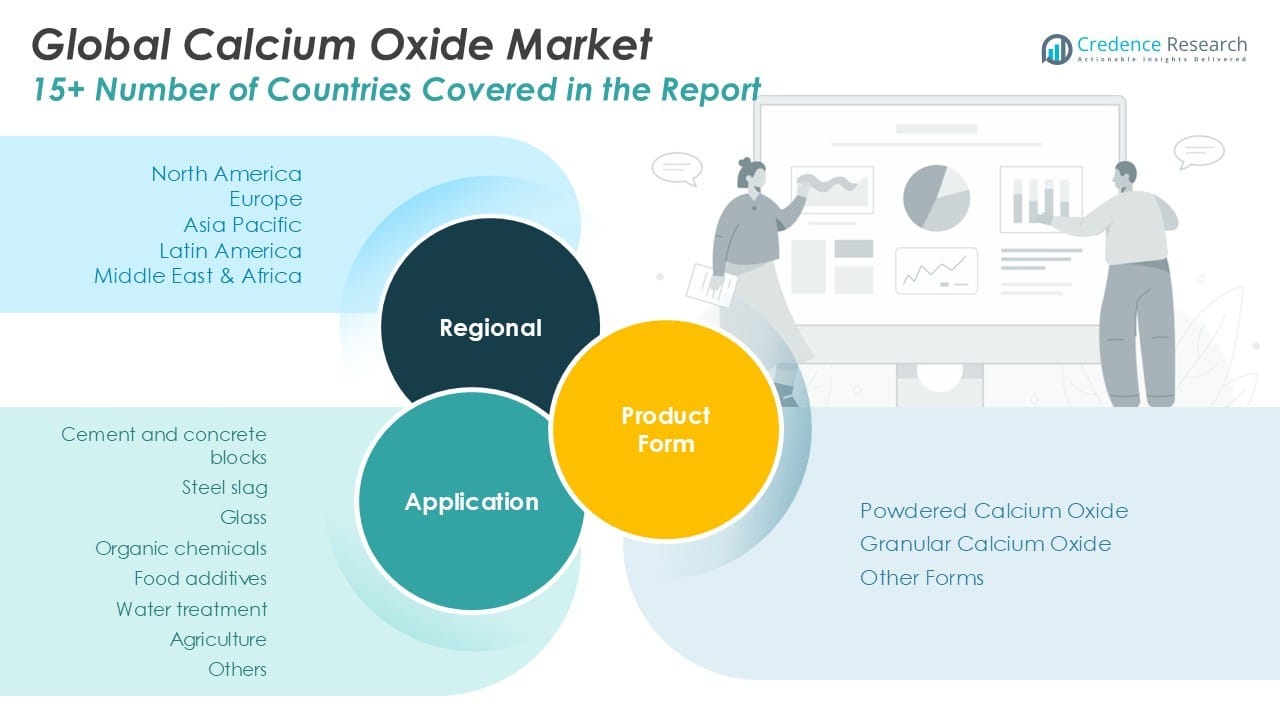
By Product Form
- Powdered Calcium Oxide
- Granular Calcium Oxide
- Other Forms
By Application
- Cement and concrete blocks
- Steel slag
- Glass
- Organic chemicals
- Food additives
- Water treatment
- Agriculture
- Others
By Region
- North America
- Europe
- Asia Pacific
- Latin America
- Middle East
- Africa
Regional Analysis:
North America
The North America Global Calcium Oxide Market size was valued at USD 1,074.54 million in 2018 to USD 1,477.16 million in 2024 and is anticipated to reach USD 2,279.22 million by 2032, at a CAGR of 5.2% during the forecast period. North America holds a prominent share in the Global Calcium Oxide Market, supported by a strong industrial base and ongoing investments in infrastructure and environmental management. The region’s advanced steel and cement sectors drive consistent demand, while technological innovation supports new applications in water treatment and pollution control. The United States leads regional consumption, benefiting from regulatory measures and capacity expansion. Stringent environmental regulations foster adoption of calcium oxide in emission control. The market also benefits from the presence of key industry players with robust supply chains. North America’s share accounts for a significant portion of global revenue, reinforcing its leadership position.
Europe
The Europe Global Calcium Oxide Market size was valued at USD 747.23 million in 2018 to USD 990.13 million in 2024 and is anticipated to reach USD 1,392.42 million by 2032, at a CAGR of 4.0% during the forecast period. Europe commands a substantial share of the Global Calcium Oxide Market, driven by well-established end-use industries and a focus on sustainability. The region’s manufacturers prioritize product quality and environmental compliance, especially in Germany, France, and the UK. Market growth is supported by ongoing investments in eco-friendly construction materials and advanced metallurgical processes. Adoption of calcium oxide in wastewater treatment and soil stabilization remains high. Policy support for circular economy initiatives strengthens market prospects. Europe maintains its competitive edge through innovation and regulatory leadership.
Asia Pacific
The Asia Pacific Global Calcium Oxide Market size was valued at USD 1,569.08 million in 2018 to USD 2,276.28 million in 2024 and is anticipated to reach USD 3,719.96 million by 2032, at a CAGR of 5.9% during the forecast period. Asia Pacific dominates the Global Calcium Oxide Market, capturing the highest market share globally. The region’s rapid urbanization, infrastructure development, and thriving construction and steel sectors fuel sustained demand. China and India serve as major consumption hubs, supported by government-led initiatives for industrial expansion. Local manufacturers continue to increase production capacity to address domestic and export needs. Application in environmental remediation and agriculture further diversifies its demand base. Asia Pacific’s growth trajectory outpaces all other regions.
Latin America
The Latin America Global Calcium Oxide Market size was valued at USD 181.40 million in 2018 to USD 250.31 million in 2024 and is anticipated to reach USD 341.42 million by 2032, at a CAGR of 3.6% during the forecast period. Latin America’s market share in the Global Calcium Oxide Market reflects stable growth, led by Brazil and Mexico. Expanding construction and mining industries drive regional consumption, while modernization of industrial processes strengthens demand. Environmental and agricultural applications gain momentum through policy incentives. Regional supply chains are improving, which supports market accessibility. Local production benefits from abundant limestone reserves. The market remains attractive for new investments and regional partnerships.
Middle East
The Middle East Global Calcium Oxide Market size was valued at USD 109.29 million in 2018 to USD 140.04 million in 2024 and is anticipated to reach USD 182.95 million by 2032, at a CAGR of 3.0% during the forecast period. The Middle East holds a moderate share in the Global Calcium Oxide Market, anchored by the growth of the construction sector and water treatment initiatives. Major economies invest in urban development and infrastructure, which supports market expansion. Demand for high-purity calcium oxide grows in chemical and petroleum sectors. Import dependence remains a challenge, prompting efforts to enhance local production. Technological advancements in cement and steel manufacturing foster regional adoption. The market outlook remains positive amid ongoing industrial diversification.
Africa
The Africa Global Calcium Oxide Market size was valued at USD 71.13 million in 2018 to USD 107.85 million in 2024 and is anticipated to reach USD 137.68 million by 2032, at a CAGR of 2.7% during the forecast period. Africa’s presence in the Global Calcium Oxide Market is gradually increasing, supported by infrastructure development and rising investment in mining and agriculture. Regional growth is concentrated in South Africa, Nigeria, and Egypt. It finds utility in cement manufacturing and soil stabilization. Access to raw materials remains favorable, though logistics and technology gaps persist. The region represents an emerging market with long-term potential. Ongoing urbanization and resource development projects are expected to bolster future demand.
Key Player Analysis:
- Carmeuse
- Graymont Limited
- Lhoist
- Mississippi Lime Company
- Omya AG
- Heidelberg Cement Group
- Lafarge Tarmac
- American Elements
- Calchem
- CAO Industries
- Merck KGaA
- The Dow Chemical Company
Competitive Analysis:
The Global Calcium Oxide Market features a competitive landscape marked by the presence of established multinational corporations and regional suppliers. Key players such as Carmeuse, Graymont Limited, Lhoist, Mississippi Lime Company, and Omya AG hold significant market shares due to their broad product portfolios, advanced manufacturing capabilities, and extensive distribution networks. It continues to witness investments in production technology and capacity expansion to meet rising demand from construction, metallurgy, and environmental sectors. Companies focus on product quality, supply reliability, and cost competitiveness to strengthen their market positions. Strategic collaborations, acquisitions, and regional expansion remain common approaches to capturing emerging opportunities and expanding customer bases. Smaller regional players maintain relevance by catering to niche requirements and providing flexible supply solutions. Continuous innovation and operational efficiency define the strategies of leading participants, driving sustainable growth and resilience in the competitive landscape.
Recent Developments:
- In September 2023, Graymont Limited announced the acquisition of Compact Energy, a major lime processing facility in Banting, Selangor, Malaysia, adding substantial capacity and reinforcing its network in Southeast Asia.
- In December 2024, American Elements announced the expansion of its production facilities for Gallium, Germanium, and Antimony to support growing global demand from the semiconductor, solar, and defense sectors.
Market Concentration & Characteristics:
The Global Calcium Oxide Market exhibits moderate to high market concentration, with a few large players controlling significant shares alongside several regional and local manufacturers. It demonstrates characteristics of a mature industry, driven by consistent demand from construction, steel, and chemical sectors. The market emphasizes product quality, compliance with safety standards, and efficient logistics. Companies invest in process innovation and capacity enhancement to stay competitive. Entry barriers remain high due to the need for substantial capital investment, established supply chains, and regulatory compliance. The market benefits from stable long-term contracts and strong customer relationships, ensuring a steady flow of business for leading suppliers.
Report Coverage:
The research report offers an in-depth analysis based on Product Form, Application and Region. It details leading market players, providing an overview of their business, product offerings, investments, revenue streams, and key applications. Additionally, the report includes insights into the competitive environment, SWOT analysis, current market trends, as well as the primary drivers and constraints. Furthermore, it discusses various factors that have driven market expansion in recent years. The report also explores market dynamics, regulatory scenarios, and technological advancements that are shaping the industry. It assesses the impact of external factors and global economic changes on market growth. Lastly, it provides strategic recommendations for new entrants and established companies to navigate the complexities of the market.
Future Outlook:
- Manufacturers will expand production capacity to address growing demand from infrastructure and steelmaking sectors.
- Innovations in pelletized and granular formats will improve handling and reduce dust emissions.
- Producers will enhance product purity to meet stricter regulatory standards in food-grade and water treatment applications.
- Companies will integrate advanced process control technologies to reduce energy usage and operational cost.
- Regional hubs, particularly in Asia‑Pacific and Latin America, will see increased investments in local production facilities.
- Strategic partnerships between calcium oxide suppliers and end‑users will streamline supply chains and ensure reliable access.
- Suppliers will offer value‑added services such as technical support and customized formulations to differentiate offerings.
- Environmental compliance will drive the development of low‑emission kilns and carbon‐capture processes.
- Digitalization in logistics and inventory management will improve delivery speed and transparency.
- Recycling of industrial byproducts like steel slag and flue‐gas gypsum will emerge as a source of feedstock to support circular economy initiatives.

Request a Free Sample
Fill in your details and we'll send you a free sample report.
- Sample data tables & charts
- Research methodology
Market Dynamics
Rising Demand in Cement and Steel Manufacturing
Calcium oxide is a critical ingredient in cement and steel production, improving product quality and process efficiency. Rapid urbanization and infrastructure development, especially in Asia-Pacific, are driving increased consumption in these sectors.
Environmental Regulations and Pollution Control
Stricter global regulations on air and water quality are accelerating the adoption of calcium oxide in flue gas desulfurization and wastewater treatment. Its effectiveness in neutralizing pollutants makes it a preferred choice for industries aiming to comply with environmental standards.
Technological Advancements and Product Innovation
Continuous improvements in production technology, such as advanced kiln designs and pelletized forms, are enhancing product quality, reducing emissions, and lowering operational costs. These innovations support broader adoption across diverse industrial applications.
Expansion in Agriculture and Chemical Processing
Calcium oxide's role in soil pH management, fertilizer production, and chemical synthesis is expanding, driven by investments in agritech and the need for higher crop productivity. Its versatility supports growth in both agricultural and chemical sectors.
Strategic Partnerships and Capacity Expansion
Major producers are forming alliances with end-user industries and investing in new facilities, particularly in high-growth regions like Asia-Pacific and Latin America. These strategies ensure reliable supply, customized solutions, and access to emerging markets.
Need a Custom Version of This Report?
Tailor the scope, geography, or segments to your exact requirements.
- Custom geography or segment scope
- Direct access to our analyst team
Frequently Asked Questions
What is the current size of the Global Calcium Oxide Market?
What factors are driving the growth of the Global Calcium Oxide Market?
What are the key segments within the Global Calcium Oxide Market?
What are some challenges faced by the Global Calcium Oxide Market?
Who are the major players in the Global Calcium Oxide Market?
Which segment is leading the market share?
Table of Content
Chapter 1 Market Segmentation
- 1.1 Segmentation Framework
- 1.1.1 Product and Service Classification
- 1.1.2 Application and End-Use Classification
- 1.1.3 Technology and Solution Classification
- 1.1.4 Customer and Distribution Channel Classification
- 1.1.5 Geographic Segmentation
- 1.1.6 Market Segment Definitions and Boundaries
- 1.2 By Application
- 1.2.1 Cement and Concrete Blocks
- 1.2.2 Steel Slag
- 1.2.3 Glass
- 1.2.4 Organic Chemicals
- 1.2.5 Food Additives
- 1.2.6 Water Treatment
- 1.2.7 Agriculture
- 1.2.8 Others
- 1.3 By Product Form
- 1.3.1 Powdered Calcium Oxide
- 1.3.2 Granular Calcium Oxide
- 1.3.3 Other Forms
Chapter 2 Introduction
- 2.1 Report Objectives and Scope
- 2.2 Product Definition and Industry Terminology
- 2.3 Market Inclusions and Exclusions
- 2.4 Research Process
- 2.4.1 Primary Research and Expert Interviews
- 2.4.2 Secondary Research and Source Review
- 2.4.3 Top-Down and Bottom-Up Estimation
- 2.4.4 Data Triangulation and Verification
- 2.5 Market Size Measurement Basis
- 2.5.1 2024: USD 5,241.77 million → 2032: USD 8,053.65 million
- 2.6 Historical and Forecast Reference Periods
- 2.6.1 Base Year: 2024
- 2.6.2 Forecast Period: 2024-2032
- 2.7 Research Assumptions and Limitations
Chapter 3 Executive Summary
- 3.1 Market Snapshot and Key Findings
- 3.2 Base-Year Market Size, 2024
- 3.3 Forecast Market Size, 2032
- 3.4 Revenue and Volume Growth Outlook
- 3.5 Key Demand and Supply Indicators
- 3.6 Leading Market Segments
- 3.7 Fastest-Growing Market Opportunities
- 3.8 Regional Performance Highlights
- 3.9 Technology and Industry Transformation
- 3.10 Competitive Landscape Summary
- 3.11 Analyst View and Strategic Implications
Chapter 4 Global Calcium Oxide Market Trends and Developments
- 4.1 Historical Industry Development
- 4.2 Recent Market Trends and Developments
- 4.3 Demand and Customer Behavior Trends
- 4.4 Technology and Product Innovation
- 4.5 Artificial Intelligence, Automation and Digitalization
- 4.6 Local Manufacturing and Supply Chain Realignment
- 4.7 Industry Partnerships, Mergers and Acquisitions
- 4.8 Sustainability and Circular Economy Developments
- 4.9 Government and Private Sector Investment Trends
- 4.10 Emerging Business Models and Commercialization
- 4.11 Industry Developments and Announcements
Chapter 5 Global Calcium Oxide Market Production, Supply and Demand Analysis
- 5.1 Demand Trend and Consumption Analysis
- 5.2 Demand Forecast, 2024-2032
- 5.3 Production and Output Trend
- 5.4 Production and Output Forecast, 2024-2032
- 5.5 Installed Capacity and Capacity Utilization
- 5.6 Company-Wise Production Plants and Statistics
- 5.6.1 Installed Production Capacity
- 5.6.2 Actual Production
- 5.6.3 Planned Capacity and Expansion Targets
- 5.7 Supply Chain Structure and Procurement Trends
- 5.8 Supply-Demand Gap and Bottlenecks
- 5.9 Import Dependence and Sourcing Structure
- 5.10 Contract Manufacturing and Outsourcing
- 5.11 Regional Supply and Demand Concentration
Chapter 6 Global Calcium Oxide Market Pricing Analysis
- 6.1 Pricing Structure and Measurement
- 6.2 Historical Pricing Trends
- 6.3 Pricing Outlook, 2024-2032
- 6.4 Average Selling Price and Unit Economics
- 6.5 Pricing by Product and Market Segment
- 6.6 Geographic Pricing Differences
- 6.7 Key Input, Energy, Labor and Logistics Costs
- 6.8 Contract Pricing and Purchasing Models
- 6.9 Pricing Sensitivity and Competitive Positioning
- 6.10 Price, Margin and Profitability Implications
Chapter 7 Global Calcium Oxide Market Dynamics
- 7.1 Market Growth Drivers
- 7.1.1 Demand-Side Drivers
- 7.1.2 Technology and Innovation Drivers
- 7.1.3 Infrastructure and Investment Drivers
- 7.1.4 Regulatory and Policy Drivers
- 7.2 Market Restraints
- 7.2.1 Cost and Affordability Constraints
- 7.2.2 Technology and Adoption Barriers
- 7.2.3 Supply Chain and Operational Constraints
- 7.3 Market Challenges
- 7.3.1 Competitive Pressure and Margin Erosion
- 7.3.2 Skills, Infrastructure and Implementation Gaps
- 7.4 Emerging Market Opportunities
- 7.5 Market Dynamics Impact and Time-Horizon Assessment
Chapter 8 Global Calcium Oxide Value Chain Analysis
- 8.1 Industry Value Chain Overview
- 8.2 Upstream Suppliers and Critical Inputs
- 8.3 Technology and Component Providers
- 8.4 Manufacturing or Service Delivery
- 8.5 Distribution, Channel Partners and Integrators
- 8.6 Downstream Applications and End Users
- 8.7 Value Addition and Profit Pools
- 8.8 Vertical Integration and Outsourcing
- 8.9 Supplier Concentration and Risk
- 8.10 Supply Chain Localization and Resilience
Chapter 9 Global Calcium Oxide Market Regulations and Policies
- 9.1 Relevant Laws, Standards and Compliance Frameworks
- 9.2 Product, Service, Safety and Quality Requirements
- 9.3 Government Policies, Incentives and Subsidies
- 9.4 Imports, Exports and Trade Barriers
- 9.5 Public Procurement and Local Content Requirements
- 9.6 Environmental and Sustainability Compliance
- 9.7 Upcoming Policy Changes and Market Implications
Chapter 10 Global Calcium Oxide Market Hotspots and Opportunities
- 10.1 Market Opportunity Mapping and Growth Hotspots
- 10.2 High-Growth Applications and Customer Groups
- 10.3 Underserved Markets and White-Space Opportunities
- 10.4 Emerging Technology and Product Opportunities
- 10.5 New Capacity and Investment Hotspots
- 10.6 Market Entry and Expansion Opportunities
- 10.7 Distribution and Partnership Opportunities
- 10.8 Near-Term and Long-Term Commercial Potential
- 10.9 Opportunity Attractiveness and Execution Risks
Chapter 11 Global Calcium Oxide Market Outlook, 2024-2032
- 11.1 Market Size and Analysis
- 11.1.1 Revenue (Market Measurement: 2024: USD 5,241.77 million → 2032: USD 8,053.65 million)
- 11.1.2 Market Volume and Quantity Sold
- 11.1.3 Historical Market Size
- 11.1.4 Base-Year Market Size, 2024
- 11.2 Market Forecast, 2024-2032
- 11.2.1 Revenue Forecast to 2032
- 11.2.2 Volume Forecast to 2032
- 11.2.3 CAGR and Year-on-Year Growth
- 11.2.4 Incremental Revenue Opportunity
- 11.3 Forecast Assumptions and Scenario Analysis
- 11.3.1 Base-Case Forecast
- 11.3.2 Optimistic and Conservative Scenarios
- 11.3.3 Technology, Pricing and Policy Sensitivities
- 11.4 Market Attractiveness and Growth Outlook
Chapter 12 Global Calcium Oxide Market Segmentation and Outlook
- 12.1 Segmentation Summary and Market Shares, 2024
- 12.2 Largest and Fastest-Growing Segments
- 12.3 By Application - Market Size and Forecast, 2024-2032
- 12.3.1 Segment Definition and Scope
- 12.3.2 Historical Market Size
- 12.3.3 Revenue Forecast, 2024-2032
- 12.3.4 Volume Forecast, 2024-2032
- 12.3.5 Base-Year Market Share, 2024
- 12.3.6 Segment CAGR and Growth Drivers
- 12.3.7 Subsegment Market Size and Forecast
- 12.3.7.1 Cement and Concrete Blocks
- 12.3.7.2 Steel Slag
- 12.3.7.3 Glass
- 12.3.7.4 Organic Chemicals
- 12.3.7.5 Food Additives
- 12.3.7.6 Water Treatment
- 12.3.7.7 Agriculture
- 12.3.7.8 Others
- 12.3.8 Subsegment Pricing and Adoption Trends
- 12.3.9 Leading Suppliers and Competition
- 12.3.10 Regional Demand and Opportunities
- 12.4 By Product Form - Market Size and Forecast, 2024-2032
- 12.4.1 Segment Definition and Scope
- 12.4.2 Historical Market Size
- 12.4.3 Revenue Forecast, 2024-2032
- 12.4.4 Volume Forecast, 2024-2032
- 12.4.5 Base-Year Market Share, 2024
- 12.4.6 Segment CAGR and Growth Drivers
- 12.4.7 Subsegment Market Size and Forecast
- 12.4.7.1 Powdered Calcium Oxide
- 12.4.7.2 Granular Calcium Oxide
- 12.4.7.3 Other Forms
- 12.4.8 Subsegment Pricing and Adoption Trends
- 12.4.9 Leading Suppliers and Competition
- 12.4.10 Regional Demand and Opportunities
- 12.5 Segment Growth Comparison
- 12.6 Segment Attractiveness and Priority Matrix
Chapter 13 Global Calcium Oxide End-Use and Application Market Outlook
- 13.1 End-Use Industry and Customer Demand Structure
- 13.2 Leading Applications and Customer Groups
- 13.3 End-Use Market Size, Share and Forecast
- 13.4 Major End-Use Industry Deep Dives
- 13.4.1 Customer Requirements and Use Cases
- 13.4.2 Demand and Replacement Cycles
- 13.4.3 Technical and Regulatory Considerations
- 13.4.4 Purchasing and Procurement Models
- 13.4.5 Leading Vendors and Distribution Channels
- 13.4.6 Forecast and Commercial Opportunities
- 13.5 Emerging Applications and Cross-Segment Demand
- 13.6 End-Use Industry Investment Priorities
Chapter 14 Global Calcium Oxide Geographic Market Outlook, 2024-2032
- 14.1 Regional Market Size and Share, 2024
- 14.2 Regional Market Forecast, 2024-2032
- 14.3 Regional Pricing, Production and Demand Differences
- 14.4 North America
- 14.4.1 United States
- 14.4.2 Canada
- 14.4.3 Mexico
- 14.5 Europe
- 14.5.1 Germany
- 14.5.2 France
- 14.5.3 Italy
- 14.5.4 United Kingdom
- 14.5.5 Spain
- 14.5.6 Poland
- 14.5.7 Russia
- 14.5.8 Netherlands
- 14.5.9 Belgium
- 14.5.10 Sweden
- 14.5.11 Denmark
- 14.5.12 Norway
- 14.5.13 Rest of Europe
- 14.6 Asia Pacific
- 14.6.1 China
- 14.6.2 India
- 14.6.3 Japan
- 14.6.4 South Korea
- 14.6.5 Thailand
- 14.6.6 Indonesia
- 14.6.7 Vietnam
- 14.6.8 Malaysia
- 14.6.9 Australia
- 14.6.10 Rest of Asia Pacific
- 14.7 Latin America
- 14.7.1 Brazil
- 14.7.2 Argentina
- 14.7.3 Colombia
- 14.7.4 Chile
- 14.7.5 Rest of Latin America
- 14.8 Middle East
- 14.8.1 Saudi Arabia
- 14.8.2 United Arab Emirates
- 14.8.3 Turkey
- 14.8.4 Israel
- 14.8.5 Iran
- 14.8.6 Rest of the Middle East
- 14.9 Africa
- 14.9.1 South Africa
- 14.9.2 Egypt
- 14.9.3 Nigeria
- 14.9.4 Morocco
- 14.9.5 Rest of Africa
- 14.10 Regional Investment, Policy and Supply Chain Differences
- 14.11 Regional Competitive Landscape
- 14.12 Geographic Growth Hotspots
Chapter 15 Global Calcium Oxide Technology, Innovation and Sustainability Outlook
- 15.1 Technology Landscape and Maturity
- 15.2 Product, Process and Service Innovation
- 15.3 AI, Automation and Digital Tools in the Industry
- 15.4 Technology Adoption and Performance Benchmarking
- 15.5 Innovation Pipeline and R&D Investment
- 15.6 Patent and Intellectual Property Trends
- 15.7 Energy Efficiency and Resource Management
- 15.8 Sustainability, Recycling and Circularity
- 15.9 Technology Roadmap, 2024-2032
- 15.10 Risks of Obsolescence and Technology Substitution
Chapter 16 Global Calcium Oxide Market Key Strategic Imperatives
- 16.1 Growth and Market Entry Priorities
- 16.2 High-Return Products and Segments
- 16.3 Pricing, Profitability and Cost Optimization
- 16.4 Technology Investment and Product Differentiation
- 16.5 Supply Chain Localization and Resilience
- 16.6 Distribution and Customer Acquisition
- 16.7 Partnership, Acquisition and Capacity Strategy
- 16.8 Regional Expansion Priorities
- 16.9 Short-, Medium- and Long-Term Actions
Chapter 17 Competition Outlook
- 17.1 Industry Competition Characteristics
- 17.2 Market Structure and Concentration
- 17.3 Market Share and Competitive Positioning, 2024
- 17.4 Company-Wise Revenue and Product Benchmarking
- 17.5 Production and Service Capacity Benchmarking
- 17.6 Technology, Pricing and Differentiation
- 17.7 Regional Footprint and Distribution Strength
- 17.8 Mergers, Acquisitions and Strategic Alliances
- 17.9 New Entrants and Competitive Threats
- 17.10 Porter's Five Forces and Industry Attractiveness
- 17.11 Competitive Outlook, 2024-2032
Chapter 18 Company Profiles
- 18.1 Company Coverage and Selection Criteria
- 18.2 Carmeuse
- 18.2.1 Business Description
- 18.2.2 Company Ownership and Geographic Presence
- 18.2.3 Product and Service Portfolio
- 18.2.4 Manufacturing and Operating Footprint
- 18.2.5 Production Capacity and Expansion Plans
- 18.2.6 Financial Performance and Investment
- 18.2.7 Market Share and Competitive Position
- 18.2.8 Technology and Innovation Capabilities
- 18.2.9 Strategic Alliances or Partnerships
- 18.2.10 Recent Developments
- 18.2.11 Growth Strategy and Outlook
- 18.3 Graymont Limited
- 18.4 Lhoist
- 18.5 Mississippi Lime Company
- 18.6 Omya AG
- 18.7 Heidelberg Cement Group
- 18.8 Lafarge Tarmac
- 18.9 American Elements
- 18.10 Calchem
- 18.11 CAO Industries
- 18.12 Other Relevant Market Participants
Note: Every listed company is profiled on the structure shown under the first company. The company list is preliminary and may change based on research findings, market developments, data availability and client requirements.
Chapter 19 Disclaimer
- 19.1 Research and Forecast Disclaimer
- 19.2 Data Source and Estimation Limitations
Note: The depth of individual sections depends on data availability for this market. Volume, capacity, trade and other unit-based metrics are included where applicable.

