
Executive Summary & Core Metrics
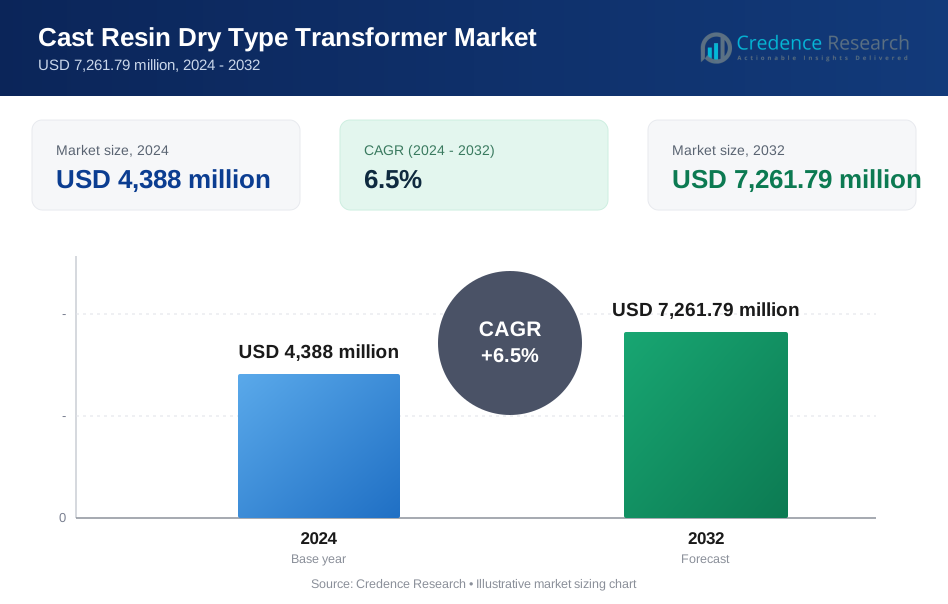
The global cast resin dry type transformer market was valued at USD 4,388 million in 2024 and is projected to reach USD 7,261.79 million by 2032, expanding at a compound annual growth rate (CAGR) of 6.5% during the forecast period, according to Credence Research. This growth reflects rising demand for fire-safe, oil-free and low-maintenance power distribution equipment across utilities, industrial facilities, commercial buildings, transport infrastructure, data centers and renewable energy projects.
| REPORT ATTRIBUTE | DETAILS |
|---|---|
| Historical Period | 2020-2023 |
| Base Year | 2024 |
| Forecast Period | 2025-2032 |
| Cast Resin Dry Type Transformer Market Size 2024 | USD 4,388 million |
| Cast Resin Dry Type Transformer Market , CAGR | 6.5% |
| Cast Resin Dry Type Transformer Market Size 2032 | USD 7,261.79 million |
The global cast resin dry type transformer market is characterized by the presence of large electrical equipment manufacturers and specialized transformer suppliers competing on insulation technology, fire safety, compact design, thermal performance, reliability and regulatory compliance. Leading players focus on cast resin dry type transformers and vacuum pressure impregnated transformers designed for indoor substations, urban power distribution, industrial automation and public infrastructure. Strategic priorities across the sector include advanced epoxy insulation, improved cooling systems, digital monitoring, compact transformer designs, regional manufacturing expansion and compliance with fire safety and environmental standards.
Strategic Market Insights
- Market growth is primarily driven by rising demand for fire-safe, environmentally compliant and oil-free transformers across dense urban locations, indoor substations, commercial buildings, industrial plants, metros, hospitals and data centers.
- Dominant industry trends highlight increasing adoption in smart cities, data centers and renewable energy projects, with medium voltage transformers holding the leading share due to urban distribution, grid upgrades and industrial power requirements.
- The competitive landscape is defined by global transformer manufacturers focusing on advanced resin insulation, compact designs, improved thermal performance, regional manufacturing and compliance with utility and infrastructure safety standards.
- According to Credence Research regional mapping, Asia Pacific represents the largest market, accounting for a definitive 41% share due to large-scale urban infrastructure projects, industrial expansion, grid upgrades, strong manufacturing bases and smart city investments.
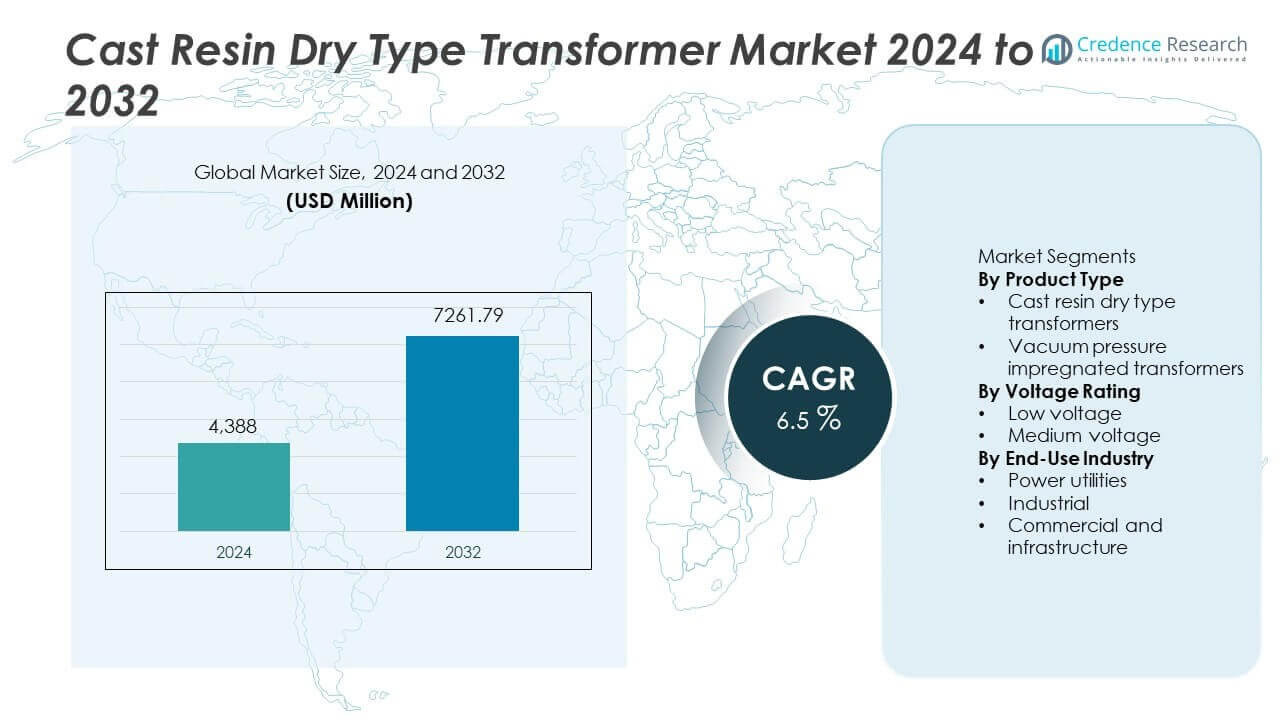
Cast Resin Dry Type Transformer Market Segmentation Analysis
By Product Type
- Cast resin dry type transformers
- Vacuum pressure impregnated transformers
Data compiled by Credence Research confirms that cast resin dry type transformers constitute the dominant product type, holding an estimated 68% market share. Their leadership is supported by superior safety, low maintenance and strong operating performance in humid, polluted and space-constrained environments. Utilities, industries and infrastructure operators prefer cast resin designs because epoxy insulation reduces fire risk, eliminates oil leakage concerns and supports reliable indoor operation. Growing installations in metros, airports, hospitals, commercial towers and data centers further strengthen demand for cast resin variants.
Vacuum pressure impregnated transformers account for the remaining share and continue to see steady adoption in controlled indoor environments. These systems are used where operating conditions are less demanding and cost considerations are important. However, stricter fire safety rules, rising urban infrastructure development and increasing deployment in public buildings continue to favor cast resin dry type transformers as the preferred solution.
ABB deployed its RESIBLOC cast resin transformers rated up to 40 MVA with thermal class F epoxy systems, supporting high-performance applications in demanding indoor and industrial power environments.
By Voltage Rating
- Low voltage
- Medium voltage
Credence Research identifies medium voltage transformers as the leading voltage segment, accounting for approximately 61% of global market share. Medium voltage units dominate due to widespread use in distribution networks, industrial plants, renewable energy integration and urban substations. These transformers support efficient power transfer in dense city grids, infrastructure projects and manufacturing facilities. Utilities deploy medium voltage dry type transformers for load management, grid modernization and safer indoor distribution.
Low voltage transformers serve localized applications in small commercial buildings, light industrial facilities and localized electrical systems. However, expanding electrification, industrial automation, data center construction and renewable-linked infrastructure continue to increase demand for medium voltage solutions. Their ability to handle higher loads with reliable performance makes them the preferred option across utility and industrial deployments.
Hitachi Energy supplied dry type transformers operating at 33 kV with insulation systems tested for 30-year service life, supporting long-term reliability in utility and industrial applications.
By End-Use Industry
- Power utilities
- Industrial
- Commercial and infrastructure
The industrial segment leads end-use demand with an estimated 46% market share. This leadership is supported by rising investments in manufacturing, process industries, automated plants, refineries and energy-intensive production facilities. Industries adopt cast resin dry type transformers because they offer safety, low fire risk, reduced maintenance and reliable indoor operation. Oil-free transformer designs are especially valuable in facilities where safety, uptime and environmental compliance are critical.
Power utilities follow closely, driven by grid modernization, urban distribution upgrades and replacement of aging electrical infrastructure. Commercial and infrastructure applications, including hospitals, transport hubs, airports, metros and office complexes, are also expanding steadily. However, continuous industrial capacity additions, stricter safety standards and rising demand for stable power in automated facilities keep the industrial sector as the dominant end-use segment.
Key Market Dynamics
Primary Market Drivers
Rising Demand for Fire-Safe and Environment-Friendly Transformers:
Utilities and industries increasingly adopt cast resin dry type transformers due to their fire-safe, oil-free and environmentally safer design. These transformers eliminate oil leakage risks and reduce fire hazards in dense urban locations, public infrastructure and indoor substations. Stricter safety rules across commercial buildings, metros, hospitals and industrial facilities accelerate adoption. Epoxy resin insulation supports stable performance under humidity, dust and pollution exposure. Growing preference for indoor installations further strengthens demand. Credence Research identifies fire safety and environmental compliance as core drivers of cast resin dry type transformer adoption. Schneider Electric’s Trihal cast resin transformers are designed to meet high environmental and fire safety certification standards while operating effectively across typical ambient conditions.
Expansion of Urban Infrastructure and Smart Cities:
Rapid urbanization is increasing demand for reliable and compact power distribution systems. Cast resin dry type transformers are well suited for space-constrained environments such as basements, indoor substations, underground facilities, metro stations and commercial complexes. Smart city projects require safe, low-maintenance and efficient electrical equipment that can support growing urban loads. Governments continue investing in metro rail, airports, hospitals, smart buildings and urban utility upgrades. Indoor substations are becoming more important in high-density areas where land availability and public safety are critical. Siemens Energy supplied cast resin transformers for metro substations with insulation systems validated for continuous service life exceeding 30 years.
Growth in Industrial Electrification and Automation
Industrial electrification and automation are strengthening demand for dry type transformers across manufacturing and process sectors. Automated plants require stable, safe and reliable power supply for motors, control systems, robotics, drives and critical production equipment. Cast resin transformers provide high reliability with minimal maintenance and reduced fire risk. Industries also prefer oil-free solutions to reduce downtime, environmental risks and safety hazards. Growth in process industries, data centers, renewable-linked facilities and advanced manufacturing supports new installations and retrofit demand. Credence Research indicates that industrial electrification will remain a major long-term demand driver for medium voltage cast resin dry type transformers.
Key Trends & Structural Opportunities
Increasing Adoption in Renewable Energy and Data Centers
Renewable energy projects and data centers present strong opportunities for cast resin dry type transformer manufacturers. Wind and solar installations require safe transformers for enclosed, indoor and distributed power applications. Data centers adopt dry type transformers due to fire safety, reliability and low maintenance requirements. Growth in cloud computing, AI workloads and digital infrastructure is accelerating data center construction across developed and emerging regions. Utilities also integrate renewable power into urban grids, creating new installation points. Toshiba Energy Systems has installed cast resin units in commercial facilities where short-circuit withstand strength and low-maintenance operation support demanding infrastructure environments.
Technological Advancements in Resin and Cooling Designs
Manufacturers are investing in improved epoxy resin systems, better thermal management and advanced cooling designs. Enhanced insulation improves service life, short-circuit strength and load-handling performance. Advanced cooling systems reduce temperature rise under high-load conditions, supporting reliability in industrial and utility applications. Digital monitoring integration also supports condition-based maintenance and early fault detection. These innovations attract utilities and industrial users seeking higher efficiency, safer operation and lower lifecycle costs. Mitsubishi Electric has validated dry type transformer performance with hot-spot temperatures controlled within safe limits during overload testing, consistent with industry insulation standards.
Integration of Digital Monitoring and Condition-Based Maintenance
Digital monitoring is becoming an important opportunity in the cast resin dry type transformer market. Utilities and industrial operators increasingly want real-time visibility into transformer temperature, loading, humidity, insulation condition and operating performance. Connected monitoring solutions help identify faults early, reduce unplanned downtime and improve maintenance planning. This trend is especially important in data centers, smart cities, industrial plants and urban substations where reliability is critical. Credence Research identifies digital monitoring as a key differentiator for manufacturers offering next-generation dry type transformer solutions.
Industry Challenges
Higher Initial Cost Compared to Oil-Filled Transformers
Cast resin dry type transformers involve higher upfront costs than conventional oil-filled transformers. Epoxy insulation materials, specialized manufacturing processes, compact designs and advanced safety features increase product pricing. Cost-sensitive utilities and infrastructure developers in developing regions may hesitate to adopt these systems, especially for rural or low-budget projects. Oil-filled transformers remain cheaper for several outdoor applications, limiting broader dry type penetration. Manufacturers must balance safety, performance and cost optimization to improve adoption across price-sensitive markets.
Limited Suitability for Very High Voltage Applications
Dry type transformers face technical limitations in very high voltage and extra-high voltage applications. Heat dissipation becomes more challenging in large-capacity units, while oil-filled transformers remain dominant in long-distance transmission networks. Utilities often prefer proven oil-filled technologies for high-voltage grid infrastructure where capacity, cooling and long-distance reliability are critical. This limits the penetration of cast resin dry type transformers in certain transmission segments. Overcoming design, cooling and capacity constraints remains an important technical challenge for broader market expansion.
Detailed Regional Analysis
| Region | Market Share (%) | Strategic Regional Catalysts & Insights |
| Asia Pacific | 41.0% | Global leader. Driven by rapid urbanization, industrial expansion, metro rail projects, smart city investments, grid upgrades and strong manufacturing bases across China, India and Southeast Asia. |
| Europe | 27.0% | Mature regional market. Supported by strict fire safety rules, environmental regulations, renewable energy integration, urban grid upgrades and sustainability-focused infrastructure. |
| North America | 21.0% | Strong demand market. Driven by data center expansion, healthcare infrastructure, commercial construction, industrial automation and replacement of aging transformers. |
| Rest of the World | 11.0% | Emerging territory. Supported by commercial complexes, transport hubs, renewable energy projects and power distribution upgrades across Latin America, the Middle East and Africa. |
Asia Pacific leads the global cast resin dry type transformer market with a 41% share, according to Credence Research. The region benefits from rapid urbanization, large-scale infrastructure development and industrial expansion across China, India and Southeast Asian countries. Metro rail, commercial buildings, industrial parks and smart city projects are increasing the need for compact, fire-safe and low-maintenance transformers. Utilities are upgrading distribution networks to meet rising electricity demand and support grid reliability. Strong local manufacturing capacity and cost-efficient production further strengthen regional dominance. Rising safety standards in public infrastructure are expected to support long-term growth.
Europe accounts for 27% of the global market, supported by strict fire safety and environmental regulations. Germany, France, the United Kingdom and other major European markets prioritize oil-free transformer installations in commercial buildings, public infrastructure and dense urban areas. Aging power infrastructure replacement also supports demand for cast resin dry type transformers. Renewable energy integration across urban grids creates additional installation opportunities. Utilities and building owners focus on reducing fire risk, improving sustainability and increasing energy efficiency. Established industrial bases and advanced grid modernization programs sustain steady market performance across Western and Northern Europe.
North America holds 21% of the global cast resin dry type transformer market. Growth is driven by investments in data centers, healthcare facilities, commercial infrastructure and urban distribution networks. The United States leads regional demand due to cloud computing expansion, digital services and large-scale data center development. Utilities deploy dry type transformers for indoor substations and grid upgrades in dense urban areas. Industrial automation and safety-focused electrical standards further support adoption. Replacement of aging transformers and renewable energy installations within cities also contribute to steady regional demand.
Rest of the World captures 11% of the global market, supported by gradual infrastructure development across Latin America, the Middle East and Africa. Commercial complexes, transport hubs, industrial zones and power distribution upgrades create demand for indoor and fire-safe transformers. Urban growth increases the need for compact electrical equipment in public buildings and infrastructure projects. Renewable energy development in the Middle East and grid investments across developing economies create new installation opportunities. While adoption remains slower than in developed regions, improving safety standards and infrastructure spending support long-term market expansion.
Competitive Landscape & Recent Developments
The cast resin dry type transformer market is highly competitive, with strong participation from global electrical equipment manufacturers and transformer specialists. Key players include ABB Ltd., Siemens Energy, Schneider Electric, Hitachi Energy, General Electric, Eaton Corporation, Mitsubishi Electric Corporation, Toshiba Energy Systems & Solutions, Hyundai Electric & Energy Systems and CG Power and Industrial Solutions Ltd. These companies compete through product reliability, fire safety performance, insulation technology, thermal efficiency, compact designs and compliance with utility standards.
Market leaders focus on expanding cast resin transformer portfolios for indoor, urban and infrastructure applications. Investments in advanced epoxy insulation, improved cooling designs, digital monitoring and compact configurations strengthen differentiation. Companies also emphasize compliance with fire safety and environmental standards to serve commercial buildings, metros, hospitals, data centers and industrial facilities. Strategic partnerships with utilities and infrastructure developers support large-scale deployments. Regional manufacturing expansion improves supply chain reliability and reduces delivery timelines. Ongoing grid modernization, renewable integration and data center growth continue to shape competitive strategies.
Recent Industry Developments (2024–2025)
- In August 2025, Eaton completed the acquisition of Resilient Power Systems Inc., a company developing solid-state transformer-based technology that supports a more reliable and efficient grid.
- In September 2024, Prolec GE acquired full ownership of Menk USA to secure the supply chain for transformer components in North America.
- In 2024, ABB launched a digital monitoring solution developed in collaboration with Danish start-up Oktogrid, which is being applied by European customers, including utilities, to monitor both dry type and oil-immersed distribution transformers.
Request a Free Sample
Fill in your details and we'll send you a free sample report.
- Sample data tables & charts
- Research methodology
Need a Custom Version of This Report?
Tailor the scope, geography, or segments to your exact requirements.
- Custom geography or segment scope
- Direct access to our analyst team
Frequently Asked Questions
What is the current and projected size of the global cast resin dry type transformer market?
What is the projected growth rate of the cast resin dry type transformer industry over the forecast period?
Which product type holds the maximum market share within the cast resin dry type transformer industry?
Which voltage rating dominates the cast resin dry type transformer market?
Which end-use industry leads the cast resin dry type transformer market?
Which region commands the highest market share in the global cast resin dry type transformer space?
Table of Content
Chapter 1. Report Introduction
- 1.1 Report Description & Purpose
- 1.1.1 Report Title & Market Definition
- 1.1.2 Unique Selling Propositions (USP) & Key Differentiators
- 1.1.3 Value Proposition for Stakeholders
- 1.2 Research Objectives
- 1.2.1 Market Sizing Objectives (Volume & Revenue)
- 1.2.2 Segmentation Objectives
- 1.2.3 Competitive Intelligence Objectives
- 1.2.4 Forecast & Scenario Objectives
- 1.3 Report Scope
- 1.3.1 Cast Resin Dry Type Transformer Scope – Types & Subtypes Covered
- 1.3.2 Geographic Scope – Regions & Countries Covered
- 1.3.3 Historical Period, Base Year & Forecast Period (2024; forecast to 2032)
- 1.3.4 Inclusions & Exclusions
- 1.4 HS Code & Classification Framework
- 1.5 Currency, Units & Pricing Basis
- 1.6 Target Stakeholders
- 1.7 Limitations & Assumptions
Chapter 2. Executive Summary
- 2.1 Global Cast Resin Dry Type Transformer Market Snapshot
- 2.1.1 Market Size – Historical (2024) & Forecast (2024-2032) (2024: USD 4,388 million → 2032: USD 7,261.79 million)
- 2.1.2 Volume & Revenue – Global Totals
- 2.1.3 Key Market Highlights – Top Five Facts
- 2.2 Cast Resin Dry Type Transformer Market Segmentation Snapshot
- 2.2.1 Market Split by Region – 2024 vs. 2032
- 2.3 Competitive Snapshot
- 2.3.1 Top 10 Players by Revenue Share – 2024
- 2.3.2 Top 10 Players by Volume Share – 2024
- 2.3.3 Recent Strategic Developments (18-Month Summary)
- 2.4 Key Investment Highlights & Strategic Conclusions
Chapter 3. Cast Resin Dry Type Transformer Market Dynamics & Industry Analysis
- 3.1 Market Overview & Context
- 3.1.1 Cast Resin Dry Type Transformer Market Position in the Broader Automotive Value Chain
- 3.1.2 OEM vs. Replacement Market Dynamics
- 3.1.3 Market Maturity & Development Stage by Region
- 3.2 Cast Resin Dry Type Transformer Market Drivers
- 3.3 Cast Resin Dry Type Transformer Market Restraints & Challenges
- 3.4 Cast Resin Dry Type Transformer Market Opportunities
- 3.5 Porter's Five Forces Analysis
- 3.5.1 Threat of New Entrants
- 3.5.2 Bargaining Power of Suppliers
- 3.5.3 Bargaining Power of Buyers
- 3.5.4 Threat of Substitutes
- 3.5.5 Competitive Rivalry – Intensity Assessment
- 3.6 Cast Resin Dry Type Transformer Value Chain Analysis
- 3.6.1 Upstream – Raw Material/Input Suppliers
- 3.6.1.1 Raw Material/Input 1
- 3.6.1.2 Raw Material/Input 2
- 3.6.1.3 Raw Material/Input 3
- 3.6.2 Midstream – Production/Manufacturing/Service Delivery
- 3.6.2.1 Production/Process Overview
- 3.6.2.2 Key Facility Locations & Capacity by Manufacturer
- 3.6.3 Downstream – Distribution & End Consumer
- 3.6.3.1 Primary Channel – B2B/OEM
- 3.6.3.2 Secondary Channels – Dealer, Retail, Online, Direct
- 3.6.4 Value Chain Profitability Analysis
- 3.6.1 Upstream – Raw Material/Input Suppliers
- 3.7 PESTEL Analysis
- 3.7.1 Political Factors
- 3.7.2 Economic Factors
- 3.7.3 Social Factors
- 3.7.4 Technological Factors
- 3.7.5 Environmental Factors
- 3.7.6 Legal Factors
- 3.8 Cast Resin Dry Type Transformer Supply Chain Analysis
- 3.8.1 Raw Material/Input Supply Risk Assessment
- 3.8.2 Manufacturing Concentration Risk (Geographic Exposure)
- 3.8.3 Trade Disruption Impact Analysis
- 3.9 Regulatory & Policy Landscape
Note: The regulatory and policy landscape section covers regulations based on their applicability to the market, Cast Resin Dry Type Transformer category, geography, and scope of the study. Only regulatory frameworks with a material impact on operations, compliance, trade, sustainability, or market access are analyzed in detail.
Chapter 4. Key Investment Pockets & Opportunity Analysis
- 4.1 Cast Resin Dry Type Transformer Market Attractiveness Analysis
- 4.1.1 By Region – Investment Attractiveness Matrix (Volume × CAGR)
- 4.2 Absolute Revenue Growth Opportunity
- 4.2.1 By Region – Absolute USD Growth Through 2032
- 4.3 Incremental Volume Opportunity
- 4.3.1 By Region – Incremental Volume Through 2032
- 4.3.2 Segment – Incremental Volume
- 4.4 Emerging Submarket Opportunity Deep Dive (Subject to Applicability)
- 4.5 Emerging Market Opportunity Scorecards
- 4.5.1 United States
- 4.5.2 Europe
- 4.5.3 Asia
- 4.5.4 Middle East & Africa
Note: Emerging Market Opportunity Scorecards will be included based on relevance and strategic importance. Regions listed are indicative and may vary depending on data availability and market dynamics.
Chapter 5. Cast Resin Dry Type Transformer Import-Export Analysis & Trade Flows
- 5.1 Global Trade Overview
- 5.1.1 Global Export Value by Country (2024)
- 5.1.2 Global Export Volume by Country (2024)
- 5.1.3 Global Import Value by Country (2024)
- 5.1.4 Global Import Volume by Country (2024)
- 5.1.5 Net Trade Balance by Country (2024)
- 5.2 Export Analysis – Segment
- 5.2.1 Type 1 (HS Code)
- 5.2.2 Type 2 (HS Code)
- 5.2.3 Type 3 (HS Code)
- 5.2.4 Type 4 (HS Code)
- 5.2.5 Type 5 (HS Code)
- 5.3 Import Analysis – Segment
- 5.3.1 Type 1 (HS Code)
- 5.3.2 Type 2 (HS Code)
- 5.3.3 Type 3 (HS Code)
- 5.3.4 Type 4 (HS Code)
- 5.3.5 Type 5 (HS Code)
- 5.4 Average Unit Trade Prices
- 5.4.1 Average Export Price – Segment & Country
- 5.4.2 Average Import Price – Segment & Source Country
- 5.4.3 Price Trends (2024)
- 5.5 Key Trade Route Analysis
- 5.5.1 Trade Route 1
- 5.5.2 Trade Route 2
- 5.5.3 Trade Route 3
- 5.5.4 Trade Route 4
- 5.5.5 Trade Route 5
- 5.6 Trade Policy Impact Assessment
- 5.6.1 US Anti-Dumping & Section 301 Tariffs
- 5.6.2 EU Customs Union Impact
- 5.6.3 Major Free Trade Agreements
- 5.6.4 USMCA Rules of Origin
Note: Trade policy analysis will be included only where relevant to the Cast Resin Dry Type Transformer market.
Chapter 6. Competitive Landscape & Company Benchmarking
- 6.1 Cast Resin Dry Type Transformer Market Concentration & Structure
- 6.1.1 Herfindahl-Hirschman Index (HHI) – vs. 2024
- 6.1.2 Tier 1, Tier 2 & Tier 3 Market Structure
- 6.1.3 Global, Regional & Local Player Dynamics
- 6.2 Cast Resin Dry Type Transformer Market Share Analysis – 2024
- 6.2.1 Global Revenue Share by Company
- 6.2.2 Global Volume Share by Company
- 6.2.3 Regional Revenue Share
- 6.2.4 Market Share Evolution ( vs. 2024)
- 6.2.5 OEM Segment Share by Company
- 6.2.6 Replacement Segment Share by Company
- 6.3 Production/Delivery Capacity & Facility Analysis
- 6.3.1 Global Installed Capacity
- 6.3.2 Capacity Utilization Rates
- 6.3.3 Production/Output Volume
- 6.3.4 Facility Locations & Capacity Map
- 6.3.5 Planned Capacity Additions
- 6.4 Cast Resin Dry Type Transformer Competitive Benchmarking Matrix
- 6.4.1 Revenue, Volume, CAGR & Profitability Comparison
- 6.4.2 Channel Revenue Mix
- 6.4.3 Geographic Revenue Exposure
- 6.4.4 R&D Intensity
- 6.4.5 Sustainability Maturity
- 6.5 Strategic Developments in Cast Resin Dry Type Transformer (Last 24 Months)
- 6.5.1 Mergers, Acquisitions & Divestments
- 6.5.2 New Cast Resin Dry Type Transformer Launches
- 6.5.3 Facility Expansions
- 6.5.4 Strategic Alliances, Joint Ventures & Partnerships
- 6.5.5 Distribution Expansion & Market Entry
- 6.5.6 Sustainability & ESG Initiatives
- 6.6 Competitive Strategy Mapping
- 6.6.1 Leader, Challenger, Follower & Niche Classification
- 6.6.2 Pricing Strategy Comparison
- 6.6.3 Channel Strategy Matrix
Note: Strategic developments are included based on their materiality and the availability of reliable information.
Chapter 7. Global Cast Resin Dry Type Transformer Market – By Distribution Channel
- 7.1 Segment Overview
- 7.1.1 Volume & Revenue Split by Channel (2024 & 2032)
- 7.1.2 Channel Mix Evolution (2024-2032)
Chapter 8. Regional Market Analysis – Global Overview
- 8.1 Global Regional Overview
- 8.1.1 Regional Volume Share
- 8.1.2 Regional Revenue Share
- 8.1.3 Regional Volume by Region
- 8.1.4 Regional Revenue by Region
- 8.1.5 Regional Forecast Through 2032
- 8.2 Cross-Regional Segment Analysis
- 8.2.1 By Distribution Channel
- 8.2.2 By Brand/Price Tier
Chapter 9. North America Cast Resin Dry Type Transformer Market
- 9.1 United States
- 9.2 Canada
- 9.3 Mexico
Chapter 10. Europe Cast Resin Dry Type Transformer Market
- 10.1 Germany
- 10.2 France
- 10.3 Italy
- 10.4 United Kingdom
- 10.5 Spain
- 10.6 Poland
- 10.7 Russia
- 10.8 Netherlands
- 10.9 Belgium
- 10.10 Sweden
- 10.11 Denmark
- 10.12 Norway
- 10.13 Rest of Europe
Chapter 11. Asia Pacific Cast Resin Dry Type Transformer Market
- 11.1 China
- 11.2 India
- 11.3 Japan
- 11.4 South Korea
- 11.5 Thailand
- 11.6 Indonesia
- 11.7 Vietnam
- 11.8 Malaysia
- 11.9 Australia
- 11.10 Rest of Asia Pacific
Chapter 12. Latin America Cast Resin Dry Type Transformer Market
- 12.1 Brazil
- 12.2 Argentina
- 12.3 Colombia
- 12.4 Chile
- 12.5 Rest of Latin America
Chapter 13. Middle East Cast Resin Dry Type Transformer Market
- 13.1 Saudi Arabia
- 13.2 United Arab Emirates
- 13.3 Turkey
- 13.4 Israel
- 13.5 Iran
- 13.6 Rest of the Middle East
Chapter 14. Africa Cast Resin Dry Type Transformer Market
- 14.1 South Africa
- 14.2 Egypt
- 14.3 Nigeria
- 14.4 Morocco
- 14.5 Rest of Africa
Chapter 15. Cast Resin Dry Type Transformer Company Profiles
- 15.1 [Company 01]
- 15.1.1 Company Overview
- 15.1.2 Key Management Personnel
- 15.1.3 Products & Services Portfolio
- 15.1.4 Financial Performance
- 15.1.5 Key Market Focus & Geographic Presence
- 15.1.6 Recent Developments & Strategic Initiatives
Note: The company profile list is preliminary and may change based on research findings, market developments, data availability, and client requirements.
Chapter 16. Appendices
- Appendix A – List of Abbreviations & Acronyms
- Appendix B – Industry Classification Code Reference – Full Series
- Appendix C – Production & Capacity Data Tables
- Appendix D – End-Use & Demand Base Tables
- Appendix E – Consumption & Replacement Rate Assumptions
- Appendix F – ASP Reference Tables
- Appendix G – Manufacturing & Facility Database
- Appendix H – Import-Export Data Tables
- Appendix I – Regulatory Summary Tables
- Appendix J – Primary Research Participant List (Anonymized)
- Appendix K – Primary Research Questionnaire Framework
- Appendix L – Data Sources & Bibliography
- Appendix M – Market Size Divergence & Source Comparison
Chapter 17. Research Methodology
- 17.1 Research Framework & Philosophy
- 17.2 Secondary Research – Sources, Hierarchy & Data Extraction
- 17.3 Data Modeling – Bottom-Up & Top-Down Market Sizing
- 17.4 Primary Research – Stakeholder Framework, LOI & Sample Sizes
- 17.5 Forecast Methodology – Regression, Scenario & Sensitivity Analysis
- 17.6 Quality Control – Four-Layer Validation Framework
- 17.7 Limitations & Standard Assumptions
- 17.8 Disclaimer
