
Cattle Management Software Market Overview:
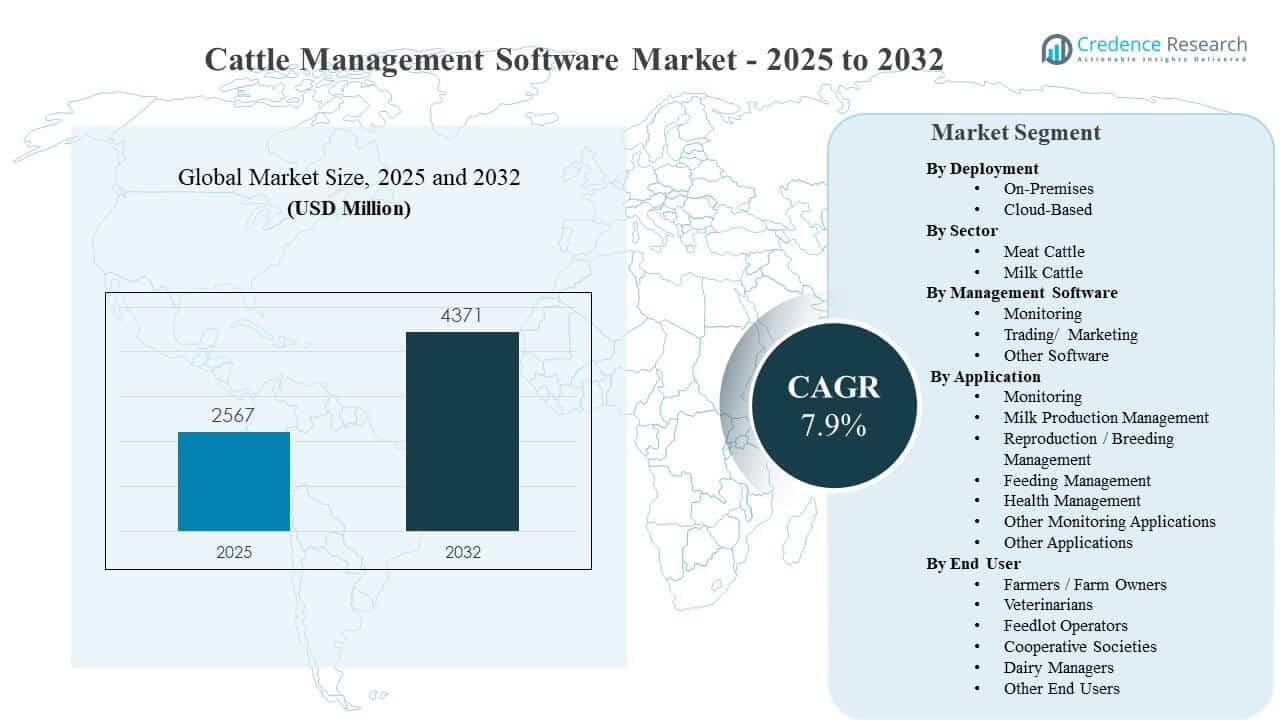
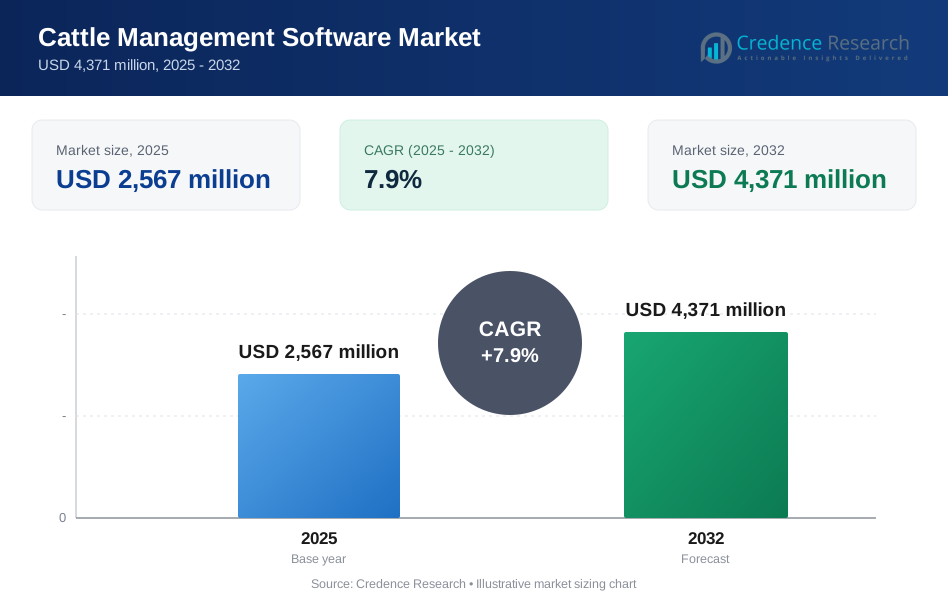
The global Cattle Management Software Market size was estimated at USD 2,567 million in 2025 and is expected to reach USD 4,371 million by 2032, growing at a CAGR of 7.9% from 2025 to 2032. Growth is being driven most strongly by the shift toward sensor-enabled herd visibility and decision support, as farms and feedlots prioritize earlier issue detection and standardized workflows across health, feeding, and reproduction. Expanding connectivity in on-farm devices and more user-friendly platforms are also reducing adoption friction across both dairy and beef operations, supporting broader use across day-to-day production management.
| REPORT ATTRIBUTE | DETAILS |
|---|---|
| Historical Period | 2020-2024 |
| Base Year | 2025 |
| Forecast Period | 2026-2032 |
| Cattle Management Software Market Size 2025 | USD 2,567 million |
| Cattle Management Software Market, CAGR | 7.9% |
| Cattle Management Software Market Size 2032 | USD 4,371 million |
Key Market Trends & Insights
- The market is projected to expand at a CAGR of 7.9% during 2025–2032, supported by rising adoption of digital herd monitoring, workflow automation, and data-driven decision support across dairy and beef operations.
- Asia Pacific leads the regional landscape with a 31.40% share in 2025, driven by rapid modernization of livestock management practices.
- North America remains a major revenue hub with a 28.10% share in 2025, reflecting strong penetration of farm management platforms, higher technology readiness.
- Monitoring is the largest management software segment with a 58.40% share in 2025, as real-time alerts and continuous tracking improve early disease detection, reproduction timing, and day-to-day operational control.
- Milk Production Management is the largest application area with a 28.60% share in 2025, supported by the need for consistent dairy workflow execution, yield tracking, and tighter coordination with feeding, health, and reproduction activities.
Segment Analysis
Cattle management software adoption is increasingly shaped by the need to convert day-to-day herd data into actionable decisions across production, health, and reproduction workflows. Operators are prioritizing platforms that reduce detection lag for health issues, improve task execution, and consolidate animal histories into audit-ready records. As farms scale, exception-based management becomes more important, which strengthens demand for alerts, dashboards, and standardized operating routines. This environment favors solutions that integrate multiple data sources, including farm devices and third-party systems, without adding operational complexity.
Cloud-centric delivery is gaining momentum because it supports remote access, multi-site visibility, and smoother integration with connected devices. Buyers are also placing higher value on usability, automation, and interoperability, since software is often adopted alongside broader modernization initiatives. Within applications, modules tied to daily production management, especially dairy workflows, tend to be adopted first because operators can observe faster operational feedback and process improvement. Over time, add-on modules such as breeding, feeding, and health management reinforce stickiness by embedding the platform into routine decisions.
By Deployment Insights
Cloud-Based solutions are increasingly favored because they simplify remote access to herd metrics and enable faster decision cycles across multiple sites. Cloud delivery supports smoother integration with sensors and automated monitoring devices, helping users maintain consistent data capture without manual consolidation. It also reduces the burden of local IT maintenance and enables quicker feature updates, which is important for farms with limited technical staffing. On-Premises deployments remain relevant for operations that prefer tighter local control, but long-term momentum continues to shift toward cloud-enabled platforms.
By Sector Insights
Milk Cattle deployments typically adopt management software earlier because dairy operations run frequent, repeatable production cycles that benefit from digitized workflows and monitoring-driven exceptions. Dairy managers often prioritize modules that optimize daily routines and help standardize actions across staff, especially as herd sizes increase. Meat Cattle operations adopt software strongly in contexts where feed efficiency, weight-gain tracking, and morbidity management can be systematized. Over time, both sectors benefit as platforms broaden from basic recordkeeping toward analytics-supported decision support.
By Management Software Insights
Monitoring accounted for the largest share of 58.40% in 2025. Monitoring leads because real-time alerts and trend visibility directly improve daily responsiveness for health, feeding behavior changes, reproduction signals, and performance deviations. These tools reduce decision latency by highlighting exceptions that require intervention, helping farms allocate labor where it matters most. Monitoring platforms also integrate well with sensors and wearables, which accelerates adoption by delivering measurable operational value through routine use.
By Application Insights
Milk Production Management accounted for the largest share of 28.60% in 2025. This segment leads because dairy workflows are continuous and measurement-rich, making software a practical tool for improving consistency, reducing variability, and supporting daily decision-making. Production management modules also act as a hub that ties into feeding, reproduction, and health actions, strengthening platform stickiness. As farms scale, these modules help standardize routines across shifts and locations, reinforcing adoption in both established and expanding dairy operations.
By End User Insights
Farmers and farm owners typically anchor adoption because they own the operational outcomes and prioritize tools that improve visibility, reduce losses, and standardize daily execution. Veterinarians benefit from consolidated records, treatment histories, and more consistent follow-up workflows, which supports recurring use through advisory and health programs. Feedlot operators prioritize tools that streamline high-throughput management and exception handling in large herds. Cooperative societies and dairy managers often drive adoption through data standardization initiatives that improve traceability, benchmarking, and advisory services across member farms.
Cattle Management Software Market Drivers
Expansion of sensor-enabled monitoring and alert-driven workflows
Connected monitoring devices are increasing the volume and frequency of herd data available for decision-making. Software platforms convert this into alerts, dashboards, and prioritized task lists that support faster interventions. This is particularly important for early identification of health and reproduction issues where delays can increase costs and productivity losses. As farms scale, these tools help teams focus on exceptions instead of manual checks, improving labor efficiency and operational consistency.
Rising need for productivity optimization and labor efficiency
Labor constraints and higher expectations for consistent output push farms toward workflow digitization. Software helps standardize feeding, breeding, and treatment actions through scheduling, reminders, and task tracking. Multi-site operations also require unified visibility across locations, which increases the value of centralized herd records and analytics. These capabilities support more predictable execution and improve management discipline across large and distributed herds.
Stronger focus on herd health, traceability, and compliance readiness
Disease management, treatment documentation, and traceability are increasingly important across cattle value chains. Software platforms support structured recordkeeping and reporting that can reduce administrative burden and improve audit readiness. Health management modules also support better continuity between farm teams and veterinary advisors. Over time, consistent documentation strengthens decision quality and supports more reliable herd performance programs.
- For instance, CAT Squared positions its Livestock Receiving module around RFID-based traceability, while Canadian traceability testing showed bypass software scanning 118,200 head over 15 weeks for tag collection and reporting, demonstrating the scale at which digital identification workflows can support traceability discipline.
Digital transformation of farm operations and decision support adoption
Farm modernization initiatives increasingly include data-driven management practices, supported by more accessible software platforms. Cloud delivery, mobile interfaces, and improved integration reduce implementation friction, enabling broader adoption across farm sizes. Software is also evolving from simple records to decision support through analytics, benchmarking, and anomaly detection. This progression increases perceived value and supports deeper use across operational workflows.
- For instance, Merck Animal Health reported that its Allflex Livestock Intelligence platform reached a one millionth-cow monitoring milestone, and Allflex monitoring materials also describe a 0–100 heat index used to score heat-associated behaviour, showing how herd software is shifting from record storage toward algorithm-led decision support.
Cattle Management Software Market Challenges
Adoption can be constrained by data fragmentation and integration complexity across devices, legacy systems, and vendor ecosystems. When sensor data quality is inconsistent or workflows are not aligned, users may experience alert fatigue or limited trust in recommendations. Connectivity limitations in rural areas can also reduce the reliability of real-time use cases, especially for remote monitoring. These issues can slow expansion beyond early adopters and require stronger onboarding, integration support, and workflow tuning.
Cost sensitivity and change management remain meaningful barriers, particularly for smaller farms and operators with limited technical capacity. Software value is often realized only after behavioral and process changes are implemented, which can take time and sustained training. Vendors must also address concerns about data ownership, privacy, and long-term platform dependence. These challenges increase the importance of transparent implementation models and measurable operational outcomes.
- For instance, CropX reported that in a controlled California grapefruit trial covering 50 trees, its sensor- and weather-driven irrigation system delivered 68% water savings and a 14% yield increase versus conventional irrigation, showing why vendors need to demonstrate clear field-level outcomes to justify adoption.
Cattle Management Software Market Trends and Opportunities
Platforms are moving toward more unified ecosystems that combine monitoring, records, and operational modules in a single interface. This supports higher user retention because decisions can flow from insight to action without switching tools. There is also growing interest in analytics-supported benchmarking that helps farms compare performance across herds, periods, and management practices. As these tools mature, they can expand from operational visibility to structured decision improvement.
- For instance, DeLaval states that its DelPro platform is used on more than 12,000 farms across 56 countries, supports operations with up to 20,000 animals per farm, delivers 95% heat detection, and enables advisors to benchmark farm performance against similar farms while also allowing remote access for veterinarians and advisors within the same data environment.
Computer-vision and advanced analytics are emerging as complementary monitoring modalities, particularly for welfare and locomotion-related insights. Vendors that integrate multi-modal data sources can differentiate through more comprehensive herd intelligence and better exception prioritization. Opportunity also exists in strengthening veterinarian-facing collaboration features and standardizing data flows across cooperatives and advisory networks. These pathways support broader adoption through institutional influence and program-based onboarding.
Regional Insights
North America
North America holds a 28.10% share in 2025, supported by larger commercial operations and strong adoption of digitized herd management practices. Farms and feedlots increasingly prioritize always-on monitoring and standardized health workflows to reduce losses and improve labor efficiency. The region benefits from broad device availability and established vendor ecosystems that support integration. The United States remains the primary country-level anchor for deployments due to scale and technology adoption intensity.
Europe
Europe accounts for 22.90% in 2025, driven by structured dairy operations and strong emphasis on traceability and operational standardization. Adoption is supported by the need to improve workflow consistency across production, health, and reproduction management. Vendors often compete on usability and module depth, especially in dairy-focused markets. Germany remains a key country-level market due to its strong livestock technology base and commercial dairy footprint.
Asia Pacific
Asia Pacific leads with a 31.40% share in 2025, reflecting expanding digitization and strong momentum in modern herd monitoring practices. Large cattle populations and intensifying production systems support demand for tools that improve visibility and decision speed. Buyers increasingly seek scalable platforms that can support multi-site operations and simplify data centralization. India remains a major growth engine, supported by accelerating modernization across cattle management practices.
Latin America
Latin America holds 12.10% in 2025, supported by large herd scale and rising emphasis on productivity and disease monitoring in commercial operations. Adoption is growing as operators invest in better visibility of herd performance and health management routines. Brazil remains a central market due to cattle scale and growing modernization initiatives. Vendors that offer practical, mobile-friendly workflows tend to perform well given operational realities across diverse production environments.
Middle East & Africa
Middle East & Africa represents 5.50% in 2025, reflecting lower overall penetration but increasing pockets of adoption in modern dairy operations. Growth is supported by investment in structured herd management practices and improving access to connected technologies in select markets. Fragmented production systems and uneven connectivity can slow adoption in some areas. Countries with more industrialized livestock operations tend to adopt earlier, especially where productivity and traceability initiatives are prioritized.
Competitive Landscape
Competition in the cattle management software market centers on building integrated platforms that connect monitoring data with operational workflows across production, reproduction, feeding, and health management. Vendors differentiate through interoperability with sensors and devices, ease of implementation, and workflow automation that reduces daily management burden. Product strategies increasingly emphasize actionable alerts, user-friendly dashboards, and modular expansion pathways that allow farms to start small and scale usage. Partnerships, feature release cadence, and ecosystem compatibility are critical to sustaining adoption and reducing churn.
Datamars SA is positioned as a broad livestock technology provider that connects identification and monitoring capabilities with software-led management workflows. The company’s approach typically emphasizes operational practicality, integration readiness, and scalable deployment models across farm sizes. By supporting data continuity across animals and workflows, Datamars SA can strengthen platform stickiness and improve day-to-day decision visibility for operators. This type of platform breadth helps address buyer demand for fewer tools, better interoperability, and more standardized management routines.
The industry research and growth report includes detailed analyses of the competitive landscape of the market and information about key companies, including:
- Datamars SA
- Nedap Livestock Management
- Afimilk Ltd.
- Valley Agricultural Software (VAS)
- smaXtec animal care GmbH
- CowManager B.V.
- Breedr Ltd.
- Performance Livestock Analytics
- GEA Group AG
- Merck Animal Health
- Livestock Improvement Corporation (LIC)
- DeLaval
- BouMatic
- AgriWebb
- Connecterra
Qualitative and quantitative analysis of companies has been conducted to help clients understand the wider business environment as well as the strengths and weaknesses of key industry players. Data is qualitatively analyzed to categorize companies as pure play, category-focused, industry-focused, and diversified; it is quantitatively analyzed to categorize companies as dominant, leading, strong, tentative, and weak.
Recent Developments
- In September 2025, CowManager B.V. launched Find my Cow Flash to improve animal identification and on-farm locating workflows, targeting labor efficiency and faster exception handling.
- In December 2024, CowManager B.V. launched its Youngstock Monitor system, a comprehensive solution designed to monitor calf behavior and optimize rearing for future herd health and productivity. This innovative system provides real-time alerts for early disease detection and notifies producers when a calf may be falling behind its herd mates.
- In November 2024, AgriWebb Pty Ltd., Australia's market leader in livestock farm management software, acquired FarmWizard Ltd., a UK-based livestock and dairy software company, from Wheatsheaf Group as part of a AUD 14 million (USD 7.3 million) transaction that also included a minority equity investment from Wheatsheaf in AgriWebb.
- In March 2024, GEA Group, a Germany-based industrial machinery manufacturing company, acquired Cattle Eye Ltd. for an undisclosed amount. This acquisition significantly enhances GEA's cattle management software capabilities, particularly in lameness detection and body condition monitoring. Cattle Eye Ltd. is a UK-based agricultural software company specializing in AI-driven technology that monitors and analyzes cattle health and behavior using advanced image recognition and machine learning.
Report Scope
| Report Attribute | Details |
| Market size value in 2025 | USD 2567 million |
| Revenue forecast in 2032 | USD 4371 million |
| Growth rate (CAGR) | 7.9% (2025–2032) |
| Base year | 2025 |
| Forecast period | 2026–2032 |
| Quantitative units | USD million |
| Segments covered | By Deployment Outlook: On-Premises, Cloud-Based; By Sector Outlook: Meat Cattle, Milk Cattle; By Management Software Outlook: Monitoring, Trading/ Marketing, Other Software; By Application Outlook: Monitoring, Milk Production Management, Reproduction / Breeding Management, Feeding Management, Health Management, Other Monitoring Applications, Other Applications; By End User Outlook: Farmers / Farm Owners, Veterinarians, Feedlot Operators, Cooperative Societies, Dairy Managers, Other End Users |
| Regional scope | North America, Europe, Asia Pacific, Latin America, Middle East & Africa |
| Key companies profiled | Datamars SA, Nedap Livestock Management, Afimilk Ltd., Valley Agricultural Software (VAS), smaXtec animal care GmbH, CowManager B.V., Breedr Ltd., Performance Livestock Analytics, GEA Group AG, Merck Animal Health, Livestock Improvement Corporation (LIC), DeLaval, BouMatic, AgriWebb, Connecterra |
| No. of Pages | 337 |
Segmentation
By Deployment
- On-Premises
- Cloud-Based
- By Sector
- Meat Cattle
- Milk Cattle
By Management Software
- Monitoring
- Trading/ Marketing
- Other Software
By Application
- Monitoring
- Milk Production Management
- Reproduction / Breeding Management
- Feeding Management
- Health Management
- Other Monitoring Applications
- Other Applications
By End User
- Farmers / Farm Owners
- Veterinarians
- Feedlot Operators
- Cooperative Societies
- Dairy Managers
- Other End Users
By Region
- North America
- U.S.
- Canada
- Mexico
- Europe
- Germany
- France
- U.K.
- Italy
- Spain
- Rest of Europe
- Asia Pacific
- China
- Japan
- India
- South Korea
- South-east Asia
- Rest of Asia Pacific
- Latin America
- Brazil
- Argentina
- Rest of Latin America
- Middle East & Africa
- GCC Countries
- South Africa
- Rest of the Middle East and Africa
Request a Free Sample
Fill in your details and we'll send you a free sample report.
- Sample data tables & charts
- Research methodology
Need a Custom Version of This Report?
Tailor the scope, geography, or segments to your exact requirements.
- Custom geography or segment scope
- Direct access to our analyst team
Frequently Asked Questions
What is the market size and forecast for the Cattle Management Software Market?
What is the CAGR for the Cattle Management Software Market?
What is the largest segment in the market?
What are the key growth factors supporting this market?
Who are the leading companies operating in this market?
Which region leads the market in 2025?
Table of Content
Chapter 1. Report Introduction
- 1.1 Report Description & Purpose
- 1.1.1 Report Title & Market Definition
- 1.1.2 Unique Selling Propositions (USP) & Key Differentiators
- 1.1.3 Value Proposition for Stakeholders
- 1.2 Research Objectives
- 1.2.1 Market Sizing Objectives (Volume & Revenue)
- 1.2.2 Segmentation Objectives
- 1.2.3 Competitive Intelligence Objectives
- 1.2.4 Forecast & Scenario Objectives
- 1.3 Report Scope
- 1.3.1 Cattle Management Software Scope – Types & Subtypes Covered
- 1.3.2 Geographic Scope – Regions & Countries Covered
- 1.3.3 Historical Period, Base Year & Forecast Period (2025; forecast to 2032)
- 1.3.4 Inclusions & Exclusions
- 1.4 HS Code & Classification Framework
- 1.5 Currency, Units & Pricing Basis
- 1.6 Target Stakeholders
- 1.7 Limitations & Assumptions
Chapter 2. Executive Summary
- 2.1 Global Cattle Management Software Market Snapshot
- 2.1.1 Market Size – Historical (2025) & Forecast (2025-2032) (2025: USD 2,567 million → 2032: USD 4,371 million)
- 2.1.2 Volume & Revenue – Global Totals
- 2.1.3 Key Market Highlights – Top Five Facts
- 2.2 Cattle Management Software Market Segmentation Snapshot
- 2.2.1 Market Split by Region – 2025 vs. 2032
- 2.3 Competitive Snapshot
- 2.3.1 Top 10 Players by Revenue Share – 2025
- 2.3.2 Top 10 Players by Volume Share – 2025
- 2.3.3 Recent Strategic Developments (18-Month Summary)
- 2.4 Key Investment Highlights & Strategic Conclusions
Chapter 3. Cattle Management Software Market Dynamics & Industry Analysis
- 3.1 Market Overview & Context
- 3.1.1 Cattle Management Software Market Position in the Broader Automotive Value Chain
- 3.1.2 OEM vs. Replacement Market Dynamics
- 3.1.3 Market Maturity & Development Stage by Region
- 3.2 Cattle Management Software Market Drivers
- 3.3 Cattle Management Software Market Restraints & Challenges
- 3.4 Cattle Management Software Market Opportunities
- 3.5 Porter's Five Forces Analysis
- 3.5.1 Threat of New Entrants
- 3.5.2 Bargaining Power of Suppliers
- 3.5.3 Bargaining Power of Buyers
- 3.5.4 Threat of Substitutes
- 3.5.5 Competitive Rivalry – Intensity Assessment
- 3.6 Cattle Management Software Value Chain Analysis
- 3.6.1 Upstream – Raw Material/Input Suppliers
- 3.6.1.1 Raw Material/Input 1
- 3.6.1.2 Raw Material/Input 2
- 3.6.1.3 Raw Material/Input 3
- 3.6.2 Midstream – Production/Manufacturing/Service Delivery
- 3.6.2.1 Production/Process Overview
- 3.6.2.2 Key Facility Locations & Capacity by Manufacturer
- 3.6.3 Downstream – Distribution & End Consumer
- 3.6.3.1 Primary Channel – B2B/OEM
- 3.6.3.2 Secondary Channels – Dealer, Retail, Online, Direct
- 3.6.4 Value Chain Profitability Analysis
- 3.6.1 Upstream – Raw Material/Input Suppliers
- 3.7 PESTEL Analysis
- 3.7.1 Political Factors
- 3.7.2 Economic Factors
- 3.7.3 Social Factors
- 3.7.4 Technological Factors
- 3.7.5 Environmental Factors
- 3.7.6 Legal Factors
- 3.8 Cattle Management Software Supply Chain Analysis
- 3.8.1 Raw Material/Input Supply Risk Assessment
- 3.8.2 Manufacturing Concentration Risk (Geographic Exposure)
- 3.8.3 Trade Disruption Impact Analysis
- 3.9 Regulatory & Policy Landscape
Note: The regulatory and policy landscape section covers regulations based on their applicability to the market, Cattle Management Software category, geography, and scope of the study. Only regulatory frameworks with a material impact on operations, compliance, trade, sustainability, or market access are analyzed in detail.
Chapter 4. Key Investment Pockets & Opportunity Analysis
- 4.1 Cattle Management Software Market Attractiveness Analysis
- 4.1.1 By Region – Investment Attractiveness Matrix (Volume × CAGR)
- 4.2 Absolute Revenue Growth Opportunity
- 4.2.1 By Region – Absolute USD Growth Through 2032
- 4.3 Incremental Volume Opportunity
- 4.3.1 By Region – Incremental Volume Through 2032
- 4.3.2 Segment – Incremental Volume
- 4.4 Emerging Submarket Opportunity Deep Dive (Subject to Applicability)
- 4.5 Emerging Market Opportunity Scorecards
- 4.5.1 United States
- 4.5.2 Europe
- 4.5.3 Asia
- 4.5.4 Middle East & Africa
Note: Emerging Market Opportunity Scorecards will be included based on relevance and strategic importance. Regions listed are indicative and may vary depending on data availability and market dynamics.
Chapter 5. Cattle Management Software Import-Export Analysis & Trade Flows
- 5.1 Global Trade Overview
- 5.1.1 Global Export Value by Country (2025)
- 5.1.2 Global Export Volume by Country (2025)
- 5.1.3 Global Import Value by Country (2025)
- 5.1.4 Global Import Volume by Country (2025)
- 5.1.5 Net Trade Balance by Country (2025)
- 5.2 Export Analysis – Segment
- 5.2.1 Type 1 (HS Code)
- 5.2.2 Type 2 (HS Code)
- 5.2.3 Type 3 (HS Code)
- 5.2.4 Type 4 (HS Code)
- 5.2.5 Type 5 (HS Code)
- 5.3 Import Analysis – Segment
- 5.3.1 Type 1 (HS Code)
- 5.3.2 Type 2 (HS Code)
- 5.3.3 Type 3 (HS Code)
- 5.3.4 Type 4 (HS Code)
- 5.3.5 Type 5 (HS Code)
- 5.4 Average Unit Trade Prices
- 5.4.1 Average Export Price – Segment & Country
- 5.4.2 Average Import Price – Segment & Source Country
- 5.4.3 Price Trends (2025)
- 5.5 Key Trade Route Analysis
- 5.5.1 Trade Route 1
- 5.5.2 Trade Route 2
- 5.5.3 Trade Route 3
- 5.5.4 Trade Route 4
- 5.5.5 Trade Route 5
- 5.6 Trade Policy Impact Assessment
- 5.6.1 US Anti-Dumping & Section 301 Tariffs
- 5.6.2 EU Customs Union Impact
- 5.6.3 Major Free Trade Agreements
- 5.6.4 USMCA Rules of Origin
Note: Trade policy analysis will be included only where relevant to the Cattle Management Software market.
Chapter 6. Competitive Landscape & Company Benchmarking
- 6.1 Cattle Management Software Market Concentration & Structure
- 6.1.1 Herfindahl-Hirschman Index (HHI) – vs. 2025
- 6.1.2 Tier 1, Tier 2 & Tier 3 Market Structure
- 6.1.3 Global, Regional & Local Player Dynamics
- 6.2 Cattle Management Software Market Share Analysis – 2025
- 6.2.1 Global Revenue Share by Company
- 6.2.2 Global Volume Share by Company
- 6.2.3 Regional Revenue Share
- 6.2.4 Market Share Evolution ( vs. 2025)
- 6.2.5 OEM Segment Share by Company
- 6.2.6 Replacement Segment Share by Company
- 6.3 Production/Delivery Capacity & Facility Analysis
- 6.3.1 Global Installed Capacity
- 6.3.2 Capacity Utilization Rates
- 6.3.3 Production/Output Volume
- 6.3.4 Facility Locations & Capacity Map
- 6.3.5 Planned Capacity Additions
- 6.4 Cattle Management Software Competitive Benchmarking Matrix
- 6.4.1 Revenue, Volume, CAGR & Profitability Comparison
- 6.4.2 Channel Revenue Mix
- 6.4.3 Geographic Revenue Exposure
- 6.4.4 R&D Intensity
- 6.4.5 Sustainability Maturity
- 6.5 Strategic Developments in Cattle Management Software (Last 24 Months)
- 6.5.1 Mergers, Acquisitions & Divestments
- 6.5.2 New Cattle Management Software Launches
- 6.5.3 Facility Expansions
- 6.5.4 Strategic Alliances, Joint Ventures & Partnerships
- 6.5.5 Distribution Expansion & Market Entry
- 6.5.6 Sustainability & ESG Initiatives
- 6.6 Competitive Strategy Mapping
- 6.6.1 Leader, Challenger, Follower & Niche Classification
- 6.6.2 Pricing Strategy Comparison
- 6.6.3 Channel Strategy Matrix
Note: Strategic developments are included based on their materiality and the availability of reliable information.
Chapter 7. Global Cattle Management Software Market – By Distribution Channel
- 7.1 Segment Overview
- 7.1.1 Volume & Revenue Split by Channel (2025 & 2032)
- 7.1.2 Channel Mix Evolution (2025-2032)
Chapter 8. Regional Market Analysis – Global Overview
- 8.1 Global Regional Overview
- 8.1.1 Regional Volume Share
- 8.1.2 Regional Revenue Share
- 8.1.3 Regional Volume by Region
- 8.1.4 Regional Revenue by Region
- 8.1.5 Regional Forecast Through 2032
- 8.2 Cross-Regional Segment Analysis
- 8.2.1 By Distribution Channel
- 8.2.2 By Brand/Price Tier
Chapter 9. North America Cattle Management Software Market
- 9.1 United States
- 9.2 Canada
- 9.3 Mexico
Chapter 10. Europe Cattle Management Software Market
- 10.1 Germany
- 10.2 France
- 10.3 Italy
- 10.4 United Kingdom
- 10.5 Spain
- 10.6 Poland
- 10.7 Russia
- 10.8 Netherlands
- 10.9 Belgium
- 10.10 Sweden
- 10.11 Denmark
- 10.12 Norway
- 10.13 Rest of Europe
Chapter 11. Asia Pacific Cattle Management Software Market
- 11.1 China
- 11.2 India
- 11.3 Japan
- 11.4 South Korea
- 11.5 Thailand
- 11.6 Indonesia
- 11.7 Vietnam
- 11.8 Malaysia
- 11.9 Australia
- 11.10 Rest of Asia Pacific
Chapter 12. Latin America Cattle Management Software Market
- 12.1 Brazil
- 12.2 Argentina
- 12.3 Colombia
- 12.4 Chile
- 12.5 Rest of Latin America
Chapter 13. Middle East Cattle Management Software Market
- 13.1 Saudi Arabia
- 13.2 United Arab Emirates
- 13.3 Turkey
- 13.4 Israel
- 13.5 Iran
- 13.6 Rest of the Middle East
Chapter 14. Africa Cattle Management Software Market
- 14.1 South Africa
- 14.2 Egypt
- 14.3 Nigeria
- 14.4 Morocco
- 14.5 Rest of Africa
Chapter 15. Cattle Management Software Company Profiles
- 15.1 [Company 01]
- 15.1.1 Company Overview
- 15.1.2 Key Management Personnel
- 15.1.3 Products & Services Portfolio
- 15.1.4 Financial Performance
- 15.1.5 Key Market Focus & Geographic Presence
- 15.1.6 Recent Developments & Strategic Initiatives
Note: The company profile list is preliminary and may change based on research findings, market developments, data availability, and client requirements.
Chapter 16. Appendices
- Appendix A – List of Abbreviations & Acronyms
- Appendix B – Industry Classification Code Reference – Full Series
- Appendix C – Production & Capacity Data Tables
- Appendix D – End-Use & Demand Base Tables
- Appendix E – Consumption & Replacement Rate Assumptions
- Appendix F – ASP Reference Tables
- Appendix G – Manufacturing & Facility Database
- Appendix H – Import-Export Data Tables
- Appendix I – Regulatory Summary Tables
- Appendix J – Primary Research Participant List (Anonymized)
- Appendix K – Primary Research Questionnaire Framework
- Appendix L – Data Sources & Bibliography
- Appendix M – Market Size Divergence & Source Comparison
Chapter 17. Research Methodology
- 17.1 Research Framework & Philosophy
- 17.2 Secondary Research – Sources, Hierarchy & Data Extraction
- 17.3 Data Modeling – Bottom-Up & Top-Down Market Sizing
- 17.4 Primary Research – Stakeholder Framework, LOI & Sample Sizes
- 17.5 Forecast Methodology – Regression, Scenario & Sensitivity Analysis
- 17.6 Quality Control – Four-Layer Validation Framework
- 17.7 Limitations & Standard Assumptions
- 17.8 Disclaimer
