
Market Overview
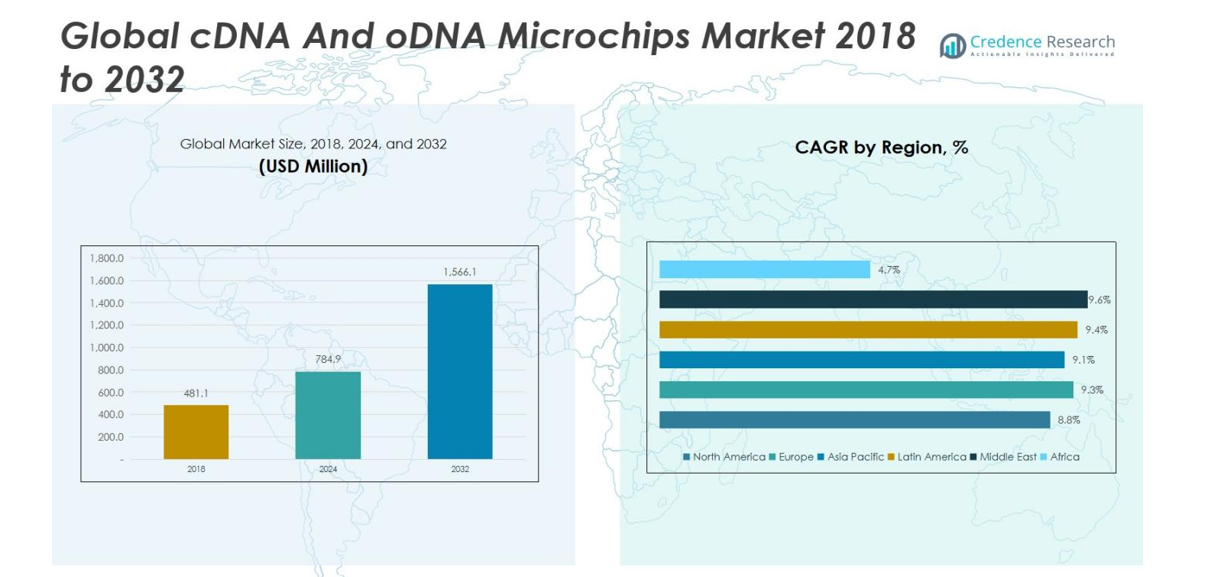
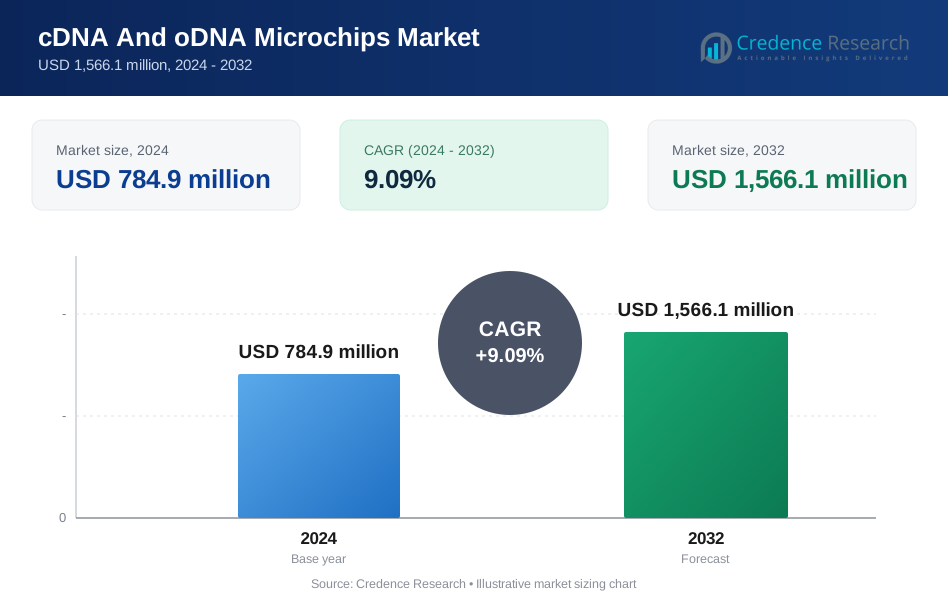
The Global cDNA and oDNA Microchips Market size was valued at USD 481.1 million in 2018, increased to USD 784.9 million in 2024, and is projected to reach USD 1,566.1 million by 2032, growing at a CAGR of 9.09% during the forecast period.
| REPORT ATTRIBUTE | DETAILS |
|---|---|
| Historical Period | 2020-2023 |
| Base Year | 2024 |
| Forecast Period | 2025-2032 |
| cDNA and oDNA Microchips Market Size 2024 | USD 784.9 million |
| cDNA and oDNA Microchips Market, CAGR | 9.09% |
| cDNA and oDNA Microchips Market Size 2032 | USD 1,566.1 million |
The global cDNA and oDNA microchips market is highly competitive, with major players such as Life Technologies Corporation, Illumina Inc., Sequenom Inc., GE Healthcare, Thermo Fisher Scientific, Roche, and Guangzhou Daan Gene Co., Ltd. leading innovation and market expansion. These companies focus on technological advancements, strategic partnerships, and R&D investments to enhance product performance and application diversity. North America emerged as the leading region in 2024, commanding over 33% of the global market share, supported by advanced genomic research infrastructure, strong funding for biotechnology, and the early adoption of precision medicine and molecular diagnostic technologies.
Market Insights
- The Global cDNA and oDNA Microchips Market was valued at USD 784.9 million in 2024 and is projected to reach USD 1,566.1 million by 2032, growing at a CAGR of 9.09% during the forecast period.
- Market growth is driven by increasing applications in genomic research, personalized medicine, and early disease diagnosis, supported by advancements in microarray technology and next-generation sequencing integration.
- Emerging trends include the integration of AI and bioinformatics tools for data interpretation, accelerating gene analysis and improving clinical accuracy in genetic profiling.
- The market is highly competitive, with Illumina Inc., Thermo Fisher Scientific, GE Healthcare, and Roche leading through R&D investments, product innovation, and global expansion strategies.
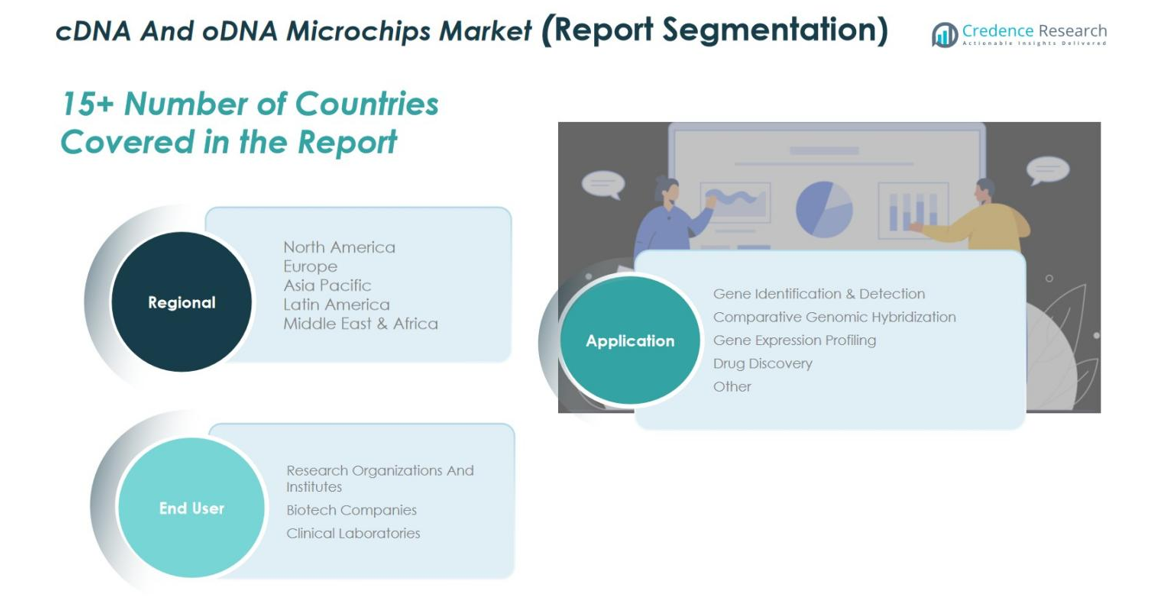
- North America dominated with over 33% market share, followed by Europe at 27%, while gene expression profiling and research organizations remained the leading application and end-user segments in 2024.
Market Segmentation Analysis:
By Application
The global cDNA and oDNA microchips market by application is dominated by gene expression profiling, accounting for over 35% of the total market share in 2024. This segment leads due to its extensive use in studying gene activity, disease mechanisms, and personalized medicine. The demand is further driven by advancements in transcriptomics and the rising adoption of microarray technology in cancer research. Gene identification and detection follow closely, supported by increased clinical diagnostics usage. Meanwhile, comparative genomic hybridization and drug discovery segments continue to grow with expanding genomic applications in biotechnology and pharmacogenomics.
- For instance, Illumina’s HumanHT-12 v4 Expression BeadChip enables the analysis of more than 47,000 transcripts, supporting large-scale cancer transcriptomics research.
By End User
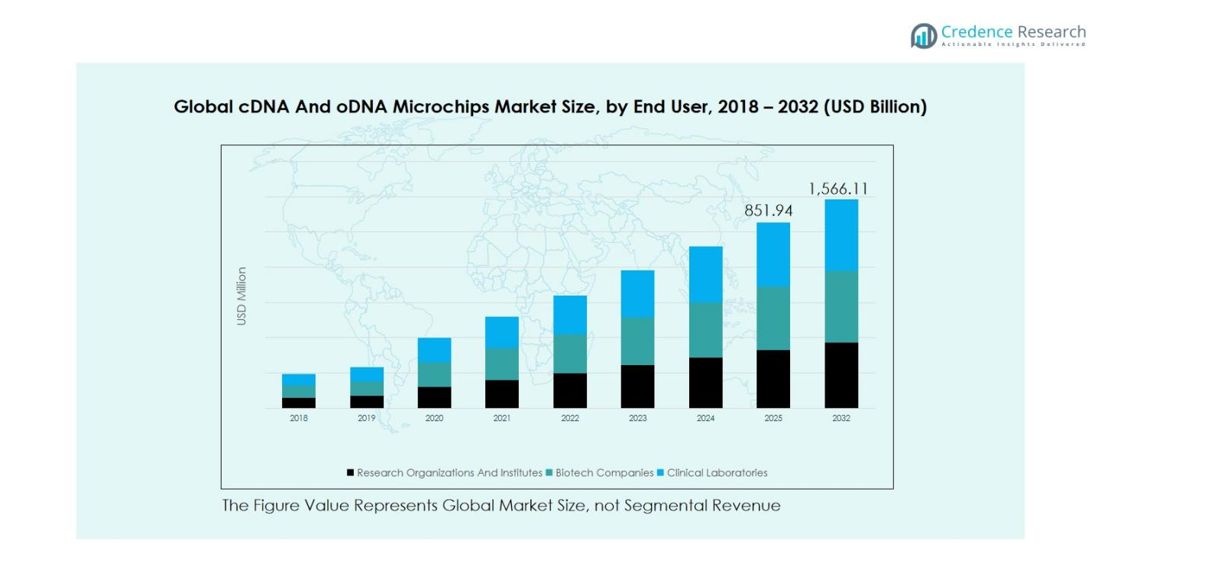
Among end users, research organizations and institutes held the largest share, representing around 42% of the global market in 2024. Their dominance is attributed to the growing investment in genomics research, academic collaborations, and large-scale sequencing projects. Biotech companies form the second-largest segment, benefiting from increasing R&D in biomarker discovery and molecular diagnostics. Clinical laboratories are steadily expanding their adoption of cDNA and oDNA microchips for disease screening and precision medicine applications, supported by technological advancements and declining costs of microarray assays.
- For instance, Amgen integrated single-cell transcriptomic profiling into its drug discovery pipeline to identify new therapeutic targets for autoimmune diseases.
Key Growth Drivers
Advancements in Genomic Research and Personalized Medicine
Rapid advancements in genomics and the increasing focus on personalized medicine are major drivers of the global cDNA and oDNA microchips market. The growing demand for genetic profiling to understand disease mechanisms and predict treatment responses has boosted microchip adoption across research and clinical settings. Integration of next-generation sequencing (NGS) data with microarray technology enhances gene expression analysis accuracy, driving innovation and application expansion in oncology, pharmacogenomics, and genetic disorder diagnostics.
- For instance, the NHS Genomic Medicine Service in the UK is centralizing nationwide genomic efforts to customize cancer diagnostics and treatment plans, enhancing precision in oncology care.
Rising Investments in Biotechnology and Research Infrastructure
Expanding biotechnology research, supported by government funding and private sector investments, continues to strengthen market growth. Research institutes and universities are increasingly employing cDNA and oDNA microchips for functional genomics, molecular biology, and drug discovery applications. The proliferation of large-scale genome projects and public-private collaborations across North America, Europe, and Asia Pacific are enhancing access to advanced genetic tools, thereby accelerating adoption and creating significant opportunities for microchip manufacturers and service providers.
- For instance, NantOmics integrates whole genome sequencing with proteomics to offer GPS Cancer, a comprehensive test that supports personalized cancer treatment strategies.
Growing Demand for Early Disease Diagnosis and Precision Healthcare
The increasing global emphasis on early disease detection and precision healthcare is driving the demand for cDNA and oDNA microchips. These microchips enable high-throughput genetic screening, allowing clinicians to detect gene mutations and expression changes linked to various diseases, including cancer and genetic disorders. The rising awareness of preventive diagnostics, coupled with technological improvements in microarray sensitivity and affordability, is propelling clinical adoption and supporting the market’s steady expansion across emerging and developed economies.
Key Trends & Opportunities
Integration of AI and Data Analytics in Genomic Interpretation
Artificial intelligence (AI) and advanced bioinformatics tools are reshaping data interpretation in genomic research. The integration of AI algorithms with cDNA and oDNA microchip platforms enhances data accuracy, speeds up gene expression analysis, and facilitates better disease correlation. This trend creates opportunities for developing intelligent diagnostic solutions and predictive genomics tools, enabling faster discovery of biomarkers and therapeutic targets, which is expected to redefine research and clinical diagnostics efficiency in the coming years.
- For instance, Google's DeepVariant utilizes convolutional neural networks to improve the precision of variant calling in whole-genome sequencing, reducing false positives significantly.
Emerging Applications in Drug Development and Pharmacogenomics
Expanding applications of cDNA and oDNA microchips in drug discovery and pharmacogenomics present substantial growth opportunities. Pharmaceutical companies increasingly use these technologies to identify genetic variations influencing drug response and to streamline target validation. The ability of microchips to support multi-gene analysis accelerates candidate screening, reduces development timelines, and enhances personalized drug formulation. This growing integration into the drug development pipeline positions the market for long-term expansion and innovation-led growth.
- For instance, Roche developed the Amplichip CYP450, the first microarray approved for clinical use, which detects genetic variations in drug metabolism genes CYP2D6 and CYP2C19, facilitating personalized drug dosing.
Key Challenges
High Cost of Microchip Technology and Data Management
Despite technological progress, the high cost associated with cDNA and oDNA microchips remains a significant challenge, particularly for small laboratories and research institutions. Expenses related to microarray fabrication, data analysis software, and skilled personnel limit accessibility in developing regions. Moreover, the large volume of genetic data generated requires advanced computational infrastructure and secure storage systems, adding further cost burdens that may restrain wider market adoption among resource-constrained organizations.
Complexity of Data Interpretation and Lack of Standardization
Interpreting large-scale genomic data from cDNA and oDNA microchips poses considerable complexity due to variability in assay performance and data processing methods. The absence of standardized protocols for gene expression analysis can lead to inconsistent results across studies. Additionally, limited interoperability between analytical platforms hinders data sharing and validation. These factors collectively slow clinical translation and reduce the reproducibility of research outcomes, posing ongoing challenges to market growth and application scalability.
Regional Analysis
North America
North America dominated the global cDNA and oDNA microchips market with a market share of over 33% in 2024, valued at USD 263.63 million, up from USD 164.12 million in 2018, and is projected to reach USD 515.09 million by 2032 at a CAGR of 8.8%. The region’s growth is driven by advanced genomic research infrastructure, strong funding for biotechnology, and the widespread adoption of personalized medicine. The U.S. leads the market due to the presence of major industry players, high R&D expenditure, and increasing integration of genomic technologies in clinical diagnostics.
Europe
Europe accounted for a significant 27% share of the global market in 2024, valued at USD 212.60 million, rising from USD 128.61 million in 2018 and expected to reach USD 431.62 million by 2032, expanding at a CAGR of 9.3%. The region benefits from strong regulatory support for genomic studies, high healthcare spending, and robust collaboration between research institutions and biotech firms. Countries like Germany, the UK, and France are leading innovation through government-backed genome programs and clinical application of DNA microchip technologies in disease diagnosis and therapeutics.
Asia Pacific
The Asia Pacific market represented about 24% of the global revenue in 2024, valued at USD 187.96 million, up from USD 114.94 million in 2018, and is projected to reach USD 376.18 million by 2032, growing at a CAGR of 9.1%. Growth in this region is driven by expanding biotechnology research, rising healthcare investments, and increased adoption of genomic tools across China, Japan, and India. Government initiatives promoting precision medicine and local manufacturing of genomic technologies are further accelerating market development and positioning Asia Pacific as a key growth hub in the coming years.
Latin America
Latin America accounted for approximately 10% of the global market in 2024, valued at USD 77.35 million, compared to USD 46.53 million in 2018, and is anticipated to reach USD 158.18 million by 2032, registering a CAGR of 9.4%. The region’s growth is supported by rising investments in biomedical research and growing awareness of genetic testing in countries such as Brazil and Argentina. Expanding healthcare infrastructure and regional collaborations with global biotech firms are improving access to advanced diagnostic tools, fostering steady adoption of cDNA and oDNA microchips across clinical and academic research institutions.
Middle East
The Middle East held a 6% share of the global market in 2024, reaching USD 35.18 million, up from USD 20.88 million in 2018, and is forecasted to attain USD 73.14 million by 2032, advancing at a CAGR of 9.6%. Growth in the region is fueled by increasing investments in genomic research, particularly in the GCC countries, Israel, and Turkey. National genomics initiatives and the expansion of precision healthcare programs are driving adoption. Strategic partnerships with international biotechnology firms are further enhancing the research ecosystem and supporting early disease detection through genomic technologies.
Africa
Africa represented a smaller share of around 2% of the global market in 2024, valued at USD 8.21 million, compared to USD 6.06 million in 2018, and is projected to reach USD 11.90 million by 2032, growing at a modest CAGR of 4.7%. Market growth is constrained by limited research funding, inadequate laboratory infrastructure, and slow adoption of genomic technologies. However, emerging initiatives in South Africa and Egypt focusing on genomic medicine and infectious disease research are expected to gradually enhance regional capacity and promote future growth opportunities in the cDNA and oDNA microchips market.
Market Segmentations:
By Application
- Gene Identification & Detection
- Comparative Genomic Hybridization
- Gene Expression Profiling
- Drug Discovery
- Others
By End User
- Research Organizations and Institutes
- Biotech Companies
- Clinical Laboratories
By Region
- North America
- U.S.
- Canada
- Mexico
- Europe
- Germany
- France
- U.K.
- Italy
- Spain
- Rest of Europe
- Asia Pacific
- China
- Japan
- India
- South Korea
- South-east Asia
- Rest of Asia Pacific
- Latin America
- Brazil
- Argentina
- Rest of Latin America
- Middle East & Africa
- GCC Countries
- South Africa
- Rest of the Middle East and Africa
Competitive Landscape
The competitive landscape of the global cDNA and oDNA microchips market is characterized by the presence of major players such as Life Technologies Corporation, Illumina Inc., Sequenom Inc., GE Healthcare, Thermo Fisher Scientific, Roche, and Guangzhou Daan Gene Co., Ltd. These companies focus on product innovation, strategic collaborations, and technological integration to strengthen their market positions. Continuous advancements in microarray technology, data analytics, and bioinformatics have intensified competition, driving firms to invest heavily in R&D to enhance accuracy, throughput, and application scope. Strategic mergers and acquisitions are common, enabling companies to expand their product portfolios and geographic reach. Furthermore, the growing emphasis on precision medicine and molecular diagnostics is encouraging partnerships between biotech firms and research institutions. Regional players are also gaining traction by offering cost-effective solutions tailored to emerging markets, making the competitive environment dynamic and innovation-driven across global and regional segments.
Key Player Analysis
- Life Technologies Corporation
- Illumina, Inc.
- Sequenom, Inc.
- GE Healthcare
- Thermo Fisher Scientific
- Roche
- Guangzhou Daan Gene Co., Ltd.
- Other Key Players
Recent Developments
- In October 2025, Illumina, Inc. introduced a new business unit named BioInsight, aimed at integrating omics data, advanced software, and AI tools to enhance life-science discovery and microarray-based research workflows.
- In February 2025, Mitsui Chemicals, Inc. acquired a controlling stake in DNA Chip Research Inc. through a tender offer, making it a wholly owned subsidiary to strengthen its Life & Healthcare Solutions segment.
- In October 2025, Illumina also launched its innovative 5-base solution, enabling simultaneous genomic and epigenomic analysis to advance multi-omic and microchip assay capabilities.
Report Coverage
The research report offers an in-depth analysis based on Application, End User and Region. It details leading market players, providing an overview of their business, product offerings, investments, revenue streams, and key applications. Additionally, the report includes insights into the competitive environment, SWOT analysis, current market trends, as well as the primary drivers and constraints. Furthermore, it discusses various factors that have driven market expansion in recent years. The report also explores market dynamics, regulatory scenarios, and technological advancements that are shaping the industry. It assesses the impact of external factors and global economic changes on market growth. Lastly, it provides strategic recommendations for new entrants and established companies to navigate the complexities of the market.
Future Outlook
- The market is expected to witness steady growth driven by advancements in genomic research and personalized medicine.
- Increasing adoption of cDNA and oDNA microchips in clinical diagnostics will strengthen healthcare applications.
- Rising investments in biotechnology and research infrastructure will accelerate technology development.
- Integration of AI and bioinformatics tools will enhance data analysis and improve result accuracy.
- Expanding use of microchips in drug discovery and pharmacogenomics will support pharmaceutical innovation.
- Emerging economies will experience higher adoption due to growing healthcare awareness and funding support.
- Strategic collaborations between academic institutions and biotech firms will boost research efficiency.
- Technological improvements will make microchip platforms more affordable and accessible.
- Demand for precision and early disease detection will continue to drive clinical implementation.
- Sustainable growth is anticipated as companies focus on innovation, automation, and data-driven genomic solutions.
Request a Free Sample
Fill in your details and we'll send you a free sample report.
- Sample data tables & charts
- Research methodology
Need a Custom Version of This Report?
Tailor the scope, geography, or segments to your exact requirements.
- Custom geography or segment scope
- Direct access to our analyst team
Frequently Asked Questions
What is the current market size for the Global cDNA and oDNA Microchips Market, and what is its projected size in 2032?
At what Compound Annual Growth Rate is the Global cDNA and oDNA Microchips Market projected to grow between 2025 and 2032?
Which Global cDNA and oDNA Microchips Market segment held the largest share in 2024?
What are the primary factors fueling the growth of the Global cDNA and oDNA Microchips Market?
Who are the leading companies in the Global cDNA and oDNA Microchips Market?
Who are the major players in this Market?
Table of Content
Chapter 1. Report Introduction
- 1.1 Report Description & Purpose
- 1.1.1 Report Title & Market Definition
- 1.1.2 Unique Selling Propositions (USP) & Key Differentiators
- 1.1.3 Value Proposition for Stakeholders
- 1.2 Research Objectives
- 1.2.1 Market Sizing Objectives (Volume & Revenue)
- 1.2.2 Segmentation Objectives
- 1.2.3 Competitive Intelligence Objectives
- 1.2.4 Forecast & Scenario Objectives
- 1.3 Report Scope
- 1.3.1 cDNA And oDNA Microchips Scope – Types & Subtypes Covered
- 1.3.2 Geographic Scope – Regions & Countries Covered
- 1.3.3 Historical Period, Base Year & Forecast Period (2024; forecast to 2032)
- 1.3.4 Inclusions & Exclusions
- 1.4 HS Code & Classification Framework
- 1.5 Currency, Units & Pricing Basis
- 1.6 Target Stakeholders
- 1.7 Limitations & Assumptions
Chapter 2. Executive Summary
- 2.1 Global cDNA And oDNA Microchips Market Snapshot
- 2.1.1 Market Size – Historical (2024) & Forecast (2024-2032) (2024: USD 784.9 million → 2032: USD 1,566.1 million)
- 2.1.2 Volume & Revenue – Global Totals
- 2.1.3 Key Market Highlights – Top Five Facts
- 2.2 cDNA And oDNA Microchips Market Segmentation Snapshot
- 2.2.1 Market Split by Region – 2024 vs. 2032
- 2.3 Competitive Snapshot
- 2.3.1 Top 10 Players by Revenue Share – 2024
- 2.3.2 Top 10 Players by Volume Share – 2024
- 2.3.3 Recent Strategic Developments (18-Month Summary)
- 2.4 Key Investment Highlights & Strategic Conclusions
Chapter 3. cDNA And oDNA Microchips Market Dynamics & Industry Analysis
- 3.1 Market Overview & Context
- 3.1.1 cDNA And oDNA Microchips Market Position in the Broader Automotive Value Chain
- 3.1.2 OEM vs. Replacement Market Dynamics
- 3.1.3 Market Maturity & Development Stage by Region
- 3.2 cDNA And oDNA Microchips Market Drivers
- 3.3 cDNA And oDNA Microchips Market Restraints & Challenges
- 3.4 cDNA And oDNA Microchips Market Opportunities
- 3.5 Porter's Five Forces Analysis
- 3.5.1 Threat of New Entrants
- 3.5.2 Bargaining Power of Suppliers
- 3.5.3 Bargaining Power of Buyers
- 3.5.4 Threat of Substitutes
- 3.5.5 Competitive Rivalry – Intensity Assessment
- 3.6 cDNA And oDNA Microchips Value Chain Analysis
- 3.6.1 Upstream – Raw Material/Input Suppliers
- 3.6.1.1 Raw Material/Input 1
- 3.6.1.2 Raw Material/Input 2
- 3.6.1.3 Raw Material/Input 3
- 3.6.2 Midstream – Production/Manufacturing/Service Delivery
- 3.6.2.1 Production/Process Overview
- 3.6.2.2 Key Facility Locations & Capacity by Manufacturer
- 3.6.3 Downstream – Distribution & End Consumer
- 3.6.3.1 Primary Channel – B2B/OEM
- 3.6.3.2 Secondary Channels – Dealer, Retail, Online, Direct
- 3.6.4 Value Chain Profitability Analysis
- 3.6.1 Upstream – Raw Material/Input Suppliers
- 3.7 PESTEL Analysis
- 3.7.1 Political Factors
- 3.7.2 Economic Factors
- 3.7.3 Social Factors
- 3.7.4 Technological Factors
- 3.7.5 Environmental Factors
- 3.7.6 Legal Factors
- 3.8 cDNA And oDNA Microchips Supply Chain Analysis
- 3.8.1 Raw Material/Input Supply Risk Assessment
- 3.8.2 Manufacturing Concentration Risk (Geographic Exposure)
- 3.8.3 Trade Disruption Impact Analysis
- 3.9 Regulatory & Policy Landscape
Note: The regulatory and policy landscape section covers regulations based on their applicability to the market, cDNA And oDNA Microchips category, geography, and scope of the study. Only regulatory frameworks with a material impact on operations, compliance, trade, sustainability, or market access are analyzed in detail.
Chapter 4. Key Investment Pockets & Opportunity Analysis
- 4.1 cDNA And oDNA Microchips Market Attractiveness Analysis
- 4.1.1 By Region – Investment Attractiveness Matrix (Volume × CAGR)
- 4.2 Absolute Revenue Growth Opportunity
- 4.2.1 By Region – Absolute USD Growth Through 2032
- 4.3 Incremental Volume Opportunity
- 4.3.1 By Region – Incremental Volume Through 2032
- 4.3.2 Segment – Incremental Volume
- 4.4 Emerging Submarket Opportunity Deep Dive (Subject to Applicability)
- 4.5 Emerging Market Opportunity Scorecards
- 4.5.1 United States
- 4.5.2 Europe
- 4.5.3 Asia
- 4.5.4 Middle East & Africa
Note: Emerging Market Opportunity Scorecards will be included based on relevance and strategic importance. Regions listed are indicative and may vary depending on data availability and market dynamics.
Chapter 5. cDNA And oDNA Microchips Import-Export Analysis & Trade Flows
- 5.1 Global Trade Overview
- 5.1.1 Global Export Value by Country (2024)
- 5.1.2 Global Export Volume by Country (2024)
- 5.1.3 Global Import Value by Country (2024)
- 5.1.4 Global Import Volume by Country (2024)
- 5.1.5 Net Trade Balance by Country (2024)
- 5.2 Export Analysis – Segment
- 5.2.1 Type 1 (HS Code)
- 5.2.2 Type 2 (HS Code)
- 5.2.3 Type 3 (HS Code)
- 5.2.4 Type 4 (HS Code)
- 5.2.5 Type 5 (HS Code)
- 5.3 Import Analysis – Segment
- 5.3.1 Type 1 (HS Code)
- 5.3.2 Type 2 (HS Code)
- 5.3.3 Type 3 (HS Code)
- 5.3.4 Type 4 (HS Code)
- 5.3.5 Type 5 (HS Code)
- 5.4 Average Unit Trade Prices
- 5.4.1 Average Export Price – Segment & Country
- 5.4.2 Average Import Price – Segment & Source Country
- 5.4.3 Price Trends (2024)
- 5.5 Key Trade Route Analysis
- 5.5.1 Trade Route 1
- 5.5.2 Trade Route 2
- 5.5.3 Trade Route 3
- 5.5.4 Trade Route 4
- 5.5.5 Trade Route 5
- 5.6 Trade Policy Impact Assessment
- 5.6.1 US Anti-Dumping & Section 301 Tariffs
- 5.6.2 EU Customs Union Impact
- 5.6.3 Major Free Trade Agreements
- 5.6.4 USMCA Rules of Origin
Note: Trade policy analysis will be included only where relevant to the cDNA And oDNA Microchips market.
Chapter 6. Competitive Landscape & Company Benchmarking
- 6.1 cDNA And oDNA Microchips Market Concentration & Structure
- 6.1.1 Herfindahl-Hirschman Index (HHI) – vs. 2024
- 6.1.2 Tier 1, Tier 2 & Tier 3 Market Structure
- 6.1.3 Global, Regional & Local Player Dynamics
- 6.2 cDNA And oDNA Microchips Market Share Analysis – 2024
- 6.2.1 Global Revenue Share by Company
- 6.2.2 Global Volume Share by Company
- 6.2.3 Regional Revenue Share
- 6.2.4 Market Share Evolution ( vs. 2024)
- 6.2.5 OEM Segment Share by Company
- 6.2.6 Replacement Segment Share by Company
- 6.3 Production/Delivery Capacity & Facility Analysis
- 6.3.1 Global Installed Capacity
- 6.3.2 Capacity Utilization Rates
- 6.3.3 Production/Output Volume
- 6.3.4 Facility Locations & Capacity Map
- 6.3.5 Planned Capacity Additions
- 6.4 cDNA And oDNA Microchips Competitive Benchmarking Matrix
- 6.4.1 Revenue, Volume, CAGR & Profitability Comparison
- 6.4.2 Channel Revenue Mix
- 6.4.3 Geographic Revenue Exposure
- 6.4.4 R&D Intensity
- 6.4.5 Sustainability Maturity
- 6.5 Strategic Developments in cDNA And oDNA Microchips (Last 24 Months)
- 6.5.1 Mergers, Acquisitions & Divestments
- 6.5.2 New cDNA And oDNA Microchips Launches
- 6.5.3 Facility Expansions
- 6.5.4 Strategic Alliances, Joint Ventures & Partnerships
- 6.5.5 Distribution Expansion & Market Entry
- 6.5.6 Sustainability & ESG Initiatives
- 6.6 Competitive Strategy Mapping
- 6.6.1 Leader, Challenger, Follower & Niche Classification
- 6.6.2 Pricing Strategy Comparison
- 6.6.3 Channel Strategy Matrix
Note: Strategic developments are included based on their materiality and the availability of reliable information.
Chapter 7. Global cDNA And oDNA Microchips Market – By Distribution Channel
- 7.1 Segment Overview
- 7.1.1 Volume & Revenue Split by Channel (2024 & 2032)
- 7.1.2 Channel Mix Evolution (2024-2032)
Chapter 8. Regional Market Analysis – Global Overview
- 8.1 Global Regional Overview
- 8.1.1 Regional Volume Share
- 8.1.2 Regional Revenue Share
- 8.1.3 Regional Volume by Region
- 8.1.4 Regional Revenue by Region
- 8.1.5 Regional Forecast Through 2032
- 8.2 Cross-Regional Segment Analysis
- 8.2.1 By Distribution Channel
- 8.2.2 By Brand/Price Tier
Chapter 9. North America cDNA And oDNA Microchips Market
- 9.1 United States
- 9.2 Canada
- 9.3 Mexico
Chapter 10. Europe cDNA And oDNA Microchips Market
- 10.1 Germany
- 10.2 France
- 10.3 Italy
- 10.4 United Kingdom
- 10.5 Spain
- 10.6 Poland
- 10.7 Russia
- 10.8 Netherlands
- 10.9 Belgium
- 10.10 Sweden
- 10.11 Denmark
- 10.12 Norway
- 10.13 Rest of Europe
Chapter 11. Asia Pacific cDNA And oDNA Microchips Market
- 11.1 China
- 11.2 India
- 11.3 Japan
- 11.4 South Korea
- 11.5 Thailand
- 11.6 Indonesia
- 11.7 Vietnam
- 11.8 Malaysia
- 11.9 Australia
- 11.10 Rest of Asia Pacific
Chapter 12. Latin America cDNA And oDNA Microchips Market
- 12.1 Brazil
- 12.2 Argentina
- 12.3 Colombia
- 12.4 Chile
- 12.5 Rest of Latin America
Chapter 13. Middle East cDNA And oDNA Microchips Market
- 13.1 Saudi Arabia
- 13.2 United Arab Emirates
- 13.3 Turkey
- 13.4 Israel
- 13.5 Iran
- 13.6 Rest of the Middle East
Chapter 14. Africa cDNA And oDNA Microchips Market
- 14.1 South Africa
- 14.2 Egypt
- 14.3 Nigeria
- 14.4 Morocco
- 14.5 Rest of Africa
Chapter 15. cDNA And oDNA Microchips Company Profiles
- 15.1 [Company 01]
- 15.1.1 Company Overview
- 15.1.2 Key Management Personnel
- 15.1.3 Products & Services Portfolio
- 15.1.4 Financial Performance
- 15.1.5 Key Market Focus & Geographic Presence
- 15.1.6 Recent Developments & Strategic Initiatives
Note: The company profile list is preliminary and may change based on research findings, market developments, data availability, and client requirements.
Chapter 16. Appendices
- Appendix A – List of Abbreviations & Acronyms
- Appendix B – Industry Classification Code Reference – Full Series
- Appendix C – Production & Capacity Data Tables
- Appendix D – End-Use & Demand Base Tables
- Appendix E – Consumption & Replacement Rate Assumptions
- Appendix F – ASP Reference Tables
- Appendix G – Manufacturing & Facility Database
- Appendix H – Import-Export Data Tables
- Appendix I – Regulatory Summary Tables
- Appendix J – Primary Research Participant List (Anonymized)
- Appendix K – Primary Research Questionnaire Framework
- Appendix L – Data Sources & Bibliography
- Appendix M – Market Size Divergence & Source Comparison
Chapter 17. Research Methodology
- 17.1 Research Framework & Philosophy
- 17.2 Secondary Research – Sources, Hierarchy & Data Extraction
- 17.3 Data Modeling – Bottom-Up & Top-Down Market Sizing
- 17.4 Primary Research – Stakeholder Framework, LOI & Sample Sizes
- 17.5 Forecast Methodology – Regression, Scenario & Sensitivity Analysis
- 17.6 Quality Control – Four-Layer Validation Framework
- 17.7 Limitations & Standard Assumptions
- 17.8 Disclaimer
